Introduction
The knowledge on the course of disorders across the lifespan is essential for planning accurate clinical approaches. Few clinical longitudinal studies have followed up children and adolescents with attention deficit hyperactivity disorder (ADHD) until adulthood (Faraone et al. Reference Cubillo, Halari, Smith, Taylor and Rubia2006), and only five of them retained at least 50% of the original sample (Weiss et al. Reference Weiss, Hechtman, Milroy and Perlman1985; Mannuzza et al. Reference Mattos, Palmini, Salgado, Segenreich, Grevet, Oliveira, Rohde, Romano, Louzã, Belmonte de Abreu and Lima1998; Rasmussen & Gillberg, Reference Ramtekkar, Reiersen, Todorov and Todd2000; Barkley et al. Reference Barkley and Murphy2008; Biederman et al. Reference Biederman, Mick and Faraone2011). Even less information is available on the course of patients diagnosed with full ADHD after brain maturation, since only one follow-up study evaluated patients at two time points during adulthood (Klein et al. Reference Kieling, Kieling, Rohde, Frick, Moffitt, Nigg, Tannock and Castellanos2012). The authors followed 135 boys with ADHD assessing the cohort three times, two of these in adulthood (mean age: 25 and 41 years) and found an increase of ADHD persistence rates from first to second evaluation in adulthood (7.4–22%). They attributed this increase to greater awareness due to wide media coverage (Klein et al. Reference Kieling, Kieling, Rohde, Frick, Moffitt, Nigg, Tannock and Castellanos2012). There is, as far as we know, only one population-based, epidemiologic study of ADHD across the lifespan (Barbaresi et al. 2013). Despite the fact that these authors performed the diagnosis of ADHD during childhood based on retrospective assessments, the study has the strength of assessing all individuals in a birth cohort. Unfortunately, the authors did not analyze potential predictive factors for ADHD persistence into adulthood and did not evaluate patients more than once. Therefore, due to the paucity of ADHD follow-up studies during adulthood, several data for understanding the disorder in this age group are missing, including persistence rates over time and the possibility of remission.
The substantial differences between the characteristics of children and adults with ADHD bring doubts if clinical follow-up samples that start in childhood are adequate to investigate the course of ADHD among patients that seek treatment during adulthood. In regard to these differences there are at least six issues: (1) type of referral and source of information in child and adult samples are different (parents and teachers for children v. self-referral for adults), which might imply different clinical and biological characteristics between the two age groups (Weiss et al. Reference Wechsler1985; Mannuzza et al. Reference Mattos, Palmini, Salgado, Segenreich, Grevet, Oliveira, Rohde, Romano, Louzã, Belmonte de Abreu and Lima1998; Barkley et al. Reference Barkley and Murphy2008); (2) gender ratio in clinical samples tends to differ, while boys have a much higher prevalence than girls in childhood, this difference practically disappears in adults (Gaub & Carlson, Reference First, Spitzer, Gibbon and Williams1997; Biederman & Faraone, Reference Barkley, Murphy and Fischer2004; Grevet et al. Reference Gaub and Carlson2006); (3) the age-dependent decline of symptoms, although widely accepted for children and adolescents (Biederman et al. Reference Biederman and Faraone2000; Faraone et al. Reference Cubillo, Halari, Smith, Taylor and Rubia2006), might be less relevant during adulthood, considering the more advanced stage of brain maturation (Shaw et al. Reference Rosellini, Rutter and Bourgeois2007; Nakao et al. Reference Moriyama, Polanczyk, Terzi, Faria and Rohde2011; Hoekzema et al. Reference Hart, Radua, Nakao, Mataix-Cols and Rubia2012; Cortese et al. Reference Cloninger and Svrakic2013); (4) the main complaint in childhood is hyperactivity/impulsivity, while for adults referred to ADHD clinics it is inattention and executive dysfunction, commonly associated with periods of higher cognitive demand (Biederman & Faraone, Reference Barkley, Murphy and Fischer2004; Volkow & Swanson, Reference Volkow and Swanson2013); (5) the profile of co-morbidities tends to be quite distinct, whereas in childhood disruptive behaviors represent the most prevalent co-morbidities, the adult profile is more complex and largely influenced by adolescent- and adult-onset psychiatric disorders (McGough et al. Reference Mannuzza, Klein, Bessler, Malloy and LaPadula2005); (6) the prevalence of ADHD in childhood is estimated as 5.3% (Polanczyk et al. Reference Nutt, Fone, Asherson and Bramble2007) and only 15% of children followed into adulthood remain with a full ADHD diagnosis (Faraone et al. Reference Cubillo, Halari, Smith, Taylor and Rubia2006), therefore considering prevalence rates reported in adults of 2.5–4.4% (Kessler et al. Reference Kessler, Adler, Barkley, Biederman, Conners, Faraone, Greenhill, Jaeger, Secnik, Spencer, Ustün and Zaslavsky2006; Simon et al. Reference Sheehan, Lecrubier, Sheehan, Amorim, Janavs, Weiller, Hergueta, Baker and Dunbar2009), there is a clear inconsistency between the two estimates (i.e. 5.3% × 0.15 = 0.8% instead of 2.5–4.4%). Although these differences between child and adult ADHD might describe the developmental trajectory of the disorder, it is possible to speculate that some patients seeking treatment during adulthood (although having symptoms since childhood) might not be included in follow-up studies starting at childhood.
The present 7-year follow-up study addresses the rates and predictors of ADHD persistence or remission among individuals seeking treatment during adulthood at a wide age range.
Method
Probands
This is a prospective follow-up study of adults with ADHD. This study is part of the Porto Alegre cohort of adults with ADHD. Patients were recruited in the ADHD Outpatient Program – Adult Division at the Hospital de Clínicas de Porto Alegre (HCPA), which is the teaching hospital of the Federal University of Rio Grande do Sul, Brazil. The inclusion criteria at baseline assessment were (1) Native Brazilian of European descent, (2) age ≥18 years, (3) fulfillment of diagnostic criteria for ADHD (DSM-IV; APA, 1994), both currently and during childhood. Exclusion criteria were the presence of (1) evidence of clinically significant neurological disease (e.g. delirium, dementia, epilepsy, head trauma), (2) current or past history of psychosis, (3) estimated intelligence quotient (IQ) ≤70 (Kaplan et al. Reference Hoekzema, Carmona, Ramos-Quiroga, Richarte Fernández, Picado, Bosch, Soliva, Rovira, Vives, Bulbena, Tobeña, Casas and Vilarroya1991).
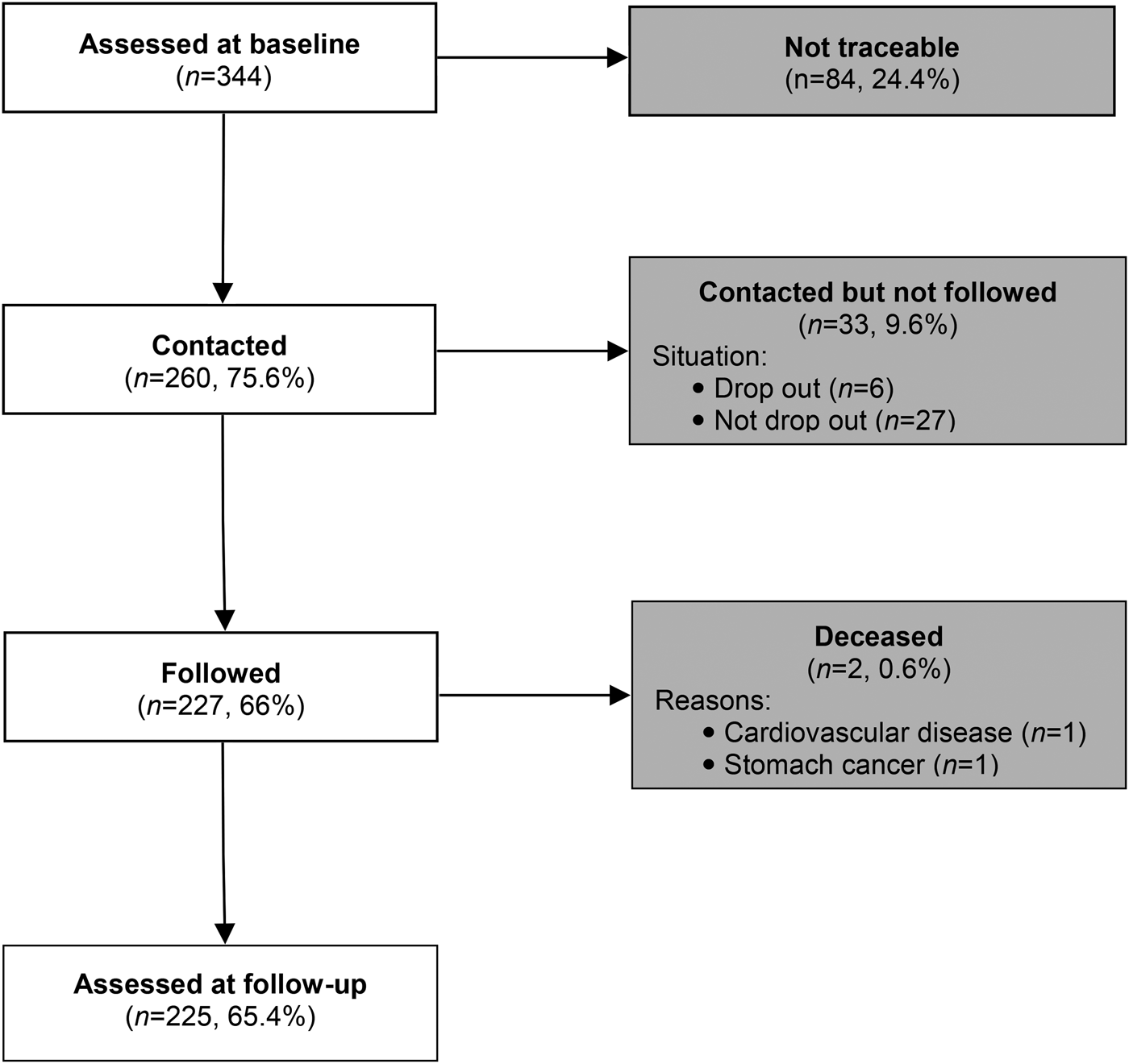
The individuals in this study (see Fig. 1 for study flow chart) had their first evaluation in the ADHD outpatient clinic between 2003 and 2007. This baseline sample includes 344 adults with all ADHD subtypes (combined type 55.9%, inattentive type 38.3%, hyperactive-impulsive type 5.8%). Subjects’ age ranged from 18 to 68 years (mean age = 34.1, s.d. = 10.9), with average IQ (mean full-scale IQ = 100.9, s.d. = 8.38), subjects were predominantly from middle-class families (mean family income 14.16, s.d. = 29.47 Brazilian monthly minimum wages, as multiples of the equivalent to ~290 US$) and 49.9% were males. Previous studies have provided a more detailed phenotypic characterization of the sample, in terms of co-morbidity (Grevet et al. Reference Gaub and Carlson2006; Vitola et al. Reference Vitola, Salgado, Silva, Karam, Victor, Mota, Contini, Picon, Guimarães-da-Silva, Giordani, Rohde, Belmonte-de-Abreu, Bau and Grevet2012) and response to treatment (Victor et al. Reference Victor, Grevet, Salgado, Silva, Sousa, Karam, Vitola, Picon, Zeni, Contini, Rohde, Belmonte-de-Abreu and Bau2009). The study was approved by the institutional review board of the Hospital de Clínicas de Porto Alegre. Participants were fully informed of study procedures and provided signed consent.
Baseline assessment
All diagnoses followed a three-step procedure: (1) clinical interview, (2) structured interviews (Mercadante et al. Reference McGough, Smalley, McCracken, Yang, Del'Homme, Lynn and Loo1995; First et al. Reference Faraone, Biederman and Mick1998; Sheehan et al. Reference Shaw, Malek, Watson, Sharp, Evans and Greenstein1998), (3) review of diagnosis in a clinical committee, as described previously (Grevet et al. Reference Gaub and Carlson2006). The interviewers in this research were psychiatrists extensively trained in the application of this research protocol.
ADHD diagnosis
The diagnosis of ADHD followed DSM-IV criteria using the Portuguese version of K-SADS-E (Mercadante et al. Reference McGough, Smalley, McCracken, Yang, Del'Homme, Lynn and Loo1995), in which questions about symptoms originally used for children were adapted for adults (Grevet et al. Reference Grevet, Bau, Salgado, Fischer, Kalil, Victor, Garcia, Sousa, Rohde and Belmonte-de-Abreu2005). Subjects needed to fulfill DSM-IV criteria for ADHD with the exception of age-of-onset of impairment (Karam et al. Reference Kaplan, Fein, Morris and Delis2009; Kieling et al. Reference Kessler, Adler, Barkley, Biederman, Conners, Demler, Faraone, Greenhill, Howes, Secnik, Spencer, Ustun, Walters and Zaslavsky2010; Polanczyk et al. Reference Polanczyk, de Lima, Horta, Biederman and Rohde2010). The inter-rater reliability kappa coefficients for the K-SADS-E ADHD diagnosis and subtypes during childhood and adulthood were all >0.9 (Grevet et al. Reference Grevet, Bau, Salgado, Fischer, Kalil, Victor, Garcia, Sousa, Rohde and Belmonte-de-Abreu2005). The impairment measures used in this study for assessing DSM-IV criterion C were the specific questions from the K-SADS-E, as well as Barkley's problem areas scale (self-report form), which addresses the impairment due to current symptoms listed in the DSM-IV diagnostic criteria (Barkley & Murphy, Reference Barbaresi, Colligan, Weaver, Voigt, Killian and Katusic1998). The subset of Barkley's scale used asks patients to report how often their symptoms interfere in ten areas of life activities.
Co-morbidities
The Structured Clinical Interview for DSM-IV (SCID-IV) was performed to evaluate most co-morbid psychiatric disorders (First et al. Reference Faraone, Biederman and Mick1998). The diagnosis of oppositional defiant disorder was performed with K-SADS-E (Mercadante et al. Reference McGough, Smalley, McCracken, Yang, Del'Homme, Lynn and Loo1995) and of conduct and anti-social personality disorder by the appropriate sections of the Mini-International Neuropsychiatric Interview (M.I.N.I.; Sheehan et al. Reference Shaw, Malek, Watson, Sharp, Evans and Greenstein1998).
Other measures
Temperament and character dimension scores were assessed by Cloninger's Temperament and Character Inventory (TCI), version 9 (Cloninger & Svrakic, Reference Castells, Ramos-Quiroga, Rigau, Bosch, Nogueira, Vidal and Casas1993). The vocabulary and block design subtests of the Wechsler Adult Intelligence Scale – Revised (WAIS-R; Wechsler, Reference Wechsler1981) were used to evaluate the cognitive performance. The research protocol also included assessment of demographic and education data, medical history and social problems. The complete baseline evaluation process lasted for at least four weekly sessions.
Pharmacological intervention
After the baseline assessment, all subjects were invited to participate in a naturalistic study with immediate-release methylphenidate (MPH-IR). This drug was selected because it is freely available in the Brazilian public healthcare system. The treatment protocol was designed following Brazilian guidelines (Mattos et al. Reference Lara, Fayyad, de Graaf, Kessler, Aguilar-Gaxiola, Angermeyer, Demytteneare, de Girolamo, Haro, Jin, Karam, Lépine, Mora, Ormel, Posada-Villa and Sampson2006) for ADHD treatment that are very similar to the worldwide practice (Nutt et al. Reference Nakao, Radua, Rubia and Mataix-Cols2007). A detailed description of this part of the study can be found in Victor et al. (Reference Victor, Grevet, Salgado, Silva, Sousa, Karam, Vitola, Picon, Zeni, Contini, Rohde, Belmonte-de-Abreu and Bau2009, Reference Victor, Rovaris, Salgado, Silva, Karam, Vitola, Picon, Contini, Guimarães-da-Silva, Blaya-Rocha, Belmonte-de-Abreu, Rohde, Grevet and Bau2014). Each subject who participated remained for around 6 months in the ADHD Outpatient Program and was then referred to other facilities of the healthcare system (public or private).
Follow-up assessment
All patients assessed between 2003 and 2007 were eligible to follow-up. The procedure designed to contact patients and invite them to a new assessment was performed in up to four steps: (1) six phone calls on different days and times – 197 patients contacted, (2) internet search via social media, email, and search engines – 29 patients contacted, (3) letter to patient's address – 24 patients contacted the program after receiving the letter, (4) visit to patient's address when they received the letter but did not contact the program – 10 patients contacted. If the four steps failed, the subject was considered not traceable and lost to follow-up. Subjects known to have died were considered as followed for the calculation of retention rate.
All patients were interviewed at follow-up by trained psychiatrists (V.B., F.A.P, E.V., R.G.K) with experience in ADHD and blind to baseline data. All interviews were discussed with R.G.K. If doubts remained, cases were discussed in committee chaired by E.H.G. Five of 225 followed-up subjects were living at long distance and could not be interviewed face-to-face but were able to be evaluated through telephone or Skype. Each interview required about 2 h for completion.
The procedure and instruments used in the follow-up assessment were similar to those used at baseline, with the difference that the sociodemographic questionnaire was simplified. Information about the duration of ADHD medication use (months) was collected using an adherence questionnaire.
Attrition analysis
Retention rate at follow-up was 66% (225/344 patients assessed at baseline were reassessed at follow-up, and two were known to have died, totaling 227). Among the 34% of individuals that were not assessed at follow-up, the majority (24.6%, 84 patients) was not traceable and therefore could not receive the invitation to participate. The lack of traceability may be substantially ascribed to the fact that the service of telephone ‘portability’ (possibility of keeping the same telephone number after changing telephone provider) was not available in Brazil before 2008. At the same time, there was a trend towards the cancellation of previously omnipresent landline numbers. Therefore, a substantial fraction of telephone number information in our sample was lost.
The remaining 33 (9%) individuals were located but for different reasons could not be assessed. Six patients stated they did not wish to participate and requested withdrawal from the study and were considered as definitive dropouts. Of the remainder, 12 patients agreed to participate, but missed at least three scheduled appointments (six of these patients lived in another city); six agreed to participate, but contact was lost before assessment; only family members could be contacted for five patients, four of whom had left the country – attempts to contact them via email brought no response, and one patient was living in an isolated hippie community and could not be contacted; three patients said they were interested in participating, but could not define a time for appointment before the end of this part of the study; one patient had a severe kidney disease that precluded his participation. Descriptive baseline characteristics of patients approached are given in Table 1.
Descriptive characteristics at baseline among adults with ADHD

ADHD, Attention deficit hyperactivity disorder; IQ, intelligence quotient; s.d., standard deviation.
a Two individuals who were known to have died between baseline and follow-up assessment
were not included in this table.
b Significant bivariate p values were verified for years of schooling (p = 0.03), estimated IQ (p = 0.003) and number of hyperactivity/impulsivity symptoms (p = 0.03). These variables plus age (p = 0.07) were selected for the multiple model of attrition (Table 2).
c Number of monthly minimum wages (multiples of the equivalent to ~290 US$).
d Lifetime data.
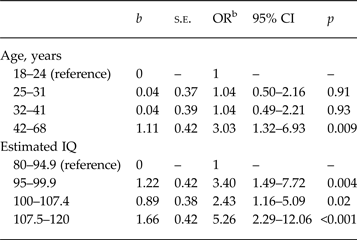
Baseline predictors of attrition at follow-up among adults with ADHD (n = 342) a

ADHD, Attention deficit hyperactivity disorder; b, regression coefficient; s.e., standard error; OR, odds ratio; CI, confidence interval; IQ, intelligence quotient.
a Two individuals who were known to have died between baseline and follow-up assessment were not included in this table.
b Higher odds ratio is related to higher assessment rates at follow-up.
Years of schooling and number of hyperactivity/impulsivity symptoms presented p values <0.15 in the bivariate model and were therefore included in the initial multiple logistic regression model but did not remain significant in the final model.
Age, IQ and number of hyperactivity/impulsivity symptoms were categorized according to quartiles due to the lack of linear relationship with outcome.
The comparison between assessed and not assessed individuals (regardless of reason) showed that both groups are similar regarding number of symptoms, co-morbidity profile and sociodemographic characteristics. However, significant effects of age and IQ were found (Table 2). Patients in the older quartile (42–68 years old) were significantly assessed more [odds ratio (OR) 3.03, 95% confidence interval (CI) 1.32–6.93, p = 0.009], as were patients with higher IQ scores (OR 5.26, 95% CI 2.29–12.06, p < 0.001).
Outcome measures
Most of the sample discontinued medication use between baseline and follow-up assessments. At least 72 h of washout was requested for patients that were using ADHD medication when contacted for follow-up. The evaluation of ADHD symptoms at follow-up focused on clinical status rather than on medication use, considering all periods without ADHD medication in the last 6 months.
The study focused on rates and predictors of diagnostic status at follow-up. The group that lost diagnostic status was subdivided into subthreshold (4 or 5 symptoms at inattention and/or hyperactivity/impulsivity domains; subjects may have <4 symptoms in one of the domains) and remitters (<4 symptoms at inattention and hyperactivity/impulsivity domains).
Statistical analysis
Three-step regression analyses were applied to evaluate predictors of attrition and ADHD diagnosis persistence. For all regression models, a first step individually evaluated several variables from different domains [social demographics, co-morbidities, temperament, medication status, ADHD measures (Table 1), plus months of treatment and follow-up time – the last two variables were not included in the attrition analysis]. Variables with p values <0.15 were entered in the multiple logistic regression models (second step). We included co-morbidities in the multiple logistic models when they had a frequency >10% in our assessed sample. These approaches were adopted to avoid saturated models. Using a forward procedure, we obtained the final model for each outcome (third step). The linear relationships between continuous variables and binary outcomes were tested after the final analyses. When the relationship was not linear, variables were categorized according to quartiles.
Secondary statistical analyses were performed to characterize individuals with full remission (<4 symptoms) at follow-up. Since it might be argued that full remission could be a consequence of the remission of co-morbidities, specific analyses were performed for this group of individuals. Fisher's exact test was used to compare changes in co-morbidities frequencies and other demands (marital status and occupation) at the follow-up between individuals who remitted or not.
We also assessed the variation (Δ) between the K-SADS and SNAP-IV scores at baseline minus the follow-up scores using forward linear regression, in order to compare the results of the categorical analysis with those from continuous scores attributed by the psychiatrist (K-SADS) or patient's self-report (SNAP-IV). The criteria for inclusion of covariates were the same as in the main analyses. All analyses were performed with SPSS v. 18.0 software (SPSS Inc., USA) with the significance level set at 0.05.
Results
ADHD persistence at follow-up
The average follow-up time (time between baseline and follow-up assessment) was 7.28 years (s.d. = 1.53). At follow-up, the mean age of reassessed patients was 42 years (s.d. = 11.10), and the proportion of males was 48%. The majority of these patients (n = 157, 69.8%) continued to meet DSM-IV criteria (combined, inattentive and hyperactive-impulsive types), 40 patients (17.8%) changed to subthreshold ADHD. Of these, 33 patients (82.5%) had impairment at ≥2 settings, and five (12.5%) had impairment at one setting (DSM-IV criterion C). One group of 28 patients (12.4%) had <4 symptoms (remitters), and only two of them had impairment at two settings.
Study flowchart.

Predictors of ADHD diagnosis persistence at follow-up (DSM-IV)
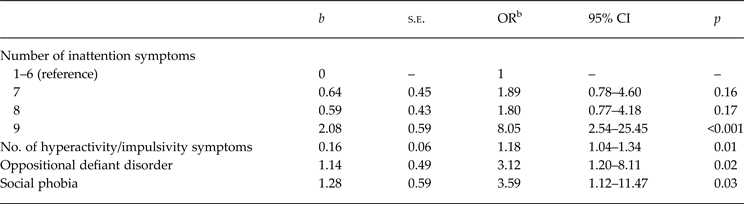
All variables listed in Table 1 plus months of treatment and follow-up time were tested for possible inclusion in a regression model if associated with persistence at p < 0.15. Most of them did not fulfill this criterion. Impairment at Barkley problem areas and novelty seeking scores (respective p values of 0.005 and 0.14 in the bivariate analyses) were included in the initial multiple logistic regression model but did not remain significant in the final model. Table 3 shows the final logistic regression model evaluating persistence at follow-up. Four variables were significant: higher number of inattention symptoms (nine symptoms) (OR 8.05, 95% CI 2.54–25.45, p < 0.001), number of hyperactivity/impulsivity symptoms (OR 1.18, 95% CI 1.04–1.34, p = 0.01), oppositional defiant disorder at baseline (OR 3.12, 95% CI 1.20–8.11, p = 0.02), and social phobia (OR 3.59, 95% CI 1.12–11.47, p = 0.03).
Baseline predictors of ADHD DSM-IV diagnosis persistence at follow-up (n = 225) a

ADHD, Attention deficit hyperactivity disorder; b, regression coefficient; s.e., standard error; OR, odds ratio; CI, confidence interval; IQ, intelligence quotient.
a Two individuals who were known to have died between baseline and follow-up assessment were not included in this table.
b Higher odds ratio is related to higher persistence rates at follow-up.
Impairment at Barkley problem areas and novelty seeking were also entered in the initial multiple logistic regression model but did not remain significant in the final model.
Number of inattention symptoms and novelty seeking were categorized according to quartiles due to the lack of linear relationship with outcome.
Secondary analyses
Full remission
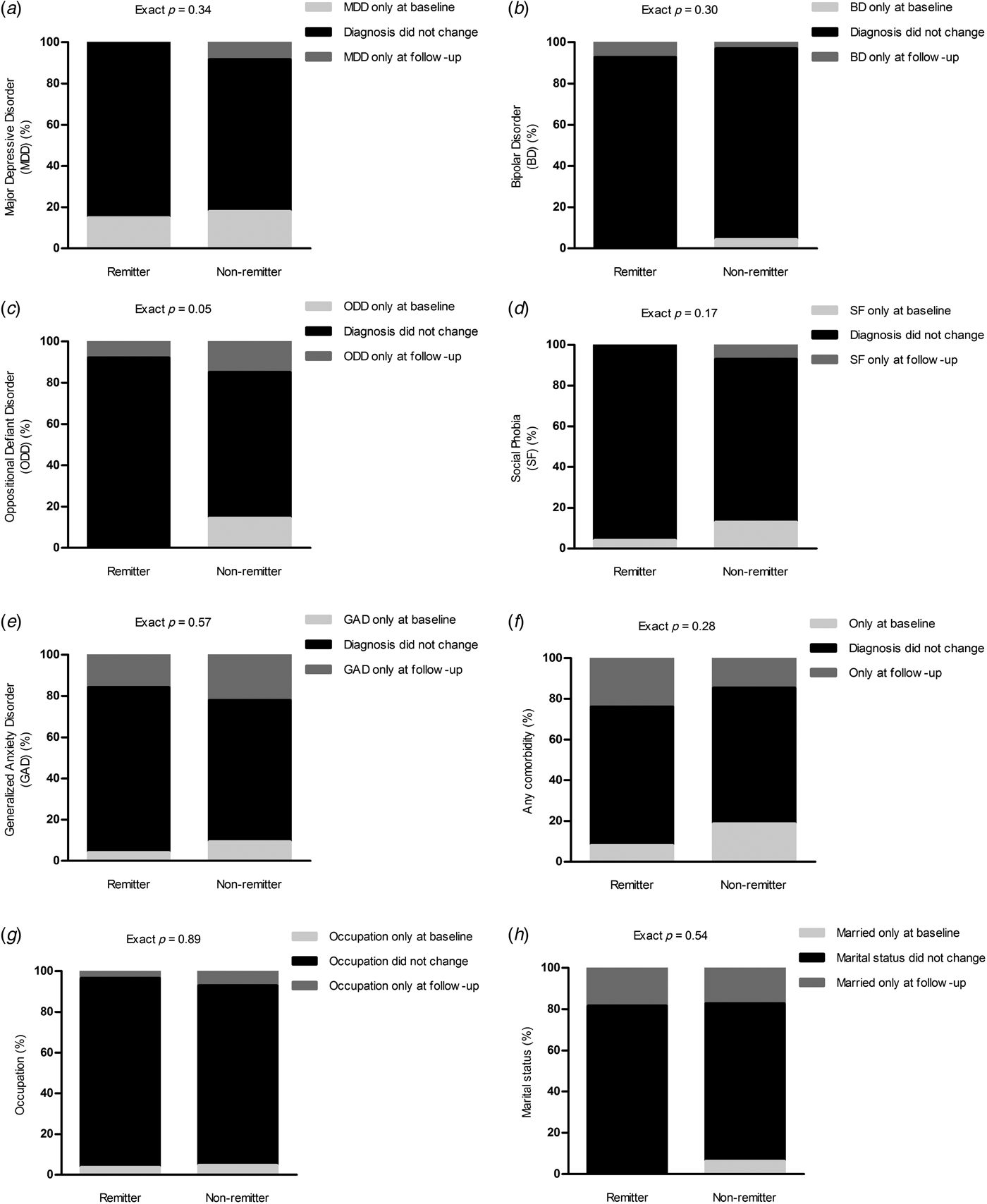
The group of ADHD remitters did not present more remission from co-morbidities or changes in work/academic or marital status at follow-up than the group of non-remitters. No significant difference was found between these groups for major depressive disorder (Fig. 2a ), bipolar disorder (Fig. 2b ), social phobia (Fig. 2d ), generalized anxiety disorder (Fig. 2e ), presence of any co-morbidity (Fig. 2f ), occupation (Fig. 2g ) and marital status (Fig. 2h ). There was a trend for lower rates of oppositional defiant disorder among remitters (p = 0.05), but this difference did not remain significant after Bonferroni post-hoc analysis (Fig. 2c ).
Co-morbidity and cognitive demand profiles of remitters and non-remitters. Fisher's exact test was used to compare frequency changes in co-morbidities and environment characteristics or demands between first assessment and follow-up.

Analyses with continuous outcomes
We performed a linear regression analysis where the outcome variable was the variation (Δ) between the K-SADS baseline minus follow-up scores. The significant predictors in the final model were higher total number of ADHD symptoms at baseline (b = 0.38, p < 0.001), oppositional defiant disorder at baseline (b = −1.31, p = 0.009), and novelty seeking (b = −0.07, p = 0.04).
In order to verify if patient self-rating of symptoms follow the same pattern as the clinician assessments, we ran a linear regression analysis where the outcome variable was the variation (Δ) between SNAP-IV scores from baseline to follow-up. The significant predictors in the final model were higher total SNAP-IV scores at baseline (b = 0.48, p < 0.001), and oppositional defiant disorder at baseline (b = −4.64, p = 0.001).
The percent decrease in ADHD symptoms as measured by K-SADS [21.3%, from 13.06 (s.d. = 2.89) at baseline to 10.28 (s.d. = 3.80) at follow-up] and SNAP-IV [18.2%, from 29.96 (s.d. = 9.09) at baseline to 24.51 (s.d. = 9.93) at follow-up] was very similar, and the correlation coefficient of both variations (Δ) was 0.58 (p < 0.001).
Discussion
To our knowledge, this is the first follow-up study of ADHD to assess a clinical sample of patients seeking treatment during adulthood. By contrast to child and adolescence ADHD (Biederman et al. Reference Biederman and Faraone2000; Faraone et al. Reference Cubillo, Halari, Smith, Taylor and Rubia2006; Monuteaux et al. Reference Mercadante, Asbahr, Rosário and Ayres2010), age of subjects at baseline was not a significant predictor of loss of diagnosis among adults. However, contrary to what might be expected considering the optimal developmental period for brain maturation (Hoekzema et al. Reference Hart, Radua, Nakao, Mataix-Cols and Rubia2012; Shaw et al. Reference Shaw, Eckstrand, Lerch, Greenstein and Clasen2012), approximately one third of the sample in this study did not maintain full DSM-IV diagnosis at follow-up, and even complete remission (<4 symptoms) was present in 12.4% of the sample. Higher number of inattention symptoms, number of hyperactivity/impulsivity symptoms, oppositional defiant disorder and social phobia were associated with persistence of ADHD diagnosis 7 years after first assessment.
Regarding the unexpected presence of full ADHD remission after brain maturation, at least two hypotheses could be raised. First, it should be considered that age, strongly associated with decline of ADHD symptoms at childhood and adolescence (Biederman et al. Reference Biederman and Faraone2000; Faraone et al. Reference Cubillo, Halari, Smith, Taylor and Rubia2006; Ramtekkar et al. Reference Polanczyk, Caspi, Houts, Kollins, Rohde and Moffitt2010; Barbaresi et al. 2013), could present a residual effect in adults, mainly in early adulthood. However, our analyses over a wide age range (18–68 years) show that after 18 years the patients’ age did not influence the rates of ADHD persistence. This result is in agreement with previous neuroimaging findings (Nakao et al. Reference Moriyama, Polanczyk, Terzi, Faria and Rohde2011; Hoekzema et al. Reference Hart, Radua, Nakao, Mataix-Cols and Rubia2012; Shaw et al. Reference Shaw, Eckstrand, Lerch, Greenstein and Clasen2012) pointing to absence of age effect in the decline of ADHD symptoms in adulthood. Second, it might be suggested that complete ADHD remission in these adult patients might be influenced either by the remission of co-morbidities or by a lower cognitive demand at the time of follow-up compared to the circumstances in the first assessment. Since remitters and non-remitters did not differ on any measurements (Fig. 2), our data supports the argument that there is indeed a group with real ADHD remission at adulthood.
The evaluation of baseline characteristics as possible predictors of persistence or loss of ADHD diagnosis considered a less stringent but more formal threshold of six symptoms at follow-up. Higher number of ADHD symptoms at first assessment was associated with persistence, in line with results from previous studies (Kessler et al. Reference Karam, Bau, Salgado, Kalil, Victor, Sousa, Vitola, Picon, Zeni, Rohde, Belmonte-de-Abreu and Grevet2005; Lara et al. Reference Klein, Mannuzza, Olazagasti, Roizen, Hutchison, Lashua and Castellanos2009). Another significant predictor of ADHD persistence was oppositional defiant disorder diagnosis, extending to adulthood a reported predictor of persistence from childhood studies (Barkley et al. Reference Barkley and Murphy2008; Lara et al. Reference Klein, Mannuzza, Olazagasti, Roizen, Hutchison, Lashua and Castellanos2009; Biederman et al. Reference Biederman, Mick and Faraone2011; Riddle et al. Reference Rasmussen and Gillberg2013). This represents further evidence to a long lasting influence of oppositional defiant disorder in ADHD persistence and it is in line with data indicating that different circuitries may be dysfunctional in patients with ADHD that also present emotional dysregulation/irritability (Cubillo et al. Reference Cortese, Imperati, Zhou, Proal, Klein, Mannuzza, Ramos-Olazagasti, Milham, Kelly and Castellanos2012). Such neurobiological mechanisms and related clinical features could be further impairing the possibility of clinical improvement.
We are unaware of previous evidence highlighting social phobia as a predictor of ADHD persistence, although there is evidence that anxiety disorders as a group may have an effect on persistence (Biederman et al. Reference Biederman, Mick and Faraone2011). A possible reason for the lack of previous findings regarding social phobia might be the fact that only two studies included individual anxiety disorders among the co-morbidities investigated (Kessler et al. Reference Karam, Bau, Salgado, Kalil, Victor, Sousa, Vitola, Picon, Zeni, Rohde, Belmonte-de-Abreu and Grevet2005; Barkley et al. Reference Barkley and Murphy2008). One of these studies verified significant effects only for generalized anxiety and post-traumatic stress disorders, but social phobia was slightly more frequent among persistent patients (Barkley et al. Reference Barkley and Murphy2008). The other study did not find predictive effects for any co-morbidity (Kessler et al. Reference Karam, Bau, Salgado, Kalil, Victor, Sousa, Vitola, Picon, Zeni, Rohde, Belmonte-de-Abreu and Grevet2005). Another possible reason for the lack of association between social phobia and persistence in childhood ADHD is the fact that a significant fraction of cases of social phobia starts during or after adolescence (Rosellini et al. Reference Riddle, Yershova, Lazzaretto, Paykina, Yenokyan, Greenhill, Abikoff, Vitiello, Wigal, McCracken, Kollins, Murray, Wigal, Kastelic, McGough, dos Reis, Bauzó-Rosario, Stehli and Posner2013). Previous studies have suggested that both oppositional defiant disorder and social phobia may be related with a worse response to treatment as well as with some difficulty to engage in clinical interventions (Souery et al. Reference Simon, Czobor, Bálint, Mészáros and Bitter2007; Stringaris & Goodman, Reference Stringaris and Goodman2009; Victor et al. Reference Victor, Grevet, Salgado, Silva, Sousa, Karam, Vitola, Picon, Zeni, Contini, Rohde, Belmonte-de-Abreu and Bau2009). It should be noted that all patients underwent detailed and individualized interviews to fulfill evaluation protocols and received information about ADHD that could represent at least some degree of clinical intervention.
This investigation also provides relevant information about the lack of effect of several characteristics over persistence or remission. One issue is that duration (months) of treatment with MPH during follow-up did not influence the long-term course of ADHD symptoms. This is a disputed topic, since while some neuroimaging studies found that stimulant medication could have structural (Nakao et al. Reference Moriyama, Polanczyk, Terzi, Faria and Rohde2011) or activation (Hart et al. Reference Grevet, Bau, Salgado, Fischer, Victor, Garcia, de Sousa, Nerung and Belmonte-De-Abreu2013) ‘normalizing’ effects in brain areas related to ADHD, follow-up studies with children and adolescents (Biederman et al. Reference Biederman, Mick and Faraone2011; Riddle et al. Reference Rasmussen and Gillberg2013) and a retrospective study in adults with ADHD (Lara et al. Reference Klein, Mannuzza, Olazagasti, Roizen, Hutchison, Lashua and Castellanos2009) point to an absence of permanent clinical effects. Therefore, despite the clear therapeutic effect of current use of MPH in adults with ADHD (Castells et al. Reference Biederman, Petty, Clarke, Lomedico and Faraone2011; Moriyama et al. Reference Monuteaux, Mick, Faraone and Biederman2013), and preliminary evidence for positive long-term effects in neuroimaging (Nakao et al. Reference Moriyama, Polanczyk, Terzi, Faria and Rohde2011; Hart et al. Reference Grevet, Bau, Salgado, Fischer, Victor, Garcia, de Sousa, Nerung and Belmonte-De-Abreu2013), MPH use does not seem to modify the ADHD symptomatology after discontinuity, independently of however long the patient was treated. Another issue refers to the time between baseline and follow-up assessments. Although it would be intuitive to think that patients with a longer time between these assessments would have a higher probability of losing diagnosis, we could not detect such an effect.
Some characteristics of this study should be considered when analyzing its contribution to the understanding of the course of ADHD among adults: (1) this is the first follow-up in a clinical sample of individuals diagnosed during adulthood, (2) the sample has relevant peculiarities which are unusual in previous follow-up studies as representative proportions of men and women and a wide co-morbidity profile, allowing a broader picture of the disorder, (3) the fact that patients were interviewed face-to-face by trained psychiatrists ensures the accuracy of diagnosis and measurements, and (4) this is the first study on the persistence of ADHD performed outside the USA and Europe, which has great importance for cultural external validity. Despite these previously described strengths, some limitations must be considered. Since our sample was of adults referred to an ADHD clinic, the generalizability of our findings for non-referred adults with ADHD in the community is uncertain. However, this design is appropriate to answer questions about adults with full DSM-IV ADHD who seek treatment for themselves, an especially relevant group of patients. Moreover, we could not evaluate 34% of the original sample. Nevertheless, only two statistically significant differences emerged between assessed and not assessed patients and they did not have significant effects in any further analyses. Further, we did not follow a control group to compare ADHD symptoms course, nevertheless the emergence of ADHD diagnosis after brain maturation is not expected (Polanczyk et al. Reference Polanczyk, de Lima, Horta, Biederman and Rohde2010). It could be argued that the relatively small proportion of subjects that lost ADHD diagnosis (30%) would limit the strength of the findings. However, the fact that similar results were observed with the continuous analyses suggests the robustness of our findings. Finally, while this study had only one follow-up assessment, more evaluation points throughout adulthood and aging will be necessary to better understand the course of ADHD in adults.
In conclusion, a sizable proportion of patients with ADHD did not keep the diagnosis 7 years after the first assessment, regardless whether at early, middle or older adulthood. The information reported here on co-morbidities and characteristics associated with persistence or remission shed light on the largely unexplored topic of course of ADHD during adulthood. Ultimately, they may be considered in the design of future neuroimaging and neuropsychological studies on the neurobiological mechanisms behind persistence and remission and hopefully lead to new treatment targets or approaches. A relevant clinical implication of these findings is that periodic evaluation of symptoms in adults with ADHD should be encouraged. This evaluation may be relevant both to the majority of patients that persist with ADHD diagnosis and therefore might continue medication use, as well as to remitters without significant symptoms and impairments that could stop using medications.
Acknowledgements
We thank the volunteers for their participation, which made this research possible and other members of the research team for help in the data collection process (A. G. Fischer, L. Nerung, N. O. Sousa, C. R. Garcia). This research was supported in part by the following Brazilian government institutions: Conselho Nacional de Desenvolvimento Científico e Tecnológico (CNPq), Coordenação de Aperfeiçoamento de Pessoal de Nível Superior (CAPES), Fundação de Amparo à Pesquisa do Estado do Rio Grande do Sul (FAPERGS) and Hospital de Clínicas de Porto Alegre (FIPE-HCPA).
Declaration of Interest
E.H.G. has been on speakers’ bureau and received travel awards from Shire to take part in one scientific meeting during the last 3 years. P.BdA. has been on the speakers’ bureau or acted as a consultant for Janssen-Cilag, Bristol-Myers Squibb, Cristália and Shire during the past 3 years. L.A.R. has been on the speakers’ bureau/advisory board and/or acted as consultant for Eli-Lilly, Janssen-Cilag, Novartis and Shire during the last 3 years. The ADHD and Juvenile Bipolar Disorder Outpatient Programs chaired by him received unrestricted educational and research support from the following pharmaceutical companies during the last 3 years: Eli-Lilly, Janssen-Cilag, Novartis, and Shire. All other authors declare that they have no conflicts of interest.