Introduction
Cochlear implantation is the definitive procedure used to manage patients with severe-to-profound hearing loss. During cochlear implantation, which is mainly performed using a posterior tympanotomy approach, visualisation of the round window and the round window membrane is needed as these are essential landmarks for successful insertion of the electrode array; otherwise, the electrode may be misplaced in a hypotympanic air cell.Reference Ying, Lin, Oghalai and Williamson1 The round window membrane is a soft-tissue barrier separating the middle ear and inner ear that can be visualised underneath the round window niche promontory bony overhang.Reference Goycoolea and Lundman2
In some cases, accessing the round window is still challenging and not always possible using the posterior tympanotomy approach. For these cases, the electrode can be inserted through a cochleostomy or extended round window approach as alternative access. In addition, it is difficult to identify the round window in patients with inner-ear malformations.Reference Leong, Jiang, Agger and Fitzgerald-O'Connor3,Reference Marchioni, Soloperto, Guarnaccia, Genovese, Alicandri-Ciufelli and Presutti4 A cochleostomy is usually performed by drilling antero-inferior to the round window membrane to access the scala tympani through the outer wall. However, this route is associated with the potential risk of damaging the spiral ligament and basilar membrane.Reference Pau, Just, Bornitz, Lasurashvilli and Zahnert5 The round window route has been associated with a lower risk of intra-cochlear trauma, labyrinthitis and perilymph fistula neuronal ganglions injury.Reference Pau, Just, Bornitz, Lasurashvilli and Zahnert5,Reference Roland, Wright and Isaacson6 In addition, electrode insertion through the round window ensures electrode placement in the scala tympani, which is associated with better audiological outcomes than electrodes placed in the scala vestibule.Reference Finley, Holden, Holden, Whiting, Chole and Neely7 Thus, the round window technique is now the preferred method for electrode array insertion and may result in better hearing preservation. Compared with only 16 per cent of surgeons who reported using the round window approach in 2006, this approach has become increasingly popular.Reference Adunka and Buchman8
There are a wide range of anatomical variations in the degree of intra-operative round window membrane visibility, which have been classified into four main groups according to the St Thomas’ Hospital classification (type I: 100 per cent of the membrane is exposed, type IIa: more than 50 per cent and less than 100 per cent of the membrane is exposed, type IIb: less than 50 per cent and more than 0 per cent is exposed, and type III: no membrane exposure). Pre-operative high-resolution computed tomography (CT) of the temporal bone provides high-quality radiological images of the inner-ear structures and their relation to the facial nerve as well as the angle of the round window membrane to predict intra-operative round window visualisationReference Park, Amoodi, Kuthubutheen, Chen, Nedzelski and Lin9,Reference Xie, Tang, Miao, Tang, Li and Tang10 and thus determine the appropriate surgical approach.
Knowing about the alternative approaches to the round window besides the standard posterior tympanotomy approach can help the surgeon in achieving the highest rates of round window insertion and obtaining the benefits of this. Therefore, studying and reviewing the published works on the possible round window approaches would be helpful. However, to the best of our knowledge, there are no systematic reviews on this topic.
In this study, we aimed to systematically review the different surgical approaches used to access the round window and explore associated intra-operative findings.
Materials and methods
Study design
A comprehensive systematic review of the literature was conducted according to the Preferred Reporting Items for Systematic Review and Meta-Analyses (‘PRISMA’) guidelines (Appendix 1). Our study protocol was registered and approved by Prospero (reference number: CRD42021226940).
Literature search strategy
In June 2021, the PubMed, Scopus, Web of Science and Cochrane Library electronic databases were searched using the following search strategy: ((round window) OR (scala tympani) OR (approach) OR (insertion))/AND (cochlear implant OR cochlear implantation)).
Selection criteria and screening process
Articles were combined in the main Endnote library, and any repeated references were then removed. Additional articles were retrieved by manually searching the citations of the relevant articles. Found articles were entered into an Endnote library file; through this process, the duplicated articles were removed. The remaining articles were combined into one Excel® spreadsheet to facilitate screening. Two reviewers independently evaluated the articles’ titles and abstracts based on the pre-established inclusion and exclusion criteria in Prospero. Articles were considered relevant if they reported cochlear implantation through the round window. There were no restrictions on study design; clinical trials, observational studies, case reports and case series were included. In addition, no limitations were applied regarding patient age, country of origin or year of publication. However, the following articles were not included: (1) conference abstracts or proceedings; (2) comments and letters to editors; (3) overlapped data sets; (4) review articles; (5) book chapters; (6) theses; (7) non-English articles; and (8) non-human studies.
Data extraction and result synthesis
Two authors were assigned to extract the following data from the eligible studies: (1) baseline demographic data including the country where the research was conducted, sample size, age and sex; (2) details of the surgery; and (3) clinical outcomes including audiological assessment outcomes and complications.
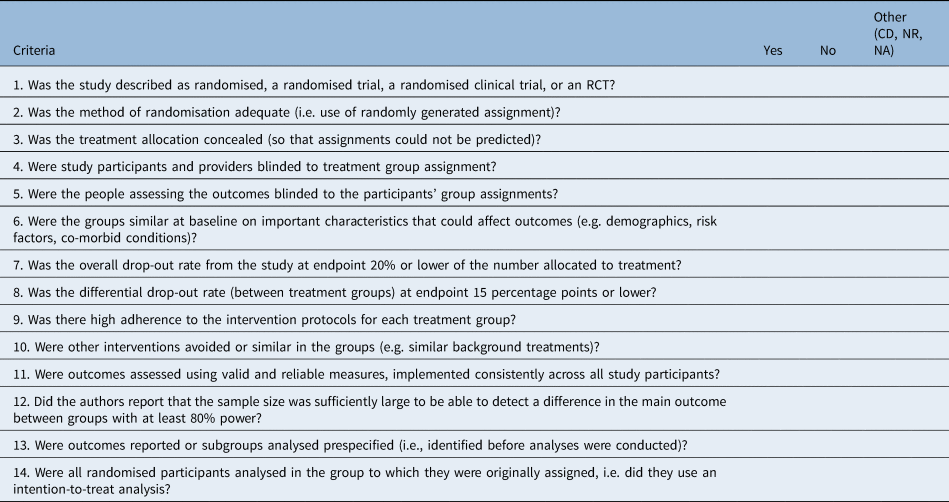
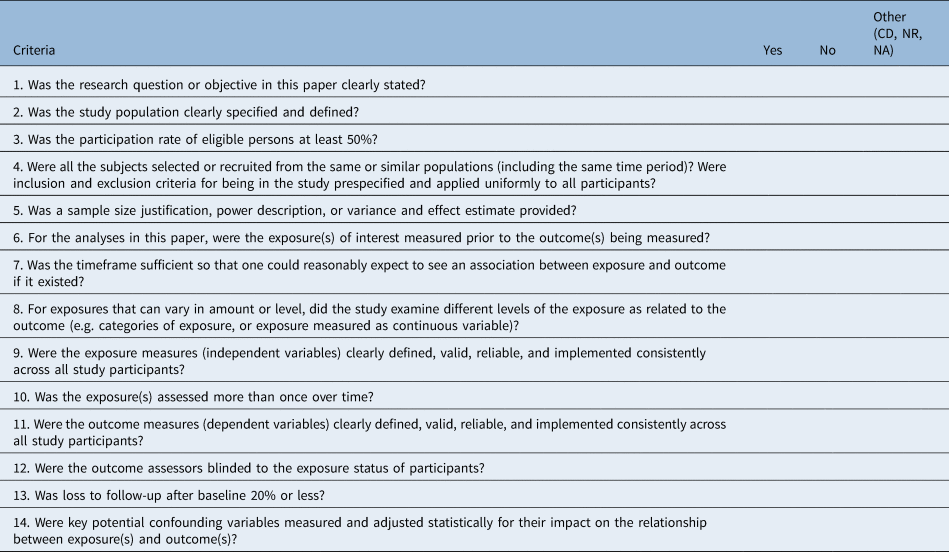
Any differences in the data reported by the two authors were resolved through a discussion with a senior investigator. The quality of the eligible articles was assessed by two independent authors using the National Institutes of Health evaluation tool for observational studiesReference Lung11 and controlled interventions, and using the Case Report (‘CARE’) checklist for case reports (Appendices 2 and 3).Reference Rison, Kidd and Koch12
Statistical analysis
A synthesis of the descriptive data was performed using SPSS® statistical software (version 23) and Excel® spreadsheet software to report numbers, percentages, means and standard deviations.
Results
Search results
A total of 2436 reports were retrieved. After removing duplicates using Endnote software, 875 reports were included in the title and abstract screening. Of these, 53 studies were eligible for full-text screening following our inclusion and exclusion criteria. Finally, 42 reports with a total sample size of 2237 patients were included in this systematic review (Figure 1). The quality assessment scores indicated good quality, regardless of the type of study design used.
The Preferred Reporting Items for Systematic Reviews and Meta-Analyses (‘PRISMA’) study flow chart.

Baseline demographic characteristics
The direct round window approach was performed in 1890 ears, with a cochleostomy in 335 ears and an extended round window approach in 27 ears. There were 25 retrospective cohort studies, 9 prospective studies, 1 randomised, controlled trial, 6 case reports and 1 case series.
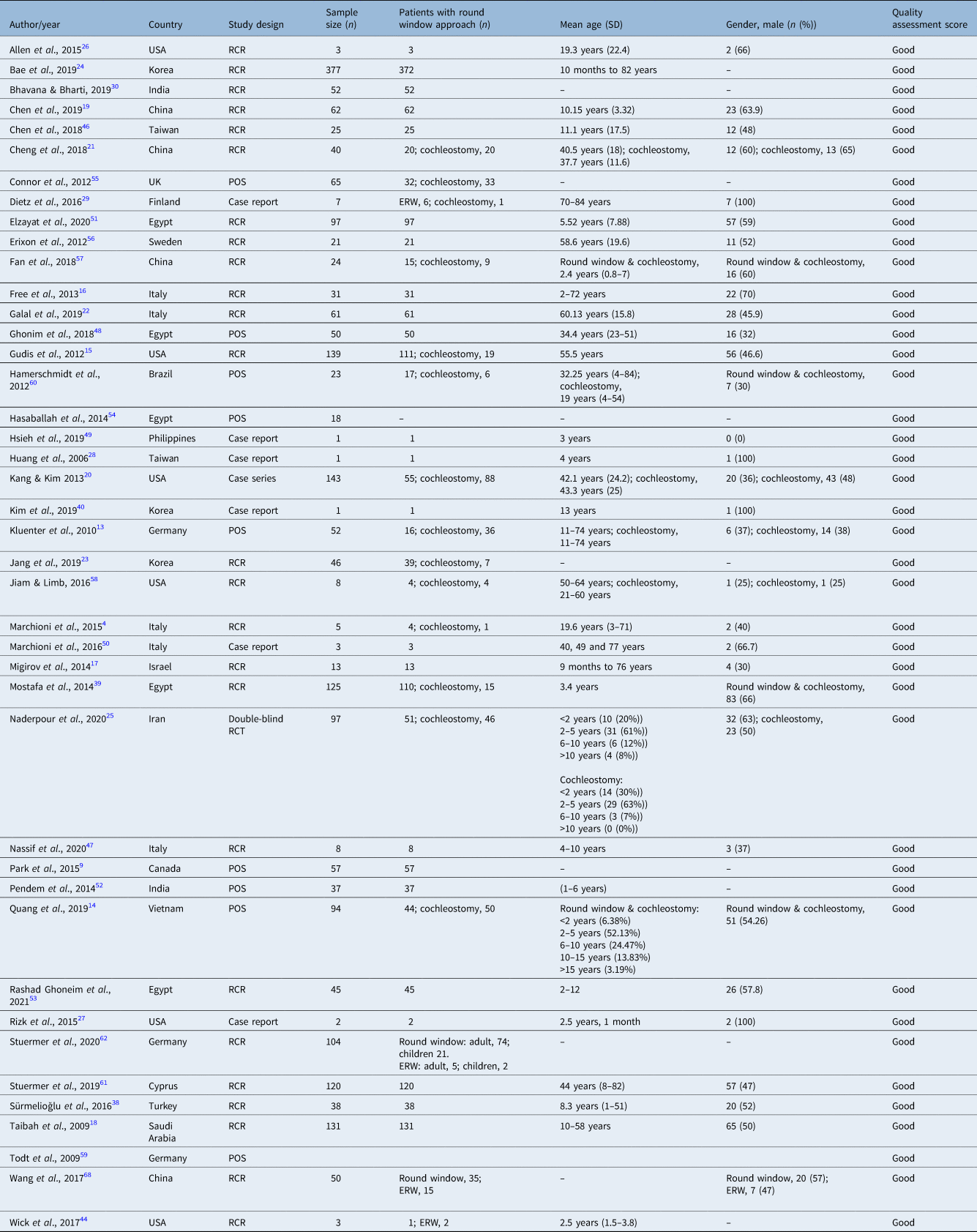
Among the 32 studies that reported the gender and age of the participants, 63.2 per cent of patients were male (881 of 1394), and the ages varied among infants, children and adults. For all cases, except 29 cases in 6 studies, cochlear implantation was unilateral.Reference Kluenter, Lang-Roth, Beutner, Hüttenbrink and Guntinas-Lichius13–Reference Taibah18 The most frequent abnormal anatomy reported was otosclerosis (54 patients), followed by abnormal cochleae or vestibules in 11 patients, an enlarged vestibular aqueduct in 10 patients, coloboma, heart defects, atresia choanae, growth retardation, genital abnormalities and ear abnormalities (‘CHARGE’) syndrome in 5 cases, and Mondini dysplasia in four cases. The facial nerve was located in the anterior and lateral positions in three and two patients, respectively. Patient characteristics, cochlear implantation models and pre-operative assessments are provided in Table 1.
Baseline characteristics of included studies

SD = standard deviation; RCR = retrospective case review; POS = prospective observational study; ERW = extended round window; RCT = randomised, controlled trial
Surgical approaches
After cortical mastoidectomy, the entry approach to the round window was performed through the facial recess in 9 studiesReference Park, Amoodi, Kuthubutheen, Chen, Nedzelski and Lin9,Reference Gudis, Montes, Bigelow and Ruckenstein15,Reference Chen, Wu, Shi, Jia, Wang and Zhang19–Reference Naderpour, Aminzadeh, Moghaddam, Pourshiri, Ariafar and Akhondi25 (round window, n = 337), and the retrofacial approach was used in 3 studiesReference Allen, Bartels and Isaacson26–Reference Huang, Lin and Wu28 (round window, n = 6). The modified suprameatal (extended round window, n = 6)Reference Dietz, Wüstefeld, Niskanen and Löppönen29 and modified Veria approaches have been associated with better exposure to the anatomy of the middle ear compared with the posterior tympanotomy approach along with easier localisation of the round window, especially for malformed cochleae.Reference Bhavana, Bharti and Vishwakarma30 Additionally, external auditory canal mobilisation (in three cases) and the endomeatal approach (in two cases) were used when the round window membrane was not easily accessed.Reference Bae, Shin and Chun24 The St Thomas' Hospital classification was used in the majority of studies (n = 5 out of 12 articles reporting any classifications); otherwise, the intra-operative visibility of the round window niche or round window membrane was used. According to round window accessibility and visualisation, full insertion of the electrode was performed through the round window membrane, extended round window marginal approach or antero-inferior round window cochleostomy. A summary of the steps of the surgical procedures with intra-operative findings and complications is provided in Appendix 4 and Figure 2.
Diagrams showing the various approaches to the round window: (a) the standard facial recess or posterior tympanotomy approach, (b) the keyhole approach, (c) the retrofacial approach, (d) the modified suprameatal approach, (e) the transaditus or transattic approach, (f) the combined posterior tympanotomy plus endomeatal approach or transcanal approach, (g) the modified Veria approach, and (h) the canal wall down approach.

Standard facial recess or posterior tympanotomy approach
This is the classic and most commonly used approach for cochlear implantation. It was first proposed by William House in 1961. After performing a mastoidectomy, the triangular facial recess is drilled between the chorda tympani anteriorly, facial nerve posteriorly and fossa ambos superiorly. This allows for the visualisation of the round window and direct insertion of the electrode array (Figure 2a).Reference Park, Amoodi, Kuthubutheen, Chen, Nedzelski and Lin9,Reference Gudis, Montes, Bigelow and Ruckenstein15,Reference Chen, Wu, Shi, Jia, Wang and Zhang19–Reference Naderpour, Aminzadeh, Moghaddam, Pourshiri, Ariafar and Akhondi25,31,Reference House32
Keyhole approach
This approach is a modification of the classic posterior tympanotomy approach. It involves a limited 15-mm mastoidectomy with stepwise identification of the landmarks that lead to the round window. The first landmark is the stalagmite spicules of bone on the medial aspect of the antrum that lead to the next landmark, the lateral semicircular canal. The posterior geniculate artery that is posterolateral-inferior to the lateral semicircular canal defines the superior end of the facial nerve, which is used to perform the posterior tympanotomy approach. This approach allows for the visualisation of the round window; however, in the reported cases, a cochleostomy was performed (Figure 2b).Reference Black33
Retrofacial approach
In cases where the facial nerve is anteriorly displaced or the round window is located more posteriorly, the surgeon may not be able to visualise the round window through posterior tympanotomy. A retrofacial approach can be used in these situations. This approach is limited by the facial nerve anteriorly, lateral semicircular canal superiorly and posterior semicircular canal posteriorly. The inferior crus of the posterior semicircular canal can be followed to reach the round window. This approach can be limited by an anteriorly placed sigmoid, which can necessitate sigmoid decompression (Figure 2c).Reference Naderpour, Aminzadeh, Moghaddam, Pourshiri, Ariafar and Akhondi25–Reference Huang, Lin and Wu28
Modified suprameatal approach
For this approach, a small antrostomy is drilled, which allows for the identification of the tegmen, lateral semicircular canal and the short process of the incus. Subsequently, the tympanomeatal flap is elevated. The electrode passes through the antrostomy lateral to the short process of the incus and below the chorda tympani (Figure 2d).Reference Dietz, Wüstefeld, Niskanen and Löppönen29
Transaditus or transattic approach
For this approach, the tympanomeatal flap is elevated to widen the exposure anterior to the external auditory canal after performing a cortical mastoidectomy. Using the transcanal view, the incudostapedal joint can be separated, and the incus is then removed. Preservation of the incus is possible if a wide atticotomy is performed. The widened transaditus passage can then be used to insert the electrode into the middle-ear space. The electrode array can either be inserted into the round window directly or the electrode tip can be delivered using the transcanal view to allow for a controlled final insertion of the electrode.
This approach can be used when the round window is not easily accessible even with a well performed posterior tympanotomy. The advantage of the transaditus approach over the retrofacial approach is that the danger of drilling around the vertical segment of the facial nerve can be avoided, which is not possible with the retrofacial approach. Given this advantage, the transaditus approach is easier for less experienced surgeons. This approach also allows for the visualisation of the round window, while a cochleostomy was chosen for electrode insertion by the authors (Figure 2e).Reference Al Sanosi34,Reference Vaca, Gutiérrez, Polo, Alonso and Álvarez35
Combined approach
Similar to the transaditus approach, the combined posterior tympanotomy plus endomeatal approach, also known as the transcanal approach, provides double views that allow for better visualisation and manipulation. These two views are anterior and posterior to the posterior canal wall. However, in contrast to the transaditus approach, the middle ear is entered using posterior tympanotomy (Figure 2f).Reference Volpe, Cantore, Nolè, Valente, Varricchio and Santandrea36–Reference Surmelioglu, Ozdemir, Tarkan, Tuncer, Çetik and Kara38
Modified Veria approach
For this non-mastoidectomy approach, the tympanomeatal flap is elevated after a postauricular incision. If the round window is not visualised, minimal canaloplasty can be performed. A posterosuperior canal is then drilled into the external auditory canal, starting medially just above the incus. A small bridge of bone can be preserved in the most lateral aspect of the tunnel to cover the electrode and prevent any future displacement. After insertion of the electrode, the bony canal can be either covered with a cartilage graft or glass ionomeric cement to further reinforce the electrode and prevent extrusion through the skin of the external auditory canal (Figure 2g).Reference Bae, Shin and Chun24,Reference Bhavana, Bharti and Vishwakarma30,Reference Surmelioglu, Ozdemir, Tarkan, Tuncer, Çetik and Kara38–Reference Kronenberg, Migirov and Baumgartner41
The Veria operation or the suprameatal approach was originally described as a cochleostomy technique rather than round window approach. The possibility of round window insertion through this approach was considered difficult because of limited visualisation.Reference Mostafa, Ezzat and El Mogui42–Reference Wick, Moore, Killeen and Isaacson44 However, by rotating the head of the patient toward the surgeon, visualisation of the round window and round window niche can be improved, and round window insertion is possible. This solution was first proposed and demonstrated by Bhavana et al. and named the modified Veria approach.Reference Bhavana, Bharti and Vishwakarma30
The pericanal approach, which does not involve the time-consuming mastoidectomy step that is used in the classic posterior tympanotomy approach, is believed to be faster. Additionally, if the facial recess is narrow, the jugular bulb is high, the round window is inferiorly rotated or there is prominent vessel growth in the mastoid, this approach can allow for access to the round window.Reference Chen, Wu, Shi, Jia, Wang and Zhang19,Reference Kronenberg and Migirov40 However, the possibility of electrode extrusion through the thin skin of the external auditory canal and an inability to visualise the round window in all cases remains a concern. A canaloplasty, performed by drilling part of the external auditory canal, can be conducted using this approach if the round window cannot be visualised through the canal.Reference Kronenberg and Migirov40,Reference Kronenberg, Migirov and Baumgartner41
Canal wall down approach or transcanal approach
In the classic mastoidectomy and posterior tympanotomy approach, the posterior auditory canal should be thinned to a ‘paper thin’ thickness. If the round window cannot be visualised after thinning the canal appropriately, the canal wall down or transcanal approach can be used. The tympanomeatal flap should be elevated to preserve the skin of the canal. The external auditory canal is then drilled laterally to the facial nerve, increasing the access and possibility of visualising the round window. Some authors have recommended the canal wall be reconstructed to protect the electrode array, and others prefer not to perform any reconstruction. One study that used this approach with a cochleostomy for insertion of the electrode array referred to this approach as the transcanal approach.Reference Carfrae and Foyt45 In cases with chronic suppurative otitis media with or without cholesteatoma, canal wall down approach cochlear implantation is performed as a part of subtotal petrosectomy.Reference Free, Falcioni, Di, Giannuzzi, Russo and Sanna16 Performing a blind sac closure would best protect the electrode array in cases of subtotal petrosectomy, particularly as the ear canal would no longer be needed for hearing when the patient has a cochlear implant (Figure 2h).Reference Free, Falcioni, Di, Giannuzzi, Russo and Sanna16,Reference Bae, Shin and Chun24,Reference Surmelioglu, Ozdemir, Tarkan, Tuncer, Çetik and Kara38,Reference Carfrae and Foyt45
Endoscopic-assisted surgery
In recent studies, endoscopic surgery has demonstrated better visualisation of the round window niche. In seven studiesReference Marchioni, Soloperto, Guarnaccia, Genovese, Alicandri-Ciufelli and Presutti4,Reference Migirov, Shapira and Wolf17,Reference Chen, Liu, Yang, Lin, Wu and Hsu46–Reference Marchioni, Soloperto, Bianconi, Guarnaccia, Genovese and Presutti50 that reported on microscopic and endoscopic approaches, the round window membrane and round window niche were visualised in spite of the significant difference in round window membrane exposure classifications between the microscopy and endoscopy approaches. The endoscope allowed for full exposure of the features of the round window niche without any associated complications. In two studies,Reference Marchioni, Soloperto, Guarnaccia, Genovese, Alicandri-Ciufelli and Presutti4,Reference Marchioni, Soloperto, Bianconi, Guarnaccia, Genovese and Presutti50 a cochleostomy was performed through the round window by drilling on the promontory near the anterior portion of the fustis when the round window could not be accessed. Endoscopic-assisted cochlear implantations were performed either through the classic posterior tympanotomy or endomeatal approach.
Prediction of round window visibility
Pre-operative imaging scans of the temporal bone are an important step in evaluating the anatomy of the round window, including its angulation, the size of the round window niche and the location of the round window in relation to the other anatomical structures (most importantly the facial nerve, sigmoid sinus, external auditory canal and skull base).
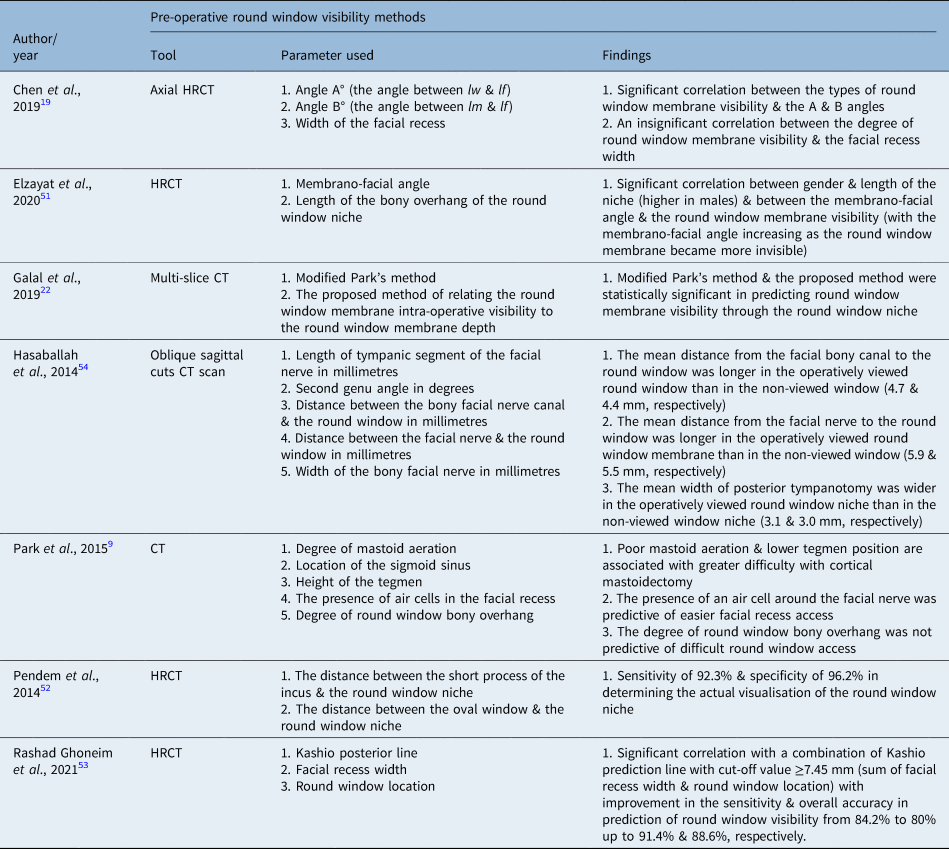
In four studies that used pre-operative high-resolution CT, a significant correlation was found between the classification of round window membrane visibility and the angle between lw and lf, and the angle between lm and lf,Reference Chen, Wu, Shi, Jia, Wang and Zhang19 where lw is a line drawn from the posterior margin of the round window membrane to the intersection point of the posterior wall of the external auditory canal and mastoid cortex, lf is a line drawn between the posterior margin of the round window membrane and the lateral margin of the facial nerve, and lm is a line drawn from the anterior to the posterior margin of the round window membrane (Figure 3a).
Images showing computed tomography scan parameters for predicting the ease of round window visualisation through the posterior tympanotomy approach. (a) The axial view and (b) the oblique sagittal reconstruction. Lw is a line drawn from the posterior margin of the round window membrane to the intersection point of the posterior wall of the external auditory canal and mastoid cortex; lf is a line drawn between the posterior margin of the round window membrane and the lateral margin of the facial nerve; and lm is a line drawn from the anterior to the posterior margin of the round window membrane. EAC = external auditory canal; RW = round window; RWM = round window membrane

In addition, there was a significant correlation between round window membrane visibility and the membrano-facial angleReference Elzayat, Soltan, Talaat and Fouad51 (Figure 3b). Furthermore, the high-resolution CT measurements had an overall sensitivity and specificity of 92.3 per cent and 96.2 per cent, respectively, for predicting the round window nicheReference Pendem, Rangasami, Arunachalam, Mohanarangam and Natarajan52 and a sensitivity and specificity of 91.4 per cent and 88.6 per cent, respectively, for predicting round window visibility.Reference Rashad Ghoneim, Ghonim, Mohamed Badawy, Abdel Razek, Salam Hafez and Hamad53
In one study using multislice CT,Reference Galal, Eldin, Baki and Sanna22 the prediction of round window membrane visibility through the posterior tympanotomy had a sensitivity of 65.71 per cent and a specificity of 96.15 per cent. In another study that used oblique sagittal-cut CT scanning,Reference Hasaballah and Hamdy54 the mean distance from the facial bony canal to the round window and from the facial nerve to the round window was longer than the distances observed using the operative view. Table 2 lists all the parameters used and the findings.
Prediction of round window visibility by computed tomography

Lw is a line drawn from the posterior margin of the round window membrane to the intersection point of the posterior wall of the external auditory canal and mastoid cortex; lf is a line drawn between the posterior margin of the round window membrane and the lateral margin of the facial nerve; and lm is a line drawn from the anterior to the posterior margin of the round window membrane. HRCT = high-resolution computed tomography; CT = computed tomography
Method of detecting the electrode position
Post-operative assessments using either CT or X-ray were performed in all eight studiesReference Quang and Duc14,Reference Jang, Choo, Kim, Park and Choung23,Reference Allen, Bartels and Isaacson26,Reference Connor, Holland, Agger, Leong, Varghese and Jiang55–Reference Todt, Rademacher, Wagner, Göpel, Basta and Haider59 that reported detecting the electrode position. The X-ray images were reported to be performed using the transocular viewReference Jang, Choo, Kim, Park and Choung23,Reference Kronenberg and Migirov40 and Stenver's view.Reference Quang and Duc14 Intra-operative imaging might be indicated if there is a high level of uncertainty regarding the electrode positioning, and this imaging was reported in two studies.Reference Quang and Duc14,Reference Jang, Choo, Kim, Park and Choung23
Audiological and speech outcomes
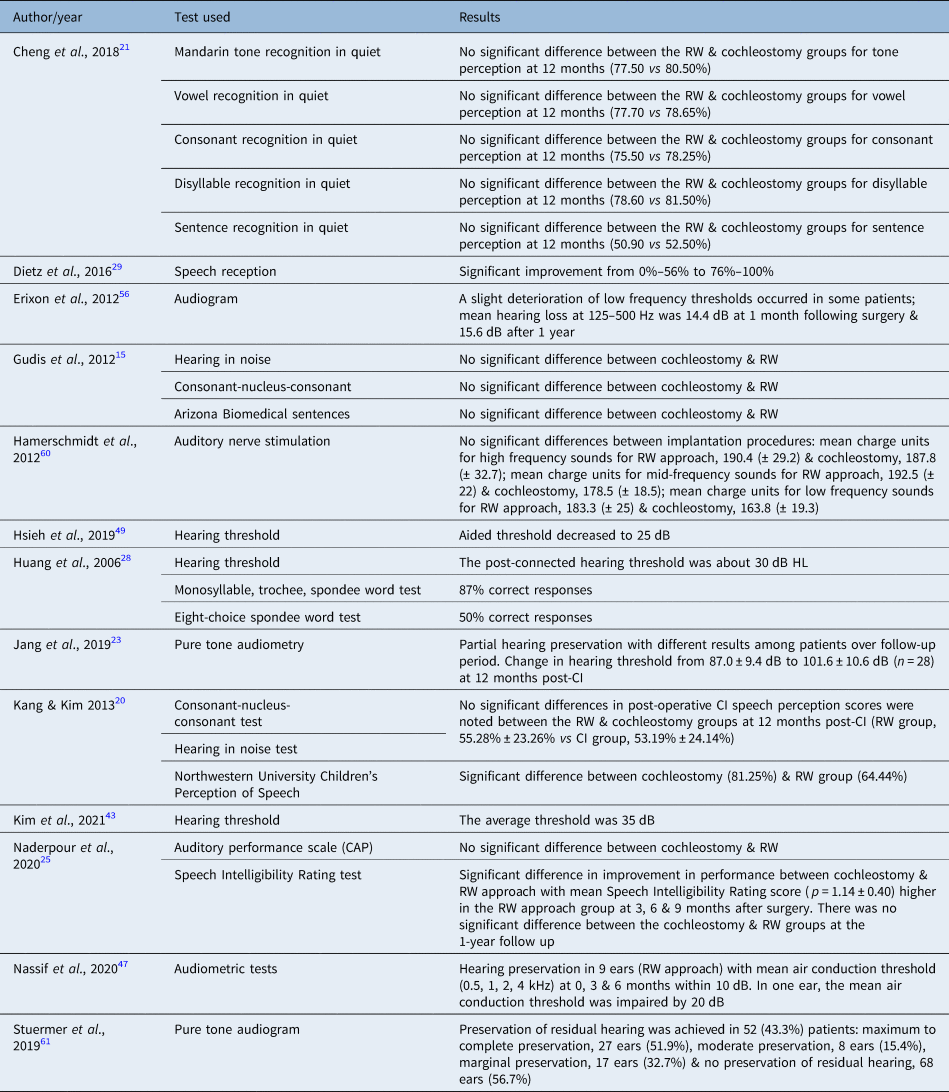
For the included studies, no significant differences were reported for the audiological and speech outcomes between the round window and cochleostomy approaches. The authors used various measures for evaluation, including: perception of each tone, vowel, consonant, disyllable and sentence;Reference Cheng, Wang, Liu, Yuan, Shu and Chen21 auditory nerve stimulation;Reference Hamerschmidt, Schuch, Rezende, Wiemes, Oliveira and Mocellin60 speech perception;Reference Kang and Kim20 auditory performance scale and speech intelligibility rating scores;Reference Naderpour, Aminzadeh, Moghaddam, Pourshiri, Ariafar and Akhondi25 hearing in noise testing; consonant-nucleus-consonant testing; and the Arizona Biomedical sentences test.Reference Gudis, Montes, Bigelow and Ruckenstein15 Performing a meta-analysis was not possible because of the diversity of the reported outcome measures reported.
A slight deterioration in low-frequency thresholds,Reference Erixon, Köbler and Rask-Andersen56 changes in hearing preservationReference Jang, Choo, Kim, Park and Choung23,Reference Nassif and Zinis47,Reference Stuermer, Kluenter, Lang-Roth, Schwarz, Hüttenbrink and Anagiotos61 and a lower perception of speech scoresReference Kang and Kim20 were reported in some patients after the round window approach between six months and one year after implantation (Table 3).
Audiological and speech outcomes after cochlear implantation

RW = round window; CI = cochlear implantation; CAP = categories of auditory performance
Discussion
Posterior tympanotomy is the most commonly used approach to the round window. Because it is not always possible to visualise the round window through posterior tympanotomy, it is important for surgeons to know about the alternative approaches to reach the round window. Before considering these alternative approaches, the surgeon needs to ensure that the posterior tympanotomy is well performed and ensure proper skeletonisation of the facial nerve, proper thinning of the external auditory canal, proper widening of the posterior tympanotomy up to the fossa incudes and inferiorly to the bifurcation of the facial nerve and the chorda tympani, and proper rotation and positioning of the microscope and the patient's head.
In this review, we summarised all available clinical evidence regarding the different microscopic and endoscopic approaches to access the round window. Forty-two articles were found to be within the scope of this review, describing eight distinct approaches to the round window, including: the standard facial recess or posterior tympanotomy approach,Reference Ying, Lin, Oghalai and Williamson1,Reference Gudis, Montes, Bigelow and Ruckenstein15,Reference Chen, Wu, Shi, Jia, Wang and Zhang19–Reference Naderpour, Aminzadeh, Moghaddam, Pourshiri, Ariafar and Akhondi25,31,Reference House32 the keyhole approach,Reference Black33 the retrofacial approach,Reference Naderpour, Aminzadeh, Moghaddam, Pourshiri, Ariafar and Akhondi25–Reference Rizk, O'Connell, Stevens and Meyer27 the modified suprameatal approach,Reference Dietz, Wüstefeld, Niskanen and Löppönen29 the transaditus or transattic approach,Reference Al Sanosi34,Reference Vaca, Gutiérrez, Polo, Alonso and Álvarez35 the combined posterior tympanotomy plus endomeatal approach or transcanal approach,Reference Volpe, Cantore, Nolè, Valente, Varricchio and Santandrea36–Reference Surmelioglu, Ozdemir, Tarkan, Tuncer, Çetik and Kara38 the modified Veria approach,Reference Bae, Shin and Chun24,Reference Bhavana, Bharti and Vishwakarma30,Reference Surmelioglu, Ozdemir, Tarkan, Tuncer, Çetik and Kara38–Reference Kronenberg, Migirov and Baumgartner41 and the canal wall down approach.Reference Bae, Shin and Chun24,Reference Surmelioglu, Ozdemir, Tarkan, Tuncer, Çetik and Kara38,Reference Carfrae and Foyt45 Endoscopic-assisted techniques were also described for use in the classic posterior tympanotomy or endomeatal approaches.Reference Marchioni, Soloperto, Guarnaccia, Genovese, Alicandri-Ciufelli and Presutti4,Reference Migirov, Shapira and Wolf17,Reference Chen, Liu, Yang, Lin, Wu and Hsu46–Reference Marchioni, Soloperto, Bianconi, Guarnaccia, Genovese and Presutti50
Prediction of round window visibility using CT was described in seven articles using various radiological parameters,Reference Park, Amoodi, Kuthubutheen, Chen, Nedzelski and Lin9,Reference Chen, Wu, Shi, Jia, Wang and Zhang19,Reference Galal, Eldin, Baki and Sanna22,Reference Elzayat, Soltan, Talaat and Fouad51–Reference Hasaballah and Hamdy54 with a reported sensitivity of up to 92.3 per cent and specificity of up to 96.2 per cent in determining the actual visualisation of the round window niche (Table 2).Reference Pendem, Rangasami, Arunachalam, Mohanarangam and Natarajan52
We also reviewed the audiological and speech outcomes of the included cases with the round window approach. Because of the diversity of reported outcome measures, meta-analysis was not possible.
St Thomas’ Hospital classification may provide useful guidance for selecting the appropriate approach for electrode insertion.Reference Leong, Jiang, Agger and Fitzgerald-O'Connor3 In one study, the round window membrane could not be visualised in 8 per cent of patients through the posterior tympanotomy approach.Reference Leong, Jiang, Agger and Fitzgerald-O'Connor3 Thus, extended round window insertion could be an alternative treatment option for these cases. This could be explained by the fact that the round window membrane is located in the fossula fenestrae rotunda covered with overhanging bony ridges that limit the visibility of the round window membrane during surgery.Reference Roland, Wright and Isaacson6 In a recent study,Reference Stuermer, Winter, Nachtsheim, Klussmann and Luers62 the authors reported a higher percentage of type I visualisation of the round window, which was explained by sufficient surgical preparation and having experienced surgeons to explore the anatomy.
Moreover, performing a pre-operative CT may allow for a better prediction of round window visualisation, and one study recommended using the Kashio line, which is a facial recess width with a cut-off value equal to or more than 4.75 mm, and round window location with a cut-off value equal to or more than 2.95 mm.Reference Rashad Ghoneim, Ghonim, Mohamed Badawy, Abdel Razek, Salam Hafez and Hamad53 Another studyReference Pendem, Rangasami, Arunachalam, Mohanarangam and Natarajan52 found an inverse relationship between round window niche visualisation and the distance between the fossa ambos and round window niche: the shorter the distance, the more difficult visualising the round window niche became. The shorter distance could be explained by the anatomical variation of round window niche displacement either posteriorly or superiorly and the displacement of the tip of the short process of the incus.Reference Pendem, Rangasami, Arunachalam, Mohanarangam and Natarajan52
A benefit of the round window approach is that it has a low impact on cochlear microenvironments.Reference Briggs, Tykocinski, Xu, Risi, Svehla and Cowan63 The soft surgery technique has been applied to the round window approach to reduce intra-cochlear trauma and inflammation.Reference Cohen64 Wanna et al. also reported that round window approaches were associated with a lower rate of electrode displacement outside the scalar tympani than the cochleostomy approach.Reference Wanna, Noble, Gifford, Dietrich, Sweeney and Zhang65
The retrofacial approach has been used in other ear surgery procedures to reach the sinus tympani and hypotympanum.Reference Chen, Yin and Shen66,Reference Roland, Hoffman, Miller and Cohen67 In this review, two of the included studiesReference Allen, Bartels and Isaacson26,Reference Rizk, O'Connell, Stevens and Meyer27 reported using the retrofacial approach to access the round window because visualisation of the round window was not possible using the standard facial recess approach. In the study by Allen et al.,Reference Allen, Bartels and Isaacson26 the retrofacial approach was performed because of an anterio-laterally displaced facial nerve. These authors suggested considering the retrofacial approach with a high-riding jugular bulb to avoid posterior semicircular canal fenestration.
The extended round window approach is believed to be less traumatic than cochleostomy and is proposed to be used when there is difficulty visualising the round window membrane through the posterior tympanotomy approach.Reference Wang, Sun, Sun and Chen68 The electrode impedance that is used to evaluate function and reflect the state of the area surrounding the arrays after cochlear implantation can be affected by inflammatory reactions and was found not to be significantly different in the round window approach compared with the extended round window approach.Reference Wang, Sun, Sun and Chen68
Conclusion
The findings of the present study suggested that there are numerous approaches to reaching the round window during cochlear implantation. These approaches have been reported to be safe. If the visualisation of the round window cannot be achieved through the standard facial recess approach, the surgeon can try the other approaches. We recommend pre-operative temporal bone CT assessment as certain parameters could provide some important information to predict round window visualisation and possible difficulties during cochlear implantation surgery.
Competing interests
None declared
Appendix 1. Preferred Reporting Items for Systematic Reviews and Meta-analyses ('PRISMA') 2009 checklist

Appendix 2. National Institutes of Health tools for quality assessment of studies
National Institutes of Health tool for quality assessment of controlled intervention studies

National Institutes of Health Tool for quality assessment tool for observational cohort and cross-sectional studies

Appendix 3. Case Report (‘CARE’) checklist of information to include when writing a case report

Appendix 4. Summary of steps and outcomes of surgical procedures