Introduction
Four species of the rare earth element (REE) vanadate wakefieldite, ideally (REE,Y)(VO4), are known: wakefieldite-(Ce) (Deliens and Piret, Reference Deliens and Piret1977, Reference Deliens and Piret1986), wakefieldite-(La) (Witzke et al., Reference Witzke, Kolitsch, Warnsloh and Göske2008), wakefieldite-(Nd) (Moriyama et al., Reference Moriyama, Miyawaki, Yokoyama, Matsubara, Hirano, Murakami and Watanabe2010), and wakefieldite-(Y) (Miles et al., Reference Miles, Hogarth and Russell1971). They occur in a large number of parageneses, including Fe–Mn deposits, granitic pegmatites and silicified wood, and in a wide range of mineral associations. All occurrences of which we are aware, and their host rocks, are listed in the Supplementary Material (see below), although some reports are not accompanied by confirmatory X-ray diffraction or electron microprobe analytical data. Published analyses have shown that there is considerable compositional variation in wakefieldites, with significant degrees of solid solution between each species and with chernovite (YAsO4) and xenotime (YPO4). Silicon and Th can also be significant components.
This paper describes previously unrecorded wakefieldite-(Nd) and wakefieldite-(Y) from a high-silica (SiO2 75–77 wt.%) rhyolitic ash-flow deposit, the Joe Lott Tuff, Utah, USA. These new data have allowed us to comment on compositional variation in the phase and to propose the major substitution schemes. It is suggested that the wakefieldites crystallised from carbonate-rich fluids associated possibly with local vanadium–uranium mineralisation.
The four species of ‘wakefieldite’ belong to the xenotime group of minerals and do not themselves form a group. To stress this point, we refer to the four species in general in the plural as ‘wakefieldites’. Suffixes are used where the species is known.
Joe Lott Tuff
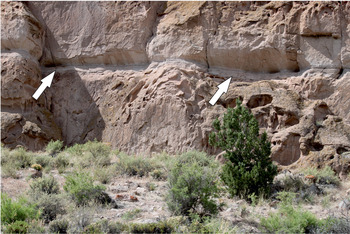
The Joe Lott Tuff Member of the Mount Belknap Volcanics is a rhyolitic ash flow tuff sheet associated with the collapse of the Mount Belknap caldera in west-central Utah (Fig. 1; Cunningham and Steven, Reference Cunningham and Steven1979; Budding et al., Reference Budding, Cunningham, Zielinski, Steven and Stern1987). Erupted at 19.2 ± 0.4 Ma, it has a volume of 150 km3. The tuff is a composite sheet, changing laterally from a single cooling unit near source to four distinct cooling units distally (Fig. 2). The Lower Unit is up to 64 m thick and has a basal vitrophyre. Initial collapse of the caldera accompanied eruption of the Lower Unit. The unit is followed upwards by a Middle Unit up to 43 m thick, a 26 m thick Pink Unit, and an Upper Unit 31 m thick. The poorly welded, pumice-rich Pink Unit comprises two ash-flow tuffs (17 m and 9 m thick) separated by a fall layer 0.5 m thick (Fig. 3).
Locality map of the Mount Belknap Caldera in southwestern Utah, USA, showing the distribution of the Joe Lott Tuff and the location of samples (JLT4.1 and M831) used in this study.

Stratigraphic relationships in the Joe Lott Tuff Member, the underlying Bullion Canyon Volcanics and the overlying crystal-rich member of the Mount Belknap Volcanics (after Budding et al., Reference Budding, Cunningham, Zielinski, Steven and Stern1987, fig. 4). The approximate positions of samples M831 and JLT4.1 are shown.

Pink Unit, exposed near the junction of State Road 4 and Interstate 89. Two ash-flows are separated by a thin fall layer (white; arrows).

The major variability in the tuff is in the degree of welding and the abundance of phenocrysts. The most densely welded, eutaxitic, rocks are at the base of the Lower Unit (the basal vitrophyre); the degree of welding increases upwards in both the Lower and Middle Units (Budding et al., Reference Budding, Cunningham, Zielinski, Steven and Stern1987). With the exception of the basal vitrophyre, the groundmass of all samples is essentially devitrified.
Occurrence of wakefieldites
Wakefieldites have been investigated in two samples: M831, from the upper part of the Middle Unit; and JLT4.1, from the upper ash-flow layer in the Pink Unit. M831 is poorly welded, with pumices and shards in a devitrified matrix rich in lithophysae up to 0.7 mm across. It contains ~1 modal % phenocrysts of quartz, sanidine, plagioclase, augite, FeTi oxides, apatite, zircon and monazite (Budding et al., Reference Budding, Cunningham, Zielinski, Steven and Stern1987). JLT4.1 is more densely welded and lithophysae-bearing, with the principal phenocrysts being alkali feldspar, quartz and magnetite.
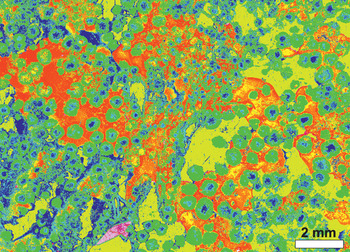
The wakefieldites occur in disseminated veins and patches, associated with rhodochrosite, calcite, Fe oxides, cerite-(Ce), a Mn silicate (caryopilite?), monazite and quartz (Fig. 4). The assemblage is similar to that of the type wakefieldite-(Nd) from the Arose stratiform deposit, Japan, reported by Moriyama et al. (Reference Moriyama, Miyawaki, Yokoyama, Matsubara, Hirano, Murakami and Watanabe2010) as hematite, caryopilite, calcite and rhodochrosite. In the Joe Lott Tuff, the wakefieldites are relatively abundant: in JLT4.1, over 100 crystals have been identified in a single thin section. Crystals are invariably small; the majority are ≤5 μm in size, although a few range up to 10 μm. Representative occurrences of wakefieldite-(Nd) are shown in Fig. 5, in two examples associated with rhodochrosite and two associated with magnetite phenocrysts. The crystals show several habits, including platy, prismatic and rounded. Contacts with neighbouring minerals are normally very well defined.
False colour back-scattered electron (BSE) image of a thin section of JLT4.1. The dark cores of the rounded lithophysae (green) are composed of caryopilite(?) and silica. Yellow areas – calcite; red – rhodochrosite; blue – quartz and alkali feldspar. The pink crystal is magnetite.

BSE images of wakefieldite-(Nd) (Wf). (a) In rhodochrosite (Rds) associated with magnetite phenocryst (Mag). (b) Associated with magnetite phenocryst, which also has inclusions of cerite-(Ce) (Cer) and ilmenite (Ilm). Afs is an alkali feldspar phenocryst. (c) Subhedral crystal embedded in rhodochrosite. Rds is italicised to show the textural difference to that in Fig. 5a; the darker Rds to the right is more calcic. Qtz – quartz. (d) As an inclusion in magnetite phenocryst. The pale rim marked X is an unidentified Mn, Pb, Al, Ca silicate.

Analytical methods
Accessory phases were initially identified by scanning electron microscopy (SEM), using a Zeiss ΣigmaTM/VP FE (field emission) – SEM equipped with new generation SDD-type two Bruker EDS detectors (XFlash 6/10TM). An acceleration voltage of 20 kV was used for the acquisition of the images presented in Figs 4 and 5. Additionally the wakefieldites were analysed with energy dispersive spectroscopy using 5.4 kV, insufficient to excite the V K shell but sufficient to rule out secondary fluorescence effects induced by strong VKα X-rays.
Mineral compositions were determined by electron microprobe analysis, using a Cameca SXFiveFE microprobe equipped with five wavelength-dispersive spectrometers. Four spectrometers were equipped with large diffracting crystals. Wakefieldites were analysed using an electron beam with 15 kV potential and a probe current of 30 nA, reduced to 20 nA for smaller grains. The standards, counting times, diffracting crystals and selected X-ray lines, and approximate detection limits are given in the Appendix. The φ(ρZ) correction model developed by Merlet (Reference Merlet1994) was used in the estimates of composition (X-PHI correction model in the Peaksight microprobe software).
The preliminary electron microprobe data showed a significant content of Ca (0.53–4.80 wt.% CaO: average 1.20 wt.%). These values are, however, an artefact, caused by secondary fluorescence of Ca in the host rhodochrosite, calcite and Ca-bearing glass. To rule out Ca from the wakefieldite structure, a few energy-dispersive spectra were acquired at 15 kV and 5.4 kV acceleration voltages on the same crystal. The significant reduction of CaKα observed with the reduced acceleration voltage and with the absence of VKα x-rays, shows that the wakefieldites studied contain no, or insignificant, amounts of Ca. Accordingly, the CaO data are presented in Table 1 and Table S1 (Supplementary – see below), but Ca is not included in the formula calculations.
Representative compositions of wakefieldites in the Joe Lott Tuff.

FeO*, all Fe as Fe2+. ‘bd’ = below detection. ‘–‘ = not determined.
Mineral compositions
Composition of wakefieldite-(Nd) and wakefieldite-(Y)
Sample JLT4.1 contains both wakefieldite-(Nd) and wakefieldite-(Y); M831 has only wakefieldite-(Y) (Fig. 6; Table 1). After Nd, the most abundant REE in wakefieldite-(Nd) is La, followed by Y. Total REE + Y are in the range 0.82–0.90 apfu. The chondrite-normalised REE patterns (Fig. 7a) show strong negative Ce anomalies (Ce/Ce* = 0.08–0.18), peaks at Pr, then a steady decrease to the HREE (Gd–Yb) with large negative Eu anomalies (Eu/Eu* = 0.06–0.30). The minor troughs at Ho in some patterns may be an artefact as the levels of the element are close to the detection limits. Inter-crystal variations are exemplified by [La/Ce]CN = 4–12 and [La/Yb]CN = 6–24 (CN – chondrite normalised). The dominant cation replacing the REE is Th (0.05–0.09 apfu). Arsenic (0.03–0.11 apfu) is the main substituent for V (0.77–0.89 apfu), with lesser amounts of P (0.02–0.04 apfu) and Si (≤0.04 apfu).
Ce–Nd–Y (apfu) plot for the Joe Lott Tuff and comparative suites. Data sources: Joe Lott Tuff – Table S1; fossilised wood – Matysová et al. (Reference Matysová, Götze, Leichmann, Škoda, Strnad, Drahota and Grygar2016); Arose – Moriyama et al. (2010); Arkaroola – Bakker and Elburg (Reference Bakker and Elburg2006); Tifernine – Baudracco-Gritti et al. (Reference Baudracco-Gritti, Quartieri, Vezzalini, Permingeat, Pillard and Rinaldi1987). Wakefieldite-(La) is not plotted.

Chondrite-normalised REE plots for (a) wakefieldite-(Nd) and (b) wakefieldite-(Y) in the Joe Lott Tuff. Data source: Table S1, analysis numbers 1, 4, 9, 13, 14, 16, 22 and 17. Normalising factors from Sun and McDonough (Reference Sun, McDonough, Saunders and Norry1989).

Compared to the Nd-dominant variety, wakefieldite-(Y) in M831 has higher Th (0.05–0.15 apfu), As (0.05–0.37 apfu), P (0.04–0.11 apfu) and Si (≤0.20 apfu), and lower REE + Y (0.69–0.75 apfu), and V (0.36–0.76 apfu). The crystals show, with one exception, positive Ce anomalies (Ce/Ce* = 1.4–2.2), a peak at Sm, and have negative Eu anomalies (Eu/Eu* = 0.13–0.26) (Fig. 7b). The wakefieldite-(Y) contains ≤0.18 wt.% SO3 (≤0.01 apfu). The only other report of anions in wakefieldite of which we are aware is of SO3 in fossilised wood from the Czech Republic (0.14 wt.%; Matysová et al., Reference Matysová, Götze, Leichmann, Škoda, Strnad, Drahota and Grygar2016), although Khoury et al. (Reference Khoury, Sokol and Clark2015) refer to the occurrence in marbles in central Jordan of a Ca- rich, U- and S-bearing analogue of wakefieldite-(Ce) [(Ce,Ca,U)(VO4)(SO4)]. The wakefieldite-(Y) from sample JLT4.1 is different to that in sample M831 in having lower abundances of As, P, Th and V (Fig. 8). The patterns in chondrite-normalised REE plots in JLT4.1 are broadly similar to those for wakefieldite-(Nd) in the same rock (Figs. 7a, b).
(a) V vs. As and (b) V vs. P plots for Joe Lott Tuff and comparative suites. Data sources as in Fig. 6.

Substitution mechanisms
In this section, the new and published compositions are used to determine generally applicable substitution schemes. Among the REE, the main substitution is LREE 1(Y,HREE)–1, where LREE are La–Eu (Fig. 9).
(Y + HREE) vs. LREE plot for Joe Lott Tuff and comparative suites. Data sources as in Fig. 6, plus Glücksstern-Witzke et al. (Reference Witzke, Kolitsch, Warnsloh and Göske2008).

The major substituent for V in the Joe Lott samples is As (As1V–1), with As levels up to 0.37 apfu (15.34 wt.% As2O5) in wakefieldite-(Y) (Fig. 8a). These are the highest values yet recorded in wakefieldites. In their study of LREE- and Y-arsenates from an Fe–Mn deposit in the Maritime Alps, Miyawaki and Nakai (Reference Miyawaki, Nakai, Jones, Wall and Williams1996) found up to 30 mol.% of LREEVO4, broadly similar in amount to the entry of As into wakefieldites. Phosphorus also substitutes for V (P1V–1) in significant amounts in the Joe Lott minerals (≤0.11 apfu; 5.7 wt.% P2O5), again the highest values yet recorded in wakefieldites (Fig. 8b). It is still uncertain, however, whether there is a complete YVO4–YPO4 solid solution (Kolitsch and Holtstam, Reference Kolitsch and Holtstam2004; Hetherington et al., Reference Hetherington, Jercinovic, Williams and Mahan2008). Silicon is present at levels ≤0.19 apfu (4.1 wt.% SiO2), although some high values may be due to beam contamination by neighbouring quartz grains. A positive correlation between Th and Si is here taken to suggest that the Si is incorporated structurally into wakefieldites by the substitution (REE,Y)3+ + V5+ ↔ Th4+ + Si4+, i.e. it is broadly analogous to the huttonite-type substitution in monazite (Fig. 10a).
(a) (REE,Y)3+ + V5+ ↔ Th4+ + Si4+ and (b) Y3+ + P5+ = Th4+ + Si4+ as possible substitution schemes in wakefieldites in Joe Lott Tuff.

As noted above, in their study of LREE and Y arsenates Miyawaki and Nakai (Reference Miyawaki, Nakai, Jones, Wall and Williams1996) found up to 30 mol.% of LREEVO4, in LREE and Y arsenates. They suggested that the presence of large AsO4 tetrahedra could enable Y arsenates to accept the larger LREE ions. In the Joe Lott case, however, the situation is reversed: the highest As contents are accompanied by higher HREE + Y and lower LREE (Fig. 11a,b).
Arsenic plotted against (a) HREE + Y and (b) LREE for Joe Lott Tuff and comparative suites.

Formation conditions
The wakefieldite-(Nd) and wakefieldite-(Y) in the Joe Lott Tuff are found in veins and patches associated with rhodochrosite, calcite, cerite-(Ce), monazite, quartz, Fe oxide and caryopilite(?), strongly suggesting that they are of hydrothermal origin. This is consistent with the negative Ce anomalies in wakefieldite-(Nd): the mineral was formed in fluids depleted in Ce by oxidation of Ce3+, with the Ce then entering cerite-(Ce) (c.f. Witzke et al., Reference Witzke, Kolitsch, Warnsloh and Göske2008). We have no independent evidence of the T/P conditions under which they crystallised. However, Bakker and Elburg (Reference Bakker and Elburg2006) found that wakefieldite-(Ce) in diopside–titanite veins in Arkaroola, Flinders Range, South Australia, was formed by remobilisation of LREE and Y from titanite and/or the granitic host rock by a hydrothermal fluids of fairly pure H2O at T <200°C and P <50 MPa.
The large number of parageneses in which wakefieldites have been found is reflected in the many mechanisms proposed for their formation. Miles et al. (Reference Miles, Hogarth and Russell1971) proposed that the type wakefieldite-(Y) is a secondary mineral, possibly derived by leaching of Y-bearing hellandite [(Ca,REE)4Y2Al2(Si4B4O22)(OH2)]. The type wakefieldite-(Ce) was formed, along with vanadinite [Pb5(VO4)3Cl], in an oxidation zone in a silicified limestone (Deliens and Piret, Reference Deliens and Piret1977). Howard et al. (Reference Howard, Tschernich and Klein1995) reported wakefieldite-(Ce) occurring with Sr-rich zeolites and fluorite, suggesting that the REE and V were carried by hydrothermal solutions during the last stages of formation of the zeolites. Wakefieldite-(Ce) occurs with roscoelite, a vanadium mica, in reduction spots in Devonian sandstones in Banffshire, Scotland. The roscoelite is thought to have formed by a reaction involving a change in redox potential of the groundwater and the release of V from V-rich FeTi oxides in the sandstone (van Panhuys-Sigler et al., Reference van Panhuys-Sigler, Trewin and Still1996). Moriyama et al. (Reference Moriyama, Miyawaki, Yokoyama, Matsubara, Hirano, Murakami and Watanabe2010) proposed that the type wakefieldite-(Nd) was formed during prehnite–pumpellyite facies metamorphism by recrystallisation and hydration of Fe and Mn hydroxide. A solid solution of wakefieldite-(Ce) and wakefieldite-(Y) was formed in silicified plant tissue of Lower Palaeozoic age from the Studenec area, Czech Republic, as a secondary mineral during post-depositional diagenesis (Matysová et al., Reference Matysová, Götze, Leichmann, Škoda, Strnad, Drahota and Grygar2016).
The presence of the oxidised species V5+ and As5+ and the association of wakefieldites with carbonates in the Joe Lott Tuff strongly suggest that the mineral was deposited from oxidised, pH ≥6.5 to 7, CO2-rich hydrothermal fluids but this study has provided no evidence of the source of the inferred fluids. However, the Mount Belknap Volcanics (23–14 Ma) formed above a western and eastern source area spanning the central part of the Marysvale volcanic field (Fig. 1). Intrusions in the source area resulted in hydrothermally altered rocks and deposits mostly of uranium and molybdenum (Rowley et al., Reference Rowley, Mehnert, Naeser, Snee, Cunningham, Steven, Anderson and Sable1994; Cunningham et al., Reference Cunningham, Rasmussen, Steven, Rye, Rowley, Romberger and Selverstone1998). The uranium mines in the Marysvale region were operated by the Vanadium Corporation of America. Whereas the mineralisation described in this paper is clearly of a different type, it might also have been related to fluids released by these intrusions.
Supplementary material
To view supplementary material for this article, please visit https://doi.org/10.1180/mgm.2019.66.
Acknowledgements
We thank Adam Pieczka and an anonymous reviewer for constructive advice that improved the paper. We also thank Dr Uwe Kolitsch for supplying us with a copy of the 2011 paper by Gröbner et al. on the Harz Mountains occurrence (see Supplementary Material). The work was supported through the Innovative Economy Operational Program POIG.02.02.00-00-025/09 (NanoFun; Cryo-SEM microscopy lab). Financial support was also provided by the project BSt 185704 IGMiP.
Analytical conditions for the electron microprobe analysis.