I. Introduction
The legislative environment in Congress underwent a major transformation with the adoption of the Twentieth Amendment in 1933. This amendment, perhaps best known today for moving the presidential inauguration date forward from March to January, significantly reorganized the congressional terms of office and the dates of annual convening. Prior to passage of the amendment, the congressional terms of office began on March 4 (at noon), and a Congress typically met for two sessions: a “long” session, lasting six to eight months, and a “short” session, lasting just over three months (terminating on March 4, at noon). And as both sessions convened in December, the short session met after the November elections to the next Congress. This meant that a portion of the short-session membership was made up of “lame ducks”—members who would be exiting the chamber, because of retirement or having lost their reelection bids—which introduced a potential agency problem in representation.Footnote 1 Since the passage of the amendment, the congressional terms of office begin in January, and Congress typically meets for two sessions (an “even” and an “odd” session, each of indefinite length), both of which convene before the elections to the next Congress. Thus, the second, or “lame-duck,” session was eliminated by the amendment, along with the potential agency problem therein. (See Appendix 1 for a graphical illustration.)
The passage of the Twentieth Amendment—or Lame Duck Amendment, as it has also become known—was accomplished due to the Herculean efforts of Sen. George W. Norris (R-NE). Norris began his crusade against the short session of Congress in 1922, working tirelessly for its elimination until finally achieving the required two-thirds votes in each chamber a decade later. Norris's arguments for the amendment were many, but all involved the representational dangers inherent in a Congress populated in part by lame ducks. Norris held that democratic accountability and responsiveness were hampered in lame-duck sessions, as departing members were allowed to participate and, more importantly, vote after the public had acted to replace them. With the electoral connection severed, Norris argued, lame-duck members were no longer formally beholden to their constituencies and thus were susceptible to influence from congressional party leaders and (especially) the president, who possessed the ability to bestow valuable rewards in the form of executive appointments. Thus, in Norris's mind, lame-duck sessions were perverse legislative settings, as they produced policy outcomes that were often contrary to the public will and were routinely determined by a small group of political elites.
Was Norris justified in his fears regarding lame-duck sessions? This is unclear, as the validity of the “Norris Thesis” has never been investigated. While plausible, as historian Norman L. Zucker has stated, “[Norris's] argument … that lame ducks voted the way that they did in order to remain in the good graces of the party and the executive so as receive jobs is open to conjecture.”Footnote 2 More broadly, we know exceedingly little about how the institutional arrangement of long and short congressional sessions during the pre-Twentieth Amendment era affected congressional decision making, and whether the potential agency problem in representation in lame-duck sessions was often realized. Thus, several questions deserve consideration. For example, to what extent could party leaders entice departing party members to “remain on the farm” in lame-duck sessions and continue supporting the party's legislative initiatives? Did the president wield excessive influence in lame-duck sessions, and did he disproportionately parcel out appointments to lame-duck members who supported his (or his party's) policy requests? Finally, were party leaders more successful in generating policy outputs in lame-duck sessions?
We explore each of these questions within a well-established theoretical framework. Specifically, the potential agency problem in representation in lame-duck sessions fits neatly within a longstanding research agenda in political science and economics, that of analyzing legislative shirking in Congress. Shirking is typically defined as “the failure by the legislator to act in the interests of his constituents.”Footnote 3 The shirking literature is vast and takes many forms; the form closest to the subject of this paper is the literature on “last-term effects” in Congress.Footnote 4 Studies in this tradition, which will be discussed in more detail later, examine whether contemporary members of Congress who are planning to retire (and thus no longer view themselves as accountable to their constituents) alter their voting behavior in their last legislative term of office.Footnote 5 In our view, the lame-duck agency issue prior to the Twentieth Amendment provides a much cleaner and more definitive case to investigate possible last-term effects. First, rather than having to make assumptions about when a member will decide to exit the chamber (and possibly shirk) in the contemporary era, the time of exiting in the pre-Twentieth Amendment Era was exogenously determined by an election, and a new postelection legislative session was then held (providing the ideal venue for shirking). Second, contemporary studies focus only on members planning to retire, whereas a pre-Twentieth Amendment analysis examines the full range of exiting member types: retirees as well as members who lost their reelection bids. Third, contemporary studies are often ambiguous about the “direction” of shirking (toward personal preferences; toward the wishes of party leaders; toward the wishes of actors outside of Congress, like interest groups or business firms; etc.), while a pre-Twentieth Amendment study, following the historical dynamics of the amendment's passage, identifies clearly the direction of the expected shirking—toward the interests of the president—as well as the specific currency that drives the shirking decision—postelective employment, via executive appointments.
In addition to subjecting Norris's arguments for a constitutional amendment to empirical scrutiny, and thereby adding significantly to the literature on legislative shirking and last-term effects, we also strive to analyze Lame Duck Amendment politics more broadly, by discussing how the struggle to eliminate lame-duck sessions might inform (or be informed by) our more general understanding of institutional change in Congress. Here, we focus a good deal of attention on the motives of Norris and other key actors in the political drama, and speculate on how different interests embedded in the broader political dynamics of the time might explain the eventual adoption of the Twentieth Amendment. In doing so, we incorporate recent important work on institutional change by such scholars as Sarah A. Binder, Charles Stewart III, Eric Schickler, and Paul Pierson.
Finally, we believe our analysis provides an interesting perspective on politics and legislative choice in lame-duck sessions of Congress as well as offers a unique view of how partisanship and presidential–congressional relations operated in a fundamentally different legislative setting. The latter contribution is especially useful, we contend, as a new form of lame-duck session is very much in operation today. That is, since the passage of the Twentieth Amendment, the odd session of Congress occasionally extends beyond the November elections, creating a small part of the second session that is effectively a lame-duck session. Though sporadic over much of the twentieth century, this “modern” lame-duck session has become increasingly common in recent years, appearing in every Congress but one since the 103rd (1993–94). These modern lame-duck sessions have received little empirical examination, but as we begin to consider the political strategies that lead to their existence and the political dynamics in the proceedings themselves, our understanding of the previous era of lame-duck sessions will provide important and useful theoretical guideposts. This is but one way that history is useful to contemporary analysis.
We organize the paper as follows. In Section II, we describe how the congressional terms of office and dates of annual convening came to be, and how efforts to change them emerged over time. In Section III, we document the rise of George W. Norris as the champion of the Lame Duck Amendment, and discuss at length his arguments for its necessity. In Section IV, we discuss the theoretical literature on legislative shirking and last-term effects in greater detail, and, in Section V, we use the theory as a backdrop to investigate the tenets of the Norris Thesis, generating individual hypotheses and testing them systematically. In Section VI, we conclude by summarizing our findings and assessing the degree to which Norris's concerns about agency issues in lame-duck sessions were justified. We then discuss how the political dynamics leading up to the Twentieth Amendment might relate to the study of institutional change (more broadly construed), and speculate as to how our results may relate to modern lame-duck sessions.
II. A Short History of Lame-Duck Sessions of Congress
The emergence of lame-duck sessions was more an accident of history than the product of a conscious design. During the Constitutional Convention, delegates decided that Congress should meet at least once annually, and the date chosen was the first Monday in December (see U.S. Constitution, art. 1, sec. 6). This date emerged, according to B. M. Crowe, for economic reasons, “because it was between the harvest and the planting season.”Footnote 6 Ratification of the Constitution came in June of 1788, leaving the Continental Congress to decide when the terms of office for the new government would begin. Several months of debate followed; finally, on September 13, 1788, Congress chose the first Monday of March, which happened to be March 4.Footnote 7 An earlier date that might align with the December date of annual convening was unworkable: a number of official decisions were required—for example, elections to the House would need to be held and special sessions of the various state legislatures would need to be called to choose senators and presidential electors—which could not be completed quickly enough, given the state of communications in eighteenth-century America.Footnote 8 In 1792, the Second Federal Congress followed up on the Continental Congress's decision by passing a law that adopted March 4 as the official opening date of the congressional and presidential terms.Footnote 9
With an annual convening date of early December and a term of office that began on March 4 (and ended on that date two years later), along with congressional elections typically held in November,Footnote 10 an odd legislative arrangement was created. As a result, Congress developed a set of disjointed sessions: the first session, which was open-ended and typically extended into the late spring or summer, met thirteen months after the relevant November elections; the second session, which extended from early December to March 4, met after the elections to the next Congress. The second session thus introduced a potential agency problem in representation, as it was populated in part by members who would be departing the chamber, due either to retirement or having lost their reelection bids. These departing members—or lame ducks—could still participate and vote, just as before, but they were no longer tied to their geographic units through an electoral connection; as a result, their incentives were different, which made them potentially susceptible to outside influences. The second session—or lame-duck session, as it became known—was thus seen by many as a threat to the concept of democratic representation.
The conflict between the congressional terms of office and the date of annual convening, and the potential agency problem in representation that conflict caused, was recognized fairly early on. One option to deal with the problem was for Congress to change the date of annual convening; while Article I, Section 6 of the Constitution established the first Monday in December as the date, a stipulation was included that allowed Congress to select a new date by simple statute. Moving the December convening date forward (i.e., earlier in the year) to March or April would have eliminated the lame-duck session and, thus, the potential agency problem. But concerns about the early and intense summers in Washington, in an era devoid of air conditioning, prevented this option from gaining much support.Footnote 11 The more realistic option was to change the congressional terms of office, which would require a constitutional amendment. If the March 4 date could be brought forward to better align with the congressional elections and the annual convening date, a number of problems could be resolved: the thirteen-month gap between election and oath-taking could be reduced considerably, two regular sessions could be created that would be mostly free of the Washington heat, and the lame-duck session could be abolished.
The first realistic amendment proposal in this vein was offered by Rep. Millard Fillmore (W-NY) in 1840, which would have changed the congressional and presidential terms of office to the first day of December, following the November elections.Footnote 12 The bill died in committee. The next serious effort at promoting a constitutional amendment was made in the mid-1880s by Rep. William H. Crain (D-TX), who proposed that the congressional term begin on December 31, with the annual date of convening as the first Monday in January. While his initial attempts were bottled up in the Judiciary Committee in 1885, Crain eventually received floor consideration for his amendment proposal in 1888. After a spirited debate, in which opponents of the proposal argued that newly elected members needed thirteen months before entering Congress to prepare adequately for the job, Crain's measure went down to defeat, 80–154.Footnote 13 Crain continued pushing his amendment proposal for the next several years, once more gaining floor consideration in 1893, but his adversaries—who steadfastly opposed tinkering with a system that they believed worked well for over a century—defeated it yet again, 49–128.Footnote 14
With Crain's death in 1895, the call for a constitutional amendment to revamp the congressional and presidential terms of office faded. Sporadic attempts occurred in Congress over the next few decades, but none of the proposals made it out of committee. The progressive press tried to stir up outrage and raise the public's awareness on the issue, but their attempts fell largely on deaf ears. For such an amendment to be viable, a flashpoint was needed, along with the emergence of a new champion in Congress. In the early 1920s, these two criteria were met.
III. The Norris Thesis and the Passage of the Twentieth Amendment
The issue that would serve as the lightning rod for the resurrection of the anti-lame-duck session forces was the proposed ship subsidy bill of 1922.Footnote 15 In 1919, the federal government found itself owner of a large fleet of ships, built during the emergency construction surrounding U.S. involvement in World War I. After the war was over, Congress was left to deal with these ships and subsequently passed the Merchant Marine Act of 1920, which created a peacetime Shipping Board to administer the fleet. The board created a program to lease the ships to private firms; however, the stipulations of the program were biased heavily toward the interests of said firms. Specifically, firms that participated in the government leasing program could make profits, but were not liable for any losses. This perverse incentive structure resulted in the U.S. government running deficits of $16 million a month during the first year of the program.Footnote 16 While better management dropped these monthly deficits to $4 million a month by the beginning of Warren Harding's administration, the president wanted the hemorrhaging to stop and the government fleet eliminated.
In 1922, the Shipping Board met and proposed that the fleet be sold off to private firms, with the government providing a subsidy to interested buyers to underwrite the purchase. President Harding supported the proposal and urged Congress to pass a bill per its guidelines. The ship subsidy bill was debated throughout 1922, forcing members to stake out positions. The bill caused consternation among the public—opponents framed it as the government paying private firms to take possession of government ships, which seemed un-American—and emerged as a critical issue as the November elections approached.Footnote 17 Indeed, as Crowe contends: “In many states the congressional elections of 1922 tested the popularity of the proposed shipping bill.”Footnote 18 And when the electoral dust had cleared, the Republicans were devastated, having lost sixty-nine seats in the House and twelve in the Senate. In the House, there would be 114 lame ducks in the short session of the 67th Congress.
Ignoring the Republican defeats, and their potential connection to the proposed shipping bill, President Harding continued to push for elimination of the government fleet and invoked his constitutional power to call an extra lame-duck session of Congress for late November, to provide ample time to pass the legislation.Footnote 19 He also delivered a special message before a joint session of Congress, making his case for the economic sense of the subsidy as well as imploring members to consider the public good and not simply the narrow interests of their particular constituencies.Footnote 20 In the end, Harding's efforts were successful, as the House voted 208–184 to pass the ship subsidy bill. Ninety-four of the 208 yea votes were cast by lame-duck members.Footnote 21
The House vote spawned a torrent of outrage. Accusations rang out that the president bought the votes of lame-duck members with promises of executive appointments.Footnote 22 Progressives throughout the country condemned the House decision, vilifying the president for his attempted end run around the will of the people. In the Senate, progressive members of both parties vowed to prevent the ship subsidy bill from becoming law. And, in the end, they were successful, as a filibuster was launched that prevented the bill from receiving a floor vote for the remainder of the short session. Harding was defeated. But, even more importantly, a concerted effort to eliminate the lame-duck session of Congress was renewed, as Rep. William Crain's decades-old mantle was taken up by Sen. George W. Norris.Footnote 23
Norris, a progressive Republican from Nebraska, not only helped lead the filibuster of the proposed ship subsidy bill in the Senate, but he also emerged as the new champion of institutional reform in Congress. Norris would become an active spokesman for eliminating the lame-duck session and reorganizing the congressional terms of office and dates of annual convening, so as to achieve greater democratic accountability and responsiveness.Footnote 24 In leading the charge against the lame-duck session, Norris elaborated several overlapping arguments, all of which dealt with the agency problem in representation.Footnote 25 We consolidate these arguments into two major tenets and dub them the “Norris Thesis.”
First, Norris argued that legislative shirking was a significant danger in lame-duck sessions. Members who would be departing Congress in a few short months, and thus no longer tied electorally to their constituents, would be susceptible to outside influences, as they would be in need of new employment. The president, in particular, could play a major role in enticing lame-duck members to vote a certain way, by virtue of his ability to hand out lucrative appointments in the executive branch. As Norris stated:
It has often been true in the past … that some members of Congress, defeated for re-election, have, during the short session, been absolutely subservient to the wishes of the President in their official capacities, and have willingly obeyed the wishes and commands of political bosses, who are powerful in party machines and in the distribution of Federal patronage.Footnote 26
In practice, this meant that the president, or party leaders acting on his behalf, could manipulate the agenda in lame-duck sessions and force through (or block) legislation by relying upon the subservience of lame ducks who were willing to trade their votes for (the possibility or promise of) an executive appointment.Footnote 27 As a result, according to Richard Lowitt, the president was able “to exert overpowering influence on the legislative process” in lame-duck sessions.Footnote 28
Second, Norris argued that the definite March 4 end date of the lame-duck session provided the majority party in Congress with significant agenda-setting power. In a series of essays, Norris made the politics of this argument clear:
When the short session is about to close, a jam always takes place in legislative matters, and with the Calendars of the House and Senate clogged, when everybody knows that all of the bills cannot be considered, the party in power possesses a great advantage in determining which bills shall come up and which shall die a smothering death. It means likewise a clog with regard to conference reports.Footnote 29
As the fourth of March approaches, this tension increases its strength in a wonderful degree. Members of Congress who are trying to prevent the passage of what they believe to be obnoxious legislation very often remain silent because they think other legislation in which they are deeply interested may stand some show if they do not take up the time of the Senate and House in debating what is to have considered.Footnote 30
Stated differently, the lame-duck session provided majority-party leaders with a perfect environment to “cartelize” the policy agenda. Lame-duck majority-party members were at the behest of party leaders who might have a say in patronage appointments. But returning majority-party members—those who were just reelected—also could be manipulated into voting for bills desired by party leaders. These returning members would not stand for reelection again for nearly two years—after the regular session of the next Congress—and thus could afford to shirk their constituents' interests on some matters in the hopes of getting their pet bills plucked off the crowded calendar and considered on the floor before the session expired. In effect, returning majority-party members would go along with the party leadership, in the hopes of getting along.
With these arguments in hand, Norris went to battle to eliminate the lame-duck session of Congress. He was immediately successful in the Senate, where on February 13, 1923, during the lame-duck session of the 67th Congress, his amendment proposal—to change the congressional terms of office and the dates of annual convening to the first Monday in January, and thereby abolish the lame-duck session—was passed on a 63–6 roll call.Footnote 31 However, the amendment proposal was opposed by President Harding as well as the conservative Republican leadership in the House, led by Speaker Nicholas Longworth (R-OH), and while reported favorably out of committee, it was not granted a rule by the Rules Committee and died as the session expired.Footnote 32 This cross-institutional pattern of support and opposition would continue for over a decade. In each of the next four Congresses, Norris managed overwhelming votes of passage for his amendment proposal in the Senate, but he was always stymied by the conservative Republican opposition in the House (as well as the White House, with Presidents Coolidge and Hoover also opposed to the amendment).Footnote 33 At one point in this arduous process, Norris lashed out against the House leadership on the Senate floor, stating that his amendment proposal was “being held up, because machine politicians can get out of this jam [i.e., the short session] more than the people's representatives can get.”Footnote 34
Why were House Republican leaders so intent on maintaining the lame-duck session? Several reasons were given in press accounts of the time, but perhaps the most prominent was that Longworth and his “Old Guard” Republican allies viewed themselves as holding the line against the growth of government, which would occur if the progressives were given more time (i.e., two long sessions) to legislate.Footnote 35 More generally, the Old Guard leaders during this period actively sought to eliminate any hint of internal division within the party. Longworth, in particular, was fiercely opposed to the progressive agenda, and he was able to rise within the Republican leadership (first as majority leader, then as speaker) by rooting out intraparty insurgency and insisting on strict party discipline on organizational matters.Footnote 36 All told, Longworth and his Republican House allies had been doing quite well legislatively under the long-short institutional arrangement, and they likely saw little benefit—and much uncertainty—in changing the status quo.Footnote 37, Footnote 38
Finally, in the 72nd Congress, Norris caught a break. The 1930 midterm elections, following the stock market crash in 1929, swept out the Republican House majority and gave the Democrats control of the chamber for first time since the Wilson administration. For Norris, this made all the difference, as the Democratic House leadership supported the reform, and his lame-duck amendment proposal—which set the congressional terms of office and dates of annual convening for January 3, and the presidential term for January 20—passed easily in each chamber.Footnote 39 On March 8, 1932, the approved bill was sent to the states for ratification; on January 23, 1933, Missouri became the thirty-sixth state to ratify, completing the amendment process.Footnote 40 After a decade of battling, Norris had prevailed—his proposal to eliminate lame-duck sessions had become the Twentieth Amendment to the Constitution. The 72nd Congress would be the last in which a separate lame-duck session convened.
While few would argue that Norris's amendment did not provide a normative improvement in terms of democratic accountability and responsiveness—as all members of Congress were now linked directly to their geographic units throughout their terms of office—questions remain regarding the degree to which representational breakdowns actually occurred in lame-duck sessions. Stated differently, during the lame-duck era, how pervasive was the representation-based agency problem in reality rather than in theory? Was presidential manipulation of lame-duck members widespread, as Norris argued? He claimed that “[t]he ship subsidy legislation was only one [such] example,” but identified no others in his writings (nor did any of his various biographers).Footnote 41 And were majority-party leaders able to systematically take advantage of the definite March 4 end date in lame-duck sessions to push through a stream of party-preferred bills? Again, Norris makes only passing references to “half-baked legislation” and “jokers being [added] in conference,” but says little of substance beyond that.Footnote 42
In short, the evidence for the Norris Thesis is strictly anecdotal. A more systematic analysis is thus needed to investigate Norris's arguments more fully. But, before conducting this analysis, we step back and take a broader perspective by discussing how Norris's arguments are grounded in more general theory.
IV. Legislative Shirking, the “Last-Term” Problem, and Lame-Duck Sessions of Congress
To theoretically position our study of lame-duck sessions of Congress and the arguments made by Norris about agency problems in representation in such sessions, we turn to the literature on legislative shirking, a well-established body of research in political science and public choice economics. As noted in the Introduction, legislative shirking is typically defined as elected representatives acting contrary to the wishes or interests of their constituents. Thus, “shirking representatives” are those who do not act as faithful agents of their underlying principals (constituents). We focus here on one strand of the shirking literature: research on “last-term” effects (or the “last-term problem”) in Congress. This subliterature, which analyzes how members of Congress behave in their last legislative terms, as they are about to exit the institution, is most suitable for our interests, as it applies directly to the Norris Thesis. Moreover, we argue that the political context in the pre-Twentieth Amendment era, prior to the elimination of the regularly occurring lame-duck session, provides the cleanest, most definitive framework to investigate possible last-term effects in Congress. Before laying out our argument, however, we discuss the literature on last-term effects in more detail.
The literature on last-term effects is premised on the assumption that reelection is the mechanism that ensures that members of Congress represent the interests of their constituents.Footnote 43 More explicitly, the assumption is that reelection is highly valued by members of Congress, and the threat of losing their seats (by vote of their constituents) keeps them honest and behaving as faithful agents. Thus, when that threat is taken away—for example, when members of Congress decide that they will retire—the question becomes: To what extent do they then shirk their constituents' interests by voting in ways that run counter to what constituents want? Stated differently, when the reelection incentive no longer applies for some members of Congress, a potential agency problem in representation (specifically, a moral hazard problem) exists.
Empirical studies on last-term effects, which came into vogue in the late 1980s, have arrived at different conclusions, some finding evidence of shirking while others do not. Early work is decidedly mixed, with studies by Mark A. Zupan (alone and with Joseph P. Kalt) uncovering evidence of last-term shirking, whereas studies by John R. Lott, Jr., and James R. Vanbeek find no such evidence.Footnote 44 Methodological problems plagued these early studies, however, with the most severe being the limited scope of analysis: behavior in only one or two Congresses was examined. As a result, time-series (more specifically, pooled cross-sectional time-series) data were introduced in the early 1990s, and cross-time shirking analyses were produced. Studies by John R. Lott, Jr., and Stephen G. Bronars, and Keith T. Poole and Thomas Romer were state of the art, and both uncovered little evidence of shirking by members in their last terms.Footnote 45 As a result, for the rest of the decade, the consensus view of scholars working on congressional representation was that last-term shirking, while an interesting theoretical issue, was not in fact a serious problem.
Since 2000, however, the case for last-term shirking has grown considerably stronger. Studies by Lawrence S. Rothenberg and Mitchell S. Sanders; Charles Tien; and James M. Snyder, Jr., and Michael M. Ting challenged the Lott and Bronars, and Poole and Romer findings, arguing that (among other things) the dependent variables in the latter studies contained too much measurement error.Footnote 46 Specifically, the dependent variables in the Lott and Bronars, and Poole and Romer designs focused on the difference in member voting behavior across consecutive Congresses; this made uncovering last-term effects difficult, because the timing of members' retirement decisions (which occurred somewhere toward the middle of their last Congress) conflated shirking and nonshirking behavior in the last two-year period. Rothenberg and Sanders; Tien; and Snyder and Ting all designed their dependent variables differently, in ways that avoided the earlier studies' shirking and nonshirking conflation, and all uncovered significant last-term shirking effects.Footnote 47 Thus, it is fair to say that the belief among scholars of congressional representation has changed since the late 1990s, with the pendulum swinging toward the view that last-term shirking in Congress is in fact an empirical reality.
We believe that our examination of pre-Twentieth Amendment congressional voting across regular and lame-duck sessions can add significantly to the literature on legislative shirking.Footnote 48 Indeed, we contend that the pre-Twentieth Amendment era offers an ideal setting to search for evidence of last-term effects in Congress, because the political context provides a much cleaner, more definitive research design than those employed in any recent studies. We provide three reasons for this strong contention.
First, there was a clear, exogenous demarcation between member types in the pre-Twentieth Amendment era, as the November elections determined whether or not members would be departing Congress. And, in doing so, the elections created two distinct political contexts in which to study congressional voting behavior, regular and lame-duck sessions, with the latter being the perfect environment to search for last-term effects. In contemporary-era studies, like the shirking studies discussed above, scholars themselves must establish pre- and postperiods for an examination of last-term effects. That is, the periods examined in the contemporary era are both regular sessions, so scholars must determine (and code) when impending retirees will make their decision not to run for reelection. For example, Tien, and Snyder and Ting both assume that members have decided on their retirement decision by their last year in Congress, while Rothenberg and Sanders assume the decision is made by the last six months of their last year. Regardless of the retirement-decision date chosen, such a determination artificially presumes that all impending retirees alter their career horizon (and potentially their behavior, via shirking) at the same point in time. This obviously does not reflect reality, as there is likely a wide distribution of retirement-decision dates across impending retirees. And, methodologically, it introduces measurement error into the analysis, as impending retirees will be sorted into two distinct periods for roll-call voting analysis purposes, thereby conflating true pre- and postretirement behaviors to varying degrees for all such members.Footnote 49 A pre-Twentieth Amendment analysis, as noted above, avoids all of these coding and methodological problems.Footnote 50
Second, a more complete analysis of last-term effects can be conducted in the pre-Twentieth Amendment era, because the full set of exiting member types—retirees and reelection losers—can be examined. By the beginning of the lame-duck session, it was clear who was returning or exiting and, if the latter, whether it was due to retirement or having lost a reelection bid. Contemporary-era studies of last-term effects are restricted to examining only impending retirees. Members who will be defeated in their reelection bids do not plan to lose after all, so they do not realize (and are not behaving as if) they are in their last term.Footnote 51 Thus, relative to pre-Twentieth Amendment era analyses, contemporary-era analyses can only tell a fraction of the last-term effects story.
Third, the key elements of the last-term effects story are more transparent in the pre-Twentieth Amendment era. That is, the expected direction of member shirking—and the incentives and rewards for members to shirk—in lame-duck sessions was clearly articulated in the pre-Twentieth Amendment era. As discussed previously, historical accounts identified the president (and, to a lesser extent, party leaders) as the focal point in any shirking-related stories. Exiting members, needing postelective employment in an era with few attractive outside options (and thus possessing incentives to shirk), were portrayed as throwing their support to the president (i.e., shirking toward the president's interests) in lame-duck sessions, in the hopes that they would be rewarded (via executive appointments) for their behavior.Footnote 52 In the contemporary era, the direction of shirking is far less clear. Because lucrative outside career opportunities are plentiful for ex-members of Congress, executive appointments are not nearly as sought after, and thus presidential influence on lame ducks is dampened considerably. As a result, scholars have not always clearly specified the expected direction of shirking—whether members direct their behavior toward fulfilling their personal preferences (ideological shirking), the preferences of party leaders, the preferences of prospective employers (like interest groups or corporations), or somewhere else. Without clear expectations in the contemporary era, clear hypotheses about member behavior are difficult to derive with any degree of precision. By contrast, the pre-Twentieth Amendment era offers far tighter theoretical expectations, making hypothesis generation and testing much more straightforward and precise.
Thus, in the following section, we conduct a systematic analysis of last-term effects in Congress in the pre-Twentieth Amendment era by investigating the arguments that Norris made in his amendment crusade. This will allow us to assess how serious the agency problem in lame-duck sessions actually was and, thus, determine whether Norris was prone to hyperbole in pursuit of (in his view) a normatively superior institutional arrangement, or whether serious and pervasive problems were present that demanded a constitutional amendment.
V. In Search of Last-Term Shirking: Investigating the Norris Thesis
In elaborating his “thesis,” Norris laid out a case for why lame-duck sessions were a threat to democratic government, focusing explicitly on the potential agency problem in representation created by the last-term problem. The Norris Thesis, viewed through the lens of shirking theory, then, provides a clear set of hypotheses that can be tested. Indeed, in investigating the Norris Thesis, we contend that we possess the ideal framework to test for evidence of legislative (last-term) shirking.
To conduct our analyses, we use a variety of data that span the 45th through 72nd Congresses (1877–1933). This period of time, from the end of Reconstruction to the beginning of the New Deal, offers a continuous set of lame-duck sessions to study, during a regular and relatively stable period of two-party politics in the United States. We focus solely on the House of Representatives here, although we plan to extend the analysis to the Senate at some point.Footnote 53
Norris's First Argument: Presidential Manipulation
We first examine Norris's presidential-manipulation argument by focusing on the president as agent (and head) of his party. During this period (1877–1933), congressional party leaders often met with the president to plan legislative strategies for both regular and lame-duck sessions.Footnote 54 Party leaders also possessed some say over executive branch patronage in their states (or districts) at this time. Thus, the question becomes—to what extent could the president keep lame-duck members of his party loyal to the congressional party agenda in lame-duck sessions? Lame ducks were no longer connected electorally to their districts, making them unpredictable in terms of how they would behave. The president had the ability to reward lame ducks—members with uncertain career prospects—with jobs in the executive branch, which could be used to maintain their party loyalty in lame-duck sessions. Leaders of the other party—the party that was not the president's—had no similar reserve to draw upon to maintain the loyalty of their lame ducks. Thus, if Norris's presidential-manipulation argument worked at the general level of party loyalty in Congress, we should observe that lame-duck members of the president's party remained more loyal (relative to returning members of their party) than lame-duck members of the other party.
We test this conjecture by examining House members' party support scores across regular and lame-duck sessions. A party support score is defined as the percentage of times a member votes with the majority of his or her party on “party unity votes,” those votes in which a majority of one party opposes a majority of the other party.Footnote 55 (A breakdown of party unity votes by Congress and session appears in Appendix 2; in short, 28.6 percent of all party unity votes from the 45th through 72nd Congresses took place in lame-duck sessions.) To capture the change in party support exhibited by members, we construct separate scores for lame-duck and regular sessions and use the differential (party support score in lame-duck session minus party support score in regular session) as our dependent variable.Footnote 56 The key covariates are two dummy variables, indicating lame-duck membership in the president's party and the other party, respectively. Several control variables (dummy for member of the other party, dummy to indicate if the president's party is the majority party, seniority, and seniority squared) are also included.
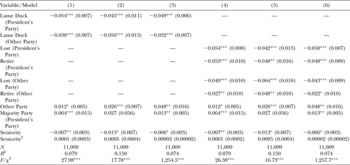
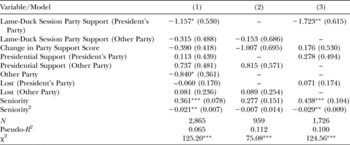
Results are presented in Table 1, in the first three columns. We conduct a pooled, cross-sectional time series on all members from the 45th through 72nd Congresses who possessed party support scores in both sessions of a Congress. The first column is a basic ordinary-least squares (OLS) regression model with Congress-specific (i.e., session-pair) fixed effects. This represents the most common specification to test for evidence of shirking in the literature.Footnote 57 Columns two and three are extensions to the basic OLS model in column one and provide sensitivity analyses. The second column is an OLS model that includes member-specific fixed effects in addition to Congress-specific fixed effects, which allows us to determine if our results are sensitive to overlapping memberships across Congresses.Footnote 58 The third column is a heteroskedastic regression model, rather than an OLS model, that includes Congress-specific fixed effects, which allows us to determine if our results are sensitive to possible differences in roll-call agendas across various long-short session pairs.Footnote 59
Examining Differences in Party Support Scores across Lame-Duck and Regular Sessions, 45th–72nd Congresses (1877–1933)

*p < .05; **p < .01; ***p < .001.
Note: The dependent variable is a member's party support score in the lame-duck session minus his or her party support score in the regular session. Columns 1 and 4 are ordinary-least squares (OLS) estimates with congress-specific fixed effects (with ordinary R 2 and F stats reported). Columns 2 and 5 are OLS estimates with Congress-specific and member-specific fixed effects (with adjusted R 2 and F stats reported). Columns 3 and 5 are heteroskedastic regression estimates with Congress-specific fixed effects (with variance-weighted R 2 and χ2 stats reported). Robust standard errors, clustered by member, appear in parentheses next to parameter estimates in each column. (Ordinary R 2 for columns 2 and 5 is 0.426. Pseudo R 2 for columns 3 and 6 is 0.652.) Fixed effects and variance effects are not reported.
If our hypothesis—that the president could sustain the loyalty of his party's lame-duck members better than congressional leaders of the other party could sustain the loyalty of their lame-duck members—holds, the coefficient on the lame-duck dummy variable for the president's party should be larger than the coefficient on the lame-duck dummy variable for the other party. In evaluating these results, we find first that there was a systematic drop-off in lame-duck support in lame-duck sessions: lame ducks of both parties were significantly less supportive than returning members of their respective parties. In fact, the decline for lame-duck members of the president's party was greater (in absolute terms) than lame-duck members of the other party in two of the three models (5.4 vs. 3.8 percent in model one and 4.9 vs. 3.2 percent in model three; the exception being model two, with 4.5 vs. 5.6 percent)—although in postestimation hypothesis tests, the relevant coefficients prove not to be significantly different from one another.Footnote 60
In models four through six of Table 1, we break out the lame-duck variable into separate components—based on whether the member retired or lost a reelection bid. We investigate this difference in lame-duck status because Norris often reserved his harshest criticisms for those members who “having been repudiated by their people, look to the man in the White House to give them jobs.”Footnote 61 Thus, reelection losers may have been most in need of executive assistance. Retirees, by contrast, might have settled on their next career opportunity already (having previously decided not to seek reelection). If so, we should observe a difference between retirees and reelection losers, with the latter more likely to have been supportive of the party in lame-duck sessions.Footnote 62 In fact, we do not find this—nominally, the coefficients are roughly the same, and postestimation tests confirm that there are no significant differences between the lost and retired dummies for the president's party across models four, five, and six. Moreover, reelection losers of the president's party exhibited declines similar to reelection losers of the other party (again, the coefficients in each model are not significantly different from one another).Footnote 63
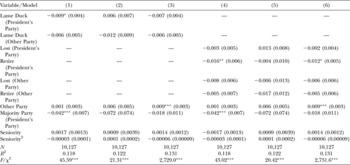
We consider whether differences in participation rates across sessions are driving the results in Table 1 by reestimating our six models using abstention-adjusted party support scores. Whereas the support scores in Table 1 were calculated on all party unity roll calls (regardless of whether members voted on them or not), the abstention-adjusted support scores are calculated on only those party unity roll calls in which members participated.Footnote 64 Thus, the denominators vary by member. This allows us to observe how members behaved when they actually voted. The results of the six models, using the difference in lame-duck and regular session abstention-adjusted support scores as the dependent variable, appear in Table 2, and are in many ways similar to those in Table 1. Lame ducks of the president's party as well as lame ducks of the other party by and large exhibited slight, but insignificant, declines in their party support (the exception being a small but significant decline by lame ducks of the president's party in the first model). And, like Table 1, there were no significant differences between the behavior of lame ducks of the president's party and lame ducks of the other party.Footnote 65 When the lame-duck variable is broken into its lost and retiring components, we again find no significant differences by exiting type across parties. We do observe, however, that the decline in support for the president's party was driven by retirees (showing significant coefficients of −1.6 and −1.2 percent in models four and six, respectively) and not by reelection losers (showing nominally negative coefficients in models four and six, and a nominally positive coefficient in model five, none of which are significant). So, when reelection losers of the president's party managed to vote, they exhibited the same cross-session support characteristics as returning members. The problem, from the perspective of majority-party leaders, was that these reelection losers simply did not vote enough.Footnote 66
Examining Differences in Abstention-Adjusted Party Support Scores across Lame-Duck and Regular Sessions, 45th–72nd Congresses (1877–1933)

*p < .05; **p < .01; ***p < .001.
Note: The dependent variable is a member's abstention-adjusted party support score in the lame-duck session minus his or her abstention-adjusted party support score in the regular session. Columns 1 and 4 are ordinary-least squares (OLS) estimates with Congress-specific fixed effects (with ordinary R 2 and F stats reported). Columns 2 and 5 are OLS estimates with Congress-specific and member-specific fixed effects (with adjusted R 2 and F stats reported). Columns 3 and 5 are heteroskedastic regression estimates with Congress-specific fixed effects (with variance-weighted R 2 and χ2 stats reported). Robust standard errors, clustered by member, appear in parentheses next to parameter estimates in each column. (Ordinary R 2 for columns 2 and 5 is 0.412. Pseudo R 2 for columns 3 and 6 is 0.261.) Fixed effects and variance effects are not reported.
Based on the results from Tables 1 and 2, which are robust across different specifications, we find that Norris's presidential-manipulation argument does not in fact work at the general level of party loyalty in Congress.Footnote 67 We do not observe that lame-duck members of the president's party remained more loyal than lame-duck members of the other party. This result also holds when we examine different types of lame ducks (i.e., losers vs. retirees). And, more generally, we find that lame ducks of the president's party were either less loyal or no more loyal than returning members of the president's party. This runs counter to the basic expectation underlying the lame-duck manipulation argument. In short, we find no evidence that lame ducks shirked toward the president, viewed narrowly as the agent of his party.
We next examine Norris's presidential-manipulation argument by focusing on the president as agent of his own interests. The president had his own set of policy preferences, which certainly overlapped with those of his party but were not identical. Moreover, the importance that the president assigned to various policies may have differed from that of congressional leaders of his party. Thus, we identify the policy stands that the president took on legislation in Congress, and examine whether his preferences were acted upon by lame-duck members hoping for an executive appointment. In this way, we investigate the degree to which the president could influence the legislative process in lame-duck sessions.
To identify those occasions in which the president took a position on legislation in Congress, and the direction of his position, we rely on the executive-request data assembled by Elaine Swift and her co-investigators.Footnote 68 To be categorized as an executive request, the matter must have been published as a presidential request to Congress in either A Compilation of Messages and Papers of the Presidents Footnote 69 or in the Congressional Record. The decision rule was purposely restrictive, erring on the side of exclusion. From the Swift et al. list, we identified the executive requests that Congress considered in lame-duck sessions and the relevant roll calls. There were a total of eighty such votes in the House from the 45th through 72nd Congresses (1877–1933), ranging from a low of zero in the 45th (1877–79), 52nd (1891–93), and 72nd (1931–33) to a high of eight in the 47th (1881–83) and 57th (1901–03).
We then estimated a series of logit models—one for each of the eighty presidential-request House roll calls—to determine whether, as Norris argued, lame-duck members of the president's party were responsive to presidential requests.Footnote 70 All roll calls were normalized so that a “1” represents a vote for the president's position and a “0” a vote against (with abstentions treated as missing data). Our primary independent variables are two dummies—for lame ducks of the president's party and lame ducks of the other party, respectively. Norris spoke often of the president's power over lame ducks of his own party, but we also examine whether his influence extended to lame ducks of the other party. We also use as covariates members' first and second W-NOMINATE scores based on votes only in the regular session.Footnote 71 These NOMINATE scores reflect members' revealed preferences before the congressional elections that led to the lame-duck session. Thus, they should not be tainted by any agency problems, and should reflect members' established policy positions (which are, to a large degree, constituency induced). This latter point will be important in determining any lame-duck effects. As Norris argued: “the country … sees these men at the demand of the President, voting contrary to the positions they have theretofore taken” (emphasis added).Footnote 72 Thus, a significant lame-duck effect is one that exists while also controlling for members' prior revealed preferences.
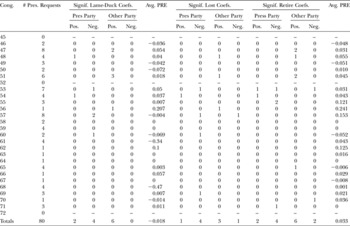
The key hypothesis is tied to the lame-duck dummy variable of the president's party. To be consistent with Norris's argument, the coefficient should be positive and significant, indicating members of the president's party eschewing former tendencies (encapsulated by the NOMINATE scores) to vote in favor of the president's request. The results of these logit estimations, by Congress, appear in Table 3, on the left-hand side. In addition to indicating significant (p < 0.05) coefficients (and the direction) for lame ducks of each party, we also present a fit-statistic measure, the Proportional Reduction in Error (PRE), to assess how much our model improves upon a simple baseline model (in this case, a basic preference-based model, using just the two regular-session W-NOMINATE scores).Footnote 73
Examining the Effect of Lame-Duck Status on Presidential Request Roll Calls, 45th–72nd Congresses (1877–1933)

Note: Cell entries are based on individual logit estimations, with first- and second-dimension regular-session W-NOMINATE scores as the covariates, along with dummy variables for lame-duck status by party (first model) and retire and lost by party (second model).
Overall, across the eighty presidential-request logits, only two displayed significant and positive coefficients for the lame-duck dummy of the president's party. Thus, in only two of eighty cases do we find lame-duck effects consistent with Norris's argument. We actually uncover more cases in the opposite direction—four of the eighty logits produced negative and significant coefficients for the lame-duck dummy of the president's party. Thus, there were twice as many cases of lame-duck members of the president's party voting against his request. We also find six cases of significant and positive coefficients for the lame-duck dummy of the other party. It thus appears that members of the other party were occasionally receptive to the president's requests.
If these results indeed reflect presidential influence in lame-duck sessions, as elaborated by Norris, then we find little evidence that such influence was pervasive. And the overall impact of lame-duck membership on roll-call voting was minimal, as indicated by the PRE statistic. The aggregate PRE (or APRE) on the eighty presidential-request roll calls was negative (−0.018), indicating the model performed worse than the simple two-dimensional W-NOMINATE model.
To ensure that we are capturing Norris's argument fully, we further unpack our lame-duck variables into their “lost” and “retired” components. As mentioned earlier, Norris often reserved his sharpest criticisms for lame-duck members who had lost their reelection bids, singling them out for their subservience to the president. And, methodologically, it is possible that the combination of the two departing types into one lame-duck variable negates significant findings, especially if the two types are pulling in opposite directions. Thus, we run another set of eighty logits, modeling vote choice as a function of the unpacked lame-duck variables by party and the two regular-session W-NOMINATE scores. The results appear in Table 3, on the right-hand side. Again, we find little evidence consistent with Norris's argument: there are five cases of significant coefficients for the “lost” dummy variable of the president's party, but only one in the correct (positive) direction. Again, there are more cases (three) of positive coefficients for the lost dummy variable of the other party. In terms of the “retired” dummy variables, there are more cases of positive coefficients for the other party (six) than for the president's party (three).
Thus, while unpacking the lame-duck variable into its component parts provides a more nuanced set of results, and generates a better overall fit with an APRE of 0.033, the general message is still the same—Norris's argument is not borne out. When executive-request roll calls are analyzed, there is little evidence that lame ducks of the president's party altered their preferences to support his initiatives. In fact, members of the other party were more inclined to do so, but even those occurrences were somewhat rare. These results suggest that the president's influence on the legislative process in lame-duck sessions was minimal.
And what of the ship subsidy bill of 1922, the measure that set Norris on his amendment crusade? Despite President Harding's strong public statements of support for the bill, the vote does not appear in the list of executive requests compiled by Swift et al. This is likely because Harding sought to publicize the matter in an address to Congress rather than in the form of a written request. However, if we subject this vote to the same sort of logit analysis, we do find that the coefficient on the lost dummy variable of the president's party is positive and significant, consistent with Norris's accusations that the bill passed on the backs of losing Republicans, possibly because of side payments made by Harding.
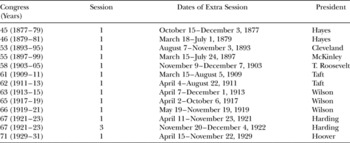
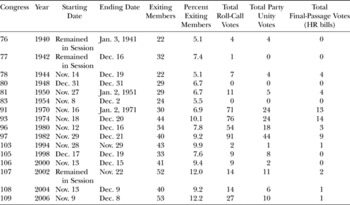
This finding is a potential concern, if there were other votes similar to the ship subsidy bill that took place but were not accounted for by our selection mechanism (the executive-request requirement). Thus, we search the 1877–1933 period for roll calls that satisfy the contextual characteristics of the ship subsidy bill; in particular, we look for roll calls in which a president took a position that were held during an extra (or “extraordinary”) lame-duck session convened by presidential proclamation. This was the political context in which the ship subsidy bill developed—it was a major issue before the 1922 midterm elections, but did not come to a vote; as a result, Harding called for an extra lame-duck session to deal specifically with the issue. Pursuant to these search criteria, we list in Table 4 all extra sessions of Congress convened by presidential proclamation between 1877 and 1933. Overall, there were thirteen extra sessions during this period, called by eight different presidents. However, only one of these thirteen extra sessions was a lame-duck session: Harding's ship subsidy bill session in 1922. The other twelve were sessions called in advance of the normal opening (regular) session of a Congress. It thus appears that the ship subsidy bill was in fact an outlier, an extraordinary case in which the president, via his proclamation power and the unique representational circumstances of the lame-duck session, attempted to wield influence. As a result, while the finding of lame-duck shirking toward the president's position on the ship subsidy bill is interesting, our previous logit results combined with our canvassing of extra sessions suggests that Norris's attempts to frame this vote as one example of a much larger pattern of presidential influence in lame-duck sessions has little empirical foundation.
Extra Sessions of Congress Convened by Presidential Proclamation, 45th–72nd Congresses (1877–1933)

Source: Official Congressional Directory, 2005–2006, 109th Congress, S.Pub. 109–12 (Washington, DC: Congress, Joint Committee on Printing, 2005), 512–27.
Last, we examine the reward mechanism in Norris's argument for presidential influence: the granting of executive appointments. In his early writing, and later in his memoirs, Norris talked about “fat executive appointments” being granted to lame-duck members who did the bidding of the president.Footnote 74 Of course, whether presidents actually used party loyalty and presidential support as decision criteria when handing out appointments is an open question, one that we set out to answer.
We examine the distribution of presidential patronage by first identifying all lame-duck House members from the 45th through 72nd Congresses (1877–1933), and then documenting whether they received an executive appointment upon their departure from Congress, using the Biographical Directory of the U.S. Congress as the main source guide.Footnote 75 Based on our coding, there were 2,865 lame-duck House members during this period who were eligible for appointment, and 273 of them (or 9.53 percent) received executive appointments.Footnote 76
With these data in hand, we estimate a logit model of presidential appointments. We incorporate a number of covariates: party support scores in lame-duck sessions (for members of the president's party and the other party, separately), the change in party-support scores across sessions, presidential support scores (again for members of the president's party and the other party, separately),Footnote 77 a dummy variable for other party, “lost” dummy variables for the president's party and the other party, and seniority (linear and squared terms). We estimate the model three different ways: on all members, and then separately on members of the president's party and members of the other party. All models incorporate Congress-specific fixed effects.
Results are presented in Table 5. Perhaps the most interesting finding is that presidential support scores were not a factor in the receipt of an appointment; that is, the probability of receiving an executive appointment did not increase significantly with higher levels of presidential support. The coefficients were in the expected direction (positive), but were not statistically significant (p < 0.573 and p < 0.154, in separate estimations for members of the president's party and the other party, respectively). Also interesting is that higher levels of party support in lame-duck sessions among members of the president's party significantly decreased the probability of receiving an appointment. When examining party-support score change across sessions, the coefficients (like those on the presidential support scores) were in the expected direction (negative for members of the other party, positive for members of the president's party), but were not statistically significant (p < 0.740 and p < 0.147, in separate estimations for members of the president's party and the other party, respectively).Footnote 78 Thus, from these results, it appears that the level of support shown for the president's party had no systematic bearing in the eventual distribution of executive appointments. By contrast, what seemed to have mattered was basic partisanship (as indicated by the significant, negative coefficient on the other party variable in the full regression), with members of the president's party given the bulk of appointments, along with seniority (the probability of receiving an appointment increased through approximately eight terms for members of the president's party, and decreased thereafter).Footnote 79
Examining Presidential Appointments, 45th–72nd Congresses (1877–1933)

*p < .05; ** p < .01; *** p < .001.
Note: Table entries are logit estimates, with robust standard errors in parentheses. Congress-specific fixed effects in each model are not reported. The difference between the N in the full model and the combined N from the two party models is due to 180 observations in the other-party model being dropped, as several Congress dummy variables predict failure perfectly.
Once again, Norris's argument does not comport with the empirical analysis. Lame-duck members who were more supportive of the president were not systematically rewarded with executive appointments. And the same holds true for members of both parties who increased their support for the president's party. In the end, presidents appear to have parceled out assignments with little nuance, rewarding partisanship and seniority generally. In this regard, presidents seem to have done the bidding of the party at large, keeping valuable, senior lame-duck party members in the political game by giving them appointments, so that they had a safe harbor until they could run for Congress or another elected post again.
In sum, we uncover little to support Norris's first argument. In separate analyses of party support, presidential support, and presidential appointments, we find no evidence to suggest that lame duck “shirking” or presidential influence in the legislative process were significant problems in lame-duck sessions.
Norris's Second Argument: Majority-Party Advantage
To examine Norris's majority-party advantage argument, we look at legislation considered on the House floor. This is because Norris based his argument specifically on the majority party's ability to take advantage of the known March 4 end date in lame-duck sessions to enact bills that the leadership desired. Thus, we limit the scope of our roll-call analysis and focus solely on final-passage votes on HR bills (House-generated bills) and conference reports across regular and lame-duck sessions of Congress.
Our level of analysis differs from the previous section, as we adopt a more macro-level perspective, focusing on the individual Congress rather than the individual member by Congress. In this regard, we follow the approach laid out by Gary Cox and Mathew D. McCubbins in their analysis of final-passage votes in the House across time.Footnote 80 To assess the majority party's success in securing the leadership's preferred legislation, we adopt a “success rate” measure, similar in spirit to Cox and McCubbins's roll rate measure. A majority-party “success” occurs when a majority of the majority party votes in favor of a bill, and the bill passes. Hence, a majority-party success rate for a given Congress measures the number of times a majority of the majority supported bills that eventually passed, as a function of all final-passage votes considered. More simply, it is the ratio of successes to final-passage votes.
Success rates provide a good way to capture the spirit of Norris's argument. Norris believed that the definite March 4 end date provided “the party machine in power almost a supreme advantage.”Footnote 81 Based on Norris's logic, with lame-duck members in need of employment assistance and returning members in need of policy assistance, party leaders should have been more successful in pushing through their preferred legislation in lame-duck sessions relative to regular sessions. Evaluating majority-party success rates across sessions provides a way to examine this conjecture.
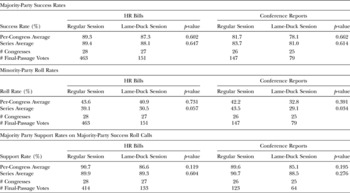
Results are presented in the first section of Table 6. We examine majority-party success rates for both HR bills and conference reports. The “per-Congress average” treats every Congress as an equally weighted observation. The “series average” is the ratio of successes to final-passage votes, aggregating over the entire time span for both the numerator and denominator without regard to the Congress in which the vote occurred.
Examining Majority-Party Agenda Power, 45th–72nd Congresses (1877–1933)

Note: In the first two subtables, the p-value in per-Congress average comparisons is generated by a two-tailed t-test for difference in means, while the p-value in series average comparisons is generated by a two-tailed z-test for difference in proportions. In the third subtable, the p-value in both comparisons is generated by a two-tailed t-test for difference in means.
As the numbers indicate, focusing on either HR bills or conference reports and using either per-Congress averages or series averages, the majority party was no more successful in lame-duck sessions than in regular sessions. In fact, the majority party was nominally more successful in regular sessions across the board, with success rates as much as 3.6 percent higher—although none of the cross-session differences are statistically significant from zero. Thus, in terms of majority-party success rates, regular sessions and lame-duck sessions were effectively equivalent, a result that runs contrary to Norris's argument.
Success rates, by themselves, may not capture the full extent of Norris's logic. If Norris was referring to the content of legislation when discussing majority-party power in lame-duck sessions, he may have been suggesting that leaders were selecting especially partisan legislation for floor consideration. For example, Norris stated: “In a general way, the party in power is able to prevent consideration of meritorious legislation and to bring up whatever it would like to see put into law.”Footnote 82 Thus, if the majority party was pushing through extreme legislation (i.e., highly partisan legislation) in lame-duck sessions, then our use of success rates may not capture this well.
To examine this potential content bias in lame-duck sessions, we incorporate minority-party roll rates.Footnote 83 A “roll” occurs when a majority of a given party votes against a bill, but it nonetheless passes. A “roll rate” is then just the ratio of rolls to final-passage votes in a Congress. We focus on minority-party roll rates, as they are most useful for indicating the existence of an extreme majority-party agenda. That is, if majority-party leaders are selecting highly partisan bills (i.e., those skewed heavily toward the interests of the majority party) in lame-duck sessions, these bills should be opposed strongly by members of the minority party. And this should lead to higher minority-party roll rates, as a majority of the minority party should vote unsuccessfully against said bills.
Minority-party roll rates across regular and lame-duck sessions, for both HR bills and conference reports, are presented in the second section of Table 6. The evidence, in fact, runs counter to Norris's conjecture, as roll rates for the minority party were higher in regular sessions than in lame-duck sessions. While the per-Congress differences were not statistically significant, the series average differences were—minority-party roll rates were 8.6 and 14.4 percent higher in regular sessions on HR bills and conference reports, respectively.Footnote 84 These results suggest that the content of legislation in lame-duck sessions was more consensual, rather than being more partisan. That is, these lower minority-party roll rates are consistent with legislation that is more majoritarian, as policy alternatives located more toward the median of the chamber rather than the majority-party extreme were chosen for floor votes.
A final direction in evaluating Norris's argument is to examine the ease with which legislation in lame-duck sessions was passed. Norris spoke of both lame-duck and returning majority-party members going along with leadership demands, in hopes of acquiring a particular discretionary payoff (in the former case, this meant a job, while in the latter case, this meant floor consideration for a pet bill). While this arrangement may not have led to higher majority-party success rates or higher minority-party roll rates in lame-duck sessions, it could have led to higher levels of majority-party support on leadership-chosen legislation generally—where “support” is defined as the percentage of individual majority-party votes in support of the party's position on a roll call, and “support rate” is defined as the average of majority-party support percentages across the set of roll calls in a session. This higher level of party support could have been useful if majority-party leaders wanted a higher likelihood that their chosen bills would pass successfully. This could have been important if majority-party leaders utilized lame-duck sessions to enact controversial legislation, such as bills that cut across the interests of majority-party members.
Party support rates on majority-party success roll calls (again, those that a majority of the majority party supported, that passed), for both HR bills and conference reports, are presented in the third section of Table 6. Like the results in the first two sections of the table, the evidence here runs counter to Norris's argument. Party support rates were in fact nominally higher in regular sessions relative to lame-duck sessions, although none of the differences are statistically significant. Thus, the level of party support on bills successfully passed by the majority party was relatively constant across regular and lame-duck sessions. These results do not support the manipulation/side-payments story that Norris articulated; majority-party members did not “remain silent” and fall in line en masse behind leadership-chosen bills in lame-duck sessions. The level of majority-party opposition across sessions was effectively the same.
Thus, on the whole, the second of Norris's two arguments receives little empirical support. Using a variety of measures and exploring a variety of angles, we uncover no evidence to suggest that majority-party leaders were able to use the known March 4 end date to the lame-duck session to systematically manipulate the agenda to their advantage.
VI. Summary and Discussion
In 1922, Sen. George W. Norris (R-NE) began a crusade for the elimination of the lame-duck (or short) session of Congress, which culminated in the passage of the Twentieth Amendment to the Constitution in 1933. The lame-duck session, which assembled after the November elections and thus was populated in part by departing members, was an artifact of decisions made early in U.S. history regarding the congressional terms of office and dates of annual convening. Norris believed that the lame-duck session introduced a serious agency problem in representation and articulated two major arguments—which we call the Norris Thesis—for its elimination.
We examined the political dynamics in the pre-Twentieth Amendment era, and the potential agency problem in representation therein, through the lens of the shirking theory literature, specifically that portion that focuses on “last-term” effects in Congress. This subliterature, which analyzes how members of Congress behave in their last legislative term prior to exiting the institution, we contended, applies directly to the Norris Thesis. That is, we argued that the political context in the pre-Twentieth Amendment era, prior to the elimination of the lame-duck session, provides the cleanest, most definitive framework to investigate possible last-term effects in Congress—much more so than any similar framework constructed by scholars to examine last-term behavior in the post-Twentieth Amendment Congress.
Norris's first argument dealt with presidential influence. Norris believed that the president could affect the legislative process in lame-duck sessions by virtue of his power of executive appointment. Since the session was populated by a number of lame ducks, many of whom had uncertain career prospects and would eagerly accept a patronage appointment, the president possessed “enormous power over legislation.”Footnote 85 Thus, by dangling executive appointments, the president could pursue a policy agenda (via executive requests) in lame-duck sessions that was biased heavily toward success. Norris's second argument dealt with majority-party agenda control. Norris believed that because the lame-duck session had a definite end date (March 4), majority-party leaders possessed a significant agenda-setting advantage, which they could use to push through their preferred legislation. Because the congressional calendar was typically overloaded with legislative initiatives in lame-duck sessions, majority-party leaders could compel party members to support their bills as a group, quickly and quietly. This would leave more time potentially for leaders to select individual members' pet bills for floor consideration before the session expired. Hence, the March 4 end date created an implicit intraparty logroll, controlled by majority-party leaders.
We examined both of Norris's arguments and constructed tests to determine their validity. Overall, we uncovered little evidence to support either argument. In terms of the first argument, we incorporated data on party support scores, presidential request roll calls, and presidential appointments to examine Norris's conjectures in full. First, we found that exiting members of the president's party remained no more loyal than exiting members of the other party (relative to returning members of their respective parties) in lame-duck sessions. Second, we found that presidential-party lame-duck status was a poor predictor of support on executive-request roll calls, when also accounting for member ideology. Third, we found that members' party and presidential support scores were not significant predictors of executive appointments. In short, evidence that lame ducks “shirked” toward the goals of the party and the president, as well as evidence that the president rewarded lame ducks' support of his (and the party's) legislative initiatives, was lacking. In terms of the second argument, we found that majority-party success rates were no higher in lame-duck sessions, while minority-party roll rates were often significantly lower. Moreover, the level of majority-party support on majority-party bills was no higher in lame-duck sessions than in regular sessions—party members did not in fact support leadership initiatives en masse. Hence, claims that the majority party possessed an agenda-setting advantage in lame-duck sessions were not borne out.
Before concluding, we discuss two issues related to our research. First, given that the Norris Thesis was not supported by our statistical evidence, we speculate about Norris's motivations and conjectures, and frame them within the larger context of institutional change in Congress. Second, we examine how our findings regarding lame-duck political behavior in the pre-Twentieth Amendment era might help us understand political behavior in the “new” lame-duck sessions that have emerged in recent years.
Why Was Norris Wrong? Thinking About Institutional Change in Congress
To reiterate, our results suggest that Norris's concerns about the agency problem in representation in lame-duck sessions appear to have been overstated. His outrage over the ship subsidy bill of 1922, which in fact was a case consistent with presidential influence, spurred him to argue that such abuses were widespread in lame-duck sessions. Our results suggest that this was not the case. So, while the decision to eliminate the lame-duck session led to an arguably better normative arrangement—with members tied electorally to their constituents throughout their tenure in a given Congress—it appears that this was a precautionary move rather than one to remedy systematic abuses.
Was Norris then simply wrong in his conjectures about last-term shirking in Congress? Or did he engage in intentional hyperbole, taking advantage of the political firestorm (and genuine evidence of lame-duck shirking) on the ship subsidy bill to ensure that a reform agenda was maintained and pushed through? It is difficult to determine the answers to these questions. As noted, our results indicate that last-term shirking was not pervasive during the period in question. That said, there are hints that some roll calls might have been tainted by lame-duck shirking (see Table 3), and there is some evidence that the president might have used his executive-appointment powers sparingly to reward lame-duck members (of both parties) who were loyal to his agenda (see the positive but insignificant coefficients on the presidential support variables in Table 5). While beyond the scope of this paper, a more intensive case-study analysis of those executive-request roll calls with significant lame-duck coefficients may be able to ascertain whether lame ducks who voted contrary to their established preferences might have later been rewarded by the president.
Thus, Norris could have been recalling the (potentially) small set of cases of genuine “representational corruption” (member shirking and subsequent presidential rewards) when making his arguments; this may have led him to overstate the pervasiveness of said corruption. Or Norris (and his progressive followers) could have simply been opportunistic, using the ship subsidy bill as a flash point to continue pushing a reform agenda, using whatever means (and arguments) necessary to do so. As Sarah A. Binder has argued, members of Congress often push for institutional reform (innovation) as a strategy to fulfill their short-term goals.Footnote 86 Such an argument, applied to this case, would suggest that Norris and his progressive followers wielded influence by advocating democratic reform initiatives, and displays of such influence were necessary (given their constituencies) to build a case for continued reelection. And, in this regard, Longworth and his conservative Republican allies could have been correct—Norris and his progressive followers might have viewed the eradication of the lame-duck session and the creation of two regular sessions as a way to generate more reform-minded policy initiatives. Such an outcome would have been normatively and instrumentally (electorally) beneficial to Norris and the progressives (and anathema to the Republican Old Guard). Viewed in this way, Norris was—per Charles Stewart III's coinage—a legislative technician, in that he did not invent the concept of using Constitutional amendments to promote reform but rather adopted and applied the concept (here, the Lame Duck Amendment) for his own benefit.Footnote 87
It may be impossible to determine Norris's actual motives. As Daniel T. Rodgers argues persuasively, progressivism, progressive thought, and progressive motives are hard to pin down, as each exhibited a good deal of fluidity (and, often, contradictions).Footnote 88 In reality, progressive motives likely ran the gambit from democratic “true believerism” to rational opportunism. That said, it might be possible to separate Norris from many of his progressive colleagues. As strong a critic of 1920s-era progressive reform as Richard Hofstader states: “the Congressional Progressives of the twenties, except for activities of a rare soul like George W. Norris and the exposure of the Teapot Dome scandal, were on the whole a fake, and many contemporaries knew it.”Footnote 89
Thus, Norris's motives may have differed from those of many other progressive members of Congress of the era. He may in fact have been an idealist, whereas others were (at least to some degree) opportunists. This latter characterization, at least, would square with his vocal leadership in political fights over the direct election of U.S. senators; the move to unicameral state legislative systems (which eventually occurred in Nebraska); various regulatory reforms in the power industry, like the Tennessee Valley Act and the Rural Electrification Act; and the elimination of the Electoral College (which never captured the electorate's attention).Footnote 90
More generally, the complexity of motives among political leaders of the time (like the progressives) is consistent with recent arguments about the bases for institutional change in Congress. As Eric Schickler writes, “Congressional institutions typically develop through an accumulation of innovations that are inspired by competing motives …”Footnote 91 In this regard, a set of mixed motives (among progressives) and adversarial motives (between progressive leaders, like Norris, and Republican regulars) might have created a set of feasible reform alternatives, from which the specific tenets underlying the Lame Duck Amendment were chosen. In addition, Paul Pierson suggests that to understand institutional change, we must move beyond basic motives and take into account contextual factors. In this case, such contextual factors would include dynamics inside and outside of Congress in the 1920s like the public controversy surrounding the ship subsidy bill, President Harding's insistence on pursuing the bill's passage in an extra lame-duck session, and the pivotal nature of the progressive Senate Republicans, who consistently passed Norris's lame-duck amendment proposal and in doing so kept the issue in the press and the heat on the Old Guard Republicans in the House.Footnote 92 Still others, like Keith Krehbiel, suggest that uncertainty exists between policies and outcomes; it is not always clear that a given institutional change will result in the desired outcome, given that information asymmetries in the policymaking process typically exist.Footnote 93 For many progressives, perhaps even for Norris, the advocacy of “reform legislation” was the primary goal; whether (and to what extent) reform legislation produced the preferred democratic outcomes was another question, and one that perhaps got lost in time, as they shifted their attention to the next reform battle that needed to be waged.
A contention made by Norris in support of the Lame Duck Amendment, unexplored in this paper, touches on this last point. In 1925, fairly early in his amendment crusade, Norris argued that the elimination of the lame-duck session would lead to the end of filibusters in the Senate:
A filibuster can never be successfully waged unless the time for adjournment is definitely and irrevocably fixed. We therefore find filibusters taking place in the short session of Congress, when by constitutional limitation the Congress must adjourn at noon on the fourth day of March. If the time were unlimited, no filibuster would ever be attempted and would be a failure if it were attempted … There would be no necessity, if this amendment were agreed to, for Congress to adjourn on the fourth day of March. There would be no session of an old Congress after an election has taken place selecting a new Congress. There would be no limitation on the adjournment and, hence, no possibility of a filibuster succeeding. The filibuster would disappear because there would be no ground upon which it could operate.Footnote 94
This argument clearly proved false. Filibustering in the Senate continued after the passage of the Twentieth Amendment. And, in the last several decades, the use of filibusters has increased substantially. This particular point supports Pierson's claims about the influence of environmental changes in Congress. The increasing acceptance that filibusters may be used for non-controversial legislation has led to changes in the institution of the filibuster itself.Footnote 95 Put simply, Norris did not forecast accurately how the Senate would adjust to the uncertainty in the new post-amendment environment. In fact, despite not having a “hard” deadline in place, as the March 4 constitutional end date provided, obstructionist members would come to realize that they could look ahead to other “softer” deadlines (the January start of the second [regular] session, and the November elections on the back end of the second [regular] session) to force the hand of Senate leaders, and threaten to gum up the works until their demands were met or cloture could be invoked.Footnote 96
Finally, given that agency theory holds that elections are critical to keeping members of Congress responsive to constituents, why in fact do we find no systematic evidence of last-term shirking? Here, we rely upon the work of Keith T. Poole, who contends that “members of Congress die in their ideological boots.”Footnote 97 Poole argues that nearly all members of Congress enter the institution with a well-established ideology already in place, and they maintain that ideology throughout their careers. Poole attributes this ideological stability to members maintaining a consistent view of what “good” politics actually is (a form of “integrity”) and believing that “people are suspicious of those who change their minds, especially about something as fundamental as what is good in politics” (a form of political pragmatism).Footnote 98 Thus, based on Poole's argument, lame-duck members in the pre-Twentieth Amendment Congress eschewed shirking toward the president's positions in their last terms of office because of either ideological integrity (i.e., they disagreed with the president on those issues) or pragmatic foresight (i.e., they planned to run for office again, and did not want to be viewed as a “presidential supplicant”), or perhaps both.
Lame-Duck Sessions of Congress: Then and Now
As stated in the Introduction, our analysis also has a contemporary application. In recent years, a “modern” lame-duck session has emerged, as members of Congress occasionally reconvene after the November elections to finish off remaining legislative matters on the second-session docket. Since the passage of the Twentieth Amendment in 1933, there have been sixteen such instances of modern lame-duck sessions in Congress. And many of these have occurred recently, in six of seven Congresses since 1994. Do we know much generally about modern lame-duck sessions? And what can our investigation of pre-Twentieth Amendment lame-duck sessions suggest regarding what we should expect in terms of behavior in modern lame-duck sessions?
First, little research has investigated modern lame-duck sessions. A roll-call voting study in the late 1980s by John McArthur and Stephen V. Marks found that lame-duck members of Congress voted differently from returning members on the 1982 automobile domestic content bill, a protectionist piece of legislation, with lame ducks more likely to support industry (free-trade) interests.Footnote 99 More recently, a roll-call voting study by Lawrence S. Rothenberg and Mitchell S. Sanders in 2000 found that lame-duck House members were less supportive of President Bill Clinton's impeachment than returning (reelected) House members.Footnote 100 This result, however, has been challenged by Christopher N. Lawrence.Footnote 101 Finally, a study by Jeffery A. Jenkins and Timothy P. Nokken uncovered no evidence of significant party effects (measured as differences in either party pressure votes or roll rates) across regular and lame-duck sessions, and as a result argued that modern lame-duck sessions are perhaps best thought of as extensions of regular sessions.Footnote 102
The difficulty in studying modern lame-duck sessions generally is that, when they do convene, they only meet for a short time, and roll-call votes are often sporadic. Relevant information is presented in Table 7. Modern lame-duck sessions typically last less than a month and contain, on average, just over ten party unity votes and just over three final-passage policy votes. Viewed differently, only 3 percent of all party unity votes and 3.2 percent of all final-passage policy votes in Congresses since 1940 took place in lame-duck sessions. This compares to 28.6 percent and 24.6 percent, respectively, in our set of pre-Twentieth Amendment Congresses.Footnote 103 On the whole, the contingent nature of modern lame-duck sessions, and the fleeting quality of their proceedings, make systematic analysis difficult.
Post-Twentieth Amendment Lame-Duck Sessions

Note: Dates for the 83rd Congress are for the Senate, which called a lame-duck session to consider the censure of Sen. Joseph McCarthy (R-WI); the House did not convene. All other dates refer to the beginning and ending of House lame-duck sessions. Data through the 108th Congress compiled from Richard S. Beth and Richard C. Sachs, “Lame Duck Sessions of Congress, 1935–2004 (74th–108th Congresses),” (Washington, DC: Congressional Research Service, Library of Congress, 2006). Dates and roll calls for the 109th Congress were located at www.house.gov, www.voteview.com, and http://clerk.house.gov/legislative/index.html?curr_month=11&curr_year=2006.
Aside from this general problem of systematic analysis, specific difficulties also exist in pursuing a shirking-based analysis on modern lame-duck sessions. Three stand out. First, the direction of shirking is not always obvious. Unlike the pre-Twentieth Amendment era, when shirking meant members shifting their behavior away from constituents' preferences and toward the president's preferences, a number of potential directions exist in the modern era. Often members are thought to be shirking away from constituents' preferences and toward personal preferences—but other shirking permutations are possible and often discussed, such as shirking away from constituents' preferences and toward party leaders' preferences, shirking away from party leaders' preferences and toward personal preferences, and shirking away from constituents' preferences (and party leaders' preferences) and toward outside actors' preferences, such as interest groups or business firms. The interest-group/business-firm direction is quite possible, for example, as exiting members in the modern era often have lucrative opportunities available to them in the private sector, something that did not readily exist in the pre-Twentieth Amendment era. Second, even when a shirking direction is determined, measuring the underlying preferences of the relevant actors is difficult, which makes causal claims about lame-duck effects problematic. For example, in studies (like McArthur and Marks, and Rothenberg and Sanders) where shirking is portrayed as members shifting their behavior away from constituents' preferences and toward personal preferences, district-level demographic and/or economic characteristics, as well as presidential vote data, are often used as proxies for constituents' preferences, because district-level survey data rarely exist. As proxies for constituency preferences, such nonsurvey data may be quite unreliable, which makes arguments about the significance of other factors (like lame-duck status) on member behavior somewhat suspect. Third, the potential agency problem in representation in modern lame-duck sessions is of a lesser magnitude, as lame ducks constitute a much smaller percentage of the chamber. As Table 7 indicates, lame ducks comprise, on average, 8.2 percent of the overall House membership in the modern era. This compares with 30.2 percent, on average, in the pre-Twentieth Amendment (1877–1933) era.Footnote 104 As a result, the probability that exiting members can be pivotal in lame-duck session decision making (in terms of altering policy outcomes) is considerably lower in the modern era, lessening the “pull factors” (i.e., outside actors attempting to influence member behavior) that might lead to last-term shirking.
Thus, the comparability between pre- and post-Twentieth Amendment lame-duck sessions is far from perfect. So it is not obvious that our specific results regarding pre-Twentieth Amendment lame-duck sessions can easily translate to the modern era. That said, we do find generally that the agency problem in representation was not serious in the 1877–1933 period; and since the conditions for a representational agency problem are less suitable in the modern era—given the much smaller number of lame ducks—we are probably safe in assuming that fears about threats to democratic accountability and responsiveness in modern lame-duck sessions are most likely unwarranted. This claim notwithstanding, we believe that separate analyses need to be conducted to investigate modern lame-duck politics in depth, to determine how they are shaped and to what degree they may be different from (or similar to) their historical counterparts empirically. This will likely require numerous in-depth case studies, rather than systematic statistical analyses (given the issues mentioned above). We believe that such a case-study approach, while cost intensive, is worth the time and resource investment, as there is likely a large payoff to be gained. As modern lame-duck sessions have become regular events over the past decade, understanding their representational elements and the policy impacts of their proceedings should be important goals for scholars of Congress as well as the general citizenry.
Appendix 1: Sequence of Congressional Sessions and Elections, Pre- and Post-Twentieth Amendment
Pre-Twentieth Amendment

Post-Twentieth Amendment

Appendix 2: Party Unity Votes, by Session, 45th–72nd Congresses (1877–1933)

Note: A party unity vote is one in which a majority of one party opposes a majority of the other party.