Children of immigrants currently make up more than one-fifth of the child population and are projected to reach one-third by 2020 (Mather, Reference Mather2009; Suárez-Orozco & Suárez-Orozco, Reference Suárez-Orozco and Suárez-Orozco2001). Most children of immigrants come from homes where a language other than English is spoken and begin to learn English when they enter school. US schools experienced an unprecedented, 105% increase in the numbers of English language learners (ELLs) between 1990 and 2001 (National Education Association, 2005). The increase in ELLs, 80% of whom speak Spanish, has had an enormous impact on US schools, yet dual language children of immigrants remain a widely understudied and underserved population.
Of considerable concern with this large and growing population is how to properly recognize and understand normal and delayed dual language development of ELLs. Educators and specialists are often uncertain as to how to interpret low scores on standardized measures of language proficiency (Bialystok, Reference Bialystok2001; Crutchley, Reference Crutchley2000; Thordardottir, Rothenberg, Rivard, & Naves, Reference Thordardottir, Rothenberg, Rivard and Naves2006). There is a pressing need for standard, accepted guidelines to aid in the understanding of normal dual language development when using the currently available measures and normative databases recommended for assessing oral language proficiency (Thordardottir et al., Reference Thordardottir, Rothenberg, Rivard and Naves2006).
An additional and ongoing problem in understanding the development of dual language children is that children's English language proficiencies are often the only ones assessed. This renders it impossible to differentiate children who, due to impairments, may not make significant gains in either language from those who have not yet had the opportunity or the time to learn English. It is important to consider both first language (L1) and second language (L2) proficiencies, which define an individual dual language profile for each child. Therefore, understanding dual language profiles, their prevalence, how they evolve over time, and what factors may be influencing this evolution is of utmost importance.
This study aims to describe dual language proficiencies of children of immigrants by examining the prevalence of dual language profiles during their first years of schooling. We identify longitudinal change and stability of dual language profiles from kindergarten to second grade through direct assessment of language competences in a range of linguistic domains. It is important to note that we also analyze the contribution of the linguistic environments at school and home, as well as other family and child factors, to the stability and change in dual language profiles.
TYPES OF BILINGUALS
Bilingual children differ in many ways and can be characterized by multiple criteria that focus on unique aspects of ability or experience. Research on the development of bilinguals has centered on: age of acquisition (early/late), language input (simultaneous/sequential), circumstance (elective/circumstantial), social valuation (folk/elite), as well as on the relationship between the proficiencies in each language (Genesee, Paradis, & Crago, Reference Genesee, Paradis and Crago2004; Valdes & Figueroa, Reference Valdés and Figueroa1994). Second-generation immigrants, the focus of this study, typically have a first language (most often Spanish in the United States), which is acquired prior to school years, whereas the L2 is acquired later. Thus, children of immigrants are usually early, sequential bilinguals who, as a result of their immigration circumstance, must use L1 and L2 in different contexts.
Language competence is a broad and complex construct composed of organizational and pragmatic knowledge and skills used in communication (Canale & Swain, Reference Canale and Swain1980). Although the representation of language is thought to be different between bilinguals and monolinguals, the basic process of language acquisition is similar (Valdés, Capitelli, & Alvarez, Reference Valdés, Capitelli and Alvarez2011; Verhoeven, Reference Canale and Swain2007). Bilinguals often operate with varying degrees of skills in each language, influenced by conditions such as who the bilingual is speaking or listening to, and the situation, the topic, or the purpose of the interaction (Grosjean, Reference Grosjean1998). Language competence can be context-specific for dual language children. For instance, they may have stronger skills in one language when talking about a particular topic (e.g., family), but stronger skills in the other when talking about a different topic (e.g., school). Differences across languages can also be found in terms of the strength of receptive or expressive oral abilities. Although there is evidence to support the independence of multiple language systems within an individual (Genesee, Reference Genesee1989), these systems interact with each other, thus bilinguals should not be thought of as two monolinguals in one (Grosjean, Reference Grosjean1989). The descriptive term “dual language children” does not presume full proficiency in both languages, and in this way encompasses all children meaningfully exposed to two languages, allowing for the wide variability of proficiency often seen in these children (Genesee et al., Reference Genesee, Paradis and Crago2004; Gutiérrez, Zepeda, & Castro, Reference Gutiérrez, Zepeda and Castro2010).
DUAL LANGUAGE PROFILES
To better understand the unique linguistic complexities of dual language children and the typical development of their language systems, it is important to study L1 and L2 as they relate to one another in the individual child. Previous studies have focused on language dominance (Birdsong, Reference Birdsong2006; Dunn & Fox Tree, Reference Dunn and Fox Tree2009); however, determining that one language is stronger is not equivalent to determining whether functionally critical levels of proficiency in the stronger (dominant) language have been reached. A dual language child may be dominant in one language yet have limited proficiency in both as compared to monolinguals. A child with limited proficiency in both languages will encounter difficulties by not being able to meet language demands in either language. This situation draws attention to the importance of characterizing dual language profiles with consideration to both language dominance and level of dual language proficiency. A taxonomy of dual language profiles identifies children with age-appropriate proficiency in both L1 and L2 (dual proficient bilinguals), children with age-appropriate proficiency in only one of their languages (English proficient or Spanish proficient), and children with limited proficiencies in both of their languages (Baker, Reference Baker2006; Cummins, Reference Cummins1977; Tabors, Paez, & Lopez, Reference Tabors, Paez and Lopez2003; Verhoeven, Reference Canale and Swain2007). Although it is rare for anyone to be equally proficient across all linguistic contexts and domains, high proficiency in two languages is possible (Rosenberg, Reference Rosenberg1996). More common is for bilinguals to be dominant in one language; however, the particular configuration of language dominance varies widely (Valdes & Figueroa, Reference Valdés and Figueroa1994). Although the tendency has been to view dominance as a generally stable condition, the dominant language of an individual often varies over time (Döpke, Reference Döpke and Döpke2000) and across contexts (Baker, Reference Baker2006). Thus, a developmental perspective on dual language profiles should consider changes over time and the contribution of contextual and individual factors to these changes.
DETERMINING DUAL LANGUAGE PROFILES
Assessing dual language proficiencies is a remarkably difficult task, and it is not always clear how the results should be interpreted in regard to appropriate developmental expectations (Thordardottir et al., Reference Thordardottir, Rothenberg, Rivard and Naves2006). Although there is a lack of consistency (Grosjean, Reference Grosjean1998) and there are no generally accepted practices used in determining language profiles (Flege, MacKay, & Piske, Reference Flege, MacKay and Piske2002), some important conceptual and empirical progress has occurred in the past decade (Bedore & Pena, Reference Bedore and Pena2008; Tabors et al., Reference Tabors, Paez and Lopez2003; Verhoeven, Reference Canale and Swain2007) that allows for more standardized methods. Methods have included interviewer ratings of fluency (Genesee, Nicoladis, & Paradis, Reference Genesee, Nicoladis and Paradis1995); vocabulary tests (Pearson, Fernández, & Oller, Reference Pearson, Fernandez and Oller1993); surveys of language history and use (Portes & Rumbaut, Reference Portes and Rumbaut2001); and measurement of word reaction time, association, and order judgments (Dunn & Fox Tree, Reference Dunn and Fox Tree2009; Gollan, Fennema-Notestine, Montoya, & Jernigan, Reference Gollan, Fennema-Notestine, Montoya and Jernigan2007; Kohnert, Bates, & Hernandez, Reference Kohnert, Bates and Hernandez1999; Ricciardelli, Reference Ricciardelli1992), yet these types of tasks are not always feasible or appropriate. Perhaps the most widely used method in determining language profiles is through self-reports of language ability and use (see Dunn & Fox Tree, Reference Dunn and Fox Tree2009). The accuracy of parent and self-reports of language proficiency is highly variable, especially in regard to young children. Although some studies have found an association between self-reports and more objective or direct measures of language ability, the correlation generally tends to be low (Bahrick, Hall, Goggin, Bahrick, & Berger, Reference Bahrick, Hall, Goggin, Bahrick and Berger1994; Delgado, Guerrero, Goggin, & Ellis, Reference Delgado, Guerrero, Goggin and Ellis1999). In studies that aim to investigate the intricacies and complexities of language proficiency in school-age children, direct assessments, when possible, are preferable to self-reports because of their reliability, accuracy, and precision.
Recent studies investigating dual language development have used standardized measures of language proficiency normed with monolinguals of each respective language (Oller & Eilers, Reference Oller and Eilers2002; Páez, Tabors, & López, Reference Páez, Tabors and López2007; Proctor, Carlo, August, & Snow, Reference Proctor, Carlo, August and Snow2005). Although there are no widely accepted standardized assessments of dual language proficiency normed exclusively with bilingual children, parallel measures of language proficiency are available in multiple languages. Dual language children with a regular and rich exposure to both languages exhibit developmental patterns and milestones in the acquisition of linguistic structures similar to those found in monolinguals (Genesee et al., Reference Genesee, Paradis and Crago2004). Therefore, it can be informative to assess each language of dual language children using procedures that are based on the monolingual sequence of acquisition (Thordardottir et al., Reference Thordardottir, Rothenberg, Rivard and Naves2006; Verhoeven, Reference Canale and Swain2007). Standardized scores of language assessments normed with monolingual populations can also be used as a reference point in the assessment of dual language children and as a reasonable indicator of age-appropriate language proficiency (Thordardottir et al., Reference Thordardottir, Rothenberg, Rivard and Naves2006). Standardized assessments of academic language skills that have been normed on monolingual children provide a reference to the level of proficiency typical among the general population and necessary to meet the linguistic and educational demands of an average school environment (Hakuta, Butler, & Witt, Reference Hakuta, Butler and Witt2000). Nevertheless, dual language children in the transitional process of language acquisition do not always perform consistent with the monolingual norm of these measures (Junker & Stockman, Reference Junker and Stockman2002; Pearson, Fernandez, & Oller, Reference Pearson, Fernandez and Oller1993; Valdes & Figueroa, Reference Valdés and Figueroa1994) due to the “distributive” nature of dual language acquisition where certain linguistic features and domain-specific competences are acquired in one language but not the other (Oller, Pearson, & Cobo-Lewis, Reference Oller, Pearson and Cobo-Lewis2007).
The use of standardized measures of proficiency in dual language children permits researchers and educators to apply a degree of objectivity when considering the L1 and L2 in relation to each other, but the results must be interpreted with consideration of the points previously raised. Previous studies using language proficiency measures to investigate dual language profiles in young children of immigrants (Tabors et al., Reference Tabors, Paez and Lopez2003; Verhoeven, Reference Canale and Swain2007) have shown that dual language children often enter school with a variety of dual language profiles.
CHANGES IN DUAL LANGUAGE PROFILES
Standardized assessments also offer the advantage of objectively measuring the development of proficiencies across languages and over time. Although the patterns and milestones of language development are often similar in monolingual and dual language children, the rate of acquisition may vary in dual language children (Bedore & Pena, Reference Bedore and Pena2008). The rate of acquisition of each language is highly dependent on multiple factors, including language input (Gathercole & Thomas, Reference Gathercole and Thomas2009; Pearson, Fernandez, Lewedeg, & Oller, Reference Pearson, Fernandez, Lewedeg and Oller1997; Verhoeven, Reference Canale and Swain2007); the level of proficiency distributed across the two languages (Junker & Stockman, Reference Junker and Stockman2002; Oller et al., Reference Oller, Pearson and Cobo-Lewis2007; Pearson, Fernandez, et al., Reference Pearson, Fernandez and Oller1993); and other child, family, and societal factors (Toppelberg & Collins, Reference Toppelberg and Collins2010). Sequential bilingual children in early stages of dual language development are likely to have language skills that are in flux (Cummins, Reference Cummins1981; Hakuta et al., Reference Hakuta, Butler and Witt2000). This results from a division of time between languages and the varying amounts of exposure necessary to acquire the vocabulary and structures to reach age-appropriate levels of proficiency (Gathercole & Hoff, Reference Gathercole, Hoff, Hoff and Shatz2007). Although there is substantial evidence of leveling in proficiencies across languages for children with regular and rich exposure to both languages (Genesee et al., Reference Genesee, Paradis and Crago2004), the specific conditions that lead to this parity are not fully clear (Gathercole & Thomas, Reference Gathercole and Thomas2009). Many dual language children, and particularly those who do not receive rich language exposure, may not become fully competent in both languages. When dual language children enter school they often continue to develop the L2 but suspend development of the L1; this is especially true in cases where the L1 is socially devalued or a minority language not widely used outside the home (Genesee et al., Reference Genesee, Paradis and Crago2004; Kohnert, Yim, Nett, Kan, & Duran, Reference Kohnert, Yim, Nett, Kan and Duran2005).
LINGUISTIC ENVIRONMENT AND CHILD AND FAMILY FACTORS ASSOCIATED WITH DUAL LANGUAGE PROFILES
A number of environmental factors may contribute to linguistic variability among dual language children. Research on the language development of children of immigrants requires an ecological approach which takes into account the linguistic environment as well as other familial and child factors (Albert, Tabor Connor, & Obler, Reference Albert, Tabor Connor and Obler2000), as language abilities are highly influenced by a constellation of contextual, social, and child factors (Cummins, Reference Cummins1979; Fishman, Reference Fishman1977). The linguistic environment at the home (including factors such as home language use and maternal L1 and L2 proficiencies); the linguistic environment at school (including factors such as language of instruction, school language use, and classroom practices); as well as other family (e.g., maternal education, birth order, and child to adult ratio) and child factors (such as nonlinguistic cognitive abilities and gender) have been shown to be predictive of dual language development (Genesee, Reference Genesee1989; Páez et al., Reference Páez, Tabors and López2007; Pearson et al., Reference Pearson, Fernandez, Lewedeg and Oller1997; Thordardottir et al., Reference Thordardottir, Rothenberg, Rivard and Naves2006).
More specifically in regard to the home linguistic environment, maternal language abilities contribute to large variation in children's vocabulary growth (Pan, Rowe, Singer, & Snow, Reference Pan, Rowe, Singer and Snow2005). Children in stimulating environments experience more rapid language development (Tamis-LeMonda, Bornstein, & Baumwell, Reference Tamis-LeMonda, Bornstein and Baumwell2001). For dual language children, the amount of exposure and input of L1 and L2 at home is closely associated with children's language preference, dominance, proficiency, and usage (Genesee et al., Reference Genesee, Paradis and Crago2004; Hakuta & Pease-Alvarez, Reference Hakuta, Pease-Alvarez, Extra and Verhoeven1994).
The school and its linguistic environment also play a crucial role in the development of children's L1 and L2 (Páez et al., Reference Páez, Tabors and López2007). For the majority of children of immigrants in the United States, substantial exposure to the L2 does not begin until they enter school. Virtually all US school programs include some amount of English language instruction (Saunders, Foorman, & Carlson, Reference Saunders, Foorman and Carlson2006), but programs for ELLs use varying degrees of L1 and English (see Brisk, Reference Brisk and Hinkel2005). Program types range from using English exclusively (mainstream English), tailoring English to support and increase comprehension (structured/sheltered immersion programs), to programs where literacy and content-area instruction are delivered in both L1 and L2 (bilingual/two-way immersion programs). The educational support of L1 does not typically delay or limit the development of L2 (Collier, Reference Collier1995; MacSwan & Pray, Reference MacSwan and Pray2005). The development of both L1 and L2 is dependent upon the level of language support and exposure in the various environments of the child.
Other family and child factors, which are consistent developmental predictors for all children, often play unique roles in language minority children (Garcia Coll et al., Reference Garcia Coll, Lamberty, Jenkins, McAdoo, Crnic and Wasik1996; Suárez-Orozco & Carhill, Reference Suárez-Orozco, Carhill, Yoshikawa and Way2008). In the general population, first-born children and girls typically develop vocabulary more quickly than later-born children and boys (Bauer, Goldfield, & Reznick, Reference Bauer, Goldfield and Reznick2002; Hoff-Ginsberg, Reference Hoff-Ginsberg1998). Girls in Latino immigrant families also outperform boys in vocabulary development (Duursma et al., Reference Duursma, Romero-Contreras, Szuber, Proctor, Snow and August2007; Reese, Garnier, Gallimore, & Goldenberg, Reference Reese, Garnier, Gallimore and Goldenberg2000). Portes and Schauffler (Reference Portes and Schauffler1994) found that Latina girls are more likely than boys to retain their home language as they often take on more family-oriented responsibilities, thereby increasing their exposure to and the linguistic demand in the L1 (Portes & Hao, Reference Portes and Hao1998; Suárez-Orozco & Suárez-Orozco, Reference Suárez-Orozco and Suárez-Orozco2001). In addition, first-born children generally develop and maintain their L1 more than their younger siblings do (Yamamoto, Reference Yamamoto2001). In terms of socioeconomic status (SES), children from lower SES typically have lower language skills and smaller vocabularies (Arriaga, Fenson, Cronan, & Pethick, Reference Arriaga, Fenson, Cronan and Pethick2008; Hoff, Reference Hoff2003). Children from higher SES gain higher levels of language proficiency than do children from lower SES, who are less likely to have an age-appropriate command of either L1 or L2 (Worthy et al., Reference Worthy, Rodriguez-Galindo, Czop, Martinez and Cuero2003). Children's cognitive functioning is linked to their language proficiency in both L1 and L2 in at least two possible ways: cognitive capacities may facilitate language acquisition, and cognitive benefits may result from levels of bilingual proficiency above certain critical thresholds (Cummins, Reference Cummins1977).
THE PRESENT STUDY
The primary aims of the present study are to investigate dual language profiles and their prevalence in Latino children of immigrants and the change and/or stability of these children's dual language profiles from kindergarten to second grade. Our study investigates overall oral language proficiencies in Spanish and English identified as central in oral communication in academic settings (August, 2003; Gottlieb, Reference Gottlieb2006). In addition, systematic examinations are performed of the contributions of contextual, family, and child factors to cross-sectional dual language profiles and to profile change and stability over time.
Research questions
Research question 1 (RQ1): What are the prevalent language profiles of dual language children during their first years of schooling?
Previous research has shown that dual language children enter school with wide variability in their L1 and L2 proficiencies (Tabors et al., Reference Tabors, Paez and Lopez2003; Verhoeven, Reference Canale and Swain2007). We propose that children's dual language proficiencies can be characterized by dual language profiles. We propose that these include competent profiles, such as dual proficient, English proficient, and Spanish proficient, and low-performing profiles, which we label borderline proficient and limited proficient. We report the cross-sectional prevalence of these dual language profiles.
Research question 2 (RQ2): Are factors in the home and school linguistic environment and other family and child factors associated with dual language profile groups in kindergarten and second grade?
We expect that factors from the home but not the school linguistic environment will be associated with dual language profile groups at kindergarten, as the majority of children have had little exposure to the school linguistic environment by this point. At second grade we expect that factors from both home and school linguistic environments will be associated with dual language profile groups. Other family and child factors (maternal education, birth order, gender, nonverbal IQ) are expected to be consistently associated with dual language profile groups at both kindergarten and second grade.
Research question 3 (RQ3): This questions includes two parts: (a) How do children's dual language profiles change from kindergarten to second grade, and (b) are kindergarten profiles predictive of second grade profiles?
We further characterize longitudinal dual language profiles as they evolve from kindergarten to second grade, and we determine prevalence of these longitudinal profiles in our sample of Latino children. In addition, we analyze the significance of change/stability in dual language profiles from kindergarten to second grade. Based on prior literature of dual language development (Kohnert et al., Reference Kohnert, Bates and Hernandez1999; Páez et al., Reference Páez, Tabors and López2007; Tabors et al., Reference Tabors, Paez and Lopez2003), we expect the lowest-performing profiles to be relatively stable, such that early limited proficient profiles will be predictive of later limited proficient profiles, perhaps as a reflection of these children's language learning difficulties and environments. In contrast, we expect positive change in the remaining profiles, with early borderline proficient profiles being predictive of later proficient profiles, and early proficient profiles being predictive of later dual proficient profiles.
Research question 4 (RQ4): Are factors in the home and school linguistic environment factors and other family and child factors associated with change and stability in dual language profiles from kindergarten to second grade?
We expect that factors in both the home and school linguistic environment and other family and child factors will be associated with longitudinal dual language profiles and changes/stability from kindergarten to second grade.
Methods
Participants
The present study draws from data collected as part of a larger, longitudinal study of Latino dual language children (N = 228) and their immigrant parents recruited from urban, public schools in the Boston area. Demographic characteristics of our sample were similar to those of northeastern urban immigrant populations who are primarily from Spanish-speaking areas of the Caribbean (US Census, 2010). Included in the present study are all children who were assessed in both Spanish and English at kindergarten and second grade (N = 163). This subset represents 71% of the full sample. Preliminary analyses revealed no systematic group differences in language performance between children who completed language assessments at both time points and those who were assessed only at kindergarten.
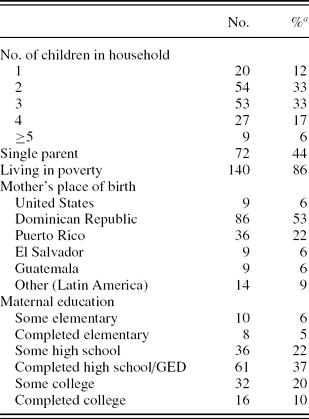
Children's mean age was 6 years, 1 month (6;1) in kindergarten and 8;1 in second grade. All of the children in the study were born in or arrived in the United States prior to age 3 and were first language speakers of Spanish whose mothers, families, and/or caregivers communicated mostly or only in Spanish. For each child, at least one parent is a first generation Latino immigrant, that is, born in Puerto Rico, Dominican Republic, or other Latin American country and currently residing in the United States. The majority of mothers (94%) were born outside the continental United States. Only children who had heard primarily Spanish during their whole life and were sequential bilinguals, with little or no exposure to English prior to age 3 were included in the study. Severe developmental disorders such as autism, aphasia, or other severe sensorimotor sequelae of neurological trauma or disorder (paralysis, deafness, blindness) were exclusion criteria. Demographic data is presented in Table 1.
Family demographics

aTotals may not add to 100 because of rounding.
Procedures
Participants were recruited from 15 urban, public primary schools with high populations of Spanish-speaking immigrant children. After receiving Institutional Review Board, district, and principal approval, student information from school enrollment lists was used to determine potential eligibility based on children's home language. Potential participants and their caregivers were sent a recruitment letter explaining the study, and then a phone call was made to confirm eligibility and willingness to participate. Upon obtaining verbal and written parental informed consent, children were assessed in three sessions of 45 min each conducted at the school on three separate days, in most cases within 2 weeks. Children's language abilities in both languages were assessed, on two separate sessions on separate days, by native speakers of Spanish and English. Language assessments were counterbalanced during each phase so that half of the sample was assessed first in Spanish (L1), and the other half was assessed first in English (L2); there were no significant differences in the language outcomes or demographic variables based on testing order. Children's cognitive competence was assessed during a third session, using a nonverbal intelligence test. Parent interviews were conducted at home by trained bilingual researchers to collect information on home, family, and sociodemographic variables. Parents were free to choose the language of the interview at any time and, as a result of their preferences, most interviews were conducted in Spanish. Teachers from 39 kindergarten classrooms reported on classroom characteristics and their teaching practices. All of the classrooms had students from English- and Spanish-speaking homes, but they differed with respect to instruction program type. Children were distributed across the various programs with an average of four participants in each classroom. Classroom observations were conducted by research assistants at the end of the school year.
Measures
Oral language proficiencies for each language were measured using the Woodcock Language Proficiency Batteries—Revised (WLPB-R; Woodcock, Reference Woodcock1991; Woodcock & Muñoz-Sandoval, Reference Woodcock and Muñoz-Sandoval1995) during separate sessions for English and Spanish. The WLPB-R measures specific linguistic domains of language skills and is considered one of the best available measures of academic oral language proficiency related to school achievement (Hakuta et al., Reference Hakuta, Butler and Witt2000). Four oral, individually measured test scores (memory for sentences, picture vocabulary, listening comprehension, and verbal analogies) were combined to yield an oral language cluster score, which is a global measure of general language proficiency (see Woodcock, Reference Woodcock1991, for cluster score method). Memory for sentences is a mixed expressive–receptive measure of syntactic and semantic proficiency in which the child is asked to repeat words, phrases, and then whole sentences of increasing length that contain a rich variety of grammatical morphemes and syntactic structures. Children must repeat a sequence requiring deployment of both working memory resources and syntactic and semantic competence in order to memorize and repeat sentences. Picture vocabulary is a measure of expressive vocabulary involving the naming of items represented as pictures on a single word level. Listening comprehension is a measure of syntactic and semantic proficiency, where the child listens to increasingly complex sentences or passages and is asked to provide the word that is missing at the end of the sentence or the passage. Verbal analogies is a measure of semantics, where the child is asked to comprehend and verbally complete a logical word relationship that increase in difficulty.
The WLPB-R was used to assess L1 and L2 oral proficiencies and determine dual language profile groups. The WLPB-R has been widely used in empirical studies in educational settings as a measure of language proficiency (Páez et al., Reference Páez, Tabors and López2007; Proctor et al., Reference Proctor, Carlo, August and Snow2005; San Francisco, Carlo, August, & Snow, Reference San Francisco, Carlo, August and Snow2006; Vaughn et al., Reference Vaughn, Linan-Thompson, Mathes, Cirino, Carlson and Pollard-Durodola2006) and in relation to academic achievement (Genesee et al., Reference Genesee, Paradis and Crago2004) and subsequent success in school (Dickinson & Sprague, Reference Dickinson, Sprague, Neuman and Dickinson2001). It has published validity, reliability, and norms for ages 2;0 to 90+ in English and Spanish. The WLPB-R yields W scores, standard scores, percentiles, and grade and age equivalents; the present study uses W and standard scores. Woodcock and Muñoz-Sandoval (Reference Woodcock and Muñoz-Sandoval1995) provide normative data from more than 6,000 participants collected in more than 100 US communities. Norms for the Spanish form were derived from 3,911 native Spanish-speaking individuals from 22 countries (with 1,325 from the United States and 1,512 from Mexico) and are equated to those of the English form. The WLPB-R demonstrates strong psychometric properties (Kirby, Reference Kirby1995) and reliability coefficients for both forms ranging from .84 to .92 across all age ranges (Woodcock & Muñoz-Sandoval, Reference Woodcock and Muñoz-Sandoval1995).
The linguistic environments of two different settings (school and home) were measured at kindergarten. School linguistic environment was measured through teacher questionnaires and classroom observations using the Classroom Quality and Language Use Checklist (Tabors & Paez, Reference Tabors and Paez2001a) and the Language and Culture Questionnaire (Tabors & Paez, Reference Tabors and Paez2001b). At the outset of this study, the state had recently instituted an “English only” policy; however, many of the schools had received a waiver to continue using Spanish and English in the classroom. Surveys and direct observation were used to measure the languages used in the schools and during instruction. Instruction type was determined by teacher reports of classroom instruction and classified as
1. mainstream English programs where all instruction was delivered in English;
2. English instruction with support such as English as a second language, structured, or sheltered techniques; and
3. bilingual programs where instruction was provided in both the children's primary languages (i.e., Spanish) and English.
School language use was rated on a Likert scale based on researchers’ direct observations of language use between teachers, support staff, and children at school. A high level of interrater reliability was demonstrated (α = 0.90), and Cronbach alpha coefficients were calculated to estimate the internal consistency between the indicators of school language use (α = 0.93). A mean score of language use was calculated and, due to positively skewed results, corrected for analyses using log10 transformation (0 = English only, 1 = Spanish only). Teacher practices were determined by teachers’ responses to 16 items from the Language and Culture Questionnaire that measures whether teachers’ beliefs and practices regarding the education of language minority students are aligned with best understanding and practices in the field (1 = poor, 4 = best); a mean score is used. Sample items include: “I include materials, such as books, pictures, toys, and labels, that reflect the cultures and languages of all the children in the classroom”; “I plan activities in my classroom so bilingual children can participate fully”; “I ask bilingual parents to provide a few key words in their home language so I can use them with their children in my class.”
Home linguistic environment was measured through parent reports of home language use between the child and family members using the Language and Literacy Use (Tabors & Paez, Reference Tabors and Paez2001c). Cronbach alpha coefficients were calculated to estimate the internal consistency (α = 0.84). A mean score of the language use items was calculated, and, due to negatively skewed results, it was corrected for analyses using Log10 transformation (0 = English only, 1 = Spanish only). Maternal language proficiency in English and Spanish was measured through direct assessment using the WLPB-R listening comprehension subtest described above.
Other family factors were collected from primary caregivers (mothers, for the most part) who responded to several questionnaires regarding demographic information using questions from the Methods for the Epidemiology of Child and Adolescent Mental Disorders study (Goodman et al., Reference Goodman, Hoven, Narrow, Cohen, Fielding and Alegria1998). Maternal education was recorded using ordinal scores to indicate the highest level of schooling completed by mothers (elementary only, partial or complete high school, college degree, etc.) ranging from 0 (none) to 12 (MA/PhD). For birth order, each child was assigned a numerical value (1 = first-born, 2 = second-born, etc.) The child to adult ratio was determined by dividing the number of children by the number of adults in the household. All related and unrelated individuals living in the household under age 18 were counted as children; those older than 18 were counted as adults.
For child factors, cognitive abilities were measured with the Universal Nonverbal Intelligence Test (UNIT; Bracken & McCallum, Reference Bracken and McCallum1998), a standardized battery administered and completed without the use of oral language. Instructions for this test are entirely pantomimed, and participants respond by either pointing or recreating a visual stimulus using manipulatives provided by the examiner. The UNIT has been widely used in the cognitive assessment of children whose test performance may be affected by language impairment or L2 barriers. The UNIT's standard battery comprises four subtests: spatial memory, analogic reasoning, cube design, and symbolic memory, whose scores can be combined to yield age dependent quotients. The full scale intelligence quotient standard score is used in the present analyses (normed mean = 100, SD = 15). Extensive studies have examined the UNIT's reliability yielding alphas from 0.91 to 0.94 for internal consistency and 0.78 to 0.91 for test–retest reliability for the full scale scores; internal validity among the four scales of the standard batteries were consistently high with coefficients above 0.90. The UNIT has strong concurrent validity with many other measures of intelligence. Gender was dummy coded with males assigned a value of 1 and females assigned a value of 0.
Data analysis
Dual language profiles cutoff criteria
Dual language profiles were conceptually constructed based on previous literature (Baker, Reference Baker2006; Tabors et al., Reference Tabors, Paez and Lopez2003; Valdes & Figueroa, Reference Valdés and Figueroa1994; Verhoeven, Reference Canale and Swain2007), taking proficiencies in both languages into account and in consideration of language expectations in academic settings. Children's L1/L2 proficiency at kindergarten varied widely (see scatterplots, Figure 1 and Figure 2). Conceptually derived cutoffs were applied to the standard scores to create meaningful and parsimonious categories. A commonly used approach is to view age-appropriate performance in normed tests as that which falls within ±1 SD of the mean standard score (SS; 100). Thus, a cutoff level of 1 SD below the normed mean (<85 SS) is considered a minimum level to be considered proficient in the academic language measured with the WLPB-R. Using this cutoff, a score of at least 85 SS was considered a reflection of proficiency in either English or Spanish. Following this logic, a child with both English and Spanish proficiencies ≥85 SS was considered “dual proficient.” Some children demonstrated proficiency in one language but not the other: a child with an English score of ≥85 SS and a Spanish score of <85 SS was considered to be “English proficient” (and vice versa for “Spanish proficient”).
Scatterplots and cutoff criteria of dual language profiles in kindergarten. [A color version of this figure can be viewed online at http://journals.cambridge.org/aps]
Scatterplots and cutoff criteria of dual language profiles at second grade. [A color version of this figure can be viewed online at http://journals.cambridge.org/aps]
Considering the unique language differences typical among dual language children, we took a conservative approach to make the limited proficiency category as educationally and clinically relevant, by using a cutoff score of 2 SD below the norm (≥70 SS). Such a low language proficiency in both languages is strongly indicative of experiencing academic and other developmental difficulties. Children who had proficiencies ≥70 SS in both languages were considered “limited proficient.”
These criteria circumscribe a fifth “gray-area” category, “borderline proficient,” characterized by children with proficiency in at least one of their languages that is not far below the cutoff level (above 70 SS but below 85 SS). A few children did have scores close to the determined cutoff levels. Due to the potential long-term clinical and educational consequences of using classification approaches as the one just discussed, and the extended time necessary for children to build dual proficiencies, we felt it necessary to include a category that accounts for this developmental uncertainty and the possibility that less extremely low proficiency levels may be transient and potentially lead to normal, functional levels over time. The borderline proficient category draws attention to the marginal scores and alerts researchers and practitioners to children who may fit this language profile over time. Dual language proficiencies are often in an emergent stage at the time children enter school. Thus, some of the children in the borderline proficient profile group may need additional time, language exposure, and targeted intervention to become competent in one or even both languages (Pearson & Fernandez, Reference Pearson and Fernandez1994).
The children in the sample were then classified in longitudinal change/stability groups with consideration to their dual language profiles in both kindergarten and second grade. The longitudinal groups were labeled based on whether children became or remained language competent, including those who became or remained dual proficient; remained English proficient; became English proficient; remained Spanish proficient; became Spanish proficient; or remained in the low-performing, borderline, or limited proficient groups.
Preliminary analyses of all study variables were conducted with measures of central tendency and variability, and transformations were computed as discussed above, in preparation for further analyses. Language profiles were determined as described above.
Prevalence for each of the cross-sectional dual language profiles at kindergarten and second grade were calculated as a percentage of the total sample (RQ1). Analyses of variance (ANOVAs) and chi-square tests were used to analyze, separately at kindergarten and second grade, between-group differences of the dual language profile groups in home, school linguistic environment and other family and child factors measured at kindergarten (RQ2). Prevalence for each of the longitudinal dual language profiles were computed as percentages of the total sample (RQ3a). Contingency tables were used to investigate change and stability in dual language profiles from kindergarten to second grade. Associations between kindergarten and second grade language profiles were analyzed using Fisher's exact tests that are appropriate for smaller sample sizes and compute probability by using an exact hypergeometric distribution to determine the significance of associations (RQ3b). Finally, ANOVAs and chi-square tests were used to analyze between-group differences in home, school linguistic environment and other family and child factors across longitudinal dual language profile groups (RQ4).
RESULTS
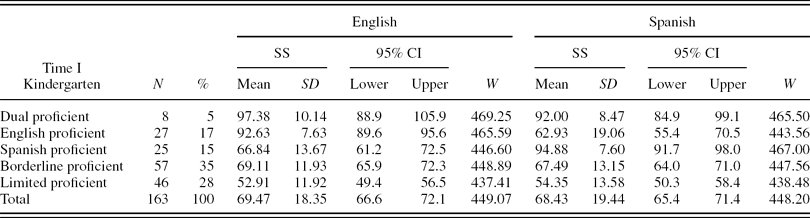
Demographic data is summarized in Table 1 and discussed above in the participant section. Descriptives for the WLPB-R oral language cluster scores for the total sample as well prevalence and descriptive data for each of the cross-sectional dual language profile groups are presented in Table 2 and Table 3. Overall, at kindergarten, the mean scores for both English (M = 69.47, SD = 18.35) and Spanish (M = 68.43, SD = 19.44) were both well below the normed mean 100 SS. Below-average performance on measures of language proficiency is typical in dual language children when compared to monolingual norms and has been reported in studies of similar populations using the same measures (Oller & Eilers, Reference Oller and Eilers2002; Páez et al., Reference Páez, Tabors and López2007) and is further discussed in this study.
English and Spanish proficiencies of dual language profiles groups at kindergarten
Note: SS, standard score; CI, confidence interval.
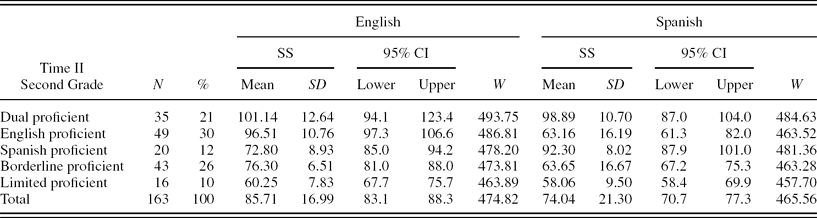
English and Spanish proficiencies of dual language profiles groups at second grade
Note: SS, standard score; CI, confidence interval.
At second grade, English mean scores were significantly higher than in kindergarten and closer to the normed average performance (M = 85.71, SD = 16.99), t (162) = 16.48, p < .001; and Spanish scores were also significantly higher (M = 74.04, SD = 21.30), t (162) = 5.17, p < .001. Overall larger gains were made in English; the SS increased by 1.04 SD in English and by 0.37 SD in Spanish. As SS reflect age-corrected proficiency, these increases were above and beyond what would be developmentally expected in a monolingual child. Change analyses using W scores (an equal interval ability scale, not normalized by age) indicated that the majority (96%) of the children experienced no loss in either L1 or L2 language ability. For the seven children (4%) who experienced loss, in each case it was in the L1 and ranged from 1 to 9 points in their W score and was a nonsignificant loss. While overall the mean scores of the sample were below the normed average, many children had scores closer to the normed mean in at least one language, as shown in Figures 1 and 2 and further described below.
In regard to the prevalence of the cross-sectional dual language profiles (RQ1), at kindergarten, the majority of children (63%) demonstrated a low-performing profile, with low proficiency in both languages and in either the limited proficient (28%) or borderline proficient (35%) groups. About one third of the children were proficient in either English (17%) or Spanish (15%). Very few children (5%) were dual proficient bilinguals at kindergarten. In contrast, at second grade, overall, children had developed significantly higher proficiencies, and the sample had a different distribution of profiles using the same WLPB-R standard score cutoff criteria. Overall, the majority (63%) of children had competent language profiles, with proficiencies above the threshold level of 85 SS in one or both languages (dual proficient = 21%, English proficient = 30%, and Spanish proficient = 12%) indicating movement from kindergarten to second grade toward the upper-right quadrant on the scatterplots (Figures 1 and 2). Prevalence of low-performing profiles decreased from 63% to 36% (borderline proficient from 35% to 26%; limited proficient from 28% to 10%), and about half of the children in the second-grade borderline profile group were in the limited proficient group in kindergarten.
Linguistic environment and other factors associated with dual language profiles
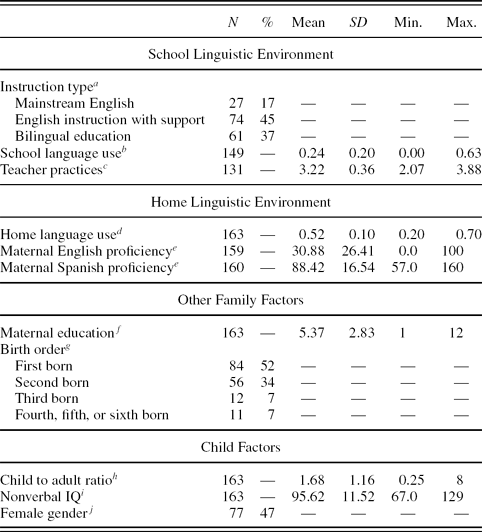
Descriptive data for the home and school linguistic environment and other family and child factors are presented in Table 4. Children were in classrooms with various instruction types ranging from English-only programs (17%), English instruction with support (62%), and bilingual programs (38%; mostly two-way immersion programs where L1 and L2 instruction was split 50:50). School language use varied, ranging from only English (0) to mostly Spanish (0.63). While the mean score was 0.22 (“mostly English” spoken), more than 75% of the children attended schools where at least some Spanish was used. Teachers, on average, demonstrated a good understanding of best practices for teaching language-minority students (M = 3.2; 1 = poor to 4 = best).
School and linguistic environment and other child and family factors: Descriptives
Note: Each variable was measured at kindergarten.
a1 = mainstream English, 2 = English with English as a second language support, 3 = bilingual education.
bThe language used in schools among teachers, students, and support staff ranging from 0 = only English to 1 = only Spanish.
cTeacher beliefs and practices regarding the education of language minority students ranging from 1 = poor to 4 = best.
dThe language used in the home between adults and children ranging from 0 = only English to 1 = only Spanish.
eThe Woodcock Language Proficiency Batteries—Revised listening comprehension score (normed mean = 100, SD = 15).
fOrdinal scores ranged from 0 = none to 12 = MA/PhD.
gEach child was assigned a value of 1 = first-born, 2 = second-born, and so forth.
hThe number of children divided by the number of adults in the household.
iUNIT full scale intelligence quotient (normed mean = 100, SD = 15).
j1 = male, 0 = female.
Home language use between adults and children ranged from mostly English (0.08) to mostly Spanish (0.70) with a M score of 0.51 and with more than 70% of the children coming from homes where Spanish was used predominantly across all dyads. While all of the children in the study came from Spanish-speaking homes, the amount of Spanish spoken varied across the different home dyads (adult to child, child to adult, child to child). No homes spoke “only” English. Maternal language proficiency, which was measured using the listening comprehension tests of the WLPB-R, was low in English (M = 30.88) on average but highly variable (SD = 26.41), whereas Spanish maternal proficiency was generally higher on average (as would be expected) and within the low-average range (M = 88.42, SD = 16.54).
Maternal education was generally low, with one third of mothers having not completed high school. The majority of children in the families were first-born (52%), but second-borns were also common (34%). On average, there were 1.7 children per adult in the household. There were approximately equal numbers of boys (86) and girls (77) included in the study. Children's cognitive abilities (nonverbal IQ; M = 96.62, SD = 11.52) were within the average range.
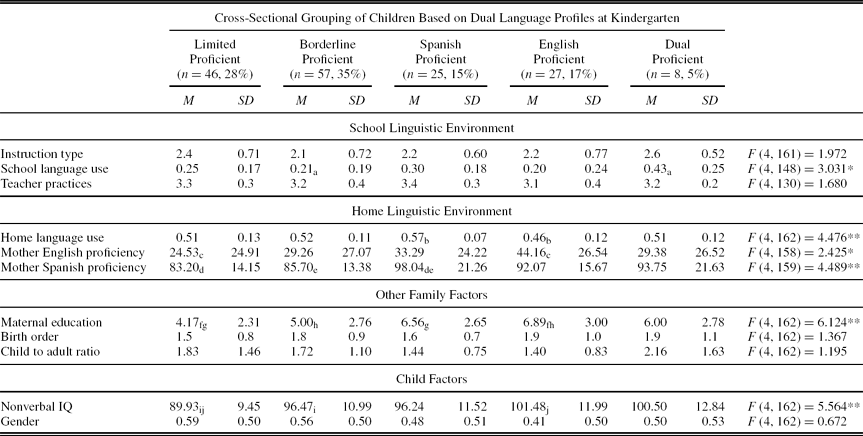
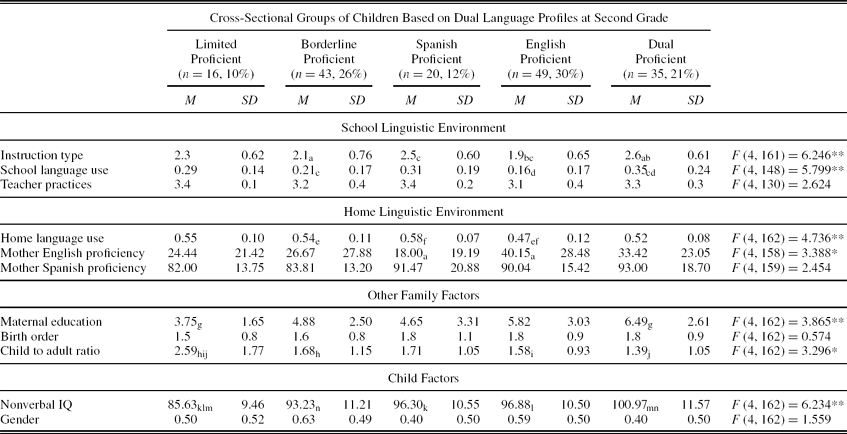
ANOVAs and chi-square tests were conducted to analyze cross-sectional and lagged differences in the home and school linguistic environment and other family and child factors across language profile groups (RQ2; Table 5 and Table 6). Significant ANOVAs were followed by Bonferroni post hoc comparisons and significant between-groups differences are noted. For the categorical variables in these analyses (instruction type and birth order), we confirmed the results of the ANOVAs with separate chi-square tests.
Contemporaneous characteristics and differences in the linguistic environment at home and school and other family and child factors across dual language profiles at kindergarten
Note: Groups that share a subscript letter for a particular variable have means significantly different from one another at *p ≤ .05 or **p ≤ .01.
Longitudinal characteristics and differences in the linguistic environment at home and school and other family and child factors at kindergarten across dual language profiles at second grade
Note: Groups that share a subscript letter for a particular variable have means significantly different from one another at *p ≤ .05 or **p ≤ .01.
At kindergarten (see Table 5), only one school linguistic environment variable was significantly different across the dual language profile groups: school language use F (4, 148) = 3.031, p < .05; with Spanish being used more with the dual proficient group (M = 0.43, SD = 0.25) than the borderline proficient group (M = 0.21, SD = 0.19). Instruction type and teacher practices were not significantly different across groups. In contrast, each of the home linguistic environment factors were significantly associated with kindergarten language profiles. Use of Spanish at home was more common among Spanish proficient (M = 0.57, SD = 0.12) than English proficient (M = 0.46, SD = 0.12) children, F (4, 162) = 4.476, p < .01. In terms of maternal language proficiency, on average, higher English proficiency was found in mothers of English proficient children (M = 44.16, SD = 26.54) than in mothers of limited proficient children (M = 24.53, SD = 24.91), F (4, 158) = 2.425 p < .05. Higher than average Spanish proficiency was found more often in mothers of Spanish proficient children (M = 98.04, SD = 21.26) than in children who were in the borderline proficient (M = 85.70, SD = 13.38) or the limited proficient groups (M = 83.20, SD = 14.15), F (4, 159) = 4.489, p < .01.
Other family and child factors were significantly different across kindergarten language profile groups. Maternal education tended to be lower in the low-performing groups F (4, 162) = 6.124, p < .01. On average, children in the limited proficient group at kindergarten had mothers with lower levels of education (M = 4.2, SD = 2.3) than children in the English proficient (M = 6.9, SD = 3.0) and Spanish proficient (M = 6.6, SD = 2.6) groups; and children in the borderline proficient group had mothers with lower education (M = 5.0, SD = 2.8) than children in the English proficient group. Of note, nonverbal intelligence tended to be lower in children who were in the limited proficient group (M = 89.93, SD = 9.45) than in children in the borderline proficient (M = 96.47, SD = 10.99) and English proficient (M = 101.48, SD = 11.99) groups. Birth order, child to adult ratio, and gender were not found to differ significantly across language profile groups.
A second set of ANOVAs and chi-square tests (with the same independent variables used in the analyses of kindergarten profiles) was conducted with second-grade profiles to analyze differences in linguistic environments at home and school and other family and child factors measured at kindergarten (Table 6). In contrast to the analyses of kindergarten profile groups, instruction type contributed significantly to second-grade dual language profiles. Dual proficient and Spanish proficient children tended to be in bilingual classrooms; English proficient and limited proficient children were more likely to be in English with support classrooms; and borderline proficient children were more likely to be in mainstream English classrooms χ2 (8, 162) = 25.034, p < .001. Similar to kindergarten, Spanish was used more in schools of children who were dual proficient (M = 0.35, SD = 0.24) than schools of children who were borderline proficient (M = 0.21, SD = 0.17), or English proficient (M = 0.16, SD = 0.17), F (4, 148) = 5.799, p < .01. Spanish was used more in homes of children who were Spanish proficient (M = 0.58, SD = 0.07) or borderline proficient (M = 0.54, SD = 0.11) than in homes of children who were English proficient (M = 0.47, SD = 0.12), F (4, 162) = 4.736, p < .01 at second grade. Children who were English proficient at second grade had, on average, mothers with higher English (yet still low) proficiency (M = 40.15, SD = 28.48) than those children who were Spanish proficient (M = 18.00, SD = 19.19), F (4, 158) = 3.388, p < .05.
Other family and child factors measured at kindergarten were also considered in relation to children's second-grade language profiles. The level of maternal education at kindergarten was lower for children in the second-grade, limited proficient group (M = 3.8, SD = 1.7) than children in the dual proficient group (M = 6.5, SD = 2.6), F (4, 162) = 3.865, p < .01. Higher average ratios of children per adults were found in the homes of children in the second-grade, limited proficient group (M = 2.6, SD = 1.8) than in the homes of children in the borderline proficient (M = 1.7, SD = 1.1), English proficient (M = 1.6, SD = 0.9), and dual proficient (M = 1.4, SD = 1.1) groups F (4, 162) = 3.296, p < .05. In terms of cognitive factors, children who were in the limited proficient group in second grade tended to have lower nonverbal intelligence in kindergarten (M = 85.63, SD = 9.46) than children who were Spanish proficient (M = 96.30, SD = 10.55), English proficient (M = 96.88, SD = 10.55), and dual proficient (M = 100.97, SD = 11.57); cognitive abilities in kindergarten were also significantly lower among children in the second-grade borderline proficient (M = 93.23, SD = 11.21) compared to the dual proficient group.
Longitudinal groups of children based on changes in dual language profiles from kindergarten to second grade
By second grade, most children (63%) changed their dual language profile, whereas 37% remained within the bounds of the same dual language profile. Based on stability and change of dual language profiles from kindergarten to second grade, children in the sample were classifiable in one of the following longitudinal groups (RQ3a): became or remained dual proficient (23%), remained English proficient (10%), became English proficient (20%), remained Spanish proficient (4%), became Spanish proficient (9%), and remained low performing (34%).
Kindergarten dual language profiles as predictors of change/stability of second-grade dual language profiles
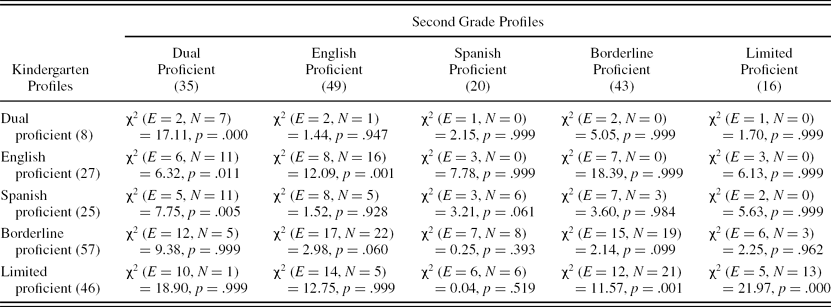
The significance of change/stability in children's dual language profiles between kindergarten and second grade (RQ3b) was systematically addressed using Fisher exact tests. Each profile at kindergarten and second grade was dummy coded and compared using contingency tables. One-sided p values of each cell where the total number was larger than the expected count demonstrated that the change/stability was significantly more likely to occur (Table 7). Children in the dual proficient group at kindergarten were most likely to remain dual proficient in second grade, χ2 (E = 2, N = 7) = 17.11, p = .000. Children who in the English proficient group at kindergarten were most likely to remain English proficient, χ2 (E = 8, N = 16) = 17.11, p = .000 or become dual proficient in second grade, χ2 (E = 6, N = 11) = 6.32, p = .011. Children who were in the Spanish proficient group at kindergarten were most likely to become dual proficient, χ2 (E = 5, N = 11) = 7.75, p = .005, and at a marginally significant level, to remain Spanish proficient, χ2 (E = 3, N = 6) = 3.21, p = .061 in second grade. Children who were in the borderline proficient group at kindergarten were most likely to become English proficient, χ2 (E = 17, N = 22) = 2.98, p = .060, or remain borderline, χ2 (E = 15, N = 19) = 2.14, p = .099, at a marginally significant levels. Children who were in the limited proficient group at kindergarten were most likely to remain in the limited proficient group, χ2 (E = 1, N = 13) = 21.97, p = .000, or be in the borderline proficient group, χ2 (E = 12, N = 21) = 11.57, p = .001, at second grade.
Fisher exact tests of change/stability in dual language profiles from kindergarten to second grade
Factors contributing to change/stability in dual language profiles from kindergarten to second grade
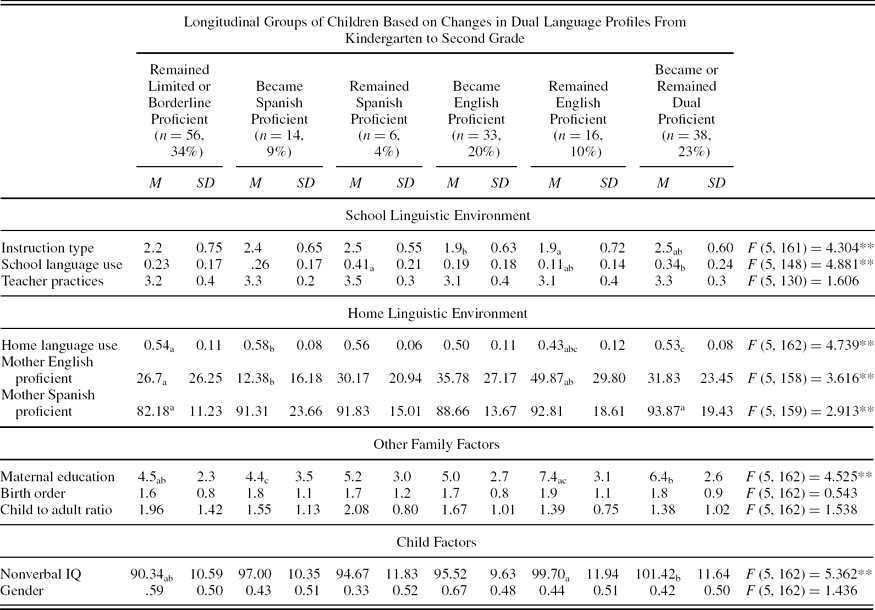
In order to investigate RQ4, a third set of chi-square tests and ANOVAs and post hoc comparisons was conducted to examine the associations of home and school linguistic environments and other family and child factors with change/stability in dual language profiles from kindergarten to second grade (i.e., longitudinal dual language profile groups discussed above; Table 8). Children who became or remained dual proficient and children who remained or became Spanish proficient, or remained borderline or limited proficient tended to be in bilingual classrooms; children who remained or became English proficient tended to be in mainstream English or English with support classrooms, χ2 (10, 162) = 24.335, p < .01. Use of Spanish at school was higher on average for children who remained Spanish proficient (M = 0.41, SD = 0.21) or became or remained dual proficient (M = 0.34, SD = 0.24) than for children who remained English proficient (M = 0.11, SD = 0.14), F (5, 148) = 4.881, p < .01. The use of Spanish at home was higher on average for children who remained or became dual proficient (M = 0.53, SD = 0.08), became Spanish proficient (M = 0.58, SD = 0.08), or remained in the limited proficient or borderline proficient groups (M = 0.54, SD = 0.11) than for children who remained English proficient (M = 0.43, SD = 0.12), F (5, 162) = 4.739, p < .001.
Characteristics and differences in the linguistic environment at home and school and other family and child factors across longitudinal dual language profiles groups
Note: Groups that share a subscript letter for a particular variable have means significantly different from one another at *p ≤ .05 or **p ≤ .01.
Teachers reported whether children received speech/language pathology services in kindergarten and/or second grade. Twenty-nine of the 163 children in the sample (18%) received speech/language pathology intervention at kindergarten (N = 7), second grade (N = 12), or in both grades (N = 10). Very few children in the low-performing kindergarten groups received services: 8 of the 57 in the borderline proficient (14%) and 16 of the 46 in the limited proficient (35%) groups. Receiving services was not significantly associated for children who were in a low-performing group at kindergarten (N = 103) and changed to a competent group by second grade (N = 47). Only 6 of the 24 low-performing children receiving services became proficient in one or both languages in second grade.
Children who remained English proficient had mothers, on average, with higher, albeit still low, English proficiency (M = 49.87, SD = 29.80) than children who became Spanish proficient (M = 12.38, SD = 16.18) or remained in the limited proficient or borderline proficient groups (M = 26.7, SD = 26.25), F (5, 158) = 3.616, p < .001. Children who became or remained dual proficient had mothers, on average, with higher Spanish proficiency (M = 93.87, SD = 19.43) than children who remained in the limited proficient or borderline proficient groups (M = 82.18, SD = 11.33), F (5, 159) = 2.913, p < .001.
Other family and child factors contributed to children's change/stability in language profiles over time. Mothers of children who remained in the limited proficient or borderline proficient groups had, on average, lower levels of education (M = 4.5, SD = 2.3) than those of children who became or remained dual proficient (M = 6.4, SD = 2.6) or remained English proficient (M = 7.4, SD = 3.1). Mothers of children who became Spanish proficient had, on average, lower levels of education (M = 4.4, SD = 3.5) than those of children who remained English proficient, F (5, 162) = 4.525, p < .01. Children who remained in the limited proficient or borderline proficient groups had, on average, lower nonverbal IQ scores (M = 90.34, SD = 10.59) than children who remained English proficient (M = 99.70, SD = 11.94) or became or remained dual proficient (M = 101.42, SD = 11.64). Birth order, number of children per adult in the home, and gender were not significantly associated with longitudinal dual language profiles. Follow-up analyses comparing all first-born with subsequently born children, total number of children in the family, and single-parent families were conducted; and there continued to be no significant effect for birth order, number of children in the household, and single parenting associated with differences in dual language profiles at kindergarten, second grade, or the longitudinal profile groups.
Children in the low-performing (limited and borderline proficient) groups in kindergarten were further investigated by separating those who remained low performing versus those who became competent by second grade and analyzing differences in home, school, child, and other family and child factors of the study (instruction type, school language use, teacher practices, home language use, maternal L1 and L2 competence, birth order, child to adult ratio, nonverbal IQ and gender). The only factor that significantly differentiated children who shifted from the low-performing group to a competent group by second grade was nonverbal IQ. Children who remained low performing had significantly lower nonverbal intelligence (M = 91.17, SD = 11.21) than children who became competent by second grade (M = 97.38, SD = 9.82), F (1, 104) = 8.952, p < .01. No significant differences in the other variables considered were found.
DISCUSSION
The primary purpose of this study was to identify dual language profiles in Latino children of immigrants and to determine their prevalence and change/stability over time from kindergarten to second grade. A closely related aim was to examine home and school linguistic factors, as well as other family and child factors, associated with dual language profiles and their longitudinal evolution. With our longitudinal design, which utilized direct measures of academic oral language proficiency in both Spanish and English and multidimensional child-level analyses, we were able to gain a deeper perspective of the range of dual language profiles of children over time as well as the potential contribution the relevant factors.
At kindergarten, mean oral language performance in both Spanish and English were two standard deviations below monolingual norms. Such low performance may appear disconcerting at first sight and deserves further discussion. There are several theories as to why this may be expected. The language proficiencies of dual language children are distributed across languages, which is related to the amount of language input in each language and to differences in the contexts of language exposure (Genesee et al., Reference Genesee, Paradis and Crago2004; Peña, Gillam, Bedore, & Bohman, Reference Peña, Gillam, Bedore and Bohman2011). Thus, dual language children enter school with varying degrees of proficiencies in both languages and need time and support to develop age-appropriate skills in each language, which our findings strongly confirm. Many immigrant groups and their children face multiple risk factors and challenges such as poverty, exposure to neighborhood violence, fewer schooling options, less-experienced teachers, low levels of family education, limited access to health care, immigration stress, and discrimination (Cosentino de Cohen, Deterding, & Chu Clewell, Reference Cosentino de Cohen, Deterding and Chu Clewell2005; Hernandez, Denton, & Macartney, Reference Hernandez, Denton and Macartney2007; Toppelberg & Collins, Reference Toppelberg and Collins2010). Nevertheless, by examining child-level profiles rather than group means, our findings suggest that some children are performing close to the monolingual norm. It is important to be explicit in recognizing that these tests are normed on Spanish and English monolingual children; previous literature demonstrates that dual language children tend to perform below the monolingual norms on such measures (Oller & Eilers, Reference Oller and Eilers2002; Páez et al., Reference Páez, Tabors and López2007), and we must take care not to expect dual language children to perform as two monolinguals in one (Grosjean, Reference Grosjean1989). For these reasons, the average dual language proficiencies of the present sample are not outside of what may be expected. Furthermore, children made significant gains in both English and Spanish proficiency beyond developmental expectations, with the largest overall gains being in English competence. It is of note that the majority of children (96%) did not evidence attrition in either language, most notably Spanish. For the other 4%, there was minimal, nonsignificant language loss in the L1. These findings are contrary to other studies documenting L1 loss (Kaufman, Reference Kaufman, Ammerlaan, Hulsen, Strating and Yagmur2001; Kohnert, Yim, Nett, Kan, & Duran, Reference Kohnert, Yim, Nett, Kan and Duran2005) as dual language children often develop the L2 but suspend development of the L1 when they enter school (Genesee et al., Reference Genesee, Paradis and Crago2004; Kohnert et al., Reference Kohnert, Yim, Nett, Kan and Duran2005). The retention of Spanish proficiency in our sample is positive and could be partially because most children lived in neighborhoods with high populations of Latinos. Although language use in most of the schools in the study was dominated by English, at least some Spanish was used at all schools. Overall, Latinos tend to retain their parental language more than other US language minorities (Portes & Schauffler, Reference Portes and Schauffler1994). Some US Latino populations, especially recent immigrant groups (Estrada, Reference Estrada2001), and Caribbean Spanish-speaking immigrants (García, Evangelista, Martínez, Disla, & Paulino, Reference García, Evangelista, Martínez, Disla and Paulino1988) demonstrate higher L1 retention. Immigrants from Puerto Rico and Dominican Republic, such as those in this study, may have higher retention of Spanish due to the strong communities, proximity, and access to their home country and easy access to Spanish language media (Suarez-Orozco, Darbes, Dias, & Sutin, Reference Suárez-Orozco, Darbes, Dias and Sutin2011).
In regard to RQs 1 and 3a considering the prevalence of dual language profiles at kindergarten and second grade, we find, consistent with extant literature, that dual language children have a range of proficiencies in their L1 and L2, which change and evolve over the first years of school. It is encouraging to note that many of the children in the current study, as illustrated in Figures 1 and 2, made substantial gains in both languages, above the age-expected gains already accounted for in standard scores. Whereas at kindergarten almost two-thirds (63%) of the children displayed low-performing dual language profiles, that is, they were not proficient in either of their two languages, 2 years later the same proportion of children (64%) had competent profiles, with above-threshold proficiencies in at least one (42%) or two (21%) languages. These findings add to the literature suggesting that dual language children need sufficient time and support to fully develop in both of their languages (Hakuta et al., Reference Hakuta, Butler and Witt2000) with the percentage of children with dual proficient profiles increasing from 5% at kindergarten to 21% in second grade. Dual language proficient profiles are viewed as optimal outcomes by research that has documented that threshold levels of proficiency in both languages are associated with cognitive and academic benefits (Cummins, Reference Cummins2001), and required for full communicative access to supports and resources both at school and within the family and ethnic community (Toppelberg & Collins, Reference Toppelberg and Collins2010).
A specific aim of our study is to investigate the prevalence of dual language profiles and gain a better understanding of dual language proficiencies at school entry as well as over time. Our findings draw attention specifically to two groups of children who are at risk for having academic and other developmental challenges (Cummins, Reference Cummins1979; Toppelberg, Munir, & Nieto-Castañon, Reference Toppelberg, Munir and Nieto-Castañon2006). Of the 46 children (28%) who were in the limited proficient profile group at kindergarten, 16 (10%) were still in the limited proficient profile group at second grade. Consistently low proficiency levels in both languages (beneath the 3rd percentile of the normed population), would render meeting typical academic language demands nearly impossible. Persistent low-performing dual language profiles are likely to be risk indicators for poor learning and language-based learning disabilities. Children in the low-performing groups had significantly lower levels of nonverbal cognitive functioning possibly consistent with language learning difficulties. A cautious approach to these children would probably warrant a screening, if not full assessment, for language disabilities. These children would most likely benefit from additional language support in both languages and speech and language pathology assessment and, if clinical language delays or language impairment is documented, possibly services (Gutierrez-Clellen, Reference Gutierrez-Clellen1996; Peña et al., Reference Peña, Gillam, Bedore and Bohman2011; Restrepo, Reference Restrepo1998). Of note, most children in the borderline and limited proficient groups were not receiving speech and language services and it is unclear if they were ever screened, which is potentially concerning and consistent with a vast literature documenting that this population is underserved (Toppelberg & Collins, Reference Toppelberg and Collins2010).
Most of the children with borderline proficient profiles at second grade were either those who had been in the limited proficient group at kindergarten (n = 21; 49%) or those who remained borderline proficient since kindergarten (n = 19; 44%). Children in this low-performing group have proficiencies below the normed 16th percentile even in their strongest language and have not reached functional academic proficiency in either language even after 2 years of US public schooling. Therefore, a borderline proficient profile at second grade is also an indicator of educational concern. As children in this group are not making necessary gains in either language to reach a functional level in the academic context, they would probably also require further evaluation for language delay and language-based learning difficulties and additional language support in both languages.
There was substantial change in children's dual language profiles during their first years of school. Most children (63%) changed their dual language profile, and most children had a competent profile by second grade. We identify the most common changes based on children's dual language profile at kindergarten. Children with competent profiles at kindergarten remained competent and in most cases gained additional competences in L1 and L2. Low-performing children who were in the borderline proficient group at kindergarten were most likely to become English proficient or remain in the borderline group. Children who were in the limited proficient group at kindergarten were most likely to remain in the limited proficient group or be in the borderline proficient group. These findings indicate that while many children who are low performing at kindergarten may become competent with adequate language exposure and support, children who are still low performing at second grade give cause for great concern and are at an academic disadvantage.
Children in this study were selected by rigorous eligibility criteria resulting in a sample with demographics and backgrounds similar to those of Spanish-speaking families living in areas with large Latino concentrations in the northeast United States, with predominantly low levels of income and education. Despite these characteristics, they entered school with remarkable variability in dual language abilities. To investigate early factors potentially responsible for this variability, we addressed RQ2 and RQ4 by examining the contribution of specific factors to dual language profiles. These factors, as measured in kindergarten, included characteristics of the home and school linguistic environments and other family and child factors identified in prior literature as predictive of children's dual language development. Unlike prior literature, however, our study considers these factors as predictors of dual language profiles at two time points, kindergarten and second grade, as well as predictors of change/stability of dual language profiles over time.
As children entered kindergarten, only one factor in the school linguistic environment, school language use, differed across groups of children with different dual language profiles; there was, on average, more Spanish spoken in the schools attended by children with dual proficient profiles than in those attended by children in the borderline proficient group. There were no significant differences in instruction type and classroom practices among kindergarten language profile groups. Overall, the limited role of the school linguistic environment could be understood as children having only recent and thus limited exposure for the school environment factors to become efficacious. An alternative explanation, given the short time, is a selection effect where certain families send children to schools where Spanish is more commonly spoken. In clear contrast, home linguistic factors (home language use and maternal Spanish and English proficiency) were consistently related to children's language profiles at kindergarten and second grade. Mothers’ years of education and language ability were both strongly associated with children's dual language profiles at both time points as well as with change/stability, which is discussed in detail below.
For second-grade profiles, factors at kindergarten in the home linguistic environment were again predictive of children's dual language profiles, whereas another school linguistic factor in addition to school language use (instruction type) was also predictive. Children with dual proficient profiles were more likely to be in dual language (two-way bilingual) programs and to attend schools where more Spanish was used between adults and children. This coincides with a large literature suggesting a sustained, positive effect on the development of the L1 and L2 when young children are educated in their primary language and English (Thomas & Collier, Reference Thomas and Collier1995). A longitudinal study of preschoolers from low-income, Spanish-speaking homes evidenced greater gains in both Spanish and English language abilities in children who attended high-quality bilingual schools when compared to the control group of children who attended English-only schools (Winsler, Diaz, Espinosa, & Rodriguez, Reference Winsler, Diaz, Espinosa and Rodriguez1997).
The contribution of the home linguistic environment was also suggested in our analyses of longitudinal change/stability in dual language profiles from kindergarten to second grade. Mother's level of Spanish proficiency was significantly lower for children who remained in the limited proficient or borderline proficient groups than for children who became or remained dual proficient. This finding could indicate that differences in the home linguistic environment related to the quality, rather than the amount, of language exposure are associated with the level of proficiency children attain in both languages, as all the mothers in this study communicated solely or mainly in Spanish with their children; a low maternal Spanish proficiency could result in a lower quality of language exposure and stimulation at home, which is not language specific, and relates to both the development of L1 and L2 (August et al., Reference August, Snow, Carlo, Proctor, Francisco and Duursma2006; Proctor, Uccelli, Dalton, & Snow, Reference Proctor, Uccelli, Dalton and Snow2009). This should be further investigated in future studies. A higher quality of language at the home stimulates children's linguistic development, builds metalinguistic awareness, and predicts subsequent academic and language proficiency (August et al., Reference August, Snow, Carlo, Proctor, Francisco and Duursma2006). In other studies, children living in crowded homes had less responsive parents (Matheny, Wachs, Ludwig, & Phillips, Reference Matheny, Wachs, Ludwig and Phillips1995; Wachs & Camli, Reference Wachs and Camli1991), which was found to be negatively correlated with the quality of parent to child speech (Evans, Maxwell, & Hart, Reference Evans, Maxwell and Hart1999). Finally, this theory is further supported by the finding that children who remained or became dual proficient had mothers who had higher levels of education on average than children who remained in the low-performing (limited proficient or borderline proficient) groups. Mothers with higher levels of education are likely to provide richer linguistic input and opportunities for dual language development than mothers who have lower levels of education (Hart & Risley, Reference Hart and Risley1995; Hoff, Reference Hoff2003). There was also a differential effect in that mothers of children who remained English proficient had on average higher education than mothers whose children became Spanish proficient in second grade, perhaps as a reflection of greater acculturation, access to English learning supports, and preference for English in the more highly educated families.
In contrast to previous studies (Hoff-Ginsberg, Reference Hoff-Ginsberg1998; Yamamoto, Reference Yamamoto2001), birth order and children's gender were not found to be significantly associated with children's language profiles. Birth order has previously been an indicator of language profiles as the balance of languages in the household can gradually change toward L2 as siblings introduce the L2 learned in school into the home, where more L2 use becomes possible. Latinos have demonstrated a greater probability of retaining their parental language than other language minorities (Portes & Schauffler, Reference Portes and Schauffler1994). This is often attributable to the established language enclaves of Spanish-speaking immigrants in major US cities, as such densely populated areas create higher exposure to the L1 in the community, mass media, and schools. There is an increased demand and need for the L1 in these linguistic enclaves as Spanish is spoken in banks, supermarkets, and restaurants, also serving as a validation of immigrants’ culture, language, and community. Living in communities with high proportions of Spanish speakers could have an equalizing effect, lessening the effect of gender and birth order on dual language development. Moreover, considering the young age of children in the present study, they may be less likely to be engaged in language brokering, an activity consider to be partially responsible for the effect of birth order and gender on dual language development.
This study adds to the literature in at least four ways. First, our study determines dual language profiles based on direct assessment of children's oral language proficiency using a measure with strong psychometric properties (WLPB-R), which summarizes multiple oral domains and modalities of each language of particular relevance to academic settings. The WLPB-R allows for accurate comparisons of L1 and L2 proficiencies within individuals and across groups within our cohort, as well as across other dual language research studies.
Second, this framework is based on child-level analyses of proficiency in each language in relation to one another. There have been recent calls to researchers who study cognitive and language development to use person-centered analyses to describe qualitative differences in children in terms of their language skills (Hoff, Reference Hoff2006). Utilizing person-centered analyses, our study identifies subgroups of children with different dual language profiles. In monolingual children, language profiles have been demonstrated to be associated with later reading skills, school achievement, and mental health outcomes (Tomblin, Zhang, Buckwalter, & Catts, Reference Tomblin, Zhang, Buckwalter and Catts2000). This methodological approach is informative in that many descriptions of dual language proficiency are based on variable-centered analyses and report on the abilities of each language separately with group means (Oller & Eilers, Reference Oller and Eilers2002). By describing typical dual language profiles at the child level, we gain the perspective of the relative proficiencies of each child with consideration to each the L1 and L2. Furthermore, our use of child-centered analyses allows us to identify categories of children at multiple points in time and determine stability and change in the category membership (Laursen & Hoff, Reference Laursen and Hoff2006).
Third, our recruitment methods involved well-defined inclusion/exclusion criteria, which resulted in a sample of children from similar cultural, linguistic, and immigration backgrounds. All children are second-generation Latino immigrants from Spanish speaking homes recruited at school entry. The transition from home to school and to the early school years is considered one of the most fundamental and influential developmental periods for children (Rimm-Kaufman & Pianta, Reference Rimm-Kaufman and Pianta2000), perhaps even more important for language-minority children of immigrants as it entails entering a new culture with a unique system of rules and behaviors and a new language (Crosnoe, Reference Crosnoe2005). Our longitudinal analysis of children's language profiles offers empirical support describing normal dual language development in this population during a critical developmental period. This becomes even more important if one considers that empirical literature on oral language development in dual language children is limited. A review of studies on ELLs in the United States identified a lack of research using sound methodology on the development of dual oral language proficiency and the consideration of language use at home and school and other contextual factors (Genesee, Lindholm-Leary, Saunders, & Christian, Reference Genesee, Lindholm-Leary, Saunders and Christian2006).
Fourth and finally, our framework investigates the contribution of the home and school linguistic environment, as well as other family and child factors, on children's dual language profiles and their change over time. The results from this study could help to further examine the influence of home and school factors and why there is such a heterogeneity in the dual language proficiencies of children of immigrants.
Limitations
This study has important limitations. While many important contributions to our current understanding of dual language development can be made with the measures of language proficiency used in this study, there is arguably a high need for psychometrically sound measures of language proficiency normed on dual language children. Such good quality measures reflecting the unique and multidimensional nature of dual language development are, however, not forthcoming or easy to develop and will not likely be available in the near future (Thordardottir et al., Reference Thordardottir, Rothenberg, Rivard and Naves2006). It is thus important to interpret findings carefully when relating dual language proficiency to monolingual norms and to consider multiple aspects and domains of proficiencies that were not captured by the WLPB measure used in the current study. Methods considered in some circles to be the gold standard for measuring language proficiency, such as language sampling analysis, should be considered for future studies (Kapantzoglou, Restrepo, & Thompson, Reference Kapantzoglou, Restrepo and Thompson2012). In order to study children from similar backgrounds and experiences, this study was designed with specific eligibility criteria for participants described above. As a result, we have a sample with demographic, linguistic, and social characteristics similar to those of many children of immigrants. While this sample shares important commonalities with most Latino second generation children, our group recruited in the northeastern United States differs from Latino children in other parts of the country, such as the southwest, where Mexican-origin Latinos prevail. Attention is thus warranted before generalizing these findings to Latino groups prevalent in other US geographic areas. A third limitation of the current study is the reduced developmental window during which the children were assessed. Additional time points may have allowed for robust analytical strategies such as growth-curve modeling, possibly providing confirmation of specific language profile trajectories. This real limitation is partially offset by the great need for data on young, dual language children whose first significant contact with English occurs at kindergarten, during this important developmental transition. Future studies would be greatly strengthened by information on children's dual language proficiency in later years.
Conclusions
These findings have implications regarding our current understanding and educational guidelines in recognizing dual language development. Understanding dual language development and the patterns and rates in young, dual language children is an essential first step in implementing appropriate services for children who are frequently underserved. In this study, children entered school with a wide distribution of proficiencies in their L1 and L2, and a large proportion of these children had low-performing profiles. However, the majority of children developed above and beyond developmental expectations making major gains during the first 2 years of school and had competent profiles at second grade. While factors at both the home and school are associated with dual language profiles, more school factors are relevant to dual language profiles in second grade than in kindergarten. Home factors, especially those related to family SES and maternal language proficiency, are consistently related to children's dual language profiles at both kindergarten and second grade.
This study puts forth an informative approach to children's dual language profiles of potential utility to researchers, educators, and specialists as the profile classifications reflect differentiable levels of risk for linguistic, academic, and other developmental outcomes and specifically draws attention to children with low-performing profiles. By better identifying children with different patterns of dual language development, targeted intervention strategies supporting the development of both languages for those at risk may be deployed earlier and more efficiently. Supporting the development of L1 and L2 proficiencies at school has been shown to be beneficial to children's academic achievement (Thomas & Collier, Reference Collier1995) and school functioning as well as social and emotional well-being (Collins, Toppelberg, Suárez-Orozco, O'Connor, & Nieto-Castañon, Reference Collins, Toppelberg, Suárez-Orozco, O'Connor and Nieto-Castañon2011). The present findings offer new information aimed at the better understanding dual language children of immigrants; however, there remains the need for a large and concerted effort in this area.
ACKNOWLEDGEMENTS
This study was supported by the National Institute of Mental Health (Scientist Development K01 Grant K01MH01947 to C. Toppelberg, Principal Investigator). The authors thank the children, families, teachers, and schools that participated in the study and the reviewers for their thoughtful comments.