Isolated unilateral absence of the proximal pulmonary artery is a rare congenital cardiovascular malformation. Reference Kruzliak, Syamasundar, Novak, Pechanova and Kovacova1 Considering its pathophysiology, that is, pulmonary artery hypoplasia on the affected side and pulmonary hypertension on the non-affected side, unbalanced pulmonary flow could become a problem after surgery. We present a case of right unilateral absence of the proximal pulmonary artery with prominent left pulmonary hypertension successfully managed using single-stage reconstruction after medical treatment of pulmonary hypertension.
Case report
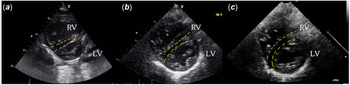
A one-and-a-half-month-old female infant was referred to our hospital and the echocardiogram revealed prominent pulmonary hypertension, pulmonary artery acceleration time to ejection time ratio was 0.17, and the left ventricle was occluded even in systole (Fig 1A). Intracardiac abnormalities were not observed. Contrast-enhanced CT demonstrated the absence of an intrapericardial right pulmonary artery. Right pulmonary circulation was supplied by the inferior thyroid artery and descending aorta. At the right hilum, the diameter of the peripheral right pulmonary artery was 4 mm, while that of the left pulmonary artery was 8.7 mm. The distance between the peripheral right pulmonary artery at the right hilum and the main pulmonary artery was 17 mm. The brain natriuretic peptide level was 3491 pg/mL. Due to prominent left pulmonary hypertension and heart failure, medical therapy was initiated. Nitric oxide inhalation, sildenafil, and macitentan were administered. Pulmonary hypertension improved in two weeks. The ventricular septum was almost straight in systole, pulmonary artery acceleration time to ejection time ratio was 0.24 (Fig 1B), and brain natriuretic peptide level decreased to 105 pg/mL. Cardiac catheterisation was performed for evaluation, and the left ventricular end-diastolic volume was 97% of normal. The ratio of right and left ventricular pressure was 0.5, and the left pulmonary arterial pressure was 33/9 (19) mmHg. At the age of two-and-a-half months (body weight 3.9 kg), single-stage reconstruction surgery of the right pulmonary artery was performed electively. The restiform ligament from the right dorsal side of the ascending aorta continued to the right pulmonary artery at the right hilum. An extension flap was created using the anterior wall of the pulmonary trunk, which was flipped over and anastomosed to the opened right pulmonary artery, making the posterior wall of the new right pulmonary artery. A fresh pericardium patch was used to make the anterior wall. Contrast-enhanced CT, performed one week after the surgery, demonstrated normal pulmonary artery branching pattern without apparent stenosis. Lung perfusion scintigraphy was R 40: L 60. Postoperative catheterisation at one month revealed good results with the main pulmonary artery pressure of 29/9 (18) mmHg while on oral sildenafil, macitentan, and oxygen inhalation. The patient was asymptomatic with oral macitentan and without oxygen therapy at 14 months postoperatively.
Pre-operative echocardiogram on admission ( a ), two weeks after medical therapy ( b ), before the surgery ( c ). (RV = right ventricle; LV = left ventricle; yellow dotted area = the ventricular septum).

Comments
Isolated unilateral absence of the proximal pulmonary artery is a rare malformation, with no consensus regarding surgical treatment. Early reestablishment of pulmonary blood flow on the affected side may allow the affected lung to develop normally and improve hypertension. Reference Kruzliak, Syamasundar, Novak, Pechanova and Kovacova1,Reference El-Hattab, Calcaterra, Parekh, Rossi, Davis and Turek2 However, unbalanced pulmonary artery flow and occlusion of the affected pulmonary artery after surgery are concerning. Therefore, the palliative procedure to grow the affected side artery has been preferred in previous studies. Reference Bilal, Yildirim, Avsar and Ozyuksel3
In our case, the patient had marked pulmonary hypertension of the non-affected left pulmonary artery at admission, and the right pulmonary artery at the right hilum was significantly small for primary anastomosis. Immediate surgery was not possible due to harmful effects of cardiopulmonary bypass during surgery, which exacerbated pulmonary hypertension on the affected side. Further, congenital hypoplasia of the affected artery contributed to pulmonary hypertension. This situation induced pulmonary hypertension crisis after surgery. Although aortopulmonary shunt was considered, unbalanced flow due to narrowing of the affected artery, possibly exacerbating pulmonary hypertension was a concern.
Finally, medication effectively decreased right ventricular pressure. Consequently, primary anastomosis was performed, and a good balance was obtained in the pulmonary blood flow. If the medication was ineffective, the alternative option should have been tried as soon as possible. In our case, we considered aortopulmonary shunt with medication for pulmonary hypertension or reconstruction of the right pulmonary artery with atrial septal defect creation.
To conclude, early surgical treatment for isolated unilateral absence of the proximal pulmonary artery is certain and acceptable. However, in cases with prominent pulmonary hypertension on the non-affected side, medication therapy for pulmonary hypertension could provide balanced pulmonary artery flow after surgical repair.
Acknowledgements
We thank Editage (www.editage.jp) for English language editing.
Conflicts of interest
None declared.
Ethical standards
Papers reporting the results of human and/or animal experimentation that do not contain an ethical standards statement will not be reviewed.