INTRODUCTION
Many species of dragonfly and land-bird migrate long distances, but most avoid crossing wide bodies of water. For example, several species of migratory dragonfly follow coastlines rather than fly out over the sea, and there are no known regular, seasonal transoceanic migrations by dragonflies (Corbet Reference CORBET2004, May & Matthews Reference MAY, MATTHEWS and Cordoba-Aguilar2008, Wikelski et al. Reference WIKELSKI, MOSKOWITZ, ADELMAN, COCHRAN, WILCOVE and MAY2006). A relatively small number of land-birds do make long ocean crossings, including several which migrate from India to their wintering grounds in eastern and southern Africa, across the western Indian Ocean (Ali & Ripley Reference ALI and RIPLEY1987, Moreau Reference MOREAU1938, Reference MOREAU1972).
In the western Indian Ocean, the Maldive Islands do not appear the most promising of locations for the study of dragonflies. All 1200 islands are small coral cays, with almost no surface freshwater, which dragonflies require to complete their lifecycles. The annual appearance of millions of dragonflies, although well known to Maldivians, is therefore something of a mystery.
The original aims of this study were to document the annual appearance of dragonflies in the Maldives and to investigate their likely origins. It soon became apparent that the dragonflies were arriving across the ocean from southern India. This then raised questions as to how they make the crossing (since the first dragonflies to arrive in October each year do so when the seasonal monsoon winds are still blowing towards India), and why they make the crossing (since the Maldives lacks surface freshwater and therefore seems an unlikely target for migrant dragonflies).
MATERIALS AND METHODS
Study area
The area covered by this study encompasses the whole of the tropical western Indian Ocean, and bordering land masses, from western India to East Africa. However, investigations were centred at Malé, the island capital of the Maldives. The Maldives is composed entirely of coral atolls, which form a chain running north-south from about 7°N to about 0.5°S, south-west of the southern tip of India. Malé lies at about 4°N. The climate of the Maldives, and indeed the entire study area, is strongly influenced by the monsoons. In the Maldives the south-west (or boreal summer) monsoon blows from about May to October, while the north-east (or boreal winter) monsoon lasts from about December to March. The Inter-tropical Convergence Zone (ITCZ) marks the boundary between these two wind systems. The ITCZ migrates north and south seasonally, following the sun, passing over the Maldives heading southwards during the November intermonsoon and northwards during the April intermonsoon.
The onset of the south-west monsoon in Maldives in May is usually marked by a period of strong wind and rain, associated with the northward passage of the Somali or Findlater Jet (Findlater Reference FINDLATER1969). It is usually only during the month of May that this seasonal, low-level (1000–2000 m) jet passes over the Maldives; in earlier months it is further south, while in later months it lies further north.
Dragonfly monitoring
Dates of first arrival of large numbers of dragonflies at Malé in October were recorded in 1983 and in every year from 1996–2008 (n = 14 y); dates of arrival of the first individuals were recorded in 1996–97 and 1999–2008 (n = 12 y). Arrival dates of dragonflies during late September to early November were recorded by local observers at other localities in Maldives and India during 2002–2008, and on three vessels at sea, in 1983 (Smith Reference SMITH1984) and 1996 (i.e. during a total of 8 y in which arrival dates were also noted in Malé). For each locality it was therefore straightforward to calculate relative arrival time in days before or after arrival in Malé. Dragonfly numbers in Malé were counted on a total of 770 d between October 2002 and September 2007 (i.e. on 42% of days), around a standard 5.2 km circuit of the island. Residency time in Malé was estimated using dragonfly numbers from 3-d periods (n = 48) during which counts were made each day, and for which there was no increase in numbers from one day to the next (which would indicate additional immigration).
Bird data
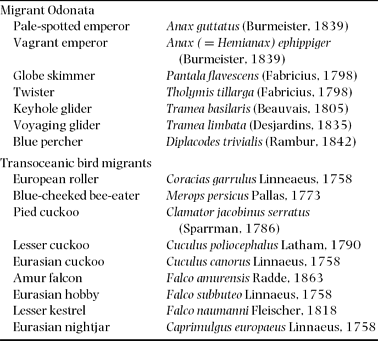
Birds that cross the western Indian Ocean include those listed in Table 1. Records of these species in the western Indian Ocean (Lakshadweep, Maldives, Seychelles and at sea) are from the literature (Anderson Reference ANDERSON2007, Skerrett et al. Reference SKERRETT, BULLOCK and DISLEY2001, and references therein), with additional information from the databases of the Seychelles Bird Records Committee and the Royal Naval Birdwatching Society.
Migrant dragonflies that occur in the Maldives (Olsvik & Hämäläinen Reference OLSVIK and HÄMÄLÄINEN1992, pers. obs.), and migrant birds that regularly cross the western Indian Ocean. An estimated 98% of dragonflies recorded at Malé are Pantala flavescens.

Meteorological information
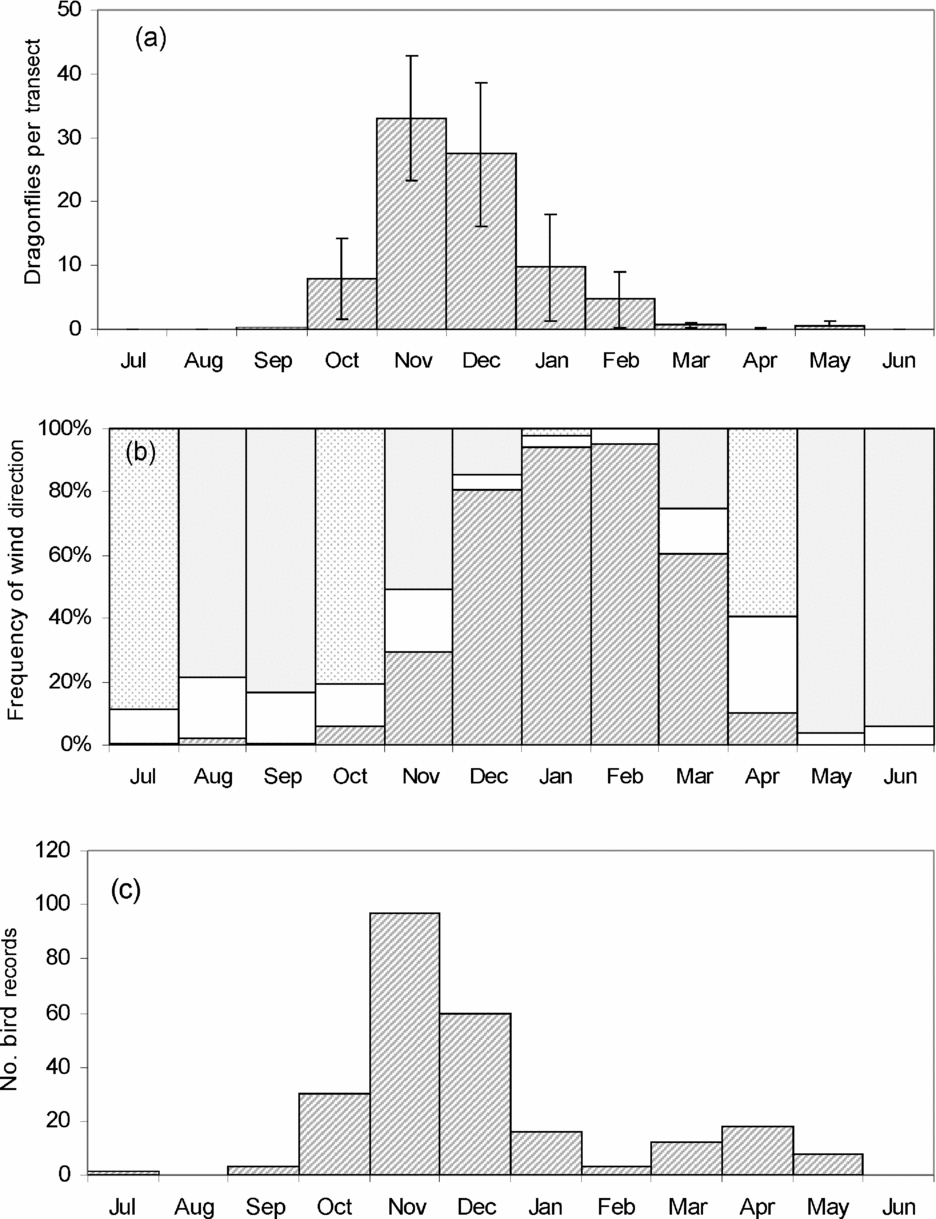
Surface wind data were provided by the Maldives Meteorological Service. Mean monthly wind direction frequencies at Malé were calculated from daily records for 2002–2006 for two sectors: north-easterly (N–E, 0°–90°) and SSW–NW (202.5°–315°). Dates of passage of the Somali Jet were estimated from daily weather records, and were considered to be periods of at least 5-d duration between late April and early June during which there was consistently lower than average mean pressure, and higher than average wind speed, rainfall, cloud cover and relative humidity.
Maldives does not have a regular radiosonde programme. However, radiosonde data were collected during the Japan Agency for Marine-Earth Science and Technology (JAMSTEC) MISMO programme (Yoneyama et al. Reference YONEYAMA, MASUMOTO, KURODA, KATSUMATA, MIZUNO, TAKAYABU, YOSHIZAKI, SHAREEF, FUJIYOSHI, McPHADEN, MURTY, SHIROOKA, YASUNAGA, YAMADA, SATO, USHIYAMA, MOTEKI, SEIKI, FUJITA, ANDO, HASE, U.K., HORII, YOKOYAMA and MIYAKAWA2008) during late 2006. Radiosonde data were collected for Hulhule (an island adjacent to Malé) from 18 October to 26 November 2006, and are freely available at: www.jamstec.go.jp/iorgc/mismo.
Regional rainfall data are from Anon. (1991). Indicative average monthly rainfall was estimated for three regions, from four rainfall stations each: western India (Ahmadabad, Hyderabad, Mumbai, Panaji), east central Africa (Dar es Salaam, Kampala, Lira, Nairobi) and south-eastern Africa (Beira, Harare, Lusaka, Zomba). Note that for East Africa, rainfall patterns are particularly complex because of topographic effects (Griffiths Reference GRIFFITHS and Morgan1969) and the averages presented here are only approximations.
RESULTS
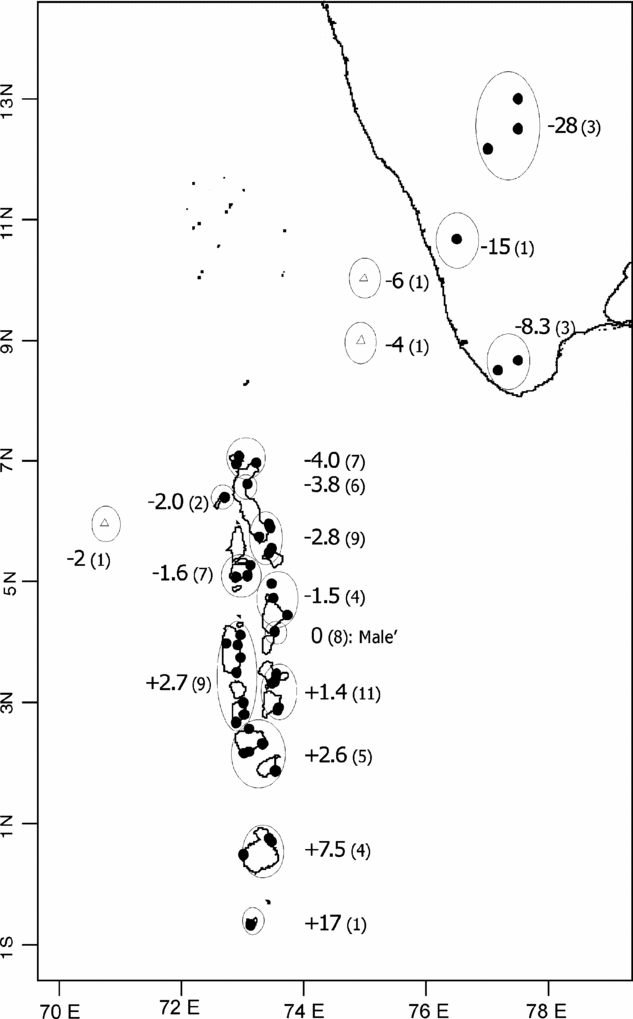
During different years of the study period, dragonflies first appeared in Malé between 4 and 23 October. Small numbers appeared initially, with large numbers appearing a few days later, usually between 14 and 28 October (in 12 out of 14 y), with 21 October being the mean arrival date. Under the 2006 JAMSTEC MISMO programme, radiosonde data collection at Malé started on 18 October (the very day that dragonflies first appeared in numbers in Malé that year). The data indicate the presence of one layer of ENE wind at 1200–2400 m (with speeds of the order of 3–4 m s−1) and another at 2900–5000 m (5–6 m s−1). Each year dragonfly numbers peaked in November–December (Figure 1a). Dates of first arrival of dragonflies at different locations in Maldives and south India are shown in Figure 2. Several species of dragonfly are involved (Table 1). The commonest was the globe skimmer or wandering glider Pantala flavescens Fabricius, which made up 98% of the total sampled in Malé; other species appeared slightly commoner on other more vegetated islands (pers. obs).
Seasonality of dragonfly occurrence, monsoon winds and bird migration. Relative abundance of dragonflies at Malé, Maldives, by month (mean ± 95% CI, October 2002 to September 2007, Σn = 770 daily counts) (a). Predominant surface wind directions at Malé, Maldives, by month (dark cross-hatching = N/E; light stippling = SSW/NW; white = other directions) (b). Relative abundance of the migratory birds listed in Table 1 in the western Indian Ocean, by month (Σn = 248 records) (c).

Map of southern India and Maldives showing average, relative arrival times of Pantala flavescens swarms during September to November (Σn = 83 observations made over 8 y). Units are days [mean (n)] relative to arrival date in Malé. Dots show sampling locations (triangles indicate observations at sea); ellipses enclose locations for which arrival dates are averaged (over sites, years or both). Scale: 2° latitude = 120 nautical miles = 222 km.

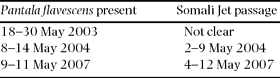
When tracked over 3-d periods, average dragonfly abundance at Malé dropped (from 100% on day 1) to 46% and then 22% on days 2 and 3 respectively. This likely overestimates residency, since any immigration of small numbers of dragonflies (less than or equal to the number emigrating) would not be detected. Considering only the four largest influxes (which accounted for 52% of dragonfly numbers in 48 influxes, and for which any subsequent immigration would likely be proportionately less significant), dragonfly numbers dropped to 40% on day 2 and just 12% on day 3. Dates of P. flavescens occurrence in April–June for the three years with the most complete data for those months, and dates of passage of the Somali Jet over Malé are noted in Table 2. Dragonfly occurrence during April–June coincided with the passage of the Somali Jet in both years during which its occurrence was clearly indicated in the available meteorological data.
Dates of main occurrence of Pantala flavescens in Malé during April–June, and of passage of the Somali Jet.

Records of migrant birds peaked during November–December (Figure 1c), and are correlated with dragonfly abundance (Kendall's rank correlation coefficient, τ = −0.68, P < 0.01).
DISCUSSION
Appearance of dragonflies in Maldives
Although surface winds are predominantly westerly during October (Figure 1b), dates of first arrival (Figure 2) strongly suggest that P. flavescens is migrating from India. There is a clear progression of first arrival dates from north to south, from south India towards Malé and on to the southern atolls. In addition, arrival dates are slightly earlier on the east of the Maldives than the west at the same latitude, hinting at arrival from the north-east rather than due north.
It is already known that, starting each September and continuing into October, P. flavescens migrate southwards in large numbers within southern India (Fraser Reference FRASER1924, Reference FRASER1936; Larsen Reference LARSEN1987). Pantala flavescens movements to the west have also been observed in southern India and Sri Lanka in September (Fraser Reference FRASER1954). If these dragonflies are indeed arriving in Maldives from India (and Sri Lanka), this would involve a sea crossing of about 600 km to Malé, and 1000 km to the southernmost islands. The first dragonflies to arrive in Malé in October invariably do so when surface winds are still from the south-west, towards India. It is not immediately obvious how dragonflies travel from India, apparently against the wind.
These dragonflies are renowned for their long-distance movements, and several have been characterized as obligate Inter-tropical Convergence Zone (ITCZ) migrants (Corbet Reference CORBET2004). In the ITCZ, winds converge, and then rise, forming clouds. Corbet (Reference CORBET1962), drawing on the locust migration studies of Rainey (Reference RAINEY1951), hypothesized that P. flavescens migrates with the ITCZ as it makes its seasonal excursions north and south, thereby taking advantage of converging winds which automatically carry them to areas where rain falls (and reproduction is possible).
In October the ITCZ moves southward (Lobert & Harris Reference LOBERT and HARRIS2002, Waliser & Gautier Reference WALISER and GAUTIER1993), across the Maldives. The ITCZ front is inclined towards the equator. Thus, while surface winds at Malé (Figure 1b) usually remain westerly until the end of October, winds north of the ITCZ (and above the front) are predominantly north-easterly. The dragonflies can thus migrate to the Maldives against the direction of the surface winds by travelling at altitude in the ITCZ.
These dragonflies are known to travel at altitude (Corbet Reference CORBET1984, Reference CORBET2004). In the case of P. flavescens, radar studies in China have detected substantial migratory movements at heights of up to 1000 m (Feng et al. Reference FENG, WU, NI, CHENG and GUO2006). Pantala flavescens occurs at particularly high altitudes in the Himalayan region (Corbet Reference CORBET2004, Vick Reference VICK1989, Wojtusiak Reference WOJTUSIAK1974), where it has been reported at up to 6300 m, the highest record for any odonate (Corbet Reference CORBET2004). The altitudes at which dragonflies may fly from India to Maldives are unknown, but suitable winds do occur at 1000–2500 m.
In the Maldives, islanders describe seeing swarms of P. flavescens ascending and descending as if to and from great altitude (although these insects are probably not visible with the naked eye at more than about 100 m). One informant, who has many years of experience as a meteorological observer, noticed large numbers of P. flavescens descending onto his island (Vilingili, adjacent to Malé) at about 1600 h local time one day in the second half of October 2008. Looking vertically upwards with binoculars he could make out descending dragonflies up to a height which he estimated to be about 1000 m (Abdul Muhusin Ramiz, Director, Maldives Meteorological Service, pers. comm.). My own observations indicate that the first appearance of dragonflies at Malé coincides with the first movements of ‘upper’ clouds (altitude unknown but by my estimate higher than 1000 m) from the direction of India, while ‘lower’ clouds continue to move from the west or south-west. For example, at Malé in 2003, both ‘lower’ and ‘upper’ clouds were moving from the south-west on 4 October. On 5 October, while ‘lower’ clouds continued to move from the south-west, ‘upper’ clouds were moving from the north-east. The first dragonfly of the season was recorded in Malé on that same day. Many more dragonflies were recorded later in October, although surface winds remained mostly westerly for nearly another month, with the first north-easterly winds at sea level not being recorded until 3 November that year. In 2006, dragonflies first appeared in numbers at Malé on 18 October. Radiosonde data from that same day indicated the presence of ENE winds at altitudes of 1200–2400 m and 2900–5000 m. Unfortunately, there are no radiosonde data from previous days.
North of the ITCZ during the north-east monsoon, air masses are transported from India to the Maldives, as studies of atmospheric pollution have clearly documented (Lelieveld et al. Reference LELIEVELD, CRUTZEN, RAMANATHAN, ANDREAE, BRENNINKMEIJER, CAMPOS, CASS, DICKERSON, FISCHER, DE GOUW, HANSEL, JEFFERSON, KLEY, DE LAAT, LAL, LAWRENCE, LOBERT, MAYOL-BRACERO, MITRA, NOVAKOV, OLTMANS, PRATHER, REINER, RODHE, SCHEEREN, SIKKA and WILLIAMS2001, Lobert & Harris Reference LOBERT and HARRIS2002). Strong sea breezes along the west coast of India lift pollutants (and no doubt also insects) up into an elevated land plume at about 1000–2500 m, where they are transported towards Maldives at speeds of about 10 m s−1 (Lelieveld et al. Reference LELIEVELD, CRUTZEN, RAMANATHAN, ANDREAE, BRENNINKMEIJER, CAMPOS, CASS, DICKERSON, FISCHER, DE GOUW, HANSEL, JEFFERSON, KLEY, DE LAAT, LAL, LAWRENCE, LOBERT, MAYOL-BRACERO, MITRA, NOVAKOV, OLTMANS, PRATHER, REINER, RODHE, SCHEEREN, SIKKA and WILLIAMS2001, Raman et al. Reference RAMAN, NIYOGI, SIMPSON and PELON2002). With such tailwinds, dragonflies might make the crossing from India to Malé in 24 h or less.
This estimate of flying time may appear at odds with Figure 2, which might seem to imply that P. flavescens take (for example) about 8 d on average to travel from the southern tip of India to Malé. But the timings in Figure 2 largely reflect the southward passage of the leading edge of the ITCZ. The ITCZ may take about 8 d to migrate south from the southern tip of India to the latitude of Malé. Only once it arrives can P. flavescens appear, but those first individuals may have left India just 1 d earlier.
The migration continues into February, but 73% of all dragonflies in Malé were recorded between 18 October and 18 December. This matches rather closely with the passage of the ITCZ. Comparison of Figures 1a and 1b shows that the occurrence of dragonflies does not correspond well with the frequency of north-east winds, which might be expected if they were being exported randomly from India, as is the case with atmospheric pollution (Lobert & Harris Reference LOBERT and HARRIS2002). Rather, the peak of dragonflies occurs during the intermonsoon period, i.e. during the passage of the ITCZ.
The appearance of the dragonflies during the intermonsoon also accords with local knowledge. In northern Maldives P. flavescens is known as hei nakaiy dhooni (which roughly translates as ‘October flyer’); this name is taken from the local calendar, hei nakaiy being the period (18–31 October) during which these dragonflies usually first appear in numbers each year. Maldivians consider the annual arrival of the dragonflies to be a harbinger of the north-east monsoon; the Maldivian saying iruvaya dhondhooni a un translates as ‘the north-east monsoon (iruvai) is about to arrive when the dragonflies (dhondhooni) come’. And finally, the popular pastime of dragonfly catching traditionally continued until 12 December, which marked the start of steady north-east winds, and the commencement of the kite-flying season. (Although many Maldivians have considerable knowledge about aspects of dragonfly biology which they can observe for themselves, I am unaware of any traditional knowledge regarding their origins or reproduction.)
To summarize so far, vast numbers of dragonflies (mainly P. flavescens) appear in the Maldives from October onwards each year. The available evidence suggests that they are arriving across the ocean from India by flying at altitude within the ITCZ.
Transoceanic dragonfly migration
The numbers of P. flavescens flying out over the ocean from India every year must be in the millions: there are 1200 islands in the Maldives; observations on several islands show that each may hold over a thousand dragonflies after a large influx; there are many influxes each season; more dragonflies may pass over or north of Maldives without stopping. This accords well with Fraser (Reference FRASER1954) who ‘observed for many years, the annual migration west of myriads of . . . Odonata belonging to the genera Pantala and Tramea. During the month of September they pass out from Ceylon [Sri Lanka] and the Western Ghats of India in a ceaseless stream of never ending millions, and none return. Is this annual migration not comparable to the periodical one of the lemmings of Scandinavia? . . . Such a prodigal waste of life . . .’
Those P. flavescens that arrive in Maldives do not appear to stay long. Large influxes are often followed by days of diminishing numbers, with counts in Malé suggesting a residence half-life of just 1 d or less before re-emigration. The reproductive status of P. flavescens arriving in Malé is unknown, but at least some are mature: a few were seen in tandem and attempting to oviposit on the shiny roofs of parked cars. A mix of mature and immature individuals has previously been reported from both the Maldives (Olsvik & Hämäläinen Reference OLSVIK and HÄMÄLÄINEN1992) and southern India (Corbet Reference CORBET1988) at the same season. Emigration may follow once the lack of suitable breeding sites becomes apparent. Whatever the reason, they are soon gone and this raises the question, where are they going?
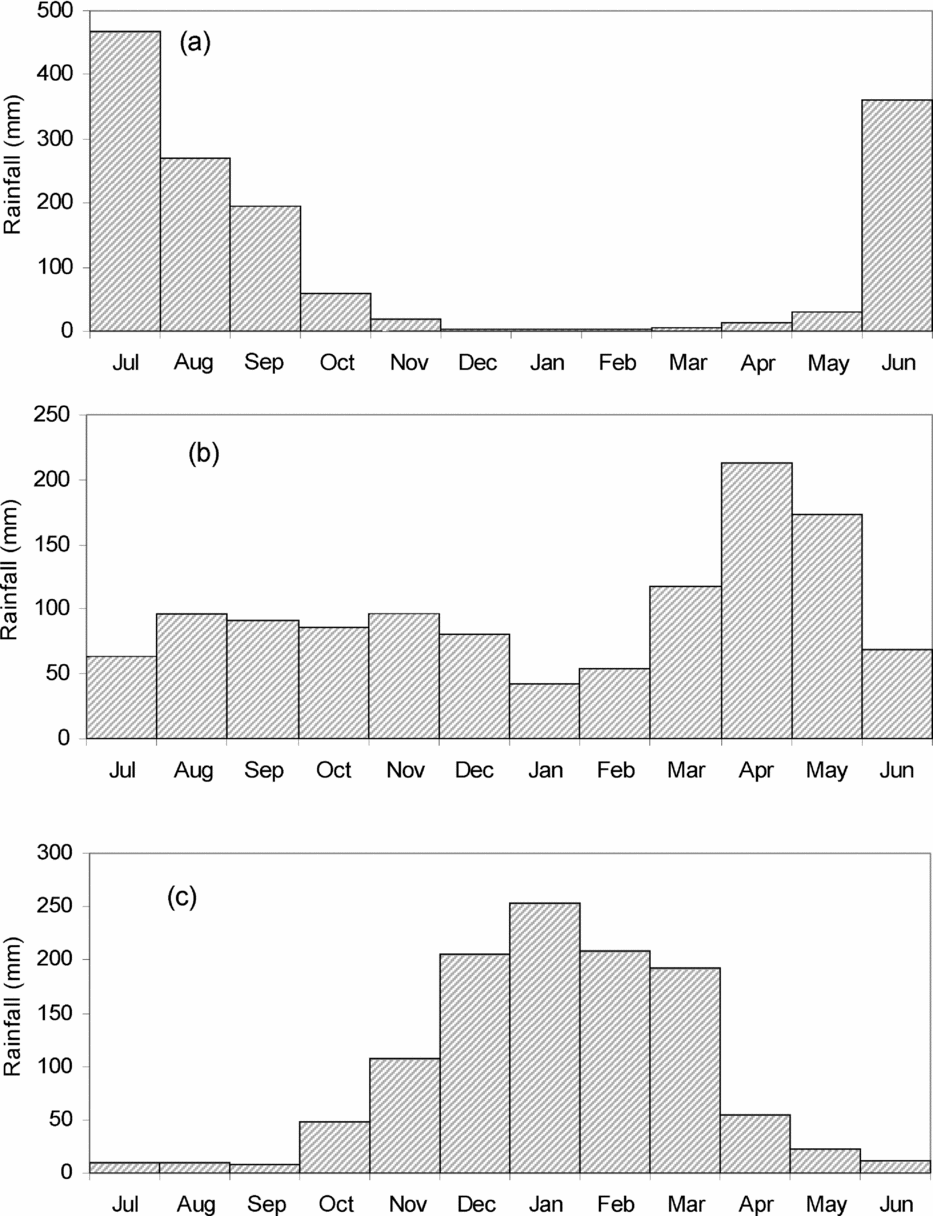
The answer appears to be Africa. The dragonflies' behaviour, with vast numbers casting themselves out across the ocean each year, must be maladaptive, as assumed by Fraser (Reference FRASER1954), unless they can reach land again. If they are able to complete the crossing they can exploit both the monsoon rains of India (Figure 3a), and the ITCZ rains of eastern and southern Africa (Figures 3b and 3c), to breed in ephemeral water bodies (free of long-lived predators like fish, but rich in food such as mosquito larvae). To capitalize on such transient opportunities these dragonflies have remarkably brief larval lives, and complete several generations each year. In the case of P. flavescens, naiads can complete their development in as little as 38–43 d (Kumar Reference KUMAR1984, Suhling et al. Reference SUHLING, SCHENK, PADEFFKE and MARTENS2004). Larval development must be rapid because rainwater pools might dry out at any time; it can be rapid both because temporary tropical pools are usually warm, and because the absence of predators frees the naiads from the typical odonate hide-and-ambush strategy, allowing them to hunt more actively (Johansson & Suhling Reference JOHANSSON and SUHLING2004, Suhling et al. Reference SUHLING, SCHENK, PADEFFKE and MARTENS2004). Longevity of the adults is unknown because they disappear soon after emergence, but it has been estimated that P. flavescens might complete four or five generations each year (Corbet Reference CORBET1984, Reference CORBET2004; Corbet et al. Reference CORBET, SUHLING and SOENDGERATH2006).
Seasonality of rainfall in three areas around the western Indian Ocean. Western India (a). East central Africa (b). South-eastern Africa (c). For each area average monthly rainfall is estimated from four stations, the locations of which are marked with triangles, squares and circles respectively in Figure 4.

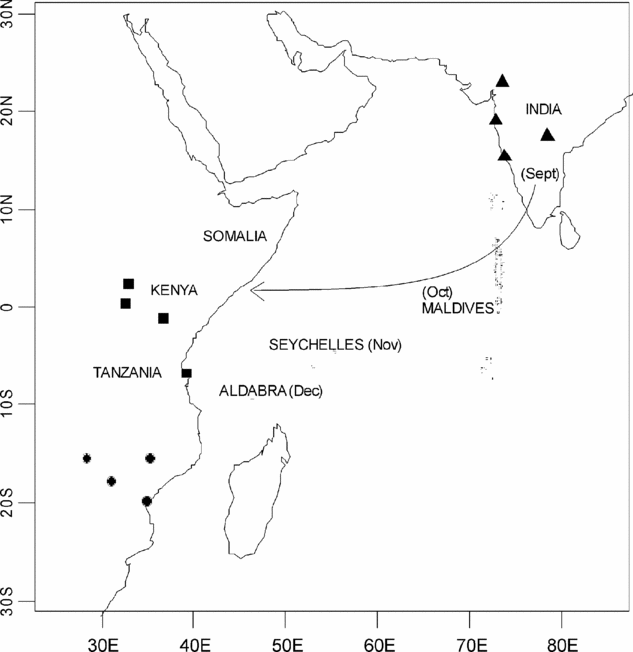
As noted above, P. flavescens migrate southwards in large numbers within southern India each September–October (Fraser Reference FRASER1924, Reference FRASER1936; Larsen Reference LARSEN1987). As shown here, dragonflies first arrive in the Maldives in October. They appear in the granitic Seychelles (in 4°S and some 2700 km from India) in November (Bowler Reference BOWLER2003) and Aldabra (9°S, 3800 km from India) in December (Campion Reference CAMPION1913) (Figure 4). These timings reflect the slow southward migration of the ITCZ (Waliser & Gautier Reference WALISER and GAUTIER1993), not the much faster westward passage of individual dragonflies, which travel with the north-east monsoon winds behind (i.e. north of) the ITCZ. As was the case with dragonflies not reaching Malé until October, P. flavescens does not reach Aldabra in numbers until December because the ITCZ has not migrated south to that latitude until December. However, the dragonflies that do arrive then may have taken only a few days to make their crossing from India. Dragonflies from India might reach East Africa in more northerly latitudes as early as September.
Location map. Months indicate first arrival dates of large numbers of Pantala flavescens at four locations across the western Indian Ocean. The arrow gives a schematic indication of the proposed passage of P. flavescens across the western Indian Ocean in October–November. Rainfall stations (as used in Figure 3) are marked with triangles (western India), squares (east central Africa) and circles (south-eastern Africa). Scale: 10° latitude = 600 nautical miles = 1110 km.

Pantala flavescens can make flights of up to 4000 km (Corbet Reference CORBET1979), which is the distance from India to Kenya. Large numbers of P. flavescens (and of several other dragonfly species listed in Table 1) do appear in eastern Africa from September onwards (Corbet Reference CORBET1962, Reference CORBET1984; Pinhey Reference PINHEY1961). It has been assumed that all are intra-continental migrants. The data presented here suggest that some may be inter-continental migrants arriving from India.
Any dragonflies flying in the elevated land plume at about 1000–2500 m would be transported from India not just towards Maldives, but on towards Africa (Lelieveld et al. Reference LELIEVELD, CRUTZEN, RAMANATHAN, ANDREAE, BRENNINKMEIJER, CAMPOS, CASS, DICKERSON, FISCHER, DE GOUW, HANSEL, JEFFERSON, KLEY, DE LAAT, LAL, LAWRENCE, LOBERT, MAYOL-BRACERO, MITRA, NOVAKOV, OLTMANS, PRATHER, REINER, RODHE, SCHEEREN, SIKKA and WILLIAMS2001, Raman et al. Reference RAMAN, NIYOGI, SIMPSON and PELON2002). The ITCZ is particularly complex over the Indian Ocean, but a pronounced convergence zone, marked by a line of clouds, develops between Maldives and Somalia each year during November–December (Sato et al. Reference SATO, YONEYAMA, KATSUMATA, SHIROOKA and TAKAYABU2007). Dragonflies carried along this route from southern India to southern Somalia would need to make an ocean crossing of about 3500 km. With tailwinds of about 10 m s−1, dragonflies, perhaps combining gliding or soaring with flight at minimum power velocity, might make the crossing in about 4 d.
Pantala flavescens and several of the other species listed in Table 1 are known gliders and have much enlarged bases to their hind wings, which is a feature associated with gliding (Corbet Reference CORBET1962, Reference CORBET2004). To make such an ocean crossing it is likely that energy consumption must be kept to a minimum, and that soaring (i.e. gliding in air that is rising faster than the dragonfly's rate of descent due to gravity) plays an important role. It seems particularly likely that soaring occurs within the rising air of the ITCZ itself.
In addition to enjoying low-cost flight across the ocean, the dragonflies might also be able to feed en route. Micro-insects appear in abundance at Aldabra with the dragonflies (and the rain), in December (Frith Reference FRITH1979). They are likely carried there, presumably involuntarily, by the same winds, and perhaps also concentrated within the ITCZ. For the larger dragonfly species, the smaller dragonflies themselves might provide food: Anax ephippiger (Burmeister) is known to prey upon P. flavescens during joint migration in the Gambia (Corbet Reference CORBET2004).
Dragonflies do sometimes occur far out at sea, well beyond coastal waters (Corbet Reference CORBET2004), and transoceanic dispersal may explain the biogeography of some taxa (Dijkstra Reference DIJKSTRA2007). However, it has been assumed that in most such cases the dragonflies were transported by weather fronts, storms or other dramatic or transient meteorological phenomena. This is the first report of what appears to be a regular, transoceanic dragonfly migration.
Transoceanic bird migration
In contrast to the dragonflies, it has long been known that several bird species (including those listed in Table 1) migrate across the western Indian Ocean from India to East Africa during the boreal autumn (Ali & Ripley Reference ALI and RIPLEY1987, Clement & Holman Reference CLEMENT and HOLMAN2001, Moreau Reference MOREAU1938, Reference MOREAU1972). Many of these birds appear to make landfall not in northern Somalia, the nearest point to India, but further south in southern Somalia, Kenya or even Tanzania, an over-water distance of about 3500–4000 km. Why and how these birds make such extraordinary migrations is unknown. That of the Amur falcon Falco amurensis is of particular interest (Bildstein Reference BILDSTEIN2006) because its migration is so long, arduous and counter-intuitive (between the Russian Far East and southern Africa); because, uniquely, the entire species makes this ocean crossing; and because parts of its migratory circuit remain unconfirmed. Its migration is still considered ‘. . . one of the great ornithological mysteries of the present day’ (Naoroji Reference NAOROJI2006).
Common features of these birds are that their crossings peak in November–December (Figure 1c), and that they travel at high altitudes (Clement & Holman Reference CLEMENT and HOLMAN2001, Moreau Reference MOREAU1938, Reference MOREAU1972; Satheesan Reference SATHEESAN1990). These coincidences in timing and altitude of bird and dragonfly migration presumably allow the birds to take advantage of the same tail winds as the dragonflies. In addition, the birds listed in Table 1 are all medium-sized species that are known to feed on large insects, with some specializing on dragonflies. This, I suggest, is no coincidence, with at least some of the birds taking advantage of the dragonflies for in-flight refuelling. Finally, all of these birds are from eastern populations of species (or in the case of the Amur falcon, an eastern sibling species, and with the apparent exception of lesser cuckoo) that also occur more widely further west, from where they migrate more directly to southern Africa. One interpretation is that, historically, as the breeding ranges of these species expanded eastwards, those eastern birds that found themselves in India in autumn were pre-adapted to head for southern Africa. The serendipitous occurrence of suitable winds and food supplies allowed them to do so directly across the ocean without making the longer and potentially more hazardous journey via Arabia.
Return migration
A second, small influx of dragonflies to the Maldives occurs over just a few days each May (Figure 1a). These dragonflies (over 99% P. flavescens) seem most likely to have arrived from Africa. Their appearance coincided in two out of three years (Table 2) with a period of strong westerly winds and rain, associated with the onset of the south-west monsoon and the westerly Somali Jet. It is usually only during May that this low-level jet passes over both East Africa and the Maldives. The collection of an African black emperor dragonfly (Anax tristis Hagen) in the Maldives in May (Blackman & Pinhey Reference BLACKMAN and PINHEY1967) supports the African origin of these dragonflies.
The arrival of small numbers of dragonflies in the Maldives out of Africa in May is of interest. But more significant is the likelihood that during June–July the Somali Jet provides a means for ITCZ dragonflies to return from Africa to India, and complete a multivoltine migratory circuit. Large numbers of P. flavescens do suddenly appear in India at this time (Corbet 1998, 2004). Again it seems to have been assumed that these are intra-continental migrants, but at least some are likely to be of inter-continental origin.
Multivoltine, ITCZ-associated migrations within Africa have already been suggested for P. flavescens (Corbet Reference CORBET1962, Reference CORBET2003, Reference CORBET2004). Corbet (Reference CORBET1962) noted that P. flavescens, and also Tramea basilaris (Beauvais), appeared in numbers in equatorial Uganda only twice annually, in March or April and again in September or October, these timings coinciding with the passage of the ITCZ. Further south, in Tanzania and Mozambique these species appeared in large numbers in December–January, again coinciding with the arrival of the ITCZ. Other reports are compatible with the hypothesis that Pantala flavescens is particularly abundant in different African locations during the ITCZ rainy seasons (Gambles Reference GAMBLES1960, Pinhey Reference PINHEY1951, Reference PINHEY1961, Reference PINHEY1976; Samways & Caldwell Reference SAMWAYS and CALDWELL1989).
For those P. flavescens that appear in the Maldives from October onwards each year, the alternating monsoons, combined with the movements of the ITCZ, provide an opportunity for an intercontinental migratory circuit that could potentially include breeding in: the ITCZ short rains of equatorial East Africa in October–November; the ITCZ summer rains of southern Africa in December–February; and the ITCZ long rains of East Africa in March–May; before returning to India with the ITCZ and Somali Jet to breed in the south-west monsoon rains in June–July (Kumar Reference KUMAR1984). This hypothetical migratory circuit, completed in four generations, would cover a total distance of about 14 000–18 000 km.
More generally, as intimated by Corbet (Reference CORBET2003), vast populations of P. flavescens must be continually on the move, with successive generations forever chasing the monsoon, forever trailing the ITCZ on its endless seasonal excursions. But the Indian subcontinent does not extend into the southern hemisphere. And so, although P. flavescens successfully exploits the vast expanse of the monsoon-soaked subcontinent for reproduction, the generation that emerges in India must emigrate to another continental area where ITCZ rains are falling. Some of their descendants may return with the next south-west monsoon. In other words, the life cycle of P. flavescens requires a transoceanic emigration from India, and an intercontinental migratory circuit is made possible by the region's seasonally alternating winds and rains.
The monarch butterfly Danaus plexippus (Linnaeus) of eastern North America (Brower Reference BROWER1995, Urquart Reference URQUART1987) is often cited as having the longest regularly repeated migration of any insect. The migration of this butterfly is indeed impressive, covering over 7000 km in an annual circuit that stretches from Mexico to southern Canada, and takes an average of four generations to complete. While the dragonflies discussed here cannot match the spectacular over-wintering aggregations of the monarch, their migrations appear even more extraordinary. In particular, the migratory circuit proposed here for P. flavescens, if correct, is twice as long as that of the monarch and includes the longest regular ocean crossing known for any insect migrant.
Relatively few birds make the return boreal spring migration to India across the western Indian Ocean (Figure 1c). The winds, and associated dragonfly cargo, do not favour a passage to India until June, which is too late for most birds. Instead most migrate up through East Africa and across Arabia (Ali & Ripley Reference ALI and RIPLEY1987, Moreau Reference MOREAU1972), mainly in March and April. An exception is the pied cuckoo Clamator jacobinus which famously arrives in India with the rains of the south-west monsoon in June (Ali & Ripley Reference ALI and RIPLEY1987, Whistler & Kinnear Reference WHISTLER and KINNEAR1934), apparently directly across the Arabian Sea from Somalia, and which, as a brood parasite of other birds, does not need to return earlier.
Unanswered questions
It must be emphasized that while the available evidence does support the various hypotheses developed here, much of that evidence is circumstantial. For example, there is as yet no proof of Indian dragonflies arriving in East Africa, far less of migrating birds eating dragonflies while at altitude over the western Indian Ocean.
Practical approaches that might test some of these hypotheses and yield further insights include: identification of Indian dragonfly vagrants in East Africa (and vice versa) at the appropriate times; regular recording of migrant dragonfly arrival dates, mass movements, numbers and breeding activity at different locations on the proposed migration routes; and trace element or stable isotope analysis (May & Matthews Reference MAY, MATTHEWS and Cordoba-Aguilar2008, Rubenstein & Hobson Reference RUBENSTEIN and HOBSON2004). Whatever the truth of the matter, the annual arrival of vast numbers of migratory dragonflies in the Maldives offers the opportunity for research into many poorly understood aspects of the biology of animals that have previously been regarded as difficult to study, because their appearances are usually so irregular (Corbet Reference CORBET2004, Holland et al. Reference HOLLAND, WIKELSKI and WILCOVE2006).
In addition to the lack of direct evidence, the discussion here raises a number of questions which cannot be answered at this stage. One argument presented in favour of P. flavescens completing the crossing from India to East Africa is that there should be strong selection against genotypes that are carried out to sea in large numbers but fail to cross. This raises questions about other species which participate in the migration, albeit in much smaller numbers than P. flavescens, but which may not reach Africa. For example, Anax guttatus (Burmeister) and Diplacodes trivialis (Rambur) are known from the Indian subcontinent, Maldives and Seychelles (Blackman & Pinhey Reference BLACKMAN and PINHEY1967, Bowler Reference BOWLER2003) but apparently not from Africa; are those that arrive in the Maldives genuine waifs?
It should also be mentioned that this study deals mostly with dragonflies that appear to be emigrating from India at the end of the south-west monsoon to avoid the dry north-east season. However, the north-east monsoon does bring rain in October–December to a limited area of south-eastern India and eastern Sri Lanka. And P. flavescens does occur there in large numbers through into January (Corbet Reference CORBET1988). How these animals fit into the migration scenario presented here is at present uncertain.
There are questions too regarding bird migrants. In addition to the species listed in Table 1, some smaller bird species also appear to make the crossing from India. The most commonly recorded are barn swallow Hirundo rustica and tree pipit Anthus trivialis. They too are insectivores and they too appear most frequently in both the Seychelles and the Maldives in November. This suggests that they too may travel with the same winds as the larger birds and the dragonflies, although much about their migrations remains unknown.
CONCLUSIONS
To summarize, the hypotheses developed here, with the best-supported first and most speculative last, are: that the dragonflies (predominantly Pantala flavescens) which appear in Maldives every year from October onwards arrive from India; that these dragonflies fly at altitude following the ITCZ and using advantageous tailwinds; that many complete the ocean crossing from India to East Africa; that there is a return crossing (of a subsequent generation) in small numbers to Maldives in May and in large numbers to India in June–July; and taken together, that, as part of a wider web of migratory movements, there is an annual migratory circuit of P. flavescens across the Indian subcontinent and eastern Africa, involving perhaps four generations, requiring two ocean crossings and covering something of the order of 14 000–18 000 km. Also, for birds, that those species which cross the western Indian Ocean at the same time as the dragonflies do so at the same altitude to take advantage of the same tailwinds and (in some cases at least) to feed on insects en route.
Despite the uncertainties regarding these hypotheses, the annual appearance of millions of dragonflies in the Maldives is in itself a quite astonishing phenomenon. The likelihood that these dragonflies are making a regular, seasonal transoceanic migration (a feat previously unknown for any insect), and the additional possibility that P. flavescens is completing a regular migratory circuit twice as long as any previously recorded for any insect, should excite further interest in these extraordinary animals.
ACKNOWLEDGEMENTS
I am most grateful to numerous colleagues and friends in Maldives and India who assisted with data collection, especially Mohamed Shiham Adam, Mohamed Ahusan, Robert Anderson, Susan Anderson, Ahmed Hafiz, Francy Kakkaserry, Donna Toon, Lucy Whitestone, Zaha Waheed and others. Abdulla Algeen and Abdul Muhusin Ramiz of the Maldives Meteorological Service, Captain Richard Smith and Nigel Collar provided helpful information and comments. Mohamed Shiham Adam produced the maps. Adrian Skerrett of the Seychelles Bird Records Committee, and Frank Ward of the Royal Naval Birdwatching Society provided copies of their databases. Radiosonde data were collected by the JAMSTEC MISMO programme. K-D Dijkstra, Mike May, Edward Munn, John Phillips and an anonymous referee reviewed drafts of this paper and provided valuable criticism.