Introduction
Lead zirconate titanate ceramics, Pb(Zr,Ti)O3 or PZT, are an important part of the worldwide piezoelectric materials and devices market, worth more than USD$20 billion annually, with a compound annual growth rate >6%.1 PZT is at the heart of the widest range of piezoelectric applications, a number of which have substantive societal benefits via medical and safety applications. PZT products are present in multiple market sectors, including automotive, aerospace, consumer electronics, chemical, and food process industries, and information technology.
The production volume of PZT and related materials is not a well-established figure. From global sales data1 and an industry assessment for European PZT usage of 350 tons annually,Reference Gensch, Baron, Blepp, Moch, Moritz and Deubzer2 we estimate world production to be between 1250 and 4000 tons annually. For this article, we assume a nominal figure of 2500 tons PZT produced annually, equivalent to 1600 tons of elemental Pb used.
The toxic nature of lead is of great concern during lead mining and the manufacture, use, and disposal of lead-based products. Historically, a number of high-volume applications (e.g., plumbing, some paints, or automotive fuel additives) were implicated in elevated blood lead levels or even lead poisoning in many communities. Legislation has been introduced in many jurisdictions to effectively outlaw the implicated products. More recently, other large-scale applications (e.g., SnPb solder in electronics) have been much reduced due to legislation implemented to reduce the risk of accumulations of lead around the disposal sites of electronic waste. Originally initiated by the European Union (EU), such legislation is now being introduced in an increasing number of countries and transnational trading blocks, which take the EU measures as a template.
At the time of writing, due to exemptions that allow the continued use of lead in piezoelectric products, the availability of products based on PZT remains largely unaffected by legislation. However, these exemptions are reviewed periodically and once scientific and technological progress enables the substitution or elimination of lead, the exemptions will be revoked.
This article reviews the need for legislation, focusing on the model created by EU directives, and its consequences for the piezoelectric industry. We discuss whether the current framework can provide the optimum balance between environmental or health risks and societal or commercial benefits of PZT products.
Lead toxicity and environmental levels
Lead is a cumulative toxicant that affects multiple body systems and is particularly harmful to children. Lead in the body is distributed to the brain, liver, kidney, and bones. It is stored in the teeth and bones, where it accumulates over time. Lead in bones can be released into the bloodstream (e.g., during pregnancy), and becomes a source of exposure to the developing fetus. There is no known level of lead exposure that is considered safe, but as lead exposure increases, the range and severity of symptoms and effects increase. In children, blood lead concentrations as low as 50 µg 1–1, which cause no obvious symptoms and were previously considered safe, can affect brain development resulting in reduced intelligence quotient (IQ), attention span, and educational attainment and increased antisocial behavior. At higher levels, lead exposure causes anemia, hypertension, and renal impairment; lead is immunotoxic and may damage the reproductive organs. The neurological and behavioral effects of lead are believed to be irreversible.3
Symptoms in adults occur when the lead content in blood exceeds approximately 500 μg 1–1. In recognition of the severe consequences of lead poisoning, the US Centers for Disease Control and the National Institute for Occupational Safety and Health recommend no safe upper limit but have published the reference level for lead in blood to be 50 µg 1–1 for both adults4 and children.5
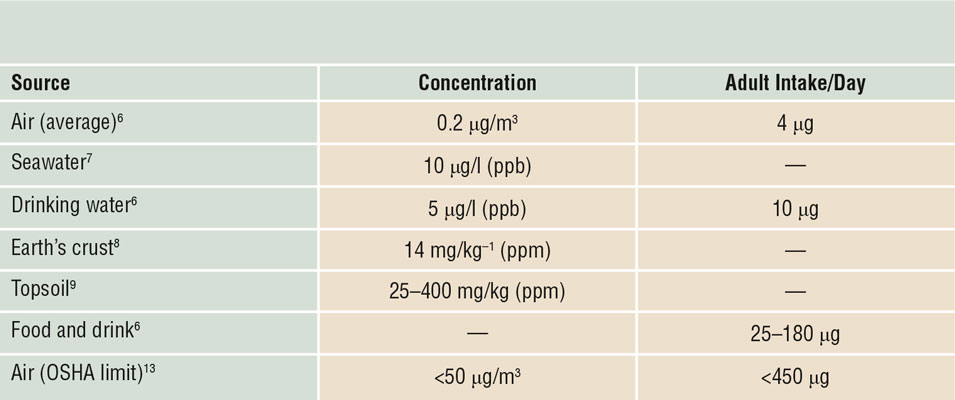
Table I shows typical environmental levels of lead in air,6 water,6,Reference Bispo, Korn, Morte and Teixeira7 soil,Reference Barbalace8,9 and food.6 These result in an average range of total adult lead intake from 25 to more than 100 µg day–1, depending on geographical location. The absorption of lead from food and drink is around 10% of intake for adults;6 however, the absorption rate in children is around four to five times higher. The half-life of lead in blood is 40 days, hence the “natural” intake does not normally aggregate toward the blood lead reference levels.
Sources of lead in the environment and the resulting potential adult daily intake compared to the US Occupational Safety and Health Administration (OSHA) maximum in the workplace.

Risks from PZT through the life cycle
The annual global production of primary (obtained from natural sources) lead is approximately 4.7 million tons10 and is exceeded by recycled, or secondary, lead production at 6 million tons;11 approximately 0.015% of the total (primary + secondary) is used in the production of PZT. Lead mining produces large amounts of waste. A considerable fraction of lead mining takes place in developing countries that suffer from low environmental and health standards and regulations.10 The production of lead causes significant degradation of the environment. Lead smelters may release large quantities of Cd and Pb into the environment and produce gaseous and particulate, aqueous, and solid wastes.Reference Singh and Li12 Under these circumstances, children living and playing close to mining and process operations are at particular risk.
In adults, the main source of lead poisoning is occupational exposure, hence in most industrial jurisdictions, there are workplace exposure limits in place. For example, in the United States, the Occupational Safety and Health Administration (OSHA) permissible exposure limit for PbO is <50 µg m–3 of air over 8 h, with an action limit of 30 μg m–3, above which the plant operator must act to reduce exposure.13
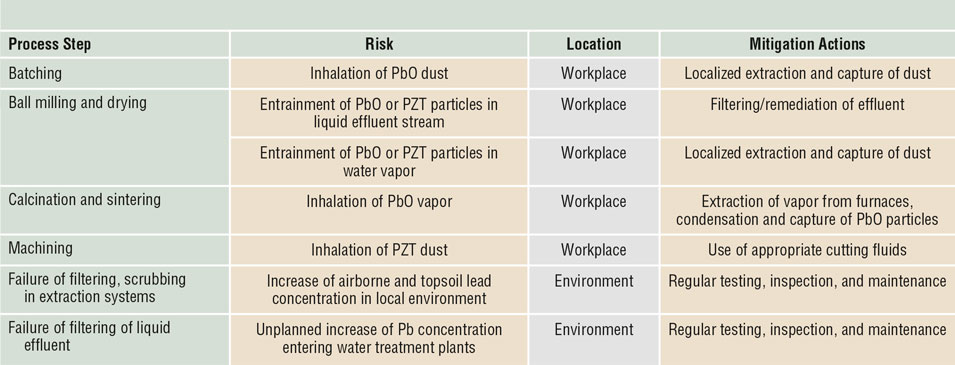
The environmental and health risks unique to the manufacture of PZT are listed in Table II. The manufacturing method for the majority of PZT production is the mixed oxide process, with batch sizes in the range of 10–1000 kg. In the main industrial nations, health and safety (H&S) in the workplace and environmental protection (EP) from industrial processes are well regulated and monitored by national agencies. The risks highlighted in Table II are now well controlled, with high fines or custodial sentences for exceeding national limits for occupational exposure and environmental discharge. Best practices in risk assessment and mitigation are widely followed, and regular monitoring of workforce blood lead levels confirms that these measures have been effective. The risk of occupational lead poisoning due to the manufacture of PZT in industrialized nations is extremely low. However, the effectiveness of similar measures in developing nations is demonstrably worse.
Environmental and health risks inherent in the mixed oxide process for manufacture of Pb(Zr, Ti)O3 (PZT).

The manufacture of PZT ceramics is part of a supply chain that further processes the PZT material into products before it reaches the end user. Lead-based piezoelectric materials demonstrate a high degree of physical integrity. The aqueous solubility of PbO is low (17 mg 1–1), however, the solubility of Pb from PZT is believed to be lower; elution tests on individual 8 mm2 × 1.1 mm thick PZT pellets, stirred in 300 ml acidified water at pH4 for 96 h at 40°C, produced a range of Pb concentrations from <0.2 to 0.8 mg 1–1, depending upon the PZT composition.Reference Tsurumi, Takezawa, Hoshina and Takeda14 Device assembly processes are also subject to local H&S measures that ensure that the risk of lead ingestion and absorption through the skin during handling is minimized. The risk to end users is even lower; PZT components are rarely accessible to the user of a system and the risk of increased lead intake in normal usage, compared to normal daily intake, is vanishingly small.
Recycling of individual PZT components is not generally practiced. Hence, disposal normally follows that of the host system. Globally, waste electrical and electronics components (e-waste) is an increasing problem. In 2018, e-waste is expected to amount to almost 50 million tons worldwide.Reference Baldé, Forti, Gray, Kuehr and Stegmann15 Due to the detrimental effects on the environment and the potential as a source of secondary raw materials, there are increasing efforts, supported by legislation, to recycle e-waste by a mixture of controlled disassembly and material extraction. While 66% of the world’s population lives in a jurisdiction with e-waste legislation, in 2016 only 20% of global e-waste was actually recycled, and 4% (1.7 million tons) of e-waste arising in higher-income countries is known to be disposed of in residual waste. Most of the remaining 76% is either dumped, traded, or recycled under inferior conditions.Reference Odeyingbo, Nnorom and Deubzer16 Higher-income nations have a record of exporting the problem to developing nations (e.g., Nigeria and Ghana). In 2015–2016, approximately 60,000 tons of used electrical and electronic equipment were exported to Nigeria every year, most of it from the EU, China, and the United States. At least 26% of these imports were nonfunctional. There are a number of studies showing increased levels of blood-lead or lead poisoning among children in the vicinity of e-waste landfills.Reference Huo, Peng, Xu, Zheng, Qiu, Qi, Zhang, Han and Piao17,Reference Pascale, Sosa, Bares, Battocletti, Moll, Pose, Laborde, González and Feola18 The problem of lead in e-waste is not a marginal issue.
Historically, cathode ray tubes (CRTs), as previously used in TVs and computer monitors, contained approximately 2 kg of lead per unit. Also, virtually all electronic items used to be assembled using SnPb solder. In 2000, around 38,000 tons of Pb were used in electronic solder. From these figures, we estimate that before 2000, e-waste contained several percent lead by weight. Since then, approximately 28,000 tons annually of lead in electronics has been replaced through adoption of lead-free alloys, the rest being mainly applied in high-melting-point solders (Pb ≥ 85%).Reference Deubzer19 High shares of lead had been used in CRTs, which are still in the disposal chain, while the production of new CRTs has virtually ceased. Furthermore, taking the example of mobile phones, between 1998 and 2006, lead content was reduced from 1% to 0.015% and has remained at the lower level since.Reference Christian, Romanov, Romanova and Turbini20 It is therefore projected that the lead levels in future e-waste will fall to between 0.015% and 0.1% (6500 to 50,000 tons annually). Assuming the rate of PZT products entering the e-waste stream is equal to their annual production, future additional e-waste will contain ∼1600 tons of Pb from PZT, corresponding to between 3% and 25% of the lead in the e-waste stream.
Legislation
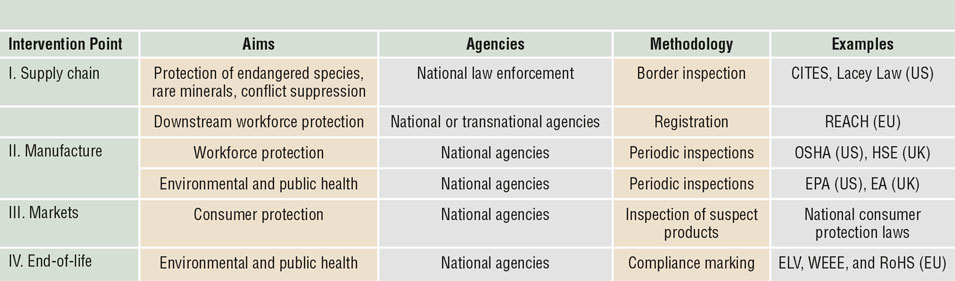
Given the risks to public health previously identified, it is appropriate that lead is subject to restrictions. Table III summarizes the types of legislation that are currently in place and the objectives they seek. Legislation at intervention points I to III are effective in their aims and the industry is able to comply without any impact on the availability of PZT. It is the legislation introduced to minimize lead entering the environment at the end of life of electrical and electronic equipment (EEE) (point IV in Table III) that will potentially have the greatest impact on the piezoelectric marketplace. As policing the disposal of products at end of life is an unreliable means of controlling proscribed substances, the legislation targets manufacturing and aims to eliminate those substances from certain products in the electronics and automotive sectors.
Points of legal intervention in minimizing health, safety, and environmental impacts of Pb(Zr, Ti)O3 (PZT) production.

Note: CITES, Convention on International Trade in Endangered Species of Wild Fauna and Flora; REACH, registration, evaluation, authorization, and restriction of chemicals; OSHA, Occupational Safety and Health Administration; HSE, Health and Safety Executive; EPA, Environmental Protection Agency; EA, Environment Agency; ELV, end of life of vehicles; WEEE, Waste Electrical and Electronic Equipment Directive; RoHS, restriction of hazardous substances.
The EU’s Restriction of Hazardous Substances (RoHS) Directive of 2002 and its revision (RoHS 2) in 201121 restrict the content of lead, mercury, cadmium, and hexavalent chromium, plus polybrominated diphenyls and polybrominated biphenyl ethers in EEE. For lead, the allowed limit in any homogeneous material in EEE is 0.1% by weight of that material. In the case of a piece of equipment employing a piezoelectric component, the 0.1% limit refers to the concentration of lead in the piezoelectric material itself, not as a percentage of the weight of the component or of the equipment. Certain products are excluded from the RoHS (“out of scope”) (e.g., military equipment, active implantable medical devices, large-scale stationary industrial tools and fixed installations). There are also a number of exemptions for specific applications for which lead-free replacements are not yet available. Piezoelectric materials are currently subject to RoHS Exemption 7(c)-I, “Electrical and electronic components containing lead in a glass or ceramic other than dielectric ceramic in capacitors (e.g., piezoelectronic devices), or in a glass or ceramic matrix compound.”
Consultants contracted by the European Commission review these exemptions on a regular basis, drawing upon evidence submitted by interested parties, and with the collaboration of an EU Expert Group (Expert Group 2810—RoHS 2 Adaptation and Enforcement) comprising representatives of EU member states. The current RoHS directive has the objective to introduce selective lifting of the exemption for applications for which:
1. the elimination or substitution via design changes or lead-free materials is scientifically or technically practicable;
2. the reliability of substitutes is ensured; and
3. the total negative environmental, health, and consumer safety impacts caused by substitution are unlikely to outweigh the total environmental, health, and consumer safety benefits thereof.
Socioeconomic impacts may be taken into account under certain circumstances. If the previously discussed criteria apply, exemptions will be revoked or restricted in scope after a transition period of at least 12 months.
Past reviews of exemption 7(c)-I have prolonged its life on the basis that replacement of PZT was not yet feasible. In 2016,Reference Gensch, Baron, Blepp, Moch, Moritz and Deubzer2 the reviewers recommended extending the exemption, concluding that “the replacement of PZT may be scientifically and technologically practical,” but only “to a certain degree.” The latest Commission draft22 proposes the renewal of exemption 7(c)-I in its current wording until 2021.
The End of Life of Vehicles (ELV) Directive23 was introduced by the EU in 2003 to encourage the reuse and recycling of vehicles. ELV bans the use of the same metals as RoHS, including lead at levels >0.1% of a homogeneous material. There are a number of exemptions currently listed in Annex II (8th revision) for specific components, of which exemption 10(a) is for “Electrical and electronic components which contain lead in a glass or ceramic, in a glass or ceramic matrix compound, in a glass-ceramic material, or in a glass-ceramic matrix compound.” Components that are not part of the engine have to be dismantled at end-of-life of the vehicle if the weight of lead exceeds 60 g as an aggregate from the ceramic components and exempted lead used in other vehicle components.
Also relevant is REACH (Registration, Evaluation, Authorization, and Restriction of Chemicals),24 which is an EU regulation that entered into force in 2007. It is administered by the European Chemicals Agency. REACH requires companies manufacturing or using chemicals in quantities of one ton or more per year to register these substances and to communicate health and safety information relating to these substances up and down the supply chain, and to manage risks appropriately. The evaluation function of REACH identifies certain toxic substances as “substances of very high concern” (SVHC). Depending on the outcome of an evaluation period, a SVHC may be included in Annex XIV of the regulation with a prescribed “sunset date” for prohibition. Beyond that date, manufacture and use by a company will require authorization for each specific application (i.e., no blanket exemptions). A substance authorization can be granted for two reasons: (1) the use is considered safe as long as the risks are adequately controlled or (2) the risks are minimized and the use of the substance can be demonstrated to be so important on socioeconomic grounds that its continued use outweighs the risks to human health and the environment. PZT has been identified as a SVHC and is currently being evaluated. Should it be included in Annex XIV, it is likely to have a sunset date in 2021. To avoid conflicting regulations, any restrictions and authorizations in REACH will be aligned with the RoHS Directive as the specific regulation for EEE.
The impact of legislation
Given the scope of RoHS, it has had a significant influence on piezoelectric materials research, initiating a global effort to identify lead-free alternatives to PZT. The total number of papers on the topic published since 1997 is approaching 4000, and lead-free materials are currently the subject of one-half of all new papers on piezoelectric ceramics.25 Some excellent and interesting science has resulted from this global effort, which has been reviewed by a number of leading authors.Reference Rödel, Webber, Dittmer, Jo, Kimura and Damjanovic26 However, as has recently been noted,Reference Koruza, Bell, Frömling, Webber, Wang and Rödel27 few of these publications describe materials in terms of the full electromechanical property matrix, the aging characteristics, electrode compatibility, machinability, and process cost that would enable device engineers to judge the suitability of a material to replace PZT in a given application.
Many authors misguidedly state that PZT is dangerous to manufacture and poses a danger to end users. There is also a widespread assumption that any lead-free material is safe, environmentally friendly, and socially acceptable. There are many examples of candidate lead-free materials that are based on toxic precursors (e.g., Ba), albeit none with the same level of human toxicity as lead. One of the lead-free piezoelectrics with the greatest potential to substitute for PZT is (K,Na)NbO3 (or KNN). However, a life-cycle analysis conducted according to ISO standards showed that due to the methods used for extraction of niobium from its ore, the environmental impact of KNN is several times greater than that of PZT.Reference Ibn-Mohammed, Koh, Reaney, Acquaye, Wang, Taylor and Genovese28 In addition, niobium ores will soon fall under the EU Conflict Minerals Regulation (EU2017/821), which limits the import of minerals to Europe from conflict-affected areas.29
Estimating the cost of publishing an academic paper to be ∼USD$100 k per item, in terms of research staff and faculty salaries, consumables, and overheads, the total cost of published Pb-free materials research amounts to $400 m in 20 years. Given the current size of the piezoelectric market, this investment in lead-free research, equivalent to ∼0.2% of sales revenue, may seem inadequate. The majority of this published research has been undertaken in universities. It is not possible to estimate the industry expenditure, but at this time, piezoceramic manufacturers with novel lead-free materials in their catalogs represent a rather small minority.
While RoHS has had a major impact on piezoelectric materials research, the same cannot be said of device development. There is little evidence to suggest that significant industrial research is being undertaken. Why has the piezodevice industry apparently not meaningfully engaged with PZT replacement? There are three main factors—the lack of commercially available lead-free materials, intellectual property (IP), and cost.
The relative commercial scarcity of lead-free piezoelectric materials is a major discouragement to those wishing to assess them for device use. Although some samples may be available, mainly from academic sources, industries are unwilling to commit significant resources to working with materials for which there is no established supply chain or second source. A further disincentive for industry is the complexity and uncertainty of the IP landscape. The manufacture and use of PZT is relatively unencumbered by IP issues, however, both universities and industry are more active in protecting their lead-free discoveries. Even if a lead-free material is reported to be an excellent PZT replacement, it may not be commercially viable for a company to use that material due to IP ownership by a competitor. On the other hand, if a competitor successfully markets a product with a lead-free PZT substitute, it could be considered as evidence that the substitution of lead in this case is technically viable, resulting in the relevant category of products being excluded from the scope of Exemption 7(c)-I and closing this market for PZT-based products.
The cost of replacing PZT in devices cannot be overestimated. None of the current candidate lead-free materials is a “drop-in” replacement for a specific proprietary variant, or grade, of PZT. Although a PZT grade’s piezocoefficient may be matched with a lead-free material, other physical properties, including the dielectric and elastic properties and their temperature dependence, will be different. This causes major differences in crucial, derived properties such as the speed of sound and acoustic impedance. For all but the simplest of devices, the replacement exercise would demand a complete redesign of the device and associated electronics, involving both modeling and experimental iterations, and requiring amendments to manufacturing processes. For a relatively simple device, a conservative estimate of the effort to redesign around a new piezoelectric material is one to two person-years, whereas for more complex devices, the redesign process may employ tens of person-years of effort and expense. The cost of developing the current “world catalog” of PZT-based devices has been spread over the last 60 years. Lifting the RoHS exemption on piezoceramics would mean that the PZT replacement costs would need to be swallowed by industry and their customers over a relatively short time scale.
Despite the progress made over the last 20 years in piezoelectric materials research, the industry is not much closer to the goal of eliminating lead now than it was 20 years ago. Even if industry accepted the materials that have been proposed to date, the effort required to convert the whole device industry to lead-free would be many times that already spent on materials research. However, if a sufficiently functional, reliable, and environmentally friendly lead-free piezoceramic is available or foreseeable at the time of a future review, the cost of compliance would probably not be a viable argument against revoking exemption 7(c)-I.
The most recent exemption reviewReference Gensch, Baron, Blepp, Moch, Moritz and Deubzer2 appears to confirm a lack of industrial engagement with the legislation. The number of piezoelectric companies providing evidence to the review represents only a small fraction of those active in the European market. Perhaps this apparent indifference to the legislation and lead-free research is considered to be an acceptable commercial risk, on the assumption that if no credible lead-free replacements for PZT are developed, the current exemptions will remain in place. However, if industry cannot prove that they undertake substantial efforts to find viable lead-free alternatives, the strategy would itself endanger the future continuation of exemption 7(c)-I.
Summary and conclusions
Although the concentration of lead in new e-waste is likely to fall well below 0.1% in the future, due to the issues previously discussed, piezoelectric devices will account for an increasing fraction of that figure, increasing the pressure for the piezoindustry to adopt lead-free solutions.
For EU regulations, the last exemption review in 2015–2016 followed the objective of the EU RoHS directive to restrict exemptions as much as possible.Reference Gensch, Baron, Blepp, Moch, Moritz and Deubzer2 So far, industry has focused on the argument that substitution or elimination of lead is not technically viable because there is no single lead-free PZT replacement suitable for all applications. However, maintaining the current EU policy will increase pressure on industry to focus on more application-specific, lead-free solutions, such that periodic reviews can recommend selective lifting of the exemption.
In certain quarters, there is some skepticism concerning the feasibility of this scenario. The complexity of piezoelectric technology and its markets means the decision-making process for selective lifting of the exemption will be technically demanding. Unlike solders, piezoelectric materials are used in innumerable and different ways in electronics. Segmentation by usage or material performance specifications will therefore be challenging, and there may be a mismatch of expectations between industry and the reviewers concerning the number of different usage categories the methodology should address. The process will require device companies to divulge potentially business critical material requirements, something they will wish to avoid.
From the perspective of industry, a risk management approach, such as that intrinsic to REACH, would probably be the preferred solution. This could allow manufacturers to apply for authorization for specific uses, taking into account use-specific risks, risk-mitigation measures, and socioeconomic aspects. Each case would be judged on its own merits, rather than being subject to the strict and rigid RoHS exemption criteria.
In summary, RoHS-style legislation in many countries has proved to be extremely successful, with current compliance levels resulting in a significant reduction in lead in EEE and in the concentrations being added to landfill. More positive action by the piezoelectric industry would enable an additional, significant reduction in future e-waste lead concentrations. The work required to enable progressive, selective lifting of RoHS Exemption 7(c)-I will be technically and commercially challenging, but ultimately of benefit in reducing global public health risks.

Andrew J. Bell has been a professor of electronic materials at the University of Leeds, UK, since 2000. He received his BSc degree in physics from the University of Birmingham, UK, in 1978, and his PhD degree in ceramic science and engineering from the University of Leeds in 1984. He has previously held industrial research positions in the Plessey Company (1978–1981), Cookson Group plc (1984–1989), and Oxley Developments (1995–2000), and was a senior scientist at École Polytechnique Fédérale de Lausanne, Switzerland (1991–1995). His research includes ferroelectric and piezoelectric materials. He was elected a Fellow of the Royal Academy of Engineering in 2016. He is also the founder and chief scientific adviser of Ionix Advanced Technologies Ltd. Bell can be reached by email at a.j.bell@leeds.ac.uk.

Otmar Deubzer joined Fraunhofer IZM, Germany, in 2001. He graduated from the Technische Universität (TU) Berlin, Germany, as an environmental engineer, earned his PhD degree at Delft University of Technology, The Netherlands, and holds a degree in medicine. Since 2006, he has been reviewing the exemptions from the substance regulations of the RoHS Directive and the End-of-Life Vehicles Directive for the European Commission. From 2008 to 2012, he was a visiting professor at the Brandenburg University of Technology, Germany, for industrial sustainability. Since 2008, he has been working at the United Nations University in Bonn, Germany, with a focus on e-waste management, in particular, in developing countries in Africa. Deubzer can be reached by email at otmar.deubzer@izm.fraunhofer.de.