When Marie-Dominique-Joseph Engramelle published his treatise La tonotechnie, ou l'art de noter les cylindres (1775), he boasted that his method of pinning cylinders for use in automated musical instruments would offer composers a means of preserving their own performance practice and conception of their music for future generations, ‘transmitting for posterity the proof of their genius without any alteration’.Footnote 1 Listeners, in turn, would have seemingly direct access to the great French composers, and would no longer require unreliable performers to act as intermediaries. Engramelle ridiculed performers with bad taste, who ‘disfigured’ the works of towering composers of the past, including Jean-Baptiste Lully, Jean-Philippe Rameau and François Couperin. Valorizing his automated technology, he asked: ‘Would it not be better to hear the same thing many times, if it were good, than to have the ears perpetually tormented by a mediocre organist?’Footnote 2
Engramelle was not alone in the French Enlightenment in viewing transmission of the composer's intentions as the ultimate aim of musical performance.Footnote 3 Jean-Jacques Rousseau summarized this point clearly: ‘What should be the primary concern of a musician in performance? Without doubt it is to enter into the spirit of the composer, and to appropriate his ideas so as to render them with all the fidelity that befits the taste of the piece.’Footnote 4 Numerous writers on aesthetics and performance practice agreed that there was, in fact, a ‘correct’ manner of playing a given piece that originated with the composer; the work as an idea could not simply or easily be separated from the work as a performance.Footnote 5 Yet, as is well known, music of the French Baroque was also widely described as encompassing a certain level of subjectivity – especially in its mouvement, its approach to tempo and temporal fluctuations. The ‘correct’ interpretation of a musical composition was one that captured the proper balance between precision and nonchalance, between freedom and good taste.Footnote 6 All of these elements were, in the imagination of French thinkers, epitomized in the ‘true intentions’ of the composer, who was often also a performer. As Engramelle complained, the difficulty lay in the nature of music as a time-bound art; once a composer died, it was difficult not to let the composer's intentions with respect to performance die as well.
Musical notation was a poor vehicle for the preservation of those intentions. While it captured pitches, some ornaments and basic metrical and rhythmic patterns, it could hardly convey the fluidity and flexibility of execution that was encompassed by the aesthetic ideal of mouvement.Footnote 7 In the eyes and ears of Engramelle, Denis Diderot and other thinkers of the Enlightenment, great musical traditions of the past were being lost to time, with notated music offering little more than a sketch of this lost ideal. It is within this context that Engramelle's treatise La tonotechnie should be understood: he claimed that his automated technology would enable composers to disseminate their music and its associated performance practices across time and geographical space with an ideal purity that would demonstrate its greatness. Working with the skilled artisan-musicians responsible for pinning the cylinders for use in automated instruments, the composers would ensure that the resulting cylinders would realize whatever was in their musical imaginations.
Engramelle's application of automated technology to music was related to broader tendencies in French thought and scientific cultures during the age of Enlightenment. A connection with materialist philosophy is suggested by a 1748 essay by Diderot that prefigured Engramelle's treatise in numerous ways. In this piece, Diderot outlined an aesthetic justification for automated musical instruments of the sort later expounded by Engramelle, in which he blurred the line between human musicians and musical machines. If this move seems strange today, it becomes clearer in light of the views of materialist philosophy, which saw both the human body and the human soul as functions of mechanics, understandable through analogy to machinery and android automata.Footnote 8 Indeed, while such ideas had been in circulation in both popular and learned culture earlier in the eighteenth century, the classic statement on materialism, the treatise L'homme machine by Julien Offray de La Mettrie, appeared in print in the same year as Diderot's essay on automated musical instruments.
Consideration of Engramelle's automated technology from this perspective opens the door to an understanding of the performativity implicit in his treatise. In openly displaying a technology that had been kept a trade secret for centuries, Engramelle participated in the culture of popular science that dominated eighteenth-century France. La tonotechnie not only revealed a means for recreating the ideal performance of a given piece of music, but also unmasked the mysteries surrounding popular automata in human or animal form, such as those famously displayed by Jacques Vaucanson in 1738. Such revelations were an integral part of the acquisition and spread of knowledge among educated listeners and spectators in the eighteenth century. If Engramelle's technology could be enacted only by a small number of artisans, his claim that his technology would preserve great works of French musical history for posterity gave all French listeners a stake in its success.
Engramelle's project culminated in his collaboration with the composer Claude Balbastre, one of the last leading figures of the French school of clavecinistes. Together, the composer and the artisan produced a notage – a notated map for the creation of a pinned cylinder – of a Romance by Balbastre, publishing it within François Bedos de Celles's treatise on organ building, L'art du facteur d'orgues, a volume considerably more dense and technical than La tonotechnie.Footnote 9 Engramelle boasted that this notage represented a crystallization of Balbastre's playing style, thus fulfilling the purpose of the technology: to preserve the human art of musical performance through mechanization. Yet the notage raises as many questions as it answers. Even as Engramelle claimed fidelity to the composer, he made subtle but significant alterations to the articulations in Balbastre's work and, therefore, to the work's performance style. Even in applying a technology designed to preserve a single, idealized performance of the piece, the subjectivity of musical mediation stubbornly persisted.
The musician as machine
An understanding of Engramelle's effort to capture the vicissitudes of performance through La tonotechnie must begin from two related – yet sometimes conflicting – aspects of French musical culture. The first of these is the difficulty, remarked upon by numerous French writers on performance, of capturing in notation the temporal flexibility inherent in French performance style. These writers claimed that foreign players, unable to discern this flexibility in notated music, judged French music inferior to their own. And, perhaps more significantly, even those players trained in France had lost the tradition of performance of earlier French masters such as Lully and Rameau. In other words, standard musical notation did not do justice to French music. The second aspect of French culture that provides context for Engramelle's project is the handful of attempts throughout the long eighteenth century – widely publicized in print – to create mechanical timekeeping devices for use in measuring time for the purpose of regulating musical performance. On the one hand, such mechanical timekeepers could preserve the basic tempos of compositions, thus conveying one important aspect of French practice. On the other, these devices could not accommodate the moment-by-moment flexibility that was claimed as an essential aspect of the French style. As I will show, pinned-cylinder technology was conceived as a synthesis – even an apotheosis – of these competing concerns.
Writers and composers of the eighteenth century remarked frequently on the distinction between their national style and the styles of composers of other nations – a circumstance that led, as is well known, to long-lived and continent-wide spats over the supremacy of one national style or another. It was perhaps the initiation of discussions about the merits of one national style over another, and a resulting self-consciousness about how markers of national styles were conveyed in notation, that led numerous French writers to claim that foreign players could never hope to play French music well, for notation could not capture the flexible timing required for the execution of French music. A classic statement on this issue comes from Couperin's 1717 treatise L'art de toucher le clavecin, in which the composer called attention to the distinction between mesure (tempo) and cadence or mouvement (the flexible manner of execution of each beat). While not every writer of the eighteenth century observed this terminological distinction as clearly as Couperin did, many of them did write of similar phenomena in other terms. As Couperin explained:
I find that we confuse mesure with what one calls cadence or mouvement. Mesure is defined as the quantity and duration of time-beats, and cadence is, properly, the spirit and the soul that must be added to it. The sonatas of the Italians are hardly susceptible to this cadence. But our violin works, our compositions for harpsichord, for viols, etc. are designed and seem to want to express some sentiment.Footnote 10
Susan McClary, among others, has observed the effects of this particularly French approach to conceptions of time in music in creating a sense of suspended time; she describes mouvement as the music's ‘particular way of inhabiting each successive beat’.Footnote 11
The determination of the mouvement of a given passage of music was not simply a matter of personal preference. Le bon goût could be subjective, to be sure, but determination of mouvement in music required attention to the details of the notation and its correct realization according to the intentions of the composer; in this understanding, there was indeed a ‘correct’ way of playing, and it was the player's responsibility to discern it. With some frustration Couperin explained the difficulties that performers had in deciphering the mouvement of French music. Addressing the issue of notes inégales, the convention of playing successive notes written in equal values with more or less unevenness, Couperin wrote:
In my view there are defects in our style of writing music which correspond to the manner of writing our language. That is, we write differently from the way we perform; this is what makes foreigners play our music less well than we play theirs. By contrast, the Italians write their music in the true values that they intended. […] Our usage has enslaved us, so we continue with it.Footnote 12
Concerns about the transmission of music through notation likewise informed a project undertaken by Étienne Loulié and expounded in his Éléments ou principes de la musique of 1698. The project was his chronomêtre – a timekeeping device designed for use in music, consisting of a large pole with a pendulum hanging from its top. The length of the pendulum could be adjusted so that, when set into motion, its oscillations would occur either more or less quickly. By marking the length of the pendulum at the top of a piece of music, a composer could communicate a fixed tempo to anyone who wished to play the piece – that is, as long as the player also had a chronomêtre, enabling him or her to translate the composer's instruction into the tempo of the pendulum swing. Foreshadowing Couperin, Loulié wrote that his invention would be especially useful for conveying the true tempo of a piece of music to players in different regions or countries: ‘Often musicians – even very experienced ones – cannot discover the true tempo of a piece, particularly with regard to the music of foreigners.’Footnote 13 Perhaps more important, though, was Loulié's concern with capturing the precise performance practices of the most famous French composer of the seventeenth century, Lully. As he explained,
I flatter myself that those who have fine taste, and who have seen how much of the beauty of a composition is lost if it is executed too quickly or too slowly, will appreciate my giving them a sure means of knowing the true tempo [of a work] – especially those who live in the provinces, who can now know exactly the true tempo of all the works of Monsieur de Lully, which I have marked very exactly by means of the chronomêtre by consulting people who played them under the direction of Monsieur de Lully himself over the course of many years.Footnote 14
Loulié's instrument thus not only provided a means for executing the works of this great composer in their true ‘tempo’, but also served to record and spread the performance practices of the master, both to musicians residing outside Paris and to those in subsequent generations. Complicating the notion of the inseparable composer-performer, Loulié and his contemporaries were already anticipating the later pan-European movement to perform the music of composers from the past. Thus while composers of the French Baroque often also performed, performers were not always composers, and keyboardists in remote locations could not be trusted to preserve information about performance practices in musical centres such as Paris, nor to know how to interpret notated music from past generations. In creating a mechanism to establish an absolute tempo, Loulié was filling a pedagogical need for these provincial performers, to be sure; but he was also removing some of the decision-making from the domain of the performer. He presented his chronomêtre as a device for ensuring the correct dissemination of musical information, and, as the inventor of the chronomêtre, he set himself up as the source of knowledge about Lully's performance style.
It seems clear that Loulié meant his chronomêtre to serve primarily as a general guide, rather than a device that should govern the moment-by-moment execution of a given piece of music; this is how Johann Joachim Quantz understood it when he related it to his own reference system for relative tempos – a system that relied on the ‘pulse-beat at the hand of a healthy person’.Footnote 15 Yet other French theorists of the eighteenth century tried to improve upon Loulié's device by making it audible over the sound of the music, and thus applicable as a consistent, unwavering guide to the performance of a given work – much like the metronome of the nineteenth century. A player using Loulié's method could not apply his device without looking at it to determine the apex of each swing of the pendulum, and it was therefore impractical for consistent use during the act of playing. By contrast, the so-called métromêtre invented by Louis-Léon Pajot, Comte d'Onzembray, and presented at the Académie Royale des Sciences in 1732, made a clicking sound with each swing of the pendulum, thus allowing the player to hear the beat precisely, even over the sound of the instrument. The métromêtre was designed to govern the tactus of a piece of music from beginning to end.
D'Onzembray was even more explicit than Loulié about the advantages of his métromêtre in preserving ‘for posterity’ the performance practices of composers:
There is no doubt that each composer has always been careful to have his pieces played more or less quickly, according to his taste; but he was never able to transmit [the tempo] for posterity, never having imagined a machine with which one could record the exact duration of bars and of pieces of music. This can be done easily by means of the vibration of a pendulum, because, as one can augment or diminish the duration of each vibration [of the pendulum] by lengthening or shortening the pendulum, one may know which length to give it. […] Therefore all musicians can know the duration of bars and the tempo of pieces; they will never again be altered, and will be preserved for the future.Footnote 16
‘Never again be altered’: this phrase confirms d'Onzembray's desire to stop the loss of knowledge of musical information through the years and generations. Like Loulié, d'Onzembray set himself up as the innovator who could make this wish a reality. Even in compounding the technology for the mediation and regulation of music, d'Onzembray claimed that the purpose of his technology was the pursuit of a musical truth.
Despite its advantages for the transmission of knowledge about tempo from one generation to the next, d'Onzembray's invention was at odds with the principle that Couperin called mouvement or cadence – the temporal flexibility from one moment to the next that constituted such an important point of pride for French writers and performers. Thus, when Diderot reported in 1748 his own view of tools like the chronomêtre and the métromêtre, he admitted that ‘the only good chronometer is an experienced, tasteful musician, who has read the score carefully, and who knows how to keep time’.Footnote 17
If, in this statement, Diderot seems to have expressed faith in the abilities of musicians, the overall context in which he made this observation – characteristically penetrating and sarcastic – contradicts such an impression.Footnote 18 The passage in question comes from the fourth essay in Diderot's Mémoires sur différens sujets de mathématiques of 1748, in which he discussed two different mechanical inventions for measuring time in music. The first part of the essay, a version of which had been published anonymously in the Mercure de France in the preceding year, discussed Diderot's ‘plan for a new organ on which one can play every piece of music for two, three, four parts, etc.; [it is an] instrument equally useful for those who know enough about music to compose, and for those who know nothing at all’.Footnote 19 The essay describes – albeit in vague terms – the technology of pinning cylinders to produce music precisely as intended by its composer, prefiguring Engramelle's treatise of more than a quarter of a century later. Confessing that his investigation of this topic began as ‘half-serious, half in jest’,Footnote 20 stemming from the fact that he ‘like[d] music very much, and […] would like to know a great deal about it without having to learn anything’,Footnote 21 Diderot claimed to have developed a means for any piece to be played on a mechanical organ in the manner intended by its composer, rather than leaving the execution of music to poor performers. Indeed, he spared no insult for professional musicians, writing that
one would certainly take greater pleasure in hearing this instrument than a mediocre organist (which the majority of them are) who knows nothing but how to stutter on his organ, never proceeds in time, plays discords at every instant, repeats himself without end, and never repeats anything unless it is bad.Footnote 22
He continued by noting wryly that many a provincial gentleman, driven from church by incompetent organists, would be brought back by an instrument such as his.
The aesthetic implications of Diderot's proposal for a mechanical organ emerge in the second section of the essay – a section that had not appeared in the Mercure de France previously. This portion of the essay took as its subject the chronomêtre (Diderot subsumed under this term the inventions of Loulié and of d'Onzembray, as well as others like theirs),Footnote 23 and it was in this context that Diderot admitted that the temporal flexibility so essential to the French style of playing music could not be subjected to the strictness of the timekeeping instruments developed by Loulié and his followers. Instead, Diderot proposed that a pendulum-based instrument like the chronomêtre be ‘applied’ to a mechanical organ operated by means of a pinned cylinder. In this way, the piece would always be executed at the correct tempo, for its total duration would be measured precisely, in seconds, rather than using relative terms such as vite or lent; however, the mouvement of individual passages as intended by the composer – the fluctuations and irregularities in the placement of each note, which depend on the harmonic, melodic and textural context – would be preserved.
Diderot did not sully his hands with the precise details of how the chronometric pendulum would be ‘applied’ to the mechanical organ, writing: ‘I will not enter at all into the manner in which this application of the pendulum to the cylinder can be done; it is a good clockmaker who should be consulted on that matter.’Footnote 24 Nevertheless, his conception of the relationship between the pinned cylinder on the one hand and the chronomêtre on the other is significant for the light that it sheds on conceptions of human creativity and expression in automated music. He cast both the human performer and the chronomêtre as machines:
One has made of the musician and the chronometer two distinct machines, of which the one can never be accommodated to the other. This hardly needs to be demonstrated: it is not possible for the musician to have his eye on the motions or his ear on the sound of the pendulum throughout his piece. […] But how, one might ask me, can we make of the musician and the chronometer one and the same machine? It seems that this is impossible.Footnote 25
Yet this, Diderot claimed, was precisely what the mechanical organ could achieve: the conflict between the subjectivity and fallibility of the human performer and the unrelenting nature of the chronometric instrument could be resolved by an automated musical machine, prepared by the artisan and the composer together. Composers ought to be willing to abandon their subjective musical notation, writing instead at the head of each piece precisely how many seconds the piece was meant to last. A pendulum could then be used to govern the pinned-cylinder organ; the total allotted time would be divided by the number of bars that needed to be played. The result would be a performance of the piece with precisely the right tempo, played with the ease and flexibility recorded by the composer in the pinned cylinder.
Thus Diderot took it upon himself to resolve the conflict between the regular beat of the chronomêtre and the temporal flexibility of French music: composer-performers would record their music on cylinders, preserving their individual performing styles and compositional intentions, including the precise placement of each note and the mouvement of the work as a whole, while the tempo – the large-scale mesure that determines the character of the work – would be governed by the pendulum. Bypassing the technological difficulties involved, Diderot chose instead to focus on the aesthetic results of the juxtaposition of the musician and the chronomêtre – ‘deux machines distinctes’.
As Diderot's essay makes clear, the application of automatic machinery – both the cylinder organ and the chronomêtre – to the art of music had the capacity to augment its emotional impact through the preservation of the precise performance style and mouvement of the composer. Far from rendering music faceless or impersonal, the synthesis of the human composer-performer with the machinery of the mechanical organ would allow a more faithful, and thus more expressive, performance.Footnote 26
Artisanship and public display
The basic technology that Engramelle described had its roots in a long tradition of the use of cylinders as the driving mechanisms for automated musical instruments and other automata.Footnote 27 The foundation for his work was laid in the Renaissance, when humanist scholars and the artisans in their employment, inspired by accounts of such ancient Greek inventors as Hero of Alexandria, had attempted to simulate the motions of life through the invention of automated machinery.Footnote 28 While some of these Renaissance-era inventions were illustrated in books known as ‘theatres of instruments’, such volumes generally contained only short descriptions of the technology that powered the automata; details of the machinery were often kept secret with a view to inspiring the wonder and curiosity of the reader.
Engramelle's treatise departed from this tradition by expounding on the technology at length, putting in print what would earlier have been thought of as a trade secret. In publicizing his technology – in unveiling the mechanism that had driven cylinder technology in more or less the same way for centuries – Engramelle joined numerous other inventors, curators and merchants of the eighteenth century who cultivated a public ‘spectacle of science’.Footnote 29 Within this environment, inventors and natural philosophers sought to reveal the workings of the natural and man-made worlds to an eager public, hungry for easily digestible knowledge.
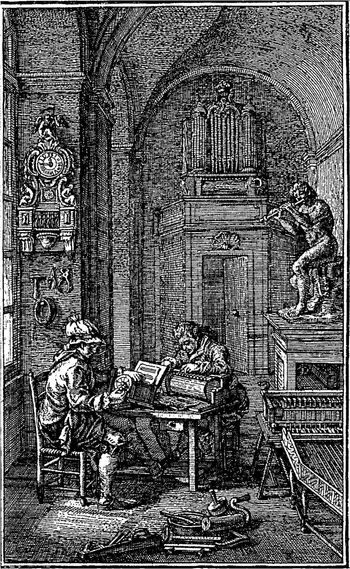
The frontispiece of La tonotechnie (see Figure 1) highlights the place of his treatise within this broader culture of public science. The engraving, as Engramelle explained,
places before the eyes of the reader the most sought-after operations of La tonotechnie […]: at the side is a cylinder-harpsichord; behind it is an automaton playing the flute, its pedestal left open to show the mechanism that drives it; at the bottom is seen a cylinder-organ, and in the light of the window a chiming clock with a pendulum.Footnote 30
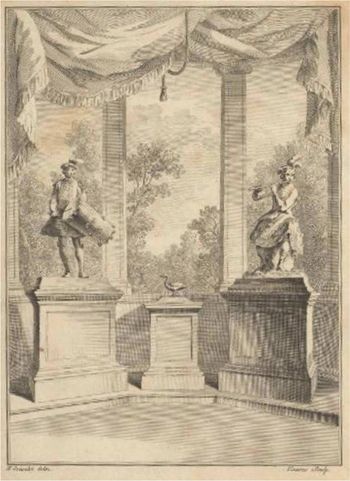
(In case there should be any doubt about the realism of this and other images in the book, Engramelle assured his reader that ‘for greater precision, the author has made all of the drawings and engravings himself’.Footnote 31) Engramelle's readers might well have recognized the flute-playing automaton pictured here as an approximation of the famous automaton flute-player crafted by Vaucanson and displayed – together with an automaton that played a pipe and tabor and another in the form of a duck that could eat, digest and expel waste – in Paris in 1738 (see Figure 2).
Frontispiece, Marie-Dominique-Joseph Engramelle, La tonotechnie, ou l'art de noter les cylindres (Paris, 1775).

Jacques Vaucanson's three automata: the flute-player, the duck and the pipe-and-tabor player. From Vaucanson, An Account of the Mechanism of an Automaton, or, Image Playing on the German-flute: As was Presented in a Memoire to the Gentlemen of the Royal-Academy of Sciences at Paris (London, 1742). Harvard University, Houghton Library, Hyde Mus. 359.10.

The relationship between Vaucanson's automata and Engramelle's treatise is noteworthy, for, as Engramelle explained, Vaucanson's creations relied on the very technology that Engramelle unveiled in La tonotechnie. In this context, it is significant that two of Vaucanson's three automata relied on music as a marker of their verisimilitude. Indeed, Vaucanson's creation of the flute-player involved technological feats that stretched the boundaries of both human capability and mechanical technology. The automaton could actually play any flute placed in its hands – an accomplishment difficult enough for human players, since the instrument presented innumerable difficulties, resulting from the variations that it required in breath control, embouchure and articulation. In the pamphlet entitled Le mécanisme du fluteur automate that he submitted to the Académie Royale des Sciences as evidence of his flute-player's authenticity and ingenuity,Footnote 32 Vaucanson stressed that the construction of this flute-player required a careful knowledge of the physical process of playing the flute. Whereas seventeenth-century automata might simulate the motions of a musician but produce sound through some unconnected mechanism, Vaucanson's flute-player actually played his instrument – breathing into it, fingering its holes with automatic finger movements, and adjusting the air pressure and angle of the instrument to alter the pitch further. It was apparently in response to viewers’ initial disbelief that the flute-player was really playing his instrument that Vaucanson felt compelled to explain its workings to the reading public.Footnote 33 In his pamphlet he stressed the connection between his automaton and a human flute-player, claiming to demonstrate ‘how these different motions have contributed to produce the effect which I have proposed in this automaton, comparing them with those of a living person’.Footnote 34 Yet, as Jessica Riskin notes, ‘he deliberately chose an instrument that involved motions he could only approximate’, yet ‘he was nevertheless able to use his simulation to discover features of its natural subject’.Footnote 35 Members of the Académie Royale des Sciences were satisfied that Vaucanson's automaton truly performed its mechanical operations to play its flute, rather than merely creating the illusion of musical performance. In his description of its workings, appended to Vaucanson's published pamphlet on his automaton, the secretary of the academy confirmed that the members of his institution had
judg'd this machine to be extremely ingenious, and that the author of it has found the means of employing new and simple contrivances, as well for giving the fingers of that figure the necessary motions, as for modifying the wind which goes into the flute by encreasing or diminishing its velocity, according to the different notes; by varying the position of the lips, and moving a valve which performs the office of the tongue; and lastly, by imitating by art all that is necessary for a man to perform in such a case.Footnote 36
The automaton flute-player thus compounded the artifice required for the playing of music. A human flautist is required to master all of the subtle and difficult aspects of performance on the instrument, adjusting air pressure, shape of the mouth, angle of the mouthpiece and so on according to the needs of the instrument and the music being played. Vaucanson studied these aspects of musical performance by means of an instrument and the human physiology and techniques needed to perform them, but he then conceived a mechanical means of imitating these human physiological processes. Through his ingenuity, he became a master of both nature and art, and it was in this doubling of the artifice involved in musical performance that he inspired the admiration of both the intelligentsia of the Académie Royale des Sciences and the public at large.Footnote 37
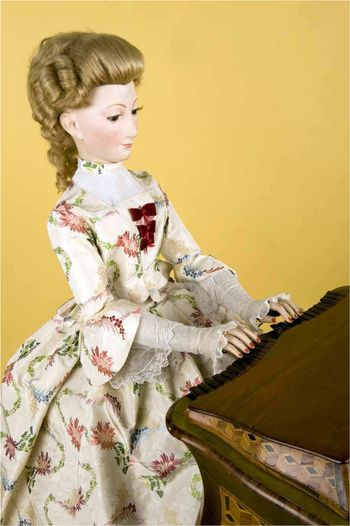
That the imitation of human expression formed an essential component of the most celebrated automata of the eighteenth century is clear from descriptions of the automaton keyboard-player built between about 1772 and 1774 by the clock-makers Pierre and Henri-Louis Jacquet-Droz. This keyboard-player (see Figure 3) is an automaton in the form of a young woman, approximately four feet high, elaborately dressed and made up, with even her fingernails polished. She is seated on a bench, and inside the bench is a pinned-cylinder mechanism – a product of the Jacquet-Droz family's expertise in clockwork – that causes her to move. Like Vaucanson's flute-player, the Jacquet-Droz keyboard-player actually plays her instrument, though it needs to be modified with a split keyboard so that her fingers can reach all the keys necessary. (Originally, she had before her a combination harpsichord-organ, but this has since been replaced by a small organ.Footnote 38) Her hands, which, as Riskin notes, display an internal construction very much like the bone structure of a human hand, operate the keys in front of her.
Pierre and Henri-Louis Jacquet-Droz, ‘The Keyboard Player’. Musée d'Art et d'Histoire de Neuchâtel, Inventory AA 1. Reproduced by permission of the Musée d'Art et d'Histoire de Neuchâtel.

But the aspects of her performance that made her most lifelike – and therefore most impressive to the spectators who paid to view her – were the movements of her body, for these gave the impression that this petite automaton was actually expressive. This feature of her performance was described in the pamphlets that the Jacquet-Droz workshop distributed; as the English version of this pamphlet explained:
The first figure represents a girl of ten or twelve years of age, sitting on a stool and playing on a harpsichord. This automaton, whose body, head, eyes, arms, hands and fingers have various motions, all which appear natural, performs several airs in two or three parts with great precision; the head has every natural motion, and the eyes look indiscriminately on its hands, the music and the spectators; the body is flexible, and inclines sometimes to see the music nearer; the bosom also rises and falls, to imitate respiration.Footnote 39
Adelheid Voskuhl has emphasized the significance of these lifelike bodily motions, arguing that they functioned as markers of the bourgeois culture of sentimentalism that became widespread in Europe in the second half of the eighteenth century. Within eighteenth-century musical culture, expression of sentiment often went hand in hand with physical movement and gesture, and the fact that these overlap within the Jacquet-Droz keyboard-player enhances both its spectacle and its ability to arouse a sentimental reaction within the audience.Footnote 40 The pamphlet's lengthy remarks about the automaton's concomitant musical performance and expressive physical motions underscore the role of such technological marvels as vehicles for shared, public experiences of sentiment.Footnote 41
Little wonder, then, that Engramelle should construct La tonotechnie upon the scaffolding of well-known automata such as Vaucanson's flute-player. In placing an image of people applying his pinned-cylinder technology to a keyboard instrument alongside an image of the famous flute-player, its pedestal open to the curious gaze of the reader, Engramelle asserted his own place at the intersection of technology, sentiment, public spectacle and shared cultural experience. Indeed, it was perhaps this sense of shared experience that prompted Engramelle – and Loulié, d'Onzembray, Diderot and others before him – to emphasize the role of his technology in constructing and preserving a French musical tradition. As these justifications imply, the technology was essential above all because it would allow listeners distant in place and time to partake of a common – and uncommonly worthwhile – social, intellectual and artistic heritage.
If the juxtaposition of automation and human expression, whether in the Jacquet-Droz keyboard-player or in Engramelle's pinned cylinders, seems incongruous today, this connection lay at the heart of the materialist philosophy of the eighteenth century. Indeed, popular cultural artefacts such as Vaucanson's automata made their way into the writings of some of the most revolutionary French thinkers of the age, who saw automata as a means of experimentation that would lead to new understandings of human life.Footnote 42 To build an automaton was to proceed, step by step, through the process of creation. Indeed, Vaucanson himself was cast as a Promethean figure in La Mettrie's L'homme machine (1748), which argues that ‘the human body is a machine which winds itself up, a living picture of perpetual movement’.Footnote 43 Rejecting the dichotomy between body and soul that lay at the heart of Cartesian dualism, La Mettrie and other materialists claimed that the soul was essentially linked to the workings of the body: when the body flourishes, so does the soul; as the body declines, the soul grows weaker as well.Footnote 44 It was on these grounds that La Mettrie and his followers asserted the usefulness of automata, mentioning Vaucanson by name and comparing him to Prometheus; in this world-view, automata served as a test case for the idea of mechanistic materialism. All life existed along a single continuum, with the principles of mechanics at its core:
We can see that there is only one substance in the universe and that man is the most perfect one. […] If it took more instruments, more cogs, more springs to show the movement of the planets than to show or tell the time, if it took Vaucanson more artistry to make his flutist than his duck, he would have needed even more to make a speaking machine, which can no longer be considered impossible, particularly at the hands of a new Prometheus.Footnote 45
Vaucanson's experiments with automated technology were playful machines, to be sure, but La Mettrie placed such play at the centre of his proof about the mechanical nature of both the human body and the soul.Footnote 46 Vaucanson himself may first have become interested in creating automata when he was a medical student, since his studies exposed him to the idea that working physiological models could teach physicians about the nature of human life; this point underscores the relationship between popular and learned science.Footnote 47 As Horst Bredekamp has shown, automata had long functioned in European society as a nexus of creative ingenuity and playful experimentation.Footnote 48
Whereas Diderot, in the Mémoires, wrote disparagingly of curiosities such as android automata,Footnote 49 Engramelle, like La Mettrie, instead placed automata front and centre in La tonotechnie, alongside conventional musical instruments that could also be programmed using pinned cylinders. He lamented the fact that the art of pinning cylinders had been ‘shrouded until now under the mysterious shadow of secrecy’, and that ‘this ignorance has deprived the public of an infinite number […] of advantages’.Footnote 50 Among these, to be sure, was the knowledge of the interior workings of automata. He claimed that the ‘notage of automata or other extraordinary instruments does not require any more difficulty than that of a small barrel organ [serinette]’,Footnote 51 and he mentioned specifically automata in the form of both keyboard-players and flute-players as examples of the combined automation of both physical motion and sound.
Yet chief among Engramelle's concerns – overriding curiosities such as android automata – was the loss of the knowledge of past performance practices owing to the imprecision of musical notation and the fleeting nature of musical performance. In expressing this concern he joined the numerous other French writers who, as discussed above, sought various means – including the use of mechanical timekeeping devices – to preserve and disseminate their national performance practices across geographical regions and through generations. Lamenting the bad musical habits and poor understanding of provincial keyboardists, who repeatedly subjected the music they played to the most insensitive realizations, Engramelle argued that use of his technology would restore French music of the past to its place of honour. Key to his understanding was the notion that the composer's intentions and manner of playing were the highest aesthetic ideal:
One may say that a well-made cylinder-driven machine would render musical works with a cleanness and a correctness in execution that even the best musician could not attain, because it would be without error, and because if these pieces were arranged on cylinders by their composers, they would transmit them to posterity in their purity; thus they would not run the risk of being disfigured after [their deaths …], for the Lullys, the Corellis, the Couperins and the Rameaus themselves would be revolted if they were to hear their pieces the way they are executed at present.Footnote 52
Engramelle envisioned the involvement of the composer in the notage of pieces – a process that, as we shall see, he claimed to have brought to fruition in his collaboration with Balbastre – so that the composer's exact performance practices could be preserved. Indeed, his frontispiece (see again Figure 1) seems to show two men of different rank working together with Engramelle's technology, and it is possible that they represent the artisan and the composer. Replication of the composer's playing style was so essential that Engramelle actually took up Diderot's challenge of ‘applying’ a pendulum to the mechanical organ, thus effecting the conflation of the ‘deux machines distinctes’.Footnote 53 Engramelle also advocated Diderot's system of calculating the number of seconds that a piece was meant to last, then determining the tempo by dividing the total time by the number of bars in the piece.Footnote 54 In Engramelle's understanding, there was little room for personal interpretation of individual players in the performance of music: the composer's intentions were of paramount importance, and it was best to preserve them right down to the last second.
Just as the Jacquet-Droz automaton keyboard-player gave the impression of both mechanical ingenuity and human expression, Engramelle's technology, he argued, permitted the encoding and reproduction of both body and soul, which were encapsulated within the ideal performance of a composer. Composers’ physical movements could be recorded in the manner and speed of their execution of a work. But, just as important, that ineffable and utterly essential component of French performance – its mouvement – could be preserved with astonishing exactness, since the precise placement (and displacement) of each note in time could be reflected in the notage for the creation of a pinned cylinder. What Couperin had described as ‘l'esprit, et l’âme’ of music – its spirit and soul, its humanity and expression – could now be captured and reproduced for generations.
A long tradition in France, some of which I have surveyed, confirmed that while freedom in musical performance, its mouvement, was essential, unruly performers also needed to be regulated by means of external machinery. The chronomêtre of Loulié and the métromêtre of d'Onzembray represented means of regulation, but the straitjacket that they imposed was too strict, even for Diderot, who was cynical in the extreme about the abilities of ordinary musicians. Engramelle combined the chronometric pendulum and the pinned cylinder, thus preserving the ideal performance: flexible in its mouvement, executed at exactly the right tempo, and fully in keeping with every nuance of the performance style of the composer. La tonotechnie represented a musical culmination of eighteenth-century materialism – not as seen, but as heard.Footnote 55
Balbastre's Romance: La tonotechnie undone?
Or such was the ideal. The results of Engramelle's project are, perhaps, more difficult to assess. They raise numerous questions related to aesthetics and performance practice, and, more broadly, authenticity and mediation, though the answers may be uncomfortably elusive.
Among Engramelle's crowning achievements was his collaboration with the composer Balbastre, which resulted in a notage of the latter's Romance published in nine elaborate illustrations in Bedos de Celles's treatise on organ-building, L'art du facteur d'orgues (1778).Footnote 56 Bedos de Celles explained that he had been poised to begin work on his own essay on cylinder-pinning for automated organs when he happened upon Engramelle's La tonotechnie, and he thought it best to allow Engramelle to write this portion of the work.Footnote 57 Engramelle took the opportunity to put into practice the sort of composer–artisan collaboration that he had advocated in La tonotechnie, and in his chapter in this later work he boasted of the success of this effort, claiming that
not only did [Balbastre] notate his piece on paper, as is seen engraved here, but he performed it many times, and his performance was followed with a watch that had a second hand. This is why one can be sure that the whole piece should not exceed 165 seconds.Footnote 58
Balbastre's repeated performances of the piece would account for fluctuations in tempo, mouvement, articulation and ornamentation, resulting in a notage that captured an idealized performance of the piece. Although Engramelle did not cite Diderot by name, it seems clear that the method that Diderot had advocated in the 1740s – using a watch with a second hand to govern the speed of a pinned-cylinder organ – was the one that Engramelle used in this project.
In his chapter Engramelle repeated a number of the principles – both aesthetic and practical – that he had laid out in La tonotechnie only a few years earlier. He outlined his lofty ambitions right from the start, describing the art of notage as ‘a manner of conceiving of music that is totally different from that taught in all the treatises on this art; it is founded on performance itself’.Footnote 59 Machines, of course, could not be relied upon to cultivate le bon goût, which meant that they would not know how to realize the mouvement of a piece of music that could only be implied in standard musical notation. The notage of a work thus demanded a level of specificity and attention to detail that was lacking in most scores, and in this sense it forced the composer and the artisan to overcome the obstacle that Couperin had described with such frustration: ‘We write differently from the way we perform’ (see above, p. 6). The cylinder-driven instrument could do no more and no less than it was programmed to do.
Although no pinned cylinder that preserves Balbastre's Romance in Engramelle's notage is known to survive from the eighteenth century, attempts have been made in the modern era to realize the notage in sound. Both the computer-generated recording made by Peter Gena and used by David Fuller in his study of Engramelle's technology and the ‘educed-sound’ realization made more recently by Patrick Feaster (sound clip 1) confirm that mouvement was an essential component of performance that Engramelle was able to capture in a way that was not possible in standard musical notation.Footnote 60
A first hearing of sound clip 1 is jarring: the music sounds comical, almost disorientated. The treble melody has a degree of flexibility that is uncommon in contemporary performance, but the ‘performance’ sounds so much like the music of an organ-grinder at a carnival that it is difficult to take seriously. Can this really be the epitome of the great French style that Engramelle had in mind? Are contemporary ears so disconnected from eighteenth-century aesthetics and performance practice that we cannot recognize le bon goût when we hear it? Or was there, perhaps, something wrong with Engramelle's technology – something that prevented him from achieving his goal of conveying Balbastre's intentions faithfully?
In fact, as I will show in the discussion that follows, it was Engramelle himself who seems to have lost faith in this process. The technology did its job exactly as he designed it to do. But in transmitting the music from one agent (the composer) to another (the automated instrument), Engramelle consciously modified Balbastre's music: he altered the composer's articulation markings, thereby changing entirely the sonic result. A second hearing of sound clip 1 may be helpful here, as it enables us to tease apart two aspects of mouvement that seem to come into conflict. First, using the description of Couperin and the interpretation of McClary – namely that mouvement constitutes the music's ‘particular way of inhabiting each successive beat’ – I propose to consider the timing and placement of each note (whether it anticipates or lags behind the theoretical ‘beat’) separately from articulation (the amount of time occupied by sound as opposed to silence).
Engramelle, like the other French writers discussed here, insisted that flexibility in the placement of notes, suggesting a degree of nonchalance, was the key to good performance. On the subject of inégalité, for example, he wrote: ‘This inequality should be varied according to the expression of the piece. […] Taste – or rather, experience with notage – will make this difference apparent.’Footnote 61 His approach to inégalité and other fluctuations in placement matches descriptions by other writers of the eighteenth century: ‘In happy pieces [the inequality] should be more marked than in pieces full of grace and with a tender expression.’Footnote 62 In approaching a cadence as well, Engramelle claims to have captured Balbastre's flexible style in the most careful way:
Notating this cadence in this way [captures] the most common manner of M. Balbastre, for sometimes he prolongs this expansion of tempo a little, gradually, and other times he decreases it: the detail that I have shown in this expansion over the duration of a semibreve will suffice to indicate the means.Footnote 63
And in ornamentation, flexibility is again essential: the speed of trills fluctuates with context and duration. These aspects of mouvement are indeed revealing, as other writers have remarked, for they shed important light on eighteenth-century French performance practice.Footnote 64
However, the left-hand articulation is more problematic. It is executed in the same detached manner in both Gena's and Feaster's realizations, and it calls into question both Engramelle's claims to represent Balbastre's intentions and the project of La tonotechnie as a whole. What is striking about these sound realizations is the extent to which each note of the left-hand accompaniment is detached from the notes around it. George Houle and Fuller both remarked on this problem: Houle characterized Engramelle's notage as ‘overly mechanical’, suggesting that nuanced articulation was ‘beyond the capability of the serinette’.Footnote 65 Fuller, admitting that a barrel organ should in theory be able ‘to reproduce every nuance of which a harpsichordist's or organist's fingers are capable’, wondered why the release of each note is everywhere ‘almost instantaneous’. Yet he also accepted at face value Engramelle's claim that ‘we have, in the matter of articulation at least, a direct link between the analysis of a playing style and its realization on cylinders’.Footnote 66 It is this point that I wish to consider more closely now.
Engramelle took numerous paragraphs – both in La tonotechnie and in L'art du facteur d'orgues – to justify his approach to articulation. He wrote that
all notes have two essential constituent parts, which are the sound [tenue, ‘holding’] and the silence. […] These should [both] be captured exactly in the notage; in this way one must express the value not only of the part of each note that speaks, but also their silences, which serve to detach them to create articulation in music, and without which [the music] cannot but produce a poor effect, similar to a musette, of which the most appalling defect is that it has no articulation.Footnote 67
He admitted that the length of the silence should be varied according to the emotional content of the music, and indeed he wrote of Balbastre's piece that ‘this Romance, being of a gracious expression, should be less detached than other, ordinary pieces; this is why the silences at the end of each note should be less short than in pieces [with a] detached [execution]’.Footnote 68 But even in pieces with a ‘tender expression’, he claimed, some articulation was still necessary after every note; ‘no note is exempt’.Footnote 69
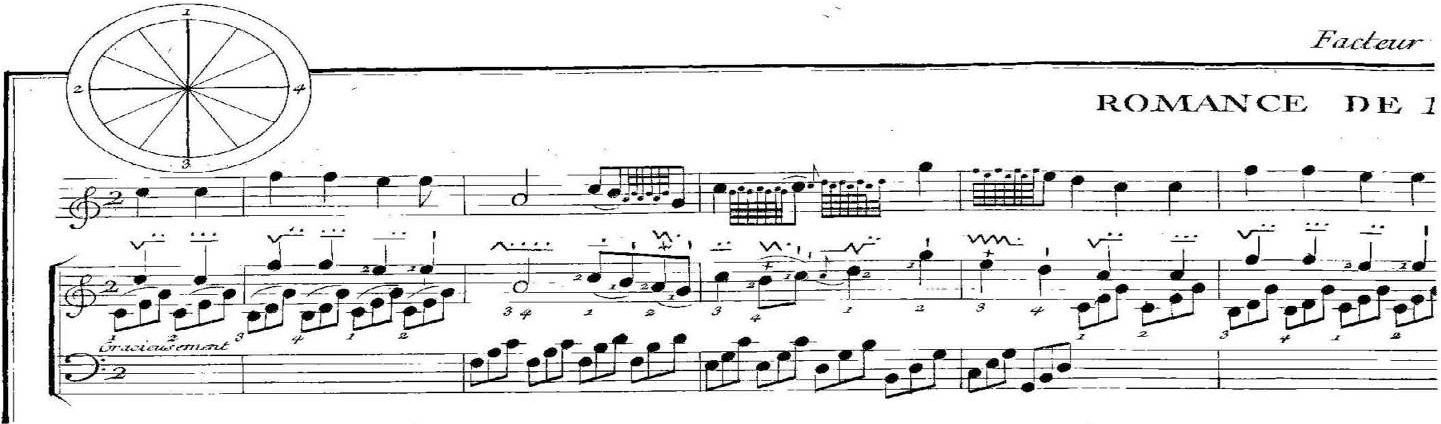
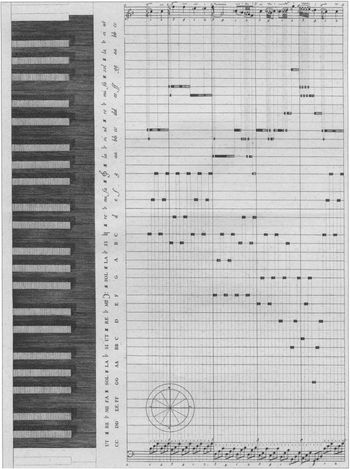
Indeed, Engramelle made a special point of altering the articulation left by Balbastre. Whereas Balbastre had written a slur over each group of three triplet quavers, each group outlining a distinct harmony (see Figure 4), Engramelle replaced these with the sharpest articulation he could. He placed a vertical line, which he called a tactée, over each triplet quaver note (Figure 5a shows the complete page; Figure 5b shows the detail with the tactée articulation). As he explained in La tonotechnie,
The character that indicates the ordinary tactée is the same that musicians use to mark a detached note. […] I have preferred to use the term tactée over détaché for these notes, because it seems to me more expressive, in that [these notes], described in this way, allow nothing to be heard but the striking of the note – that is to say, a very short sound at the beginning of the note, the rest of which is consequently in silence.Footnote 70
To convince his readers of the need for this detached articulation on every note, Engramelle challenged his reader to play ‘on an organ, a harpsichord, a spinet, or any other keyboard instrument, whatever piece he wishes’, and to pay attention to the articulation: he claimed that the finger ‘is often lifted long before the finger plays the next note […] now if [the player] pays careful attention, he will find between every note, some spaces – more or less long – without which the execution will necessarily be poor’.Footnote 71 Likening silences to the consonants of speech, Engramelle claimed that without a silence after each note, ‘the syllables would have no more distinction than the sound of unarticulated vowels’.Footnote 72
Detail of François Bedos de Celles, L'art du facteur d'orgues ([Paris], 1778), plate 119, showing the opening of Balbastre's Romance in standard musical notation and in Engramelle's shorthand for the artisan pinning a cylinder. Note the slurs over the groups of triplet quavers in the left hand.

François Bedos de Celles, L'art du facteur d'orgues, plate 120, showing Engramelle's notage for Balbastre's Romance. The slurs have been replaced by his vertical strokes known as tactées.

Detail of François Bedos de Celles, L'art du facteur d'orgues, plate 120.

While there is ample evidence that the basic articulation of the eighteenth century was a detached one,Footnote 73 the vast majority of sources on French execution stand in opposition to Engramelle's position on this accompanimental figure. Slurs over accompanimental harmonic groupings would imply a highly connected execution, and perhaps even an ‘over-legato’, in which notes are held longer than their notated value, to provide a rich harmonic foundation for the melody. In the words of Rameau (a much more experienced keyboardist than Engramelle), ‘A slur that embraces many notes indicates that one must hold them all down from one end of the slur to the other.’Footnote 74 The silence would occur only at the end of the slur. This view was echoed by writers throughout the eighteenth century. I have tried to illustrate this sort of execution as applied to Balbastre's Romance in sound clip 2.Footnote 75
Where does this leave us? Is it possible that Engramelle exaggerated the extent of Balbastre's involvement in the preparation of the notage for the Romance? Alternatively, could Balbastre have made himself available to embark on this musical experiment with Engramelle, not taking it seriously as a true representation of his art? Could he have judged this automated technology to be a curiosity, in the same way that Diderot viewed the automata of Vaucanson? Or could the composer have been willing to play for Engramelle but have neglected to follow up by listening to the sonic result? Finally, is it possible that no sonic product was ever produced, and instead, that the notage for the Romance remained inscribed silently in a book – an artwork unto itself? Engramelle wrote that the piece ‘was reviewed by [the composer] himself’, and that Balbastre confirmed that ‘it is in his true manner of performance’.Footnote 76 But it seems possible that the composer was only looking at the notage – not hearing the musical result.
Perhaps the most likely answer is that Balbastre's collaboration with Engramelle, like La tonotechnie itself, was a public performance in the science and technology of music, a thought experiment that sought to pique the curiosity of readers and listeners even as it tested the implications of automated technology for musical practice. Engramelle lamented the fact that so few great composers knew how to apply La tonotechnie to preserve their music. But Engramelle himself was not a composer or musician of any renown, and the aesthetic result of his effort raises as many problems as it answers. Whatever the motivations – philosophical, musical, scientific or commercial – that lay behind his efforts to preserve musical practice through this mechanical technology, musical texts and performances remained mired in the messy subjectivity of players, listeners, technologists and composers. Like other thinkers of the French Enlightenment, Engramelle chased the chimera of certain knowledge, but ‘l'esprit, et l’âme’ of French music remained as elusive as ever.