In global politics, climate change is increasingly conceived as a security issue. Key international institutions, most notably the UN Security Council but also the UN General Assembly, have discussed the regional and international security implications of climate change on several occasions since 2007. A range of states, by one estimation over 70% of those who have released national security strategy documents (Scott Reference Schlosberg2015, 1330), have explicitly recognized the threat of climate change in national security planning. And while finding increasing purchase at the level of security practice in global politics, public policy-oriented think-tanks have particularly emphasized the role of climate change as a ‘threat multiplier’ (see Dalby Reference Dalby2015b).Footnote 1 These voices have joined media outlets and international organizations in linking climate change to contemporary conflicts in Darfur and Syria, for example, and even to the rise of Daesh (see Strozier and Berkell Reference Trombetta2014; Schafer, Scheffran, and Penniket Reference Schwartz and Randall2016). And of course, a range of scholars of international relations have explored the relationship between climate change and security, with several suggesting it constitutes the security issue confronting present and future generations (see Burke, Lee-Koo and McDonald Reference Burke, Lee-Koo and McDonald2016).
But if we have seen the increasing ‘securitization’ of climate change in global politics, it does not follow that we have seen a consensus about the way in which climate change threatens security or indeed on the issue of whose security it threatens. While some actors have focused on climate change as a trigger for conflict and associated threats to national security (Busby Reference Busby2007, Reference Busby2008), others have focussed on the challenges posed to international stability or to the lives and livelihoods of vulnerable human populations directly exposed to manifestations of climate change (Barnett et al. Reference Barnett, Matthew and O'Brien2010). These different conceptions of the climate change–security relationship can ultimately be located in different security discourses: frameworks of meaning with different conceptions of whose security is at stake; what threatens security; which actors are capable of or even responsible for providing security; and through what means. The latter point is a particularly important feature of these discourses, suggesting that these frameworks encourage different sets of responses to climate change (see McDonald Reference McDonald2013; Floyd Reference Floyd2015; Diez, von Lucke, and Wellmann Reference Diez, von Lucke and Wellmann2016; Hardt Reference Hardt2017). While some discourses privilege adaptive measures to protect the sovereignty and territorial integrity of the state, others encourage urgent mitigation efforts oriented to the welfare and resilience of vulnerable communities.
Recognition that there are multiple ways of approaching this relationship, and that these have different implications in terms of the practices they encourage and discourage, raises important questions. Certainly, it raises questions about the analytical, political, and ethical choices made around how to conceptualize this relationship. But more importantly, a recognition that different discourses encourage different responses to climate change raises questions about what types of discourses are most likely to encourage progressive approaches to climate change, oriented towards addressing the problem itself and the needs of those most vulnerable to it. How should we approach the climate–security relationship? What sets of assumptions and choices should inform the way political communities come to understand (and subsequently approach) this relationship? And what possibilities exist for such a discourse of climate security to find support or purchase within those communities?
In this paper, I make a case for an ecological security discourse in informing approaches to the climate change–security relationship. Such a discourse is oriented towards ecosystem resilience and with it the rights and needs of the most vulnerable across time, space, and species: impoverished populations in developing states; future generations; and other living beings. It suggests the need to radically alter the way we conceive of the relationship between humans and the natural world (see, e.g. Morton Reference Morton2007), not least in the context of the Anthropocene, and the need to orient our actions towards maintaining ecosystem functions in the context of perturbation and change. The focus here is on urgent mitigation action to quickly reduce greenhouse gas emissions, but with a place for adaptation to what are now unavoidable impacts of climate change. And in terms of agency, all those with the capacity to generate avoidable harms to ecosystems have a responsibility to provide ecological security, with those responsibilities varying based on the extent of contribution to those harms and the capabilities of those actors.
This discourse of climate security faces difficult challenges. For some, any attempt to articulate a framework that extends our moral universe beyond contemporary human communities is inherently problematic. Objections range from the tendency towards misanthropicism or ecofascism to the impossibility of accounting for the needs of non-humans or future humans, to the difficulty of how we define the biosphere or ecosystems themselves in need of protection (see McShane Reference McShane2014). Then there are strategic questions of practicality and purchase. With significant challenges facing attempts to orient security practices towards the rights and needs of vulnerable human populations, is it really possible to imagine an ecological perspective genuinely informing the way key institutions and the communities they represent approach climate security? And of course, there is the issue of whether we should engage with ‘security’ at all, not least given concerns that security constitutes a ‘master narrative’ that serves to preserve a national or international status quo and concerns that ‘securitization’ will encourage inappropriate and even counter-productive responses to climate change. This paper will address these concerns, engaging with ethical and analytical objections while making the case that we need to engage security precisely because it underpins the legitimacy of the key institutions of global politics. In this sense, the politics of security necessitates engaging with attempts to securitize climate change, pointing to the implications of different climate security discourses, and making a case for a more progressive framework for approaching this relationship.
This paper proceeds in four stages. In the first section, I make a case for approaching this question through the lens of competing security discourses. The second section notes engagement with the climate change–security relationship, locating this engagement in discourses of climate security. The third section of the paper outlines the key contours of an ecological security discourse regarding climate change. I conclude with a discussion of the significant challenges facing its articulation, embrace, and institutionalization, noting possibilities for such a discourse to inform political practice.
Why security?
There is nothing inevitable about approaching climate change, or contestation over approaches to climate change, through the lens of ‘security’. For some, security might be largely irrelevant to this contestation. Broader arguments about the distribution of costs, timeframes, and vulnerabilities playing out in the United Nations Framework Convention on Climate Change (UNFCCC) process may be viewed as far more consequential to the international politics of climate change than (even high-profile) discussions in the UNSC. Maarten Hajer (Reference Hajer1995) has mapped discursive contestation over environmental change in a manner similar to that employed here, without defining this competition as orienting around the question (or content) of security (see also Dryzek Reference Dryzek1997). And Matthew Paterson (Reference Paterson2009) has argued that the language of economics and ethics has been more successful in mobilizing international responses to climate change and feeding into consequential discussions about its impacts in the Intergovernmental Panel on Climate Change (IPCC), for example. These analyses question the necessity of approaching contestation over climate change as contestation over the meaning and practice of security.
For others still, rather than irrelevant to or unnecessary for understanding the politics of climate change, the language of security may, in fact, be dangerous. Daniel Deudney (Reference Deudney1991) has cautioned against linking the environment and security, suggesting that the logics of the latter are inconsistent with effective responses to environmental change, risking the militarization of the environment. In linking security with illiberal, state-based practices, Deudney here outlines concerns later articulated by theorists of the Copenhagen School. These theorists reject the idea of an abstract, universal definition of security, and point instead to the constructed nature of security. For them, the process of securitization entails speech acts depicting particular issues as existential threats being endorsed by relevant constituencies, enabling emergency measures in response to that threat. Rather than simply developing an analytical account of the politics of security, however, Ole Wæver (Reference Watts1995) and others advanced the normative claim that desecuritization (the removal of issues from the security agenda) is generally to be preferred in practice. For these theorists, rejecting security follows their view that ‘at the heart of the concept (of security) we still find something to do with defence and the state’ (Wæver Reference Watts1995, 47), and/or because security has a logic that is ultimately illiberal, exclusionary and exceptionalist (Buzan, Wæver, and Wilde Reference Buzan, Wæver and Wilde1998; McDonald Reference McDonald2008; Hansen Reference Hansen2012).
This skeptical view is generally endorsed in post-structural accounts of security, which have tended to define security representations as state declarations of the ‘exception’ that serve to enable control of populations and exceptionalist practices (e.g. Berki Reference Berki1981; Campbell 1992; C.A.S.E. Collective Reference Campbell2006). Most starkly, in Mark Neocleous’ terms, security can be understood as:
the master narrative through which the state shapes our lives and imaginations … producing and organizing subjects in a way that is always already predisposed towards the exercise of violence in defence of the established order (Reference Neocleous2008, 5).
Finally, rejecting security is also a recommendation of recent post-humanist accounts of ecology with which this paper shares common philosophical and normative ground. Cudworth and Hobden (Reference Cudworth and Hobden2013, 664), for example, warn against approaching environmental issues ‘within the existing frameworks of securitization and governance’ (on this point, see also Buxton and Hayes Reference Buxton and Hayes2015; Marzec Reference Marzec2015; Fagan Reference Fagan2017).
By and large, the analysis to follow does not challenge the arguments advanced by Hajer, Paterson, and others that it is possible to examine contestation over environmental change generally, and climate change specifically, other than through the lens of security. This is clearly the case. What I would suggest here, however, is that the attempt to draw linkages between security and climate change are becoming more prominent and consequential, as noted. Recent analyses of the role of climate change in conflict in Syria (Gleick Reference Gleick2014; Baker Reference Baker, Matthew and O’Brien2015; Selby et al. Reference Smith and Vivekananda2017) and even the rise of Daesh (Strozier and Berkell Reference Trombetta2014), building on earlier discussion of the role of climate change in conflict in Darfur (Moon Reference Moon2007; UNEP Reference Von Lucke, Wellman and Diez2007), illustrates growing engagement with the role of climate change as a so-called ‘threat multiplier’ (CNA Reference Clark2007). It has found its way into deliberations of key international institutions (from the UN Security Council to the General Assembly), and features more often than not in states’ national security strategy documents (Brzoska Reference Brzoska2008; Scott Reference Schlosberg2015).
If this is the case – if climate change is increasingly ‘securitized’ or defined as a security concern (see Von Lucke, Wellman, and Diez Reference Wæver2014; Diez, von Lucke, and Wellmann Reference Diez, von Lucke and Wellmann2016; Hardt Reference Hardt2017)- it becomes particularly important to ask how that relationship is conceived and what types of practices might follow from it. The argument for engaging security becomes even more compelling if we view security as politically consequential: defining priority and urgency for dealing with issues, and underpinning the political legitimacy of the key actors in global politics (see Browning and McDonald Reference Browning and McDonald2013).
It is precisely this sense that security is fundamental to political legitimacy, that it serves to define the core values of communities in need of preservation or advancement, and that it ultimately designates ‘high politics’, which helps account for the volume of attempts to promote issues such as climate change as ‘security’ issues. For proponents, through such attempts neglected international issues might be given the attention, funding, and priority they deserve (see Hartmann Reference Hartmann2009; McDonald Reference McDonald2013). In this context, Copenhagen School theorists and theorists working in the post-structural tradition are right to suggest we should not assume that securitization amounts to effective and progressive mobilization. In a range of settings, not least as invoked by national governments and their militaries, securitization seems to limit political deliberation or enable illiberal sets of (exceptional) practices (Marzec Reference Marzec2015).
While right to note that we should be wary of the politics of security, however, the associated call to reject or escape security is built on a monolithic and universalist logic and meaning of security, not the essence of security itself (see Nunes Reference Nunes2013). Ultimately, the effects of linking climate change and security are different in different historical and political contexts (see Hayes and Knox-Hayes Reference Hayes and Knox-Hayes2014), while the specific implications of depicting this issue as a security issue are a product of the way in which that linkage is made. Ultimately, the politics of security – the question of what security does – is a product of the discourse of security invoked and the context in which it is applied.Footnote 2 Once we recognize security as a site of contestation between alternative discourses, we can begin to recognize the multiple different logics, institutions, and practices associated with security – some better, some worse than others. This was illustrated clearly in the UNSC debates. Here, even those participants welcoming the discussion of this issue within the UNSC differed over the nature of the threat posed by climate change and what constituted an appropriate response to it (see Oels Reference Oels2012).
Finally, while sympathetic to the normative position of Cudworth and Hobden (Reference Cudworth and Hobden2013), I would suggest that their concerns about securitization are directed at a particular (albeit dominant) discourse of environmental or climate security. If alternative discourses come to define responses to climate change – discourses consistent with cosmopolitan principles, ecosystem resilience and/or the rights and needs of vulnerable beings – then we should expect different and often more progressive practices to follow. In these senses, it is not simply possible to read contestation over climate change as contestation over the meaning of security, but politically important to recognize the logics and pathologies of different discourses of climate security, the sources of their power or marginalization, and the practices they encourage (see Dalby 2009).
Climate security discourses
While environmental issues provided a central example for those concerned with broadening the agenda of security studies in the 1980s and 1990s, in particular, climate change did not feature prominently. Early arguments focussed on the likelihood of conflict arising as a result of scarce resources: as displaced populations came into contact with each other, or as groups fought over access to dwindling resources. While the work of Thomas Homer-Dixon (Reference Homer-Dixon1991, Reference Homer-Dixon1999) generally emphasized the complex interplay between environmental change and social and political dynamics that might contribute to intrastate war, in particular, others were less sanguine in suggesting the possibility that contestation over the ‘environment’ might trigger interstate war. The 1990s, in particular, saw a series of analysts predict a future spate of ‘water wars’. For these analysts, drawing either implicitly or explicitly on realist thought (see Stucki Reference Strozier and Berkell2005), transboundary water resources could become a site of conflict as states looked to manipulate these resources for their own ends, particularly in the arid and politically volatile Middle East (see Bulloch and Darwish Reference Bulloch and Darwish1993; Gleick Reference Gleick1993).
This latter example of possible environmental conflict over transboundary water resources is problematic for a range of reasons. On methodological and indeed empirical grounds this link has been consistently and convincingly challenged (e.g. Wolff Reference Yusoff1998; Allan Reference Allan2002) while the (realist) assumptions frequently underpinning these analyses are all too often unacknowledged. And while a high-profile example for environmental security, the example of ‘water wars’ is striking for the fact that the role of environmental change itself has largely been marginal to this literature. This relates to a broader problem with environment–security research identified by authors such as Simon Dalby (2009), Jon Barnett (Reference Barnett2000), Hartmann (Reference Hartmann2009), Harrington and Shearing (Reference Harrington and Shearing2017), and Cudworth and Hobden (Reference Cudworth and Hobden2011): the tendency to define the ‘environment’ in such a way as to separate it from humanity and the conditions of human existence.
It was not until the 2000s, and in particular, the mid-2000s, that the climate change–security relationship began to dominate accounts of the relationship between the environment and security, reflecting the place of climate change in considerations of environmental change more broadly. Building on an upsurge of global concern regarding climate change in this period (see Oels Reference Oels2012), analysts ‘rediscovered’ the environment–security relationship regarding the issue of climate change. In turn, analysis of this connection found its way on to various national and international political agendas.
Some interventions, arguably those advanced by the most consequential security actors, focussed on the idea of climate change as a threat to national security. Here, analysts and practitioners explored the ways in which climate change might pose a threat to the sovereignty and territorial integrity of the nation-state. Think-tanks attempting to address the concerns of policy-makers were particularly active in examining this possible relationship, with prominent American think-tanks such as the CNA, the Council on Foreign Relations and the Centre for a New American Century all publishing studies on the ways in which climate change might act as a ‘threat multiplier’, complicating US national strategic considerations (see Busby Reference Busby2007; CNA Reference Clark2007; Burke and Parthemore Reference Burke and Parthemore2008, respectively). And examinations of the national security implications of climate change were taken up by Governments, with a range of defence departments ‘incorporating’ considerations of climate change into their national security planning and documents. These included the United States, United Kingdom, Australia, Germany, Finland, Pakistan, Vietnam, Bangladesh, New Zealand, and many others (see American Security Project 2014). Here, state governments and militaries are seen as key agents for the provision of climate security (see Brzoska Reference Brzoska2008; Scott Reference Schlosberg2015).
A related discourse explored threats that climate change posed to international security and stability. Most recently, a range of analysts has claimed that conflict in Syria and the conditions for the rise of Daesh itself were in part created by dynamics of climate change (Gleick Reference Gleick2014; Strozier and Berkell Reference Trombetta2014; Baker Reference Baker, Matthew and O’Brien2015).Footnote 3 The notion that climate change potentially posed a threat to regional and international stability was particularly prominent in United Nations interventions on the climate change–security relationship. The United Nations Environment Programme and UN Secretary-General Ban Ki-moon both linked earlier civil conflict in Darfur to climate change, suggesting in the process the likelihood that climate change posed a potentially broader threat to regional and international stability (Moon Reference Moon2007; UNEP Reference Von Lucke, Wellman and Diez2007). This was taken up in UNSC discussions of the international security implications of climate change in 2007 and 2011, with subsequent Arria Formula meetings of the UNSC also exploring this issue in 2013, 2015, and 2017 (see Scott Reference Schlosberg2015). An International Alert publication (Smith and Vivekananda Reference Steffan, Crutzen and McNeill2007) focussed on threats to international stability associated with climate change, noting some 40 states at risk of climate-induced conflict. While the emphasis in these interventions remained largely violent conflict, the referent object was defined ultimately as an international society, with conflict threatening the norms and rules of that society and the capacity of its institutions to function effectively. Agency here was defined in terms of international cooperation to act to reduce emissions or to manage responses to climate-induced conflicts. A Brookings Institute report noted that risks to international peace and security associated with climate change required ‘well-conceived actions within the UN system’ (Purvis and Busby Reference Purvis and Busby2004, 72).
Other framings of the climate change–security relationship defined climate change as a human security threat. Here, the emphasis was less on the preservation of the status quo or threat of climate change in terms of triggering violent conflict, and more on the rights and needs of individuals whose well-being would be fundamentally undermined by manifestations of climate change. This was evident in the way some state aid agencies approached this link, such as DFID in the United Kingdom (e.g. Harris Reference Harris2012). Human security was also explicitly endorsed in the way UNDP (2008) and UN General Assembly (2009) reports conceptualized the climate–security relationship. Most recently, the IPCC included a chapter on Human Security in its Impacts, Adaptation, and Vulnerability 5th Assessment Report of 2014. And under the auspices of the Global Environmental Change and Human Security project, funded by the Norwegian government, a range of analysts attempted to make a case for framing climate change as a human security threat. Here, human security was defined in terms of the capacity ‘to end, mitigate, or adapt to threats to … human, environmental or social rights’, to ‘exercise these options’, and ‘actively participate in pursuing these options’ (Barnett et al. Reference Barnett, Matthew and O'Brien2010, 18). While people were returned to the centre of analysis as the key referent object of security, the agency was defined in broad terms, emphasizing the potential capacity of states, institutions, sub-state groups, and global civil society forces as providers of climate security (see also O’Brien Reference O’Brien2006).
The differences across these discourses of climate security (from the national to the international to human security discourses) are striking. Clearly, they conceive of the nature of the threat posed and the question of whose security is threatened in varied ways. But in political and normative terms, differences between these discourses are significant for the very different responses to climate change they encourage. While human security discourses encourage mitigation of climate change through the reduction of greenhouse gas emissions, national security discourses tend to orient towards adaptation in response to manifestations of climate change. In exploring national security implications of climate change, for example, Joshua Busby argued, ‘adaptation and disaster risk reduction strategies should be the priority response for climate security concerns’ (Reference Busby2008, 500). And in a Pentagon-commissioned report on the national security implications of an abrupt climate scenario for the United States, Schwartz and Randall (Reference Scott2003) suggested that some relatively self-sufficient states might focus their attention on constructing more effective national barriers to keep out populations displaced as a result of manifestations of climate change (whether rising sea levels or extreme weather phenomena).
The problems with such a response to climate change are immediately clear. A global problem is approached in terms of its implications for nation-states; a problem requiring global responses is defined in terms of the responsive capacities of individual states; and the problem of climate change itself is not addressed at all, only its manifestations. This leaves those without the equivalent adaptive capacity to respond to climate threats (impoverished populations, future generations, and other living beings) wholly exposed to these effects, and even represented as a potential threat to the nation-state. Indeed some have suggested that core national values of political communities (the right to high standards of living and continued economic growth) are threatened by mitigation strategies (e.g. Schaefer et al. Reference Schaefer, Annett and Antonelli1997). The focus on the maintenance of international stability in international security discourses regarding climate change at least acknowledges climate change itself as a problem in need of a response. But the primary commitment to preserving existing international systems and institutions is problematic given the ways in which contemporary political and economic institutions are implicated in (and even drive) processes of global climate change.
Finally, while the embrace or implementation of a human security discourse confronts relatively predictable political/ practical impediments, it also has significant normative limitations in the context of climate change. Such an approach to climate change draws our attention to vulnerable people and to the need to focus our attention on mitigation strategies, but it fails to address obligations to future generations or other living beings. Of course for some, drawing ethical boundaries at currently living human populations is inherently partial and limited (see Eckersley Reference Eckersley1992; Mitchell Reference Mitchell2014). But it is particularly problematic in the context of the Anthropocene and the changing nature of the relationship between humanity and ecosystems, to be discussed. There is also a tendency here to default to key existing institutions as agents of climate security on pragmatic grounds, as witnessed in the ‘adoption’ of human security by a range of states and international organizations (see Booth Reference Booth2007, 323–26). The danger here is that a human security discourse will be defined and limited by those actors with an interest in their institutional survival, even with an interest in the continued functioning of a global fossil fuel economy.
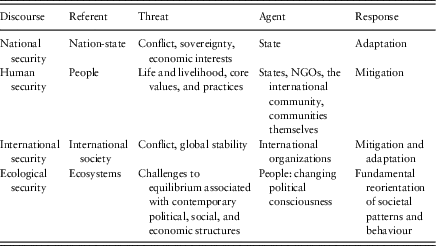
The contours and pathologies of various discourses of climate security are represented in Table 1. This is, of course, necessarily a simplified account, one that downplays some of the overlaps between and debates within these discourses. And of course, no single discourse ever completely captures the ways in which particular political communities approach the climate change–security relationship. The key points to note, however, are that there are multiple different ways of conceiving the climate change–security relations in both theory and practice, with different implications in terms of the practices they encourage. Some prioritize the maintenance of unsustainable lifestyles at the extreme; others might encourage adaptation to climate change that fails to address the problem itself or the rights of vulnerable others. For that reason, we should not simply endorse the securitization of climate change, even if it means mobilization or political attention (see also Dalby Reference Dalby2015b; Floyd Reference Floyd2015). But neither should we abandon security altogether. Security is increasingly tied to climate change in practice, of course, making engagement with the pathologies and contours of these (different) linkages all the more important. If claims of security and threat serve to define priority, urgency, and even political legitimacy, the concept is also too politically significant, as Ken Booth (Reference Booth1991, Reference Booth1999) has argued, to be left to strategists. And if security is viewed as a site of contestation between different actors articulating different ideas of who we are, what we value and how (and from what) those values are to be protected or advanced (see McDonald Reference McDonald2012), we need to advance credible alternatives that can serve to provide the lens through which the climate change–security relationship is viewed, and serve in turn to guide effective responses to threats as fundamental and existential as global climate change. This is the task of the remainder of this paper.
Climate Security Discourses (adapted from McDonald 2013, 49).

Ecological security and climate change
In work exploring the links between climate change and security, there is a clear tendency for advocates to attempt to employ the language of security to mobilize political action on climate change. This has often involved defining this relationship in such a way as to speak to the immediate concerns of the state and the key institutions of international politics to encourage effective environmental action. Indeed as Hartmann (Reference Hartmann2009) has illustrated, many of those making the link between the environment and security are representatives of environmental organizations or think-tanks (Mathews Reference Mathews1989; Myers Reference Myers1989; Renner Reference Renner1996). The tendency to invoke the powerful and often resonant language of ‘national security’ to justify progressive climate practices was even apparent in President Obama’s argument that the United States should invest in renewable energy to reduce its energy reliance on undemocratic regimes in the Middle East (see Hayes and Knox-Hayes Reference Hayes and Knox-Hayes2014; Dalby Reference Dalby2015b).
But even with the best intentions, harnessing the mobilizing potential of security is fraught with danger. This is illustrated by Obama’s ‘energy security’ justification for the shift towards renewable energy. While this logic might justify a movement away from fossil fuel consumption, it could also be used to justify the expansion of coal seam gas fracking or domestic oil exploration in the Alaskan wilderness, for example. Neither does such a justification engage with the necessity of reducing consumption, recognize the role of contemporary energy use in creating climate change or acknowledge the more pressing vulnerabilities experienced by impoverished populations, future generations, or other living beings. In short, it is not enough to link climate change and security in the hope that progressive practices will follow from the invocation of security and threat. If the ‘first principles’ of these discourses – their ethical foundations – are insufficiently oriented towards the rights and needs of the most vulnerable, we cannot expect the practices they encourage to consistently serve progressive ends. While defining climate change as a threat to national security may generate attention from the national security establishment, it may encourage practices inconsistent with addressing the problem itself. In this context, I make a case for an ecological security discourse, oriented towards ecosystem resilience and with it the rights and needs of the most vulnerable from the threat posed by climate change. Before outlining the possibilities for this discourse constituting the lens through which political communities view the relationship between climate change and security, and even security more broadly, I will outline the key contours of this discourse.
The environment and the Anthropocene
At an immediate level, the first distinguishing feature of this climate security discourse concerns the focus on ecosystems rather than the ‘environment’. The latter tends to suggest a natural world distinct and distinguishable from the human world (see Morton Reference Morton2007; Cudworth and Hobden Reference Cudworth and Hobden2011), encouraging us to view the ‘environment’ as a resource to be exploited or even as a source of threat (e.g. Kaplan Reference Kaplan1994).
While frequently normatively problematic this is also analytically misleading given the arrival of the new geological age of the ‘Anthropocene’.Footnote 4 In the words of the International Geosphere Biosphere Program authors (Steffan et al. Reference Stucki2004, 1) this refers to a situation in which:
human activities are now so pervasive and profound in their consequences that they affect the Earth at a global scale in complex, interactive and accelerating ways; humans now have the capacity to alter the Earth System in ways that threaten the very processes and components, both biotic and abiotic, upon which humans depend.
The notion of the Anthropocene, introduced to the mainstream debate by Paul Crutzen in 2000, fundamentally challenges still-dominant ideas of an external environment central to modernity (see Steffan, Crutzen, and McNeill Reference Steffan, Sanderson, Tyson, Jäger, Matson, Moore III, Oldfield, Richardson, Schellnhuber, Turner and Wasson2007; Sample Reference Sample2014). In an era in which humanity is so implicated in the conditions and dynamics of environmental change, the idea of a separation between humanity and nature becomes difficult if not impossible to sustain. Indeed for some, the Anthropocene changes the nature of what it means to be human (see, e.g. Yusoff Reference Zebrowski2013; Clark Reference Christoff2014).
Yet, if the geological reality of the Anthropocene questions the separation between humans and nature so central to a range of accounts of the ‘environment’ and certainly ‘environmental security’, it also challenges the normative commitment to ecosystem balance or equilibrium in some early accounts of ecological security. In perhaps the most explicit direct discussion of ecological security, Dennis Pirages (Reference Pirages2005, 4) describes it as resting on:
Preserving the following four interrelated dynamic equilibriums:
1) Between human populations living at higher consumptions levels and the ability of nature to provide resources and services;
2) Between human populations and pathogenic microorganisms;
3) Between human populations and those of other plant and animal species;
4) Among human populations.
Pirages (Reference Pirages2005, 4) argues that imbalance in any of these equilibriums can be viewed as insecurity.
Yet, notions of ‘balance’ or ‘equilibria’ sit uneasily with the contemporary realities of environmental change (see Fagan Reference Fagan2017). They imply the possibility of a return to a previous (geological) era, while the focus on preservation means downplaying the enormity of change and the role of human populations in creating that change. As a range of analysts have suggested, by necessity the future of life on Earth, and with it, the role of ecosystems themselves, may look markedly different from the past (Steffan, Crutzen, and McNeill Reference Steffan, Sanderson, Tyson, Jäger, Matson, Moore III, Oldfield, Richardson, Schellnhuber, Turner and Wasson2007; Schlosberg Reference Schafer, Scheffran and Penniket2013; Dalby 2015a). This suggests the need to think in different ways about what ecosystems can and should do, and what capacities there are to fulfil those functions traditionally associated with them.
From balance to resilience
In this context, here I suggest that ecological security should be oriented less towards the preservation of balance and more towards ecosystem resilience. This refers to the capacity of ecosystems to function to sustain life across time and space, retain their ‘organizational structure following perturbation’ (Barnett Reference Barnett2001, 110) and to ‘absorb change while retaining essential function’ (Adger, Brown, and Waters Reference Adger, Brown and Waters2011, 696). Such a conceptualization retains a focus on complex inter-relationships between ecosystems and humans, but more easily accommodates dynamics of ongoing environmental change. With some degree (or more accurately, degrees) of climate change now ‘locked in’ (see Christoff 2013; IPCC 2014), it is clearly necessary to develop an understanding of climate security that focusses on the mitigation of the problem itself while responding to the inevitable effects of climate change and our (continued) role in contributing to it.
The notion of resilience is helpful in this sense, though of course not without its dangers and limitations. David Schlosberg (Reference Schafer, Scheffran and Penniket2013, 13) notes that a focus on resilience can suggest a need ‘to simply adapt to, rather than understand and resist’ climate change, in the process undermining the continued urgent need for climate mitigation. And while resilience has become a ubiquitous concept across a range of academic fields (from community resilience to the resilience of vulnerable populations, infrastructure, and trade, for example), its growth and its political embrace have raised suspicions that the concept constitutes a new mechanism or rationality of neoliberal governance (see Zebrowski Reference Zebrowski2013; Evans and Reid Reference Evans and Reid2014; Cavelty, Kaufmann, and Kristensen Reference Cavelty, Kaufmann and Kristensen2015). As Kevin Grove has argued, ‘the effect of resilience initiatives is often to defend and strengthen the political economic status quo against uncertainty and surprise’ (Reference Grove2013, 146).
Yet, if the growing scale and transnational nature of threats in global risk society has transformed notions of resilience into a ‘master narrative’ of contemporary security (Watts Reference Wolff2013, 86; see also Grove Reference Grove2013; Aradau Reference Aradau2014), the realities of dynamics of environmental change mean we need to think of ecological security in a manner that enables us to recognize and respond to a changed and changing world. In the context of ecosystem resilience and ecological security, resilience should not imply acceptance of and adaptation to change. It must entail a focus on proactive and radical measures to minimize the scale and severity of change in order to help ensure ecosystems continue to function (see Corry Reference Corry2014; Bourbeau Reference Bourbeau2015).
Whose security?
There are therefore compelling pragmatic reasons to focus our attention on the possibilities for the resilience of dynamic, complex, and inter-related ecosystems that will experience perturbation and change. But in turn, there are compelling normative reasons to focus our attention on ecosystems in the context of climate change relative to states, international society or human societies. While discourses of national and human security are fundamentally different in terms of their ethical assumptions and implications, for example, the tendency to endorse a focus on human communities and/or the institutions that represent them entails inadequate attention to the rights and needs of other living beings or future generations. They also inadequately tie us to the conditions of our own existence. The focus here is therefore on ecosystems themselves, a more ethically defensible referent object in the context of climate change even if one that throws up a series of complex moral and practical problems.
The normative commitment to this focus on ecosystems draws on a holistic approach to ethics (see Pojman Reference Pojman2005; Nolt Reference Nolt2011, Ch. 22–28). It suggests the need to challenge the anthropocentrism of existing accounts of environmental ethics and security, and to develop an approach that allows us to recognize the complex relationships between species (see Eckersley Reference Eckersley1992). This focus on the dynamic inter-relationship between beings, while clearly informed by ecological thought, also attempts to move beyond traditional binaries of anthropocentrism vs. ecocentrism, or the welfare of individual beings contrasted with the preservation of ecological wholes, for example (see Eckersley Reference Eckersley2005; McShane Reference McShane2014). Debates about the choice between humans and the environment, intrinsic or instrumental value of beings or the needs of ecological systems and the value of individual beingsFootnote 5 have largely failed to precipitate a wholesale shift in the ways in which we comprehend or approach environmental issues, and has allowed ecological debate to be cut-off from broader ethical and philosophical debate. In a manner consistent with so-called ‘second wave’ green political theorists (see Eckersley Reference Eckersley2005, 365), the focus here is on recognition of interdependence in a manner that addresses the needs of both vulnerable human populations and other species (see Burke, Lee-Koo, and McDonald Reference Burke, Lee-Koo and McDonald2016). The arrival of the Anthropocene builds on this recognition, of course, underscoring the dynamic inter-relationship between humans and the ecosystems in which they live.
Within such an approach, the emphasis on the resilience of ecosystems is viewed as the best means to ensure not only the long-term survival of life but to ensure appropriate ethical consideration for vulnerable beings. This clearly applies to other living beings and future generations (see Page Reference Page2006), but applies in varying degrees to currently living human populations with limited capacity or resources to influence decision-making on their behalf or to respond to large-scale manifestations of climate change.
Of course, such a position can be (and has been) criticized on both moral and pragmatic grounds. Central among these is the inability to truly know the perspectives of those on behalf of whom we claim to act; the inability to escape our own humanity and therefore anthropocentrism (see Floyd Reference Floyd2013; Fagan Reference Fagan2017); and the challenges associated with integrating a concern for future generations, who may in fact not exist if our action or inaction allows ecosystems to decline significantly.Footnote 6 Pragmatic objections focus on the fact that it is excessively morally demanding (see Nolt Reference Nolt2011), or that it lacks the political constituency to genuinely advance such a position. Indeed this is central to Jon Barnett’s (Reference Barnett2001) rejection of ecological security, a point I will return to later. And a holistic-level focus does not give us a ready-made set of resources for prioritizing or even potentially adjudicating between different harms experienced between or within species.
Many of these objections can be applied to any group or institution: not all people are equally capable of contributing to conversations about national- or even local- security, and claims to speak on behalf of other members of a broader society are often little more than claims. Other objections focus on the fact that any non-anthropocentric or ecological perspective is difficult given the acute complexity of ecosystems and their dynamic inter-relationships. Assessing threats and responses in such a perspective is hard, assessing and prioritizing harms and harm-reduction strategies over time as well as across and between species is clearly difficult, and it would certainly be easier to continue to suggest practices and responses consistent with the interests and perspectives of key actors in the international political system. But our contemporary politics of climate security are manifestly failing to reverse the threat of climate change, and the challenges of adopting a markedly different perspective must surely pale into insignificance relative to the structural and existential harm associated with ‘business as usual’ practice (see Burke, Lee-Koo, and McDonald Reference Burke, Lee-Koo and McDonald2016).
For all its challenges, then, the referent objects of security in this ecological security discourse are ecosystems themselves, with a focus on their long-term resilience that would enable them to function despite perturbation or change. Focussing attention on long-term ecosystem resilience in this way is certainly complicated, but it allows us to recognize the rights and needs of a wider array of actors in space and in time, and crucially the inter-relationships between those actors. Such a change requires us to challenge the anthropocentrism that underpins dominant discourses of security and indeed international relations, as post-humanist accounts of politics have recently suggested (see, e.g. Cudworth and Hobden Reference Cudworth and Hobden2011, Reference Cudworth and Hobden2013; Mitchell Reference Mitchell2014; Eroukhmanoff and Harker Reference Eroukhmanoff and Harker2017). Here, genuine and sustainable processes for arresting environmental change are built upon an ecological sensibility that recognizes humanity’s place within ecosystems and the imperative of preserving and strengthening ecosystem function over time (see also Dryzek Reference Dryzek1997; Eckersley Reference Eckersley2005; Dalby 2009). Processes and practices in this direction necessarily orient towards the rights and needs of those most vulnerable to even minor disruptions in ecosystem function associated with climate change (impoverished populations, other living beings, future generations), who are also least able to articulate their needs and concerns given their communicative capacity and contemporary distributions of political and economic power. As such, the rights and needs of these vulnerable populations are ultimately prioritized through the attention to ecosystem resilience, rather than these groups constituting a referent object of climate security themselves.
In orienting towards ecosystem resilience, the ecological security discourse, therefore, extends the range of threats to security and entails recognition of the moral obligation to other living beings and future generations via the ecosystems upon which they rely or will rely upon. But this still raises difficult questions with regards the means through which ecosystem resilience might be advanced.
Means of security? From precaution to geoengineering
The question of how to go about advancing or realizing ecological security is a difficult question for several reasons. First, the scale of complexity, inter-relationships, and uncertainty around questions of ecology is profound. In this sense, anticipating the effects of our actions is acutely difficult, especially if those actions involve the attempt to manipulate ecosystems to facilitate their functioning (see Clark Reference Christoff2014). Second, attempting to build or strengthen ecosystem resilience will inevitably involve difficult choices about prioritizing different sets of responses, which may, in turn, have different implications across different human communities, between different human communities and non-human ones, and over time.
Working to ensure ecosystems’ resilience will primarily involve minimizing and ideally eradicating those practices that create or worsen the problem of climate change itself. In this sense, traditional mitigation strategies – essentially, producing less greenhouse gas – are central and should be prioritized. Yet, in the context of the Anthropocene and the associated inevitability of climate change, the imperatives of ecosystem resilience may necessitate radical forms of intervention to ensure ecosystem functions continue. As such, practices founded upon relatively traditional environmental principles might need to sit alongside radical changes.
Clearly, a discourse of ecological security focusses our attention on the long-term resilience of the earth’s ecosystems. The dynamic, inter-related, and complex nature of these ecosystems – so clearly illustrated in the context of global climate change – demand political approaches that accept some degree of uncertainty and non-linearity while endorsing the imperative to exercise caution in our exploitation of the natural environment. While challenging in many senses, both analytically and (in particular) politically, a broad outline of this approach can be found in the core elements of the so-called ‘precautionary principle’ endorsed as part of the Rio Declaration at the United Nations Conference on Environment and Development in 1992:
In order to protect the environment, the precautionary approach shall be widely applied by States according to their capabilities. Where there are threats of serious or irreversible damage, lack of full scientific uncertainty shall not be used as a reason for postponing cost-effective measures to prevent environmental degradation.
Concessions to relative ‘capacities’ and ‘cost-effective’ measures were clearly incorporated in response to the concerns of developing and developed states, respectively, in the above formulation. But even here the precautionary principle does recognize the complexity of ecosystems, the imperative of exercising caution in the exploitation of natural resources, and some degree of recognition of obligation to other living beings (see also Cudworth and Hobden Reference Cudworth and Hobden2013, 659).
In the specific context of climate change, approaching this issue in terms of a concern with ecosystem resilience compels us to move towards effective solutions to the problem of climate change, in which the precautionary principle encourages the rapid movement towards low or no-carbon economies. We know that concentrations of carbon dioxide have increased significantly from the pre-industrial era; that this increase will lead to a rise in sea levels, an increase in frequency and intensity of severe weather events, and changes in rainfall patterns; and that these changes ‘will have devastating social, health and economic consequences, especially for those populations in the developing world least able to fund disaster-relief, new healthcare programs or provide financial support for those whose livelihoods have been affected’ (Burke, Lee-Koo, and McDonald Reference Burke, Lee-Koo and McDonald2014, 116). But we cannot say with certainty when and where changes will happen, whether consequences will be more or less severe than current models suggest, or even whether current severe weather phenomena are directly attributable to global climate change. In this context, precaution is indeed needed, and the international endorsement of this principle through the Rio Declaration suggests some hope for the embrace of principles associated with an ecological security discourse in global practice.
Yet, in the context of the Anthropocene and the reality of some form of climate change, climate engineering has increasingly become part of the discussion about ensuring ecosystem resilience. Geoengineering refers to attempts to ‘artificially change the atmosphere in ways that will counteract the enhanced warming effects of carbon dioxide and methane’ (Dalby 2015a). Geoengineering options with regard climate change usually focus on two forms: solar radiation management (e.g. the use of sun-shields or large mirrors to reflect sunlight back into space, thus reducing insolation of the earth’s surface) and measures to reduce carbon dioxide in the atmosphere (e.g. carbon capture and storage) (Dalby). Both would constitute interventions on a potentially unprecedented scale and cost, and there are significant uncertainties around the feasibility and effects of any such projects.
Geoengineering raises acutely difficult questions for advocates of strong action on climate change informed by an ethical commitment to vulnerable populations. Geoengineering might entail the investment of time and energy into a search for a climate ‘silver bullet’, rather than mitigation practices focussing on rapidly reducing greenhouse gas emissions. Indeed some political advocates of geoengineering are also proponents of the continued and expanded use of fossil fuels.Footnote 7 In this sense, some fear that talk of geoengineering might be a ruse to prevent us making the necessary but difficult decisions associated with transitioning to low or no-carbon economies (see Corner and Pidgeon Reference Corner and Pidgeon2014; Dalby 2015a). The scale and uncertainty of larger-scale geoengineering is not just a practical question, but a moral one. The opportunity costs involved in investing significant resources into these types of projects is clear, but they may also have unintended consequences. Given the complexity of ecosystem functioning and inter-relationships between ecosystems, it is acutely difficult to assess how such projects might affect those functions, and whether they might have unintended consequences (see Clark Reference Christoff2014, 34). As Simon Dalby (2015a) notes, the use of ocean seeding off the west coast of Canada in 2012Footnote 8 raised significant concerns about the effects this practice would have on other marine life.
In this context suspicion of geoengineering is understandable, and many would suggest it should have no place in a discussion of an appropriate ethical response to climate change (Gardiner Reference Gardiner2010; Hamilton Reference Hamilton2013). But the reality of climate change means it will increasingly need to form part of a conversation about how to ensure or build ecosystem resilience, even if necessarily a short-term or stop-gap set of measures (Dalby Reference Dalby2013, 174). In this sense, the embrace of an ecological security discourse would encourage an openness to such practices depending on the severity of climate change effects on ecosystem function and the extent to which we can be confident such measures would work effectively to build resilience (see also Corry Reference Corry2017).Footnote 9 And the focus on protecting vulnerable beings from the effects of climate change means we should continue to prioritize precaution in the first instance, along with the development of adaptive capacity for already vulnerable populations. An ecological security discourse would emphasize the imperative of transitioning to low or no-carbon economies (through renewable energy use in particular) to best avoid dangerous climate change that will almost certainly undermine the continued functioning of ecosystems.
Conclusion: towards ecological security?
While the relationship between climate change and security has commanded ever-increasing academic and political attention, the realities of the politics associated with these linkages have often been obscured or elided. Declarations of climate threat are variously made to reaffirm the centrality of state militaries; to justify budgets for aid agencies; to compel long-term action to reduce greenhouse gas emissions and decarbonize the global economy. And with these declarations of threat come often radically different ideas about whose security is at stake, how it might be realized, through what measures and by what actors. Different discourses of security matter, not just at an analytical level in making sense of the climate–security relationship. At a practical level, they are significant in terms of the practices endorsed or dismissed and the actors or institutions legitimized or marginalized.
The answer to the potential dangers of endorsing perverse practices or unhelpful actors is not to escape security, however. If security is politically significant – underpinning the legitimacy of key actors and defining the values of political communities in need of protection or advancement (McDonald Reference McDonald2012) – then there is too much at stake in allowing traditional security discourses associated with the ‘threat and use of force’ to dominate the way we think about security, regarding climate change or in general. Rather, if security is understood as a site of contestation between different actors articulating alternative security discourses, we should ask which associations of climate change and security are most progressive in terms of their ethical defensibility and in particular the nature of the practices that they encourage. I have made a case here for an ecological security discourse, oriented towards ecosystem resilience and the (associated) rights and needs of the most vulnerable across space, time, and species.
Key challenges remain, of course, regarding how to interpret threats in the context of acutely complex and inter-related ecosystems, along with how to prioritize different responses to those threats and distribute responsibility or agency in dealing with them. But such dilemmas or difficulties are hardly novel. Unless working with a particularly limited and atavistic understanding of security tied to the nation-state (and in some cases even then), proponents of particular security discourses must confront precisely the challenges of defining threats, prioritizing responses and conceptualizing responsibility for addressing them.Footnote 10 It has, however, been beyond the scope of this paper to systematically engage what is perhaps the key challenge for the ecological security discourse advanced here: the question of how it might find political purchase and come to genuinely inform the way political communities approach the climate change–security relationship, even the way security itself is understood and the values of the community in need of being protected and advanced.
The ecological security discourse outlined here may be the most ethically defensible approach to climate change in terms of its ethical foundations and implications in practice, but it is also the most marginal to academic debate and contemporary political practice. It has a limited constituency among the most powerful actors in international politics, and the frameworks and practices it compels are foreign and challenging to almost all forms of contemporary political and economic practice. This point is at the heart of Jon Barnett’s (Reference Barnett2001) rejection of an ecological security discourse – as ethically worthy but insufficiently engaged with the politics of security. For Barnett (Reference Barnett2001, 121), ecological security is too foreign to policy-makers, leaving it a ‘sympathetic bystander on the sidelines of the substantive contest’ over the climate change–security relationship. It is perhaps significant that in more recent work, Barnett has been a key advocate for approaching climate change through the lens of human security (e.g. Barnett and Adger Reference Barnett and Adger2007; Barnett et al. Reference Barnett, Matthew and O'Brien2010).
There is little doubt this is a key challenge for proponents of this discourse. But if we are convinced that such a perspective should underpin how we understand and approach the relationship between security and climate change, the challenge is one of identifying possibilities for its articulation, embrace, and institutionalization. Global civil society mobilization, movements towards stronger international political action on climate change (including through the 2015 Paris Agreement), and even the endorsement of core principles through international environmental regimes (the precautionary principle and common but differentiated responsibility, for example) all suggest themselves as at least movements in the direction of an ecological security discourse at a practical level. The increasing salience of concepts such as the Anthropocene in academic and practical debates about climate change also creates an opportunity to reconsider and reflect upon the nature of our (inter) relationships with the natural world in a manner more consistent with an ecological security discourse. And of course, if such a discourse of security finds increasing purchase and resonance in the way we view an issue such as climate change, there is no reason that it cannot also compel fundamental reassessment of the limits of ‘national security’ more broadly (see Trombetta 2008; Oels Reference Oels2012; Burke, Lee-Koo, and McDonald Reference Burke, Lee-Koo and McDonald2014).
Existing accounts of security and its relationship to climate change noted earlier (whether national, international, or human) uniformly lack engagement with the rights and needs of future generations and other living beings and separate humanity from nature. Some of these discourses clearly encourage better sets of practices than others. The human security discourse, for example, encourages mitigation action to address the problem itself and recognizes the importance of action to redress harms suffered by vulnerable populations. But the scale of the climate threat necessitates a change in the way we view security: away from self-contained groups of particular species at particular times and towards a holistic approach that encourages us to act urgently to sustain the conditions of life on the planet (Harrington and Shearing Reference Harrington and Shearing2017).
More than 25 years ago, Robyn Eckersley argued that ‘it is only in those political communities in which an ecocentric sensibility is widely shared that there will be a general consensus in favour of the kinds of far-reaching, substantive reforms that will protect biological diversity and life-support systems’ (Reference Eckersley1992, 185). As applied to this paper and the project of promoting an ecological security discourse, it might be argued that the corresponding political challenge is one of instilling this sensibility in existing political communities, such that values most in need of being protected or advanced (security) are associated with the imperative of ensuring the resilience of ecosystems. Debates about the relationship between climate change and security should not be limited to discussions about the circumstances in which climate change might trigger armed conflict, especially given the political significance of ‘security’ as the raison d’etre of key institutions of global politics. Rather, debates about the meaning and practice of security can and should be another site in which the imperative of action oriented towards the long-term survival of life on the planet is advanced.
Acknowledgements
This paper has evolved as part of a larger research project over a number of years, and the author indebted to the research assistance, insights, criticisms, and suggestions of a range of scholars across a range of institutions. For his original research assistance, the author is indebted to John de Bhal at the University of Oxford. The author presented an earlier version of this paper at the Environmental Politics stream in the Australian Political Studies Association conference in Perth in 2013, and the author is grateful for feedback received there. The author also benefited from feedback received through research seminar presentations on variations of this paper since: at the Universities of Warwick, Birmingham, St Andrews, and Glasgow in the United Kingdom; UQ and ANU in Australia; and elsewhere in Europe at the University of Copenhagen, University of Hamburg, University of Lausanne and Sciences Po, Paris. Finally, the author is particularly grateful to the reviewers and editorial team of International Theory for their suggestions and insights, which have strengthened the paper. All errors, sweeping claims, and questionable assertions remain, of course, the author’s responsibility.