1 Introduction
In 1996, having suffered almost complete political defeat in the parliamentary election of 1995, Yeltsin and the team of ‘reformers’ were facing a presidential election and were heavily reliant on media support. The Russian media in 1996 was both politicized and commercial and had its own interests in advocating Yeltsin’s reforms (Zassoursky, Reference Zassoursky, Nordenstreng, Vartanova and Zassoursky2001). Nevertheless, winning the presidential election even with media support presented a huge challenge. Ivan Zassoursky (2001) points out: “Propagating the ideals of the free market and democracy after the people became impoverished and the tanks fired shots on the Russian parliament, the ‘democratic’ press and even state television discredited itself. They could no longer persuade.” However, Zassoursky rightly adds: “as it turned out, they could still manipulate” (Zassoursky, Reference Zassoursky, Nordenstreng, Vartanova and Zassoursky2001, pp. 75−76). This raises the question: How did the Russian media help persuade the Russian people to vote for a president advocating a reformist platform, despite their disillusionment with reformist ideals?
The role of the media and its manipulation of public opinion in securing Yeltsin’s victory in the presidential election of 1996 have been discussed in various fields of scholarship, including media studies, political science, sociology, and anthropology (e.g., Mickiewicz, Reference Mickiewicz1997; Nordenstreng, Vartanova, & Zassoursky, Reference Nordenstreng, Vartanova and Zassoursky2001; Y. Zassoursky & Vartanova, Reference Zassoursky and Vartanova1998; I. Zassoursky, Reference Zassoursky2004; Deriabin, Reference Deriabin1998; Smith, Reference Smith2002). As distinct from the aforementioned works emphasizing the role of Russian TV in the 1996 election campaign, the most influential medium at the time, I shall look into the use of manipulation by the Russian print press, thereby exploring a less dominant but still important channel of communication and propaganda at the time (see, e.g., Vartanova, Reference Vartanova, Nordenstreng, Vartanova and Zassoursky2001). I will concentrate on the investigation of the almost invisible, hidden manipulative attempts to propagate ideas through the news discourse, and being primarily concerned with the language−cognition−culture interface, I shall approach the exploration of manipulation here from the perspective of cognitive linguistics.
Cognitive linguistics has provided some researchers with tools for the critical investigation of ideologically loaded meanings, and, as I will attempt to show in the paper, it is well equipped to do just that. As George Lakoff argues in an interview:
Any ideology is a conceptual system of a particular kind, including a moral system. However, ideologies have both conscious and unconscious aspects. If you ask someone with a political ideology what she believes, she will give a list of beliefs and perhaps some generalisations. A cognitive linguist, looking at what she says, will most likely pick out unconscious frames and metaphors lying behind her conscious beliefs. To me, that is the interesting part of ideologies – the hidden, unconscious part. It is there that cognitive linguists have a contribution to make. (Pires de Oliveira, Reference Pires de Oliveira, Dirven, Hawkins and Sandikcioglu2001, p. 37)
Very few cognitive linguists − George Lakoff, Paul Chilton, Andrew Goatly, Christopher Hart − have been concerned with covert ideologically loaded meanings. This paper draws on one such valuable contribution made by Paul Chilton (Reference Chilton, Saussure and Schulz2005), who builds upon Lakoff’s framework of cognitive linguistics, and the conceptual blending theory in his analysis of manipulation and metaphors in Hitler’s Mein Kampf.
Cognitive linguistics scholarship concerned with the investigation of political and ideological discourse and covert meanings in particular have mainly looked into the construction and functioning of metaphors (Dirven, Polzenhagen, & Wolf, Reference Dirven, Polzenhagen, Wolf, Geeraerts and Cuyckens2007; Musolff, Reference Musolff, Hart and Lukes2007; Hart, Reference Hart, Hart and Lukes2007). In contrast to these, my case study will explore the emergence of a counter-factual meaning behind a news story, and will strive to prove that such counter-factual structures can constitute a hidden manipulation technique no less creative and productive than metaphors.
2 Manipulation, propaganda, and propagation of ideas
During the presidential election campaign, the main media outlets were almost unanimous in their support of Boris Yeltsin and became willing tools for orchestrating public opinion. In line with the scenarios worked out by the president’s campaign ideologues, state-of-the-art propaganda techniques were employed. The media owners went through a process of learning the latest methods for swaying votes. (I. Zassoursky, Reference Zassoursky2004, p. 28).
Propaganda has been explored in such fields as history, journalism, political science, sociology, and psychology, as well as from an interdisciplinary perspective. Jowett and O’Donnell (Reference Jowett and O’Donnell2006) discuss propaganda in the context of rhetorical background, cultural studies, and collective memory, and formulate propaganda in terms of the communication process as “a subcategory of persuasion, as well as information”, “the deliberate, systematic attempt to shape perceptions, manipulate cognitions, and direct behaviour to achieve a response that furthers the desired intent of the propagandist” (2006, p. 7). Manipulation is central to Jowett and O’Donnell’s definition of the propaganda process, as well as the suggested differentiation from persuasion and information. They regard persuasion as propaganda whenever “an audience will believe a persuader’s spoken intent, and consequently, it will be manipulated and used without knowing what is happening”. The propagandist as opposed to persuader cannot reveal the true intent of the message. His purpose is not to promote mutual understanding or satisfy mutual needs but rather to promote his own objectives, and manipulate behaviour in order to achieve such an action response from the audience as, e.g., the ‘voting’ relevant to this study (pp. 38, 44, 47). Manipulation is examined by Jowett and O’Donnell in terms of beliefs, attitudes, perceptions, and action responses and cannot be fully analyzed as propaganda without analyzing all constituents of the propaganda process (see Jowett and O’Donnell’s ten-step plan of propaganda analysis).
Since this paper is primarily concerned with the analysis of manipulative media discourse rather than the propaganda process of the presidential election campaign of 1996 as a whole, I follow Paul Chilton’s thinking and refrain from further formulating manipulation in terms of “an addresser’s intention to deceive, lure or inspire, or in terms of an addressee being unconsciously thought controlled”. I shall look into the propagation of ideas through news management in media rather than propaganda and adopt Chilton’s definition of manipulation as the spreading of ideas (Chilton, Reference Chilton, Saussure and Schulz2005, pp. 16−17). Chilton underscores that though readers are by no means absolutely manipulable and may reject manipulative attempts, “ideas propagate themselves or are propagated or get propagated”. He poses the following most interesting and important questions: “How do ideas spread?”, “Why do some ideas or idea-clusters propagate more than others?”, “How does ‘an idea’ affect the mind or the cognitive system where it finds itself?”, and “How do ideas get transferred from mind to mind?” In order to answer these questions, Chilton focuses on exploration of a rapid, largely unconscious process of interpretation of the perceived signal the receiver goes through, and the cognitive aspects of this process in particular: “if it is anywhere that language-borne ideas might just be ‘contagious’” (pp. 15−17).
Drawing upon Chilton’s approach to exploration of the propagation of ideas, I shall concentrate on the investigation of this ‘interpretation’ process in relation to one concrete potentially ‘contagious’ counterfactual scenario of potential proisshestvie ‘adverse event/accident’ conveyed by one concrete manipulative news story.
3 Case study
3.1 method: conceptual integration or blending
Conceptual Integration or Blending (Fauconnier & Turner, Reference Fauconnier and Turner2002) provides an approach to discourse analysis which is cognitively based and socio-culturally committed (see, e.g., an overview in Hougaard and Oakley, Reference Hougaard and Oakley2008; Dirven et al., Reference Dirven, Polzenhagen, Wolf, Geeraerts and Cuyckens2007; Hart and Lukes, Reference Hart and Lukes2007). It describes and explores conceptual integration – a basic mental operation and the ubiquitous form of cognition − and offers a productive research framework for meaning construction and understanding. Within this framework, conceptual integration networks are constructed to provide understanding of meanings. Networks consist of interconnected mental spaces – partial representations connected to long-term schemes of knowledge called frames. In the network there are two or more input spaces, one or more generic spaces that contain what the inputs have in common, and one or more blended spaces that are products of imaginative thinking and contain some selected structure and elements from each of the inputs. All-important conceptual relations − vital relations − between and within mental spaces may include: change, identity, time, space, cause−effect, part−whole, representation, role, analogy, disanalogy, property, similarity, category, intentionality, and uniqueness. In the blend, emergent structure is developed through the processes of conceptual integration. These involve processes of composition, completion, and elaboration, as well as mappings, multidirectional projections, compression, and blending. The networks are controlled by a number of constitutive and governing principles as well as overarching goals.
Central to the method I am using in this study is the conducting of conceptual blending discourse analysis, which in other words is “the … detailed analysis for meaning construction in real discourse, explaining how and why each linguistic cue prompts a certain kind of construction” (Oakley, Reference Oakley1998, p. 322), and “how discourse functions as a vehicle of particular cognitive processes of conceptual integration” (Hougaard & Oakley, Reference Hougaard and Oakley2008, p. 13). I assume that investigation of a blend (grand idea and discourse) at a conceptual tier supported by the analysis of other text tiers (Chilton, Reference Chilton, Saussure and Schulz2005) will lead us to an understanding of how manipulation occurs behind a non-metaphorical news story about aircraft mechanics.
3.2 news story
In the first half of 1996, one of the leading media, Kommersant, reported strikes in the sectors of Russian health and education, the car and mining industries, and airports, mainly taking place due to delays in salary payments. American consultants hired to assist with Yeltsin’s election campaign in 1996 identified such delays as the most important problem the president faced. The consultants strongly advised Yeltsin to move from promises to the demonstrative payment of the back salary. They also insisted on the president putting the blame for the increase in salary arrears on his subordinates (I. Zassoursky, Reference Zassoursky2004). It appears that along with Yeltsin publicly rebuking his subordinates for not using funds as directed, there was also manipulation of public opinion through news discourse about the strikes in the press. Let us consider a news text published in the Proisshestvia ‘Adverse Events/Accidents’ column in Kommersant (1996).
Aviatekhniki otkazalis’ obsluzhivat’ samolety.
Pozavchera teknicheskij personal pensenskogo aeroporta objiavil bessrochnuiu zabastovku. Ee prichinoj stala nevyplata zarplaty s dekabria 1995 goda. Otkazavshis’ obsluzhivat’ samolety, aviatekhniki uzhe vchera ne osmotreli i ne dozapravili tranzitnyj samolet AN-24. Tem ne menee, samolet pokinul Penzu.
‘Aircraft mechanics have refused to service planes.
Two days ago, technical personnel at Penza airport walked out on indefinite strike because they had not been paid since December 1995. Having refused to service planes, the mechanics neither inspected nor refuelled an AN-24 transit plane yesterday. Nevertheless, the plane left Penza.’
At first glance, this short text does not seem important or remarkable. In many ways this text is just like any other news text a reader would come across at that period of time. However, having looked closely, we can see the interesting thing about this text − although published in the Proisshestvia column, it is not labelled as any particular type of proisshestvie. In other words, a majority of texts about proisshestvie can be routinely reduced by the reader to conventional names or nominalizations for events-proisshestvia, such as, e.g., ‘murder’, ‘car accident’, ‘robbery’, ‘kidnapping’, etc. The news text about aircraft mechanics seems to be easily compressed to a proposition expressed by a title sentence; however, the problem with this text is that neither the title sentence nor any other sentence in this text realizes verbally any existing type of proisshestvie. The only nominalization reflecting the event in this text – zabastovka ‘strike’ again does not name any type of proisshestvie, since proisshestvie being a sudden, unexpected event and often evaluated as a crime, contrasts with the definition of strike as a planned event. Elsewhere I have pointed out that such news texts where a type of proisshestvie is not easily determined, and not labelled linguistically by names or nominalizations for events-proisshestvia, often appear to be creative and ideologically charged (Pleshakova, Reference Pleshakova1998, Reference Pleshakova, Parrill, Tobin and Turner2010). Thus, to understand the manipulative message of this text, the study needs to consider carefully why this news text about the strike is categorized as proisshestvie by the newspaper and what type of proisshestvie the reader is dealing with.
3.3 conceptual blending analysis of the news text
3.3.1 Grounding space
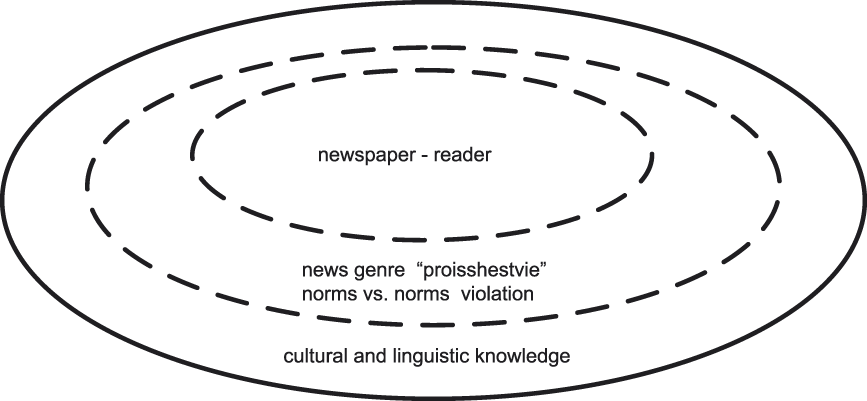
As noted above, neither the title nor the text about the airport strike refers to any type of proisshestvie. The title of the news story tells us that Aviatekhniki otkazalis’ obsluzhivat’ samolety ‘Aircraft mechanics have refused to service planes’ − in other words, they were on strike. We know that a strike is a planned event, which contrasts with the definition of proisshestvie as an unexpected event. Therefore, normally we cannot refer to a strike as proisshestvie. However, from the very beginning, the title of the newspaper column − Proisshestvia − and the title of the news story, as well as the grounding context in general (Chilton, Reference Chilton, Hougaard and Oakley2008), encourages the reader to activate two frames − cultural models of strike and proisshestvie in two input mental spaces, and map them onto each other. I follow Chilton (Reference Chilton, Hougaard and Oakley2008) who reflecting on Oakley and Coulson’s understanding of grounding proposes to see grounding as a very important tool in modelling the context dimension of the blending process as discourse processing. He also emphasizes the relation of grounding context to genre. Chilton argues that consideration of grounding leads us to a better understanding of discourse constraints and thus the meaning construction behind discourse. Though the news text I analyze in this study does not represent the interactive discourse type, as opposed to the texts analyzed in Hougaard and Oakley (Reference Hougaard and Oakley2008), the consideration of the grounding space seems to be crucial for an understanding of how the reader may construct the network behind the text about aircraft mechanics. The input spaces for strike and proisshestvie, as well as other mental spaces in the network, “operate in ‘dialogue’ with the grounding” (Oakley & Coulson, Reference Oakley, Coulson, Hougaard and Oakley2008, p. 30). I draw upon Oakley and Kaufer (Reference Oakley, Kaufer, Hougaard and Oakley2008) to introduce three ‘porous’ circles of the grounding space here (see Figure 1).
Grounding Space

An inner circle presents a writer(s) from Kommersant newspaper and the reader(s) − the public, who reads this major national newspaper.
It is important to remember that at the time Kommersant was a private media outlet, a leader in the media market for the first time functioning outside the Soviet propaganda system, rapidly developing and gradually evolving, belonging to the new publications group, which contrasted itself in relation to two other groups − oppositional and democratic (see, e.g., I. Zassoursky, Reference Zassoursky2004). This paper was the most influential and was likely to have appealed to a wider audience, as well as to have been perceived as trustworthy by the reader at that time.
A middle circle relates to the news genre and its subgenre proisshestvie and the situation where newspapers communicate news to the reader through publishing texts of news subgenre proisshestvie, and the reader needs to learn news about proisshestvia.
An outer circle will contain information stored in the long-term memory of the reader and will be related to her previous conversations, experiences, and cultural knowledge of varying degrees and complexity (see Chilton, Reference Chilton, Hougaard and Oakley2008). The middle and outer spaces will also correspond to Russian linguistic structures shared by the newspaper/writer and the reader and necessary for successful interpretation of the text.
Central to the middle and outer spaces of our grounding space is the concept of proisshestvie. In Pleshakova (Reference Pleshakova1998) I explored this concept through the comparative analysis of Russian and English newspaper texts in the genre of news reports, with a view to determining universal and specific features of the concept of proisshestvie, as well as the factors these features are conditioned by. I constructed and analyzed the thematic and narrative frames (terms coined by Minsky, Reference Minsky and Winston1975) and the nominative frames for Russian ‘proisshestvie’ and English ‘accident’, respectively. In so doing I used the methods of lexico-semantic analysis and cultural analysis, corpus analysis, and frame analysis of discourse as well as psycholinguistic experiments on associations and reconstruction of texts. I drew upon the works of Iu. D. Apresian, N. D. Arutiunova, A. N. Baranov, A. Wierzbicka, T. A. van Dijk, A. E. Kibrik, E. A. Kibrik, E. S. Kubriakova, G. Lakoff, M. Minsky, I. A. Mel’chuk, A. I. Novikov, Ch. Fillmore, W. Chafe, and A. A. Zalevskaya, among others. I analyzed approximately 750 news texts in Russian and around 1,000 news texts in English from the 1990s. From these I selected 180 Russian and 200 English texts dealing with proisshestvia and accidents on the basis of carefully devised criteria, and subsequently analyzed two text corpora. The general volume of material for comparative analysis amounted to 9,867 word-usages in the Russian texts and 10,654 in English. Among other findings, my study revealed that: there are compulsory and optional nodes within the frames of proisshestvie and accident; the absence of linguistic realization of compulsory nodes of the frames is felt acutely; these nodes are filled by typical nominative units with a more or less complex structure (words, word combinations, texts, or discourse of any length); how they are selected is conditioned by linguistic and socio-cultural factors; the core features of the concepts ‘proisshestvie’ and ‘accident’ are universal, but at the same time − as my case study of the news text about the strike at Penza airport will demonstrate − there are socio-culturally and historically specific features in our understanding of the respective categories, as well as the structure of the texts and their nominative infill.
The interrelated thematic, narrative, and nominative frames of proisshestvie explored in Pleshakova (Reference Pleshakova1998) constitute the news subgenre of proisshestvie. They can be seen as long-term memory structures, which afford the activation of the mental input of event-proisshestvie in the conceptual integration network underlying the text about aircraft mechanics. The reader understands proisshestvie in its interrelation to norm(s). The rhetorical situation linked to this interrelation constitutes an important dimension of the grounding space. The activated frames for news subgenre proisshestvia make the reader evaluate the discourse event as abnormal against the background of norm(s). From a logical point of view an event-proisshestvie and its central action cannot be positive, because it always includes somebody being hurt, i.e., a victim. This is so even if they are not an apparent victim in the eyes of an evaluator but rather in the eyes of the victim herself. Evaluation of an event as proisshestvie could be more subjective or objective depending on whether it breaks socio-cultural norms or norms adopted by a group of people or by individuals. The stories about proisshestvia reported by mass media usually describe breaking norms adopted by society in general. Thus, in the outer circle of the grounding space we will have a set of frames activated for both norm(s), including beliefs, values, and ideologies adopted in Russian society at that period of time, and proisshestvia (norm violation) simultaneously.
3.3.2 Strike and proisshestvie
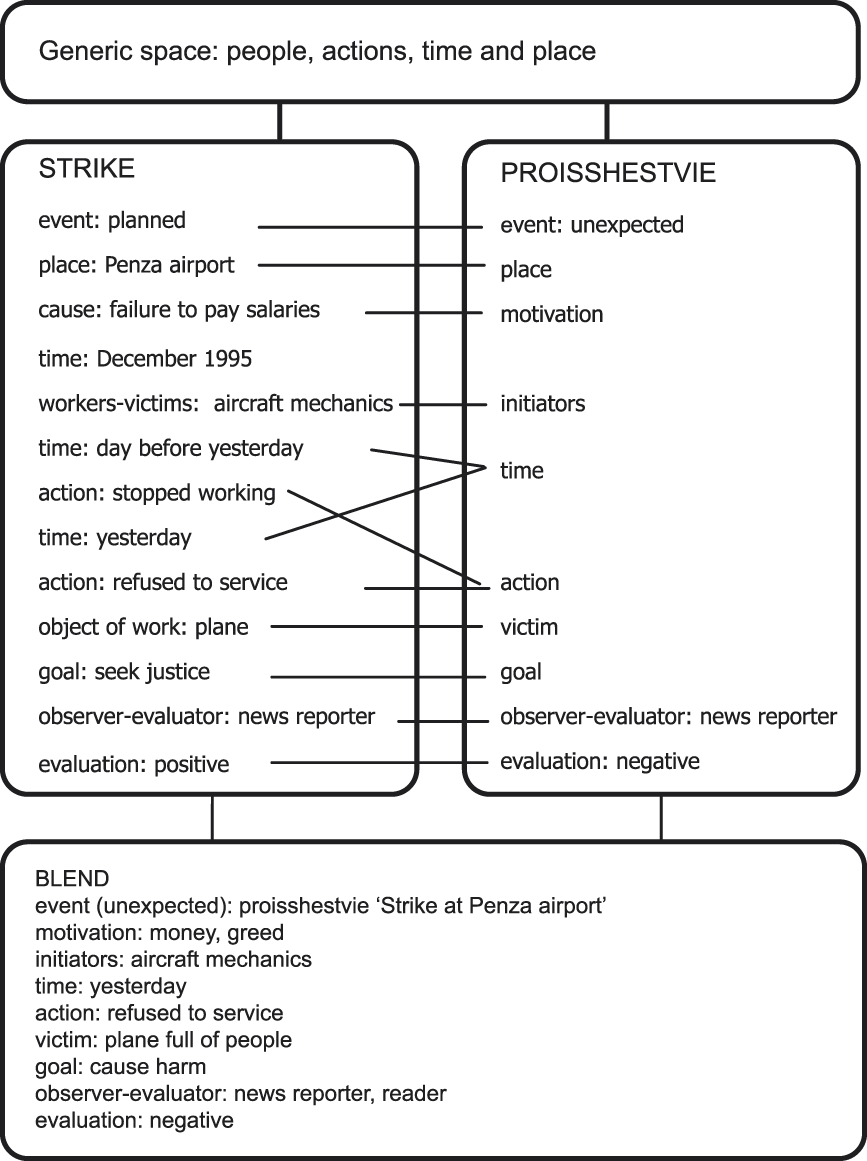
From the very beginning the grounding space prompts the understanding of this news story as a story about proisshestvie. Let us consider Figure 2, representing two input spaces: one mental input space for the zabastovka ‘strike’ frame, which includes conditions: time and place of the event, cause, workers, action, object of work, goal, outcome and evaluation; and the second input of the proisshestvie frame (discussed in more detail below), which includes conditions − again the time and place of the event, an unknown cause/motivation, initiators of the proisshestvie, action, victims, goal (this is negative since proisshestvie always has negative consequences), consequences and evaluation. Workers are victims who are being exploited. They take action − namely, they stop working. There is a cause for such an action – the failure to pay salaries. The workers’ goal is positive – they seek justice, as they want to receive money they have earned. The conditions are the time and place of this event. The generic space presents the common characteristics: the same people, the same actions, the same place, and the same time.
Conceptual Integration Network for proisshestvie ‘Strike at Penza Airport’.
The mappings between ‘strike’ and ‘proisshestvie’ are motivated by their cultural specificity. The Russian ‘strike’ frame differs from its Western counterpart due to the influence of its Soviet interpretation, which is still entrenched in people’s minds in the 1990s. According to this interpretation it would be impossible to go on strike in the ‘perfect world’ of Soviet society, especially in the field of airport transport, where a strike would be considered a crime and an act of sabotage. In 1990s Russia, a strike is perceived by the public as a norm violation rather than as a legitimate action, a mechanism for seeking justice, if not a crime. Such an interpretation is culturally conditioned by the Russian concept of money, among others. Analyzing the Russian constant of ’den’gi ‘money’ as one of the key Russian national concepts of Russian culture, Stepanov (Reference Stepanov2004) points out that Russians are characterized by the absence of ‘greedy’ and ‘money grabbing’ attitudes. This national cognitive and cultural concept of money was ruthlessly exploited by the Soviet authorities and Soviet ideology. For decades, the favourite theme of Soviet literary history and art history, literary critique, and school pedagogy constituted the typical juxtaposition of the power of money vs. emotions of a positive protagonist in a novel, drama, or film. Such representation of money has influenced the scale of values. The possibility of doing some work was considered a sufficient reward for this work, which has had a significant impact on post-Soviet work motivation (Rakovskaya, Reference Rakovskaya1994). Such dimensions of Russian ‘strike’ concept as ‘strike versus justice’, ‘strike as implication of a crime’, and ‘Russian perception of money’ make it culturally specific and very different at that time from Western conceptions about strikes.
Proisshestvie can be used to refer to different events breaching norms, including crimes. However, where the crime is mainly about ‘breaking norms in the Russian law domain’, proisshestvie presents the framing of ‘breaking norms in the various domains of Russian society’. Thus frame of proisshestvie allows conceptual integrations, which can both include or exclude the evaluation of ‘strike’ as a crime. When needed, the input of proisshestvie permits a shift from the frame of norm violation to the frame of crime. Input spaces of strike and proisshestvie are linked by outerspace vital relations, which are compressed into inner relations inside the blend. The vital relations of analogy/disanalogy, identity, change, cause−effect and role−value are observed here. The workers in both spaces are the same, but they acquire different characteristics: in the first input they are ‘good’ people, in the second they are ‘bad’ people, but in both spaces they are proactive ones. Workers change from victims to initiators of proisshestvie, and the role of worker-victims is mapped onto the role of initiators and compressed into the value of aviamekhaniki ‘aircraft mechanics’; cause−effect changes into part−whole. The chain of events − the failure to pay salaries (nevyplata zarplaty), the indefinite strike (bessrochnaia zabastovka), the plane leaving the airport without being serviced and refuelled (aviatekhniki uzhe vchera ne osmotreli i ne dozapravili tranzitnyj samolet AN-24. Tem ne menee, samolet pokinul Penzu) − compresses into one act of refusal (otkasalis’ obsluzhivat’, otkazavshis’ obsluzhivat’), which obtains a status of uniqueness in the blend. All past time and variety of spaces in the strike input are scaled down to a single day – yesterday (vchera), highlighting the recent past and a single physical space – Penza airport (aeroport Penzy), and compressed into the scene of proisshestvie in the blend.
The conceptual integration network behind this text is double-scope. At first glance, this text reflects an organizing frame of strike but a closer look reveals that the network has inputs from both the organizing frames of strike and proisshestvie. These two conflicting frames can blend in our network due to their cultural specificity both inherited from the Soviet time and acquired during the transition from Soviet to post-Soviet Russia, as noted earlier in this section. The resulting blend is creative, as the two input frames, clash and therefore it challenges people’s imagination. The topologies of the inputs clash on causality and intentionality: whereas a strike (zabastovka) is a planned event, proisshestvie is an unexpected event; whereas a strike aims at achieving a positive goal, proisshestvie leads to something which is evaluated negatively. The topologies clash on roles, identity, temporal sequence, and internal event structure: the aircraft mechanics are victims defending themselves in the frame of the strike but they are mapped onto the role of initiators in the frame of proisshestvie, which is projected onto the blend along with their identity.
The causal structure in the blend comes from the proisshestvie input, not the strike input. It is the mechanics’ action otkazalis’ obsluzhivat ‘refused to service’ which causes the failure to operate the airport and the aircraft in a safe manner, thereby threatening people’s lives, and not the failure on the government’s part to pay salaries or the action to make the government pay salaries. The temporal sequence and space allocation from the strike input are not projected onto the blend directly. The initial cause of the chain of events Ee [zabastovki] prichinoj stala nevyplata zarplaty s dekabria 1995 goda ‘because they [the mechanics] had not been paid since December 1995’ is given retrospectively. Time and space are tightened to present a place and time of the incident, which happened yesterday at the Penza airport. The evaluation and judgement of an event by the reader depends on how it is stated verbally, and this is exploited here to manipulate the meaning construction (cf. Kahneman & Tversky, Reference Kahneman and Tversky2000; Turner, Reference Turner2001). The construction Ee [zabastovki] prichinoj stala nevyplata zarplaty s dekabria 1995 goda (literally ‘the reason for the strike was the failure to pay salaries since December 1995’) is the only reference to a cause for the strike action − failure on the government’s part to pay salaries. This sentence omits the name of any actors. Though the sentence gives a reason, there is no reference to any initiator of (adverse) events here. The use of nominalization nevyplata zarplaty ‘the failure to pay salaries’ within this sentence conveys a message in a more compressed form as opposed to a full sentence (which would incorporate a verb and its arguments), and thus makes omitting the actor’s name − the government – sound more natural. I believe that such a construction is preferred in our news text in order to shift the initiator’s role and support attaching the ‘blame’ to the ‘initiators-mechanics’ element (cf. Hart, Reference Hart2013). The intentional structure in the blend again comes from the proisshestvie input. Aircraft mechanics going on strike do not intend to harm people, but in the blend they do so, since they now fulfil the role of initiators of proisshestvie. Here the active construction is preferred to activate the idea of blame and its relation to the initiators-mechanics: Otkazavshis’ obsluzhivat’ samolety, aviatekhniki uzhe vchera ne osmotreli i ne dozapravili tranzitnyj samolet AN-24. ‘Having refused to service planes, the mechanics neither inspected nor refuelled an AN-24 transit plane yesterday’. The reader of our news text is very unlikely to see that she is being manipulated into attaching blame to aircraft mechanics. As Clark and Clark (1977; cited in Kahneman & Tversky, Reference Kahneman and Tversky2000) point out:
Studies of language comprehension indicate that people quickly record much of what they hear into an abstract representation that no longer distinguishes whether the idea was expressed in an active or in a passive form and no longer discriminates what was actually said from what was implied, presupposed, or implicated.
The deliberate usage of the nominalization structure and the active form of the sentence in our news text functions as tool of manipulation. And it is the intentional structure of the frame proisshestvie which allows such manipulation to occur.
The internal event structure comes from the proisshestvie input. In the blend we have initiators, actions which have negative consequences, victims, the time and location of event-proisshestvie, and the observer, who is also the evaluator. Telling the reader that Otkazavshis’ obsluzhivat’ samolety, aviatekhniki uzhe vchera ne osmotreli i ne dozapravili tranzitnyj samolet AN-24. Tem ne menee, samolet pokinul Penzu ‘Having refused to service planes, the mechanics neither inspected nor refuelled an AN-24 transit plane yesterday. Nevertheless, the plane left Penza’, the text does not specify whether the plane landed safely at its destination or not. This is done on purpose. The last sentence and the expression tem ne menee ‘nevertheless’ in particular prompt the emergence of the counter-factual scenario of potential proisshestvie (cf. the role of in fact in the building of a counterfactual relation, analyzed in Fauconnier and Turner, Reference Fauconnier and Turner2002, pp. 238−239). The Russian verb pokinul also contributes to this counter-factual scenario emergence. As Apresian (Reference Apresian2000) notes, the Russian language normally forces its speakers, whenever they talk of locomotion, to specify the manner of locomotion (flying, walking, etc.), even when it is irrelevant to their thought. In the sentence Tem ne menee, samolet pokinul Penzu ‘Nevertheless, the plane left Penza’, the manner of locomotion – flying – is not specified, and the idea of leaving a certain place at the point of observation is expressed by the perfective verb pokinut’ ‘leave’. It is true that Russian sentences incorporating this verb “sound unmotivatedly elevated with regard to the required meaning, or else express an entirely different idea of ‘leaving a certain place for good’” (Apresian, Reference Apresian2000, p. xii). Again, since such ‘leaving Penza for good’ is not specified or explained in the news text in any way, the reader is encouraged to activate the frame of risk for this conceptual integration network and to consider a possible negative outcome, which normally should fill the node of consequences in the frame of proisshestvie.
3.3.3 Risk and potential proisshestvie
Fillmore and Atkins (Reference Fillmore, Atkins, Lehrer and Feder Kittay1992) identify the following elements of the Risk frame: Chance (uncertainty about the future), Harm, Victim (of the Harm), Valued Object (potentially endangered by the risk), Situation (which gives rise to the risk), Deed (that brings about the Situation), Actor (of the Deed), (Intended) Gain (by the Actor in taking a risk), Purpose (of the Actor in the Deed), Beneficiary and Motivation (for the Actor). Developing the analysis given in Fillmore and Atkins (Reference Fillmore, Atkins, Lehrer and Feder Kittay1992), Turner (Reference Turner and Favretti2008) argues that in fact here we deal with the frame-blend ‘Risk’ with possible emergent structures. He shows that blending Harm and Chance results in Risk with the crucial emergent structure ‘hope’. Further possible blending of Risk with Choice gives the emergent structure ‘thrill of uncertainty’. He also explains the additional characteristics the blend Risk acquires in different contexts by the ‘blended syntax’.
Inspired by the same work of Fillmore and Atkins, Paducheva (Reference Paducheva2004) analyzes the Russian speech verbs riskovat’ and risknut’ ‘to risk’ in the frames of the Russian ‘linguistic worldview’ paradigm. She argues that these Russian verbs not only differ in their aspectual characteristics but present significant semantic differences and refer to different conceptual schemes. Building upon Paducheva’s semantic interpretation for risknut’ and riskovat’ I present a mental input of risk analyzed as a product of blending the frames Risk 1 and Risk 2, activated by the reader in our conceptual integration network.
The schematic interpretation of risknut’ can be presented briefly as follows: before Time and Time 1 (the moment of observation), an Agent considers a Choice of whether to do a particular Deed (because she wants Motivation/Benefit). The Agent understands that Deed can lead to Harm. Nevertheless, at Time the Agent decides to do the Deed and does it, soon after Time, at Time 1. The speaker does not know whether Harm has happened or not. The theme here is that of making a Decision, using Will and Reason.
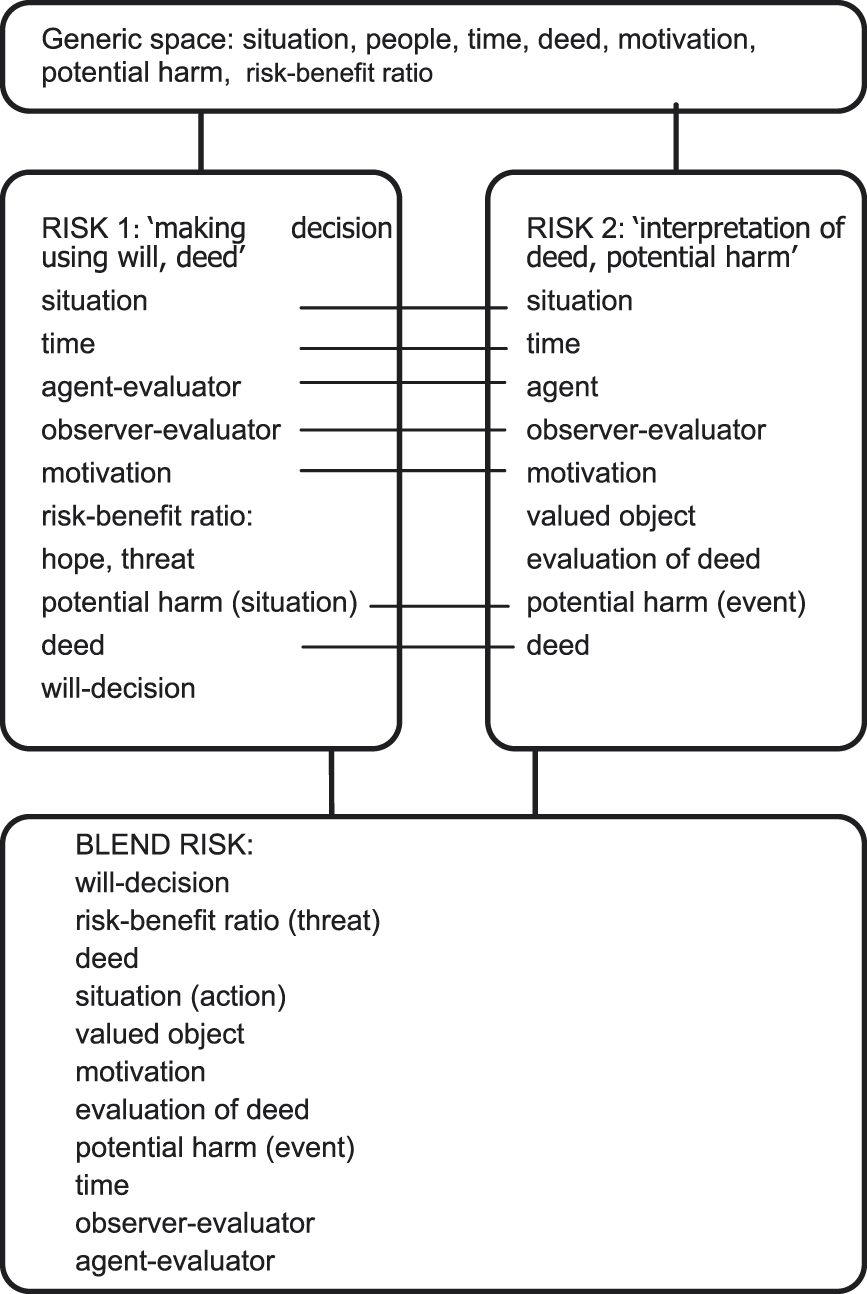
Here, Risk 1 is an integration of Choice, Chance, and Harm, incorporating the same Action. It has the following elements: Situation, Time, Agent−Evaluator, Observer−Evaluator, Motivation (intended Gain), Risk−Benefit Ratio (Hope, Threat), Potential Harm (Situation), Will−Decision, Deed, where Risk−Benefit Ratio (Hope, Threat), Potential Harm, and Will present an emergent structure with highlighted intentionality and Deed in the central position. Russian Risk with the profiled Will can be further mapped onto Russian Courage (cf. the phenomenon of Russian roulette). The resulting blend creates a possible emergent structure of ‘nobleness’, which has a highly positive evaluation by both the Agent and the Observer and is verbalized in the Russian proverb ‘Risk is a noble deed’.
The conceptual integration of the same mental inputs (but with slightly different profiling of the elements and vital relations between them) can result in a blend incorporating a counter-factual scenario and creating another possible emergent structure: ‘fear vs. victory’, verbalized in the Russian proverb Kto ne riskuet, tot ne p’et shampanskoe ‘No risk, no champagne’. Here, the negation of Risk is evaluated negatively by the Observer and the choice made in avoidance of risk is indeed semantically equivalent to fear and defeat.
Risk 2 incorporates Situation, Time, Agent, Observer−Evaluator, Motivation (intended Gain), Valued Object, Potential Harm (Event), Deed, and Interpretation (Evaluation) of Deed. Risk 2 differs from Risk 1 in that it profiles Potential Harm and positions Motivation at the periphery. Here, Potential Harm acquires the status of Event and, together with Interpretation of Deed, constitutes an emergent structure. The position of Observer−Evaluator in this input is retrospective. Interpretation of the Deed incorporates the knowledge of the feared negative consequences that have not taken place in reality.
As noted earlier, in our conceptual integration network, ‘Risk’ is a product of blending Risk 1 and Risk 2 (see Figure 3). It incorporates Situation (Action), Time, Agent−Evaluator, Observer−Evaluator, Motivation (Intended Gain), Risk−Benefit Ratio (Threat), Will−Decision, Deed, Valued Object, Potential Harm (Event), and Interpretation (Evaluation) of Deed. The emergent structure in the blend includes the profiled Action in the Situation (which gives rise to the risk), the profiled Threat in the Risk−Benefit Ratio, Will−Decision, and Potential Harm (Event) resulting from this decision. The Deed and the Interpretation of the Deed leave the knowledge that the feared negative consequences have not taken place in reality, off-camera.
Conceptual Integration Network ‘Risk’.
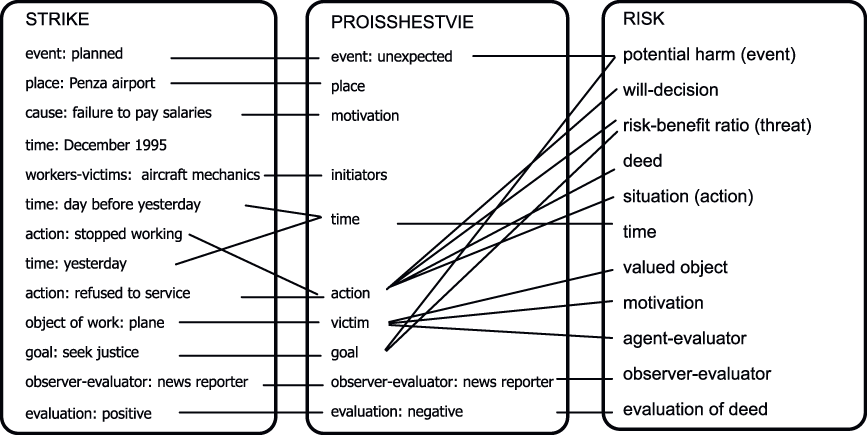
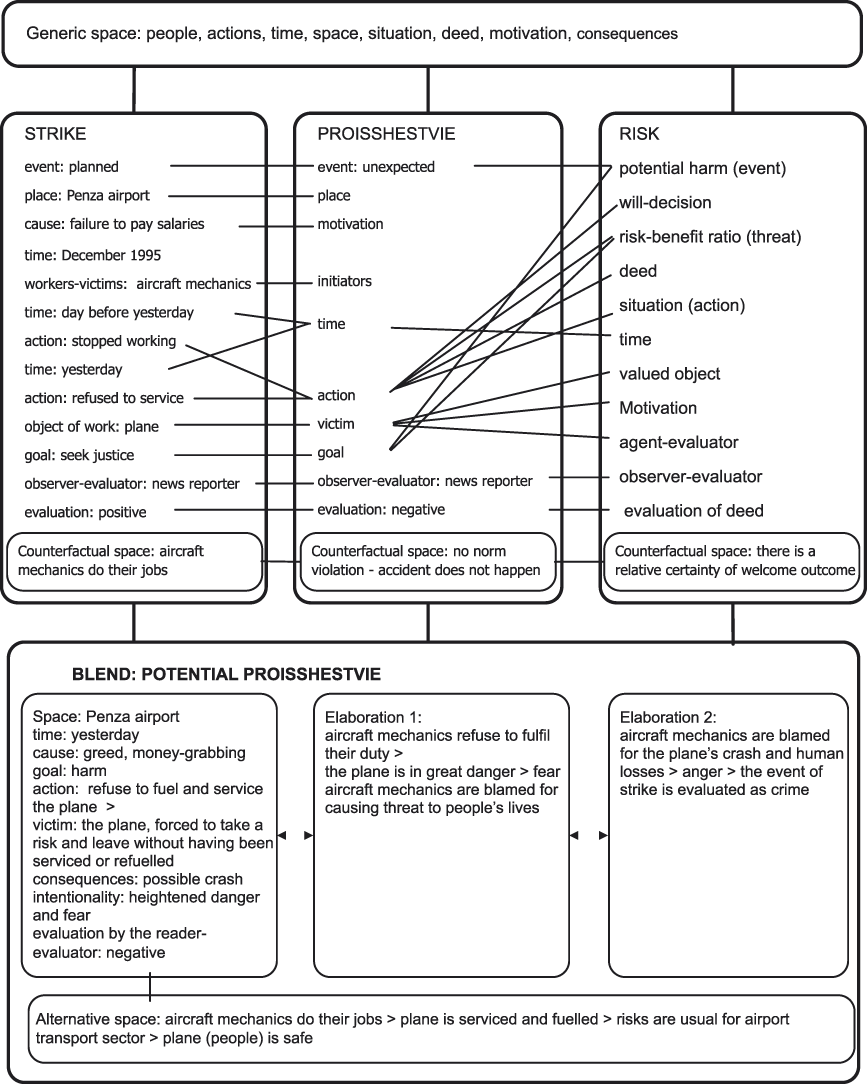
The mental input of risk in our conceptual integration network is mapped onto the strike and proisshestvie inputs (see Figure 4). The Action in Situation (which gives rise to risk) is mapped onto the Action in the proisshestvie and strike inputs by Analogy/Disanalogy and Change and compressed into the Action of Initiators − ne osmotreli i ne dozapravili ‘neither inspected nor refuelled’ − in the potential proisshestvie in the blend. The Action in the strike input is mapped onto the Risk−Benefit Ratio, the Will−Decision, and the Deed (risk) by Cause−Effect and is compressed into a Forced Action of the Victim−Plane in the potential proisshestvie − pokinul ‘left’ − in the blend. Prompted by Tem ne menee samolet pokinul Penzu ‘Nevertheless, the plane left Penza’, the Outcome (strike) is mapped onto the Consequences (proisshestvie) and the Potential Harm (risk) and compressed into counter-factual Consequences of potential proisshestvie – a Plane Crash - in the blend.
Mappings between mental inputs ‘Strike’, ‘Proisshestvie’ and ‘Risk’.
The text does not give us any names or information about the pilots who made a decision to take a risk and fly the plane not having been fuelled or serviced, or the airport operator who allowed the plane to take off. In fact, they are not mentioned at all. Here the blend is characterized by a weakened Intentionality (negative) of the plane’s Will−Decision The Actor (of the Deed) in the risk input is referred to by a rather general nomination of samolet ‘plane’, which also represents a Valued Object (risk). They are mapped onto the Victim in proisshestvie and the Plane−Object of work in the strike input by Analogy/Disanalogy and compressed into the Unique Plane−Victim in the blend. The Plane−Object of Work in the strike is mapped onto the Motivation (Intended gain) in the risk input by Cause−Effect and compressed into the Unique Justification of Risk in the blend, linguistically realized by tranzitnyj samolet ‘transit plane’. Simultaneously, but in a different respect, the blend is characterized by a heightened Intentionality (positive) of the plane’s Will−Decision. The Will−Decision of the plane taking a risk is evaluated positively due to both the fact that the plane is a transit one and full of people eager to go home, and the specificity of the Russian cultural model of risk, which allows integrating Risk with such concepts as Volia ‘Will’, Muzhestvo ‘Courage’, Schast’e ‘Happiness’, Sud’ba ‘Fate’, and Dusha ‘Soul’ (e.g., Stepanov, Reference Stepanov2004; Zalialeeva, Reference Zalialeeva and Galiullin2004; Maslova, Reference Maslova2004). Such integrations produce a culturally specific concept of russkoe avos’ ‘hope for Russian maybe’, which is seen by many linguists, philosophers, and writers as an original Russian myth and a key idea of the Russian linguistic worldview (e.g., Zalizniak, Levontina, & Shmelev, Reference Zalizniak, Levontina and Shmelev2005; Popova, Reference Popova2001; Stepanov, Reference Stepanov2004). Avos’ presents the Russian attitude to life, in which Russians would rather rely on luck or fate than on themselves. Academics and writers often refer to Russian avos’ whilst talking about Russian national identity and the ‘paradox of Russia’. Avos’ can be evaluated both positively and negatively. In our conceptual network, Russian avos’ is likely to be activated to support the positive evaluation of the plane/pilots’ risk-taking.
The Goal (positive) in the strike is mapped onto the Goal (negative) in the proisshestvie input and onto the Risk−Benefit Ratio (Threat) by Analogy/Disanalogy, and compressed into the unique Goal of aircraft mechanics doing harm. The heightened Intentionality of the aircraft mechanics is presented by Will−Decision leading to negative consequences. In the blend, mechanics are greedy, they want money, and they risk people’s lives and harm them, which obtains a strong negative evaluation. Evaluation (risk) is mapped onto Evaluation (proisshestvie) and the Interpretation of the Deed/Evaluation (risk) by Analogy/Disanalogy, and compressed into Danger created by the aircraft mechanics. This in turn enables the emergence of heightened Fear in the blend, related to the perception of counterfactual potential proisshestvie as real. Tem ne menee ‘nevertheless’ plays a crucial role in heightening ‘fear’ under blending. In the blend there is a juxtaposition of the good (people wanting to go home and trusting fate) and the bad (the mechanics taking advantage of these people’s desires and trust by letting the plane take off without servicing it).
3.3.4 Counter-factuality
The cognitive ability of the human mind to imagine and construct counter-factual concepts is widely acknowledged in many different fields, including the field of cognitive science and cognitive linguistics (see, e.g., Kahneman, Slovic, & Tversky, Reference Kahneman, Slovic and Tversky1982; Barsalou, Reference Barsalou, Lehrer and Feder Kittay1992; Turner, Reference Turner1996; Coulson, Reference Coulson2001; Fauconnier & Turner, Reference Fauconnier and Turner2002; Sweetser & Dancygier, Reference Sweetser and Dancygier2005; Chilton, Reference Chilton2010). People construct imaginative concepts in evaluating typicality, in planning, in decision-making, in evaluating past events, for predicting future events, and, as in Kahneman and Miller (Reference Kahneman and Miller1986), for reflecting on/undoing accidents. Frames play a crucial role in supporting this process (Barsalou, Reference Barsalou, Lehrer and Feder Kittay1992).
Fauconnier and Turner (Reference Fauconnier and Turner2002) discuss the ability of humans to operate mentally on the unreal, and its role in our mental and cultural lives. They argue that, typically, any conceptual integration network has implicit counter-factual spaces. Fauconnier and Turner (p. 230) understand counter-factuality as “forced incompatibility between spaces” and argue that it is “often a vital relation between spaces that involves some of the same people and the same events”. They present linguistic examples, their interpretation of which involves analysis of counter-factual inputs in double-scope blending. Coulson (Reference Coulson2001) discusses counter-factuals in both blending and frame-shifting. She stresses that structuring the counter-factual blend employs the same analogy vital relation. The counter-factual mental space inherits the structure of the source input, but in contrast with an analogy, which usually evokes structure in the target, a counter-factual tends to project structure back onto the source input.
The conceptual integration that occurs in counter-factual spaces is yet another instance in which projection mappings are used to evoke different patterns of inference, affective responses, and action frames. In everyday life, counter-factuals are almost always set up for rhetorical purposes in which the aim is to profile a particular construal. Since the rhetorical efficacy of a counter-factual does not depend on the plausibility of the counter-factual scenario arising in the first place, speakers employ counter-factual blending to promote scalar implicature and to trigger frame-shifting (Coulson, Reference Coulson2001, p. 219).
The counterfactual scenario of the potential proisshestvie underlying our news text about aircraft mechanics is used as a rhetorical tool. The reader’s interpretation and evaluation of the text event is occurring with the background of the computation of norms. Kahneman and Miller (1986, p. 150) argue “that norms – and sometimes even their elements – are constructed on the fly in a backward process that is guided by the characteristics of the evoking stimulus and by the momentary context”. They also emphasize the huge role played by the construction of counter-factual alternatives to reality in the computation of norms, and point out that “the affective response to an event is enhanced if its causes are abnormal” (p. 145). In our conceptual integration network, the norms are activated in the mental input spaces through their links to the grounding space, and constitute the alternative/counter-factual spaces within them. Strike has a counter-factual element to it, in that it evokes a space in which the workers do their jobs. Proisshestvie also has a counter-factual element to it, evoking a space in which the accident does not happen (i.e., the normal course of life or the normal pattern of things). Moreover, our risk frames also involve implicit counter-factuals. Risk frame-blend is characterized by absence of certainty and hence involves implicit alternative scenarios (see Turner, Reference Turner and Favretti2008). Among other alternatives, the risk input space incorporates a scenario where there is the relative certainty of a welcome outcome. The counter-factual spaces in the inputs are mapped into each other and projected into the blend via the Cause−Effect relation, where they provide the background of norms – the alternative space where the aircraft mechanics do their jobs, the plane is serviced and fuelled, and the risks are usual for air transport sector (see Figure 5).
Conceptual Integration Network for potential proisshestvie.
In the blend there is the concrete structure of a strike, with mechanics who are not being paid for their work going on strike in order to seek justice. However, at the same time the blend inherits causal, intentional, and internal event structure from the input space of proisshestvie. Elements from the risk input are projected onto the blend to contribute to the construction of the counter-factual scenario with its heightened Intentionality of Danger and Fear.
While running the network, the reader projects the counter-factual structure back to the inputs. Thus, in the conceptual integration network behind this news story the strike frame is shifted to the proisshestvie frame through the counter-factual space of potential proisshestvie, thereby affording the extension of the category of proisshestvie presented in the grounding space.
The ideas of risk, and relatedly, of morals, danger, and blame, have always been important for constructing political configurations, ideologies, and propaganda (Douglas, Reference Douglas1992). Blending the culturally conditioned frames of strike, proisshestvie ‘accident’ and risk, the network here is serving a particular pragmatic function. The emergence of heightened Danger and Fear motivated by Risk evokes the Blame idea in the blend. The blame is attached to the aircraft mechanics. There is the emergent structure in the blend (see Figure 5), presenting the chain of events: greedy aircraft mechanics go on strike > they do not fuel or service the plane > the plane is forced to take a risk and fly anyway > the plane is in danger. This chain can be further elaborated: the aircraft mechanics’ refusal to fulfil their duty puts the plane in danger, which in the reader’s counterfactual thinking is likely to transform into: the aircraft mechanics cause the plane to crash. When the aircraft mechanics are blamed for the plane crash in the counter-factual scenario, the cultural specificity of proisshestvie allows further elaboration through the shift from the frame of norm violation to the frame of crime, and encourages the reader to evaluate the whole event as a crime caused by these aircraft mechanics, and thus to perceive the aircraft mechanics as criminals.
The conceptual integration network with its counter-factual emergent structure serves the pragmatic goal of shifting the blame for disruptions observed in the important air transport sector from Yeltsin and his government to the aircraft mechanics, ultimately influencing public opinion about Yeltsin and his reforms and potentially increasing Yeltsin’s chances of winning the election.
4 Conclusion
Public opinion and public reactions, including the ones formed during election campaigns, are known to be influenced by the news frame, “especially if there is a broad consensus creating ‘one-sided’ interpretation among … those who share a common national culture and identity” (Norris, Kern, & Just, Reference Norris, Kern and Just2003, p. 5), similar to the mass-media coverage of the Russian presidential election campaign of 1996 (see I. Zassoursky, Reference Zassoursky2004, p. 28). Norris et al. (Reference Norris, Kern and Just2003) argue that news framing constitutes a significant aspect of political communication. The news text about the aircraft mechanics presents “the calculated explanation of the social situation in such a way that individuals think they are making free personal choices while they are adapting and conforming to the orchestrated society” (Fowler, Reference Fowler2000). Potential proisshestvie behind the news text emerges to affect what the public learn about the event of a strike, how they evaluate the risks, main actors, and issues under contention. Moreover, such news stories may influence public perceptions of other events at this socio-political stage, or, as in our case study, the public voting in the presidential election of 1996.
Underscoring the absence of a coherent belief system – an ideology – in 1996, I. Zassoursky (Reference Zassoursky2004) argues that strong manipulation using the laws of drama was employed to control public opinion in Russia. Such employment could be observed at different scales and levels of complexity in news management, among other processes, within the election campaign. As the study’s conceptual blending analysis has demonstrated in some detail, the propagation of the ideas of risk and blame as shifted from Yeltsin and his team of reformers was likely to be based on the counter-factual event of the plane’s crash as dramatized in the reader’s mental simulation. The cognitive and pragmatic importance of dramatization is emphasized by Brandt in her analysis of fictive interaction (2008).
This cognitive, and pragmatic, reward, it is argued, is due not only to the shift from abstract thought content to representations at “human scale” (cf. Fauconnier & Turner, Reference Fauconnier and Turner2002), but also to “how we experience representations when they are dramatized in our mental stimulation, that is, when particular instantiations of concepts are acted out theatrically on the stage of our inner vision” (Brandt, Reference Brandt, Hougaard and Oakley2008, p. 110).
Though our news text does not prompt the construction of fictive interaction, following Brandt’s logic I assume that the reader of our news text is likely to see strike as proisshestvie-plane crash and dramatize the latter through the counter-factual emergent structure in the blend. Brandt points out that the representation of an event or story dramatized in our mental stimulation makes the discourse more rhetorically successful. In our case the scenario of the virtual plane crash in the blend translates the abstract and complex socio-political and economic life of 1996 into the representation of the concrete event at a ‘human scale’, where the attachment of blame serves as a simplified model, which prompts the reader’s thinking about strike events. Together with the cognitive affordance of dramatization in the reader’s mind, it allows realizing the pragmatic implication of shifting the blame from the Yeltsin government to the people who are not happy about the reforms resulting in delays in salary payments and who go on strike, for the purposes of restoring Yeltsin’s political credibility.
It is true, as Chilton (Reference Chilton, Saussure and Schulz2005, Reference Chilton, Hougaard and Oakley2008) emphasizes, that the reader may construct the blend in the conceptual network behind this text in a slightly different way, or choose not to run it at all, due to the influence of certain features of the grounding space. As Cienki points out, “any blending analysis is really a hypothesis about conceptual operations that may be involved in the formulation or interpretation of an expression of some type” (Cienki, Reference Cienki, Hougaard and Oakley2008, p. 236). Therefore, I see my study’s approach as “a way of capturing some of the processes which can explain how a reader could construct” a counterfactual story behind the news discourse being analysed (p. 236). However, I argue that when the conceptual blending analysis of discourse is based on the analysis of cultural models and networks, the reliability of such analysis significantly increases (on cultural models, and their role in the cognitive analysis of discourse, see, e.g., Coulson, Reference Coulson2001, Reference Coulson, Achard, Dirven and Ruiz de Mendoza Ibáñez2006; Chilton, Reference Chilton, Saussure and Schulz2005, Reference Chilton, Hougaard and Oakley2008; Dirven, Frank, & Putz, Reference Dirven, Frank and Putz2003; Dirven, Wolf, & Polzenhagen, Reference Dirven, Polzenhagen, Wolf, Geeraerts and Cuyckens2007; Lukes, Reference Lukes, Hart and Lukes2007; Oakley & Coulson, Reference Oakley, Coulson, Hougaard and Oakley2008; Palmer, Reference Palmer1996, Reference Palmer, Achard, Dirven and Ruiz de Mendoza Ibáñez2006; Sharifian & Palmer, Reference Sharifian and Palmer2007; Sharifian, Reference Sharifian, Kristiansen and Dirven2008; Shore, Reference Shore1996; also see the discussion on cultural niches and networks following Mark Turner’s essay on human singularity at www.onthehuman.org August 2009, and the contributions by Harrell, Pleshakova, and Turner, in particular).
As Chilton (Reference Chilton, Hougaard and Oakley2008) rightly argues, the construction of a blended concept behind the manipulative discourse item as well as acceptance or rejection of ideas being propagated are always dependent on social, cultural, and psychological factors. This is the main reason behind grounding my analysis in the consideration of the social context and media-political situation of 1990s Russia, and joining the forces of two research frameworks, namely Conceptual Integration or Blending and the Russian ‘linguistic worldview’, where the former provides the cognitive research tools for analyzing the way humans understand discourse and the latter provides us with linguistic, cultural, and psychological evidence for activating and blending of certain concepts underlying discourse (cf. Zinken, Reference Zinken, Bartminski and Zinken2009). My study has shown that the conceptual integration analysis of discourse based on the findings of the ‘Russian linguistic worldview’ research provides tools for a more holistic approach to the investigation of Risk, Blame, Accident, Danger, and Counter-factuality and the ways in which they are politicized. Such an investigation reflects a more objective, whole view on the human mind and human action, and hence models cognitive operations which are most likely underlying the reader’s interpretation of our news text.
Furthermore, I argue that the rooting of meaning construction in Russian cultural and linguistic knowledge – or in other words the achievement of ‘cultural scale’ as ‘human scale’ − is what makes the news text about aircraft mechanics rhetorically successful, and allows its function as a tool of manipulation. The cognitive goal of ‘achieve cultural scale’ ensures the activation of inputs and selection of mappings and projections which make the blend culture-friendly and the news text rhetorically successful. Making the blend more intelligible, engaging, and vivid, this goal allows the propagation of hidden ideas to the readers, as human beings thinking in Russian culture.
I have attempted to show in some detail how a blending analysis can throw light on Russian conceptual frames, which are culturally and historically embedded. I argue that the development of Russian cultural networks for proisshestvie and strike in the transition from the USSR to Russia allows these conflicting frames to blend through integrating with the culturally specific frame-blend of risk. Proisshestvie, risk, and strike interacting with the particular grounding space allows the emergence of the counter-factual cultural scenario of potential proishestvie − human-friendly and perfectly suited to Russian culture − which acts as one cognitive vehicle of manipulation for the presidential election campaign of 1996.