With the growing integration of domestic markets into the world economy, trade agreements have reshaped the labor and living conditions of an increasing number of individuals, raising public fears about unemployment, societal disintegration, and unfair competition, particularly among the “losers” in trade liberalization. A large body of research has examined various determinants of public attitudes toward trade liberalization. Since earlier studies examined the relative strength of skill level or employment sector in explaining the formation of trade preferences,Footnote 1 later scholarship has complemented these major economic accounts by emphasizing sociotropic concerns,Footnote 2 national sentiment,Footnote 3 and economic knowledge.Footnote 4
Yet despite different accounts of trade attitude formation, these studies are classified as so-called “bottom-up”Footnote 5 or “demand-side” models because they primarily focus on relatively fixed, predefined individual attributes, and therefore leave little room for political factors to influence public attitudes. In response, emerging studies have started to examine the “top-down” process or “supply-side” of trade preference formation and revealed its dynamic and contextual nature by stressing the roles of government programsFootnote 6 and political persuasion.Footnote 7
However, much of this literature barely notes the variation in content and design across trade agreements or examines whether and how specific design features influence public support for trade agreements. Current trade agreements encompass a wide range of issues, including the elimination of tariffs and nontariff barriers to market access, various rules and regulations, investment protection, and dispute settlement mechanisms. Although recent studies have examined diverse components of trade agreements and their distinct implications,Footnote 8 whether and how individuals weigh the multiple aspects of the trade agreement, beyond the one-dimensional evaluation of whether they support or oppose trade liberalization, largely remains as an open question.
In this study, we pay attention to the multidimensionality of trade agreements and show that specific treaty designs—in particular, the characteristic of dispute settlement mechanisms—shape trade preferences. We find that this effect is strikingly large and consistent across key individual-level attributes that have offered major explanations for public attitudes toward trade liberalization.
The institutional design in international agreements matters, but this insight has rarely been incorporated into the individual-level study of trade preferences,Footnote 9 which has important implications for the political dynamics of trade negotiations and their consequences. By incorporating the so-called “rational design of international institutions” framework into the study of individual preferences over trade liberalization, we seek to contribute to a further understanding of the micro-foundation of trade agreements. In particular, recent work notes a vital role that dispute settlement mechanisms play in negotiating and implementing trade agreements.Footnote 10 They detect and disseminate information about noncompliance with institutionalized commitments, and thus increase international and domestic audiences’ ability to monitor and sanction the government for its noncompliance. This threat of ex-post punishment helps facilitate cooperation and enhance the credibility of commitments that governments embody in trade agreements. Accordingly, states have increasingly delegated their legal authority to third-party tribunals designed to resolve international disputes through the application of general legal principles.
However, facing enforcement problems, domestic constituents play a crucial role in imposing costs on governments who defect from their agreements.Footnote 11 A complete understanding of why and how states tie their hands through delegation to a legal dispute mechanism requires careful attention to the public, which holds the governments accountable for their policy choices. How much does this treaty element matter for the public? What type of dispute settlement mechanisms is the public willing to accept? How does the choice of a specific dispute settlement mechanism influence public support for trade agreements?
The mechanism of investor-state dispute settlement (ISDS), which has increasingly attracted the attention of both the academic community and the lay public, demands close examination.Footnote 12 ISDS enables foreign investors to bring a legal claim directly against host countries before specialized tribunals set up under international rules on arbitration, such as the rules of the International Center for Settlement of Investment Disputes (ICSID) or the UN Commission on International Trade Law (UNCITRAL), when host countries expropriate them in a discriminatory fashion and without providing compensations. Consequently, it has served as an effective means to strengthen foreign investors’ bargaining positions and to force host countries to comply with commitments taken up in the agreements.Footnote 13 But scholars have paid relatively little attention to the wider implications that ISDS has for the other side of the audience: the domestic constituents who constitute an alternative enforcement mechanism, but who may view this particular type of dispute settlement as not in their interests.
While dispute settlement mechanisms can help uninformed audiences gain information about government behavior and empower them to deter noncompliance, the audience's decision to adopt a certain type of dispute settlement involves an assessment of whether the expected benefit of utilizing the signaling device outweighs its potential costs. We expect that ISDS can incur substantial costs (such as sovereignty costs and the problem of transparency) that cut across determinants of trade preferences and thus generate broad public opposition to trade agreements.
To evaluate the empirical validity of our expectations, we design a conjoint experiment that enables us to randomly vary diverse treaty design elements simultaneously and to evaluate individuals’ relative preferences across multiple dimensions of trade agreements. Relating to the current literature on treaty design and competing explanations that emphasize endorsement effect, we distinguish between three main dimensions—the scope, depth, and dispute settlement mechanisms—along with the endorsements by different political actors, and ask respondents to evaluate various treaty designs and contents. We conducted our study in Germany, which is one of the largest and the most economically powerful European Union (EU) member states. Since July 2013, the EU has been negotiating a free trade agreement with the United States, the Transatlantic Trade and Investment Partnership (TTIP), aiming to lower the barriers to trade and investment. Compared to measuring respondents’ abstract preferences about trade liberalization, the ongoing controversy over the TTIP provides an opportunity to assess individual-level trade preferences on a specific real-world case of relatively high salience. The major components of the TTIP proposals under negotiation map nicely onto the design features emphasized by our theoretical expectations about the depth, scope, and dispute settlement mechanisms. To fully utilize this opportunity, we make use of a large-scale representative online panel survey, the German Internet Panel (GIP).
According to our study, individual attitudes toward the TTIP vary depending on the content and design of the trade agreements. In particular, the features of dispute settlement mechanisms, which vary in the degree of legal delegation, are the single most important factor affecting public support for the TTIP. Contrary to the logic of aggregate economic benefits, our findings suggest that deeper and wider trade agreements do not always increase public support. We also find some evidence that political elites’ endorsements matter. The most significant result, however, concerns the dispute settlement mechanisms. Introducing ISDS as a safety net for foreign private investors significantly reduces public support compared to other alternatives, such as a domestic court and a tribunal organized by governmental representatives, regardless of individuals’ skill levels, information about the TTIP, and national sentiment. While the effects of the depth/scope of the treaty and endorsement on trade support vary depending on several key individual-level attributes, we uncover broad public opposition to ISDS that cuts across different economic and political subgroups.
Our findings demonstrate that the design of trade agreements and, in particular, the specific features of dispute settlement mechanisms, can play a critical role in building domestic support, which has important implications for negotiation and compliance with international trade agreements. We do not view recent public backlash against trade agreements as a reflection of distributional concerns or peculiar sentiments, but rather as reactions to their evaluation of specific treaty design and its dispute settlement mechanisms.
Treaty Design and Trade Attitudes
Depth and Scope
International agreements vary significantly in their designs. In particular, the depth and the scope of the treaty constitute the core of a trade agreement, directly determining the extent of market opening and subsequent aggregate efficiency. Downs, Rocke, and Barsoom define the depth of an international agreement as “the extent to which [the agreement] requires states to depart from what they would have done in its absence.”Footnote 14 The depth of a trade agreement can refer to both tariff bindings and nontariff barriers that are used to control the amount of trade.Footnote 15 Deeper trade agreements have significant tariff reductions and make it more difficult for treaty members to impose nontariff barriers.
Compared to depth, scope refers to the number of issue areas covered by the agreement.Footnote 16 Some agreements focus on a single, narrow issue while others deal with multiple issue areas. For example, most of the trade agreements regulate the trade of goods, but they occasionally do not cover agricultural goods. Citing World Trade Report 2011, Johns and Peritz summarize that nearly 73 percent of the preferential trade agreements (PTAs) in their sample address nontariff barriers on agricultural goods,Footnote 17 but these provisions tend to differ significantly from one agreement to the other, reflecting member states’ domestic political concerns. Roughly half of PTAs regulate the trade of services, such as accounting and telecommunications.Footnote 18
To the extent to which depth and scope directly relate to the aggregate economic benefits, we expect that the variation in depth and scope can play a significant role in shaping public attitudes toward trade agreements. While these two design elements are often interdependent in practice, the conceptual distinction between them is important. That is, one can discuss the extent of nontariff barriers to certain goods only when treaty members decide to deal with the related areas. According to classical economics, deeper and wider trade agreements would eventually provide more benefits from the aggregate efficiency gains associated with expanded trade. This may suggest that the public is more likely to support the TTIP as its depth and scope increase. However, the major economic models including the Stolper-Samuelson theorem and the Ricardo-Viner model focus on the distributional consequences of trade and would predict that the effect of depth and scope on public support for the TTIP will depend on an individual's factor endowment or sector of employment.
Compared to these economic considerations, some recent studies find an alternative possibility. In general, a trade agreement is more effective when member states comply with treaty rules and when they create stable regimes that endure over time. Wider and deeper agreements are likely to impose more constraints on their members, making it more difficult for them to comply and thus making the treaties less stable.Footnote 19 In this vein, Rosendorff emphasizes that all trade agreements attempt to manage a fundamental trade-off: deeper concessions in the form of lower tariff bindings increase the gains from freer trade, but countries are reluctant to join a regime that binds too tightly.Footnote 20 While this theoretical discussion and empirical evidence largely focuses on the level of member state behavior, it is plausible that public attitudes toward trade agreements are also likely to reflect this tension.
Dispute Settlement Mechanisms
A large body of literature argues that dispute settlement mechanisms play a critical role in facilitating international cooperation by promoting compliance. Scholars emphasize that member states face the uncertainty about the future cost of compliance, which may create a “time inconsistency” problem that undermines the credibility of their commitments and thus endangers the prospects for an agreement in the present.Footnote 21 A treaty design that is “optimal in expectation ex-ante may not be so ex-post.”Footnote 22 As a response, scholars argue that dispute settlement mechanisms serve as a fire alarm by detecting and signaling possible violations of the agreement, and as an information clearing house by providing a venue in which the facts of the case can be investigated.Footnote 23
On the one hand, serving a crucial information-providing role, dispute settlement mechanisms can allow members to make credible commitments by reducing transaction costs and increasing transparency.Footnote 24 In particular, trade agreements aim to address the uncertainty that foreign private investors face by clarifying rules and procedures to protect and promote their engagement in the host country. On the other hand, the alarm can activate domestic audiences to punish the violating member government politically. This threat of ex-post punishment is considered to facilitate cooperation and enhance the credibility of commitments by making compliance more attractive ex ante.Footnote 25 Member governments must therefore balance the need to satisfy foreign private investors with the domestic political need to protect constituents from the negative implications of more competition.
We assess the current controversy over the mechanisms of investor-state dispute settlement (ISDS) by taking into account these dual audiences. ISDS is expected to allow member governments to credibly commit themselves to protect foreign investors’ property rights, lowering risks and increasing expected returns to their investment. To some extent, as Wellhausen's paper in this issue suggests, it has served as an effective means to strengthen the bargaining position of foreign corporate actors and force a host country to comply with commitments taken up in trade agreements and to facilitate international investment.Footnote 26 However, relatively little attention has been paid to the domestic constituents and their attitudes, which constitute an alternative enforcement mechanism.
Facing enforcement problems, domestic constituents can play a crucial role in imposing costs on governments who defect from their agreements. Dispute settlement mechanisms can help uninformed audiences to gain information about government behavior, empowering them to deter noncompliance. However, the public decision to adopt a certain type of dispute settlement involves an assessment of whether the expected benefit of utilizing the signaling device outweighs its potential costs. We expect that these costs can significantly increase with the extent of legal delegation.Footnote 27
One defining but contentious trait of the ISDS regime is its long delegation chain from the principal, that is, domestic constituents.Footnote 28 Its tribunals are constituted for each individual case and are usually composed of highly specialized lawyers from international law firms. As many scholars point out, the delegation of legal authority to a foreign tribunal generates “sovereignty costs” by constraining a broad range of policy instruments that government can utilize to maintain domestic political support and stay in power.Footnote 29 This significant constraint on the government's ability to protect domestic constituents from negative or uncertain consequences of trade liberalization constitutes “the single biggest potential cost of delegation of dispute settlement authority.”Footnote 30 Accordingly, domestic constituents may expect from their domestic court, rather than an ad hoc international arbitration tribunal which they may feel “distant,” that their home country and/or their own interests will be less likely to be “run over” by foreign investors.
Another common feature of ISDS is its lack of transparency.Footnote 31 Despite growing pressure for transparency, ISDS disputes remain confidential in many instances. While ISDS has become more transparent since the early 2000s,Footnote 32 not all awards are made public and the existence of proceedings can be kept confidential (if both parties agree), even where the dispute involves matters of public interest.Footnote 33 The settlement may be more likely when negotiations are conducted behind closed doors.Footnote 34 However, to serve as an effective enforcement mechanism, signals must be observed easily. The likelihood that the public becomes aware of and informed about dispute settlement is influenced by not only the secrecy of ISDS but also many other factors, including opinion leadership of political elites, media coverage, and the complexity of the issue at hand. Combined with relatively low salience and the complexity of foreign affairs, the limited transparency of ISDS can make it significantly costly for the domestic constituents to be informed about ISDS decisions, undermining its role as a signaling device to the public.
Two alternative options that have been discussed in the context of the TTIP and other trade agreements can also be placed in the continuum of legal delegation. Contrary to the existing ISDS systems, treaties may establish the principle (also known as the Calvo Doctrine) that jurisdiction in international investment disputes lies with the country in which the investment is located. While critics say that domestic courts might be biased in favor of “host” countries, this option can guarantee the right of governments to pass regulations in the public interest, providing legitimacy and transparency to domestic constituents in host countries with long traditions of the rule of law. Another option is a tribunal with publicly appointed judges. In the face of public backlash, in November of 2015, the European Commission proposed the adoption of a permanent court, the International Court System (ICS) as an option that will “be subject to democratic principles and public scrutiny” in place of ISDS.Footnote 35 Also, the transparency mechanism set forth in this new proposal is expected to address the public concerns and increase public awareness.Footnote 36
Endorsement
Given the multidimensionality of current trade agreements, the aggregate level of public support for the TTIP would vary depending on the treaty's specific design and issue areas that prevail in the dynamic process of public debate. Accordingly, political parties and other elites can play a significant role in this process,Footnote 37 highlighting different aspects of the agreement and framing the discussion over the TTIP in very different ways. We juxtapose the existing argument about endorsements with treaty design elements to directly evaluate their relative explanatory power.
When forming an opinion on such a complex agreement like the TTIP, the public is likely to rely on heuristics or informational shortcuts that do not require effortful thinking about the substantive details of an agreement.Footnote 38 Bechtel and coauthors note that this endorsement effect on public attitudes could be the reason that governments as well as opposition parties make frequent statements about certain topics or proposals that are internationally bargained over.Footnote 39 Indeed, different political actors have actively participated in the current debate on the TTIP, seeking to mobilize the public for or against the agreement. Different endorsers can influence public attitudes toward the TTIP. According to Lupia and McCubbins, “speakers” are persuasive if “principals” perceive them as “knowledgeable” and having “congruent interests.”Footnote 40 For example, the public should be more in favor of the TTIP if it is supported by an actor known for corresponding interests and expertise. In this context, different political actors, such as the German government, opposition parties in the Bundestag, European Commission, and German consumer organizations might represent different types of endorsers. We expect the effects of public endorsements will depend on the congruence of political interests between endorsers and individuals.
Research Design
The Experimental Setup: Conjoint Analysis
We use a conjoint experiment to analyze the relative impact of different dimensions of public support for the TTIP. This method enables us to evaluate individuals’ relative preferences over each treaty dimension in relation to others. The survey experiment was fielded in the GIP survey, which was administered in July 2015. The GIP is one of the very few online panels that are based on a representative sample of the general population and include individuals who previously had no or limited access to the Internet (and who therefore would not have been represented in any other online panel).Footnote 41 Based on a probability sampling strategy, this online panel is recruited face-to-face and is representative of both the online and the offline population aged sixteen to seventy-five in Germany.
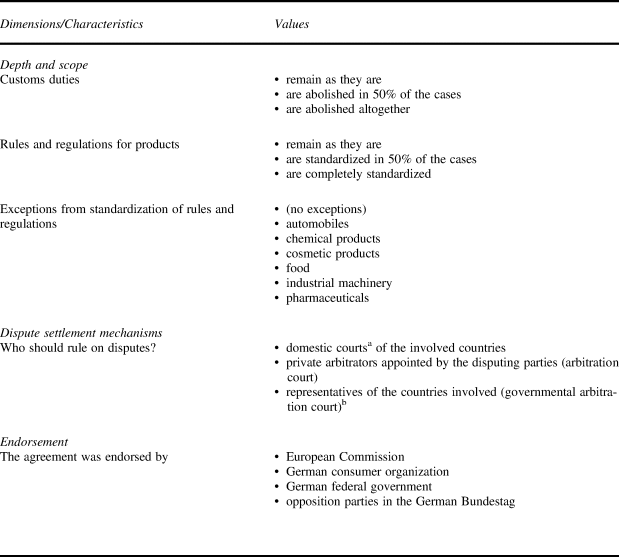
In our experiment, 3,079 respondents are provided with pairs of treaty designs where the treaty attribute is randomly assigned across multiple dimensions. We ask them to choose between each pair of treaty designs to simplify the decision task, following similar studies that consider the limits of short-term memory.Footnote 42 We first provided respondents with brief background information about the TTIP and the instruction about the conjoint exercise, and then showed them a screen with two versions of treaty designs. The two treaty versions vary along three main dimensions: scope/depth, dispute settlement mechanisms, and endorsement. Each dimension consists of one or several characteristics (depth, for example, is measured by tariff rates and the extent of regulations, and scope by exceptions from the tariff reduction and standardization of regulations). Finally, each treaty characteristic has different values. Table 1 summarizes the different characteristics and values each dimension includes.Footnote 43
Dimensions of the conjoint experiment

a Considering the German context of the survey, we used the term, ordentliche Gerichte (courts of general jurisdiction), in the experiment. The German courts are divided into five groups which correspond to the main areas of the law: regular courts (ordentliche Gerichte), the Labor Courts, the General Administrative Courts, the Social Courts, and the Financial Courts. In addition to these courts, there is the German Federal Constitutional Court (Bundesverfassungsgericht), which serves as a safeguard of the Grundgesetz.
b The survey experiment was fielded before the EU finalized its proposal for the ICS. However, the wording of the “representatives of the countries involved” captures the key characteristic of the ICS, in particular, in terms of the extent of legal delegation.
We ask each respondent to evaluate four comparisons between two versions of trade agreements.Footnote 44 Each comparison, displayed on a new screen, presents the respondent with a table listing the five different characteristics that reflect the three underlying dimensions. For each characteristic, one randomly drawn value is shown (see appendix for details about the instruction and question wording). To focus on substantively plausible and theoretically relevant treaty designs, we impose one restriction on the combinations of characteristics: we present exceptions to the standardization of rules only if the rules are partly standardized. If rules and regulations are completely standardized or if they stay the same regarding all the areas, making specific exceptions is not possible by definition. We also randomize the order in which the dimension characteristics are mentioned to prevent profile-order effect. Following the table presenting the two treaty versions, we measure the respondent's preferences for the different treaty characteristics by asking which treaty the respondent prefers.
Our data allow us to assess our central argument, juxtaposed with existing explanations that emphasize diverse individual-level attributes. To this purpose, before we conduct the main experiment, we ask a series of questions to measure the respondents’ skill levels, information, national sentiment, and other factors to evaluate potential mechanisms to explain our findings.
Results
We first examine our main expectations by using conjoint analysis and then we investigate how these effects vary across different subgroups. We use the methodological approach developed by Hainmueller, Hopkins, and YamamotoFootnote 45 and estimate average marginal component effects (AMCEs). The AMCE expresses the average effect of a treaty attribute on the probability that an individual supports the trade agreement, where the average is computed on the basis of all the other treaty attributes. We use the cjoint R package to estimate the AMCEs.Footnote 46 For all estimations, we calculate clustered standard errors by respondents as the respondents participate in four conjoint comparisons. We assume that there are no carryover, profile-order, and randomization effects. Hence, the AMCE can be nonparametrically identified. The appendix includes additional results on the robustness and validity tests using an alternative specification of the dependent variable and diagnostic tests to check the main assumptions of our analysis.
Figure 1 summarizes the conjoint experiment's main results. The AMCE estimates are the dots, and the lines represent confidence intervals. The experiment considers the dimensions of scope and depth (concerning the level of customs duties and standards with exceptions), dispute settlement mechanisms, and endorsement. The estimates for each treaty attribute are calculated relative to a reference value denoted by the dot without confidence intervals. For example, the second line from the top indicates that trade agreements with customs duties reduced in 50 percent of the cases are 3.6 percentage points more likely to win public support than the status quo.
Effects of treaty attributes on the probability to prefer a trade agreement

The results demonstrate that public support for the TTIP varies significantly with the specific characteristics of the treaty. First, we find evidence that respondents prefer agreements that reduce customs duties in 50 percent of the cases rather than the status quo. However, respondents do not prefer the complete elimination of customs duties to the status quo. This finding suggests that the preferences may not be linear and corroborates Rosendorff's theoretical insights into the trade-off of free trade agreements, according to which deeper and wider trade agreements would enable people to get more benefits from expanded trade, but they are also likely to impose stricter constraints.Footnote 47 However, it is also notable that the effects of standards are somewhat different from those of customs duties. Respondents are less likely to support treaties that harmonize more standards. The findings also show that exceptions in automobiles, chemicals, and industrial machines, which are often perceived as Germany's more competitive sectors, reduce support for the treaty. A notable exception is food, where people are likely to support the TTIP when excluding it from the standardization. This finding corresponds to previous reports that Germans are particularly concerned about US food safety standards.Footnote 48
Most importantly, we find a significant and substantively large effect of dispute settlement. In comparison to ad hoc private arbitration, dispute settlement through a domestic court increases public support by about nineteen percentage points. The dispute settlement via representatives of the member states is also more likely to be accepted compared with private arbitration, but less likely to be accepted compared with a domestic court. Taken together, these results suggest that public support for the TTIP is highly sensitive to different types of dispute settlement mechanisms, confirming our main hypothesis. People oppose more delegative forms of dispute settlement such as ISDS.Footnote 49
Finally, we also find that the endorsement profile matters. Overall, compared to endorsement by the European Commission or other political bodies (such as the government or the opposition parties), public endorsement by the consumer organization is 6.4 percentage points more likely to win public support for the TTIP. While smaller than the effect of dispute settlement mechanisms, the effect of endorsements is still significant.Footnote 50
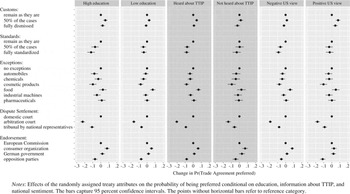
To assess potential interactions between respondents’ characteristics and the effects of the treaty designs, we stratify the main analysis by key individual attributes such as skills, information about the TTIP, and national sentiment (among others) and estimate the conditional AMCEs (Figure 2).Footnote 51 These results based on split sample tests are suggestive rather than definitive. However, overall, we find that the treaty design, its specific content, and endorsement by different political actors systematically shift public support for the TTIP. In particular, the treaty design involving dispute settlement mechanisms exercises strikingly large and robust influence over public support toward the TTIP. The effects of the depth, scope, and endorsement vary across the different subgroups. On the contrary, the effect of the form of dispute settlement is evident among all of these different groups that constitute major explanations of trade preferences.
Effects of treaty attributes on the probability to prefer a trade agreement across subgroups of respondents

Concluding Remarks
Analyzing public attitudes toward the TTIP provides an invaluable chance to test existing theories of trade preferences by drawing on specific predictions in a more focused way within a real-world context. In particular, by connecting the rational design literature to the existing studies on trade preferences, our results suggest that the existing understanding of trade attitudes as a function of relatively fixed individuals’ attributes requires substantial qualification. Our findings demonstrate that public attitudes toward the TTIP vary depending on the specific content and design of trade agreements.
Specifically, the features of dispute settlement mechanisms, which vary in the degree of legal delegation, are the single most important factor affecting public support for the TTIP. Compared to alternative options including a domestic court, ISDS generates particularly strong opposition to trade agreements. Public support for the TTIP appears to reflect the tension between economic benefits from deeper and wider agreements and reluctance to join an agreement that binds too tightly. Yet the effects of reducing customs duties are distinct from those of standardizing rules and regulations. Our results also largely confirm the role of major political actors who endorse the agreement.
Given the effect of treaty design, we have also examined their potential interactions with a wide variety of individuals’ key attributes. Compared to other factors, the effect of dispute settlement mechanisms remains particularly large and consistent across individuals’ key attributes including skill levels, information, and national sentiment, which constitute major explanations of trade preferences. Introducing a private arbitration court significantly reduces public support for the TTIP, compared to a domestic court across different subgroups. Considering the importance of the key individual-level attributes that the existing literature emphasizes, the underlying consensus about which types of dispute settlement mechanisms to accept deserves keen attention. According to our findings, ISDS is the most important source of public opposition to trade agreements.
Several caveats to our study should be noted for future research. First, despite our attention to sovereignty costs and the problem of transparency to understand the opposition to ISDS, we did not directly test the underlying causal mechanisms. Future research may further investigate the sources of this strong resistance to ISDS. Additionally, more work can be done to examine the way domestic political factors condition this public opposition. Second, we acknowledge that our findings may have limited external validity. Our sample consists of respondents from only one country, Germany, which is known to have strong domestic courts with high popular support.Footnote 52 Citizens in a country with weak domestic courts or considering an agreement with a country with weak domestic courts may have very different preferences about institutional design. Future research can utilize our general approach as the foundation to generalize our findings to other settings and to examine how domestic conditions interact with treaty design to shape public support.
Our results highlight the contextual and dynamic nature of public support for trade. Given the multidimensionality of trade agreements, the aggregate level of public support for the TTIP would vary depending on the treaty's specific design and issue areas that prevail in the dynamic process of public debate. Anecdotal evidence from Germany, where high-ranking politicians drastically changed their political standpoints on the TTIP and its specific components after observing increasing media attention and skepticism toward the particular issue,Footnote 53 confirms these findings. This suggests that negotiations on trade agreements and their outcome can be influenced by public support that is shaped by interactions between the proposed treaty design and dynamic process of political persuasion.
In line with some other recent studies,Footnote 54 we show that treaty design has a significant impact on support toward an international agreement. Our findings are particularly important considering their implications for the existing literature on dispute settlement mechanisms and, in particular, for resolving disputes between foreign investors and member states. According to the literature, the dispute settlement mechanisms transmit information about member state behavior to not only foreign investors but also domestic audiences who can punish or reward their elected leaders. This threat of punishment helps member states more credibly commit to cooperation. While ISDS can effectively serve this role on behalf of foreign investors, domestic audiences are likely to oppose the existing ISDS systems that can incur the sovereignty costs and the problems of transparency. This asymmetry may underlie the growing pressure to reform the existing ISDS, as Simmons notes.Footnote 55 She presents evidence that a growing number of countries are beginning to renegotiate or even to terminate their obligations under the investor-state system of dispute settlement. Increasingly, highly democratic countries with clear lines of accountability to their domestic constituents are seeking to annul the decisions of arbitration panels over time. Our findings stress that further understanding of domestic constituents and their accountability pressure on the governments is necessary for treaty design that makes international cooperation “feasible and durable.”Footnote 56
Supplementary Material
Supplementary material for this research note is available at <https://doi.org/10.1017/S0020818319000249>.
Acknowledgments
For constructive comments and suggestions, we thank Michael Bechtel, David Hilpert, Christina Schneider, Anton Strezhnev, and Stefanie Walter. We also thank the editors and two reviewers for their thoughtful comments and suggestions. Previous versions of this paper were presented at the Political Economy of International Organizations and the Midwest Political Science Association conferences.
Funding
The authors gratefully acknowledge support of the Collaborative Research Center 884 “Political Economy of Reforms” (SFB 884) at the University of Mannheim. SFB 884 is funded by the German Research Foundation (DFG).