This article, which contains evidence supporting CPT, is about a turning point in the relationships between Britain, the United States, and the British colony of Canada. In the 1860s, the British Empire and the United States came to the brink of war. Canadians were especially concerned that the Anglo-American War of 1812–1815 might be repeated, this time with a deadlier generation of weapons. The War of 1812 had involved a US invasion of Canada and the widespread destruction of life and property there. This article argues that Canadian entrepreneurs played an active and important role in preserving peace between the United States and the British Empire during the tumultuous period surrounding the American Civil War. Footnote 3
Canadian entrepreneurs in the 1860s built the capitalist peace in a variety of ways. In particular, they resisted British plans for the remilitarization of the Canada-US border and the Great Lakes, the bodies of water shared by the two countries. Rather than being informed by religious pacifism of the type espoused by Quakers, the thinking of Canada’s antimilitarist entrepreneurs was informed by Enlightenment-derived assumptions that the best way to avoid war was to increase trade. Their efforts to promote the idea of peace through trade contributed to and continued well after the signing of the Treaty of Washington in 1871. The Treaty settled a broad range of disagreements between the United States and the British Empire, established an arbitration procedure for others, and set the foundations for progressively closer relations between London and Washington. Although Britain was responsible for Canada’s foreign relations in this period, the residents of this self-governing British colony were anything but passive participants in the process that led to the Treaty of Washington.
Historians and IR scholars have published extensively on the impact of the American Civil War on the security relationship of Britain, the United States, and Canada. Footnote 4 Unfortunately, our understanding of the role of business in the preservation of peace between the United States and the British Empire in the 1860s is still underdeveloped. Kenneth Bourne observed in his 1967 study of nineteenth-century relations between Britain and the United States that trans-Atlantic trade was “a peace factor.” Footnote 5 However, he did not develop this idea. The most recent detailed study of Anglo-American diplomacy in the Civil War era, Jay Sexton’s Reference Sexton2005 Debtor Diplomacy, emphasizes the role of London and Wall Street bankers in lobbying their respective governments to avoid war. Sexton’s book certainly acknowledges the role of Sir John Rose, a supremely well-connected Canadian financier-politician in brokering the diplomatic settlement that resulted in the 1871 Treaty of Washington. Footnote 6 Rose, who had recently relocated from Canada to Britain, was a partner in the London branch of a Wall Street bank and had retained close connections to Canada’s most influential financial institution, the Bank of Montreal. Footnote 7 Sexton’s research on Rose’s role as a trusted go-between linking policymakers in London and Washington is important, as it allows us to connect the abstractions of CPT to a specific episode in diplomatic history. Sexton’s book, which is specifically focused on high finance, does not discuss the role of other Canadian businessmen in influencing the Anglo-American relationship and in building the capitalist peace during and immediately after the American Civil War. This article explores the role of this latter group of Canadian businessmen. If their individual influence was limited, their collective stand on questions of war and peace in North America made a significant impact on the direction of military policy in Canada.
The Development of Commercial Antimilitarism in the English-Speaking World
Throughout history, the typical merchant has likely dreaded military conflict. Footnote 8 The Enlightenment saw the emergence of a consciously articulated and coherent ideology of capitalist antimilitarism. Enlightenment thinkers argued that the commercialization of society and the growth of cross-border economic interdependence would reduce the frequency and severity of warfare. Footnote 9 Their writings had a lasting influence: in the nineteenth century, the idea that cross-border commerce promoted peace was disseminated by peace societies in many countries. Footnote 10 In Britain, the peace movement was associated with the laissez-faire, low-tax ideology of Manchester liberalism and specifically of the factory owner and MP Richard Cobden. Footnote 11 Cobden argued that if another nation was threatening one’s country, the best course of action was actually to reduce the size of one’s own military while befriending the population of the other country through commercial interdependence. Footnote 12 Similar ideas were promoted in the United States by the New York Peace Society (established in 1815) and the American Peace Society (established in 1828). Footnote 13
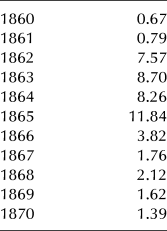
The Civil War divided the US Peace Societies with some members, such as Senator Charles Sumner of Massachusetts, viewing the conflict as a rare example of a “just war.” Footnote 14 Other pacifists, including several who were equally committed to the end of black slavery, became part of an unwieldy antiwar coalition that included Copperhead Democrats, outright Southern sympathizers, and merchants who simply regarded the war as bad for business. Footnote 15 During the Civil War, most people in the North abandoned or at least suspended their traditional opposition to standing armies, which allowed Lincoln to build a powerful military backed by conscription and income taxes. Footnote 16 However, with the coming of the peace in 1865, the traditional opposition to standing armies and high taxes reasserted itself in the form of electoral pressure for a dramatic reduction in the size of the military. Footnote 17 As Table 1 indicates, military spending as a share of GDP quickly fell back towards antebellum levels. Rapid demobilization in the summer of 1865 meant that within a few months of the surrender of the South, the United States had a much smaller army at its disposal for use against perceived foreign and domestic enemies.
US Defense spending as a percentage of GDP, 1860–1870
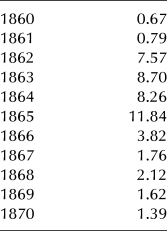
Data Sources: Historical Statistics of the United States, Colonial Times to 1970 (Washington, D.C.: U.S. Dept of Commerce, Bureau of the Census, 1975); Louis Johnston and Samuel H. Williamson, “What Was the U.S. GDP Then?” MeasuringWorth, 2013.URL: http://www.measuringworth.org/usgdp/;
Canadians of this period were avid readers of US and British books and periodicals and thus had the opportunity to learn about the Enlightenment-derived arguments used by the British and American peace societies. In the 1850s, the local press discussed the peace movement, as did the popular Nova Scotian novelist Thomas Chandler Haliburton. Footnote 18 Events in the 1860s would bring questions of war and peace forcefully home to Canadians. During the first year of the American Civil War, Palmerston’s government dispatched additional troops to Canada and took other steps for the defense of Canada in the event of an outbreak of hostilities with the republic. These moves alarmed classical-liberal businessmen in both Canada and Britain. Cobden’s Reference Cobden1862 pamphlet, The Three Panics denounced these moves as yet another example of gratuitous militarism. Footnote 19 Taking a less polemic tone, business interests in Britain also encouraged their government to adopt a conciliatory attitude to the United States and to avoid war at all costs.
Commercial interdependence between Britain and the United States had deepened since the end of the Napoleonic Wars in 1815. On the eve of the Civil War, bilateral trade flourished with the British exporting manufactured goods and the Americans exporting Northern wheat and Southern cotton. Footnote 20 The antebellum period also saw substantial British investment in US securities, land, and other assets. Footnote 21 The financial houses that specialized in trans-Atlantic trade and investment, such as J. Pierpont Morgan & Co. and Baring Brothers, had extensive commercial and kinship networks on both sides of the Atlantic. Footnote 22 They naturally favored the maintenance of peace between Britain and the United States. During the Civil War, London banker Thomas Baring MP repeatedly encouraged the British government to adopt a conciliatory policy toward the United States. Footnote 23
During the first few months of the Civil War, British public and parliamentary opinion had polarized into pro-Southern and pro-Northern camps. Britain recognized the “belligerency” of the South, which allowed it to issue bonds and purchase warships in Britain. In late 1861, two Confederate officials were seized from the RMS Trent by an overzealous US Navy captain. When it learned of the seizure of these men from a British ship, the British government issued an ultimatum demanding their release. Footnote 24 Lincoln’s Cabinet then reluctantly agreed to release the prisoners. Word that the United States had acquiesced reached Britain in early January and was greeted by widespread relief. Footnote 25 During the Trent Affair, the British government dispatched troops to Canada to reinforce garrisons along the United States border. Footnote 26 To complicate the situation, some of the British officers sent to defend the Canadian frontier were notorious for their pro-Southern views. Footnote 27 Canadian public opinion was itself divided between those who supported the North and those who were more sympathetic to the Southern Confederacy. Footnote 28
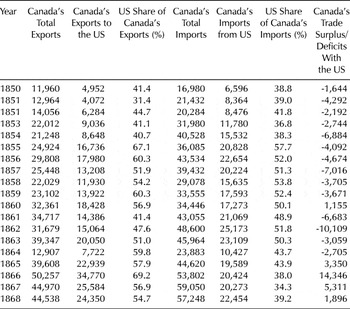
Canadians’ ambivalent attitudes toward the Civil War meant that the colonies could and were used as a base of operations for Confederate blockade runners and fifth columnists, much to the resentment of people in the North. Footnote 29 Some Canadians, including several businessmen who openly sympathized with the Southern Confederacy, helped Confederate agents to mount cross-border raids and urged Canadians to prepare for war with the United States. Footnote 30 Pro-Southern sentiments continued to be expressed after the defeat of the Confederacy: when Jefferson Davis, the former President of the Confederacy, visited Toronto in June 1867, he was received by a cheering crowd of 6,000–7,000 people before dining with prominent local citizens. Footnote 31 The fact that a large minority of Canadians openly sympathized with the South is striking when one considers how integrated Canada’s economy was with that of the neighboring Northern states. As Table 2 indicates, the relative importance of the United States as a destination for Canada’s exports increased after the implementation of the reciprocity free trade agreement in 1855, although economic historians caution that this increase may have been due more to the completion of cross-border railways than the reduction in tariffs. The 1850s saw a surge in Canada’s timber exports to the United States, whereas Great Britain had previously been Canada’s primary customer. Footnote 32 Canadian entrepreneurs took advantage of the new availability of the US market and upgraded from the export of lightly processed logs (i.e., square timber), into the export of value-added goods, such as boards and planks. Footnote 33 Canadians were also conscious of the increase in exports of wheat, barley, and animals to the United States in this period. Footnote 34 Canadians paid for the American goods they consumed by exporting to Britain, where they earned sterling for use in the US market. Britain’s own balance of payments with the United States included capital flows, trade in services, and trade in visible goods. Footnote 35 Canadians were thus part of a complicated web of payments linking countries on both sides of the Atlantic. The sheer interconnectedness of the Canadian, US, and British economies predisposed Canadian entrepreneurs to favor political solutions that preserved flows of goods and capital.
Canada’s trade with the United States and rest of world, 1850–1868 (Figures in thousands of dollars)

Table based on Officer and Smith, “Reciprocity Treaty,” p. 600. Calculations by authors.
The aggregate trade data in Table 2 should be read with the understanding that local and regional conditions varied widely. Some regional economies like that of Quebec City were timber-based, export-oriented, and dependent on British markets. Footnote 36 A growing number of Canadian regions were increasingly tied to the Canada-US trade, especially after the 1854 Reciprocity Treaty that permitted freer trade between the countries. The Treaty resulted in a rapid expansion of so-called “trade of convenience,” as border-town entrepreneurs took advantage of their new ability to trade with each other by conducting many small transactions. Footnote 37 Canadian localities that were in the commercial orbit of a large US city such as Detroit or Buffalo produced the most forceful opposition to the militarization of the Canada-US border. The data in Table 2 do not capture all of the cross-border economic ties that influenced how Canadians viewed their security relationship with the United States, for flows of labor, capital, and technological expertise were also important factors. For instance, in the petroleum-rich regions that experienced an oil boom in the 1860s, workers from the older oilfields of Pennsylvania brought crucial know-how. Footnote 38 US FDI in the Canadian manufacturing and mining sectors was also growing in this period. Footnote 39 In sum, the economic relationship between Canada and the United States was increasing in both complexity and relative importance in this period. We argue that this economic reality encouraged Canadian entrepreneurs to adopt a staunch antimilitarization stance.
Competing Security Paradigms in British North America
It was in this tense context that discussions over the defense of Canada would unfold. In the aftermath of the Trent Affair, the British government began to overhaul its plans for the defense of Canada and the sharing of the attendant financial burdens. Previously, the Province of Canada had left military spending to the imperial government, relying primarily on British regulars and the goodwill of the United States for its defense. Footnote 40 Efforts to strengthen the Canadian militia during the Crimean War and the Indian Mutiny were both modest and temporary. Footnote 41 The Trent Affair, therefore, was a godsend for the Canadian advocates of a strong and well-funded Canadian army. Footnote 42
At the time of the Trent Affair, Canada was governed by an unstable coalition of conservative factions. After 1861, the British government began pressuring the Canadian government to create an effective military force to fight alongside British regulars in the event of an American invasion. The Canadian government responded by planning to create an “active militia” of 50,000 men who would volunteer or be conscripted if necessary. The armed forces were to be supplemented by gunboats on the Great Lakes. The estimated cost of this defense plan, $1.1m, alarmed many taxpayers. Footnote 43 Most controversial, however, was the specter of conscription and the re-navalization of Great Lakes, waters that had been effectively de-navalized since 1817. The measure was so unpopular with the public and backbenchers that the Militia Bill led to the fall of the Canadian government and its replacement with a new ministry that included many classical liberals who identified with Britain’s Liberal Party. Footnote 44 The defeat of the Militia Bill was reported by newspapers in Britain, where Canada’s apparent unwillingness to pay for its own defense generated a negative reaction. Footnote 45
The Minister of Finance in the new government was Montreal entrepreneur Luther Hamilton Holton. Holton was born in 1817 to American parents who had moved to present-day Ontario on the eve of the War of 1812. In the 1840s, Holton prospered through his involvement in the trading networks that ran through Montreal and which linked wheat-growing communities around the Great Lakes to consumers in Europe. He acquired a fleet of steamships for moving grain. Footnote 46 Throughout his career as a legislator, Holton was noted for his belief in the classical liberal doctrines of “Jeremy Bentham, John Stuart Mill, and John Bright.” Footnote 47 In July 1866, the New York Tribune reported that Holton enjoyed the support of most of the “commercial classes” of Montreal, Canada’s commercial capital. Footnote 48
In the 1850s and 1860s, Montreal “commercial classes” had strong and multiplying ties to the United States, although ties to Glasgow, Liverpool, and London remained important. The volume of Canada-US trade increased in the period 1854–1866, when there was free trade in natural products between the two countries, although economic historians have cautioned that much of the prosperity Canada enjoyed under the 1854 Elgin-Marcy Treaty was due to factors independent of the treaty, such as the land boom in Upper Canada, good harvests, and the strong demand for Canadian commodities during the American Civil War. Footnote 49 As Canada’s principal financial center, Montreal and its capitalists eagerly pushed into new markets and sought new opportunities in the United States. Here, the activities of Canada’s oldest and largest financial institution, the Bank of Montreal, are of particular importance. The Bank established a New York agency in 1858 to sell commercial paper and to deal in foreign exchange. In 1861, it opened a lucrative agency in Chicago “to capture a portion of the great produce trade.” During the Trent Affair, the bank had briefly restricted the extension of credit in Chicago. Footnote 50 After this dispute was resolved peacefully, the turnover of this agency increased steadily throughout the 1860s as Chicago’s role in the handling of agricultural commodities flourished. Footnote 51 New York City was, however, the most important US market for the Bank. By the early 1860s, the Bank of Montreal, which was then larger than any bank in the United States, was “probably the largest and most powerful transactor in the New York money market, where it maintained and employed immense sums.” Footnote 52 After the outbreak of the Civil War, the Bank also traded heavily on the loan security of the United States Federal Stock with very healthy margins of not less than 10%. Footnote 53
The greatest opportunity for Canadian bankers in the 1860s was the New York gold market. The departure of the United States from the gold standard had put gold to a premium against greenbacks that reached its zenith at 300% of average values. The Bank of Montreal took full advantage of its plentiful gold reserves to reap considerable profit from the demand in the New York market. The bank’s borrowers offered United States fiat currency as security on the loans, which in turn allowed the Bank to employ that capital in discounting trade bills in the city. From a single source, therefore, came a double profit. Footnote 54 In 1868 the Bank’s New York agency received a four-fold jump in its asset allocation, from $1.2 million to $8.8 million, half of that in gold to satisfy the voracious demand for specie in the New York market. Footnote 55 All major Canadian banks participated in this market, but the Bank of Montreal’s share of the Canadian business was 78%. Its share of the $20 million gold market was $7.8 million. Footnote 56
While the wartime conditions in the New York money market created opportunities for unusually high profits, the Bank also confronted risks related to the possibility of a war between the British Empire and the United States. Such a war risked destroying the value of the Bank of Montreal’s claims on counterparties in the United States: in wartime, it becomes illegal to make payments to enemy alien individuals and firms, even for debts contracted before the outbreak of the hostilities. Footnote 57 Faced with this elevated level of political risk, the Bank responded by “shoring up” gold reserves, a form of self-insurance that required the diversion of capital from other purposes. Footnote 58 In his correspondence with a London banker, Bank of Montreal director John Rose stressed that good relations with the United States were absolutely essential for Canadian business interests. Footnote 59 In January 1865, Rose bemoaned the prospect of the re-navalization of the Great Lakes, declaring that Canadians were “determined that should there ever be war England vs. US it will not be because Canada had antagonized US.” Footnote 60 In view of his belief in the commercial importance of Anglo-American amity, it is not surprising that Rose later invested considerable time in helping to broker to the Anglo-American agreement that became the 1871 Treaty of Washington.
The Bank’s cross-border links continued to multiply during Luther Holton’s term as the Province of Canada’s Minister of Finance between 1862 and 1864. In his maiden budget speech, Holton made it clear that his primary goal was to reduce government spending. Footnote 61 The ministry of which Holton was part resisted British pressure to increase military spending. After sustained pressure from the Crown’s Canadian representative, the Canadian government eventually acquiesced to an increase, but it only agreed to a compromise plan that doubled the size of the existing purely voluntary militia. This militia was comprised of reservists who were paid to train each year. This plan tripled the defense budget of the previous year, yet it was a partial victory for the anti-militarists in that it was two-thirds cheaper than the original plan that had led to the downfall of the last government in 1862. Footnote 62 The government’s reluctance to spend money on the military was reinforced by the Toronto Globe, which argued that arming in anticipation of the distant possibility of invasion would actually be counterproductive and that “trading” and ordinary “social intercourse” were the best ways of preserving peace between Canada and the United States. Footnote 63
Advocates of the Capitalist Peace and the Jervois Report
The ministry of which Luther Holton was part was defeated in early 1864 over state funding for Catholic schools, an issue unrelated to the main theme of this paper. Chronic political instability and the constant threat of military conflict led to a new coalition determined to federate the colonies of British North America. Accordingly, Canada’s new grand coalition government began talks with the other British colonies in North America to gauge interest in such a scheme. The new ministry included George-Étienne Cartier and John A. Macdonald, the authors of the ambitious but ill-fated 1862 Militia Bill, as well as George Brown, who had opposed it. It was, therefore, unclear whether Canada would undertake additional actions to militarize its frontier with the United States. Meanwhile, the strategic position of the South was becoming increasingly desperate, with the capture and destruction of Atlanta by the Union army and Lincoln’s re-election in November 1864. The North’s territorial gains continued in early 1865, culminating in Robert E. Lee’s surrender and the end of the Civil War in April 1865. From a Canadian and British military planning perspective, the presence of a large, experienced, victorious and fully mobilized army on the borders of Canada was a threat.
Debates about the defense of Canada centered on the reports written by Lieutenant-Colonel William Francis Jervois, an experienced British military engineer who had earlier designed fortifications in South Africa and Britain. Jervois believed that since war between the British Empire and the United States was likely, immediate preparations should be made. His reports, which were published in February 1864 and January 1865, recommended the fortification of the largest Canadian cities, the construction of a fleet of iron-clads on Lake Ontario, and the creation of a Canadian army of 25,000 to fight alongside British troops in the event of an American invasion. Footnote 64 Jervois estimated the initial costs of $10 million in the first year and between $3 million to $4 million thereafter. Footnote 65
Jervois’s reports provoked the advocates of the capitalist peace on both sides of the Atlantic. The Jervois proposals required British parliamentary approval, and that provided the arena for the first round of the debate. The planned debate even roused Richard Cobden from his deathbed to travel to London either to deliver one last speech against this latest manifestation of militarism. However, he was too ill to speak and soon died. Footnote 66 Instead, Cobden’s close associate, the Quaker industrialist John Bright, led the attack on Jervois’s Canadian defense plan when it came before the British parliament on 13 March 1865. Footnote 67
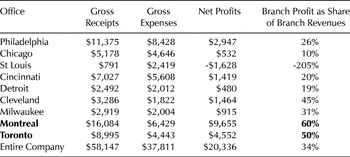
Outside Parliament, Canadian entrepreneurs of the anti-militarist camp continued the attack on the Jervois recommendations by emphasizing its fundamentally wrong-headed approach. Although these they never established a formal organization to coordinate their opposition to the proposed militarization of their society, anti-militarist entrepreneurs in different Canadian cities frequently used remarkably similar arguments. In their eyes, more cross-border trade, not more fortresses, was the best way of increasing the chances of peace. One such advocate of peace through trade was Erastus Wiman, the editor of the Montreal Trade Review, an influential commercial magazine. Wiman also managed the Canadian subsidiary of the Mercantile Agency, a New York credit-reporting firm that served businessmen throughout North America who wanted to verify the creditworthiness of potential business partners, especially those in distant cities. During the Civil War, when the Mercantile Agency’s revenues from its southern branches had been dramatically reduced, profits from the Montreal and Toronto branches had been increasingly important to the parent company in New York. Table 3 shows that these were the most profitable branches in the Mercantile Agency. Footnote 68 American businessmen used Wiman’s agency to investigate Canadian businessmen and vice versa, which meant that his profits depended, in part, on a sustained level of cross-border trade. It is not surprising, therefore, that Wiman’s magazine deplored the plans for the militarization of the Canada-US border.
Receipts and expenditures of Mercantile Agency branches, 1863

Source R.G. Dun to B. Douglas, 8 August 1863, report on operations in Dun & Bradstreet Corporation Records, Series II, Subseries A, Correspondence 1854–1931, v. 5 Letter book, Aug. 15, 1861–25 Mar. 1864. Profits/Receipts Calculated by the Author.
In a May 1865 editorial on the defense of Canada, the Montreal Trade Review argued that a war fought along the lines proposed by Jervois would be a disaster for Canadians even if Britain ultimately emerged technically victorious. The editorial, which was almost certainly written by Wiman, drew on Cobden’s theory that cross-border trade promotes peace. The editorial condemned the proposed military expenditure as “utter folly” and declared that “commercial ties and interest” would be a much more effective defense of the peace than any “redoubts or bastions.” Footnote 69 The paper argued that building more canals to bring produce from the mid-western United States to Montreal would be a better use of the money than armaments and fortifications. Not only would canals cost less than Jervois’s defensive scheme, but the resulting increase in cross-border trade would also “be a cause of friendship with the western states, which would do more than anything else to secure us against war with the United States.” Footnote 70
The anti-militarist position of Holton and Wiman was sensational, but it was far from a unanimous verdict among Canadian businessmen. There was indeed a section of the Canadian bourgeoisie that supported the Jervois plan and other measures designed to militarize Canadian society and the Canada-US border. Several groups of businessmen in Canada had a vested interest in increased military spending. In a garrison towns such as Montreal and Kingston, British military spending was very important to the local economy, since the presence of so many soldiers created demand for local businesses. Footnote 71 One of the businessmen who stood to benefit from re-armament was Casimir Gzowksi, a Polish émigré who owned a thriving civil engineering firm. Gzowksi, who was an officer in the Canadian militia, advocated the re-militarization of the Canadian frontier and the construction of elaborate fortifications around Montreal and perhaps other Canadian cities. Gzowksi could have reasonably expected that some of the work of building these fortifications would be given to his contracting firm. In 1864, Gzowksi and a group of Toronto businessmen concerned about a possible American invasion protested a proposed reduction in the number of British soldiers in Canada. Footnote 72
Canadian pro-Confederate sympathies were considered provocative and offensive, even if those views were espoused by a minority. Footnote 73 However, Canadian opposition to the British proposals to re-militarize the Canada-US border was extensively reported in the US. Footnote 74 For instance, a newspaper in Cleveland, Ohio noted that while the Canadian Cabinet wanted to put a fleet of gunboats on the Great Lakes, this proposal had been controversial in the Canadian parliament. Footnote 75 Moreover, an insurance broker and medical doctor in a Canadian border town wrote to President Lincoln to denounce the anti-US statements that had been made by prominent Britons and Canadians. Footnote 76 By sharply and vocally dissenting from and resisting the proposals for the re-militarization of the border with the United States, Canada’s anti-militarist entrepreneurs made Americans were aware that a large segment of the Canadian population did not want to prepare for even the possibility of war with the United States. Indeed, a New York newspaper declared in 1865 that in the event of an Anglo-American war, the pragmatic Canadians would likely negotiate a neutrality arrangement. Footnote 77 US awareness of the diversity of Canadians’ attitudes informed US thinking about Canada in subsequent years.
The Dominion of Canada came into existence on 1 July 1867. This federation included the Province of Canada, which became the provinces of Ontario and Quebec, along with Nova Scotia and New Brunswick. The first Canadian ministry’s first priority was to develop plans to defend the border against the United States. These plans were prioritized because Canada had been subjected to attacks by the Fenian Brotherhood, an Irish-American paramilitary group, since 1866. The Fenians believed that attacking Britain’s North American colonies might somehow result in Ireland’s independence. Although the American government eventually took steps to prevent the Fenians from using US soil to attack Canada, cross-border raids continued to 1870. The most important clash with the Fenians occurred in the Niagara Peninsula in June 1866, when a force of Canadian militiamen succeeded in repulsing a disorganized group. Footnote 78 The Fenian Raids, along with the more distant but still seemingly plausible threat of an invasion by the US military, encouraged Canadians to seriously consider the defenses of the new Dominion.
In March 1868, the Minister of Militia, George-Étienne Cartier, presented a detailed plan for a robust Canadian military to the House of Commons. It involved the creation of an “active militia” to man the fortresses and operate artillery. In the event of an invasion, it would be assisted by the “sedentary militia”, which would include every able-bodied male British subject between the ages of 21 and 40. Footnote 79 At the same time, Sir Patrick Leonard MacDougall of the Canadian Department of Militia advocated the fortification of Canada’s frontier with the United States. Footnote 80 The Canadian government’s plan provided for an effective volunteer fighting force of 40,000 soldiers, Great Lakes gunboats, and the construction of elaborate fortifications to protect Canada’s cities. If insufficient volunteers materialised, the government would resort to conscription. In introducing his plan, the Minister of Militia declared while Canada currently possessed some of the elements of “national power,” such as maritime strength and territorial extent, “the military element still remained necessary for the completion of national greatness.” Footnote 81
The 1868 Militia Bill provoked strong negative reactions from the Liberal opposition reminiscent of their similar opposition to the 1862 Militia Bill. Footnote 82 Thomas Oliver MP, a dry goods merchant from Ontario, focused on the cost, feared that the proposed expenditure of $5,000,000 “was but a beginning.” Footnote 83 Ebenezer Vining Bodwell’s speech against Cartier’s defense plan invoked the Enlightenment idea that cross-border commerce ensures peace. This theory was congruent with Bodwell’s lived experience, for he was a merchant from the Ontario county of Oxford, which was crossed by the Great Western Railway of Canada, a British-owned railway that connected Niagara Falls in New York State with Detroit, Michigan. Footnote 84 Bodwell’s fortunes were thus closely tied to those of these US urban centers. Bodwell declared that “the commercial relations of the United States with Great Britain are such as to make it the interest of both to preserve peace” regardless of any disagreement. Bodwell’s speech, which included many statistics showing the magnitude of the trade between the two countries, underlined the idea that preparing for a war with the United States was, at best a waste of money, and at worst a recipe for economic suicide for all concerned. The debate engaged other MPs whose careers and interests show just how far Canadian and American life and commerce were intertwined. Thomas Sutherland Parker had studied in Philadelphia before practicing medicine in an Ontario town located near the US border. Footnote 85 Parker believed that war between the two countries was inconceivable and that spending “money preparing for an Anglo-American war was [therefore] pointless.” Parker did not explain why such a war was impossible, but he did say that any military force created by Canada should be inexpensive and designed exclusively for maintaining domestic order and repelling small attacks such as that of 1866. The government’s “monstrous” bill, he said, involved importing into Canada “the continental system or that of Europe.” Footnote 86
Speaking on the same day, James Young MP said “for the first time on this continent the germs of the European military system were to be introduced.” Under the government’s plan, “conscription was to replace the volunteer system; and they were to have fortified cities and garrisons placed in them; so that, in almost every respect, their system was to be a copy of that obtaining on the Continent of Europe.” The result would be economic disaster. Although he did not mention it in his speech, Young’s thriving wheel manufacturing business was in a town served by the railway company that connected Niagara Falls and Detroit, which meant that his private business interests were indirectly linked to the financial health of these US cities. Footnote 87 Young, it should be noted, was a vigorous promoter of free trade between Canada and the United States. In 1865, he had won a prize from the Montreal Trade Review for an essay on the benefits of liberalized trade for both Canada and the United States. Footnote 88 As did Bodwell, Young promoted a theory of international relations that was congruent with his lived experience and his pecuniary interests.
Despite these criticisms, the bill to create a substantial Canadian military was passed. The massive militarization envisioned by the Militia Act, however, was never implemented. First, while the Minister of Militia was an enthusiast for higher military spending, Canada’s Prime Minister, Sir John A. Macdonald was a political pragmatist who understood that many Canadians were opposed to increased military spending. Throughout the post-1868 period, the Canadian government sought to contain military spending, which is perhaps the primary reason why Canada sought to avoid US-style Indian Wars with the native peoples of western Canada. Footnote 89 Macdonald’s awareness that voters were averse to military spending helps to explain why the plan embodied in the 1868 law was not implemented.
Moreover, developments in British politics soon invalidated many of the assumptions on which the 1868 militia law had been based. In December 1868, Gladstone’s Liberals formed a government in Britain, supported by John Bright and other Radical MPs. The new ministry sought to improve relations with the United States, which involved convincing the Republic that Britain did not pose a threat. Gladstone’s minister also knew that they had to address American grievances dating from the Civil War. The most important of these were the financial claims the United States had presented to the British government for losses that had been caused by the privateers the Confederacy had purchased from British shipyards. Footnote 90 In early 1869, the new Secretary of State for War, Edward Cardwell, announced that Britain was going to close the vast majority of its garrisons in the Dominion of Canada, including those on the border. Footnote 91 This strategy was vigorously protested by the Duke of Cambridge, the head of the British Army. Footnote 92,Footnote 93
Cardwell’s proposal was supported by those advanced Liberals who wished to abandon Britain’s military obligations in Canada regardless of the circumstances or actions of Canadians. Their ranks included the Liverpool Financial Reform Association, a pressure group of tax-averse anti-imperialist businessmen. Footnote 94 In the middle, were moderate Liberals such as Lord John Russell and Lord Granville who said that they would be willing to devote British taxes to the defenses of Canada provided Canadian taxpayers also displayed a willingness to contribute to the military defenses of their own country. In a February 1865 debate on whether to spend money on the defenses of Canada, Granville said that “if the colony is prepared to take its share in the exertions and expenses which are necessary for its defense” Britain would assist it. Footnote 95 Russell retired from active politics in 1866, but Granville served as Gladstone’s Colonial Secretary between 1868 and 1870 and his views undoubtedly reflected those of much of the British Liberal Party.
For these senior Liberal politicians, British expenditure on the military defense of Canada would require Canada to display the will and the capacity to create an effective deterrent to possible American aggression. Canada’s will was weak and divided on the question, even in times of heightened tension. During and after the Trent Affair in 1861, Canadians had vigorously debated whether militarizing the frontier would be the best strategy to ensure Canada’s safety. The 1862 Militia Bill was defeated in the Canadian legislature. Between 1862 and 1864, the reluctance of the Canadian parliament to authorize military expenditure was discussed extensively in the British parliament. Footnote 96 The anti-militarist businessmen in the Canadian parliament were not able to prevent the passage of the 1868 Militia Bill. However, the grandiose plan for a Canadian army contained in this bill was never implemented, likely because the Canadian Prime Minister feared a backlash from taxpayers. Given the evident unwillingness of many Canadians to spend on defense and the prior statements by Russell and Granville that Britain would only spend money on Canadian defense if Canadian taxpayers also made major contributions, the decision of Gladstone’s cabinet to close most of the Canadian garrisons and pursue a policy of conciliation towards the United States appears logical.
The Canadian response to Cardwell’s plan was divided. In garrison towns reliant on British military spending, there were, of course, loud complaints. Canadian Prime Minister Sir John A. Macdonald, whose parliamentary constituency (Kingston) was located on the border and included a major British fortress, opposed the withdrawal of the British troops. Footnote 97 It should be noted that Kingston’s hitherto prosperous economy slumped after the closure of the British garrison in 1870 and did not recover until the twentieth century. Footnote 98 Alexander Mackenzie, the leader of Canada’s Liberal Party, declared his support for the decision of the British government to withdraw its garrisons from Canada. Mackenzie, MP for Lambton, was a resident of Sarnia – an unfortified Ontario city separated from the State of Michigan by the narrow St. Clair River. Mackenzie confidently declared that he was “not afraid of the United States,” a view undoubtedly reinforced by the fact he could see United States every day from his constituency office. Footnote 99
The process of winding down the British garrisons in Canada lasted until November 1871. Thereafter, the British government maintained garrisons only at Halifax on the Atlantic coast and Esquimault on the Pacific, the two points in Canada the British regarded as important to their own defense. Most of the Dominion, however, including its major population centers, was effectively demilitarized, save for a small force of part-time reservists. Footnote 100 The fact that historic fortresses now sat essentially vacant was a bold affirmation of trust in the good intentions of the United States. Britain’s decision in the late 1860s to remove its garrison from Canada rendered the entire security paradigm implicit in the 1868 Militia Bill obsolete. That Bill was premised on a joint British-colonial defense of Canada, a defense plan that never saw the light of day. In June 1872, Canada’s Minister of Militia declared in parliament that there was as a grand total of “540” full-time soldiers in Canada – far fewer than the 40,000 men under arms envisaged by the 1868 legislation. Members of the Liberal opposition declared that even this “standing army” was dangerously large and expensive for a country of just 3.6 million. Footnote 101 Some of the more radical members of the Liberal party advocated that even Canada’s system of unpaid volunteers be scrapped. These volunteers participated in several days of training each year under the supervision of British officers. These training sessions involved overnight stays in camps near major cities. The trainees were fed at taxpayer expense, much to the chagrin of the more miserly Liberals. Luther Holton complained that the system of unpaid volunteers imposed a double burden on the economy, since the annual training days in camps near the major cities forced the taxpayer to pay for food and tents and took “young men” away from “the industry of the country at great sacrifice.” He declared that the militia was “an unmixed evil” and was now entirely superfluous in view of the recent ratification of the Treaty of Washington, which had established “perpetual amity” between the British Empire and the United States. Footnote 102 The Minister of Militia retorted that Holton’s belief that “a nation could be formed or the peace maintained without” some sort of military was an idea “so childish and unmeaning it required no reply.” Footnote 103
Although it did not mention Holton by name, an article in the Volunteer Review, a journal for Canada’s militia officers, lambasted the “small knot of busy and stupid conspirators principally to be found in our commercial centres” who were opposed to spending on the militia. According to the Review, “the organs of this party have never ceased to howl about the expense, loss of time, inefficiency of the force.” The conspirators, it asserted, harbored a secret desire to make Canada part of the United States. Like all other members of the “universal peace society,” Canada’s opponents of military spending were motivated by a utopian view of human nature, “that mankind had changed, the lion in future may lie down with the lamb, and John Bright’s millennium is about being realized.” Footnote 104
Legacies
In the two decades after 1871, the Canadian federal government did not develop a regular army, despite considerable pressure from successive British governments and ambitious would-be Canadian generals to do so. Footnote 105 Instead, it maintained only a small militia force suitable for occasional forays against rebellious Aboriginals, sectarian mobs, or striking workers. The Canadian militia was not, however, capable of mounting any defense against an invading American army. The Canadian government, moreover, displayed little interest in establishing a navy and confined itself to acquiring ships for coastguard work. Footnote 106 In 1869 and 1870, spending on defense represented 5.6% and 5.3% of the federal budget. Much of this spending related to the expeditionary force sent to the area around Winnipeg after civil disturbances in 1869–70. In the three subsequent years, defense spending fell to 4%, 2.6%, and then 3% of the federal budget, the level at which it hovered until an Aboriginal rising of 1885, when there was another brief spike. Footnote 107 Since we know the proportion of the total economy represented by federal spending was approximately 15% in this period, these figures indicate that defense spending was a fraction of one percent of Canada’s Gross National Product. Footnote 108 In the United States, which fought several Indian Wars in this period, military spending averaged 0.7% of Gross Domestic Product. The equivalent figures for Britain and Germany in late nineteenth century were both 2.6% of GDP, on average. Footnote 109 In 1884, when the Gladstone ministry was confronted by an uprising by Islamist militants in Sudan, Canada’s government adamantly refused to supply troops for a punitive expedition. Footnote 110 Canada only began to play a major role in the defense of the empire in 1899, when it sent troops to serve in the Second South African War.
In the eyes of some contemporaries, the post-1871 demilitarization of Canada helped to produce a cultural shift away from the aristocratic-warrior ethos of the British officer corps and towards peaceful industry. A New York Times reporter who returned to Montreal in 1874 after an absence of fifteen years was struck by the change in the mindset of the English-speaking population. Previously, young men from wealthy families had taken the officers of the British garrison as role models. They had done so by adopting the officers’ gentlemanly disdain for trade, love of “riotous living” and assumption of the “airs of the insolent aristocrat.” An unnamed Montreal merchant told the reporter that the closure of the British garrison had been a “good thing,” for the garrisons had “dazzled” the city’s young men with their “gay uniforms and princely way of life.” Indeed, many of the city’s young men had picked up the idea that real men were to be found only in the army “mess-room” rather than the counting house or the factory. The women of the city had “made heroes of the wearers of scarlet jackets.” All that had now changed and “idleness is no longer respectable.” “It is now considered more honourable to try and add to inherited wealth than to squander it foolishly.” Footnote 111 To borrow the terminology of Deirdre McCloskey, “bourgeois values” had triumphed over militarist values. Footnote 112
Conclusion
In the 1860s, a diverse group of Canadian businessmen took determined action to preserve the capitalist peace. They resisted British plans for the remilitarization of the Canada-US border and the re-navalization of the Great Lakes. Canadian anti-militarist thinking reflected the Cobdenite theory that increased international trade, not increased spending on military deterrents, was the best defense against the possibility of war. The anti-militarist businessmen in Canada managed to influence the calculus of British policymakers by displaying their unwillingness to contribute to the costs of preparing Canada for a war between the British Empire and the United States. The decision by the British government in the late 1860s to withdraw most of its garrisons from Canada helped to improve Anglo-American relations, thereby creating a virtuous circle of increased commercial interdependence and additional improvements in diplomatic relations. By the early twentieth century, war between the British Empire and the United States had become unthinkable to most people. Of course, there were exceptions, including a few eccentric army officers whose invasion planning continued long after any real military threat against Canada had dissipated. Footnote 113
In time, the North American capitalist peace became a model for Europeans, Footnote 114 such as Jean Monnet (1888–1979), one of the fathers of the European Economic Community. Monnet hoped that economic integration would make war between Germany and France as inconceivable as war between the United States and Canada, countries he had visited on pre-1914 business trips. Footnote 115 There is considerable evidence that the project of building a capitalist peace in the so-called “North Atlantic space” has been accomplished: despite its recent problems, the European Union has been a successful post-conflict reconciliation initiative. Footnote 116 Thanks in part to economic integration, warfare between so-called “Western countries” is now highly unlikely. In the twenty-first century, we now face the challenge of building a durable peace that includes countries whose governing institutions, social and cultural structures, values and religious traditions contrast sharply with “the West.” In thinking about how a transnational and trans-civilizational community of interests in favor of peace can be created, the study of business history can provide context for policymakers. CPT can be a useful tool in helping to understand how economic interdependence shapes the international system. As such, the theory can inform business-historical research. The actors, circumstances, and events that shaped the triangular relationship between imperial Britain, the United States and Canada in the 1860s align well with the central tenets of the theory. We also suggest that the theory can provide a useful framework for business historians of many other countries and periods.