American politics is dominated by two major parties and has been for a century. The duopoly enjoyed by the Democrats and Republicans is largely the result of Duverger's Law: the tendency of a single-member district system to produce two-party competition (Duverger 1963).1
Single-member district systems are as also known as “first past the post” or simply plurality rule elections. More generally, an “nth past the post” system will produce n + 1 parties (Cox 1997; Reed 1990). A district magnitude of one seat thus results in two-party competition. The Electoral College is a special case of first past the post since electoral votes are usually allocated on a winner-take-all plurality rule within each state.
In this paper I examine the effects of state ballot access restrictions on minor-party and independent candidates in the 2006 gubernatorial and senatorial elections. I show that raising the proportion of the state's electorate that must sign petitions for ballot access sharply reduces the number of candidates on the ballot but not their vote shares. The closeness of the vote for major-party candidates is the main determinant of the percentage of votes cast for minor-party and independent candidates. Other regulations such as the deadline for submitting nominating petitions and the availability of fusion have no effect on the minor-party vote share. So while Duverger's logic governs how well a minor party does on Election Day, signature requirements have the clearest influence on the number of parties that run in the first place. In the conclusion I argue that ballot access restrictions do little harm to the two-party system and provide some considerations for state lawmakers.
Ballot Access Laws
Regulation of ballot access became a state matter about a century ago. For much of U.S. history, ballots were provided by parties rather than by state governments. Since a party could print its own tickets, minor parties were a regular part of American electoral politics. Things changed in the late nineteenth century as the so-called Australian ballot was introduced. Unlike earlier ballots distributed by political parties, the Australian ballot was produced by the state and kept voters' choices secret. Because the government became the official distributor of ballots, decisions had to be made about precisely which parties should qualify for lines on the ballot. Thus, ballot access immediately became both an administrative and political question that the states would have to resolve. Many states chose nominating petitions as the means for deciding who deserved a spot on the ballot.
Today nearly every state requires minor-party and independent candidates to collect signatures on nominating petitions and submit them by a prescribed deadline to appear on the ballot. A minor-party or independent presidential candidate wishing to appear on the ballot in every state and Washington, D.C. in 2008 will need at least 690,000 petition signatures.2
This estimate was provided by Richard Winger. Interestingly, the total number of signatures needed reached its high point in 1964 at nearly one million, despite the fact that the voting age population has nearly doubled since then.
State ballot access regulations vary widely in both their broad contours and in the nuts and bolts that presidential candidates must navigate. In 2006, Hawaii required only 25 signatures for an independent and 648 for a minor-party candidate to appear on the state ballot, with no upper limit. At the other extreme is Texas where candidates needed over 45,000 signatures by late May to appear on the state ballot but were not permitted to begin collection until mid-March. Further, each Texas signatory must affirm that s/he is a registered voter but has not voted in a party primary that year, will not do so, and will not sign the petition of another independent candidate running for the same office.
Despite this great variation, the scholarly literature provides little evidence that ballot access signature regulations matter. Lewis-Beck and Squire (1995) and Winger (1997) provide evidence that ballot regulations harm minor parties, but neither study conducts a full multivariate analysis to control for alternative explanations. More typical is Rosenstone et al.'s (1996) otherwise comprehensive analysis, which never directly tests whether ballot access laws influence third-party showings and yet concludes that “potential third party candidates do not seem to be deterred by legal barriers to candidacy” (Rosenstone et al. 1996, 213). For example, Hirano and Snyder (2007) find no evidence that the introduction of the state ballot harmed third parties. Winger (2006) shows that the number of minor parties was actually lower from 1892 to 1930 than from 1964 to 1996, despite having less restrictive ballot access laws in the earlier period. Strattman's (2005) study of state legislative elections finds no evidence that signature requirements affect the number of minor-party candidates on the ballot. Finally, Tamas and Hindman (2007) find that signature requirements do not harm and might actually increase the number of votes won by third-party congressional candidates. Summing up these patterns, a study of the 1996 presidential election produces the “surprising finding … that ballot access laws explain very little of the variance in either the number of minor party candidacies or the vote for them. These results suggest that activists—as well as scholars—are overstating the importance of ballot access” (Collett and Wattenberg 1999, 230).
The overwhelming conclusion among political scientists is that signature requirements are not a real impediment to minor-party ballot access. Yet precisely why this should be true is unclear. Perhaps the overriding importance of Duverger's Law swamps any small effects of ballot restrictions. Or none of the restrictions on the books is severe enough to be a serious hurdle. Alternatively, maybe minor-party and independent candidates are simply too irrational to respond strategically to institutional incentives and constraints. Regardless of the reason, it seems that ballot restrictions are inconsequential. But if we learn anything from candidates' campaign budgets, ballot access would seem to be an extremely difficult and expensive legal and organizational endeavor.3
To appear on all state ballots in 1992, independent presidential candidate Ross Perot spent $20 million (Rosenstone et al. 1996).
Data and Hypotheses
I begin with two dependent variables that gauge the success of minor-party candidates. The first is a simple count of the number of minor-party and independent candidates listed on the ballot. The second is the percentage of the vote earned by these candidates. I analyze all of the gubernatorial and senatorial elections held in 2006. I hypothesize that ballot regulations should affect the number of candidates listed but not necessarily their vote shares.
Two important impediments to ballot access are the number of petition signatures required and when those petitions must be delivered to elections officials. The deadline measure is simply the number of days before the general election when the nominating petitions are due, under the assumption that earlier deadlines are more difficult to meet.
In contrast to existing research that examines the absolute number of signatures as a measure of difficulty (Allen and Brox 2005; Lewis-Beck and Squire 1995; Strattman 2005; Tamas and Hindman 2007), I consider signature requirements relative to the size of the electorate in a state. Signatures are easier to collect in more populated states and so the number of signatures should be considered relatively. A populous state like California is more likely to have multiple pockets of Libertarian or Green Party supporters who can organize and collect signatures in numerous locations, so a 10,000-signature requirement will be less onerous there than in a less populous state. Using this relative measure also helps standardize the variable across states. Many states require candidates to collect a percentage of the total registered voters or percentage of the vote cast in a recent election. For consistency's sake I compute the percentage of the eligible electorate that must sign a petition to achieve ballot access.4
I using the “voting eligible population” (VEP) as provided by Michael McDonald at http://elections.gmu.edu/voter_turnout.htm.
Yet ballot regulations should not necessarily influence how many votes are won by minor-party and independent candidates. In modeling the vote shares of these candidates, I add other explanatory variables.
If minor-party supporters are concerned about spoiling elections and wasting votes, then the psychological mechanism behind Duverger's Law should be more salient when the race between the Democratic and Republican candidates is close. In contrast, when the major-party campaign is lopsided, minor-party supporters are free to vote for their preferred candidates. Burden (2005) and Strattman (2005) show that strategic voting hurts minor parties more as the contest between the two major parties tightens. This is also the logic behind Cox's (1997) analysis of the ratio between the first- and second-place finishers. Following Burden (2005), I include a measure of closeness that is calculated as 100 − |Democratic vote percentage − Republican vote percentage|. Since high values indicate close elections, minor-party votes should decline as this measure increases.
I also consider three other structural factors. First is whether the ballot format permits a voter to cast a straight-party ticket with a single action. Since this option is most beneficial to major parties who field more complete slates of candidates, straight-party voting should decrease the vote for minor-party and independent candidates. Collett and Wattenberg (1999) find that a straight-party ballot mechanism hurts minor-party candidates for Congress.
Second, because minor-party voters often become interested in the election closer to the end of the campaign, it is possible that an early “closing date” for voter registration might depress minor-party voting. There is evidence that Reform Party candidate Jesse Ventura's successful gubernatorial campaign in Minnesota was due to the availability of same-day voter registration (Lentz 2002). Yet this would seem to run against the finding that minor-party support tends to wane as Election Day approaches (Rosenstone et al. 1996). And Allen and Brox (2005) show that Nader's vote share in 2000 was unrelated to the lateness of either the candidate filing deadline or the voter registration closing date. I test these competing ideas by including a variable measuring the number of days before the general election by which a voter must register.
Finally, with the advent of the Australian ballot, minor parties began formally cross-endorsing major-party candidates, a practice known as “fusion.” In states where it is permitted, a candidate may be listed on the ballot multiple times, one for each party that endorses him. Because it diffuses concerns about spoiling an election, fusion is thus viewed as a remedy to the handicaps inherent in a single-member district system. Widely used in the 1800s, the practice was banned in many states in the late nineteenth century and may have dampened minor-party activity (Argersinger 1980; Morse and Gass 2006). Scarrow (1986) argues that fusion laws are critical enough that Duverger's Law should be amended to specify that it holds only where fusion is outlawed. Disch (2002) and Lowi (1999), both passionate advocates of multiparty politics, contend that bans on fusion are serious impediments to minor parties. I include a dummy variable for the states where fusion is legal at the presidential level (Morse and Gass 2006).5
Fusion is only directly banned in general elections in about half of the states. But in many others it is indirectly banned by preventing nominees selected in primaries from accepting the endorsement of other parties in the general election. See www.nmef.org/statebystate.htm.
In all models I also control for the previous minor-party and independent candidate strength in the state. This measure—the total percentage of the popular vote earned by minor parties in that state in the 2004 presidential election—should roughly reflect support for third parties in a state, which could be due to political culture, organization, population demographics, or other factors. To the degree that support the last time around is also a product of ballot access laws, this is a strong control variable.
Before turning to the statistical analysis, some discussion of the raw data is illuminating. The mean number of non-major-party candidates on the ballot is about two in both gubernatorial and senatorial elections, but the range runs from zero to a high of seven. The vote share earned by minor-party and independent candidates averages about 4.4% in gubernatorial races and 5.8% in senatorial races, but this too masks tremendous variation from the complete absence of minor-party votes in several states to rather high percentages in others. Importantly, the number of candidates and vote share for minor-party candidates are only weakly correlated at .46 for senate races and .21 for governor's races. Clearly more candidates do not necessarily translate into a lower vote share for the major parties.
Results
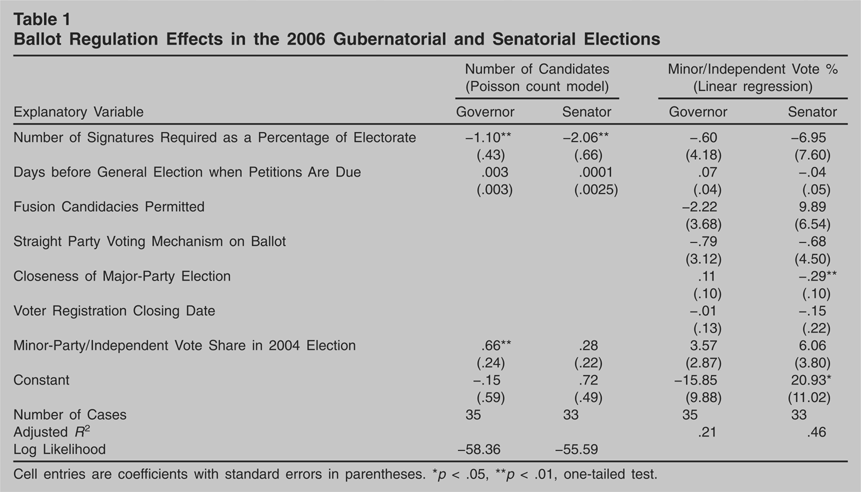
Table 1 provides the results of two models. The Poisson regression models on the left explain the number of minor-party and independent presidential candidates as a function of ballot access regulations. The linear regression models on the right attempt to explain minor-party and independent vote shares using both ballot access regulations and the other factors just described.
Ballot Regulation Effects in the 2006 Gubernatorial and Senatorial Elections

The variable that is most consistently statistically significant in both of the count models is the number of signatures required as a percentage of the electorate. As this threshold increases, the number of candidates on the ballot decreases. However, the deadline for submitting signatures does not govern how many candidates appear on the ballot.
The factors that are correlated with vote share are less predictable and more political. Signature requirements have no impact on the percentage of votes that go to minor parties. The closeness of the major-party race, at least in Senate races, operates just as the “wasted vote” logic would suggest. Neither straight-party voting levers, registration closing dates, nor fusion had much affect on minor-party and independent candidates' vote shares in 2006. Perhaps the votes earned by such candidates have more to do with their quality and resources than with these kinds of structural forces (Rosenstone et al. 1996).
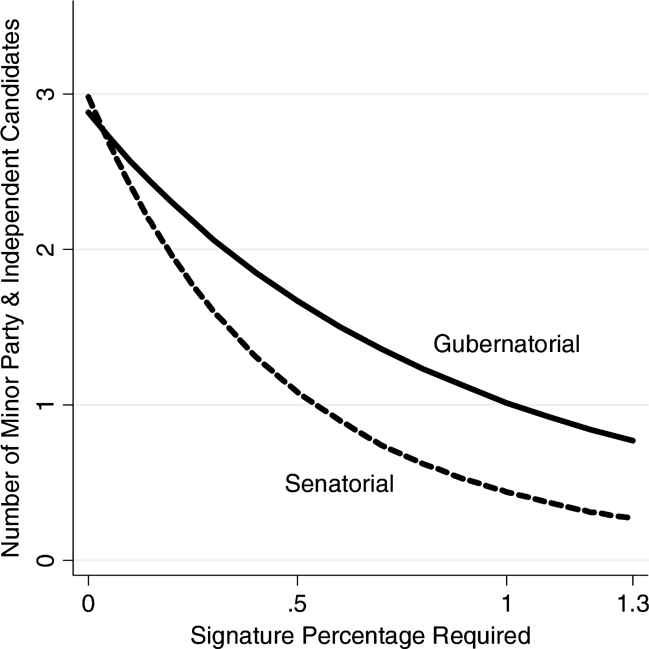
The statistical analyses show that the key ballot regulation is the signature requirement considered relative to the size of the electorate. Although its statistical significance is clear enough, the coefficients in the table do not immediately translate into substantive effects. To demonstrate these effects, I use the estimates in Table 1 to display the relationship between the number of candidates and signature thresholds. The percentage is varied along the horizontal axis while all other variables are set at their mean levels. Figure 1 shows that for both elections the number of candidates on the ballot drops dramatically as the signature requirement is shifted from 0% (the standard in five states) to 1.3% of the eligible electorate (the amount required in Alaska). For both gubernatorial and senatorial elections the number of candidates drops from about three per race to nearly zero as the threshold increases from zero to above 1%.

Effects of Signature Requirements on the Number of Gubernatorial and Senatorial Candidates
Note: Effects simulated from models in Table 1.
Conclusion
I conclude that ballot regulations primarily affect the number of candidates on the ballot but not their vote totals. The greater the share of the electorate required to sign nominating petitions, the fewer minor-party and independent candidates appear on the ballot. Increasing the percentage what seems a trivial amount nonetheless reduces the number of candidates dramatically. Extrapolating a bit from the data, it would seem that a requirement as high as 2% of the electorate would effectively eliminate all competition aside from the Democrats and Republicans. On the other side, even the most lenient signature requirements result in only about four senatorial and gubernatorial candidates who are independents or represent minor parties. Even half a dozen candidates per office seems an entirely manageable number, particularly when one considers the clutter produced by lengthy ballot initiatives and other issues put to voters. Previous research finding no effect of signature requirements was mistaken in assuming that 20,000 signatures in a small, rural state are the same as that many signatures in a heavily populated state. Once the population capacity is taken into account, signature threshold strongly influences how many candidates appear on the ballot.
Signature requirements do not seem to influence the number of votes that minor-party and independent candidates actually receive. Votes for minor-party candidates are more likely to be affected by the incentives deriving from the larger electoral system. As the major-party race grows closer, the vote share for non-major-party candidates declines. The availability of fusion appears not to dampen this fundamental relationship, at least not in 2006, but perhaps in other contexts (Tamas and Hindman 2007). In light of the evidence, minor-party activists' emphasis on fusion as a means for overcoming strategic voting seems misplaced. In neither of the models did the legality of cross-endorsement aid minor-party candidates. If fusion is a means to circumvent the third-party dilemma in American politics, minor-party organizers are not taking advantage of it outside perhaps of New York.
Signature requirements are much more important than either the deadlines for submission or the voter registration closing date. For those interested in electoral reform at the state level, this should be the most obvious target of their efforts. While fears about “spoiling” an election might lead some to make ballot access difficult, both advocates of choice and defenders of the traditional two-party system should agree that lower thresholds provide voters with more options without threatening the dominance of the two major parties. Only abandonment of the underlying electoral system can do that.