On july 1, 1945, Tanaka Masashi, a thirty-year-old lecturer on public health, began to keep a diary. In the first entry, he noted that exactly half of 1945 had passed, and in those six months, Japan's war effort had not gone well: “Leyte [in the Philippines] has been lost. Luzon [also in the Philippines] has been taken away. Iwojima is a shattered jewel. Now we hear about the end of the battle for Okinawa” (Tanaka Reference Tanaka1961, 70). Tanaka went on to chronicle the subsequent events, including the atomic bombings of Hiroshima and Nagasaki and the Soviet entry into the war, that culminated on the day in August when his neighbors and he gathered around the radio at noon to listen to the emperor's unprecedented address announcing surrender.
An interesting thing about Tanaka, though, was his location: not in metropolitan Japan but rather in Seoul, or Keijō, as the Japanese called the capital of colonial Korea. An instructor at the medical school of Keijō Imperial University, he reported witnessing the demise of his country from just outside of it, “from overseas, on a corner of the street in Keijō” (Tanaka Reference Tanaka1961, 70). He continued to record his reflections on defeat and the crumbling of the empire until his repatriation in January 1946.
Past scholarship about the Korean peninsula at the end of World War II has tended to focus on the division of the country at the 38th parallel, the arrival of the Soviet military in the north and the United States military in the south, and the emergence of two separate political regimes, Kim Il Sung's Democratic People's Republic of Korea and Syngman Rhee's Republic of Korea. It was also the period of the origins of the Korean War (Cumings Reference Cumings1981). The months following the end of the war also mark the termination of colonial rule, which prompted a change from the relatively closed Korean-Japanese colonial system into one of two national peoples trying to make themselves legible to the powerful but often ignorant new arrivals. Korean, Japanese, and American actors then performed for an international audience, real and imagined. A consideration of these months provides the means to explore the intersection between the processes of decolonization and the emergence of Cold War nation-states.
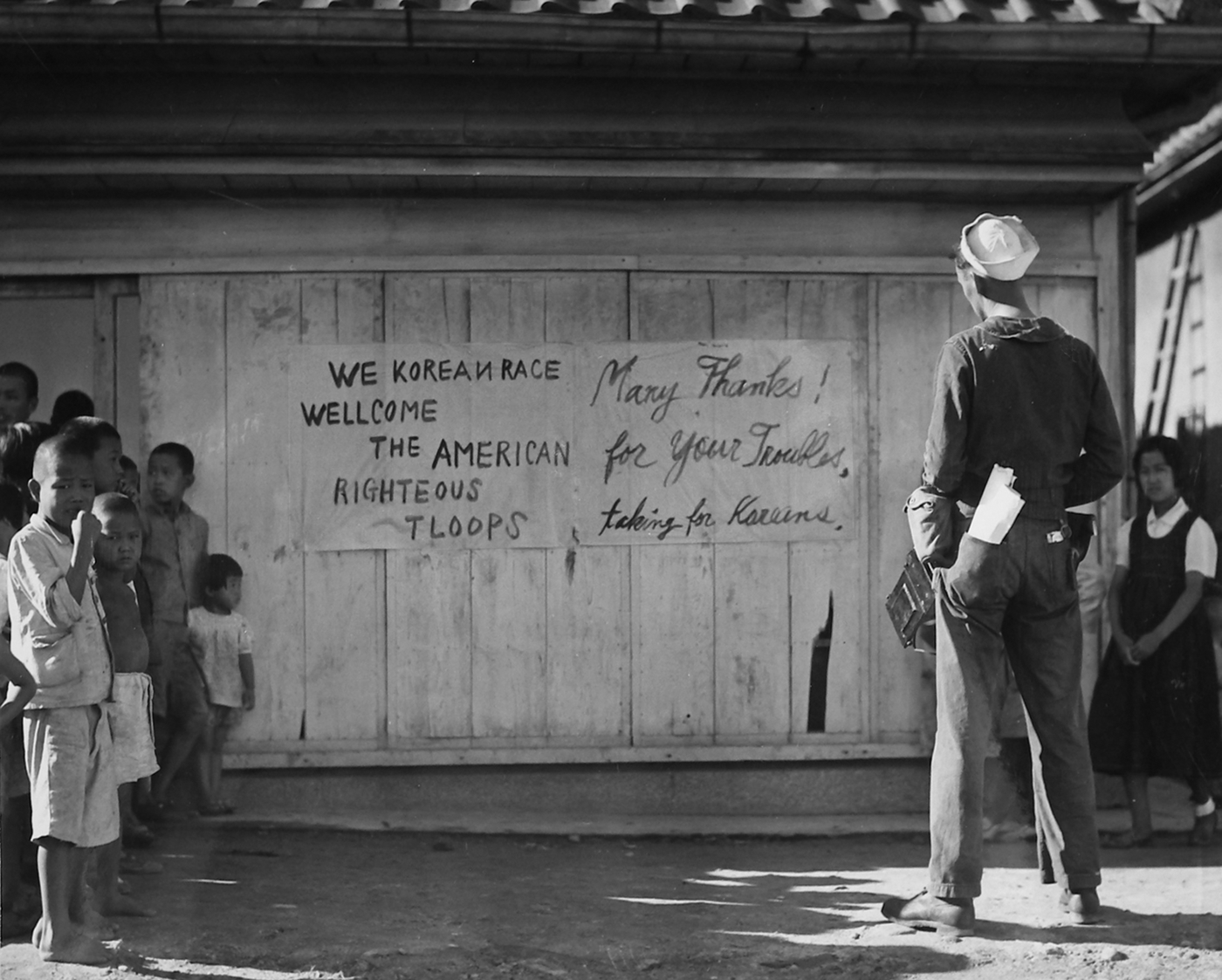
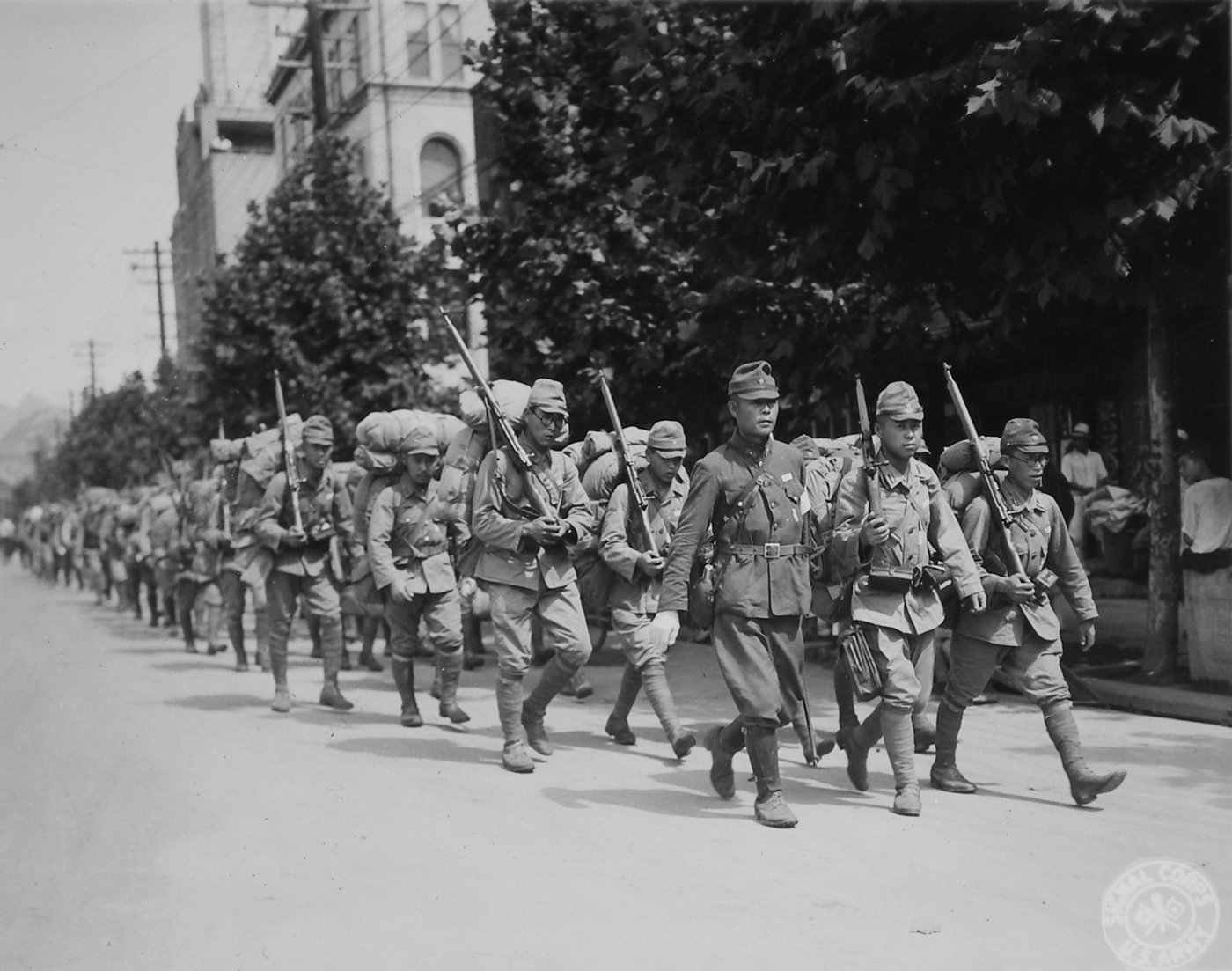
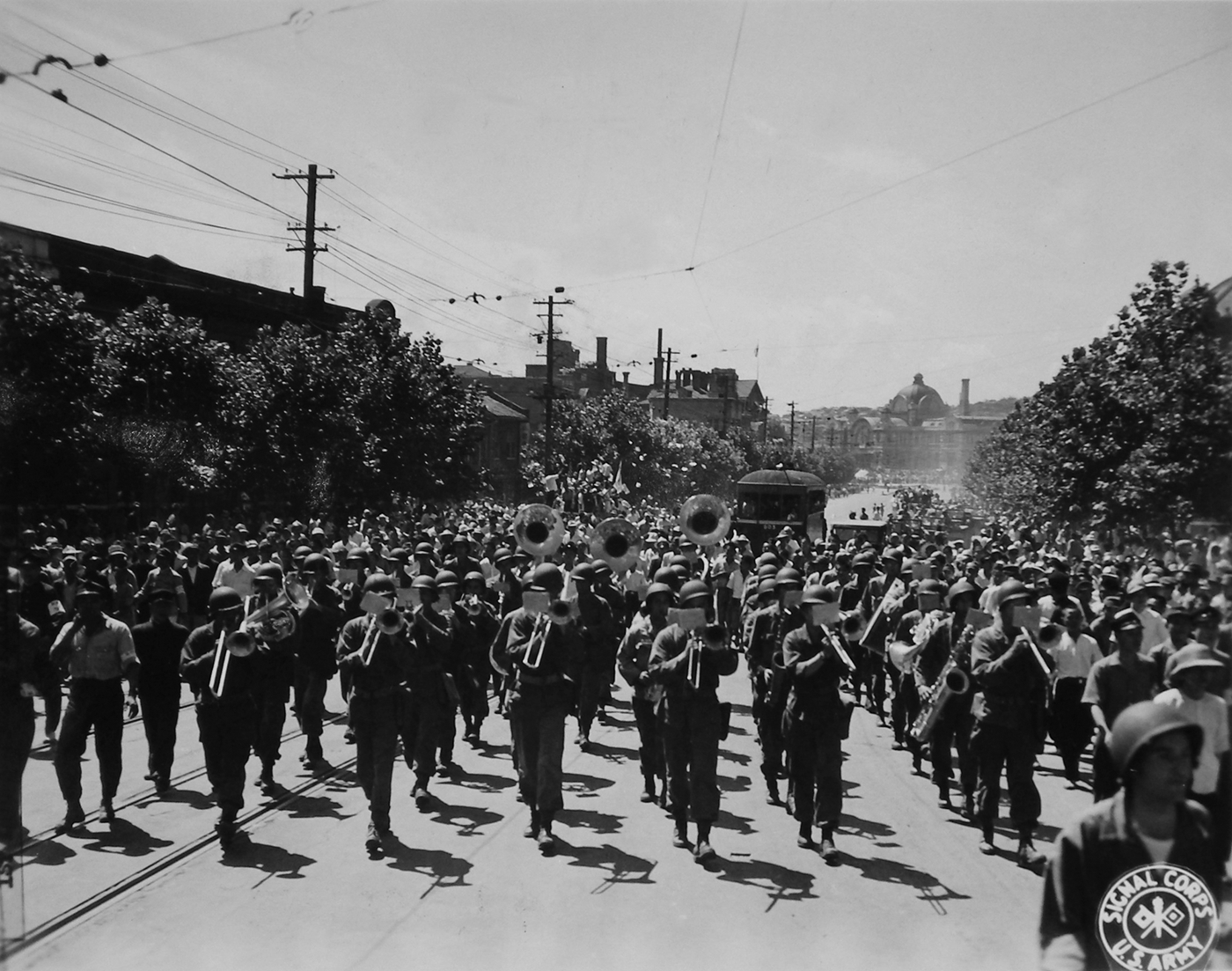
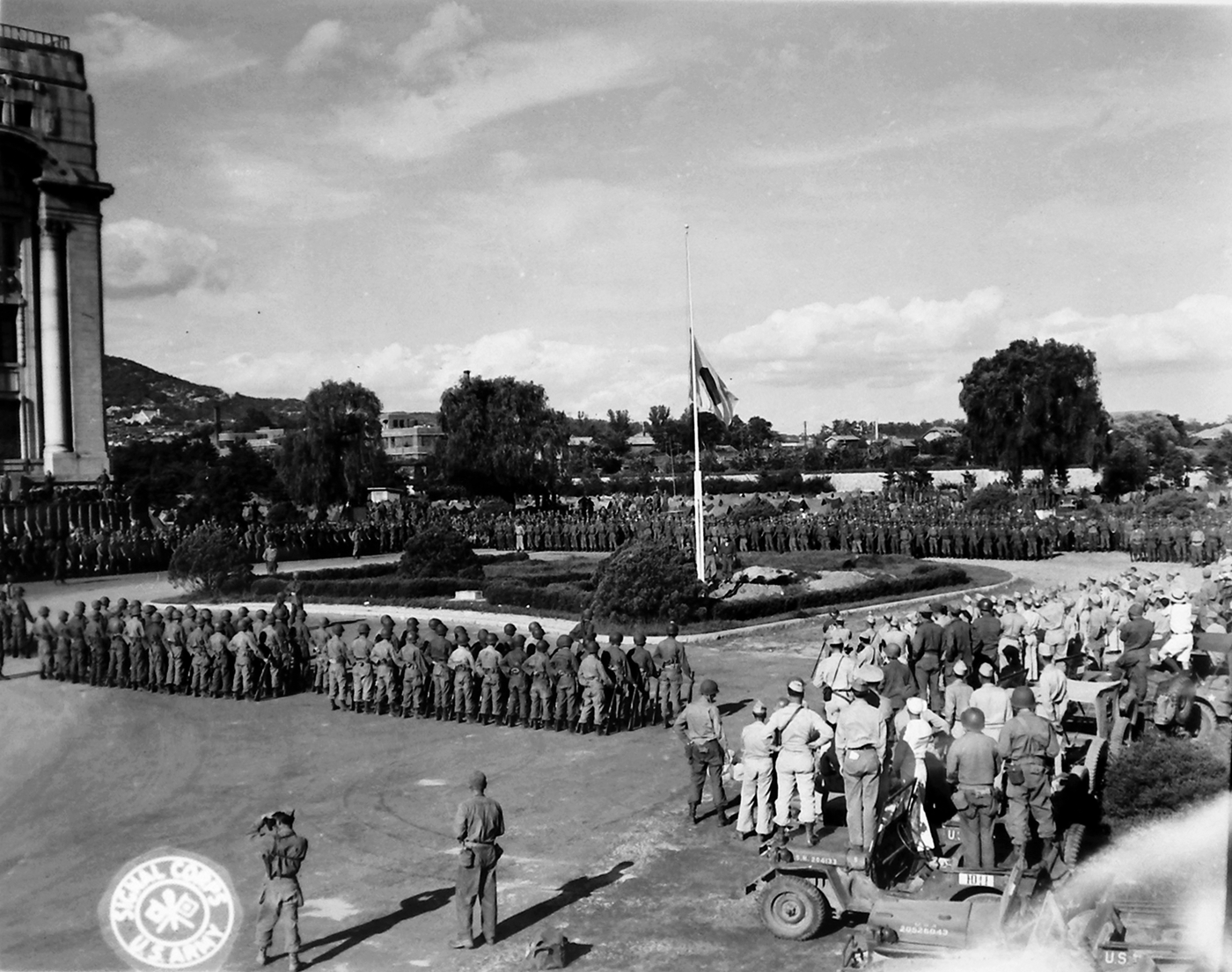
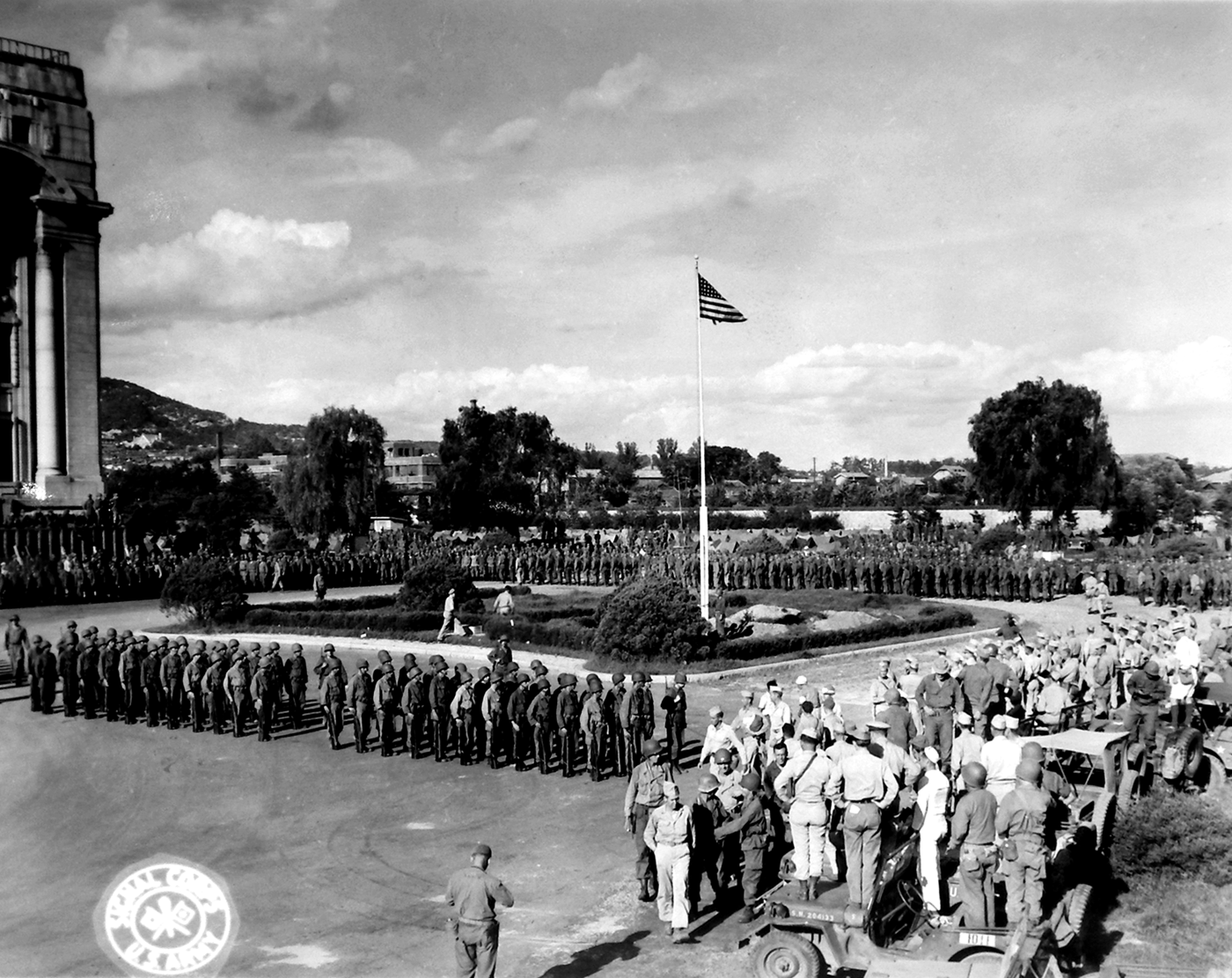
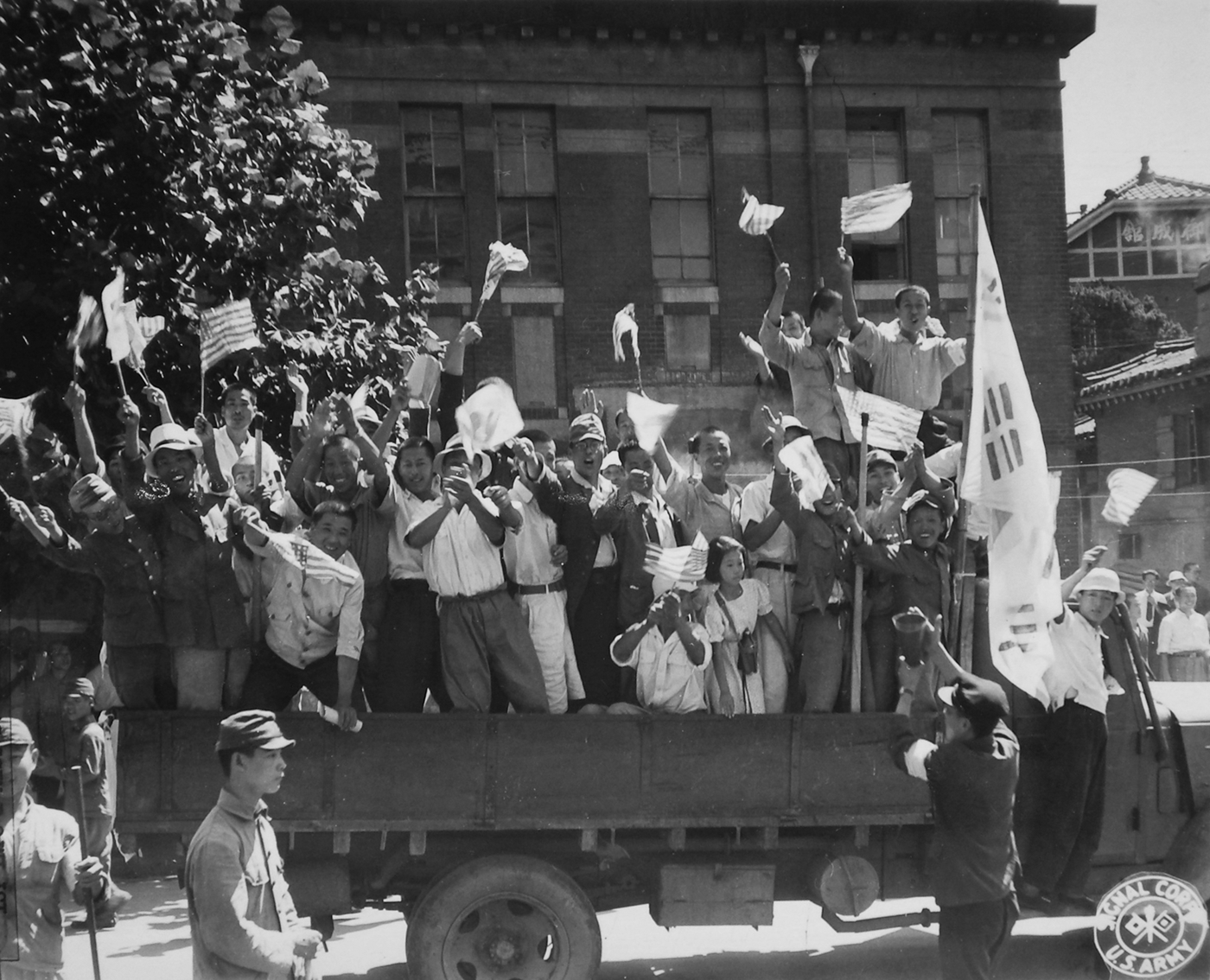
In an essay on decolonization in Asia and Africa in the twentieth century, the historian Prasenjit Duara offers a useful overview of the process, explaining that decolonization is both a political transition and an “emancipatory ideology.” In the empirical realm, decolonization is “the process whereby colonial powers transferred institutional and legal control over their territories and dependencies to indigenously based, formally sovereign, nation-states” (Duara Reference Duara and Duara2004, 2). Applying this definition to Korea south of the 38th parallel, however, reveals a glitch in that the colonial power transferred control of its territory not to an indigenously based, formally sovereign nation-state, but rather to a powerful third party, the United States military, specifically, Lieutenant General John Reed Hodge's XXIV Corps. In addition to providing visual information about Seoul in 1945, United States Navy and Army photographs relate an American version of the U.S. military's arrival in Korea and the transfer of control. The descriptions from the backs of the photos, reproduced verbatim in the following captions, tell first of Korean children welcoming the American troops an hour after their arrival in Incheon on September 9, 1945 (see figure 1). The Japanese soldiers then marched out of Keijō—note that they are out of step—and the Americans, with a marching band, proceeded to the capital from the Keijō train station, visible in the back of the frame (see figures 2 and 3). The Americans lowered the Japanese flag and raised the American flag (see figures 4 and 5). The Koreans are seen celebrating (see figure 6). Subsequently, the Americans moved into the Japanese military and colonial facilities.
“Korean Children Welcome American Troops.” September 9, 1945. United States National Archives at College Park (USNACP), Photograph No. 80-G-490500, Navy.

“Japanese Soldiers Marching out of City of Keijo to Make Room for the Americans.” September 9, 1945. USNACP, Photograph No. 111-SC-212017.
“Grand Street Parade from the RR Station to the Korean Capitol, with Thousands of Cheering Koreans, Korea.” September 9, 1945. USNACP, Photograph No. 111-SC-212021.
“Lowering of Jap [sic] flag.” USNACP, Photograph No. 111-SC-211963.
“American Flag. Up.” USNACP, Photograph No. 111-SC-211964.
“Grand Street Parade from the RR Station to the Korean Capitol, with Thousands of Cheering Koreans, Korea.” September 9, 1945. USNACP, Photograph No. 111-SC-212019.
Duara's “emancipatory ideology” also played an important role in the end of Japanese rule in Korea. During the colonial period, Korean activists made use of a discourse of anti-colonial nationalism in seeking independence (Manela Reference Manela2007). A great deal of current research is appropriately focused on how Koreans responded to colonization, with especially stimulating work that explores the legacies of colonialism in the realms of law and heritage management (Marie Seong-Hak Kim Reference Kim2007; Pai Reference Pai2013). But the lives of colonizers were transformed as well. The colonial Japanese were forced to relinquish their political power and privileges and subsequently became objects of Allied military occupation. In the transition, through occupation, from an expansive imperial formation to a delimited national one, they grasped at a variety of discursive strands, including “emancipatory ideologies” of their own.
As we know from the history of the end of other empires, the ideas devoted to sustaining the colonies did not dissipate immediately but were sometimes redirected in intriguing ways. In his history of the ideological origins of the United Nations, Mazower (Reference Mazower2009) traces how British “imperial internationalism” crossed the 1945 divide, making its way into the United Nations Charter in the preamble written by the British Commonwealth advocate Jan Smuts, and communicated in appealing ways to influential American policy makers by the British classicist Alfred Zimmern. This prompts the question of what happened to all of the intellectual resources that Japanese ideologues had devoted to building the colonies. People like Tanaka chronicled the fall of the empire as it happened and tried to imagine new futures for themselves, providing insight into how they rechanneled their colonial efforts. This essay explores, therefore, how the Japanese talked themselves out of empire in the midst of dramatic geopolitical change.
Seoul, Autumn 1945
First, the context. At the level of international diplomacy, the fate of Korea had been discussed by the Allies at Cairo and Potsdam with the idea that “in due course” Korea would be independent. The Charter of the United Nations, signed in May 1945, outlined trusteeships, a system that was meant to shepherd colonized peoples, including possibly the Koreans, to national independence. In Washington, civilian (State Department) and military (Joint Chiefs of Staff) policy makers kept a worried eye on how the Soviets would respond to the partition of the peninsula at the 38th parallel. As the Supreme Commander for the Allied Powers, General Douglas MacArthur in Tokyo saw Korea too as part of his bailiwick.
And on the peninsula: estimates of the Korean population in 1945 range from twenty to thirty million, probably around twenty-six million people, about a million of whom lived in greater Seoul. As of August 1945, approximately 160,000 Japanese residents lived in Seoul, part of a total estimated population of 710,000 on the peninsula, which was not divided under Japanese rule. The Japanese in Korea belonged to an even larger group, civilians and soldiers who had moved throughout the territory under Japanese control. As of August 1945, roughly 6.9 million Japanese people, about half civilian and half military, were spread through the expanse of the Asian-Pacific empire.Footnote 1 The civilians were a diverse group that included colonial officials and industrialists, businessmen, school teachers, and state-sponsored agricultural settlers, as well as laborers, artists, waitresses, and maids. Famously insular, colonial residents tended to live in ethnically exclusive neighborhoods in major cities.
The end of the war prompted a range of responses on the peninsula: euphoria among most Koreans and anxiety among many Japanese, although there were certainly anxious Koreans and euphoric Japanese (Michael Kim Reference Kim2010). The Japanese had good reason to be concerned. Their military in Korea ceased to have authority, and the colonial state, the Government General, stopped functioning as well. Information and instructions stopped arriving from the home islands. With the collapse of the colonial state, people like Tanaka had to figure out what to do on their own. Three days after surrender, on August 18, a group of middle- and upper-middle-class settlers responded pragmatically by banding together, believing that they would need to represent themselves to whoever came to govern. That group came to be known, in Japanese and English, as the Sewakai, and it published a daily broadsheet, Nihonjin sewakai kaihō (hereafter The Bulletin), for five months, from September 2, 1945, through February 6, 1946.Footnote 2 The fate of the Japanese on the peninsula was unclear for about a month, until September 17 when the Americans announced that repatriation was mandatory. In November, the members of the Sewakai who published The Bulletin moved into a house together on Asahimachi near Nandaimon (Nandaemon) and kept a house log, providing a closer look into their domestic lives in postcolonial Seoul.Footnote 3 The Sewakai worked closely with the arriving American forces in repatriating the Japanese and bringing colonial rule to an end.
Embracing Defeat, in Seoul
In some ways, people on the home islands and Japanese throughout the empire shared a similar experience of defeat. As noted by Tanaka, they gathered around their radios on August 15 and heard the emperor's oblique announcement of surrender. But there were differences before and after the end of the war. In the home islands, incendiary and atomic bombs had turned millions out of their homes, and people suffered from hunger. This meant that they felt, in visceral ways, the coming defeat. During the war, Korea had not been systematically bombed, and Seoul's infrastructure remained intact. Food, if limited, was available to those with money. The colonial Japanese may have anticipated defeat intellectually, but did not experience the months at the end of the war in the same way as those in the home islands. After surrender, they lived through the humiliation of national defeat while Koreans celebrated liberation, but for a few weeks and even months well-established residents of Seoul had food, shelter, and relative physical security, unlike Japanese and Koreans throughout the rest of Asia who were more vulnerable to reprisals. These circumstances provided the means for reflection.
Almost immediately, colonial residents in Seoul began to rethink who they were in the world. Tanaka began this job on the afternoon of August 15 (Tanaka Reference Tanaka1961, 84–86):
August 15, 1945, after noon:
We listened to the emperor's speech.
It is all over.
Now we are simply waiting for the next round of suffering.
We became different from the Japanese we were up until yesterday. Now we have to wait quietly for the day when we can rise up again as new Japanese, as humble Japanese. . . . After all, up until yesterday, we were the ones who, without swerving, walked around with authority as magnificent Japanese nationals (daikokumin). People's true characters are revealed in times of difficulty. Now is the time for us to show the true greatness of the Japanese people. From now.
In this passage Tanaka struggled to make the transition from the wartime rhetoric of “magnificent Japanese national,” a characterization that appears in the 1941 Instructions for the Battlefield (senjinkun), into what he hopes will be his nation's postwar identity of “humble Japanese.” Later on the same day he wrote that they needed to become more lovable (Tanaka Reference Tanaka1961, 86), anticipating Watanabe Kazuo's observations back in Japan that the Japanese had “an aptitude for being unloved” (Dower Reference Dower, Barton, Grossmann and Nolan2002, 218). During the six months that he kept the journal, Tanaka continued to assess his compatriots. On August 23, he noted incredulously that the Japanese had fallen into the fourth class of nations (shitō kokumin ni datsuraku), a category that ideologues had reserved for peoples they deemed impossible to civilize (Tanaka Reference Tanaka1961, 90–91). Humble, great, unlovable, fourth rate, these musings show the instability, but also the sense of possibility of new identities, brought by surrender.
Others in Seoul wrestled with how to move away from rhetoric appropriate for war to language appropriate for peace, or at least, occupation. An essay published in The Bulletin on the day of the United States military's arrival in Seoul used some familiar wartime vocabulary to encourage its readers to take heart and remain dignified, no matter what might come their way:
At this critical moment, we should reveal the magnanimity of the Japanese people and leave behind our mundane affairs and idle thoughts, and show the dignity and imperturbability of the Yamato race. (The Bulletin, September 9, 1945)
As of early September, The Bulletin still used language that suggested a continued belief in the superiority of “the Yamato race.” The passage continued, though, by asserting that “we should not be the kind of Oriental who goes weak in the face of a major shock.” They cast themselves as Orientals (Tōyōjin), even if they were the more resolute sort. Japanese academics had facilitated the creation of an Orient, inhabited by non-Japanese Orientals, a practice that eased expansionism in Asia. The willingness in this instance to identify as Orientals, in a familiar pairing with “Westerners” (Seiyōjin), illustrates the transformation of a colonial category into something that the defeated Japanese would inhabit under Allied Occupation.
The end of the war in Seoul brought a sense of liberation, even for some Japanese, who used the moment to explore new ways of existing in the world. On September 7, 1945, The Bulletin distinguished the Sewakai and by extension the civilian residents of Seoul from the military and the colonial government, and chided them for their past dependency on the state, which they unthinkingly followed throughout wartime and imperial expansion. It then encouraged ordinary people to acquire the spirit of self-rule (jichi), language redolent of anti-colonial activism, and perhaps echoing earlier debates on the possibility of self-rule in Korea (Uchida Reference Uchida2011b, 284–87). Colonizers appropriating the “emancipatory ideology” of decolonization may seem obtuse, but it highlights another particularity of the Japanese empire, discourses of pan-Asianism that were flexible enough to promote Asian cultural solidarity in one version and the idea that a superior Japan would lead Asia out from under the oppression of white colonialism in another (Hotta Reference Hotta2007). In the transitional period out of empire, some settlers hastily reassembled the different available strands of pan-Asianism to advocate for a new kind of Japanese self-rule.
Commentators also made optimistic use of the language of internationalism. On September 15, 1945, The Bulletin published a vision of how some Japanese might remain on the peninsula. The essay first celebrates the attitude of the Americans, who see war like sports—there are winners, there are losers, but after the game is over, all can be friends. It then recommends this approach as a model for Koreans to follow, encouraging them to let bygones be bygones. After all, the essay asserts, the Japanese and Koreans had a long friendship that would serve as the basis for the rebirth and rising of two nations on the peninsula into a world nation. The idea that the Koreans and Japanese would work together to establish a common political unit may sound unlikely, but these calls for self-rule and a binational state give a sense of the wide range of conceptual languages available and made use of during the internationalist moment of 1945.
The aspiration to find new ways for the Japanese to live in the wider world manifested itself in practical ways. The language of rule in Korea had been Japanese, and most Japanese were monolingual. On September 7, 1945, The Bulletin notified readers that the Sewakai had teamed up with the YMCA to offer Korean language classes. Opening ceremonies for the commencement of the classes, which were oversubscribed, were held several days later. On September 12, an editorial lamented past colonial education practices of not teaching English, calling for a Shōwa Restoration modeled on the Meiji Restoration, when, under the leadership of the emperor, the Japanese went out and learned many things of value from the West. When the arriving Americans made it clear that the new administrative language would be English, the Korean language classes came to an end. The Bulletin soon began to promote English instead, teaching its readers words and phrases such as “cigarette,” “how much” and “I am sorry I have kept you waiting so long,” useful for living under the Americans (The Bulletin, September 25, September 26, and October 31, 1945). The Japanese residents of Seoul appeared to have had a sudden, if brief, awakening that they would need to learn languages to live in the new societies they imagined.
With the arrival of the Americans, Koreans had to grapple with another set of administrators who could not speak their language. In a work of fiction that revolves around the value of the ability to speak English, Chae Manshik's “Mister Pang” explores the impact on social relations of the end of the war and the arrival of the Americans (Chae Reference Chae, Fulton and Fulton1994). Published in 1946, the short story tells of the 1945 reversal of fortune of two Korean men. With a son on the colonial police force, the upper-class patriarch Paek Chusa had prospered, but with liberation, his family had been stripped of its wealth and targeted for retribution. The lower-class Mister Pang, a cobbler, had managed to put his limited English to use as a translator for an American officer, resulting in a dramatic rise in wealth and status. The story shows how the change from Japanese to American dominance wreaked havoc on class relations, requiring the refined Paek to supplicate his social inferior. It presents an overturning of the Korean social hierarchy during the confusion after the war, although it also suggests the short-term nature of it. In the end, Mister Pang accidently spits in the face of his American master, who curses and strikes him, suggesting that the American promotion of ordinary Koreans over the elite was short-lived.
In processing their fall from the top of the social hierarchy, Japanese commentators unwittingly turned some of the tools they had applied to others back onto themselves. In the editorial discussed above, the writer invoked the Meiji Restoration, suggesting a return to a time when Japanese interacted with the rest of the world in productive ways. Tanaka, still trying to figure out who the Japanese were as of October 6, wrote that unconditional surrender put Japan back in time—before the Great East Asian War, the Russo-Japanese War, and the Sino-Japanese War, all the way back before the Meiji Restoration (Tanaka Reference Tanaka1961, 112). Situating groups of people back in time resonates with an early colonial practice in which commentators on the home islands cast the peoples of Hokkaidō and Okinawa, the Ainu and the Ryūkyū, not as ethnic but as chronological others—people further back in the past (Morris-Suzuki Reference Morris-Suzuki1994). In Race for Empire, Fujitani uses Dipesh Chakrabarty's notion of the “imaginary waiting room” as a means of conveying how, until the 1940s, Koreans had been located in terms of “lagging behind” the Japanese (Fujitani Reference Fujitani2011, 53–54). Here, Tanaka appears to be constructing and inhabiting an imaginary waiting room of his own.
Like other colonizers, intellectuals and bureaucrats in Japan produced a body of knowledge about their subjects and went to great lengths to categorize them. They also shaped how knowledge would be produced subsequently in the regions that they had ruled. In the early 1940s, Tanaka, an instructor at a premier imperial university, led a team of graduate students, most of whom were Korean, in the study of the lives and hygiene of impoverished slum dwellers that they called “domakumin,” an effort that resulted in one of his most influential publications (Keijō Teikoku Daigaku Eisei Chōsabu 1942). In 1945, ignoring as best he could his changed social position, Tanaka turned his powers of observation onto the Americans. Several diary entries include descriptions of Americans as ketōjin, a derogatory term for foreigners first used in early modern times to describe other Asians and then used to refer to Euro-Americans. He came face-to-face with these strangers on September 10, when three military captains involved in sanitation came to interview him about hygiene-related issues in Seoul. Tanaka noted that one of them looked like a proper foreigner (ketōjin), but the second man, if one were not careful, could be mistaken for Japanese. And the third one, unusual for a Westerner, according to Tanaka, was bald. He seemed to take some comfort in maintaining the practice of describing others. Indeed, the experience of decades of wielding the power to define others, of having the power to produce others, served as an intellectual resource in negotiating the transition from empire to occupation.
While Tanaka occasionally wrote about the Americans, most Japanese commentators focused on other Japanese people, and writings from this period go to great lengths to classify them: civilians as distinct from the military and the bureaucracy; suspected war criminals as distinct from purportedly hapless bystanders; and “war victims” (risaisha), sometimes referred to as “people from the north” (ihoku) as distinct from established residents in Seoul. Some Japanese were deemed responsible and realistic, others not (The Bulletin, September 6, 1945). Eventually, though, these discussions reached a consensus: the Japanese were a defeated people. Commentators had auditioned a variety of new identities—Orientals, humble people, and those who should practice self-determination—but over the course of autumn 1945, they settled on “defeated national” (haisen kokumin).
At first, Tanaka struggled to internalize the fact that he was a defeated national. He knew it intellectually, but his life remained much the same in the weeks after the war in that he continued to commute daily to his faculty office. In some ways, his life improved. On August 30, 1945, Tanaka described the changes in Seoul, which included a remarkable new availability of food. There was meat at the butchers, fish at the fishmongers, and, most importantly, as far as Tanaka was concerned, bottles of sake lined up on the shelves at the liquor store. Those circumstances, Tanaka reflected, were enough to make one forget one's position as a defeated national in a foreign country (Tanaka Reference Tanaka1961, 92). By September 8, though, Tanaka wrote “as a defeated person,” and relied on this more and more frequently as an explanatory device. His quality of life began to deteriorate, prompting him to comment on sights that included Japanese women fraternizing with Americans and starving Japanese children that made him understand that his country had been vanquished. The Bulletin, too, went through a similar process of trying out new identities, only to settle on one—defeated national. To use Dower's memorable phrase, by the New Year, the Japanese who remained behind in Seoul had embraced defeat (Dower Reference Dower1999).
Decolonization—a Clean Departure
The Japanese in Seoul also turned their attention to evaluating the fate of the colony. Some people responded to the news of surrender by rushing to Busan, the southern port city closest to Japan, to catch the first ship home. Others, reluctant to give up their homes and businesses, considered how they might stay. After all, some had moved there before formal colonization in 1910; moreover, Japan and Korea had not been at war. What, they wondered, did defeat have to do with them (Hiyama Reference Hiyama1999, 3)? In retrospect it may seem obvious that Japan would be stripped of its empire, but it was not clear then how the postwar settlement would play out. The Sewakai was founded on the idea that it would be the organization that would advocate for Japanese who chose to remain behind.
One problem with these plans, with the Sewakai at least, was its practice of continuing to not acknowledge Koreans. In early September, The Bulletin mentioned a few Good Samaritan Koreans, identified by their Japanese names, who aided Japanese refugees from the north (September 5, 7, and 13, 1945). It referred positively to the Korean Security Forces (hoantai and chiantai) and the Korean student organization (Chōsen gakutō) that, according to The Bulletin, worked alongside the local Japanese student organization in helping to keep order in Seoul. But it made no mention of the Government General's hasty political negotiations with leaders, including Yo Un-hyong, conducted in hopes of keeping order after defeat.Footnote 4The House Log, kept by the staff of The Bulletin who lived together, mentioned the December 30 assassination of Song Chin-u, another prominent leader, but The Bulletin did not report it. The Bulletin did not appear to imagine a Korean readership, and The House Log did not record any social visits by Koreans to their home, although it did record that two Japanese-American soldiers stopped by for meals (Watt Reference Watt and Cwiertka2013). Koreans, as individuals or a people, did not have much of an explicit presence, only occasionally appearing at the end of a list of Korea, its mountains, its fields, and its people.Footnote 5The Bulletin was remarkable in that over the five months of its existence it maintained the pretense of benevolent rule.
In the context of colonial Korea, this absence of Koreans is perhaps not surprising. As Todd Henry (Reference Henry2005) has noted, travel literature promoting tourism in early colonial Seoul focused on modern Japanese institutions but failed to include information on Korean neighborhoods or their inhabitants. This ability simultaneously to see territory but overlook or eliminate the indigenous inhabitants has facilitated settler colonialism in many times and places throughout the world. In the context of autumn 1945, however, it seems that the presence of Koreans would have been more difficult to ignore. They reportedly celebrated their liberation quite raucously throughout the peninsula and sought to requisition Japanese property. Moreover, some of the newly arrived Americans, especially newspaper reporters, were critical of the Japanese and sought to bring the Korean presence to their attention. In October, Time magazine criticized the “Japanese false front of modernism” in Seoul (Time 1945). On September 11, the military government required The Bulletin to publish a Japanese-language translation of General Douglas MacArthur's three Proclamations to the People of Korea, issued from Yokohama on September 7, 1945.Footnote 6 Using the language of the Cairo Declaration, Proclamation No. 1 asserts the enslavement of Koreans and assures that the Americans will protect personal and religious freedoms. Placed next to the daily Bulletin entries, the stern judgmental language of the proclamation contrasts dramatically with the hopeful tone of the Japanese writers.
The diarist Tanaka and his colleagues at Keijō Imperial University responded in their own way to defeat. As instructors at an institution that educated the most academically gifted Koreans, many of whom outperformed their Japanese classmates, Tanaka and his colleagues interacted more consistently with Koreans than did their colleagues at The Bulletin. On August 16, 1945, the day after catastrophic national defeat, the faculty of his university did something that may not surprise anyone in academia—they held a faculty meeting. They decided to put their offices and laboratories in order and turn them over to their Korean colleagues. By August 17, their Korean colleagues had taken things into their own hands and occupied the university, but in the next few days, the situation was calmer in Seoul than they anticipated. With the home islands in rubble, and the possibility that they might not be expelled, the Japanese faculty began to wonder whether they might be able to remain in what they considered to be their academic home.
The American policy towards Japanese in Korea had been unclear, but on September 17, 1945, The Bulletin informed its readers that the Americans had declared that they would all need to go to Japan. Subsequently, the discussion of who they were headed in a new direction. The Bulletin no longer spoke of Japanese who would hold their ground, but instead changed its focus to how the Japanese should leave. The answer soon emerged. Advice concerning the way that dignified people should depart revolved almost entirely around cleanliness. The Bulletin called upon residents to maintain high standards of cleanliness and grace (seiso tanrei) in the process of leaving Korea (The Bulletin, September 18, 1945). It used the idiom “a bird taking flight from water does not muddy it” (tatsu tori ato o nigosazu) to encourage a clean departure. It found value in a noble past and informed readers that their ancestors, “the warriors” (mononofu), had a ritual for cleaning houses before moving out: burning incense in the household altar, conducting a thorough cleaning, wiping the floors, cleaning the privy, and even sprinkling water on the garden. It exhorted residents of Seoul to follow this example.
A discourse of hygiene shaped the notion of a clean departure. As we know from Burns (Reference Burns, Brook and Schmid2000), Henry (Reference Henry2014), and Rogaski (Reference Rogaski2004), a discourse of hygiene generated in Meiji Japan was then used to administer the colonies of Taiwan, Korea, and the treaty ports of China. As the American Occupation wore on in Seoul, The Bulletin sought to discipline Japanese children for their overly friendly demeanor towards the Americans and complained that their vocabulary was limited to “how do you do?” It continued, instructing women to make sure that their children were clean—clothes laundered, collars unsoiled, noses wiped, fingernails and hair trimmed. Otherwise, children would be the image of defeat (The Bulletin, October 17, 1945). It is perhaps unsurprising to see the mechanism of hygiene, previously applied to colonial subjects, turned back onto Japanese women and children, as a way of disciplining them under foreign occupation. It is another instance of the colonial toolkit turned back upon Japanese subjects.
The same issue of The Bulletin that enjoined the Japanese to take care in how they left contained a curious notice on the anticipated arrival in the city of an important independence leader, Kim Gu. Entitled “Let's Keep the Streets Clean,” the passage read:
Let all of us buckle down and cooperate in keeping the streets clean, and in making this town a clean place worth living in. Mr. Kim Gu, the President of the Korean Provisional Government, and others will arrive soon in Seoul, so let's keep the town sanitary (seiketsu). (The Bulletin, September 18, 1945)
An anti-colonial nationalist, the returning Kim had a long history with the colonial authorities before his return to Seoul on November 23, 1945 (Cumings Reference Cumings1981, 192).Footnote 7 Convicted of murder in 1896, he escaped from prison in 1898 and spent the colonial period in exile. He worked for a unified, independent Korean government from 1945 until his assassination in 1949. It was unusual for The Bulletin to name a Korean in its pages. Here, it named Kim but placed him in the context of the city of Seoul that had been sanitized, cycling him through a familiar discourse. The interpretation of the history of Japanese rule that this passage suggests—we came, we cleaned, we will leave it clean—allows for continued focus on purported improvements of Seoul instead of any possible unjust treatment of its inhabitants. When the staff of The Bulletin, who had lived in a house together in Seoul for a few months, were repatriated to Japan, the last thing they did together was to visit a public bath to, in the words of the editor Mine Kenichi, “wash ‘the dirt of Korea’ away” (“Chōsen no aka” o otosu) (“Seisei ryō nisshi” Reference Isao1981, 125). This suggests that leaving Korea in a sanitary state was one operation, but that another cleansing process was required for reentry into the home islands. Because they were forced to leave, and because the Americans stepped into the process of the handover of institutions from the Japanese to the Koreans, the Japanese appeared to be, literally and metaphorically, wiping their hands of the colony.
American Occupation in Seoul: Performing Defeat
While the Japanese chronicled the end of the empire, and Koreans like the writer Chae Manshik negotiated the “space of liberation” (haebang konggan), the Americans were drawn into governing a portion of a country with which they had little experience. They sought what for them were the ingredients of a stable democracy, a middle class and legible capitalism (Cumings Reference Cumings2005, 192–96). Not finding these, they turned to anti-communist Koreans and relied in part on the available template, the colonial state.
Dramatically different entities, the colonial state and Hodge's XXIV Corps nevertheless had a few things in common. In the ideological realm, the colonial state was decidedly anti-communist, and therefore the arrival of the anti-communist Americans coincided with an extant ideology rather than the introduction of a new one. Both perceived anti-establishment Koreans as threats. The Americans moved into the physical spaces that the Japanese had vacated, including the Chosun Hotel and military installations at the important base of Yongsan (Ryūsan) on the edge of Seoul. The Japanese and the Americans tried to work with some of the same Korean politicians, who, of course, had their own ideas on what was best for a liberated Korea. These included Yo Un-hyong (Lyuh Woon-hyung), with whom the Japanese tried to negotiate at the end of the war, and Kim Gu (Cumings Reference Cumings2005, 197–98; Morita Reference Morita1967, 67–71). Most importantly in terms of the future of Korea, the Americans inherited and in some cases preserved and transformed Japanese colonial institutions in the realm of policing. The Americans put together an army, called a constabulary, that was formed in part by men who had served in Japanese military organizations, including future president Park Chung Hee. And they maintained the institution of the colonial police, transforming it into the national police force and retaining, to a large degree, the colonial personnel. The historian Bruce Cumings (Reference Cumings2005, 201) has shown that by November 1946, roughly 80 percent of the Koreans employed by the colonial police held positions in the Korean National Police under American supervision. In these ways, there are notable overlaps between the institutions and Korean personnel of the Japanese and American regimes.Footnote 8
The diarist Tanaka reflected on both the colonial enterprise and the American attempts to govern Korea. Unlike the writers for The Bulletin, he frankly assessed colonial rule early on. Writing as a “defeated person,” he first compared Japanese colonial rule to that of the European powers and concluded that it was not as cruel. Even so, continued Tanaka, the Japanese never gained the confidence, adoration, or respect of the people that they ruled. He concluded that the Japanese did not have sufficient “national virtue” to rule other peoples. Later, he reiterated this sentiment, saying that it was folly to have tried to spread ideology like “eight peoples under one roof” to others, especially since those others could not understand the Japanese language in which those ideas were promoted. Admitting that the Koreans never accepted Japanese colonial rule did not stop Tanaka from criticizing post-liberation Korean actions and American approaches to ruling Korea. Tanaka and his friends could not help but to express some wry satisfaction when the Americans found it difficult to facilitate a viable Korean government. Moreover, he was surprised when the Americans adopted some Japanese colonial practices. Tanaka was critical of the American decision to maintain the colonial police, calling it a kind of dirty trick (kozaiku o rōshita) (Tanaka Reference Tanaka1961, 98).
While the Japanese awaited repatriation, they faced something that defined much of Japanese life after surrender, Allied military occupation. At first it was not clear to them whether the Soviet or U.S. military would occupy Seoul. Nevertheless, like their compatriots in the home islands, Japanese in Seoul had ideas about how to respond to the social aspects of occupation, and they began planning soon after defeat. Indeed, they had twenty-four days to think about it, from August 15 until September 9, when the Americans marched into Seoul. The first thing local residents did, as early as September 1, was to make plans for a dance hall for the exclusive use of the Americans. It was to be held on the fourth floor of the Mitsukoshi department store, and they began to recruit and train local women to staff it (Tanaka Reference Tanaka1961, 94–95), reminiscent of plans in the home islands to provide sexual partners for the occupation forces.
Tanaka was surprised at his own response to the Americans. He had prepared himself to loathe the men who had wreaked such destruction on his country, but did not find them hateful, and at the very least they were interesting. On September 24 he described Americans on the streets of Seoul on the first day they were allowed to sightsee:
Today was the first day since the US military arrived that permission was granted to walk freely, so the town is full of American soldiers. There are drunken soldiers. There are soldiers walking around chugging sake straight out of the bottle. Some are purposefully looking for souvenirs. One could also see the fellows who were staring intently at women wearing lipstick. One should not be surprised that there are not very big differences between soldiers of any nation. (Tanaka Reference Tanaka1961, 106–7)
Tanaka noted that some soldiers sought souvenirs. The Sewakai also recognized this interest, and responded by holding a “Comfort Bazaar for the American Troops” at the YMCA. In early October, they organized the display and sale of kimonos, dolls, crafts, and other items. Female members of the YMCA were assigned the job of serving tea and sweets in a hall that had been decorated with Japanese art in hopes of stimulating conversation.Footnote 9 The “comfort bazaar” and other efforts to facilitate the souvenir shopping of the Americans paralleled the same kind of souvenir diplomacy carried out by women in occupied Japan, a phenomenon lucidly analyzed by Shibusawa (Reference Shibusawa2006). In trying to solve the riddle of why the war was so bitter but the occupation relatively peaceful, Shibusawa argues that ideologies of gender and immaturity—that is, the ability to see the Japanese as feminine and childlike—facilitated a change in American eyes of Japan from an enemy country into a people that needed to be rescued and reformed. Similar processes unfolded in occupied Seoul.
A few days later, on September 29, Tanaka continued his observations on the ramifications of occupation, noting that “intercourse of all sorts is occurring” (ironna imi de kōkan o okonatteiru). In a passage about “women in the entertainment business” (kurōto no onna), he first expressed a sense of resignation about women clinging to the American soldiers in Seoul, saying that fraternization was a fact of war and an expression of human nature. But he then went on to puzzle over why, in his assessment, it was Japanese and not Korean women who fraternized with the Americans. After all, he continued, there were different kinds of Korean entertainers—kisaengs, dancers, and café waitresses. Moreover, as he wrote, “the story of the prostitutes who became the comfort women of the Japanese military and went with them to north China, central China, south China, and Southeast Asia is well known” (Tanaka Reference Tanaka1961, 109). The question he was asking himself, therefore, was that since there were so many different kinds of sex workers in Korea, why were Japanese and not Korean women fraternizing with the Americans? He concluded the passage with a critique of fraternizing Japanese women, who wore makeup and flashy clothes, complaining that the Americans abused them, but, in his assessment, they secretly enjoyed that they were able to attract the attention of these men.
In trying to make sense of what for me was a disturbing reference to the system of military sexual slavery in a passage about fraternization, it may be helpful to know more about our informant. By all accounts, including his own, Tanaka was a heavy drinker. He appeared to enjoy the company of women other than his wife, whom he never mentioned in the diary, although she and their three small children apparently lived with him in Seoul.Footnote 10 As is evident in the passage above, Tanaka assumed himself qualified to assess Japanese and Korean female sex workers, indicating that he was well within the “masculinist sexual culture” (Soh Reference Soh2008, 116) of colonial Korea and part of a system that sought to preserve Japanese family lines while providing access to sex for men. From a twenty-first-century vantage point, it was jarring to see “the comfort women” listed with a whole range of sex workers, but, at the risk of applause from the wrong side, Tanaka saw them on a continuum.
Tanaka's critique of fraternizing Japanese women resonates with critics in the home islands who vilified sex workers partnering with foreign soldiers but also made use of the image of the fraternizing woman as a symbol of defeat (Kovner Reference Kovner2009). Whether in Tokyo or Seoul, fraternization under Occupation held many of the same meanings. Tanaka's presence in Korea, however, complicates his analysis. He had lived in a world in which he held a privileged position in the colonial social structure with access to metropolitan and colonial sex markets. Witnessing the reorientation of those markets for occupation soldiers made clear his fall to the bottom of the social hierarchy.
It is important to look at Tanaka's actions as well as his words. Tanaka guest-lectured at women's colleges and took his female students seriously, writing about individual students with affection and concern. He worked with his friend, the anthropologist Izumi Seiichi, to establish a system to provide medical care for Japanese refugees in Seoul after the war, an effort they extended to caring for repatriated orphans in the home islands. While working at the port of Hakata, Tanaka encountered a former student, a young woman who had become pregnant after repeated rapes by Soviet soldiers in north Korea. At the request of the woman's parents, Tanaka and Izumi arranged an illegal abortion, but she died of septic shock. Subsequently, with the medical doctor Yamamoto Yoshitake, they established a clinic at the Futsukaichi Sanatorium in Hakata that provided safer, if still illegal, abortions to repatriated women (Kamitsubo Reference Kamitsubo1979). While operating within a patriarchal system in which it made sense to prevent the birth of children fathered by non-Japanese men, they nevertheless worked without compensation to help some of the most marginalized women and children in immediate postwar Japan.
The colonial Japanese approached their partnership with the Americans with the knowledge that their nation had been defeated. The Bulletin enjoined its readers to acknowledge this fact and behave modestly. It appears that accepting defeat set the stage for the Japanese to perform defeat. The concept comes from Wolfgang Schivelbusch (Reference Schivelbusch2001, 28), relying on the work of American civil war historian Eric L. McKitrick, and seeking to understand commonalities experienced by defeated peoples. One of his postulates is that the occupation forces expect, and defeated people often comply in, the acting out of defeat. While Koreans in Seoul did not consider themselves to be defeated, and therefore did not act in ways that met American expectations, the Japanese performance of defeat appeared to ease the Japanese-American interaction in Seoul. This relationship between the occupier and the occupied made sense, at least to the occupier, with the Japanese behaving in ways that met the expectations of the occupiers. This served as a source of amusement for some Koreans, who lampooned the obsequious behavior of the Japanese (Cohen Reference Cohen2006, 221–23).
The overlapping processes of defeat, decolonization, and occupation played out differently for the Japanese, Koreans, and Americans in Seoul and had the effect of splitting the Japanese-Korean relationship into a Japanese-American relationship and a Korean-American relationship. By the time the last official group of Japanese left Korea in February 1946, they had worked productively with the American occupiers and grown comfortable with the identity as a defeated people. One of the final issues of The Bulletin called on all of the remaining Japanese to comply with mandatory repatriation, explaining that it was international demand towards the defeated Japanese that was behind their return, something with which the Japanese abroad must comply. After all, such was the fate of the defeated (yaburetaru no unmei) (The Bulletin, January 25, 1946).
Conclusion
What, then, does this tell us about the distinctive nature of the end of the Japanese empire in the world history of decolonization? As we have seen, the Americans complicated decolonization by inserting themselves between the Japanese and the Koreans. Until their arrival, there were hopes, at least on the part of the Japanese, that postcolonial Korea might be an inclusive society. Moreover, as we saw with the attempt of Tanaka and his colleagues to negotiate the handover of the university with their Korean associates, there was at least one effort at Japanese-Korean cooperation in ending the empire. By inserting themselves between the Japanese and the Koreans, the Americans created new pairings: an American-Korean and an American-Japanese relationship, and closing down the Japanese-Korean relationship, fraught and fragmentary as it had been. The Japanese-Korean colonial reckoning was thereby postponed.
And while defeat and occupation complicated decolonization, they also, in some ways, simplified it, at least in the short term. As we saw in the materials produced in 1945 and 1946, the Japanese succeeded in talking themselves into embracing defeat. While Tanaka assessed Japan's colonial history and noted that the Koreans had never accepted Japanese authority, The Bulletin did not break its façade of well-meaning colonists ruling over a subject population. The editorialists writing for The Bulletin responded to the changes not through a reevaluation of the colonial project, but rather, by latching on to the issue of defeat. Focusing on the Japanese as a defeated people allowed The Bulletin to persist in the “not seeing” of Koreans. The Japanese in Korea lived through their own American occupation, which brought jeeps, souvenir hunters, and chewing gum for children. The identity and symbols of a defeated people were available to them, ones that they acted out to the satisfaction of the Americans. In this way, they were rescued by defeat.
Moreover, because the decision to end the colony came from outside the colonial formation, from the powerful force that had defeated Japan militarily, the Japanese in the short run were able, to use their metaphor, to make a clean departure. Empirically, this was not true. The million civilians in Manchuria, especially the agricultural settlers, suffered terribly after the Japanese state ceased to protect them. The end of the empire had impacts across the postwar period in small and large ways. For Japanese raised in Korea, attempts to move from their “liminal status” (Uchida Reference Uchida2011a) as people in between the colonies and the home islands into bona fide Japanese nationals proved difficult. And the abrupt departure did little for the Koreans, who inherited many of the most draconian aspects of the Japanese colonial state, including its powerful bureaucracy, national police, prisons, and antidemocratic nature. But in terms of Japan's departure from its colonies, there was no figure comparable to the Viceroy of India Archibald Wavell, who spent the years between October 1943 and March 1947 negotiating with Gandhi, Nehru, and other Indian leaders on the end of British rule (Moon Reference Moon1973). Politicians in metropolitan Japan spent no time on the question of when, and how, to leave the colonies. While mourning the loss of their colonial lifestyles, our historical informants appeared to be relieved that they were no longer expected to perform the chores of colonialism, including the assimilation of Koreans. The diversity of a range of colonial identities was replaced by a monolithic national identity, “the Japanese,” one that worked well for Japan in the post-1945 era of national self-determination. The fact that a powerful force outside of the state brought an end to the colony made it easier to let go.
The lives of the colonial Japanese in Seoul deteriorated across the autumn of 1945. In October, Tanaka's Korean neighborhood association forced him to purchase and fly Korean and American national flags. In November, he was turned out of his house. In December, Tanaka wrote that seeing the refugees from the north, in particular the children who were near starvation, symbolized defeat for him. In January, he left Seoul, where he had lived for nearly twenty years, on the third hospital train to leave the city.
Japanese elsewhere lived through different postcolonial contexts, leading to different journeys away from their colonial lives and towards “postwar” Japan. In the much harsher conditions of postcolonial Changchun and Shenyang in Manchuria, the remaining Japanese received their repatriation-related news with a dose of propaganda, as the Chinese Nationalists turned the tables and attempted to imbue them with the three principles of Sun Yat-sen thought (Tōhoku dōhō 1946–48). Further north, in Siberia, the Soviets eventually indoctrinated some of the 540,000 detainees with Marxist-Leninist ideology through their publication, Nihon shinbun (Barshay Reference Barshay2013; Igarashi Reference Igarashi, Moore and Hately-Broad2005). The producers of The Bulletin in Seoul, experienced journalists and ideologues, had leeway and relative material security to explore a wider range of ideas.
The Bulletin staff learned in late December that the Americans planned to repatriate them at the end of January. In these last weeks, they began to imagine yet another pairing of two groups: the overseas Japanese in tension with the metropolitan Japanese, the people of naichi. In September, Seoul residents had called themselves people of naichi, as distinct from people of the peninsula. By the time they returned, they had been placed just outside of that category. In one issue, The Bulletin wrote that even though readers might be sentimental about the prospect of returning to their homeland, they should prepare by bracing for a chilly reception. The House Log also records Major Sasaki Sukesaburō advising the younger civilian members of the household to brace for a hard landing back in Japan. This indicates that the staff had gained some sense of the ambivalent response back home. These inklings were prescient. Metropolitan Japan responded to the return of the overseas Japanese by placing them into the new social category of repatriate (hikiagesha) as a means of distancing themselves from the failed colonial project. While many, if not most, returned Japanese were able to shed the label, the category itself lived on in legal, social, and imaginative realms (Watt Reference Watt2009). The Bulletin and The House Log show that the contributors demonstrated an authority in terms of the right to patrol hygiene and laid a strong claim on authentic Japaneseness, so much so that they were able to judge those who did not meet behavioral standards. They may have been caught off guard to discover that people at home at times suspected the hygiene of the returnees and tended to view them as slightly outside the category of “ordinary Japanese.”
As for the post-Korea lives of our protagonists, some affiliated with the Sewakai spent many of their postwar years tied in some way to the Japanese presence in Korea. Hozumi Shinrokurō, president of the Sewakai, spent years seeking restitution for the assets Japanese civilians left behind (Orr Reference Orr2001, 156–69). Morita Yoshio, who had worked for the colonial government on assimilation projects, spent his postwar life chronicling the history of repatriation and working for Korean-Japanese rapprochement (Morita Reference Morita1967; Uchida Reference Uchida2011b). Still others sustained their Korean-Japanese identities through school alumni associations and other affinity groups (Uchida Reference Uchida2011a).
The diarist Tanaka spent the rest of autumn 1945 in Seoul working with other medical personnel to care for refugees, and was repatriated in January 1946, after which he continued to work on behalf of repatriated women and children. Then, after serving so faithfully as our guide for understanding the unmaking of colonial Japan, he was swept up in the Cold War story, working for the ABCC (the Atomic Bomb Casualty Commission) in Hiroshima, the American initiative to study, but not to treat, the injuries inflicted by the atomic bombs. Which leaves us, with the defeated nationals within the newly redrawn borders around the four home islands, incorporated into the best-known narrative of Japan, Pearl Harbor and Hiroshima, as if the colonies never existed.
Acknowledgments
The author is grateful for the comments of three anonymous readers for the journal. She would also like to thank the following people for their insights and support: Yoshida Yutaka, Nakano Satoshi, Akioka Aya, Sheldon Garon, Jonathan Zwicker, Franziska Seraphim, Michael Kim, Barak Kushner, Azusa Tanaka, Samuel Yamashita, Robert Eskildsen, Marilyn Young, members of the History Department at Washington University in St. Louis, and the facilitators and participants of the Decolonization Seminar, especially Roger Louis. Research for this article was supported in part by a Fulbright IIE grant to Japan.