Introduction
Bladder cancer is the 7th most common cancer in the Western world.1 Despite no consistent evidence for the superiority of radical cystectomy over radiotherapy,Reference Chahal, Sundaram, Iddenden, Forman, Weston and Harrison2 cystectomy is often the treatment of choice in younger, fitter patients.3 Primary radiotherapy is generally offered to older patients or those with significant co-morbidity.
Radiotherapy alone offers initial complete response rates of the order of 75%, but in the longer term sustained local control is only achieved in 30–50%.Reference Tester, Caplan and Heaney4, Reference Kaufman, Shipley and Feldman5
The bladder is subject to significant organ motion over the course of radiation delivery, and geographical miss may contribute to reduced local control and subsequent survival. A standard margin of the order of 15–20 mm is added around the bladder to account for organ motion and set-up error. These standard margins may be inadequate with the percentage of patients observed with a partial geometric miss at least once during a treatment course ranging from 19 to 65%.Reference Sur, Clinkard and Jones6–Reference Lalondrelle, Huddart and Warren-Oseni8
Image-guided radiotherapy (IGRT) is likely to be of significant benefit in bladder treatments both to reduce the risk of geographical miss and minimise treatment-related bowel toxicity. Volumetric bladder imaging using cone beam computed tomography (CBCT) provides images of ample quality for use in IGRT.Reference Burridge, Amer and Marchant9, Reference Button and Staffurth10 The National Radiotherapy Implementation Group published guidelines for IGRT implementation and use in 2012.11 This study considers the impact of the routine introduction of an offline kV CBCT-based IGRT protocol in bladder radiotherapy patients, in terms of rate of re-planning, isocentre correction and clinical intervention. Furthermore, cancer outcomes are presented in terms of cystoscopic response rates and both overall and bladder cancer-specific survival.
Materials and Methods
A retrospective review of IGRT prospectively recorded data of 141 non-metastatic bladder cancer patients consecutively treated from March 2007 to July 2010 was undertaken. All patients were treated with three-dimensional conformal radiotherapy and volumetric IGRT with curative intent.
Treatment planning and delivery
All patients were treated in the head-first supine position with a knee rest but with no other formal immobilisation. Patients were instructed to empty their bladder immediately before computed tomography (CT) scanning and no drinking protocol was used. For patients with node-negative disease, the clinical target volume (CTV) was defined as the whole bladder including any extra-capsular spread. Isotropic margins of 1·5–2·0 cm were then added to generate the planning target volume (PTV). For patients with node-positive disease, the whole pelvis was treated with a phase 2 boost to the bladder with a 1·5-cm margin. A standard conformal three- or four-field technique was used.
In patients undergoing bladder-only treatment, a dose of 52·5–55·0 Gy was prescribed to 100%, with the PTV encompassed by the 95% isodose. Treatment was delivered in 20 daily fractions over 28 days (treatment was delivered Monday–Friday only). In those undergoing additional whole-pelvis treatments, 40–46 Gy was delivered to the whole pelvis followed by phase 2 treatment to the bladder, delivering a total dose of 60–66 Gy in 2 Gy per fraction.
Treatment verification with IGRT
IGRT was performed using a kV CBCT system (XVI, Version 4.2 (2007–2010); Elekta AB, Stockholm, Sweden) equipped on a linear accelerator (Elekta SynergyTM (2007–2010); Elekta AB). CBCTs were acquired on the day before the first treatment delivery day, in order to verify positioning and readiness before treatment, and on the first two treatment days. All images were reviewed online, and corrective action was implemented immediately for gross errors (>1 cm) and reviewed offline to identify and correct for systematic errors. Image matching was performed through an initial automatic bony alignment of the CBCT to the reference CT scan, followed by a manual alignment of the CTV (bladder). These first three images were analysed in an offline setting, and any systematic errors in bladder position >3 mm or >5° were corrected for by an adjustment of isocentre position for subsequent fractions. The patient was then imaged weekly. Additional kV CBCT was required for patients displaying daily random error and also after the application of any isocentre correction. Megavoltage (MV) portal imaging was not performed. Imaging review and interventions were radiographer led, with the involvement of medical physicists and/or the prescribing clinician where appropriate. Image analysis was undertaken independently by two radiographers from a pool of staff who had all undergone training and competency assessment in bladder IGRT using CBCT.
IGRT interventions
A number of interventions were undertaken. Isocentre shifts were used to correct for systematic bony set-up error and/or small systematic changes in bladder position, shape or volume relative to the surrounding bony anatomy. Repeat CT scanning was used when systematic changes in bladder volume or shape were found to result in the 15- to 20-mm bladder-to-PTV margin, providing either inadequate bladder coverage or excessive dose to organs at risk. Other clinical interventions identified as a result of CBCT were recorded, such as catheterisation or regular laxatives used, with the aim to reduce the effect of organ volume changes and/or improve CTV coverage.
Population bone set-up errors
Automatic bone matching software was used to generate displacements and rotations in the right–left, superior–inferior and anterior–posterior directions for each CBCT. The systematic and random components of bone error were calculated using the method described in BIR publication, ‘Geometric Uncertainties in Radiotherapy Treatment Planning’.Reference Greener12 The systematic positioning error (Σ) is defined as the standard deviation (SD) of the distribution of the average individual positioning errors in the group. The random error (σ) is defined as the SD of the day-to-day positions averaged over the study group.
Population bladder organ motion
Manual soft-tissue matching was implemented by matching CTV (bladder) on the CBCT to the planning CT; therefore, the shifts were used as a surrogate of bladder motion at the time of treatment compared with simulation. Population bladder organ motion data were generated in the right–left, superior–inferior and anterior–posterior directions. The bladder was not re-contoured on any images.
Statistics
Positioning errors were analysed using simple descriptive statistics. Kaplan–Meier curves were produced for overall and bladder cancer-specific survival using SPSS version 21 (IBM Corporation, New York, NY, USA).
Results
Patient characteristics and clinical outcomes
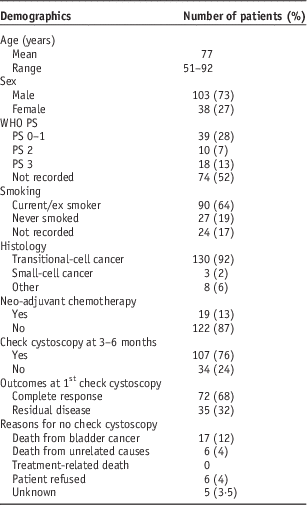
The patient group was heterogeneous (Table 1). It was an elderly cohort with a mean age at treatment of 77 years and range of 51–92 years. At least 80% of the patients had a World Heath Organization performance status of 2 or above. The majority of cancers were transitional cell carcinoma. The majority of patients had organ-confined disease and underwent radiation therapy to the bladder only. Only three patients who were pelvic-node positive on staging CT underwent additional whole-pelvis treatment.
Patient demographics and clinical outcomes

Abbreviations: WHO, World Health Organization; PS, performance status.
The median follow-up was 62·9 months. At the time of analysis, there were 103 deaths, including 69 deaths from bladder cancer. Median overall survival was 30·3 months with 1-, 2- and 3-year overall survival of 82·1, 57·6 and 47·8%, respectively (Figure 1a). Median bladder cancer-specific survival was 53·1 months, with 1-, 2- and 3-year bladder cancer-specific survival of 85·5, 64·4 and 55·9%, respectively (Figure 1b).
(a) Overall and (b) bladder cancer-specific survival for the cohort of 141 patients treated with bladder image-guided radiotherapy, 2007–2010.
At 3–6 months, 107 (76%) patients underwent check cystoscopy to assess treatment response; 72 (67% of patients undergoing check cystoscopy) patients had complete response to radiation. Post-treatment CT scanning was not routinely undertaken as most of these patients would not be considered suitable for palliative chemotherapy should nodal or metastatic disease be demonstrated. Of those patients not undergoing check cystoscopy, the majority had progressive disease with 17 (12%) dying from bladder cancer in the immediate post-treatment period. Six patients (4%) died from unrelated causes, predominantly cardiovascular disease, demonstrating the competing causes of death in this population with high rates of smoking history and its associated co-morbidities.
IGRT interventions
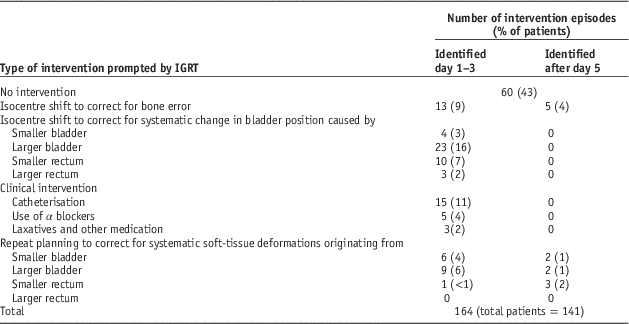
A total of 60 (43%) patients required no intervention to correct positioning errors during treatment. In all, 18 (13%) of 141 patients did not require any action beyond isocentre correction of bony set-up errors. The remaining 63 (44%) demonstrated systematic soft-tissue deformation requiring an isocentre shift, clinical intervention or repeat simulation CT and re-planning (Table 2). For 40 (28%) patients, an isocentre shift was used successfully to account for soft-tissue changes, whereas 23 (16%) patients required the use of a catheter, α-blockers or laxatives to reduce the effect of soft-tissue deformations, and a further 23 (16%) patients required repeat simulation CT and re-planning. Multiple interventions were needed for 17 (12%) patients, with five (4%) patients needing three or more interventions during their treatment course, and six (4%) patients receiving the same type of intervention twice. For six out of 23 patients managed initially with a clinical intervention, the chosen approach was unsuccessful and repeat simulation CT and re-planning were needed.
Interventions prompted by image-guided radiotherapy (IGRT)
Note: some patients required multiple interventions.
Of the 63 patients demonstrating soft-tissue deformations, 12 patients would have received a much greater dose to the small bowel had it not been for the use of IGRT, whereas the remaining 51 patients would have received inadequate dose to the target volume because of partial geometric miss. Changes in bladder or rectal volume, shape or position were the source of soft-tissue deformations with 10% of the patients demonstrating a smaller rectal volume, 4% with an increased rectal volume, 9% with a reduced bladder volume and 38% with an increased bladder volume. These soft-tissue deformations were observed at the start of treatment in the vast majority of patients; 88% of problems were identified at the first CBCT and confirmed as consistent over subsequent days. Only 12% of problems were identified during weekly reviews after the first week of treatment.
Population bone set-up errors
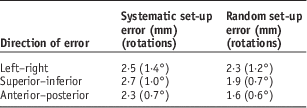
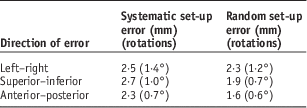
Population systematic and random bone set-up errors measured by automatic matching from CBCT were all in the range of 1–3 mm and <1·5° (Table 3), demonstrating consistent patient positioning in line with published recommendations.Reference Hurkmans, Remeijer, Lebesque and Mijnheer13, 14
Systematic and random bone translation (and rotation) set-up errors calculated using the BIR technique11 based on all cone beam computed tomographies acquired using an automatic bone match data
Population bladder organ motion errors
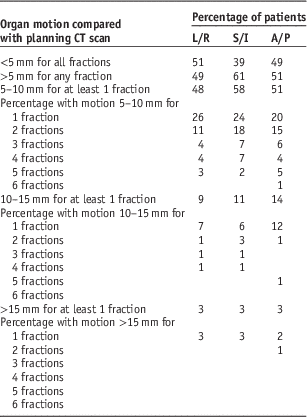
Organ motion was observed to be greatest in the superior–inferior direction in which 61% of the patients exhibited organ motion of >5 mm for at least one fraction imaged (Table 4). In each direction, right–left, superior–inferior and anterior–posterior directions, 3% of the patients demonstrated organ motion of >15 mm for at least one fraction. The right–left direction demonstrated the least organ motion in terms of proportion of patients exhibiting organ motion of <5 mm for all imaged fractions (51%) and severity of observed organ motion for those patients with motion >5 mm.
Analysis of bladder soft-tissue matching of cone beam computed tomography (CT) images compared with planning CT (population bladder motion)
Abbreviations: L/R, left–right; S/I, superior–inferior; A/P, anterior–posterior.
Discussion
This study is the largest retrospective review of the impact of introducing kV CBCT IGRT in a cohort of patients undergoing radical radiotherapy for bladder cancer. Before the introduction of volumetric IGRT, only 13% of this group would have had correction of bone set-up error with the use of MV portal imaging. The offline CBCT IGRT protocol required intervention in 57% of the patients to limit geographical miss of the target or excessive irradiation of organs at risk. This increased the need for intervention needs to be accounted for when allocating treatment schedules and resources. Most errors were identified at the first three imaged fractions, although beyond these first three images daily imaging was not acquired and a weekly regime was adopted. Random errors were also identified, with 12% of the patients requiring multiple interventions. Soft-tissue changes can be unpredictable in bladder cancer patients and patients who display random error in set-up may require daily volumetric CBCT imaging throughout their course of treatment. The compromises of increasing imaging to daily CBCT, from the local protocol of weekly after three CBCTs, include patient radiation dose and scheduling issues, both in terms of staffing and appointment lengths on the machine.
Without IGRT, the use of population margins of 1·5–2 cm from CTV to PTV can be either inadequate or excessive for individual patients. Recognising that population data for CTV-to-PTV margins do not always provide the best treatment for a given individual, adaptive radiotherapy (ART) may be a good option for bladder radiotherapy.Reference Burridge, Amer and Marchant9 ART uses either multiple CTs or CBCTs acquired over initial treatments to assess random and systematic errors for that individual and then produce an adapted plan with a PTV designed to encompass the target volume on all scans. Our study suggests that ART may benefit the 28% of patients who demonstrated soft-tissue changes that could be encompassed with an isocentre shift. However, the isocentre shift was effective without the additional work needed for ART; 28% of the patients in this review did demonstrate gross changes in target volume on the first verification image. For these patients, there may be concerns with continuing with the original plan. A ‘plan of the day’ adaptive approach may be more effective. Patients can be planned with treatments to encompass small, medium and large bladder volumes. After CBCT acquisition, the most appropriate plan from the library can be chosen for that day. This would also be effective for the 4% of patients who demonstrate large changes, resulting in repeat CT planning at some point after the first week of treatment.
The term ‘adaptive’ has been used in its broadest sense in this work, that is, any intervention during treatment delivery that improves accuracy of treatment delivery. More technical adaptive strategies, including ‘plan of the day’ approaches, have been adopted in other smaller bladder cancer patient series, and have been shown to be feasible and to result in a smaller volume of normal-tissue irradiation as well as improvements in target coverage.Reference Lalondrelle, Huddart and Warren-Oseni8, Reference Burridge, Amer and Marchant9, Reference Foroudi, Wong and Kron15, Reference Murthy, Master and Adurkar16 Intuitively, such strategies should result in improved local control and overall survival. This is the subject of clinical trials. In the HYBRID trial, palliative patients are randomised between standard radiotherapy using the same plan for each fraction and an adaptive strategy where the best of the three possible plans (small, medium and large bladder volumes) is selected on each treatment day.Reference McDonald, Lalondrelle and Taylor17 In the radical setting, the RAIDER trial investigated adaptive strategies by randomising patients between standard radiotherapy using one plan, an adaptive approach that selects one of the three (small, medium and large) plans for each treatment and an adaptive approach that also delivers escalated doses to the whole bladder and tumour.18
Similar to prostate radiotherapy patients, this study demonstrates that rectal filling impacts on bladder positioning.Reference Button and Staffurth10, Reference Fokdal, Honore, Hoyer, Meldgaard, Fode and von der Maase19 Interventions such as the use of daily enemas may result in more consistent positioning in these patients.Reference Hutton, Blair, Baker and Callender20 Changes in our practice include the introduction of a crude assessment of rectal volume and intervention if a maximum rectal diameter at CT planning of ≥5 cm adjacent to the bladder is noted.
A small proportion of our patients underwent neo-adjuvant chemotherapy. Subsequently, BC2001, a large phase 3 randomised controlled trial (RCT), has demonstrated an improvement in 2-year disease-free survival from 54 to 67% with the addition of concurrent chemotherapy to radical radiotherapy,Reference James, Hussain and Hall21 and this is now our standard practice in suitable patients. Volumetric IGRT was not available when the BC2001 trial recruited, and increased toxicity was noted during treatment in the group undergoing concurrent chemotherapy. It may be likely that the routine use of volumetric IGRT would reduce treatment toxicity when concurrent chemotherapy is delivered.
This study is limited in that it does not quantify the impact IGRT has on treatment-related toxicity and local control. We would expect IGRT to reduce radiation-related bowel toxicity and improve local bladder cancer control. We currently lack randomised trial evidence to quantify the impact of IGRT and adaptive treatments in bladder cancer. The over-arching principle of radiotherapy is to treat the target consistently with minimal dose to adjacent organs at risk (OAR). Volumetric IGRT achieves this but is more labour intensive and the optimal imaging strategy is yet to be defined.
Conclusions
Organ deformation during radiotherapy for bladder cancer can be significant and places the patient at risk of geographical miss or excessive normal-tissue irradiation. Strategies to monitor and compensate for deformation, including volumetric imaging, shifts, ART techniques and an openness to re-planning if necessary, are essential to ensure optimal plan delivery. Modern phase III radiotherapy trials should investigate the ultimate impact of such adaptive approaches on bladder cancer toxicity and survival outcomes.
Acknowledgements
The authors thank the clinical staff at St James’s Institute of Oncology Leeds for their help and contribution, with particular thanks to Drs Bottomley, Casanova, Coyle, Franks and Kiltie.
Conflicts of Interest
None.