INTRODUCTION
Many ectoparasitic insects feed on bird nestlings and require a developmental stage in the sheltered environment of nest material (Marshall Reference MARSHALL1981). Most hosts face negative reproductive consequences of parasitism, such as reduced growth rate, mass and survival of nestlings (Brown & Brown Reference BROWN and BROWN1986, Møller et al. Reference MØLLER, ALLANDER, DUFVA, Blondel, Gosler, Lebreton and McCleery1990, Reference MØLLER, ARRIERO, LOBATO and MERINO2009; O'Brien & Dawson Reference O'BRIEN and DAWSON2008). As a result, there is selective pressure on hosts to evolve behavioural, physiological and immunological adaptations that reduce the negative effects of parasitism (Heeb et al. Reference HEEB, WERNER, KÖLLIKER and RICHNER1998, Møller & Erritzøe Reference MØLLER and ERRITZØE1996).
Hosts may either adopt strategies to reduce the levels of parasitism, resisting the negative effects, or tolerate parasitism by minimizing the fitness costs associated with parasitism (Simms & Triplett Reference SIMMS and TRIPLETT1994). Resistance often leads to antagonistic coevolution of hosts and parasites, where adaptations in one species are countered by adaptations in the other (e.g. Red Queen dynamics; Woolhouse et al. Reference WOOLHOUSE, WEBSTER, DOMINGO, CHARLESWORTH and LEVIN2002). Host–parasite relationships are traditionally described as arising from resistance, however recent evidence suggests that some hosts have evolved tolerance strategies (Krüger Reference KRÜGER2007, Råberg et al. Reference RÅBERG, SIM and READ2007). Tolerance predicts a more stable evolutionary state because the host does not directly influence the number of parasites, and thus does not induce a counter response by the parasitic species (Svensson & Råberg Reference SVENSSON and RÅBERG2010). Reproductive compensation is one example of tolerance, whereby reproductive output is increased in response to parasitism, which may either increase the likelihood that some offspring express more parasite-resistant phenotypes, or dilute the number of parasites per offspring across a brood (Gowaty Reference GOWATY2008, Richner & Heeb Reference RICHNER and HEEB1995, Svensson & Råberg Reference SVENSSON and RÅBERG2010). Svensson & Råberg (Reference SVENSSON and RÅBERG2010) proposed that a larger clutch size can be demonstrated as an evolved defence (tolerance) if chicks in larger broods are less affected by parasitism than chicks in smaller broods.
Little is known about host–parasite interactions in tropical cavity-nesting birds. Tropical hosts often exhibit greater immunological responses to parasites, and suffer higher parasite-induced nestling mortality than temperate species (Møller Reference MØLLER1998, Møller et al. Reference MØLLER, ARRIERO, LOBATO and MERINO2009), suggesting that parasitism is an important mechanism shaping the evolution of life-history traits in tropical birds. Darwin's finches in the Galapagos Islands experience high parasite-induced nestling mortality by the recently introduced Philornis downsii; however nestling parasite load was reduced in larger clutches (Dudaniec et al. Reference DUDANIEC, FESSL and KLEINDORFER2007, Fessl & Tebbich Reference FESSL and TEBBICH2002), providing evidence for reproductive compensation in tropical hosts. In a review of 117 temperate and tropical studies, cavity-nesting hosts had low parasite-induced nestling mortality, even though parasite prevalence was high (Møller et al. Reference MØLLER, ARRIERO, LOBATO and MERINO2009), indicating that either parasitism is not an important determinant of life-history traits in cavity-nesters, or that the fitness impacts of parasitism are minimized via tolerance. It remains unclear whether reproductive compensation would be an advantageous anti-parasite strategy for tropical cavity-nesters.
Here, we examine how ectoparasitism by a Philornis botfly influences nestlings of a tropical cavity-nesting passerine, planalto woodcreeper (Dendrocolaptes platyrostris).
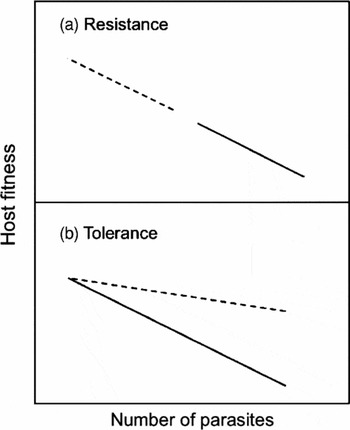
Our objectives were to determine (1) nestling development rates, (2) the extent of ectoparasitism by Philornis on nestlings, (3) whether Philornis botflies had a negative impact on survival and condition of nestlings, and (4) how per-nestling Philornis abundance and nestling body condition varied with nestling age, and brood size, for the planalto woodcreeper (Figure 1).
The resistance and tolerance hypotheses predict that some individuals of a host species will express anti-parasite phenotypes (dashed lines), leading to higher fitness than host individuals not expressing the phenotypes (solid lines). The resistance hypothesis (a) predicts that parents with anti-parasite phenotypes will increase their fitness by reducing the number of parasites in their nest. The tolerance hypothesis (b) predicts that parents will not reduce overall parasite load, but will increase their fitness by minimizing the negative effects of parasites. For planalto woodcreepers, we predicted that if nestling growth rates or fledging condition were negatively correlated with the number of Philornis botflies per nestling, then we predicted that parents expressing anti-parasite phenotypes would achieve higher fitness by either resisting or tolerating the parasites. Under the resistance hypothesis, parents exhibiting resistant phenotypes would minimize the number of parasites per nest. Under the tolerance hypothesis, parents exhibiting tolerant phenotypes could reduce infestation per nestling by laying larger clutches, and diluting the effects of parasitism. Adapted from Råberg et al. (Reference RÅBERG, SIM and READ2007).

METHODS
Study area
The study was conducted in two provincial parks and two farms in the Sierra Central Highlands region, Misiones, Argentina. The area included mature, primary forest, selectively logged, and secondary Atlantic forest, in Parque Provincial de la Araucaria (26°38′S, 54°07′W, 92 ha of secondary and selectively logged forest), Parque Provincial Cruce Caballero (26°31′S, 53°58′W, 400 ha mature forest), and Tobuna (26°28′S, 53°53′W, one farm comprised secondary and selectively logged forest and the other farm comprised highly fragmented selectively logged forest), Department of San Pedro. This region comprises a mosaic landscape of small farms, remnant forest and tree plantations, and forest classified as mixed forest with Nectandra and Ocotea spp., Balfourodendron riedelianum and Araucaria angustifolia (Cabrera Reference CABRERA, Acme and Aires1976). Mean annual rainfall is 1200 to 2400 mm, with precipitation distributed evenly throughout the year. We collected data at these sites during three breeding seasons, September to January 2006 and 2007, and September–December 2008.
Study species
The planalto woodcreeper is a forest-dependent obligate secondary cavity-nester (relying on existing tree cavities for nesting), that is found in humid forests from north-eastern Brazil to northern Argentina and eastern Paraguay (Marantz et al. Reference MARANTZ, ALEIXO, BEVIER, PATTEN, del Hoyo, Elliott and Christie2003, Skutch Reference SKUTCH1969, Reference SKUTCH1981). It is one of the two most abundant woodcreepers in our study area (Bodrati et al., in press). Planalto woodcreepers lay 2–4 eggs on a bed of bark flakes, both parents incubate for 14–16 d, and chicks fledge 14–18 d after hatching (Cockle & Bodrati Reference COCKLE and BODRATI2009). In our study, most woodcreeper nestlings were infested with Philornis botflies (Diptera: Muscidae: Philornis spp.); other ectoparasites were rare (Cockle & Bodrati Reference COCKLE and BODRATI2009).
Philornis comprises approximately 50 species of botfly, which are distributed throughout the neotropical region, parasitizing over 133 bird species (Di Iorio & Turienzo Reference DI IORIO and TURIENZO2009, Dodge Reference DODGE1955, Dudaniec & Kleindorfer Reference DUDANIEC and KLEINDORFER2006). Larvae of most species (82%) of Philornis feed subcutaneously on serous fluids, tissue debris and blood of the host for 5–7 d upon which they exit the nestling and pupate at the bottom of the nest for 14 d (Arendt Reference ARENDT1985, Dodge Reference DODGE1971, Fessl et al. Reference FESSL, SINCLAIR and KLEINDORFER2006). Thus, Philornis larvae can only pupate in nest material if they emerge from nestlings before the nestlings fledge. Up to five different Philornis females may lay eggs in a single nest, producing multiple cohorts of larvae throughout the nestling period (Arendt Reference ARENDT1985, Dudaniec et al. Reference DUDANIEC, GARDNER and KLEINDORFER2010, Young Reference YOUNG1993). Nestlings are susceptible to parasitism by Philornis for the duration of the nestling period, and the number of botflies often increases with nestling age (Arendt Reference ARENDT1985) but declines with age beyond 9 d in the house wren (Troglodytes aedon; Young Reference YOUNG1993). Philornis larvae can reduce the body mass and condition, and cause up to 62% mortality in nestlings (Dudaniec & Kleindorfer Reference DUDANIEC and KLEINDORFER2006).
Nest monitoring and chick measurements
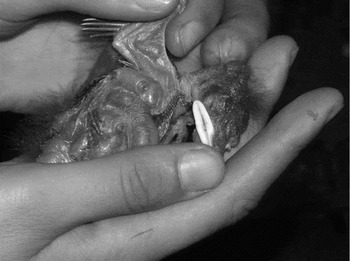
We erected nest boxes 5–9 m high on trees, from September 2006 to July 2007. We found nests and followed their fate by checking all boxes with a pole-mounted video camera every 1–3 wk. Between 2006 and 2008, we found 18 nests that hatched chicks (13 nests found during the laying and incubation periods). We recorded their hatch date, colour-marked nestlings individually, and collected morphometrics of 50 chicks every 2–4 d for the duration of the nestling period. When chicks reached approximately 14 d old, we covered the cavity entrance while climbing to and from the nest (5–10 min), to prevent early fledging, and removed the cover when all chicks were returned to the cavity and the climbing equipment was removed from the tree. At each visit, we recorded mass (g), number of botflies (apparent by subcutaneous cysts; Figure 2), wing chord (mm) and length of centre retrix of all nestlings. Since some botflies were not detected if they were embedded under others, the number of larvae was a minimum measure of botfly infestation per chick.
Philornis sp. parasites in subcutaneous layer of a planalto woodcreeper nestling at Araucaria Provincial Park, Misiones, Argentina. Photo: N. D. Fariña.

Statistical analyses
To determine whether chick growth was influenced by botfly infestation, we constructed general linear mixed-effects models. We used the natural logarithm of nestling mass to account for the log-linear growth rate. The response variable was mass, and fixed effects were chick age, squared and cubic transformations of chick age, number of botflies, number of chicks in the nest (brood size), and an interaction term of chick age and number of botflies. To avoid spurious correlations due to multiple measurements of chicks and multiple nests within sites, we partitioned this variation in a nested random term of chick identity within nest identity.
‘Fledging measurements’ were the last measurements taken 0–2 d before successful chicks were presumed to fledge (i.e. measurements at 14–18 d old). To test the hypothesis that botflies influenced fledging condition, we used a principal components analysis of fledging mass, wing chord and tail length, and regressed the collapsed variables (the main principal components) against the number of botflies in a mixed-effects model. Since fledging condition is correlated with nestling age, and we observed variation in fledging age (14–18 d old) across sites (Cockle & Bodrati Reference COCKLE and BODRATI2009), we modelled age and site as random effects. To test the resistance hypothesis that woodcreepers exhibit resistant phenotypes to minimize the parasite load per nestling in their nests, we used a main-effect mixed model to regress the number of botflies per nestling against nesting pairs (nest identity). Since the adults were not colour-marked, we could not determine whether the same pairs used multiple boxes within sites, nor the same boxes across years, so we nested the random effects of site with year to account for any potential spatial and temporal autocorrelation. To test the tolerance hypothesis (reproductive compensation) that woodcreepers experience reduced per capita negative effects of parasitism in larger broods, we regressed the number of botflies against brood size in a mixed-effects model, with site and nest identity as random effects. We nested the random effects of nest identity within site to account for correlation due to repeated measurements within nests and sites, and to account for any autocorrelation of nests due to woodcreeper pairs using the same nest boxes across years.
We used restricted maximum likelihood to calculate parameter estimates and associated standard errors for each fixed effect, with the package nlme in program R (Version 2.10.1, www.r-project.org; Ihaka & Gentleman Reference IHAKA and GENTLEMAN1996, Pinheiro & Bates Reference PINHEIRO and BATES2000). We examined residual plots to ensure that variance was homoscedastic and that all models fitted the data (Pinheiro & Bates Reference PINHEIRO and BATES2000). All data analyses were conducted in program R (Version 2.10.1, www.r-project.org; Ihaka & Gentleman Reference IHAKA and GENTLEMAN1996).
RESULTS
Of all the nests in which chicks hatched between 2006 and 2008, planalto woodcreeper pairs fledged a mean (± SD) of 3.0 ± 1.2 chicks per nest and all chicks fledged in 12 of 13 nests in the primary and secondary forest parks. On farm sites, one of which contained the most fragmented forest of all the sites, adults fledged about half as many chicks per nest, with only two of five nests fledging all chicks that hatched (Table 1). On all sites between 2007 and 2008, 33 of 50 nestlings survived to fledging, only one of which was not infested with botflies for the duration of the nestling stage. Of the 17 chicks that died before or during fledging, 13 disappeared from the nest, three were found dead in the nest, and one was found dead near the nest. Only two nest failures were attributed to Philornis parasitism, one in each of 2007 and 2008 (Cockle & Bodrati Reference COCKLE and BODRATI2009). In 2008, three of four chicks in a nest in primary forest were found dead in the nest on the day they should have fledged, apparently as a result of heavy parasitism; the fourth chick was found dead within 10 m of the nest, the following day. In this heavily parasitized nest, the first chick to die was blind because botflies had consumed its eyes. Each dead chick contained 25 to 57 Philornis larvae, and the parents left food on top of the dead chicks.
Summary of botfly infestation rates, age and condition at fledging, and fledging success of planalto woodcreeper nestlings immediately prior (0–2 d) to fledging, of all nests found that hatched chicks in nest-boxes at two parks and two farms in the Atlantic forest, Misiones, Argentina, 2006 to 2008. Mean ± SD is given for each forest and site type.

Nestling growth, fledging condition and botflies
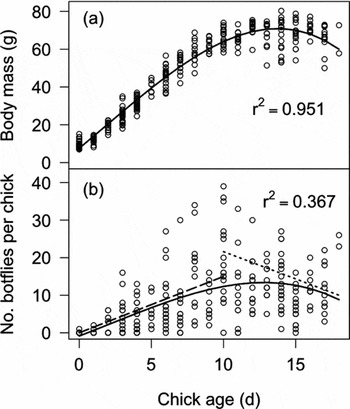
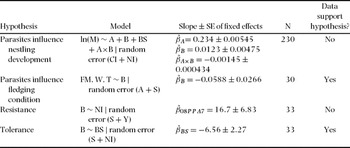
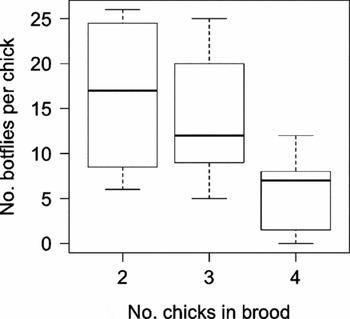
Nestling mass and number of botflies increased concordantly with age, reaching maxima around 10 to 14 d old, then declined (Figure 3). Only two chicks in two nests fledged earlier than the rest of their broods, suggesting that the decline in mass immediately prior to fledging was not due to larger chicks fledging earlier than smaller chicks in a brood. Chick age explained approximately 95% of the variation in body mass, but only 37% of the variation in ectoparasite load per nestling. Of the chicks that survived to fledging (33 of 50 measured at 14–18 d old), fledging mass, wing chord and tail length collapsed into two principal components: the first was strongly positively correlated with fledging mass and explained 66% of the total variation, and the second was strongly positively correlated with wing chord and tail length and explained 31% of the total variation. The first principal component (fledging mass) declined with increasing number of botflies, but the second component (wing chord and tail length) was not significantly correlated with number of botflies, indicating an influence on nestling condition but not size (Table 2). Only one nest comprised chicks with higher numbers of botflies per nestling compared to other nests, indicating that pairs did not exhibit resistant phenotypes to reduce the number of parasites. However, the number of botflies per nestling decreased with increasing brood size (Figure 4).
Body mass (a) and ectoparasite load of Philornis botflies (b) of 50 planalto woodcreeper nestlings measured between hatch date (0 d) and immediately prior (0–2 d) to fledging in 13 nests, in the Atlantic forest, Misiones, Argentina, 2006 to 2008. The coefficients of determination for each of the quadratic models (solid lines), y = βo + βage χ + βage2χ2 + βage3χ3, are given. The number of botflies increased with age up to 10 d old ( age 0–10 = 1.64 ± 0.130 SE, P < 0.01), then declined beyond 10 d (age 10–18 = −0.714 ± 0.255 SE, P < 0.01), as predicted by the linear models, y = βo + βageχ (dashed lines).

Major hypotheses tested using a series of linear mixed-effects models that examined correlations among: Chick mass (M), Chick age (A), Number of botflies (B), Brood size (BS), Chick identity (CI), Nest identity (NI), Fledging mass (FM), Wing chord (W), Tail length (T), Site (S) and Year (Y), across 50 nestlings and 30 to 33 nestlings immediately prior (0–2 d) to fledging (N), in 13 nests, at four sites in Misiones, Argentina, 2006 to 2008. For the Resistance model, the slope is given for the only nest (at Araucaria Provincial Park in 2008; 08PPA7) to comprise chicks with significantly different (higher) numbers of botflies than the other nests.

Median number of Philornis botflies per planalto woodcreeper immediately prior (0–2 d) to fledging (horizontal lines) declines with increasing brood size, as predicted by the linear mixed-effects model, y = 31.4 – 6.56x + ɛNestID/Site in 33 nestlings across four sites and 11 nests, in the Atlantic forest, Misiones, Argentina, 2006 to 2008. Boxes show the 25th and 75th percentiles of data, and whiskers show the maximum and minimum number of botflies detected on nestlings in each brood size.

DISCUSSION
This is the first study to report nestling growth measurements for planalto woodcreepers, and the first to examine the influence of ectoparasites on their reproduction. Number of botflies was negatively correlated with fledging mass but chicks in larger broods had fewer botflies, supporting the idea that larger broods dilute the effects of parasitism by spreading the parasites over a greater number of nestlings. Parents that maintained larger broods could tolerate parasitism by reducing the number of parasites per nestling. The negative correlation between ectoparasite load and brood size may have been influenced by differences in habitat quality such that adults in the parks could maintain larger broods and better quality nestlings compared with those in farms. However, we caution that these correlational results arose from a small sample size, thus additional study is necessary to confirm implications of our findings.
Nestling growth and botflies
The number of botflies per nestling reached a maximum when chicks were 10 d old, then declined as chicks approached fledging (Figure 3b). Woodcreeper chicks can fledge as early as 14 d after hatching, so newly established parasites, which require 5–7 d of feeding on the nestling, have a reduced chance of pupation in the sheltered nest cavity when parasitizing chicks older than 10 d, and would risk not finding a suitable substrate for pupating. Furthermore, chicks typically approach their maximum size between days 10 and 14, limiting optimal host space available to new Philornis recruits. Thus, it is advantageous for Philornis to parasitize younger and smaller chicks in which more time and space are available for larval development.
The result that the growth rate of nestlings was not correlated with the number of botflies suggests that parasitism did not influence the development of nestlings (Table 2). The negligible effects of parasitism on nestling development are often attributed to compensation by parents, usually by increasing the frequency of feeding bouts or improving the quality of food delivered throughout the nestling stage (Møller et al. Reference MØLLER, ALLANDER, DUFVA, Blondel, Gosler, Lebreton and McCleery1990, Saino et al. Reference SAINO, CALZA, NINNI and MØLLER1999, Tripet & Richner Reference TRIPET and RICHNER1997, Wesołowski Reference WESOŁOWSKI2001). In our study, woodcreeper parents increased their frequency of feeding bouts with nestling age up to 13 d then the number of bouts declined immediately prior to fledging (Cockle & Bodrati Reference COCKLE and BODRATI2009, Norris unpubl. data). As the feeding bouts seemed to match the accumulation of mass and number of botflies with age, we suspect that parents could compensate for the mass lost to botflies. The decline in feeding bouts near fledging may have released this buffer from parasitism, contributing to the negative correlation of fledging mass with number of botflies. Furthermore, brood sizes were largest in the most intact forest parks, suggesting that woodcreepers may have been able to better compensate for parasitism in the more pristine habitats (Table 1). However, an effective test of the parental compensation hypothesis would require comparing nestling development rates and parental feeding behaviours between infested and uninfested nests. In our study, we observed only one nestling that avoided parasitism. Further experimental evidence, such as a parasite removal study, is required to determine whether the observed negligible effects of Philornis ectoparasites on nestling development can be attributed to parental compensation.
Fledging condition and botflies
Mass at fledging is an important and well-known determinant of juvenile survival, and subsequently fitness, in birds (Lindén et al. Reference LINDÉN, GUSTAFSSON and PÄRT1992). The negative correlation of number of botflies with fledging mass in planalto woodcreepers supports the suggestion that parasitism represents a fitness challenge to woodcreepers and plays an important role in the life-history evolution of these tropical hosts. If pathogens or parasites are predictable costs, then host species should increase their fecundity to either dilute the negative effects of parasites across a larger brood, or increase the likelihood of resistance alleles appearing in their progeny (Gowaty Reference GOWATY2008, Richner & Heeb Reference RICHNER and HEEB1995). Thus successive parasitism events should increase the predictability of perceived risk of parasites, and influence the reproductive decisions of hosts in subsequent years (O'Brien & Dawson Reference O'BRIEN and DAWSON2005). Botflies were the dominant nestling ectoparasite in three years (Cockle & Bodrati Reference COCKLE and BODRATI2009, this study), suggesting that Philornis was a predictable cost to planalto woodcreepers. Our result that the costs of parasitism were reduced in larger broods suggests that reproductive compensation would be an effective anti-parasite reproductive strategy.
The high prevalence of ectoparasites that we observed (nearly 100%) was comparable to other studies of hosts infested by Philornis botflies (Dudaniec & Kleindorfer Reference DUDANIEC and KLEINDORFER2006, Dudaniec et al. Reference DUDANIEC, FESSL and KLEINDORFER2007). Yet, we observed relatively low parasite-induced nestling mortality (~8% of all nestlings; Cockle & Bodrati Reference COCKLE and BODRATI2009, this study). This is consistent with the finding that cavity-nesting species suffer lower nestling mortality when compared with open-cup nesters, but inconsistent with the general trend of high parasite-induced nestling mortality in tropical species (Møller et al. Reference MØLLER, ARRIERO, LOBATO and MERINO2009). Svensson & Råberg (Reference SVENSSON and RÅBERG2010) suggest that fitness costs of parasitism can be minimized despite high prevalence, if species have adapted strategies to tolerate parasites. We suggest that our finding of low nestling mortality despite high prevalence of botfly larvae may be attributed to tolerance of parasites by woodcreepers (Møller et al. Reference MØLLER, ARRIERO, LOBATO and MERINO2009).
Resistance versus tolerance
Under the resistance hypothesis, disparity in the number of parasites is attributed to parents with resistant phenotypes minimizing the number of parasites and experiencing higher fitness (Svensson & Råberg Reference SVENSSON and RÅBERG2010). Our result that the number of parasites per nestling did not vary across nesting pairs, besides one nest that had a higher parasite load than the others, suggests that the range in parasite loads per nestling was comparable across nests, and that parents did not resist parasites (Figure 1). Furthermore, if nestlings in larger broods were more immune to parasites, then we would have found a negative correlation between parasite load per nest and brood size, and this was not the case (R2 = 0.16, df = 9, P = 0.22). However, we are reluctant to reject the resistance hypothesis because our small sample size may have resulted in little power to detect differences in parasite loads across nests.
If pathogens evolve faster than hosts, then tolerance is an ideal strategy for hosts because it does not induce a counter-response in parasites (Gowaty Reference GOWATY2008). In our study, an increase in brood size in response to number of parasites did not negatively influence the overall abundance of parasites in nests. The negative correlation between parasite load per nestling and brood size indicates that parents may have adjusted their reproductive output to increase fecundity while minimizing the costs of parasitism, supporting the hypothesis of tolerance by reproductive compensation. It is important to note, however, that both resistance and tolerance alleles may be present in populations, thus these anti-parasite strategies may not be mutually exclusive (Svensson & Råberg Reference SVENSSON and RÅBERG2010). Future empirical tests of the reproductive compensation model may help disentangle these hypotheses and elucidate a mechanism by which woodcreepers tolerate parasitism.
ACKNOWLEDGEMENTS
We are very grateful to M. and T. Debarba and their families for permitting this nest-box study in their forest, and to A. Bodrati, J. Segovia, A. Fernández, E. Jordan, N. Fariña, K. Palenque Nieto, C. Ramón, M. Debarba and M. Gómez for field assistance. K. Wiebe provided helpful advice in the planning stage. P. Turienzo and O. Di Iorio identified the parasites. D. Cockle designed the nest monitoring camera and equipment. ARN was supported by post-graduate scholarships from the Natural Sciences and Engineering Research Council of Canada (NSERC), and the Forest Sciences Program. KC was supported by a Killam Predoctoral Scholarship, Donald S. McPhee Fellowship and Namkoong Family Scholarship in Forest Science. Fieldwork was supported by Environment Canada, an NSERC Discovery Grant to KM, Columbus Zoo and Aquarium Conservation Fund, Lindbergh Foundation, Explorers’ Club, and Rufford Small Grants Foundation. Equipment was loaned or donated by Idea Wild, Environment Canada, and the Area de Manejo Integral de la Reserva de la Biósfera Yaboty. The study was authorized by the Ministerio de Ecologia, RNR y Turismo of the Province of Misiones and we especially thank the park rangers of Cruce Caballero and Araucaria Provincial Parks. The quality of this manuscript was greatly improved by the comments of an anonymous reviewer.