In a letter to his wife written near Shelbyville, Kentucky on 5 October 1862, Union lieutenant Joseph Franklin Culver described a visit he had made that morning to an abandoned Confederate home. “I set [sic] down this morning to a splendid rosewood piano, as fine a tone as one I ever heard. It was covered with dirt; the ceiling had [been] broken by the bayonets of the men, & bruises and scratches from their guns, toilet & work boxes overlaid with shell & ornaments broken to pieces, & everything almost destroyed.”Footnote 1 Culver's description of a battered piano marries the brutalities of war with the living room. Although the instrument in his narrative met a particularly violent fate, the horrors of war were certainly not unfamiliar to other parlor pianos.
Pianists at home, the majority of whom were women, embodied life at the front through music.Footnote 2 Countless keyboard works and solo songs were written about the war and marketed to amateur musicians, who could envision the realities of a soldier's life as they studied and performed works on military themes. Among them were pieces composed in response to recent conflicts, often published within days or weeks of the relevant event. Popular genres for the piano on military topics included marches, galops, quicksteps, descriptive fantasies, and battle pieces. This last genre, a descendent of the battle works of the sixteenth century, depicted some of the most pivotal conflicts of the war in musical rhetoric, bringing them alive in the minds and imaginations of drawing room performers and audiences.
This article is the first detailed study of American keyboard battle pieces from the Civil War.Footnote 3 It situates these works in their historical moment: although they resemble battle works of earlier generations, particularly those from the Napoleonic era, they also incorporate cultural trends and technological advances particular to their age. Battle pieces respond to several aspects of Civil War life, particularly those related to war documentation: the civilian demand for vivid war news, especially eyewitness accounts from the front, the advent of telegraphic reporting, and the fallibility of the media in reporting news of the war. They also reflect cultural trends of the mid-nineteenth century not related to war, particularly the popularity of theatrical melodrama on the stage and the prominence of virtuosity in piano repertoire. With their diverse influences and sources, these works create a patchwork representation of Civil War life.
Civil War battle pieces attest to the huge impact the media had on civilian wartime experiences, particularly by paraphrasing and quoting accounts of battle communicated via telegraph that had been published in the newspaper. This project relies on a broad spectrum of research about the media during the war, including that focused on the use of the telegraph, the culture of war correspondents, and documentation from the front by photographers and visual artists. The classic texts about the media during the Civil War are J. Cutler Andrews's two notable volumes, The North Reports the Civil War and The South Reports the Civil War, which prompted a host of scholars to take up the topic.Footnote 4 Much of this work examines how the combination of the telegraph, a major technological advance that transformed communication from the front, and a vibrant media culture that prized the involvement and voice of the eyewitness, transformed the civilian wartime experience. Although my study of battle pieces does not modify the existing framework for understanding the media, technology, or war documentation in Civil War historiography, it does reveal another venue where we can witness the extraordinary impact the mass media had on the war experience of everyday Americans.
This article also draws inspiration from the methodology of historians investigating the Civil War through the lens of mass culture, especially those examining popular literature and wartime magazines. Popular culture provides us with a varied record of wartime life; magazines and popular fiction claimed a diverse public readership and they also reflected a vast array of personal war experiences. Important models for this project are the publications of Alice Fahs and Kathleen Diffley, which use periodicals and popular literature to explore the civilian war experiences of African Americans, children, and women at home; their work demonstrates the importance of mass culture as a source for historians seeking to understand the involvement of those removed from the front.Footnote 5 Battle pieces resemble both magazines and a great deal of fiction because they too were popular commodities representing the war marketed to civilians, and particularly to women. As it investigates the performance of battle pieces as a site where women imagined and experienced the perils of war, this project contributes to scholarship that deepens our understanding of how women at home participated in mass culture.
I. Embodying War
By the time of the American Civil War, battle music for the piano had long been a fixture of both domestic and professional music making in Europe and the United States alike. Its popularity had exploded during Napoleon's military campaigns, when the constancy of war in European public consciousness had fueled the rise of artwork on military themes, from paintings of battle scenes and military heroes to poetry on the experience of war. Music took part in the vogue for all things martial as well; markets teemed with works for military bands, patriotic songs, military marches, and songs about war. Orchestral battle pieces were some of the most popular works on late eighteenth-century stages, and keyboard pieces signifying battle abounded.Footnote 6 The most well known of these was Francis Kotzwara's 1788 “Battle of Prague,” which took hold as a staple of bourgeois women's repertoire, its reputation spreading particularly in Great Britain, France, and the United States.Footnote 7
By 1793, the “Battle of Prague” had been published in the United States, and orchestral and band arrangements soon made their way onto public stages.Footnote 8 American composers quickly began writing works of their own about historical battles, including those of the Revolutionary War, many of which were modeled on European battle pieces.Footnote 9 The bulk of American battle works was composed during the 1790s and first quarter of the nineteenth century, but years later, the Mexican-American War and Civil War would spark revivals in their composition and public interest.Footnote 10 The most prolific composer of Civil War battle pieces was Charles Grobe, a German immigrant living in Wilmington, Delaware. Born in Saxe-Weimar around 1817, Grobe had immigrated to the United States in 1839, assuming a post as a professor of music at the Wesleyan Female College in Wilmington in 1841. He composed several battle pieces during the first two years of the Civil War, issuing his works promptly after the conflicts they depict.Footnote 11 James Cox Beckel, M. H. Frank, Laura Hastings Hatch, Theodore Moelling, Joseph Raff, and Thomas Greene Wiggins (“Blind Tom”) also composed battle pieces, as did the anonymous “Skedaddles,” and countless composers wrote works on military topics, many of which share features with battle music.Footnote 12
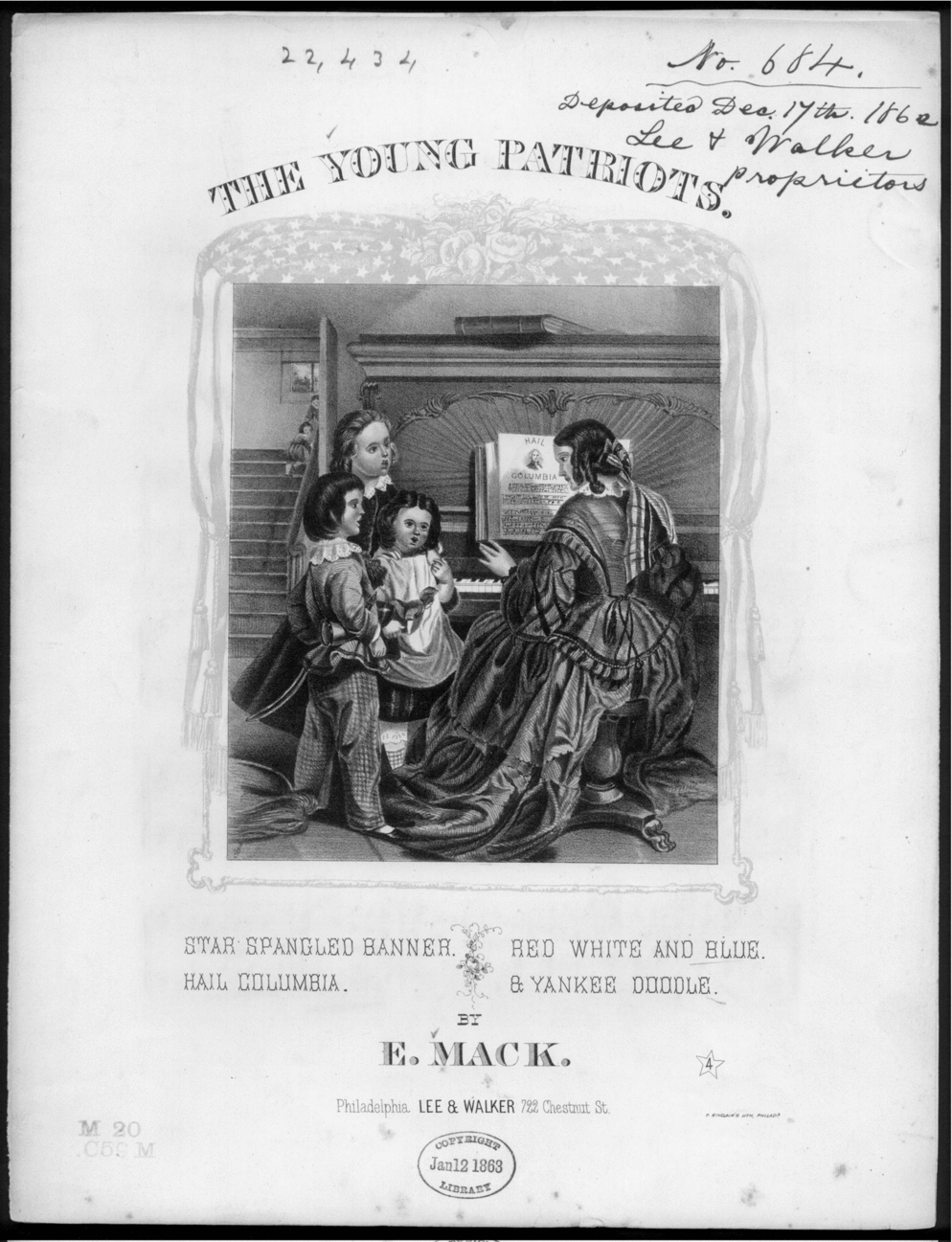
Sheet music was marketed to amateur pianists, the bulk of whom were women or “piano girl[s]” who practiced and performed on parlor instruments.Footnote 13 Keyboard battle music, particularly the “Battle of Prague,” which composer W. T. Parke had once characterized as “well-known to most of the ladies who cultivate that favorite instrument the piano-forte,” had long been the province of women, as its appearance in numerous nineteenth-century novels, where it is studied and performed by female pianists, attests.Footnote 14 Charles Grobe modeled his battle pieces after Kotzwara's work, nodding to its influence when he published his “Battle of Prague: Revamped, Remodeled, and Renovated” in 1860. He spent his career teaching at a women's school and composing works for his female pupils and for use by teachers at female seminaries.Footnote 15 Many battle works were printed as sheet music with back covers that advertised other typical parlor works, such as sentimental songs and popular dances;Footnote 16 some parlor works attest to the gendering of patriotic piano repertoire and parlor performance in their illustrations (Figure 1). As the war drew on and more men left home to fight, women—who already counted the piano as their domain and battle music as their repertoire—would have become even more exclusively the dominant performers in musical enactments of the conflict. Battle pieces were more common in the North, where there were larger numbers of both music publishers and amateur female pianists, not to mention composers. Consequently, most battle works depict conflicts in which the Union was victorious.Footnote 17
E. Mack, “The Young Patriot” (Philadelphia: Lee & Walker, 1863). Sheet music cover.

Civil War battle pieces followed a scheme that had been developed with the advent of the genre in the sixteenth century. Episodic works that depicted preparation for military battle, combat, and victory, they featured some elements also common in other works on military topics, such as march tunes, bugle and trumpet calls, and patriotic songs, as well as a number of sonic effects all their own: cannon shots created by banging bass notes, flying bullets represented by running scales and arpeggios, galloping horses, firing rockets, laments for the wounded and/or suffering of the injured, and victory dances. Many of these programmatic elements were labeled in the score, delineating their programmatic purpose, as were the various sections, such as “Word of Command,” “Attack,” and “Cries of the Wounded.” Battle pieces can be differentiated from other wartime pieces with similar programmatic elements by their detailed, and sometimes gruesome, musical representations of combat itself.Footnote 18 Both earlier battle works and those of the Civil War were often adorned with drawings of battle scenes and other visual signifiers, including portraits of soldiers, maps, and detailed color drawings.
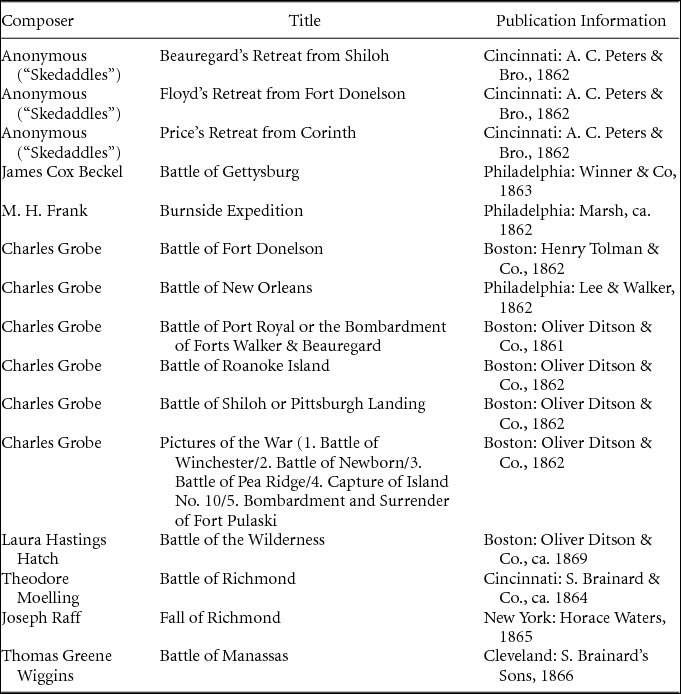
Battle works had a long tradition of borrowing from one another. Many Civil War works took motives and gestures from battle pieces of earlier generations, particularly the ever-popular “Battle of Prague,” creating a stylized and recognizable musical vocabulary. Some Civil War battle works also maintained several of the more curious features of the “Battle of Prague“ and its contemporaries, such as an “Attack” section that steadfastly avoided the minor mode, sounding at times more like a dance than a gruesome battle. Battle pieces also frequently quoted patriotic tunes; those listed in Table 1 paraphrase several songs, including “The Star-Spangled Banner,” “My Country Tis of Thee,” “Yankee Doodle,” “Battle Hymn of the Republic,” and the “Marseillaise.” This last tune may seem anachronistic, but there was a tradition of parodying the French anthem during the Civil War, particularly in the South, where the lyrics were altered to express the Confederate cause.Footnote 19
Battle pieces composed during the Civil War.
Like earlier battle pieces, those of the Civil War emphasized the importance of the visual in creating musical meaning, but they did so in ways unique to the climate of the time. Eyewitness accounts of events at the front, which included artwork, photography, and written reports often sent via telegraph, were ever-present in public consciousness, shaping perception of the war and feeding an interest in visualizing conflict on the battlefield. These reports and representations were not entirely reliable. Journalists and artists often found themselves required to depict an event that they had not witnessed, leading to the publication of both images and written accounts of battle that blended fact and fiction. In spite of their inaccuracies, however, eyewitness reports were devoured by a public hungry for war news.Footnote 20
The subtitle of Charles Grobe's “Battle of Roanoke Island; Story of an Eye Witness; Musically Portrayed” demonstrates the prominence of eyewitness reporting in its composer's mind. Three of his other works also contain subtitles suggesting their pictorial nature: “Musically Photographed” (“Battle of Shiloh”), “Musical Description” (“Battle of Fort Donelson”), and “Musically Illustrated” (“Battle of New Orleans”). These pieces exhibit elaborate cover illustrations, including maps and detailed colored drawings, which, along with their subtitles, allude to the practice of eyewitness drawing and photography. The three Northern illustrated newspapers, Harper's Weekly, Frank Leslie’s, and the New York Illustrated News, all stationed illustrators with the Union army. Known as Special Artists, they sketched drawings documenting camp life and military activities, including battles, which were then reproduced as wood engravings and published. The illustrated papers also printed the sketches of amateur artists, both civilians and soldiers, to supplement the work of their Specials. Artists’ renderings helped readers picture conflicts in detail, even though they were frequently the source of inaccuracies. At the end of the war, Harper's Weekly conveyed the importance of Special Artists’ work, declaring that “there never was a war before of which the varying details, the striking and picturesque scenes, the sieges, charges, and battles by land and sea, and all the innumerable romantic incidents of a great struggle have been presented to the eye of the world by the most skillful and devoted artists.”Footnote 21
Photography also brought images of war to civilians, a practice clearly on Grobe's mind when he subtitled the “Battle of Shiloh: Musically Photographed.” Civilians encountered photographic documentation of the war in various ways, from soldiers sending photographs of themselves in uniform home to their families to prominent public exhibitions of war photography by artists like Mathew Brady. Exhibited images included such brutal scenes as corpses lying on a battlefield. Attendees could purchase prints to take home with them, leading to the practice of collecting photographs and assembling albums. Although there are no action photographs of the Civil War, photographic technology still heralded a kind of realism that had almost no precedent, as it was the first war in which photographic documentation was widespread.Footnote 22
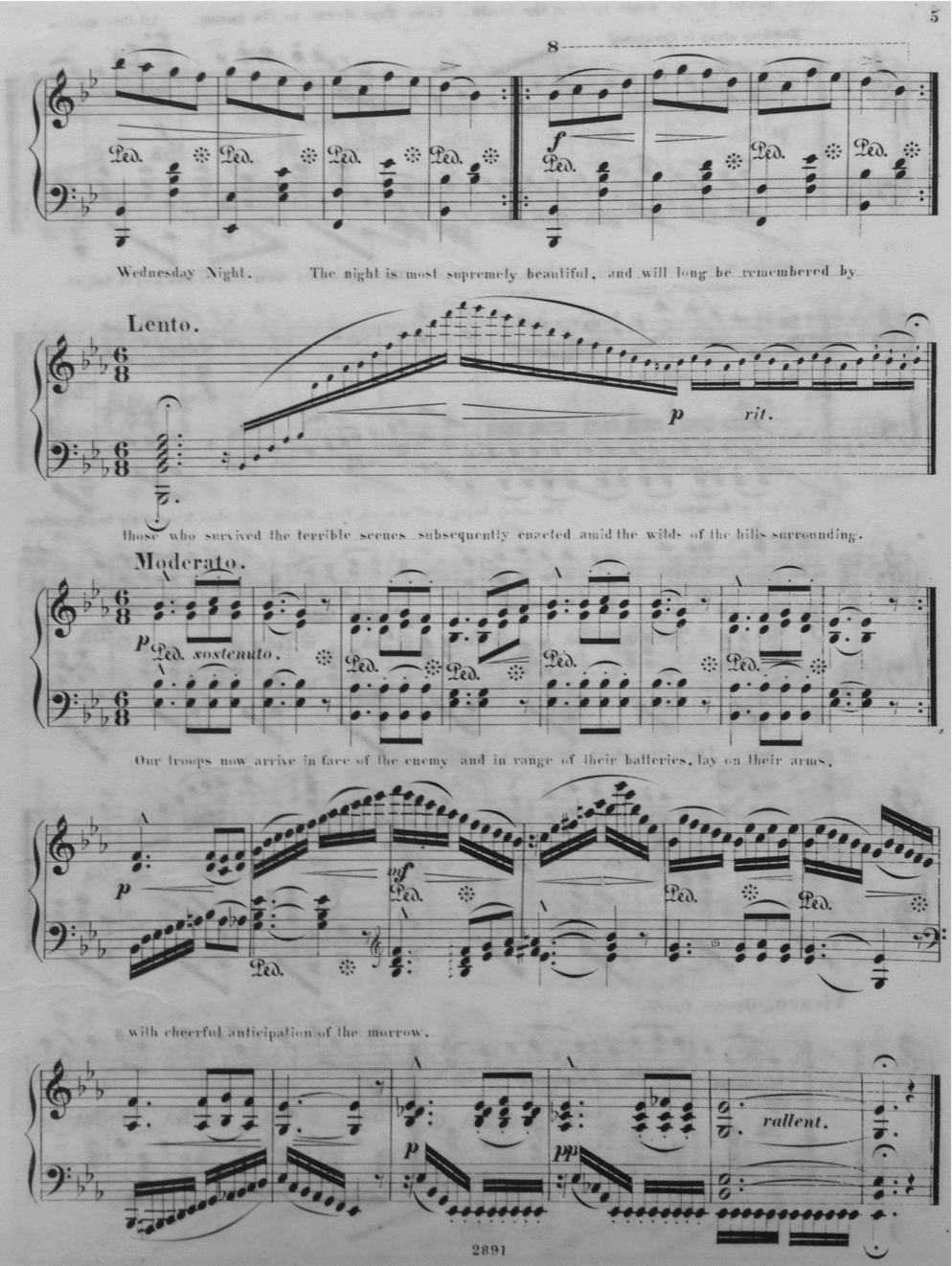
One of the most important contributions to eyewitness reporting, which had an enormous effect on Grobe's battle pieces, was the telegraph. First used extensively by the press in the Mexican-American War, the telegraph allowed newspapers to print the latest war news from the front almost instantly.Footnote 23 It was a prominent technological advance, one that changed how the government communicated with its army and the nature of war and war reporting in the public eye. Grobe responded to the technology directly, including lengthy captions above consecutive lines of music, which narrated events of the battlefield in detail. Much of the descriptive language used in his captions came directly from accounts of battle communicated via telegraph from war correspondents and printed in newspapers around the country. He included both quotations and paraphrases from the newspaper. Here, for example, is an extract from an eyewitness account originally published in the Missouri Democrat on 17 February 1862 and reprinted widely, along with Grobe's adaptation:
Daily Express, Terre-Haute, Indiana, 21 February 1862: The night was most supremely beautiful and will probably long be remembered by those who survived the terrible scenes subsequently enacted amid the wilds of the hills surrounding. Our troops, just now arrived in face of the enemy and in range of their batteries, lay on their arms, with cheerful anticipation of the morrow. The evening air was still, mild and genial, and the bright moon shone forth equally beautiful over friend and foe.
“Battle of Fort Donelson”: Wednesday night. The night is most supremely beautiful, and will long be remembered by those who survived the terrible scenes subsequently enacted amid the wilds of the hills surrounding. Our troops now arrive in face of the enemy, and in range of their batteries, lay on their arms, with cheerful anticipation of the morrow.
Example 1 is a portion of Grobe's “Battle of Fort Donelson” with the text inserted. His borrowed texts helped him create musical accounts of battle just as vivid as those proliferated by the media.
Charles Grobe, “Battle of Fort Donelson,” mm. 76–96 (Boston: Henry Tolman & Co., 1862).
II. Melodramatic Spectacle
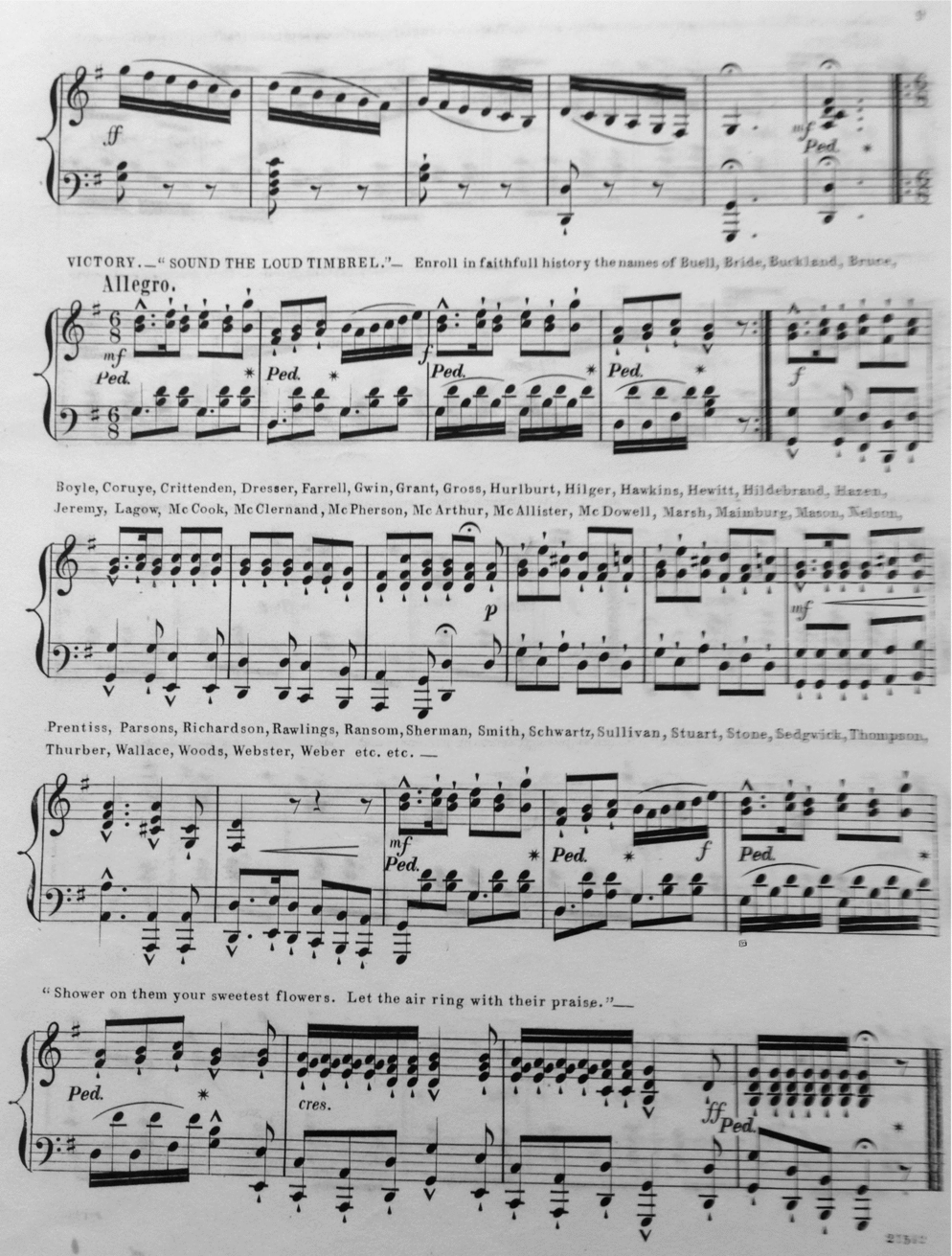
Grobe's appropriation of newspaper text reflects public enthusiasm for the detailed news that eyewitness reporting and the telegraph made possible. The reproduction of drawings and paintings, the exhibition of photographs, and the gripping narratives of battle relayed by telegraph and published in the newspaper encouraged civilians to follow the conflict between North and South closely and to visualize the experience of soldiers at war. The presence in Grobe's battle pieces of text taken from newspaper reports also raises questions about how his works were performed. It is not documented whether pianists incorporated the texts in performance, either by reciting them from the keyboard or collaborating with friends or family members who did so.Footnote 24 Although it isn't difficult to imagine a performer reciting the text in battle pieces of the Napoleonic era, where words are limited to brief labels and section headings, Grobe's texts can be lengthy, posing difficulties for the performer. In the “Battle of Shiloh” and “Battle of Fort Donelson,” for instance, the duration of the text where he lists names of major figures involved in the conflict presents problems for a performer who wishes to include narration because it would take longer to recite the text than to perform the corresponding music (Example 2). There is also no clear dramatic relationship between the list of names and the music set below the text. In these examples, the text seems more like a reminder of the event depicted in music than a performance direction; one can imagine the civilian at home sitting on the couch as easily as on the piano bench, reading the score almost as a summary of a battle.
Charles Grobe, “Battle of Shiloh,” mm. 161–86 (Boston: Oliver Ditson & Co., 1862).
Nevertheless, although it is not documented that they did so, it seems likely that pianists would indeed have integrated the texts into their performances of Grobe's battle works, either by attempting to recite them from the keyboard or by involving a friend or family member as orator.Footnote 25 When one considers the cultural capital of both eyewitness reporting and the telegraph, the text seems almost like the central focus of Grobe's battle pieces, with the music functioning as a vehicle for bringing its recitation to life. By delivering descriptive reports of battle aloud, wartime performers would have taken on the role of witness to the military confrontations depicted in music, perhaps playing the part of war correspondent themselves, embodying a persona and enacting a relationship to war different from their own.
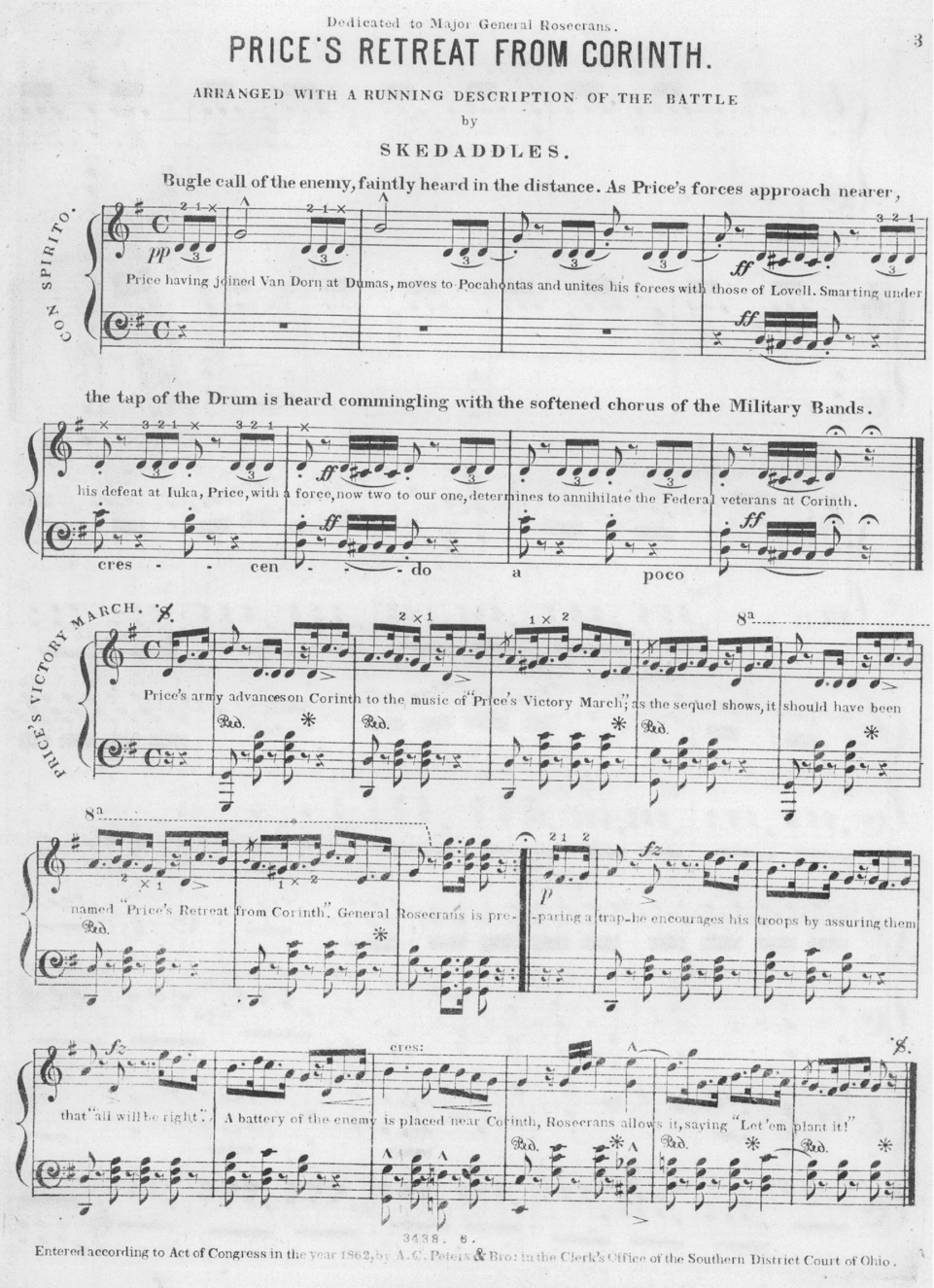
“Price's Retreat from Corinth,” an 1862 battle work written by an anonymous composer using the pseudonym “Skedaddles,” echoes the uncertainties in Grobe's music concerning the performance of text. The opening of “Price's Retreat” exhibits one line of text above the treble staff and another between treble and bass, occurring simultaneously (Example 3). Which line, if any, should the performer recite? Although the performance implications here are perplexing, Skedaddles's three battle pieces are overall the best examples of works in the genre that clearly take the form of accompanied recitations. Each of his pieces is subtitled to refer to the piano part as a “running accompaniment” or “running description,” revealing the text as its focus. The piano's designation as accompaniment implies that the keyboardist plays while the recitation unfolds, and the length of the text in each work suggests that the piece would have required two performers—a narrator and a keyboardist.Footnote 26 The subject of each piece is a major failure of the Confederate army: the retreats of Brigadier General John B. Floyd, General Pierre G. T. Beauregard, and Major General Sterling Price at the battles of Fort Donelson, Shiloh, and Corinth respectively. Unlike the majority of battle pieces, recitation and the genre's stylized musical vocabulary are put to humorous effect to depict these events. Even the composer's pseudonym is comical, poking fun at the Confederate leaders’ hasty escapes. Other pieces seem almost grisly in their vivid depictions of the battlefield, but these three use the genre and its conventions to a very different end. Perhaps Skedaddles's approach to the genre was as a coping mechanism, where humor assuaged the horrors of war—albeit temporarily.
Anonymous (“Skedaddles”), “Price's Retreat from Corinth,” mm. 1–24 (Cincinnati, OH: A. C. Peters & Bro., 1862).
Although the 1860s predate the heyday of accompanied recitation as a feminine accomplishment, a longstanding tradition of concert melodrama combining recitation and musical accompaniment was in place, which may well have served as a model for Skedaddles and, perhaps, for Grobe.Footnote 27 The similarities between battle music and theatrical or popular melodrama also provide an important context here.Footnote 28 Theatrical melodrama had originated on French stages in the late eighteenth century, growing popular in England at the same time that battle pieces became ubiquitous in the drawing room—during the late Georgian era. Its resemblance to battle music is striking. Popular melodrama depended on a suitable acting style, one that made use of a repertoire of stylized and extravagant gestures.Footnote 29 Physical movements in battle pieces, such as rapid hand crossings and vertical attacks, were akin to stage tableaux, where dramatic meaning was signified by familiar, marked gestures with specific denotations. The likelihood that composers had theatrical melodrama in mind helps account for the motivic and formal tropes common to battle pieces. Aural signifiers, such as low notes representing cannons and running scales symbolizing flying bullets, functioned much as music did in melodramatic theatricals, where familiar affects and motives signified action on the stage—or that about to occur. In fact, the musical vocabularies of both battle pieces and theatrical melodramas shared numerous elements, such as tremolos and rapid scales.Footnote 30 They also shared tropes in their narrative trajectories. Like melodramas, the plots of battle pieces are formulaic and recognizable—and the triumph of good over evil is inevitable. Theatrical melodrama grew in popularity during the first half of the nineteenth century, with Victorian stage melodramas flourishing in theaters across Europe and the English-speaking world. By the time of the Civil War, it had been around for decades as a dominant theatrical genre, one well known to American audiences—and a likely influence on battle music and its performance.Footnote 31
The similarities between popular melodrama and battle music suggest that performers may have gestured as they delivered Civil War battle works, much as they did in melodramas on the stage. It is difficult to imagine how that might work for a keyboardist fully occupied at her instrument, but it certainly seems possible that a narrator could have pantomimed the actions in the score, presenting battle pieces as theater. Civilians could then imagine events on the front all the more vividly in their performances of battle music because of its theatricality; war lurked not simply in the sounds they crafted at the keyboard, but in their voices and potentially their gestures as well.Footnote 32
III. Battle at the Keys: Virtuosity and Mimesis
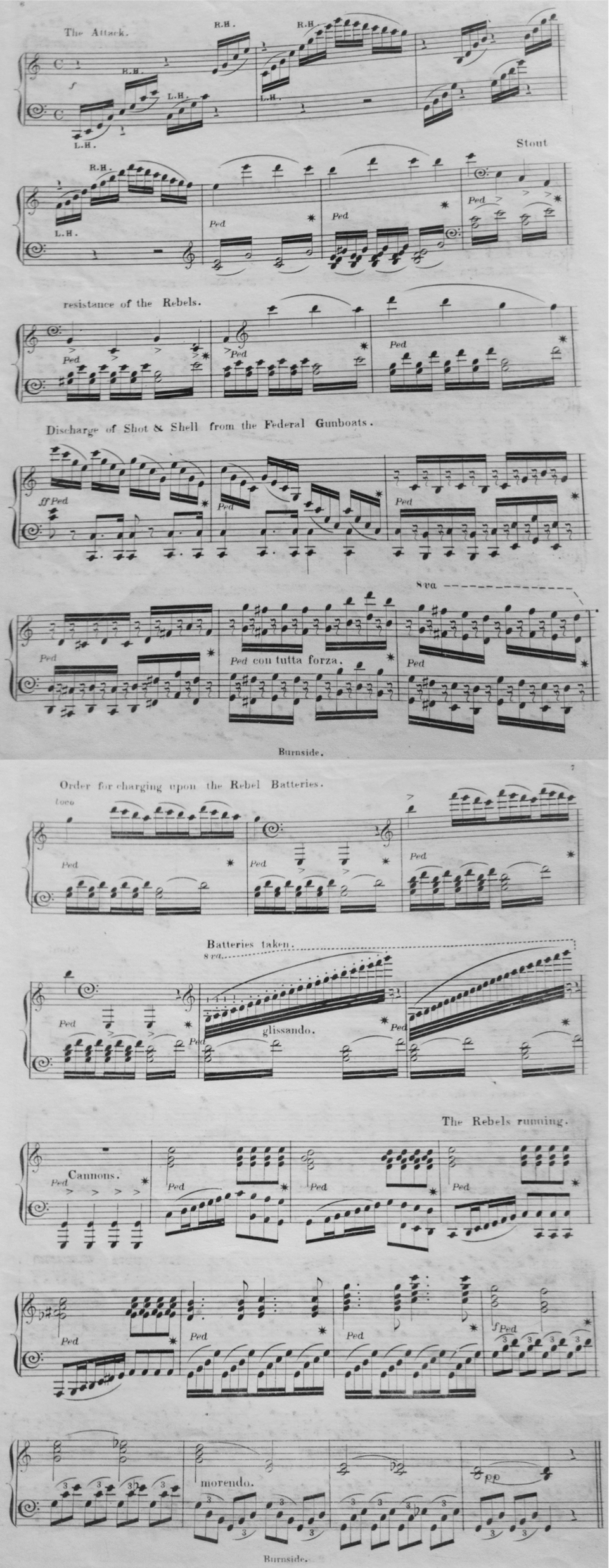
Physical spectacle at the keyboard is yet another angle from which to view the connections between gesture and keyboard battle music. The pianist performing a battle work enacts a visual spectacle with rapid hand crossings, broken octaves, wide leaps, and running scales. Dana Gooley notes the “sweeping vertical attacks” necessary to execute the “cannon shots” typical to keyboard battle pieces of the Napoleonic era, signifying the violence of the battlefield to audience members.Footnote 33 By the 1860s, these physical gestures had expanded to include glissandi, parallel arpeggios in several octaves, and other feats of bravura. Although still suitable to the intermediate pianism of the typical middle-class amateur, some battle pieces of the Civil War pushed the limits of what that pianism comprised. For example, “The Burnside Expedition,” a battle piece about the eponymous series of conflicts in North Carolina written by M. H. Frank and excerpted in Example 2, exhibits a high level of bravura virtuosity as the pianist reenacts military conflict through physical drama at the keyboard (Example 4). Confronted with a bombardment of sixteenth-note arpeggios, she relies on exacting physical control. Similarly, she must perform the rapid fire of parallel octaves with precision, engaging in vertical attacks on the keys. Her relationship to the passage is entirely individual, subject to a host of elements including the size of her hand, the action of her instrument, and the dexterity of her fingers. The arpeggios might be easy for the performer with large hands or particular independence in her fourth and fifth fingers, but for another player, they are thoroughly taxing. The glissandi are easily executed on a piano with light action, but on an instrument with weighty keys, they might be painful to perform. The pianist's level of skill and experience, as well as her chosen tempo, are all factors in her performance—although the keyboardist of even modest abilities will likely emerge victorious, delivering resounding C-major triads when the Rebels flee.
M. H. Frank, “The Burnside Expedition,” mm. 71–104 (Philadelphia: Marsh, ca.1862).
One of the most bravura of all known Civil War battle pieces for the piano is undoubtedly the “Battle of Manassas.” The work is not typical of the battle pieces of the era because it was not created with the amateur setting in mind. Its composer, Thomas Greene Wiggins, or Blind Tom, was a musical prodigy and a slave, famous for his extraordinary virtuosity at the keyboard, which he exhibited in public concerts. He composed his “Battle of Manassas” after hearing an eyewitness account of the 1861 battle and performed the work throughout the war years and on tours thereafter. It was published as sheet music in 1866. The piece incorporates extended techniques, including cannon sounds created by playing tone clusters with the flat of the hand, an effect adapted from earlier battle works.Footnote 34 Wiggins also asks the pianist to perform two vocal effects, whistling and repeatedly speaking the words “chu, chu” to depict the sounds of a train. The directions included in the 1866 score demonstrate the piece's adaptability in performance; like battle works that suggest the possibility of recitation and gesture, this piece leaves options open to performers. A note on the score states: “Those of our players who may desire to add the exercise of their vocal organs to that of their fingers for their friend's [sic] amusement, can [use their voice]; but the piece is complete without.” The pianist who chooses to imitate the train increases the element of physical drama in her performance.Footnote 35
Physical spectacle made battle works suitable objects of satire in the eyes of some nineteenth-century listeners. In his travel novel of 1880, A Tramp Abroad, for instance, Mark Twain poked fun at a young American woman's performance of the “Battle of Prague” in a Swiss hotel, caricaturing the war she waged at the keys.
The bride fetched a swoop with her fingers from one end of the keyboard to the other, just to get her bearings, as it were, and you could see the congregation set their teeth with the agony of it. Then, without any more preliminaries, she turned on all the horrors of the “Battle of Prague,” that venerable shivaree, and waded chin-deep in the blood of the slain. She made a fair and honorable average of two false notes in every five, but her soul was in arms and she never stopped to correct. The audience stood it with pretty fair grit for a while, but when the cannonade waxed hotter and fiercer, and the discord average rose to four in five, the procession began to move. A few stragglers held their ground ten minutes longer, but when the girl began to wring the true inwardness out of the “cries of the wounded,” they struck their colors and retired in a kind of panic.
There never was a completer victory; I was the only non-combatant left on the field. I would not have deserted my countrywoman anyhow, but indeed I had no desires in that direction. None of us like mediocrity, but we all reverence perfection. This girl's music was perfection in its way; it was the worst music that had ever been achieved on our planet by a mere human being.
I moved up close, and never lost a strain. When she got through, I asked her to play it again. She did it with a pleased alacrity and a heightened enthusiasm. She made it ALL discords, this time. She got an amount of anguish into the cries of the wounded that shed a new light on human suffering. She was on the war-path all the evening. All the time, crowds of people gathered on the porches and pressed their noses against the windows to look and marvel, but the bravest never ventured in. The bride went off satisfied and happy with her young fellow, when her appetite was finally gorged, and the tourists swarmed in again.Footnote 36
Twain's account relies on his reader's ability to imagine battle music in performance by visualizing a pianist at her instrument. He points to the role of the performer's body in creating musical meaning; as she heads out “on the war-path,” “wad[ing] chin-deep in the blood of the slain,” the pianist becomes the object for his caricature, which plays on the idea that her performance is a simulacrum of the battlefield. His account of her performance also recalls popular melodrama, with its exaggerated gestures and theatrics.
Battle music's mimetic relationship to war may have made it vulnerable to satire, but it also was undoubtedly a draw for performers and their drawing-room audiences. It pushed the bounds of parlor propriety, which the genre had done since keyboard battle music first became a common part of domestic repertoire. In fact, Candace Bailey notes an account of a woman performing the “Battle of Prague” in the Antebellum South, later recorded in her memoirs, in which she stunned her parlor audience into “an extended silence” when she ended the piece with a loud bang.Footnote 37 One need only imagine how shocked the same listeners would have been by a performance of the glissandi in the “Burnside Expedition”—not to mention her whistling while playing the “Battle of Manassas.” Physical display and virtuosa showmanship were not unheard of in the drawing room by the middle of the nineteenth century, but they certainly were not the norm for the amateur female pianist. Battle pieces, along with other bravura works, including those by such eminent virtuosi as Louis Moreau Gottschalk and Sigismond Thalberg, were opportunities for amateur pianists who relished virtuosity.Footnote 38 The virtuosity of battle pieces was also appealing for those players who reveled in participatory experiences; just as a narrator might pretend to be an eyewitness to battle when reciting texts in Grobe's and Skedaddles's works, here she might embody the perspective of a soldier through her physical struggles, and, potentially, personal victories, at the keyboard. Playing battle music was not simply representational, but performative: theatrical mimesis in which drawing room became battlefield and parlor pianist became soldier.
IV. Personifying the Media's Bias
The frequent presence of virtuosity in battle works of the Civil War meant that composers could also utilize its absence for dramatic effect, surprising performer and audience member alike when a battle work lacked challenging technical material. In the “Battle of New Orleans,” for instance, which depicts the capture of the largest city in the south in 1862, Grobe's representation of the battle itself is remarkably short, uneventful, and relatively easy to play. Although virtuosity was a medium for pianists to embody the drama in a given conflict, its absence here conveys the sense that the Battle of New Orleans was easily won. This version of the conflict reflects accounts of the battle found in Union newspapers, which exaggerated the dominance of Federal troops.
The “Battle of New Orleans” conveys the acute bias of Northern newspapers from start to finish. Early in the piece, for instance, Grobe quotes a comic song, “A New Ballad of Lord Lovell: The Brave Defender of New Orleans,” which had circulated widely via newspaper. The song was a parody of a ballad (Child 75) that begins in many versions “Lord Lovel he Stood at his Castle-Gate.”Footnote 39 The comic parody makes fun of the Confederate commander in New Orleans, Mansfield Lovell, who had ordered the evacuation of Confederate troops from the city before the Union army even arrived. The song would become a popular anthem for Union troops to sing in moments of raucous celebration.Footnote 40 Although the text and tune don't line up entirely, it still seems plausible that the pianist would have sung or called out portions of the text while performing (Example 5).
Charles Grobe, “Battle of New Orleans,” mm. 25–111 (Philadelphia: Lee & Walker, 1862).
There was a colossal discrepancy between how Northern and Southern newspapers reported the occupation of New Orleans, which is also reflected in Grobe's musical account.Footnote 41 Southern papers abounded with anti-Union sentiment, and civilians in the city became known for their impertinence toward the occupying soldiers. Grobe either ignored or, more likely, was unaware of this side of the story. After the Lord Lovel parody, he reverted to prose and used text adapted from Northern telegraphic reports; as the pianist plays a cheerful dance tune, signaling delight in the arrival of Union occupiers, the text reads, “Large crowds gather on the levees and cheer the ships as they approach. The fleet take [sic] possession of the city. Great rejoicing among the loyal citizens.” His depiction of Southerners is demonstrably Northern, even going so far as to imagine the New Orleans residents applauding the Northern triumph.
Other battle works also reflected the bias and caprice inherent in war news. James Cox Beckel, a Philadelphia composer and organist, may have had the fallibility of the media in mind when he composed his “Battle of Gettysburg” in 1863.Footnote 42 In the middle of its depiction of the battle, Pennsylvania militiamen attack the Army of Northern Virginia, which leads to an attack of the “whole army,” an event that is entirely apocryphal. In this version of the bloodiest battle of the Civil War, the Union's victory is swift, and its suffering minimal.Footnote 43 Beckel's work reflects the perspective of its author, his imaginative whimsy, and his commitment to the Union cause. The parlor pianist studying the work performs a version of the Battle of Gettysburg, which, had it actually occurred as Beckel imagines, might have brought the war to an early end. Through her performance, she imagines and enacts a happy alternative to the grim reality of a war nearly two years from its close.
Civil War battle music captured the imaginations of amateur female pianists with its vivid musical narratives and engaging representations of the battlefield. Much like fiction and magazines, it encouraged women at home to imagine the perils of war; its study provides a window into women's participation in mass culture during this time. Music, like other forms of popular culture, allowed women to imagine and, in the case of battle pieces, reenact the perils of the battlefield, all the while from the safety of their homes. Like any account of wartime fighting—those found in newspaper reports, as well as sketches and photographs of the war—battle music invited its audience, and in this case, its performers, to relate subjectively to the representations of war it presented. It did so overtly, using tropes from the theater to mimic the immediacy of drama on the battlefield, mirroring the poignancy of the news from the front, and employing vivid gestural rhetoric at the keyboard. Musical performance combined these elements in a theatrical embodiment of the deadliest war in American history.