Investigations of school mobility have consistently demonstrated associations between the number of times students change schools and a variety of negative developmental outcomes (Gruman, Harachi, Abbott, Catalano, & Fleming, Reference Gruman, Harachi, Abbott, Catalano and Fleming2008; Heinlein & Shinn, Reference Heinlein and Shinn2000; Mantzicopoulos & Knutson, Reference Mantzicopoulos and Knutson2000; Mehana & Reynolds, Reference Mehana and Reynolds2004; Pribesh & Downey, Reference Pribesh and Downey1999; Rumberger, Reference Rumberger2003; Rumberger & Larson, Reference Rumberger and Larson1998; South, Haynie, & Bose, Reference South, Haynie and Bose2007; Swanson & Schneider, Reference Swanson and Schneider1999; Temple & Reynolds, Reference Temple and Reynolds1999). School mobility has been shown to increase the risk of poor achievement, behavior problems, grade retention, and high school dropout. Because school mobility is a fairly common experience for many students, with approximately 75% of students changing schools at least once between kindergarten and 8th grade, it is important to understand how changing schools might impact students and communities (Torre & Gwynne, Reference Torre and Gwynne2009). Though studies examining school mobility have increased over the past few decades, results can be difficult to interpret because of the complexity of the problem, the limitations of methodologies, and inconsistencies across studies (Mehana & Reynolds, Reference Mehana and Reynolds2004; Reynolds, Chen, & Herbers, Reference Reynolds, Chen and Herbers2009). Furthermore, few longitudinal studies have the information necessary to examine school mobility throughout the school career in relation to adult outcomes. In the current study, we present findings from the Chicago Longitudinal Study (CLS) exploring the unique risk of school mobility on a variety of young adult outcomes including educational attainment, occupational prestige, depression symptoms, and criminal arrests. With 25 years of longitudinal data, we also investigate how the timing of school mobility, whether earlier or later in the academic career, may differentially predict these outcomes over and above associated risks.
School Mobility as a Risk Factor
Compared to other industrialized countries, the United States has one of the highest rates of residential and school mobility (Long, Reference Long1992). According to the US Census Bureau (2009), one in eight Americans changed residences between 2007 and 2008. Roughly two thirds of residential moves necessitate school moves for children, meaning that school mobility is a fairly common experience for many American children. Rumberger (Reference Rumberger2003) reported that in one large study, 34% of 4th graders, 21% of 8th graders, and 10% of 12th graders had changed schools at least once in the previous 2 years. More recent studies have indicated that current rates may be even higher and increasing, particularly among low-income, minority students (National Research Council and Institute of Medicine, 2010).
School mobility has been implicated as a risk factor for a variety of negative developmental outcomes (Gruman et al., Reference Gruman, Harachi, Abbott, Catalano and Fleming2008; Mehana & Reynolds, Reference Mehana and Reynolds2004). Students who change schools are more likely to demonstrate lower average academic achievement (Alexander, Entwisle, & Dauber, Reference Alexander, Entwisle and Dauber1996; Astone & McLanahan, Reference Astone and McLanahan1994; Haveman, Wolfe, & Spaulding, Reference Haveman, Wolfe and Spaulding1991; Kerbow, Reference Kerbow1996). They are more likely to experience grade retention and more likely to drop out of school (Ou & Reynolds, Reference Ou and Reynolds2008; Reynolds, Reference Reynolds1992; Rumberger & Larson, Reference Rumberger and Larson1998; South et al., Reference South, Haynie and Bose2007; Temple & Reynolds, Reference Temple and Reynolds1999; Wood, Halfon, Scarlata, Newacheck, & Nessim, Reference Wood, Halfon, Scarlata, Newacheck and Nessim1993). Furthermore, students who change schools are at risk for social problems and psychological difficulties, including less social competence and low self-esteem (Rumberger, Reference Rumberger2003; South et al., Reference South, Haynie and Bose2007; Swanson & Schneider, Reference Swanson and Schneider1999) as well as truancy and suspension from school (Fantuzzo, Rouse, & LeBoeuf, Reference Fantuzzo, Rouse and LeBoeuf2009; Simpson & Fowler, Reference Simpson and Fowler1994) and other behavior problems (Leonard & Elias, Reference Leonard, Elias, Jason, Danner and Kurasaki1993; Wood et al., Reference Wood, Halfon, Scarlata, Newacheck and Nessim1993).
The link between school mobility and negative developmental outcomes has several likely explanations. Changing schools outside of the normal structure of school progression (i.e., not because the student's current school does not provide the subsequent grade, as in the progression from middle school to high school) may present disruptions in learning experiences as students are confronted with different curricula and different expectations in new schools (Burkam, Lee, & Dwyer, Reference Burkam, Lee and Dwyer2009; Mehana & Reynolds, Reference Mehana and Reynolds2004). Many schools differ in their climate and instructional environments, and adjusting to these changes may interfere with student learning, particularly for students changing schools in the middle of an academic year (Schwartz, Stiefel, & Chalico, Reference Schwartz, Stiefel and Chalico2009; Temple & Reynolds, Reference Temple and Reynolds1999).
Along with disruption in learning experiences, school mobility presents disruptions in social relationships with peers, teachers, and other important adults. Theories of human and social capital, such as those put forth by Coleman (Reference Coleman1988), postulate that changing schools and residences can negatively impact the community and social resources available to children and their families by severing these ties. Researchers have found that high school students who change schools are more likely to have smaller networks of friends and to interact with peer groups who demonstrate lower achievement and less engagement in school (South et al., Reference South, Haynie and Bose2007). This is consistent with the ecological model (Bronfenbrenner & Morris, Reference Bronfenbrenner, Morris and Damon1998) and school learning theories (Wang, Haertel, & Walberg, Reference Wang, Haertel and Walberg1993) in which changes in settings and instructional environments can be detrimental to student well-being.
Economic disadvantage and associated risks present another likely explanation for the link between school mobility and poor outcomes. School mobility occurs more often among students who also experience a variety of other potent risk factors, including poverty or low socioeconomic status; homelessness; ethnic minority status; residing in low-income, single-parent homes; less parental involvement; residential instability; and placement in special education (Fantuzzo et al., Reference Fantuzzo, Rouse and LeBoeuf2009; Heinlein & Shinn, Reference Heinlein and Shinn2000; Mehana & Reynolds, Reference Mehana and Reynolds2004; Obradovic et al., Reference Obradovic, Long, Cutuli, Chan, Hinz and Heistad2009; Ou & Reynolds, Reference Ou and Reynolds2008; Pribesh & Downey, Reference Pribesh and Downey1999; Rumberger, Reference Rumberger2003; Rumberger & Larson, Reference Rumberger and Larson1998; South et al., Reference South, Haynie and Bose2007). School mobility is much more common in urban schools, which tend to serve higher rates of low-income, high-risk students (National Research Council and Institute of Medicine, 2010; Temple & Reynolds, Reference Temple and Reynolds1999). Students of such high-risk backgrounds are less likely to start school ready to learn and more likely to fall behind their advantaged peers (Burchinal, Roberts, Zeisel, & Rowley, Reference Burchinal, Roberts, Zeisel and Rowley2008). It is plausible, then, that risks associated with school mobility actually arise owing to these other related disadvantages (Mantzicopoulos & Knutson, Reference Mantzicopoulos and Knutson2000). To the contrary, quite a few investigators have found that school mobility predicts academic and other problems over and above substantial effects of family risk, socioeconomic status, and premobility achievement and adjustment (Alexander et al., Reference Alexander, Entwisle and Dauber1996; Lee & Burkham, Reference Lee and Burkam2002; Mehana & Reynolds, Reference Mehana and Reynolds2004; Pribesh & Downey, Reference Pribesh and Downey1999; Rumberger & Larson, Reference Rumberger and Larson1998; Temple & Reynolds, Reference Temple and Reynolds1999).
Several studies have addressed the potential for selection bias by including not only family demographics but also school achievement and performance prior to mobility. In the Beginning School Study, Alexander et al. (Reference Alexander, Entwisle and Dauber1996) found that about half of the observed differences in fifth-grade achievement test scores between mobile and nonmobile Baltimore students were explained by covariates including prior achievement in first grade. The significant difference between groups in math achievement, however, remained regardless of model specification. Using data from the CLS, Temple and Reynolds (Reference Temple and Reynolds1999) reported nearly identical findings in seventh-grade achievement between mobile and nonmobile students. Even after accounting for family background and achievement at the end of kindergarten, mobile students had significantly lower reading and math achievement tests scores in seventh grade.
Previous studies also indicate that frequent school moves are most associated with adverse outcomes, including lower school achievement and higher rates of school dropout (Fantuzzo et al., Reference Fantuzzo, Rouse and LeBoeuf2009; Mehana & Reynolds, Reference Mehana and Reynolds2004; Reynolds et al., Reference Reynolds, Chen and Herbers2009). In the Chicago study, for example, youth with three or more moves had significantly lower school achievement and lower rates of dropout than was predicted from a model assuming a linear association (Temple & Reynolds, Reference Temple and Reynolds1999; Ou & Reynolds, Reference Ou and Reynolds2008). Hanushek et al. (Reference Hanushek, Kain and Rivkin2004) reported in a Texas sample of elementary school students that multiple moves was most associated with lower achievement growth. Because most longitudinal studies examining mobility do not have data extending more than 3 years beyond the end of schooling (National Research Council and Institute of Medicine, 2010), the extent to which multiple and more frequent moves are associated with adult outcomes in different domains has not yet been investigated.
Further Challenges in the Study of School Mobility
The predictors and impacts of student mobility are complex. Mobility is much more common among higher risk students, and there are a variety of reasons for different instances of school mobility. These reasons also differ depending on child and family characteristics. Many students change schools because their families change residence (Rumberger, Reference Rumberger2003). In these instances, disruptions associated with the residential mobility rather than the school changes, or both in combination, may account for risks to academic and behavioral functioning. When students and families elect to change schools for reasons of personal preference, however, the change may present favorable opportunities. Population studies of impacts of mobility, which include nonminority, middle-class individuals who are more likely to change schools owing to improvements in lifestyle and financial circumstances or better academic opportunities, often do not show negative effects. However, studies that focus on high-risk samples of predominantly lower class, ethnic minority students have demonstrated robust evidence that the school changes themselves confer additional risk (National Research Council and Institute of Medicine, 2010). Among these families, school changes are almost exclusively accounted for by reasons of safety or financial necessity and are unlikely to result in placement in higher quality schools (Schafft, Reference Schafft2009). Perhaps because single instances of school mobility can occur for such a variety of reasons, results of many studies have indicated that frequent school mobility, often defined as three or more moves in a specified time period, is much more predictive of negative outcomes than are single moves (Gruman et al., Reference Gruman, Harachi, Abbott, Catalano and Fleming2008; Heinlein & Shinn, Reference Heinlein and Shinn2000; Mehana & Reynolds, Reference Mehana and Reynolds2004; National Research Council and Institute of Medicine, 2010; Temple & Reynolds, Reference Temple and Reynolds1999).
Children in the early elementary years have higher rates of school and residential mobility than do middle school children, and mobility rates during high school are lower still (Rumberger, Reference Rumberger2003; Schachter, Reference Schacter2004). In a cohort of mobile sixth graders, 40% reported changing schools for school-related reasons such as safety and dissatisfaction, 28% reported changing schools because of a change in residence, and 30% reported changing schools for a combination of school-related and residence-related reasons (Kerbow, Reference Kerbow1996). In a high school sample, the majority of mobile students reported moving because their families changed residences, with fewer reporting a personal choice to move and very few indicating that they changed schools because they were “asked to leave” (Rumberger, Reference Rumberger2003; Rumberger & Larson, Reference Rumberger and Larson1998). With rates of school mobility and reasons for school changes differing by age, it is important to consider whether school changes at different times in the academic career differentially predict developmental outcomes.
Some researchers have suggested that school mobility occurring in the early elementary grades may be most detrimental to student well-being (Astone & McLanahan, Reference Astone and McLanahan1994; Heinlein & Shinn, Reference Heinlein and Shinn2000; Mehana & Reynolds, Reference Mehana and Reynolds2004). It is during these early years that students are acquiring the academic building blocks and foundations for their future learning. However, some researchers have found more negative outcomes for students moving later in their school careers (Pribesh & Downey, Reference Pribesh and Downey1999; Rumberger & Larson, Reference Rumberger and Larson1998; Swanson & Schneider, Reference Swanson and Schneider1999). For older students, it may be more difficult to catch up academically as curricula become more complex and vary more across schools. Peer relationships increase in salience in middle school such that discontinuities in these relationships due to mobility could have a greater impact on school engagement (Dauber, Alexander, & Entwisle, Reference Dauber, Alexander and Entwisle1996; Rumberger, Reference Rumberger2003; South et al., Reference South, Haynie and Bose2007). Furthermore, evidence for the particular impact of frequent mobility suggests that mobility later in the school career may show greater detriments as total school changes accumulate over time, requiring highly mobile students to adapt repeatedly to disruptions and new academic and social environments (Gruman et al., Reference Gruman, Harachi, Abbott, Catalano and Fleming2008; Mehana & Reynolds, Reference Mehana and Reynolds2004; Temple & Reynolds, Reference Temple and Reynolds1999).
Given the complexity of issues related to school mobility, researchers must consider a variety of factors when addressing the impact of school changes on student outcomes. In a meta-analysis of school mobility studies, Mehana and Reynolds (Reference Mehana and Reynolds2004) found substantial differences in effect sizes for the impact of mobility on academic achievement depending on the covariates and sample characteristics. Studies of school mobility must control for student socioeconomic status and family risk and adversity (Heinlein & Shinn, Reference Heinlein and Shinn2000; Stoneman, Brody, Churchill, & Winn, Reference Stoneman, Brody, Churchill and Winn1999). In addition, studies should consider residential mobility (Pribesh & Downey, Reference Pribesh and Downey1999; Rumberger & Larson, Reference Rumberger and Larson1998; Swanson & Schneider, Reference Swanson and Schneider1999), achievement and adjustment prior to mobility experiences (Mantzicopoulos & Knutson, 2001; Reynolds et al., Reference Reynolds, Chen and Herbers2009; Rumberger, Reference Rumberger2003), and the cumulative effects of frequent changes throughout the school career and at different times (Temple & Reynolds, Reference Temple and Reynolds1999).
Less is known about impacts of school mobility beyond academic achievement, though certainly lower achievement has been associated with risk for a variety of negative outcomes in adulthood such as low attainment, less prestigious and lucrative jobs, poor mental health, and more involvement in crime (Farrington, Reference Farrington2005; Heckman, Reference Heckman2006). Competence in educational attainment, work, and appropriate conduct are important development tasks of young adulthood that are influenced by developmental history and predictive of later well-being (Masten et al., Reference Masten, Burt, Roisman, Obradovic, Long and Tellegen2004; Schulenberg, Bryant, & O'Malley, Reference Schulenberg, Bryant and O'Malley2004). With achievement as a likely mediator, it is reasonable to expect that frequent school changes will also be associated with negative outcomes beyond the school years. Which outcomes are most affected and whether these impacts differ by mobility timing, however, has not been explored extensively in the literature.
Previous studies on mobility in the CLS have demonstrated associations between risk factors and school mobility in the elementary grades (Reynolds & Wolfe, Reference Reynolds and Wolfe1999) and also that early school mobility mediated the effects of preschool intervention and parent involvement on achievement in 6th grade, child abuse and neglect, and high school completion (Reynolds, Mavrogenes, Bezruczko, & Hagemann, Reference Reynolds, Mavrogenes, Bezruczko and Hagemann1996; Reynolds, Ou, & Topitzes, Reference Reynolds, Ou and Topitzes2004; Reynolds & Robertson, Reference Reynolds and Robertson2003). Furthermore, school mobility from 1st to 6th grades has been found to predict grade retention, achievement in 1st grade, achievement in 7th grade, and high school dropout (McCoy & Reynolds, Reference McCoy and Reynolds1999; Reynolds, Reference Reynolds1992; Temple & Reynolds, Reference Temple and Reynolds1999; Temple, Reynolds, & Miedel, Reference Temple, Reynolds and Miedel2000). Although these studies included a comprehensive set of predictors of mobility, including premobility achievement, they did not include residential moves. In addition, the studies have emphasized mobility up to middle school and have not included school mobility measured throughout the school career (from kindergarten through 12th grade). Finally, as with almost all previous studies in the field, school achievement and dropout during K–12 education were the primary outcomes assessed. Links to adult life course outcomes such as educational attainment, economic well-being, and social competence have not been investigated.
The Current Study
We are extending this work to explore the impacts of school mobility on outcomes of young adulthood and to compare these impacts during the different academic and developmental periods of the early elementary years, middle school years, and high school years. Two major questions are addressed:
1. Are the number of school moves from kindergarten to 12th grade associated with indicators of adult well-being, including educational attainment, occupational prestige, depressive symptoms, and criminal arrests, above and beyond other child and family risk factors?
2. Do the links between the number of school moves and adult well-being vary by the timing of the moves (by 4th grade, 4th to 8th grades, and during high school)?
We examine 25 years of prospective longitudinal data from the CLS to address two broad hypotheses regarding the long-term unique impacts of school changes and possible differences with respect to the timing of mobility. With yearly records of school changes from kindergarten through 12th grade as well as detailed information on family background, sociodemographic risk, residential mobility, social/emotional maturity, kindergarten academic achievement, child abuse and neglect, special education, grade retention, and juvenile delinquency, we can apply a rigorous test of the effects of school mobility throughout the elementary and high school years, controlling for associated risks.
We hypothesize that the number of school moves will predict reduced likelihood of on-time graduation from high school, lower educational attainment, less occupational prestige, more symptoms of depression, and greater likelihood of involvement in adult crime, above and beyond the impact of sociodemographic risk, residential mobility, and early academic achievement. We expect to find evidence of threshold effects, such that students with two or more moves will show significantly greater impairment than those with one or fewer moves. Furthermore, we hypothesize that school moves later in the academic career, such as during middle school and high school when peer relationships are more salient and curricula more complex, will have greater unique significance for young adult outcomes than school moves early in elementary school.
Method
Sample and design
Data are from the CLS (2005), an ongoing prospective investigation of the life course development of 1,539 low-income minority children (93% African American) born in 1979 or 1980 who grew up in high-poverty neighborhoods and attended preschool or kindergarten programs in the Chicago Public Schools beginning in 1983. All participants attended kindergarten in 1985–1986. The original sample included the entire cohort of 989 children who entered the Child–Parent Center (CPC) education program in preschool and completed kindergarten in 20 centers and 550 children who participated in alternative kindergarten programs in Chicago schools without CPC preschool experience. These latter children attended 5 randomly selected schools (from 27) participating in all-day kindergarten as part of a citywide school intervention project. Although the entire sample participated in early intervention services, it is generally representative of children at risk of school failure in Chicago (Reynolds, Reference Reynolds2000).
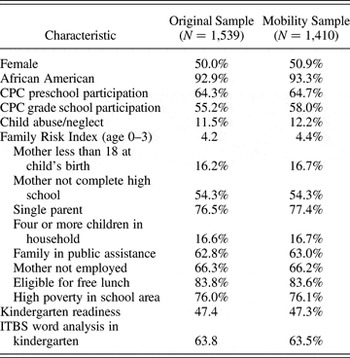
The study sample for this report comprises the 1,410 of the original 1,539 students who had at least 4 years of active status in the Chicago Public Schools between kindergarten and 12th grade. Data comparisons showed no significant differences between the school mobility sample of 1,410 and the original sample of 1,539 (see Table 1). Of these 1,410 students with at least 4 years of active status, 1,316 (93.3%) were African American, 94 (6.7%) were Hispanic, and 717 (50.1%) were female; 912 (64.7%) participated in some part of the CPC program, either in preschool or as part of the follow-up intervention that took place between 1st and 3rd grades for some students. Data for the CLS participants have been regularly collected from a wide variety of sources from birth up to early adulthood, including birth records, Chicago Public School administrative files, and data from the Illinois Board of Higher Education, the Illinois Department of Child and Family Services, the Illinois Department of Health and Human Services, Illinois Department of Public Health, Cook County Court and Circuit Court, and the Illinois Department of Employment Security, as well as data from teacher, parent, and participant surveys in childhood and early adulthood.
Comparison of original sample and school mobility sample

Note: CPC, Child–Parent Center; ITBS, Iowa Tests of Basic Skills.
Administrative school data collected every year includes standardized test scores in reading and math as well as school unit numbers and district numbers. Parent surveys were conducted when students were in second, 4th, and 12th grades. Student surveys took place each year during 3rd through 6th grades and again in 10th grade. Teacher surveys were conducted each year for kindergarten through 7th grade. School, neighborhood, and census data were gathered during 5th grade, 8th grade, 10th grade, and 12th grade. Information from court records on delinquency and abuse/neglect were first obtained when students were 19 years old, and employment data was first collected at ages 23–24. In conjunction with ongoing tracking efforts, the study has maintained high rates of sample recovery for mobility, outcome, and explanatory variables.
Outcome measures
Highest grade completed
Highest grade completed by participants is a continuous variable that indicates the highest grade of educational completion in the secondary school system as well as GED completion and college attendance. The range of this variable is 7 to 17. GED completion is coded 12, and college attendance is coded according to the credits earned by each participant. Every 30 credits earned by the participants add up to 1 year of educational attainment. Data were collected from administrative school systems and were supplemented with information from parent interviews.
On-time graduation
Another indicator of educational attainment is on-time high school graduation. On-time high school graduation is a dichotomous variable that indicates whether the participants completed secondary education on time (i.e., during or prior to 1998) based on the Chicago Public Schools administrative school system records.
Occupational prestige
The measure of occupational prestige was based on data from the adult survey in ages 22–24 and supplemented with administrative data from the state or county. Self-reported information regarding current occupation and previous two positions was coded using a 9-point scale based on well-known ratings of socioeconomic position, the Barratt Simplified Measure of Social Status and the Nakao Treas Prestige Scores (Barratt, Reference Barratt2005; Davis, Smith, Hodge, Nakao, & Treas, Reference Davis, Smith, Hodge, Nakao and Treas1991; Hollingshead, Reference Hollingshead1975) such that scores of 1 correspond to generally unskilled job classifications including laborers, scores of 5 correspond to moderate levels of job skill requiring postsecondary training, and scores of 9 correspond to high levels of job skills with advanced education and high earnings, including lawyers and doctors. For participants who did not complete the adult survey, occupational prestige was estimated based on other administrative data when possible using the following guidelines: incarceration (1), 4-year degree (5), average annual income < $9,000 (2), and high school dropout (2).
Adult arrest
Adult arrest is a dichotomous variable that measured adult arrest by age 26 through administrative reports of criminal records obtained from the county, state, and federal levels. All participants with any adult arrest by age 26 were coded 1. Participants were coded 0 if they were not arrested by that point as an adult. Administrative county-level arrest data were gathered from criminal court records in Cook County, Illinois. State-level arrest data were obtained primarily through the Illinois Department of Corrections, other midwestern states (Wisconsin, Iowa, and Minnesota), and the Department of Corrections system from nationwide states. Federal-level records were collected from the Federal Bureau of Prisons.
Felony arrest
In order to examine the impact of school mobility on the severity of adult arrest, we also included adult felony arrest in the analysis. Adult felony arrest is a dichotomous variable that indicates whether a participant had a felony arrest as an adult. Individuals with any felony arrest are coded 1; individuals with no felony arrest are coded 0. Data were collected for this measure using the same methods described previously for adult arrest.
Depression symptoms
Reported symptoms of depression were based on five items in the adult survey at ages 22–24. Participants responded to the five items modified from the depression subscale of the Brief Symptom Inventory (Derogatis, Reference Derogatis1975) indicating how often in the past month they felt depressed, lonely, helpless, sad, or as if life was not worth living. The reliability coefficient of these five items is 0.84. Composite scores of depression symptoms were calculated as the number of depression symptoms participants reported having experienced a few times a week or more in the past month, ranging from 0 to 5.
Mobility
School mobility
The school mobility variables representing the number of years in which students changed schools from kindergarten to 12th grade (school mobility K–12), kindergarten to 4th grade (school mobility K–4), 4th to 8th grades (school mobility 4–8), and 8th to 12th grades (school mobility 8–12) were used to examine the impact of frequent school moves and timing of school mobility. The three time periods of K–4, 4–8, and 8–12 were selected to represent developmentally salient intervals of middle childhood (ages 5–10), early adolescence (ages 11–14), and high school or mid to late adolescence (ages 15–18). For threshold analyses, we used dichotomized variables to indicate thresholds of mobility, defined as two or more moves, three or more moves, and four or more moves during the kindergarten to 12th-grade period. These counts were created by comparing the school unit numbers of subsequent years for each student based on school administrative system records. When school unit numbers between two grades were different, a move was counted for that school year. When data were missing, indicating that students were not enrolled or were inactive in Chicago Public Schools for 1 or more years, one move was counted for the entire duration of missing years. Available information from school records cannot account for more than one school move per year, nor can the information specify whether the move occurred between school years or during the school year. For these reasons, the school mobility measures are likely to be underestimates of school mobility for some students. We consider this measure an index of mobility rather than a true count. Leave codes indicating the reasons students changed schools were available for some students during some years but did not account for the vast majority of moves, thus they are unreliable and were not included in analyses.Footnote 1 Students with fewer than 4 years of active status in the Chicago Public Schools were not included in these analyses because they were judged to have too few years of school record data to create valid school mobility scores. Since this cutoff choice was somewhat arbitrary, we also tested our results with cutoffs of 3 and 5 years of active status and found no difference in results. Because we were interested in nonstructured school moves rather than moves that occur naturally based on school structure, one move was subtracted between 8th and 9th grades for each student who attended a traditional 9th- to 12th-grade high school (90% of students). For students who attended schools with structures other than kindergarten through 8th grade prior to high school (24% of students), appropriate corrections were made by subtracting one move between years based on their specific school structures.
Residential mobility
The residential mobility variable indicates the number of years in which students had residential moves from kindergarten to 12th grade. Data on residential mobility was taken from the adult survey in ages 22–24 and parent survey in 11th grade. This count variable was created by using information from the item “How many times did you move from kindergarten through age 18?” reported by the participants. Missing information in this item was then supplemented with the item “How many times have you and this child moved to another home since this child has been in kindergarten?” from the parent survey. The distribution of residential moves was dramatically skewed right, thus the variable was log-transformed to conform to normality assumptions for the purposes of data imputation (see below). The log-transformed variable was used in all regression analyses.
Control variables
Early family risk
The index of early family risk was created based on a count of eight different sociodemographic risk factors from birth to age 3, including the following: mother was less than 18 when child was born, mother did not complete high school, single-parent family, four or more children in the household, family attendance in the public assistance programs, mother not employed, child eligible for free lunch, and 60% or greater poverty in school attendance area.
Prior academic achievement
Academic achievement prior to student mobility was measured with word analysis subscale scores from the Iowa Tests of Basic Skills (Level 5, Form 7), which was administered to students in October of their kindergarten year. There were 35 items in the word analysis subscale that assessed preliteracy skills (e.g., letter–sound correspondence and word attack skills). The norms were based on 1978, with high internal consistency reliability of 0.87 (Hieronymus, Lindquist, & Hoover, Reference Hieronymus, Lindquist and Hoover1982).
Social/emotional maturity
Child social/emotional maturity in 1st grade was measured based on teacher response to the following six survey items, each rated on a 5-point scale: came to my class ready to learn, completes work according to instructions, complies with classroom rules, displays confidence in approaching learning tasks, participates in group discussions, and works and plays well with others. The Cronbach α for the six items was 0.79, and the sum of scores for all available participants ranged from 6 to 30.
Child abuse and neglect
The child abuse and neglect variable was created from child protective service records and indicates whether each student ever experienced substantiated child abuse or neglect between kindergarten and age 18. The data included petitions to the juvenile court and referrals to the Child Protection Division of the Illinois Department of Children and Family Services.
Grade retention
Grade retention was measured as a dichotomous variable that indicates whether each student was ever retained between kindergarten and 8th grade based on school records.
Special education
The special education variable was created from school records in the Chicago Public Schools and indicates whether each student was ever enrolled in special education placement between kindergarten and 12th grade.
Juvenile delinquency
Information on juvenile delinquency was obtained from official court reports of petitions filed when participants were ages 7 through 17. Petitions indicated both formal and informal arrests into the juvenile justice system. Formal petitions involved a juvenile court judge, whereas informal petitions often involved alternative social services for children and families. Juvenile delinquency was coded as a dichotomous variable, with a score of 1 indicating any formal or informal petition for arrest.
Descriptive statistics and correlations of all control variables and outcome variables with school mobility measures are presented in Appendix A.
Missing data
Complete data were available for the following measures: school mobility K–4, school mobility 4–8, school mobility 8–12, school mobility K–12, gender, ethnicity, CPC preschool participation, CPC grade school participation, risk, child abuse/neglect, special education placement, and juvenile delinquency. Rates of missing data for outcome variables were as follows: 8% highest grade completed, 5% on-time graduation, 11% occupational prestige, 24% depression symptoms, 5% adult arrests, and 5% adult felony arrests. Among control variables, rates of missing data were 0.3% for kindergarten achievement, 3% for grade retention, 15% for social/emotional maturity, and 17% for residential mobility. Social/emotional maturity, residential mobility, and depression symptoms had higher rates of missingness because information from these variables was drawn exclusively from survey data, for which there were lower levels of follow-up than administrative data sources. Missing data were presumed to meet the assumptions of missing at random, which means that missingness was related to other study variables that were included in imputation procedures (Fitzmaurice, Laird, & Ware, Reference Fitzmaurice, Laird and Ware2004, chap. 14).
Missing data were imputed 20 times using PROC MI in SAS version 8.1 with the recommended expectation-maximization algorithm and Markov chain Monte Carlo method (Schafer & Graham, Reference Schafer and Graham2002). Analyses were run on each of the 20 data sets with results combined according to Rubin's rules (Rubin, Reference Rubin1987) using PROC MIANALYZE. The pattern of significant findings did not differ between analyses based on imputed data and results of the same analyses performed on the original, nonimputed data using listwise deletion procedures.
Data analysis
To test cumulative effects of school mobility between kindergarten and 12th grade for each of the six young adult outcome variables, we ran separate regression models with two hierarchical steps. In the first step, outcomes were predicted by only the mobility variables, school mobility K–12 and residential mobility. The second step included covariates gender, ethnicity, CPC preschool, CPC grade school, early family risk, prior achievement, social/emotional maturity, child abuse and neglect, grade retention, special education, and juvenile delinquency to determine whether mobility predicted outcomes beyond its association with these prior and concurrent risks. Linear regressions were run on the three continuous outcomes of highest grade completed, occupational prestige, and depression symptoms. Binary logistic regressions were run for the dichotomous outcomes of on-time graduation, adult arrest, and felony arrest.
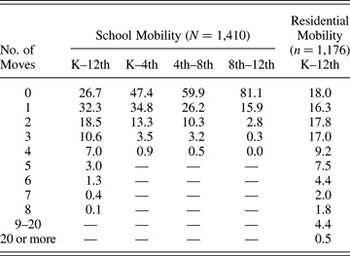
In order to test for differential impacts of school mobility based on timing, we ran similar regression models for each of the outcomes, with mobility variables entered first and the same covariates included in the second step. Based on extensive literature in support of threshold effects and the distribution of observed school moves among K–4, 4–8, and 8–12 (presented in the results section and Table 2), we utilized dummy codes to reflect the following: 1 school move K–4, 2 or more school moves K–4, 1 school move 4–8, 2 or more school moves 4–8, and any school moves 8–12. These five dummy codes were added simultaneously with each other and with residential mobility in the first step of the regression models.
Percentages of students experiencing school moves and residential moves during specified time periods, based on school records and survey data

Note: K, kindergarten.
Results
Descriptive statistics for mobility
Percentages of students who changed schools between kindergarten and 12th grade, kindergarten to 4th grade, 4th to 8th grades, and 8th to 12th grades are presented in Table 2. Based on the index of yearly changes in school unit numbers, students experienced between zero and eight unstructured school moves between kindergarten and 12th grade. More than half of the students (59%) experienced one or fewer unstructured moves, and 95% of students experienced four or fewer unstructured moves between kindergarten and 12th grade. Between kindergarten and 4th grade, the number of unstructured moves ranged from zero to four with nearly half of students (47%) experiencing no moves, 34% experiencing one move, and the remaining 19% experiencing two or more unstructured moves. Between 4th and 8th grades, number of unstructured moves also ranged from zero to four. The majority of students (59%) did not experience any unstructured moves, 26% experienced one unstructured move, and the remaining 15% experienced two or more moves. In the high school years between 8th and 12th grades, number of moves ranged from zero to three. The vast majority of students (81%) experienced no moves, 16% experienced one move, and only 3% experienced two or three moves.
Table 2 also presents the rates of residential mobility between kindergarten and 12th grade based on available participant and parent report for 1,176 students (for whom survey data were available). According to these reports, 18% of students did not change residence at all between kindergarten and 12th grade. Approximately half (52%) of students changed residence two or fewer times, with 34% changing residences between three and five times, 9% changing residences between six and nine times, and 5% changing residences nine or more times.
Regression models for young adult outcomes
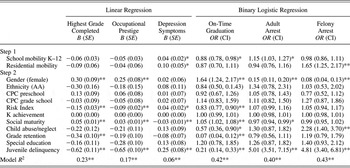
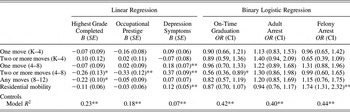
Results of the final linear and binary logistic models for cumulative school mobility K–12 are presented in Table 3. Coefficients from the final models for mobility variables separated by time periods (K–4, 4–8, 8–12) are presented in Table 4.
Final models for regressions predicting the six young adult outcomes with cumulative school mobility between kindergarten and 12th grade

Note: N =1,410. OR, odds ratio; CI, confidence interval; K, kindergarten; AA, African American; CPC, Child–Parent Center.
*p < .05. **p < .01 (two tailed).
Coefficients for mobility variables from final models for timing and threshold effects

Note: N = 1,410. OR, odds ratio; CI, confidence interval; K, kindergarten.
*p < .05. **p < .01 (two tailed).
Highest grade completed
In the first step of the model predicting highest grade completed, both school mobility K–12 and residential moves emerged as significant predictors (β = –0.19, p < .01 and β = –0.13, p < .05, respectively) and together accounted for 4% of the variance in highest grade completed. When all control variables were included in the second step, however, school moves K–12 was not a significant predictor of highest grade completed. Because some of these factors may mediate the effects of moving, this result may be conservative. The final model predicted 23% of the variance in highest grade completed (F = 30.3, p < .001). In the model with school moves measured during the three different time periods, two or more moves 4–8 and any moves 8–12 were significant predictors in the first step of the model (β = –0.57, p < .01 and β = –0.53, p < .01, respectively) and remained significant in the final model with all control variables included (β = –0.26, p < .05 and β = –0.22, p < .05, respectively). These results indicate that, on average, students who experienced two or more unstructured school moves between 4th and 8th grades or any unstructured school moves between 8th and 12th grades ultimately completed about a quarter of 1 year less of education than those who did not.
On-time graduation
School moves K–12 emerged as a significant predictor of on-time graduation in both steps of the model, with residential moves only, odds ratio (OR) = 0.71, confidence interval (CI) = (0.64, 0.77), p < .01, and with all control variables included, OR = 0.88, CI = (0.70, 1.11), p < .05. These findings indicate that each additional move is associated with a 12% to 19% reduction in the log-odds of on-time high school graduation (1.0–0.88, or 0.81) controlling for other factors. The final model predicted 42% of the variance in on-time graduation. In the model with mobility measured during different time periods, however, only two or more moves 4–8 emerged as a significant predictor of on-time graduation, OR = 0.56, CI = (0.36, 0.89), p < .05, indicating a threshold effect for multiple moves during the middle grades rather than a consistent, continuous effect per individual move across all grades.
Occupational prestige
The pattern of results for the model predicting occupational prestige was similar to that for highest grade completed, although residential moves was not a significant predictor of occupational prestige even in the first step of the model. School mobility K–12 was significant in the first (β = –0.14, p < .01) but not the final step, when all control variables were included. The first step accounted for 3% of the variance (F = 19.0, p < .001) whereas the final model accounted for 17% of the variance in occupational prestige (F = 18.6, p < .001). In the mobility timing model, two or more moves 4–8 emerged as a significant predictor of occupational prestige even when controlling for all other covariates (β = –0.33, p < .01). On average, students with two or more moves between 4th and 8th grades had significantly less prestigious and lucrative jobs (about 1/3 of a point lower on an 8-point scale).
Adult arrest
School mobility K–12 significantly predicted adult arrest in the first, OR = 1.18, CI = (1.10, 1.28), p < .01, and final, OR = 1.15, CI = (1.03, 1.27), p < .01, steps of the model. This finding indicates that each additional school move is associated with a 15% increase in the log-odds of adult arrest (controlling for other factors). Residential moves did not emerge as a significant predictor. The first step predicted 3% of the variance, and the final model predicted 40% of the variance in adult arrest. In the model considering school mobility timing, none of the thresholds in separate time periods of school mobility emerged as independently significant.
Felony arrest
The pattern of results was quite different when school moves K–12 and residential moves predicted any felony arrest. School moves K–12 did not emerge as a significant predictor of felony arrest even in the first step of the model. Residential moves was significant in the first, OR = 1.76, CI = (1.40, 2.22), p < .01, and final step of the model, OR = 1.64, CI = (1.25, 2.17), p < .01. The first step predicted 5% of the variance, whereas the final model predicted 44% of the variance in felony arrest. In the model that considered school mobility during different time periods, none of the thresholds in specific periods of mobility emerged as significant predictors.
Depression symptoms
School moves K–12 and residential moves both emerged as significant predictors of depression symptoms in both steps of the regression model (β = 0.04, p < .05 and β = 0.10, p < .05, respectively, in the final model). The first step accounted for 2% of the variance (F = 14.3, p < .001), whereas the final model with mobility and all control variables accounted for 6% of the variance in depression symptoms (F = 6.73, p < .001). In the model considering thresholds and timing of school mobility, one school move 4–8 and two or more moves 4–8 both emerged as significant predictors in the final model (β = 0.18, p < .01 and β = 0.37, p < .01, respectively). These results indicate that any unstructured school moves between 4th and 8th grades are associated with more depression symptoms in adulthood, with a particularly large effect (37% of a point on a 5-point scale) for students experiencing two or more unstructured moves during that time.
Additional analyses
Based on evidence for threshold effects of school mobility in the literature (Mehana & Reynolds, Reference Mehana and Reynolds2004; Ou & Reynolds, Reference Ou and Reynolds2008; Reynolds et al., Reference Reynolds, Chen and Herbers2009; Temple & Reynolds, Reference Temple and Reynolds1999) and in our timing analyses, we also ran models for all outcomes using dummy-coded mobility predictors of one move K–12, two moves K–12, three moves K–12, and four or more moves K–12. In the models predicting on-time graduation, depression symptoms and including all covariates, four or more moves K–12 emerged as significant, OR = 0.52, CI = (0.29, 0.91), p < .05 and β = 0.24, p < .05, respectively. For adult arrest, two moves, three moves, and four or more moves were all significant predictors, ORs = 1.90, CI = (1.24, 2.89); 1.69 (1.02, 2.81); and 1.91 (1.13, 3.24), respectively, all ps <. 05, indicating a more linear effect of cumulative school moves for this outcome. For highest grade completed, occupational prestige, and felony arrest, however, effects did not emerge for thresholds of school mobility K–12, despite the thresholds that were evident in Grades 4–8 for highest grade completed and occupational prestige. These results suggest that threshold analyses may function best when limited to shorter time periods and also that school mobility may show threshold effects for some outcomes and more continuous, linear effects for others. Overall, there is clear evidence that frequent school moves are more detrimental to student well-being than are single moves.
We also investigated whether the inclusion of additional covariates altered the magnitude of effects of the mobility measures. They did not, both in terms of effect size and the pattern of overall findings. For example, the addition of a second premobility achievement measure at the beginning of kindergarten, child welfare services, and changes in family risk status had little effect on the estimates for the number of moves, the timing of moves, and threshold levels. Results of these models are included in Appendix C.
Discussion
Results of the current study indicate that although school mobility is more likely to occur in the presence of a variety of other risk factors, school mobility itself predicts unique variance in several important outcomes of young adulthood when these associated risks are controlled. In this sample, school mobility was significantly correlated with residential mobility, gender, ethnicity, early family risk, poor achievement in kindergarten, lower social/emotional maturity in 1st grade, child abuse and neglect, special education placement, grade retention, and juvenile delinquency. With these associated risks controlled, a count of yearly school moves between kindergarten and 12th grade predicted unique variance in young adult outcomes, including the number of depression symptoms at the age of 23, having graduated high school on time, and having ever been arrested as an adult.
There were two young adult outcomes, highest grade completed and occupational prestige, for which a count of school move years in kindergarten through 12th grade did not emerge as a significant unique predictor. When thresholds for school mobility during different time periods of schooling were entered as separate independent variables, however, school moves during particular times did significantly predict both educational attainment and occupational prestige. These results are discussed in the next paragraph. Residential mobility emerged as a significant predictor for depression symptoms and felony arrest even in the full model with juvenile delinquency and all other control variables, when the count of school mobility K–12 was not a significant predictor. The finding that residential mobility was only significant in the final models for depression symptoms and felony arrest, and not in the final models for adult arrest or other outcomes, underscores the importance of considering different types of mobility and suggests that for some outcomes, perhaps those reflecting more severe disturbance, residential mobility may be a more potent factor than school mobility.
Consistent with our hypotheses related to timing of school mobility, we found greater detriments in young adult outcomes related to multiple school moves occurring later in the school career, particularly in the middle school years between 4th and 8th grades. School moves between 4th and 8th grades were most significant for predicting outcomes of highest grade completed, depression symptoms, occupational prestige, and on-time graduation. Thus, although a count of school moves throughout kindergarten to 12th grade has predictive significance for some outcomes, the particular importance of school changes during certain periods of time, particularly in middle school or later, may be obscured when all moves are considered together.
Unstructured school changes during different periods of the academic career likely represent different issues. In the early elementary years, moves are likely driven by the needs or decisions of the parents and family rather than by child behavior. A young child may change schools because her family is experiencing financial difficulties or dangerous and stressful circumstances that require changes in residence either for the family as a whole or for the child. In contrast, a young child may change schools because her parents are financially able to move to a better neighborhood or elect to send her to a private, magnet, or other possibly higher quality school. Only in rare instances does a young child have to change schools because of behavior problems resulting in expulsion. In the middle school and high schools years, however, changes related to child behavior are much more likely. Suspensions, expulsions, and issues related to truancy are more prevalent in older children and tend to co-occur with a variety of risk factors, including poverty and family adversity.
Although it is informative to investigate long-term outcomes and effects of differences in the timing of mobility, it is important to consider that mobility may occur for different reasons and with different correlates at different developmental periods and among different populations. Findings presented here reflect circumstances for low socioeconomic status minority students, a population that is much more likely to change schools and residence for reasons of necessity rather than preference (Schafft, Reference Schafft2009). Unstructured school changes among mid and high socioeconomic status samples are more likely to be benign or even beneficial to student outcomes, particularly because they are more likely to occur for positive reasons such as improvements in family financial situation and access to higher quality schools.
In our data, the association between school mobility in kindergarten through fourth grade and negative outcomes of young adulthood were found to be accounted for by other variables such as family risk, child social/emotional maturity, kindergarten achievement, and residential mobility. Young children may be more vulnerable to changes within the family system and less impacted by a change of school, perhaps because curricula in the early elementary years is more consistent across schools and because family relationships have more salience than do peer relationships when children are young. During middle school, however, school mobility introduced a unique impact beyond its association with other risk factors. This may occur because of the increasing importance of peer relationships for school engagement and competent development in general. Changing schools between fourth and eighth grades disrupts these developing peer relationships and requires adaptation to new social situations in new schools, in addition to the academic challenges of potentially changing curricula and discontinuous learning experiences. In the high school years, school changes may reflect involvement in juvenile delinquency or may support disengagement from school and association with delinquent peers.
Changing schools frequently during students' school careers has the potential to negatively impact not only academic achievement, as has been demonstrated in previous research (Gruman et al., Reference Gruman, Harachi, Abbott, Catalano and Fleming2008; Heinlein & Shinn, Reference Heinlein and Shinn2000; Mantzicopoulos & Knutson, Reference Mantzicopoulos and Knutson2000; Mehana & Reynolds, Reference Mehana and Reynolds2004; Pribesh & Downey, Reference Pribesh and Downey1999; Rumberger, Reference Rumberger2003; Rumberger & Larson, Reference Rumberger and Larson1998; South et al., Reference South, Haynie and Bose2007; Swanson & Schneider, Reference Swanson and Schneider1999; Temple & Reynolds, Reference Temple and Reynolds1999), but also developmental outcomes of young adulthood. Although results of some studies have indicated particular importance of early mobility (Astone & McLanahan, Reference Astone and McLanahan1994; Heinlein & Shinn, Reference Heinlein and Shinn2000; Mehana & Reynolds, Reference Mehana and Reynolds2004), our results indicate that school changes occurring in middle school and high school relate more strongly to negative outcomes in young adulthood. It is likely that disruptions caused by mobility at different times have different consequences. Early in the school career, students are learning fundamental academic skills. Later they may encounter greater differences in curricula across schools as academic concepts become more complex. In addition, negotiating peer relationships is a central developmental task of middle childhood and adolescence (Parker, Rubin, Erath, Woislawowicz, & Buskirk, Reference Parker, Rubin, Erath, Woislawowicz, Buskirk, Cicchetti and Cohen2006), and school changes that disrupt these relationships likely impact student school engagement, behavior, and motivation to succeed academically.
Because mobility tends to occur in the context of other risk factors, the actual consequences of changing schools has been difficult to demonstrate. However, it is becoming clear that efforts of policymakers and schools to support academic achievement and positive development of high-risk students should include attention to issues of school mobility. Because school changes in the middle school and high school years appear particularly detrimental, efforts can focus on encouraging school stability with students and families as well as providing opportunities for social support and additional educational support for students who do change schools. Furthermore, students who have experienced many school changes may require more support and guidance beyond high school as they face developmental tasks of young adulthood including seeking higher education, entering the work force, and maintaining appropriate social conduct and psychological health.
Limitations
There are several important limitations to the study described above. First, the school mobility measure was based on school records indicating a unit number for the school attended each year. Moves were determined by a change in this unit number from each year to the next. At most one move per year was possible for each student, and no information was available regarding whether this move took place between school years or within a school year. Thus, the resulting mobility variable likely represents an underestimation of actual school moves and should be considered an index of mobility rather than a true count of school moves. Based on the data from school records alone, we cannot account for differences in the timing (between or within years) or true number of moves, which could be important considerations when investigating different types of moves and thresholds of mobility effects. We also do not have the information necessary to determine the reason for school moves, though we assume based on the existing literature that the majority of these low-income, ethnic minority students are moving for reasons of necessity (National Research Council and Institute of Medicine, 2010; Schafft, Reference Schafft2009).
Second, our variable measuring residential mobility was based on retrospective self-report and parent report spanning kindergarten through 12th grade. Because this was only measured one time in the adult interview, it was not possible to consider differences in timing of residential mobility. Instead, we considered cumulative residential mobility as a control variable when we investigated differences in timing of school mobility. It is possible that a more accurate and more differentiated measure of residential mobility may have accounted for a greater proportion of the variance in young adult outcomes. Retrospective reports of other behaviors in the study (e.g., home environment and parent involvement), however, have been found to be strongly predictive of concurrent reports. Third, although we were able to include residential and school mobility in the same models, we could not identify situations in which students changed schools but not residences or residences but not schools. Based on the extant literature, it seems likely that the most detrimental mobility experiences would involve multiple school moves coupled with homelessness or multiple residential moves (Fantuzzo et al., Reference Fantuzzo, Rouse and LeBoeuf2009; Pribesh & Downey, Reference Pribesh and Downey1999).
Although our understanding of the important unique risks presented by school mobility has improved, a great many questions remain regarding the developmental processes through which mobility can take its toll. We believe that school mobility undermines academic achievement by disrupting learning experiences and affecting student motivation to succeed, but we have little empirical evidence of the transactional processes between mobility and achievement over time, or how cumulative experiences of mobility increase risk for negative outcomes. Future research efforts should more specifically examine learning, achievement, and socioemotional factors as they mediate or transact with the effects of school mobility. Furthermore, both school mobility and residential mobility are clearly important, but their interplay is not well understood. Additional studies can investigate differences in types of moves, detailing whether school and residential moves are happening in concert and whether the moves present favorable conditions or result from necessity or family financial hardship. It is likely that risk and family situation moderates the effect of mobility such that school changes often carry unique risks but particularly so in the presence of other influential risk factors such as poverty.
Implications
Our findings highlight the detrimental impacts of unstructured school mobility on life course well-being, especially if school mobility is frequent. Identification and implementation of a range of interventions, policies, and practices are warranted to reduce mobility and its negative consequences. Many types of programs, services, and policies have been developed to reduce rates of mobility or lessen its potentially negative consequences. These include peer buddies and mentoring (Cornille, Bayer, & Smyth, Reference Cornille, Bayer and Smyth1983; Titus, Reference Titus2007); orientation and transition programs for new students (Cornille et al., Reference Cornille, Bayer and Smyth1983); social skills training (Durlak, Reference Durlak1997; Elias, Gara, & Ubriaco, Reference Elias, Gara and Ubriaco1985; Jason, Danner, & Kuraski, 1993); whole school reforms such as Schools of the 21st Century (Zigler, Gilliam, Jones, & Finn-Stevenson, Reference Zigler, Gilliam, Jones, Finn-Stevenson and Zigler2006) and the School Development Program (Comer, Ben-Avie, Haynes, & Joyner, Reference Comer, Ben-Avie, Haynes and Joyner1999); and preschool to third grade programs and practices (Reynolds & Robertson, Reference Reynolds and Robertson2003; Takanishi & Kauertz, Reference Takanishi and Kauerz2008). Improvement in the general quality of schools through, for example, enhanced professional development, small class sizes, and parental involvement (Popp, Stronge, & Hindman, Reference Popp, Stronge and Hindman2003; Reynolds, Reference Reynolds2000) also have been frequently recommended. School district policies that encourage flexible attendance areas, transportation for mobile students, and collaboration with housing and other service agencies to maintain school stability also are more common (Kerbow, Reference Kerbow1996).
Although a wide array of strategies are available to address school mobility, very few have been empirically evaluated intensively and in longer-term follow-ups. Intensive and comprehensive prevention programs, presumably one of the most desirable approaches, also have been rarely investigated for their impact on mobility. There is growing evidence, however, that four attributes of early childhood and related prevention programs are key to their success: the promotion of continuity or consistency in learning, coherent organization structures such as colocated or full-service schools, alignment of curriculum across grades, and the availability of family support and community-based services. To the extent that these and other attributes are present in children's learning contexts and sustained over time, the negative consequences of mobility can be reduced.
Appendix A
Descriptive statistics for nonimputed and imputed variables

Appendix B
Bivariate correlations

Appendix C
Coefficients for linear regression and binary logistic regression models of mobility predicting outcomes in the presence of additional control variables