Introduction
The obesity epidemic in developed countries, as measured by body mass index (BMI), might be stable (Salanave et al., Reference Salanave, Peneau, Rolland-Cachera, Hercberg and Castetbon2009; Olds et al., Reference Olds, Maher, Zumin, Péneau, Lioret and Castetbon2011) but studies using skin-fold and waist circumference measurements suggest that BMI may underestimate changes in fatness in children. Between 1985 and 2007 central adiposity was found to increase at a faster rate than total adiposity in a sample of Australian school children (Garnett et al., Reference Garnett, Baur and Cowell2011). The origin of obesity is complex and influenced by genetic and environmental factors. There exists a wide literature presenting environmental determinants of overweight and obesity described by BMI, but not so many studies have focused on abdominal obesity or abdominal body fat distribution in children as described by waist circumference or waist-to-height ratio. Waist circumference, rather than BMI, has been found to be associated with cardiometabolic disease risk factors in children (Lee et al., Reference Lee, Bacha, Gungor and Arslanian2006; Reinehr & Wunsch, Reference Reinehr and Wunsch2010). As waist circumference itself does not take into account the continuously changing body height of children, another index has been suggested, i.e. waist-to-height ratio (WHtR) (Ashwell et al., Reference Ashwell, Cole and Dixon1996; McCarthy & Ashwell, Reference McCarthy and Ashwell2006; Garnett et al., Reference Garnett, Baur and Cowell2008; Goulding et al., Reference Goulding, Taylor, Grant, Parnell, Wilson and Williams2010; Campagnolo et al., Reference Campagnolo, Hoffman and Vitolo2011).
Factors affecting abdominal obesity comprise biological elements, including parental obesity, maternal nutrition at pregnancy, child's birth weight and breast-feeding (Psarra et al., Reference Psarra, Nassis and Sidossis2005; Ortega et al., Reference Ortega, Ruiz and Sjöström2007; Vale et al., Reference Vale, Soares-Miranda, Santos, Moreira, Marques and Santos2011; Kuriyan et al., Reference Kuriyan, Thomas, Sumithra, Lokesh, Sheth and Joy2011); behavioural ones, including child's dietary habits, sleep duration, physical activity or sedentary behaviours (Klein-Platat et al., Reference Klein-Platat, Oujaa, Wagner, Haan, Arveiler, Schlienger and Simon2005; Ortega et al., Reference Ortega, Ruiz and Sjöström2007; Hitze et al., Reference Hitze, Bosy-Westphal, Bielfeldtm, Settlerm, Plachta-Danielzik and Pfeuffer2009; Lazarou & Soteriades, Reference Lazarou and Soteriades2010; Vale et al., Reference Vale, Soares-Miranda, Santos, Moreira, Marques and Santos2011; Kuriyan et al., Reference Kuriyan, Thomas, Sumithra, Lokesh, Sheth and Joy2011; Lehto et al., Reference Lehto, Ray, Lahti-Koski and Roos2011); and socioeconomic factors, including educational level, social class and occupation (Shrewsbury & Wardle, Reference Shrewsbury and Wardle2008; Vale et al., Reference Vale, Soares-Miranda, Santos, Moreira, Marques and Santos2011). Certainly, these factors are close to those that determine general obesity, but nevertheless working out programmes to fight abdominal-type obesity connected with the accumulation of subcutaneous and visceral fat requires precise identification of its detailed determinants, which are often characteristic for a given population.
The aim of the study was to determine abdominal obesity risk factors in children and adolescents from Cracow, the third largest city in Poland, in cohorts examined during the years of the political transformation that took place in Poland at the end of the 20th century.
Methods
Subjects
This study was performed as a part of a project monitoring the level of biological ontogenesis in children and adolescents in the city of Cracow (Chrzanowska et al., Reference Chrzanowska, Gołąb, Bocheńska and Panek1992, Reference Chrzanowska, Gołąb, Żarów, Sobiecki and Brudecki2002, Reference Chrzanowska, Kozieł and Ulijaszek2007). The material of the work was based on two series of cross-sectional studies; the first, in 1983, included anthropological and survey data of 2160 boys and 2178 girls (4338 in total) and the second, in 2000, included 816 boys and 718 girls (1534 altogether). Both studies involved randomly selected children and adolescents aged 4–18 from kindergartens and primary and secondary schools of different types located in Cracow. Representativeness of the examinations was assured by choosing the subjects from a list of all Cracow schools and kindergartens by the use of a two-stage draw by ballot box method with no returning. Both series of research were carried out in spring by research teams from the Department of Anthropology and Anatomy, University School of Physical Education in Cracow, with more than half of the researchers taking the measurements in all series. The protocol was conducted according to the scientific studies ethic principles stated in the Helsinki Declaration. Both cohorts are relatively well described in relation to average anthropometric features and their trends and levels of biological development (Chrzanowska et al., Reference Chrzanowska, Gołąb, Bocheńska and Panek1992, Reference Chrzanowska, Gołąb, Żarów, Sobiecki and Brudecki2002, Reference Chrzanowska, Kozieł and Ulijaszek2007; Chrzanowska & Suder, Reference Chrzanowska and Suder2010).
Anthropometry
For the purpose of this study body height (Ht), body weight (Wt) and waist circumference (WC) were measured. For height subjects were measured without shoes, in standing position to the nearest 0.1 cm, with the head in the Frankfurt plane, using a stadiometer. Weight was obtained in the standing position with a standardized medical scale with an accuracy of 100 g. Waist circumference was measured to the nearest 0.1 cm using an anthropometric tape between the lower edge of the costal arch and the upper edge of the iliac crest with the subjects in standing position, wearing gym shorts and recorded at the end of gentle expiration. Data quality was assured by extensive training. Waist-to-height ratio (WHtR) was calculated by dividing waist circumference (in cm) by height (in cm) x 100. Abdominal obesity was determined based on the 90th percentiles of WC and WHtR for appropriate age and sex (Katzmarzyk et al., Reference Katzmarzyk, Srinivasan, Chen, Malina, Bouchard and Berenson2004; McCarthy et al., Reference McCarthy, Jarrett, Emmett and Rogers2005; Nawarycz & Ostrowska-Nawarycz, Reference Nawarycz and Ostrowska-Nawarycz2007). The prevalence of the abdominal type of obesity, based on a WHtR of ≥50, was 3.9% for boys and 2.4% for girls in 1983, and 6.4% and 3.1% respectively in 2000. However, a statistically significant increase in prevalence of abdominal fatness during the period of the research was observed in boys (doubled percentage of boys with abdominal obesity), but not in girls (Chrzanowska & Suder, Reference Chrzanowska and Suder2010).
Questionnaire study
Anthropometric examinations were accompanied by a thorough environmental questionnaire including information about the examined subjects, their parents and conditions of their ontogenesis. The questionnaire prepared at the Faculty of Anthropology and Anatomy at the University of Physical Education in Cracow, previously verified in former studies, was used to assess mother's age at the time of delivery, birth weight of the child (from the 1983 survey only), parents' height and weight and waist circumference (from the 2000 survey only), parents' education level, number of children in the family, economic situation of the family, number of meals consumed daily, parents' smoking habits (from the 2000 survey only) and number of hours of physical activity spent by children during leisure time and children's participation in regular physical activities organized by sport clubs (from the 2000 survey only).
The border age for mothers at the time of their child's delivery was 30 (Mazur et al., Reference Mazur, Klimek and Małecka-Tendera2011). The birth weight of the girls and boys was divided into four groups: <2500 g, 2500–3499 g, 3500–3999 g and ≥4000 g (Frye & Heinrich, Reference Frye and Heinrich2003). The parents' body mass index was determined based on their body weight and height data obtained from questionnaires and parental obesity was defined as having a BMI exceeding 30 kg/m2 (Cole et al., Reference Cole, Bellizzi, Flegal and Dietz2000). Parental abdominal obesity was defined as having a waist circumference, obtained from the questionnaires, exceeding 102 cm and 88 cm in male and female parents, respectively (Lean et al., Reference Lean, Han and Morrison1995). Parental educational level was defined as low (ground or basic vocational), medium (secondary comprehensive or technical) and high (incomplete university or university). Number of children in the family was categorized as one child, two children, three children and four and more children. The economic situation of the family was estimated by the parents themselves as bad, average and good. Number of meals consumed daily by the child was categorized as 1–3 meals and 4–6 meals. Parents' smoking habits were determined as both parents non-smoking, only father smoking, only mother smoking, both parents smoking. The data considering undertaking physical leisure time activity over 2 hours weekly and physical activity in sport clubs (more than 4 hours weekly) were used to assess physical activity in the examined children.
Statistical analysis
All statistical analyses were made using the Statistica 9.0 software package. During the first stage of working out the data, the basic statistical characteristics of somatic features of boys and girls included in the study were assessed. Because of skewed distribution of some of the somatic attributes analysed, as was demonstrated by the Shapiro-Wilk test (non-included data), measurements were transformed into a logarithmic scale. The LSD (least significant difference) test was used for post hoc comparisons in individual age categories between cohorts from 1983 and 2000 and between sexes. The influences of risk factors for abdominal obesity were examined by calculating odds ratios (OR) and 95% confidence intervals (CI) for each factor separately using logistic regression analysis. The significance of the differences was set at the level of p<0.05.
Results
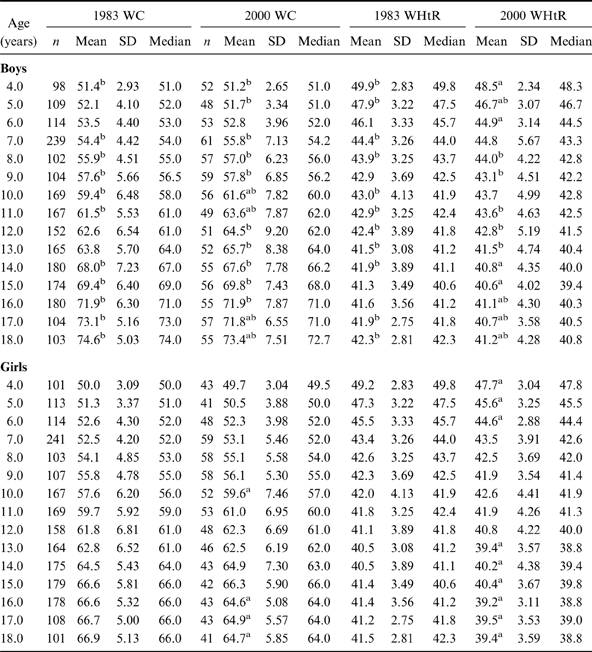
An anthropometric (WC and WHtR) description of the study sample is presented in Table 1. Note that the percentage of people who replied to the questions included in the survey in 1983 was 70% (4338 questionnaires), whereas only 36% of the children measured in 2000 had the form on their health behaviour completed by their parents (1534 questionnaires).
Statistical characteristics of waist circumference (WC) and waist-to-height ratio (WHtR) in boys and girls in 1983 and 2000 surveys

a Mean 2000 measurement significantly different from the mean 1983 measurement at p<0.05 (post hoc comparison).
b Mean boys' measurement significantly different from the mean girls' measurement at p<0.05 (post hoc comparison).
Statistically significant differences in mean values of WC between cohorts occurred in 10- and 11-year-old boys and girls indicating higher waist circumference in children examined in 2000. However, in the late adolescence period the WC of boys and girls from the 2000 series was distinctly and statistically significantly smaller than in 1983. The differences in mean values of WHtR deepened between cohorts and pointed at significantly lower values of the WHtR index in children (4–6 years) and adolescents (14–18 years) examined in 2000 compared with 1983.
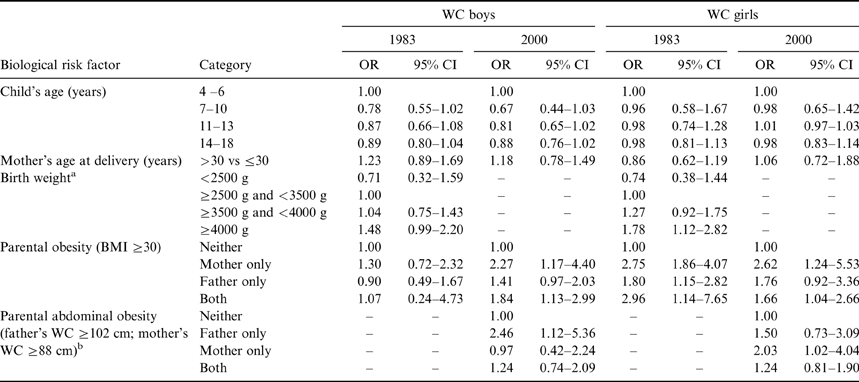
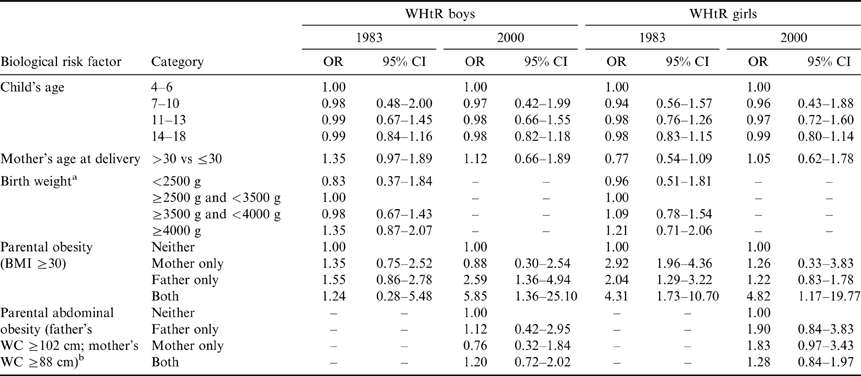
Tables 2 and 5 present the statistical analysis of the biological risk factors for abdominal obesity (WC and WHtR, respectively) in girls and boys. Child's age, accepting the border of the 90th percentile of WC and WHtR for appropriate age and sex, turned out to be statistically insignificant, as expected. Of the other factors, obesity prevalence in the family, especially in both parents (BMI), was particularly important. Obese parents' daughters were at five times higher risk of being abdominally obese (WHtR) than girls whose parents were slim. The same situation in boys increased the risk by almost six times only in one series, i.e. in 2000. Slightly lower values of OR, but in a similar direction, were obtained for WC. Mothers' obesity turned out to be a significant risk factor for abdominal obesity in their children according to WC criteria. Parental abdominal obesity was not associated with an increase in risk of abdominal obesity in their children according to WHtR criteria. However, in the case of WC, fathers' abdominal obesity increased the risk of abdominal obesity occurrence in their sons by 2.5 times, and mothers' abdominal obesity increased the risk in their daughters by more than two times. Children's mothers' age at delivery was not a significant factor for abdominal obesity risk. However, birth weight ≥4000 g was a significant risk factor for girls examined in 1983.
Biological risk factors for abdominal obesity as measured by waist circumference (WC) in boys and girls
a No data for the 2000 series;
b no data for the 1983 series.
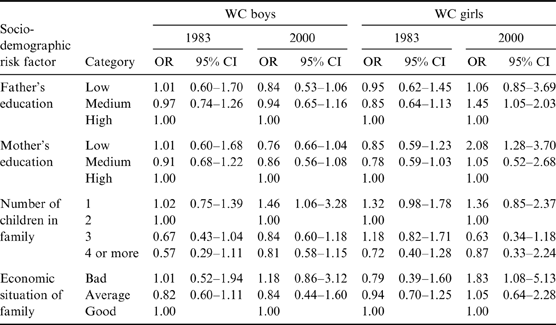
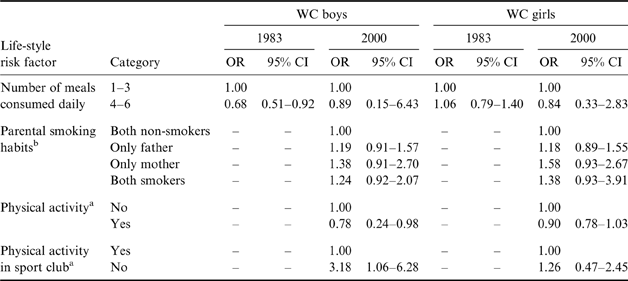
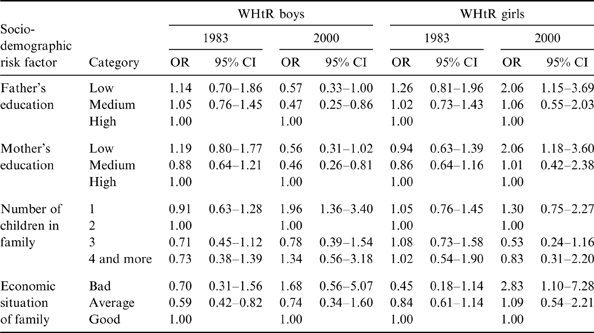
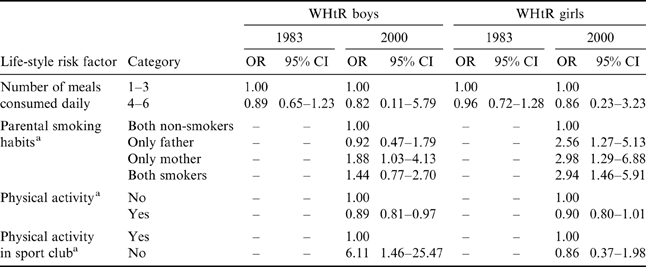
Taking into consideration socio-demographic factors (Tables 3 and 6), low level of parental education was associated with an increased risk of abdominal obesity, assessed by both WC and WHtR, particularly in girls examined in 2000. Having only one child in a family meant an increased risk of abdominal obesity in boys examined in 2000. Family economic situation declared by parents as being very bad increased the risk of abdominal obesity in girls in 2000. Lifestyle factors such as parents' smoking habits (Tables 4 and 7) led to an increased risk of abdominal obesity, estimated by WHtR, in children. The risk was three times higher for girls if their mothers or fathers smoked, whereas for boys a significantly higher risk occurred when their mothers were smokers. Lack of leisure time physical activity was found to be a significant factor for abdominal obesity (WC and WHtR) for boys, but not for girls. The risk increased by six times (WHtR) when the criterion was the lack of regular physical activity realised during organized classes in sport clubs. Higher frequency of meals consumed by children and adolescents indicated a lower risk of abdominal obesity but the statistical significance of the dependencies was not confirmed.
Socio-demographic risk factors for abdominal obesity as measured by waist circumference (WC) in boys and girls
Life-style risk factors for abdominal obesity as measured by waist circumference (WC) in boys and girls
a No data for the 1983 series.
Biological risk factors for abdominal obesity as measured by waist-to-height ratio (WHtR) in boys and girls
a No data for the 2000 series;
b no data for the 1983 series.
Socio-demographic risk factors of abdominal obesity as measured by waist-to-height ratio (WHtR) in boys and girls
Life-style risk factors of abdominal obesity as measured by waist-to-height ratio (WHtR) in boys and girls
a No data for the 1983 series.
Discussion
Discussion of the study results should be preceded by indicating certain interpretative limitations because of the cross-sectional nature of the study. The biological, socio-demographic and lifestyle factors were all measured via self-report, introducing the potential for socially desirable response patterns. Adding objective measures of physical activity, diet and other health-related behaviours may improve future research. The percentage of people who replied to the questions included in the questionnaire in 1983 was 70%, whereas only 36% of the children measured in 2000 had a questionnaire on their health behaviour completed by their parents. Despite the mentioned limitation, the obtained results, as based on a considerable number of observations conducted twice – first in 1983 and secondly in 2000 – can be, with a certain degree of approximation, treated as referring to the whole urban population. Apart from that, the strengths of this study were direct anthropometric measurements and several comprehensive, empirically derived social and lifestyle elements. The results of the performed tests should also be analysed within the context of the political transformation that took place in Poland at the end of the 20th century. Years of relative stability and an impression of prosperity based on loans from abroad (1970–1977) were followed by a deep economic crisis and collapse of the economy (1977–1989) accompanied by food shortages. After 1989, the process of post-socialist transition from a planned to a free-market economy was also accompanied by intensified psychosocial stress and feelings of insecurity, and this, as a result, affected the health of the Polish people (Watson, Reference Watson2006; Lipowicz, Reference Lipowicz2007). Higher differentiation of abdominal obesity risk factors in the 2000 cohort in comparison with the 1983 one may have resulted from these social and economic changes.
The results of the study indicate that girls whose parents were both obese had a higher risk of abdominal obesity than those with slim parents. The results refer both to the 1983 and 2000 series and are in conformity with the results of other studies showing that both maternal and paternal BMI can be associated with total and central adiposity in their offspring (Davey Smith et al., Reference Davey Smith, Steer, Leary and Ness2007, Labayen et al., Reference Labayen, Ruiz, Ortega, Loit, Harro, Veidebaum and Sjostrom2010; Vale et al., Reference Vale, Soares-Miranda, Santos, Moreira, Marques and Santos2011). An analysis of the data for boys showed that obesity in both parents increased the risk of obesity in the examined boys, but only in one series, i.e. in 2000.
According to the literature, the risk of obesity prevalence in children is higher in the case of mothers' obesity than fathers' obesity (Shrewsbury & Wardle, Reference Shrewsbury and Wardle2008; Whitaker et al., Reference Whitaker, Jarvis, Beeken, Boniface and Wardle2010), which is explained by the fact that the mothers spend more time with their children and prepare meals, which affects their families' eating habits. Similar dependencies were confirmed in the study, when abdominal obesity was assessed according to WC criterion. However, there are studies that indicate a reverse dependency, pointing at the fathers' role in arranging leisure time activities, which affects their families' physical condition (Fogelholm et al., Reference Fogelholm, Nuutinen, Pasanen, Myöhänen and Säätelä1999; Davison et al., Reference Davison, Cutting and Birch2003; Ferreira et al., Reference Ferreira, van der Horst, Wendel-Vos, Kremers, van Lenthe and Brug2006).
Fathers' abdominal obesity increased the risk of abdominal obesity in their sons, while mothers' abdominal obesity more than doubled the risk in their daughters. A similar model demonstrating that the risk of obesity prevalence in children was higher if their parent of the same sex was obese, has been described by Kivimaki et al. (Reference Kivimaki, Lawlor, Smith, Elovainio, Jokela and Keltikangas-Jarvinen2007), Lawlor et al. (Reference Lawlor, Smith, O'Callaghan, Alati, Mamun, Williams and Najman2007) and Perez-Pastor et al. (Reference Perez-Pastor, Metcalf, Hosking, Jeffery, Voss and Wilkin2009). The directions of the dependencies are not fully determined as some studies have shown that maternal BMI was more strongly associated with female offspring than male (Perez-Pastor et al., Reference Perez-Pastor, Metcalf, Hosking, Jeffery, Voss and Wilkin2009), while others, e.g. Leary et al. (Reference Leary, Davey Smith and Ness2010), have indicated that paternal associations are similar for both sexes.
Although the information on parents' body weight and height used to calculate BMI in the study came from questionnaire data, the accuracy of such data has been confirmed by other studies (Bolton Smith et al., Reference Bolton-Smith, Woodward, Tunstall-Pedoe and Morrison2000; Kuczmarski et al., Reference Kuczmarski, Kuczmarski and Najjar2001).
The results of the present study did not indicate a significantly increased risk of abdominal obesity in children whose mothers were older than 30 years when they delivered their child compared with those under 30. The results are consistent with those of studies of BMI in Polish (Mazur et al., Reference Mazur, Klimek and Małecka-Tendera2011) and Italian populations (Maffeis et al., Reference Maffeis, Micciolo, Must, Zaffanello and Pinelli1994). Many studies have shown that high birth weight of a child is an independent risk factor for overall obesity (Maffeis et al., Reference Maffeis, Micciolo, Must, Zaffanello and Pinelli1994; Mazur et al., Reference Mazur, Klimek, Telega, Hejda, Wdowiak and Małecka-Tendera2008) and high waist circumference (Ortega et al., Reference Ortega, Ruiz and Sjöström2007). Such dependencies were confirmed in this study for girls of birth weight ≥4000 g.
Of the socio-demographic factors studied, low parental education level increased the risk of abdominal obesity by two times for girls, but not for boys. Low parental education can be connected with unemployment, and thus worsening of family living conditions, incorrect diet, lack of educational and sport activities and psychosocial stress (Parizkova, Reference Parizkova2008; Shrewsbury & Wardle, Reference Shrewsbury and Wardle2008). Ferreira et al. (Reference Ferreira, van der Horst, Wendel-Vos, Kremers, van Lenthe and Brug2006) found that mothers' education level and family income emerged as independent correlates of adolescents' physical activity level. In the 2000 series a significant risk factor for abdominal obesity in boys was being an only child, which can be associated with an inactive way of spending leisure time (computer games, watching TV) and parents' excessive care (Deforche et al., Reference Deforche, De Bourdeaudhuij, Tanghe, Hills and De Bode2004). Similar results indicating an increased risk of obesity prevalence (BMI) in Polish children from families with two or fewer children were obtained by Mazur et al. (Reference Mazur, Klimek, Telega, Hejda, Wdowiak and Małecka-Tendera2008). In one study exploring family structure and physical activity those children who had an older sibling were more likely to spend time in physical activity of moderate intensity (Bagley et al., Reference Bagley, Salmon and Crawford2006).
Among the lifestyle factors studied, cigarette smoking by parents turned out to be a significant factor increasing the risk of abdominal obesity in their children. The risk increased in girls when either their father or mother smoked, whereas in boys a significantly higher risk occurred when their mothers were smokers. Smoking is commonly associated with more sedentary lifestyles (Kaczynski et al., Reference Kaczynski, Manske, Mannell and Grewal2008), usually shared by other family members. Studies on parental influences on tobacco use show that parents who have household rules against smoking and who do not smoke are more likely to have adolescents who do not smoke (O'Byrne et al., Reference O'Byrne, Haddock and Poston2002; Andersen et al., Reference Andersen, Leroux, Bricker, Rajan and Peterson2004). It has been suggested that paternal smoking during pregnancy is a risk factor for childhood obesity almost similar in amount to smoking by the mother (Leary et al., Reference Leary, Smith, Rogers, Reilly, Wells and Ness2006).
Higher frequency of meals consumed by children and adolescents indicated a lower risk of abdominal obesity but significance of the relationship was not confirmed statistically. Significant dependencies have been observed by, among others, Mota et al. (Reference Mota, Fidalgo, Silva, Ribeiro, Santos, Carvalho and Santos2008) with BMI and Barba et al. (Reference Barba, Troiano, Russo and Siani2006) with central fat deposition, showing that an additional meal reduces the probability of being at risk of obesity and central fat deposition in both boys and girls. Physical activity reduces excessive adipose tissue and many studies have demonstrated its influence on decreasing body fatness measures, including waist circumference in children (Klein-Platat et al., Reference Klein-Platat, Oujaa, Wagner, Haan, Arveiler, Schlienger and Simon2005; Ortega et al., Reference Ortega, Ruiz and Sjöström2007; Lehto et al., Reference Lehto, Ray, Lahti-Koski and Roos2011). In a large sample of 12-year-old French boys and girls, Klein-Platat et al. (Reference Klein-Platat, Oujaa, Wagner, Haan, Arveiler, Schlienger and Simon2005) reported that physical activity (>140 min/week outside school) remained independently associated with lower WC, taking into account BMI and sedentary activities (watching TV). The beneficial effect of physical activity on WC was greater in overweight adolescents compared with normal-weight ones (Klein-Platat et al., Reference Klein-Platat, Oujaa, Wagner, Haan, Arveiler, Schlienger and Simon2005). The results of the studies of Ortega et al. (Reference Ortega, Ruiz and Sjöström2007) or Dencker et al. (Reference Dencker, Thorsson, Karlsson, Lindén, Wollmer and Andersen2008) suggest that high levels of vigorous physical activity are beneficial for the prevention of abdominal obesity in the paediatric age group. Lack of undertaking leisure time physical activity by boys, but not by girls, turned out to be a significant risk factor for abdominal obesity. The risk increased by six times in boys if the criterion was lack of regular physical activity realised during organized classes in sport clubs. In the study of Mota et al. (Reference Mota, Fidalgo, Silva, Ribeiro, Santos, Carvalho and Santos2008) boys, but not girls, who were moderately active, were more likely to be of normal weight (BMI). Usually boys tend to be more active in all age groups and physical inactivity is more prevalent in obese girls than their male counterparts (Sallis et al., Reference Sallis, Prochaska and Taylor2000).
The WHtR is an anthropometric measure of central adiposity that has emerged as a better predictor of cardiovascular disease risk factors compared with BMI or WC alone in children and adolescents (Savva et al., Reference Savva, Tornaritis, Savva, Kourides, Panagi and Silikiotou2000; Hara et al., Reference Hara, Saito, Iwata, Okada and Harada2002) and adults (Ashwell et al., Reference Ashwell, Gunn and Gibson2012). The WHtR has been shown to be a simple, non-invasive and practical tool that correlates well with visceral fat (Ashwell & Hsieh, Reference Ashwell and Hsieh2005; Taylor et al., 2011). Furthermore, unlike BMI, WHtR is only weakly correlated with age, negating the need to express values relative to age and sex. However, recent papers have questioned the statistical validity of the WHtR due to the residual correlation with height (Tybor et al., Reference Tybor, Lichtenstein, Dallal and Must2008; Nambiar et al., Reference Nambiar, Truby, Abbott and Davies2009). In children aged 6–13 years WHtR will under-adjust for the effect of height, while in girls aged 14+ it will over-adjust for the effect of height (Tybor et al., Reference Tybor, Lichtenstein, Dallal and Must2008). In the present study the authors applied the border of 90th percentile of WHtR for proper age and sex to eliminate the influence of age. When the border of WHtR ≥50 was employed (data not included), age turned out to be a significant factor for abdominal obesity. However, the data of Taylor et al. (2011) demonstrated that the simple recommendation of having a waist less than half a person's height correctly discriminates between children and adolescents with low and high levels of central body fat more than 90% of the time, regardless of the DXA (dual X-ray absorptometry) referent method that was chosen.
Summarizing, higher differentiation of abdominal obesity risk factors in the 2000 cohort in comparison with the 1983 cohort may have resulted from the social and economic changes taking place in Poland at the end of the 20th century. It should be emphasized that prophylactic activities should be aimed at children with obese parents, those with parents with a low level of education, as well as children from families leading unhealthy lifestyles (smoking habits, lack of physical activity). The issue of norms and cut-off points for the application of the WHtR index to estimate abdominal obesity requires further studies.
Acknowledgments
The authors wish to acknowledge all the participants in this study and the whole research team for their collaboration in the data collection.