Implications
Our study investigated introduction and development of dairy cattle crossbreeding by smallholders within two contexts in Amhara Region, Ethiopia. Crossbreeding was introduced by different actors in each context. We assessed which support farmers received, which breeding decisions they made, which changes were triggered and how the introduction of crossbreeding influenced their livelihoods. Additionally we highlight where introduction context influenced these parameters. Results contribute farm level information on demands that crossbreeding places on smallholders and grant insight into key factors for establishment of crossbreeding on tropical smallholder farms.
Introduction
Crossbreeding of indigenous local and improved western cattle breeds as genetic improvement strategy to increase dairy cattle performance has been widely applied across the tropics. Advantages and disadvantages of this strategy are well documented (e.g. Nicholson et al., Reference Nicholson, Thornton, Mohammed, Muinga, Mwamachi, Elbasha, Staal and Thorpe1999). So far research on dairy cattle crossbreeding in the tropics mainly focused on: performance (e.g. Tadesse and Dessie, Reference Tadesse and Dessie2003), reproduction (e.g. Ibrahim et al., Reference Ibrahim, Abraha and Mulugeta2011) appropriate crossbred levels (e.g. Kahi, Reference Kahi2002), adaptive potential (e.g. Wilson, Reference Wilson2009) and economic impacts (e.g. McDowell et al., Reference McDowell, Wilk and Talbott1996). Impacts at farm level have been studied to a much lesser extent (Patil and Udo, Reference Patil and Udo1997; Samdup et al., Reference Samdup, Udo, CHAM, Ibrahim and van der Zijpp2010) but no empirical knowledge is available about on-farm development of dairy cattle crossbreeding.
Despite over 50 years of crossbreeding in Ethiopia (Haile, Reference Haile2009) and extension efforts concerning this technology, currently only 0.9% of the cattle population are crossbreds (CSA and ICF International, 2012). Barriers for adoption are numerous and well documented: no clear breeding policy (Haile et al., Reference Haile, Ayalew, Kebede, Dessie and Tegegne2011), political and structural changes (Haile, Reference Haile2009), inefficient artificial insemination (AI) service (Mekonnen et al., Reference Mekonnen, Dehninet and Kelay2010) and lack of performance records (Chebo and Alemayehu, Reference Chebo and Alemayehu2012). Still crossbreeding offers encouraging possibilities if appropriate genotypes are used and adequate nutrition and health care are provided (Wilson, Reference Wilson2009).
In development projects focusing on crossbreeding these barriers are sought to be overcome. One example was the Integrated Livestock Development Project (ILDP) jointly implemented by the Bureau of Agriculture of Amhara Regional State and the Austrian Development Cooperation between 1998 and 2007 in North Gondar area, Ethiopia. ILDP introduced crossbreeding to increase milk production, induced a shift from free grazing to forage development and stall feeding, established fatteners’ cooperatives for beef production and expanded market linkages. Farmers received training in different aspects of improved animal husbandry (ILDP, 2003).
Aim of this study was to analyse how and why smallholders in Amhara Region, Ethiopia, introduced and adapted crossbreeding at farm level and which impact this technology had on farms and livelihoods. To achieve this aim data from two different contextual settings (referred to according to their study site name or as ‘sites’ throughout the paper) representing two contexts of crossbreeding introduction have been analysed. Motivations, farmers’ experiences, breeding strategies, breed differences and impacts on production system and livelihoods are presented. Additionally some differences occurring between contexts are highlighted. Results contribute vital information on demands that crossbreeding places on smallholders in the region and grant insight into key factors that have to be taken into account for the establishment of crossbreeding on smallholder farms.
Material and methods
Study areas and respondents
Data were collected in two study areas within the Ethiopian highland. Study sites were selected within a 100 km radius of the cities Bahir Dar (hereinafter Bahir Dar or BD) and Gondar (hereinafter Gondar or G) in 2011. Bahir Dar lies 1840 m above sea level (a.s.l.), has an temperature range of 14°C to 25°C and annual rainfall of 1500 mm. G lies 2200 m a.s.l., has an temperature range of 11°C to 30°C and annual rainfall of 1170 mm. Both regions have two rainy seasons. Mixed crop-livestock systems dominate in the region. A total of 122 respondents were chosen randomly (62 in BD and 60 in G). All respondents had at least 8 years’ experience of crossbreeding local dairy cattle (hereinafter locals) with improved Bos taurus breeds (Holstein-Friesian and/or Jersey; hereinafter exotics) and managing crossbreds. They also had prior experience with local dairy cattle. They were owners of rural, peri-urban or landless farms reflecting the variety of dairy farming systems in the region. In general, selected farms were not situated in remote locations.
Smallholders in BD, a relatively urbanised area, were supported by government extension and AI or bull services. Support granted included subsidized crossbred heifers, capacity training, inputs, technical advice and animal health services. Government extension was not providing the same support to all respondents. A model farmer approach granted more support to a certain group of farmers and counted on a trickling down effect within the community. Furthermore extension services were irregular and hampered by limited funds and staff. This is a contrast to the coordinated extension approach of ILDP in which all G farmers selected for this study participated. All ILDP beneficiaries had access to the same training and support.
Data collection, preparation and analysis
A detailed questionnaire was developed, tested, refined and used to interview household heads (and/or spouses) on smallholder farms. The questionnaire contained open and closed, quantitative and qualitative questions. Topics included: household and farm description, introduction and development of crossbreeding, support system, on-farm adaptation and impacts on animal performance and production system. Respondents were interviewed in their native tongue.
Qualitative and relevant quantitative data were categorized and coded for statistical analysis using SAS® software (SAS, 2009). ‘Procedure frequency’ (proc. freq.) was used for analysis of qualitative data and to perform Fisher’s exact test to assess differences between crossbreeding contexts. Quantitative data was analysed using ‘procedure means’ and ‘procedure general linear model’ (proc. GLM) applying the model:
 $$y=\mu {\plus}s_{i} {\plus}{\varepsilon}$$
where y is the dependent variable, μ the mean, s the fixed effect context (with factor levels i=b: Bahir Dar, g: Gondar), and ε the residuals. Differences between contexts were determined with Tukey’s test.
Crossbred level and herd structure were tested for differences between crossbreeding contexts using ‘procedure genmod’ and a cumulative logit model fitted to multinomial data. Conversion factors were used to calculate Tropical Livestock Units (1 TLU=250 kg): local cow=1 TLU, crossbred cow=1.2 TLU, local heifer=0.5 TLU, crossbred heifer=0.6 TLU, bull/ox (local and crossbred)=1.5 TLU and calf (local and crossbred)=0.25 TLU (Mulindwa et al., Reference Mulindwa, Galukande, Wurzinger, Okeyo Mwai and Sölkner2009).
If not indicated otherwise, statistical differences between contexts are presented in the following section are significant for P⩽0.05. Wherever applicable, details on significant context differences are provided. In these cases, the context with the larger proportion of respondents giving the corresponding answer is indicated by its abbreviation (BD or G) in brackets. Percentages given always mean per cent of all respondents.
Results
Farm and household characteristics
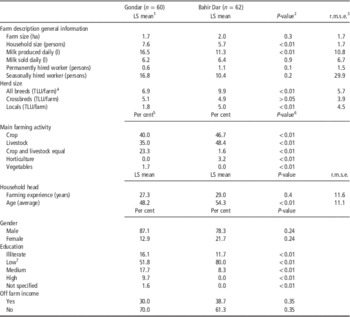
Respondent farms and household head characteristics are presented in Table 1. Although mixed crop-livestock farming was predominant some landless farmers applied zero-grazing by purchasing fodder. Larger herd sizes in BD depended solely on the higher number of local animals. Dairy production was practised mainly to generate income (93%) but also to supply family nutrition (28%; BD) or to achieve a positive impact on family life (9%; G). All family members were involved in dairy management but breeding decisions were mainly made by the household head sometimes consulting spouses or grown children.
Farm and household head description of sample farms in both contexts

1 Results of proc. GLM.
2 Determined by Tukey’s test.
3 Root mean square error (only relevant for proc. GLM results).
4 1 TLU (Tropical Livestock Unit)=250 kg.
5 Per cent of farms; results of proc. freq.
6 Determined by Fisher’s exact test.
7 Adult education, unspecified schooling or primary schooling.
Why, when and how farmers introduced crossbreeding
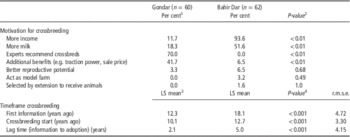
Farmers multiple motivations for crossbreeding introduction and the time that passed between the first information and implementation of crossbreeding varied between contexts (Table 2). To be able to introduce crossbreeding farmers needed information, access to the technology and support. In BD extension was most the important information source (45%) followed by other farmers (31%), Andassa Livestock Research Centre (ALRC) (8%) and livestock experts (8%). ILDP was almost the exclusive initial information source in G. Additional information sources in both sites were experienced farmers, extension, ALRC and NGOs.
Motivations and timeframe for crossbreeding introduction on respondent farms

1 Results of proc. freq.
2 Determined by Fisher’s exact test.
3 Results of proc. GLM.
4 Determined by Tukey’s test.
First access to crossbreeding technology was mostly provided by extension in BD (90%) and ILDP in G (98%). These crossbreeding initiators provided subsidized F1 heifers (50% exotic inheritance) to more than half of the farmers. One quarter started with AI. Further 17% purchased initial crossbreds from alternative sources (e.g. government farms, farmers) or received them as gift or dowry. The smallest group (5%) mated crossbred bulls to their local stock.
Half of the farmers in BD but all in G received support for crossbreeding. Crossbreeding initiators provided: information and advice (G), access to AI (G), bull or veterinary services (G), training on crossbred management, access to crossbred animals (subsidized heifers), farming inputs (free or subsidised) (G) and cash credit. Almost all farmers (97%) were generally satisfied with this support but 44% were dissatisfied with some aspects like lack of input supply, small number of selected households (G), training extent, crossbreeding problems (BD) and marketing problems. Support from other sources than the crossbreeding initiators, such as other farmers and other livestock experts, was received by 16% of farmers (BD).
Adaptation of crossbreeding at farm level
Almost all respondents (98%) continued with crossbreeding for the same reasons they introduced it for. But on-farm adaptations affected crossbred levels, exotic breed components or mating strategies. The three farmers (2%) who stopped crossbreeding could not manage feed shortage, feed prices, manpower shortage or death of a crossbred.
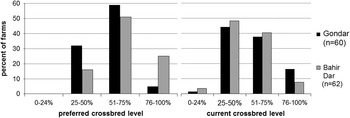
Most farmers reported a change of the initial crossbred level. This meant upgrading (64%), downgrading (10%), first up then downgrading (8%) or first down then upgrading (5%). For 10% of farms no clear trend was identified. The majority of these changes were caused by encouraging factors like increasing profits, reaching a preferred crossbred level (G) or by the easy access to breeding services (G). Fewer changes were caused by discouraging factors like lack of information, influence of others, difficult breeding and problematic management (BD). A proportion of 26% had no control over the crossbred level changes (BD). This means no choice of bulls or semen existed. By contrasting currently available crossbred levels with farmers’ preferred crossbred levels (Figure 1) it is clear that farmers prefer levels beyond 50% exotic inheritance in both sites. Respondents reported that their preferred crossbred levels are better adapted to the environment (G), perform better, can increase income, better fit the available management (G) or fit the farm’s breeding strategy (BD). An interesting result is that some farmers use purebred exotic semen (bulls or AI) only for local cows and crossbred semen (bulls or AI) only for crossbred cows to maintain constant herd crossbred levels.
Comparison of currently available and preferred crossbred levels (given in per cent of exotic blood) for both study sites.

A change to an alternative exotic cattle breed was not common (16%) (G). In G farmers were more aware of and interested in alternative exotic breeds (G).
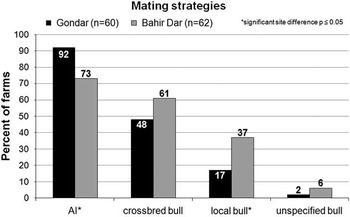
Another on-farm adaptation that has taken place is the use of multiple mating strategies for crossbreeding (Figure 2). Compared with their role during the first implementation of crossbreeding AI and bull services gained importance with only very few farmers (4%) never using either service. These user numbers, the high number of users generally satisfied with breeding service performance (83%) and the acceptability of breeding service charges to farmers (G) emphasize the importance of breeding services for crossbreeding in the region. The high general satisfaction with the breeding services is challenged by 30% of farmers in BD who reported that they had to use bulls as AI was not sufficiently available. Yet only 11% criticized breeding services as generally unsatisfactory (BD), the cause of breeding problems or inaccessible due to distance.
Mating strategies chosen by respondents to continue with crossbreeding (multiple nominations possible).

Impacts of crossbreeding at farm level, breed performance and challenges
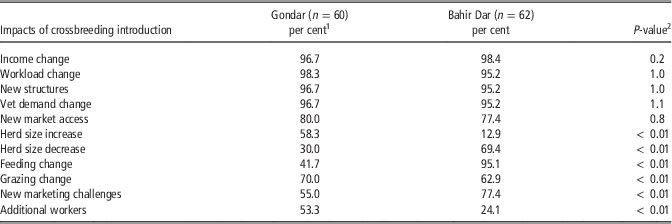
The introduction of crossbreeding had major impacts on the farm level production system (Table 3). Workload changes were reported for feed production and management (G), shelter cleaning (G), dairy activities (G), animal care (watering, health monitoring, herding) (BD) and general management and supervision. The additional workload was mainly covered by the families. The increasing workload is connected to the introduction of new grazing and feeding management. Grazing changed most profoundly as unlike locals most crossbreds were either not grazing or only at restricted times. This, together with the provision of new feedstuffs like industrial and household by-products (G), improved forage plants (G), grain and fodder crop (residues) and hay and straw (BD), represents the significant changes crossbreeding triggered at farm level. Furthermore the establishment of new structures like new cattle shelters (G), feeding troughs, shelter improvements and shelter separations (BD) added to workload and investment needs. These and other additional costs are covered by the higher incomes that were made possible not only by production increase but also by the rise of milk market participation which changed significantly from 11% before to 79% after crossbreeding. This new market access was not permanent for three per cent of farmers. The majority of farmers was able to use a larger variety of market outlets and reported an increasing importance of dairy cooperatives.
Impacts of crossbreeding introduction on the dairy production system at farm level

1 Results of proc.freq.
2 Determined by Fisher’s exact test.
Crossbreds differed from locals in selected productive and reproductive traits (Table 4). Additionally local cattle were reported to be healthier than crossbreds by 73% which was also reflected in the changing demand for veterinary services.
Farmers’ estimations for selected productive and reproductive traits of crossbred and local cattle

1 Each farm gave an estimate for each trait and both breeds.
2 Result of proc. GLM.
3 Determined by Tukey’s test.
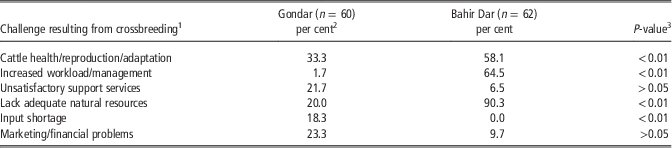
Farmers reported many challenges (Table 5) which they try to overcome by sharing their experiences among themselves and with experts mostly on general management (62%), breeding (15%, BD), crossbreds as income opportunity (15%) and processing of milk (9%). But after taking all positive and negative changes into account 94% of farmers would recommend crossbreeding to others.
Crossbreeding challenges farmers in the study region face

1 Multiple challenges per farm are possible.
2 Result of proc.freq.
3 Determined by Fisher’s exact test.
Discussion
Why, when and how farmers introduced crossbreeding
At first glance motivations to introduce crossbreeding were different in both contexts. BD farmers expectation, profit increase, is in line with Batz et al. (Reference Batz, Peters and Janssen1999) who identified profitability as an important factor in technology adoption. G farmers on the other hand trusted ILDP advice that crossbreeding would have beneficial effects on their livelihoods. This implies expectations of project benefits (e.g. inputs) which extension service was unable to supply. This implies further that the underlying reason to introduce crossbreeding was the same in both contexts: economic profit.
The crossbreeding timeframe indicates that even though BD farmers had earlier knowledge of crossbreeding, through actors like government ranches and dairy cooperatives, G farmers were able to introduce crossbreeding more quickly after receiving initial information through ILDP.
In both sites technology access was facilitated by subsidies on crossbreds and breeding services. This puts the respondents in a privileged position compared with other smallholders in Ethiopia and made initial investments, a significant parameter for farmers’ adoption decisions (Abdulai and Huffman, Reference Abdulai and Huffman2005), easier.
The important role of extension and ILDP as crossbreeding information, technology and support source must be emphasized. It is in line with earlier reports on the importance of extension services for technology adoption (e.g. Basunathe et al., Reference Basunathe, Sawarkar and Sasidhar2010). Farmers in G were more dependent on ILDP than BD farmers on extension. This is probably due to the context as farmers received all necessary information from ILDP. ILDP also provided more farmers with crossbreeding support in G than extension was able to do in BD. These facts, together with the shorter lag time to adoption in G, are in line with the reported advantages comprehensive projects have in facilitating technology adoption (e.g. Peacock et al., Reference Peacock, Ahuya, Ojango and Okeyo2011). On the other hand a larger range of different information and support sources, like in BD, could be advantageous if one fails to deliver.
High satisfaction with initiator support was surprising given earlier reports on animal service performance in the country (Haile et al., Reference Haile, Ayalew, Kebede, Dessie and Tegegne2011; Chebo and Alemayehu, Reference Chebo and Alemayehu2012). This result is most likely biased by the fact that we focused on successful crossbreeders. Farmers without the same access to support or unsuccessful with crossbreeding would probably be less satisfied with support service performance. The small number of our respondents who stopped crossbreeding did not justify an extrapolation of such data.
Irrespective of the role extension and ILDP plays, experienced farmers have proven to be important for crossbreeding information, technology access and support in both sites. This relation has been reported previously for adoption of new agricultural or livestock technologies (e.g. García et al., Reference García, Dorward and Rehman2012).
Adaptation of crossbreeding at farm level
The high level of continuation of crossbreeding indicates successful introduction of the technology. The limitation of our crossbred level data (based on farmers’ estimations) is acknowledged. But we believe that our data is sufficient for the documentation of farmers breeding strategies as it is representing the information that is also available to them.
Farmers expect a linear relationship between crossbred level and performance capacity. That this is an incorrect assumption (Syrstad, Reference Syrstad1996) but does not stop them from upgrading crossbred levels. It is necessary to train farmers on basic aspects of crossbreeding to clarify this misunderstanding.
Apart from a lack of basic understanding the major problem for implementing strategic breeding is the availability of exotic genes. Although current crossbred levels were in line with government recommendations of up 75% exotic genes (Felleke and Geda, Reference Felleke and Geda2001) the available AI options (50%, 75% or 100% exotic) were partly responsible for upgrading of crossbred levels. The distinction some farmers make in mating local and crossbred cows indicates that some are trying to keep herd crossbred levels constant.
Even though the general satisfaction of AI users is contradicting prior results (Gebremedhin, Reference Gebremedhin2008), multiple mating strategies reflect an unstable supply and lack of alternative sources for exotic genes in both sites. It has been observed that keeping breeding bulls is necessary as long as farmers cannot completely rely on AI (Basunathe et al., Reference Basunathe, Sawarkar and Sasidhar2010). But lack of pedigree records and emergency matings to local bulls make adhering to a breeding strategy so far almost impossible. This compromises long-term stability of the crossbreeding system. An interest in alternative exotic breeds (mainly Jersey) exists and the use of Holstein–Friesian genes in such a context should be debated. But, unless availability of appropriate, alternative exotic breeds is secured, introducing them is of little use.
Impacts of crossbreeding at farm level, breed performance and challenges
The impact of crossbreeding can be summarized as an intensification of dairy production at farm level. Significant increase of income, milk market access and number of market outlets are positive and in line with earlier findings (Patil and Udo, Reference Patil and Udo1997). A growing importance of cooperatives has also been reported as positive for milk market development (Tassew and Seifu, Reference Tassew and Seifu2009). But the changes required to achieve these profits have major implications.
A higher workload coupled with dependency on family labour augments pressure on farming families, especially women (Mullins et al., Reference Mullins, Wahome, Tsangari and Maarse1996), and the strained local labour market (Bitew et al., Reference Bitew, Bahata, Mekonnen and Duncan2011). Labour shortage, a restricting factor for technology adoption (Batz et al., Reference Batz, Peters and Janssen1999), seems more problematic in BD and is possibly one reason for slower crossbreeding adoption.
Intensification of feeding and grazing changes which have been connected to crossbreeding introduction earlier (Patil and Udo, Reference Patil and Udo1997; Addisu et al., Reference Addisu, Mesfin, Kindu and Duncan2012) increase the dependency on farm-external feed resources and input costs. This is partly counterbalanced in BD by herd size decrease, also a reported, and desired, consequence of crossbreeding introduction (Patil and Udo, Reference Patil and Udo1997). A distinction in feeding between genotypes, as crossbreds profit more from improved feedstuffs (Tekeba et al., Reference Tekeba, Wurzinger and Zollitsch2012), seems to be a strategy to combat rising feed costs.
In these aspects G farmers have realized the potential of crossbreeding technology better with smaller herds, larger proportion of crossbreds and higher daily milk production per farm. The comprehensive training by ILDP is a likely reason for these favourable developments.
Breed differences in performance between locals and crossbreds are in agreement with prior studies (e.g. Syrstad, Reference Syrstad1996; Ayenew et al., Reference Ayenew, Wurzinger, Tegegne and Zollitsch2009) although longevity results of this study are to be considered with care, due to a small coefficient of determination. The higher disease susceptibility of crossbreds is well documented (e.g. Wilson, Reference Wilson2009). The consequential increase in veterinary service demand emphasizes the importance of appropriate (technical) support services (Herrero et al., Reference Herrero, Grace, Njuki, Johnson, Enahoro, Silvestri and Rufino2013) and triggers further additional costs.
Crossbreeding challenges show clearly what farmers have to combat to succeed with crossbreeding. Challenges in BD mainly concern very basic inputs (resources, workforce and adapted animals) that are necessary to ‘take off’ with crossbreeding. Inputs the extension service does not supply. Farmers in BD had to deal with scarcities that did not challenge G farmers in the same way. This could be another explanation for the slower crossbreeding adoption in BD. Basic inputs were better supplied for in G, probably by ILDP. But the access to adapted animals, a problem inherent to this type of crossbreeding (Wilson, Reference Wilson2009), was more challenging for G farmers. Farmers in G there could ‘take off’ easier. But they were more challenged by the next level of the process, the ‘smoothness of the flight’: support and marketing.
Conclusion
We conclude that for the successful introduction of crossbreeding in our study contexts support and breeding services were essential. Implementation by a project, like ILDP, may speed up crossbreeding adoption and help farmers to realize the full technology potential quicker. But such an approach carries the risk to depend too much on a single actor. The intention to adapt crossbreeding at farm level to increase herd performance was visible but subjected to a lack of appropriate breeding inputs and a misconception of the crossbreeding concept. Crossbreeding introduction was accompanied by an intensification of workload, inputs and investment which resulted in a change towards a high-input/high-output system. Farmers regarded crossbreeding as success but an economic assessment of crossbred production systems in the study area would be advisable. The long-term sustainability of such a crossbreeding system has yet to be proven.
Acknowledgements
The authors wish to thank all participating farmers and experts. They acknowledge the support of Amhara Regional Agricultural Research Institute and Andassa Livestock Research Centre. Special thanks to Addisu Bitew, Tekeba Eshetie, Amlaku Asres and Alayu Kidane. R. Roschinsky is supported by BOKU DOC Grant awarded by BOKU University, Vienna, Austria.