Introduction
A spectre is haunting mainstream politics, the spectre of right-wing radicalism. On 24 October 2019, the European Parliament (EP) rejected four motions for resolutions on the issue of search and migrant rescue in the Mediterranean Sea. Rory Palmer, a Member of the European Parliament (MEP) from the Progressive Alliance of Socialists and Democrats (S&D), remarked that the resolution was ‘defeated by just two votes [290 versus 288]’ and characterized the event as ‘a bleak day for this Parliament’ (European Parliament 2019a). Another MEP, Grace O’Sullivan, member of the Greens/European Free Alliance Group (Greens/EFA), pointed out that ‘This was a vote that was swayed by the far right, who worked hard to kill the amendment and (unbelievably) cheered when it was defeated’ (Moore Reference Moore2019). An article in the EUobserver noted that ‘EU centrists ally with far right on migrant rescues’ (Nielsen Reference Nielsen2019).
The last decade has been characterized by a right-wing ethos of radicalism that has contaminated mainstream parties all over the world. Across the Atlantic Ocean, the election of Donald Trump rekindled a dormant nationalistic fervour that set its eyes on immigrants, refugees and various other minorities. On European shores, the British Conservative Party (CP) had thrown the United Kingdom (UK) into a lasting political crisis after it hubristically organized a referendum on whether the country should leave or remain in the European Union (EU) based on the false assumption that the majority of the electorate will vote to stay (Lochocki, Reference Lochocki2014). In this case as well, the immigration issue had been a driving force shaping the views and attitudes of the voters. From these examples, it can be observed that the stigma of being associated with fringe positions is not as much of a deterrent as we might have been inclined to believe. On the contrary: conservative parties have sought to establish political partnerships with the radical right ones (such as in the Austrian or Danish cases) that have strengthened the radical right positioning on certain topics such as immigration and border security. This, is turn, creates what Minkenberg (Reference Minkenberg2013, 21) has identified as a ‘radicalization of the mainstream’.
In the current article we examine how, in light of the 2019 and the 2014 EP elections, the politics of right-wing radicalism have gained a foothold into the mainstream that allows them to coordinate and advance their agenda with other kindred parties. What enables this phenomenon? Have these parties started to embrace more moderate positions in recent years? Or maybe, they have been successful because of their hard-line stances and not in spite of them? Are peers from mainstream parties and groups acknowledging them and partnering with them? And if so, have those mainstream parties ever flirted with a radical right-wing rhetoric?
In order to assess the extent to which radical right parties (RRPs) have made these types of inroads on the European and national political scene, we propose a two pronged approach: on one hand, by operating with the mainstreaming thesis, we conducted a comparative electoral analysis of the RRPs’ results registered during the last two EP elections; on the other, we used the respectable marriage thesis in order to understand how it was possible for some RRPs to make such a qualitative somersault. For this purpose, we analysed how RRPs have gone about making alliances in the EP in their pursuit of the mainstream legitimacy.
While, in the 2019 EP elections, the RRPs might not have duplicated the results obtained in 2014, they did not categorically repudiate them either. In reviewing the European RRP’s performance from 2019, Cas Mudde asserts that these parties’ continued presence in the EU confirms some worrying trends that the EU seems to be battling with, such as ‘increased fragmentation, growing support for populist parties, […] the decline of the center-right and center-left blocs’ (Mudde Reference Mudde2019, 23). This is a significant break with the past considering that, during the 2014 elections, Mudde was rather dismissive of their presence in the EP and elsewhere: at that time, RRPs had a national parliamentary presence in only 12 Members States (MSs); ‘they [were] generally a rather modest electoral factor’, they ‘seldom work[ed] effectively together within the EU’ etc. (Mudde Reference Mudde2014a). In other words, they were not supposed to be a hindrance for European affairs.
By considering the mainstreaming and respectable marriage theses, this article tracks how, during the last decade, RRPs from multiple MSs have grown by leaps and bounds: they have expanded their electorate; time and time again, they have placed among the voters’ top three political preferences; in some instances they have even won (European and national) elections; in others, they became part of ruling governmental coalitions. While this phenomenon does not affect all the remaining 27 MSs in the same way (mainstreaming is for the most part a Western European affair), it can have contagion-like effects: instead of taking notice and containing the policies pursued by the RRPs, the centrist parties on far too many occasions have conveniently adopted ‘the dog-whistles’ of the radical right (Minkenberg Reference Minkenberg2015; Hafez et al. Reference Hafez, Heinisch and Miklin2019).
Terminological Clarifications
RRPs are a heterogeneous group that defies easy taxonomical classifications. Three recurrent terms are used – sometimes interchangeably – to describe parties on the fringes of the right-wing spectrum: far right, extreme right, and radical right. For the purpose of the present analysis, we operate with the distinction between the extreme right and the radical right (Golder Reference Golder2016, 477–478). Mudde (Reference Mudde2000, 12) proposes an elegant solution to this terminological conundrum and argues that parties associated with the far right family should be divided between radical right and extreme right parties. Extremist parties seek to subvert the democratic order, while radical parties – though they (may) disagree with the current political system – will seek to reform it by participating in the democratic process (Mudde Reference Mudde2007, 31; Eatwell Reference Eatwell2000, 410–411). In this way, the qualitative differences between the United Kingdom Independence Party (UKIP) and the Greek Golden Dawn (GD), for example, are no longer so dissonant, given that the parties belong to different far right paradigms. As Mudde (Reference Mudde2007, 31, emphasis in original) remarks, ‘[m]ost importantly, the radical right is (nominally) democratic, even if they oppose some fundamental values of liberal democracy […], whereas the extreme right is in essence antidemocratic, opposing the fundamental principle of sovereignty of the people’. In the given example, both UKIP and GD put an emphasis on Euroscepticism and national sovereignty. Yet, where GD militates for outlawing immigration and the purity of the Greek identity, UKIP operates with a toned-down version of nationalism that distances itself from ethno-nationalistic criteria rooted in ‘blood, birth, creed’ (Halikiopoulou and Vasilopoulou Reference Halikiopoulou and Vasilopoulou2014, 288).
In terms of labels, Pippa Norris considers that the attempts that have sought to analyse these parties by attaching various designations such as ‘new right’, ‘neoconservative’ or ‘neofascist’ are more likely to be ‘inaccurate’, while the concept of ‘the extreme right’ implies, in her view, too wide a range of political groups (which could include even violent or terrorist movements). According to Norris, the most appropriate and advantageous concept to use in an analysis is that of ‘radical right’, because, unlike labels such as ‘anti-immigrant’, ‘nationalist’, ‘anti-system’ or ‘populist’, the ‘radical right’ label takes into account the fact that ‘these parties are located toward one pole in the standard ideological left–right scale where parties are conventionally arrayed’ (Norris Reference Norris2005, 45–46).
Cas Mudde’s theorization on the topic of far right parties and ideologies remains one of the most cited. According to him, at the core of all these parties, the ideological strata comprises the following three traits: nativism, authoritarianism and populism (Mudde Reference Mudde2007, 20–23). By comparison, Paul Hainsworth (Reference Hainsworth2008, 11–12) shows that the main features of the extreme right are ‘the espousal of narrow, ethnically based, exclusionary representations of the nation’, combined with ‘anti-partyism, anti-parliamentarism and anti-pluralism’. In this assessment, the main defining elements of these parties are ‘nationalism, racism, xenophobia, ethnocentrism and exclusionism’ (Hainsworth, Reference Hainsworth2008, 11–12). Notably, in his view, even in the case of the extremist parties, ‘they do not reject democracy per se, but have reservations about its current workings’ (Hainsworth, Reference Hainsworth2008, 12).
In a 2011 Chatham House report analysing the European far-right parties, Matthew Goodwin observed that the factors that push people to embrace RRPs have less to do with material and economic factors (lack of access to resources, economic anxiety) and more to do with symbolic aspects such as national identity or European values (Goodwin Reference Goodwin2011, x). In light of this, although there are significant differences between the European RRPs, they all have two elements in common: they ‘are hostile towards immigrants, minority groups and rising ethnic and cultural diversity and they adhere to a populist anti-establishment strategy’ (Goodwin Reference Goodwin2011, 12). In courting the mainstream, RRPs have to balance between what Hainsworth (Reference Hainsworth2008, 12) would refer to as the ‘disparity between [their] liberal-democratic pretentions and the[ir] illiberal values’.
Right-wing Radicalism and the Mainstreaming Thesis
In general, RRPs are integrated in the national political landscape irrespective of the ‘skin’ they inhabit: hard-line, pragmatic, respectable (for a discussion on the various typologies of the radical right see Minkenberg Reference Minkenberg2013; Rydgren Reference Rydgren2018). What we are seeing in recent years is that they are now becoming fixtures in the mainstream. This has been made possible due to the apparition of favourable conditions (crisis moments) in the political landscape which created, in turn, electoral opportunities. Where the political mainstream is concerned, the RRPs are faced with a double choice: stick to the traditional party rhetoric and the core electorate or attempt to appeal to a broader electorate who might otherwise not resonate with their niche rhetoric.
According to Akkerman et al. (Reference Akkerman, de Lange, Rooduijn, Akkerman, de Lange and Rooduijn2016, 3), mainstreaming (Cammaerts Reference Cammaerts2018; Odmalm and Hepburn Reference Odmalm and Hepburn2017; Pytlas Reference Pytlas, Herman and Muldoon2019; Schnose Reference Schnose2016) is based on ‘the inclusion-moderation thesis’, which states that parties will moderate their stances in order to be included in the democratic process. Yet in order for the convergence to be fully realized, the process of mainstreaming involves a transfer of attributes: mainstream parties succumb to a process of ‘radicalisation’ (Akkerman et al. Reference Akkerman, de Lange, Rooduijn, Akkerman, de Lange and Rooduijn2016, 6), while their radical counterparts pursue a deradicalization track. Yet deradicalization is not necessarily mandatory for RRPs to become part of the mainstream. In which case, if RRPs are not required ‘to rehabilitate’ themselves, why are mainstream parties engaging with them in the first place?
Michael Minkenberg (Reference Minkenberg2013, 20) observes that ‘political actors have […] not only […] adopt[ed] and legitimiz[ed] some of the [radical right] elements, but also, in a number of cases, […] [they have] forg[ed] coalitions (official as well as unofficial ones) with them’ (see Denmark, Italy). These interactions between radical right-wing parties and mainstream ones create a network of convergences that are at the basis of mainstreaming. These convergences in turn speak about how the border between the radical right sphere and the mainstream sphere is porous. This porosity might be a by-product of a specific socio-cultural phenomenon, of a change in the profile of the electorate, of a need to compete with electorally successful RRPs on their own terms, etc.
Where the EP is concerned, we can track how RRPs have moved from a phase of total or quasi-rejection (see all the EP legislatures in which RRPs failed to launch their own group) to one in which they were granted access to mainstream groups (see the Nordic RRPs and their membership in the European Conservatives and Reformists group – ECR; Fidesz in the European People’s Party – EPP), and, lastly, to one in which they partially returned to their roots (in forming the Identity and Democracy group during the ninth EP, the goal of its architects – Front National’s Marine Le Pen, La Lega’s Matteo Salvini – had been to create a policy congruent big tent group that would have allowed its members to participate, benefit, and advance their various policy agendas on issues such as immigration or the reform of the EU). If the other two groups, of which some of these parties had been previously part, had not have collapsed due to their dependency on the MEPs from the UK, the RRPs could have replicated their behaviour from 2014–2019 which saw some of them pursue various tactics rooted in mainstreaming strategies. The current domestic and international socio-cultural context favours such a policy congruent alignment.
Right-wing Radicalism and the Respectability Thesis in the EP
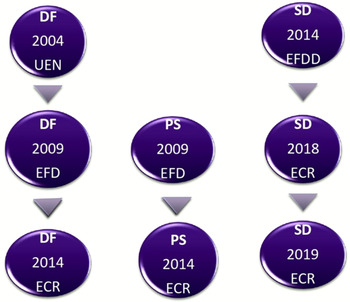
Even though, in 2014, the electoral results enabled the creation of a policy congruent radical right group, not all RRPs chose to be a part of it, opting instead for membership in other groups such as ECR or EFDD (Europe of Freedom and Direct Democracy). Prior to this moment, the extremist background and the overt racist appeals had proven for the most part to act as an efficient and effective hindrance, barring these parties from tapping into more legitimate avenues. In this regard, as can be seen in Figure 1, some RRPs had overcome this obstacle with (Danish People’s Party – DF; Finns Party – PS; Swedish Democrats – SD) or without (Freedom Party of Austria – FPÖ) recourse to respectable European alliances. Others overcame it only to fall right back into it (Alternative for Germany – AfD).
The Nordic radical right parties and their adherence to moderate groups (2004–2014).

For example, in SD’s case, McDonnell and Werner (Reference McDonnell and Werner2018, 757–758) describe how the party had envisioned ‘to improve its image’ by becoming a member of ECR and that in doing so, it needed ‘to prove itself a respectable partner by going through the same process that [DF and PS] had’. The authors quote Kent Ekeroth – SD representative in charge of European alliances – who pointed out that both DF and PS benefited from being in the ECR during the eighth European Parliament: ‘They get normalised, people meet them, […] they’re not Nazis or whatever they accuse them to be […]. We’re not either’ (McDonnell and Werner Reference McDonnell and Werner2018, 757–758).
McDonnell and Werner (Reference McDonnell and Werner2018, 748) examined why, given the formation of a policy congruent group such as the Europe of Nations and Freedom (ENF), certain RRPs became members of ECR and EFDD. By examining DF, PS, SD and UKIP, the authors found that these parties prioritized future votes and ‘spoils of office’ at either the national or European level instead of the short-term and even short-sighted policy congruence.
An article in The Guardian from May 2014 covering the potential admission of DP in ECR cited Sir Robert Atkins, former minister in John Major’s government, who warned the Conservative Party about the risks such an association could have on the public image of British Conservatives (Watt Reference Watt2014a). Martin Callanan, the chairman at that time of the ECR group (who would eventually lose his seat after the 2014 EP elections), is quoted saying that the Conservative Party was in ‘a very good relationship with Mr. Messerschmidt [the DF MEP representative]; we have worked closely with him in the present parliament, and his views on Europe are close to the ones held by the ECR’ (Watt Reference Watt2014a, emphasis added). In 2002, Messerschmidt had been convicted for inciting racial hatred after saying that multi-ethnic societies were prone to ‘mass rapes, gross violence, insecurity, forced marriages, oppression of women (and) gang crime’ (The Local 2014). He also compared the hijab to the swastika (Watt Reference Watt2014b). Gareth Thomas, the Shadow Minister for Europe at that time, noted that DF and PS were
too extreme to ally in 2009, so now [the prime-minister] needs to explain what has changed. David Cameron has isolated himself from allies in the EU, and now his MEPs are withdrawing to the extreme fringes of acceptable politics within Europe. (Watt Reference Watt2014b)
While there was some pushback from inside the ECR, Cameron had insisted that the parties shared similar stances on the EU (Jungar Reference Jungar, Bernitz, Mårtensson, Oxelheim and Persson2018).
Bressanelli and de Candia (Reference Bressanelli and de Candia2019, 31) suggest that political groups eschew the rigueur of ideological compatibility in pursuit of financial, policy-making and office-seeking incentives: ‘Financial resources are distributed among the political groups considering both their size (the number of MEPs) and their territorial heterogeneity (the number of member countries)’. The bigger the group, the higher the access to resources. Additionally, the size and representivity of the group also make it more likely to be present in key EP positions given that ‘some apical positions in the EP hierarchy are only allocated to the largest, or the pivotal, political groups’ (Bressanelli and de Candia Reference Bressanelli and de Candia2019, 31).
For some members, group membership is about respectable engagements, for others, it is a marriage of convenience. Bressanelli and de Candia (Reference Bressanelli and de Candia2019, 30–31) point out that – facing the prospect of being rejected by domestic actors – the radical parties will pursue transnational alliances in a bid for ‘respectability’. By associating with ECR, DF and Finns Party had shown ‘their desire to gain legitimacy to widen their electoral appeal and/or strengthen their coalition potential with future partners in the national government’ (Bressanelli and de Candia Reference Bressanelli and de Candia2019, 30).
McDonnell and Werner (Reference McDonnell and Werner2018) have theorized that in allying themselves with mainstream (moderate) parties, not only do the respectable radicals set themselves apart from their more intransigent peers, but they are also potentially better positioned to advance their agenda and to obtain concessions. The authors argue that once a party has been accepted into a more respectable group, it is ‘unlikely that it will move back and risk losing the “respectability bonus”’ (McDonnell and Werner Reference McDonnell and Werner2018, 760). In practice, we have seen that this is not the case: LN was a member of EFDD’s predecessor – Europe of Freedom and Democracy in 2009, but was a founding member of EFN in 2014; the remaining two AfD members were expelled from ECR after one of the MEPs declared that migrants attempting to cross the border at the height of the refugee crisis should be shot (Rankin and Oltermann Reference Rankin and Oltermann2016).
Nigel Farage refused to cooperate with FN, FPÖ, the Dutch Party for Freedom (PVV), or Flemish Interest (VB) because UKIP was envisioned as ‘an acceptable mainstream moderate party’ (Akkerman et al. Reference Akkerman, de Lange, Rooduijn, Akkerman, de Lange and Rooduijn2016, 9). Meanwhile, in the case of the New Flemish Alliance (N-VA), before becoming a member of ECR, the party had considered joining ALDE (Alliance of Liberals and Democrats for Europe). The idea was eventually dismissed since, among other things, ALDE was led by the former Belgian Prime Minister Guy Verhofstadt who opposed N-VA and regarded it as ‘a far-right political movement due to the number of former [VB] members who have been included in the party’s lists’ (Leruth Reference Leruth2014). To top it off, in 2019, DF and PS – the respectable radicals of yesteryear – became members of the Identity and Freedom group.
Preliminary Observations Regarding the 2014 and 2019 EP Elections
In the last decade, the EU has witnessed a resurgence of the radical right in multiple Member States (MSs). In terms of electoral success, until recently, breakthroughs at the aggregate level have been rare and while the instances where these parties became government members have been even rarer (see the Danish, Austrian or Italian cases), they were not to be neglected. After the 2014 EP elections, several parties witnessed a significant growth compared with the previous election. In these instances, they outperformed the mainstream parties and won the most number of seats in the EP. That being said, the presence of RRPs in the EP has generally been mitigated by several factors concerning:
-
the nature of the election itself (Reif and Schmitt Reference Reif and Schmitt1980; Hix and Marsh Reference Hix and Marsh2007; Filimon Reference Filimon2015);
-
the crisis affecting the national party systems (Mudde Reference Mudde2014b; Best Reference Best2013);
-
party congruence (parties struggled to form alliances with other national counterparts – while some, like in the Danish and Finnish cases, were actively distancing themselves from such partnerships (McDonnell and Werner Reference McDonnell and Werner2018, 747–748);
-
party performance (RRPs had proved time and time again to be rather ineffective in the EP (Mudde Reference Mudde2014b; Morris Reference Morris2013, 43–58; Almeida Reference Almeida2010; MacKenzie Reference MacKenzie2017).
As numerous analyses have noted (Mudde Reference Mudde2015; Hobolt Reference Hobolt2015; Lochocki Reference Lochocki2014; Halikiopoulous and Vasilopoulou Reference Halikiopoulou and Vasilopoulou2014), this radical right surge did not affect all MSs equally. While its prevalence has been mostly limited to the Western and Northern regions of the EU, the Southern and Central and Eastern European (CEE) regions did not escape unscathed either. In the latter regions, the number of successful RRPs may have been comparatively reduced, but on the other hand, the politics of radicalization were more entrenched within the mainstream parties (see the cases of Hungary and Poland).
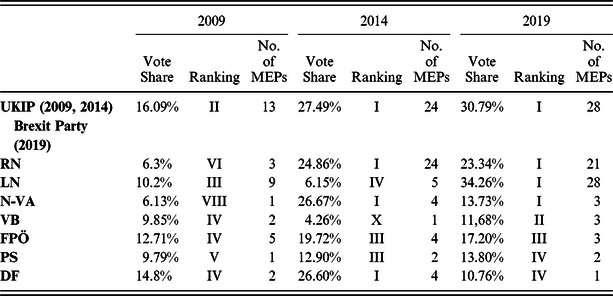
Luo (Reference Luo2017, 407) remarks that in the Western region, the issue was compounded by the fact that in the 2014 EP elections, parties such as FN (currently known as Rassemblement National (RN) or National Rally) and UKIP had been voted for by a majority of people. This situation was replicated in the 2019 EP elections: although RN lost three seats compared with 2014, it still came in first place, while, in the UK, the newly formed Brexit Party (BP) spearheaded by UKIP’s former leader, Nigel Farage, similarly came in first. Not only that, but it also became the largest single party in the EP (European Parliament 2019b). Meanwhile, though there were RRPs that lost seats compared with 2014 (as in the case of the FPÖ, the PVV, or DF), there were others that picked up the slack (VB in Belgium, LN in Italy, Vox in Spain) (Zalc et al. Reference Zalc, Becuwe and Buruian2019, 16) (see Table 1).
Sample of RRPs electoral performance across three EP cycles (2009–2014–2019). (Data Source: European Parliament (2014) Results of the 2014 and 2009 European elections – Results by country. Available at http://www.europarl.europa.eu/elections2014-results/en/country-introduction-2014.html; European Parliament (2019b) European election results. Available at https://election-results.eu/).

Aside from individual party performance, another aspect that has attracted our attention concerned the expansion of the far right group established by Marine Le Pen during the previous parliamentary exercise. The Identity and Democracy group – which succeeded the ENF – had more than doubled the number of MEPs compared with its predecessor (73 versus 30) (European Parliament 2019c). Moreover, these parties had also doubled their share of MEPs from 5% in the 2014–2019 legislature to 10% at the beginning of the ninth EP term. The Identity and Democracy group is now the fifth largest group in the EP (Rankin Reference Rankin2019). Meanwhile, a decade earlier in 2009, Marine Le Pen and other right-wing leaders such as PVV’s Geert Wilders failed to form a group after coming short of the required number of MEPs and MSs.
In analysing the results of the 2019 EP election, Cas Mudde observes that irrespective of the gains and losses registered by the various RRPs, one aspect stands out:
[…] more than anything, the populist radical right increased their presence and power within Brussels because of the transformation of two governing parties in the East, Fidesz in Hungary and Law and Justice (PiS) in Poland. Both parties were still considered conservative in 2014, but shifted to the populist radical right in the wake of the so-called ‘refugee crisis’ of 2015, and the Jihadist terrorist attacks in Brussels and Paris around that time. (Mudde Reference Mudde2019, 24)
In our view, on the domestic front, the transition towards illiberal positions in the case of Fidesz and the PiS had manifested itself even prior to the international events mentioned by Mudde (for example, in 2011, PiS supported a bill proposal that would have banned abortions, while Hungary’s embrace of ‘a degraded concept of democracy’ under Viktor Orbán could be traced even as far back as 2011–2012 (Bozóki and Hegedűs Reference Bozóki and Hegedűs2018, 1174)).
In 2014, of the 28 MSs, the RRPs present in the EP originated from only half of them. In terms of EP group membership, the majority of them were initially split between the ECR (AfD, N-VA, DF, Finns Party, PiS, NA) and the newly formed ENF (FN, FPÖ, PVV, LN). Three parties were part of Farage’s Europe of Freedom and Direct Democracy – EFDD (UKIP, SD and the Lithuanian Order and Justice – PTT) while Fidesz was a member of the EPP. The Polish Congress of the New Right’s (KNP) four MEPs were split between ENF (two MEPs), EFDD (one MEP), and non-incrits (one MEP).
Notable realignments were seen in the case of the Swedish Democrats and AfD. SD had been a member of EFDD for the greater part of the 2014–2019 cycle, but they were eventually accepted into ECR on 3 July 2018, two months prior to the Swedish general election (9 September 2018). Initially, SD had been excluded from ECR due to its extremist origins – Anders Vistisen, a DF MEP, is quoted as saying ‘we really have a hard time with them, because of their history, where they came from … They’ve changed a lot, but it’s hard for us to overlook that’ (McDonnell and Werner Reference McDonnell and Werner2018, 757). In 2018, the PiS MEP and co-chair of ECR, Ryszard Legutko, noted that ‘[a]s the Sweden Democrats move towards becoming a major party of the government in Sweden, we welcome their decision and that of their MEPs to support the ECR group’s agenda for securing meaningful and lasting reform within the EU’ (Rankin Reference Rankin2018).
In the latter instance, AfD also underwent a series of changes: five of its MEPs would leave the party after a leadership reshuffle, but remain in the ECR while the two remaining AfD MEPs would be expelled from the group on account of their ties to FPÖ (Oliveira Reference Oliveira2016). They would subsequently join EFDD and ENF respectively (Jungar Reference Jungar, Bernitz, Mårtensson, Oxelheim and Persson2018, 67).
The contemporary instantiations of right-wing radicalism are fluid and fluctuating – an expression of evolving ideological gradients where the intensities ‘sharpen up or deflate’ depending on the political context. The parties try to curb their more extremist impulses in the hope of becoming politically viable and of expanding their voters’ pool, but they also benefit from some centre-right parties’ backsliding tendencies, as seen in the examples about the rejected immigration resolutions or the Brexit referendum. Ironically, while some RRPs try to obfuscate their positions, the conservative parties are those prone to display regressive tendencies. For example, in the Dutch case, the governing right-liberal People’s Party for Freedom and Democracy (VVD) has previously entertained a rhetoric that
proposed to force unemployed workers from Eastern Europe back to their home countries; […] tried to persuade all EU member states to alter their immigration – and asylum – regimes according to the very strict Dutch regulations […] [and even] set up a ‘help-line’ where Dutch voters could call in order to complain about migrants from Eastern Europe. (Lochocki Reference Lochocki2014, 14–15)
Two Cycles of EP Elections: Radical Right (Re)Alignments from 2014 and 2019
The ninth European Parliament offers a changed landscape compared with what we had up to then. For one, it should have been the first EP representing the wills of the citizens from 27 MSs post-British referendum, but a solution to the Brexit negotiation process had been postponed over and over again by the time the EP elections rolled over. This meant that the UK, which had one foot out of the European door had to participate in the elections even if at one point prior to the electoral proceedings, the British MEP seats had already been redistributed between the other MSs.
Where the RRPs were concerned, this created an interesting dynamic since the respectable framework in which some of them had operated in 2014 was no longer viable. The British Conservatives which welcomed the Scandinavian parties (DF, Finns Party, SD) had for a second consecutive time been administered a resounding blow in the EP elections. Yet while, in 2014, the Tories managed to obtain 18 seats, which enabled them to retain the numerical control of the ECR (the only other party in ECR which had MEPs in the double digits had been PiS, with 14 MEPs), in the 2019 elections, they only won four seats. Moreover, the dominant party in the ECR for the 2019 legislature was going to be PiS which had won a record number of 25 seats. Meanwhile, parties such as the N-VA, IMRO – Bulgarian National Movement, NA, the Spanish Vox or the Sweden Democrats tilted the group in a more strongly pronounced radical right direction. By comparison, in 2014, the ECR members represented a more heterogeneous group of political beliefs. With a diminished Tory presence that would eventually exit the EP at the end of 2019, the ECR had lost its respectable veneer.
The EFDD group was disbanded altogether with the Brexit Party – UKIP’s spiritual successor – remaining non-inscrit despite winning a record number of MEPs. Any group would have been bolstered if it had those 28 Brexit Party seats at its disposal, but especially the Identity and Democracy group which would have become the third largest group in the EP and therefore not only would it have changed the narrative about RRPs performing worse than expected, it would have also changed and challenged the balance of power in the Parliament. As we have noted before, more numbers meant more resources, more influence, more access to the governing structures of the EP.
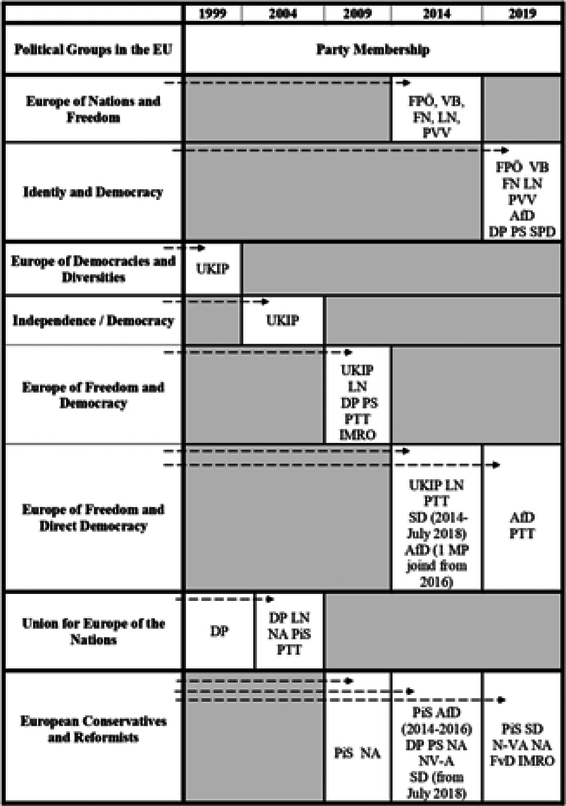
On the back of the 2014 far-right group, Europe of Nations and Freedom, emerged the Identity and Democracy group. The three largest parties representing the bulk of the members were Lega with 28 MEPs, National Rally with 20 MEPs, and Alternative for Germany with 11 MEPs (+4 compared with 2014). Other parties included in this group were: Freedom Party of Austria, Flemish Interest, Freedom and Direct Democracy, Danish People’s Party, the Conservative People’s Party of Estonia and the Finns Party. Having failed to secure any seats in the EP, the Dutch PVV was a notable absentee from this group. PVV gained one MEP in the context of the post-Brexit apportionment of seats and joined the Identity and Democracy group. Table 2 illustrates whether the parties remained stationary or moved within the various groups by linking their membership to the evolution of the various iterations that conservative, Eurosceptic and radical groups took throughout the last five EP terms.
Group affiliation of (radical) right wing parties: consistency and volatility.

The behaviour of the Danish and Finnish parties tells us that the respectable marriage thesis can only be adhered to under certain circumstances and incentives: in 2019, they joined the Identity and Democracy group after refusing to be part of the ENF in 2014. On the one hand, considering that DF came in fifth place and only managed to win one seat in the 2019 EP elections, it did not have too many viable options at its disposal. Kosiara-Pedersen (Reference Kosiara-Pedersen, Bolin, Falasca, Grusell and Nord2019, 75) notes that the times when DF enjoyed popular support have stagnated: ‘Danish People’s Party has been plagued by accusations of economic fraud in EP (MELD/FELD), and they are in decline at the level of the general election as well’. On the other hand, not the same thing can be said about Finns Party, which as Strandberg and Karv (Reference Strandberg and Karv2019, 76) point out, ‘successfully renewed their two mandates and slightly increased their vote share’.
Analysing the mainstreaming tendencies at the national level, Minkenberg (Reference Minkenberg2013, 19) remarks that
the radical right’s participation in government does not mean a permanent taming and de-radicalization since the radical right continues to abide by [what Sartori referred to as] ‘a belief system that does not share values of the political order within which it operates’. (Sartori 1976, 133; see also Albertazzi and McDonnell 2005; Minkenberg 2008)
Sartori’s rationale also applies at the European level given that the parties adhered to the respectable marriage thesis as long as it was pragmatically convenient. In terms of national performance, during the eighth EP, both the Danish and Finnish parties secured comfortable electoral scores (both placed second) which in turn enabled them to provide parliamentary support (DF) or to become coalition partners (Finns Party).
Conclusions
RRPs pursue a respectable track in an attempt to obtain gains of various kinds (electoral, political, strategic), and, as we have seen, this approach has proven to be successful on the national front (DF, Finns Party’s national performance during 2014–2018). The respectable track can provide a path out of the electoral fringes, but in order to get a foothold into the mainstream, RRPs depend on other parties to acknowledge them as legitimate actors. As seen, for example, by the entry of the Scandinavian RRPs in the ECR group during the eighth EP, the respectable makeover proved to be successful in the EP – a fact that, for the most part, was also reflected at the national level (although SD was cordoned off by the political parties that refused to collaborate with it despite its strong electoral showing as the third most voted party during the 2018 elections, in the Danish case, DF provided parliamentary support for the fourth time out of the six elections it had participated in since its founding – as a matter of fact, counting the 2019 general elections, DF had been in opposition for only three electoral cycles).
Moreover, even membership in groups such as the ENF did not constitute grounds for automatic rejection: not only did FPÖ and LN maintain electoral support during the general elections, but they also became coalition partners in their respective states.
The performance of the RRPs in the subsequent national and European elections indicates that the results registered in 2014 were not simply an isolated phenomenon or a by-product of an electoral tantrum. Instead, they were merely a preview of an emerging political market which at some other point in time, would have been relegated to the margins.
This article has shown that the RRPs’ presence in the mainstream political landscape is not necessarily a de-radicalizing one and that, more likely, we are dealing with a case where the mainstream is the one slowly succumbing to various radicalizing triggers (economic anxiety, immigration, terrorist attacks, etc.). This phenomenon is reflected in the ease with which other parties adopt radical right talking points or even go as far as slipping into an anti-democratic dynamic, such as in the Hungarian and Polish cases. These being said, it is also important to keep in mind that there are places (Ivănescu Reference Ivănescu, House and Kaniklidou2017) where the radical positions failed to grab hold of prime mainstream real-estate.
The results of the 2014 and 2019 elections reflect a ‘trust crisis [that] should not be underestimated’ (Luo Reference Luo2017, 417), ‘a “no confidence vote” on the part of various segments of a […] heterogeneous European electorate’ (Ivănescu and Filimon Reference Ivănescu and Filimon2016, 257). The fact that RRPs are found with various degrees of success in so many MSs signals the presence of a systemic dysfunction. Instead of treating the radical mainstreaming as the new de facto reality which must be appeased in light of the RRPs’ electoral prowess and of the other parties’ inability or unwillingness to cordon them off, it would be advised to identify the causes and mitigate the effects behind this trend of European and national dissatisfaction and discontent. Left unattended, this can and, as we have seen with Brexit, it has already produced long-lasting consequences. How damaging and to what extent the RRPs can further advance their radical agenda, remains to be seen.
List of Acronyms and Abbreviations
- AfD
-
Alternative for Germany
- ALDE
-
Alliance of Liberals and Democrats for Europe
- BP
-
Brexit Party
- CEE
-
Central and Eastern European
- DF
-
Danish People’s Party
- DUP
-
Democratic Unionist Party (Northern Ireland)
- ECR
-
European Conservatives and Reformists
- EFDD
-
Europe of Freedom and Direct Democracy
- ENF
-
Europe of Nations and Freedom
- EP
-
European Parliament
- EU
-
European Union
- FN
-
Front National
- FPÖ
-
Freedom Party of Austria
- FvD
-
Forum for Democracy (Dutch Party)
- IMRO
-
Bulgarian National Movement
- KNP
-
Congress of the New Right (Poland)
- LN
-
Northern League
- MEP
-
Member of the European Parliament
- NA
-
National Alliance (Latvia)
- N-VA
-
New Flemish Alliance
- PVV
-
Party for Freedom (Netherlands)
- RRP
-
Radical Right Parties
- SD
-
Sweden Democrats
- SPD
-
Freedom and Direct Democracy (Czech Party)
- PiS
-
Law and Justice (Poland)
- PTT
-
Order and Justice (Lithuania)
- RN
-
Rassemblement National
- UEN
-
Union for Europe of the Nations
- UKIP
-
United Kingdom Independence Party
- VB
-
Flemish Interest
About the Authors
Mihaela Ivănescu is Lecturer at the Faculty of History and Political Science, ‘Ovidius’ University of Constanta, Romania and chair of the Department of History and Political Science. She holds a PhD in Political Science from the University of Bucharest (2012). Her main research interests lie in the fields of comparative politics, the study of electoral systems and electoral behaviours, political attitudes and electoral behaviour in Romania, European integration, European institutions and politics.
Luiza-Maria Filimon is currently a post-doctoral researcher at the National University of Political Studies and Public Administration, Bucharest, Romania and has a PhD in Political Science awarded by the same institution in 2017. Her main research interests concern the subfield of international relations theory (with an emphasis on poststructuralism and discourse analysis) and electoral studies with a focus on European parliamentary elections and electoral behaviour.