When Munich's Alpine Museum opened in 1911, it presented Alpine tourism as a fable of success for the urban middle class of Germany and Austria. Visitors were welcomed by two art nouveau male figures, aesthetically integrating Alpinism into the Lebensreform movement of the educated German Bürgertum.Footnote 1 In one antechamber, a display of twenty mark notes represented the 8,348,615 marks invested in the Alpine terrain by the German and Austrian Alpine Association (Alpenverein) since 1874.Footnote 2 In the following rooms, the museum presented a history of ‘Alpine Erschliessung’, the ‘opening up’ or ‘development’ of the Alps, through exploration and mapping to finish with a display of mountain huts built by urban branches of the Alpenverein, including the Berlinerhütte, Hannoverhaus and Memmingerhütte. Unsurprisingly, the Alpenverein, and its largely male, wealthy and urban members, were presented as the only actors in the development of mountain tourism in the Eastern Alps.Footnote 3 According to their narrative, the mountaineers of the Alpenverein had explored the mountains, discovered their terrains, and made them accessible to others, a process understood by many as their ‘cultural mission’.Footnote 4 Like much of the historical literature that has followed, these mountaineers understood tourist cultures as created by tourists, for other tourists, and where the inhabitants of the mountains appeared, they were imagined as just another aspect of the landscape to be consumed and scrutinised by the cultured urban visitor.Footnote 5
The Alpenverein was founded in 1874, through the merger of the Austrian Alpine Association, founded in 1862, and the German Alpine Association, founded in 1869, and became the central instrument for bringing middle class income to bear on the construction of a vast network of huts and paths in the multilingual area of the Eastern Alps within Austria-Hungary and the Kaiserreich.Footnote 6 Given this dominance, and an easy accommodation of the Alpenverein’s role within broader narratives of tourism as an urban, bourgeois activity, it is understandable that historians have broadly accepted its claim to be the chief agent.Footnote 7 Yet if one of the many branches of the organisation, often based in towns and cities hundreds of miles from the mountains, wished to build huts or paths, they depended on local officials and community representatives. Rights to manage accommodation had to be sought from state authorities in Southern Germany or mountainous Austria, buildings could be vetoed by local communities, construction was negotiated with local artisans and labourers, and contracts signed to manage the huts themselves.Footnote 8 Without the consent of the local community, any intervention was likely to fail. While the financial investment in huts and paths from wealthy, urban members of the Alpenverein cannot be disputed, the Erschließung of the Eastern Alps offers an opportunity to reassess the place of local people in a quintessential example of nineteenth-century tourist interventionism. What emerges is a story of negotiation and manoeuvre, and of competing priorities on both sides, even when local people and urban elites were aligned in their objectives. This process inflected the forms of tourism generated, the politicisation of the high Alpine landscape, and the biological categorisation of Alpine people that occurred increasingly from 1895.
‘Local’ does not imply poor and agrarian. Although communities in the Alps were often both, interventionism cannot be reduced to ‘outsider’ bourgeois tourists acting on uneducated, agricultural locals as portrayed in contemporary Alpine literature.Footnote 9 While the cultural and socioeconomic differences were clear, the realities of social stratification in the Eastern Alps in the nineteenth-century meant that professionals such as religious workers, doctors or traders often acted as intermediaries between urban mountaineers and local communities. They directed tourist development, occasionally in the face of resistance, but often with the aim of improving lives in communities which at least tacitly accepted their objectives.Footnote 10 Similarly, while wealthy mountaineers from Alpine towns such as Innsbruck, Bozen/Bolzano or Salzburg characterised themselves within the same elite as counterparts in Berlin, Munich or Vienna, their relationships to state authorities meant that they often intervened in disputes over the increasingly contested Alpine landscape. These groups combined bourgeois identity and praxis with integration within, influence over, or an understanding of, other local inhabitants, and emerge as key actors in Alpine tourism elided by the condescension of tourists towards the ‘Älpler’ or ‘Alpenvolk’.
Previous studies of relations between tourists and local people in late nineteenth-century Germany and Austria have focused on nationalism, and the Alpenverein has been likened to the ‘Homeland Associations’ of the Kaiserreich, whose leaders used tourism to promote German identities invested in localities.Footnote 11 Nationalism was integral to tourism in the Alps, and the Alpenverein sought to Germanise language frontiers alongside other Austrian nationalist organisations.Footnote 12 However, national identity was not always an effective mobiliser of middle class action, or an accurate reflection of attitudes amongst the locals that it intended to represent.Footnote 13 While Alpine organisations and publications were increasingly concerned about ‘Germanness’, it formed only one element of a wider inscription of ‘primitive’ identities onto ‘Alpenvolk’, which denied their role in developing the landscapes through which Alpine tourists walked. Nationalism provides only a limited perspective from which to assess the motives and objectives of people living in the Alps and their relationship to the interventionist tourism typified by the Alpenverein.
Instead, an investigation of Alpine tourism alongside the aspirations and politics of those living in the Alps can contribute to an increased recognition of the role of local people in shaping tourist cultures. Hal Rothman's description of tourism as a ‘devil's bargain’ for communities in the American West remains a touchstone for environmental histories of tourism, although this can lead to a victim narrative in which tourists and their organisations continue to dominate.Footnote 14 With exceptions, the literature on German ‘Homeland Associations’ has also focused on early environmentalism and national identities, so that tourism appears dominated by urban elites here too.Footnote 15 Others have interrogated how locals influenced tourist culture by challenging tourists to produce new forms of pleasure. Comparative work on vacationers and seaside communities has revealed how distinctive resort cultures emerged from the resistance and entrepreneurship of local people.Footnote 16 Two recent monographs on Alpine history have also investigated local cultural innovation in the early nineteenth century, in inventing the summit as a political site, and in forming codes of body discipline.Footnote 17 While these texts do not yet amount to a revision of tourism history, they suggest that taking people who lived in tourist destinations seriously can question assumptions about the dominance of tourists over the forms that their activities took.
This paper demonstrates the saliency of this perspective in the Eastern Alps of the late nineteenth and early twentieth centuries, when urban, middle class interventionism was supposedly most intense, and mass leisure in Europe's central mountain system emerged.Footnote 18 It argues that early pioneers of high Alpine tourist infrastructure were deeply embedded in Alpine communities, in contrast to the reluctance of wealthy urban tourists to intervene, and that the establishment of key Alpine organisations should be understood as emerging from local Tiroleans who lobbied to attract investment in their localities. In a second case study, relations between the small Alpine community of Leutasch and a famous ‘elite’ branch of the Alpenverein known as ‘Bayerland’ are analysed in detail. Disputes over a single mountain hut, eventually leading to a court hearing at 2380 metres, reveal how local people could force hut and path developers to accommodate the increasingly fraught politics of the high Alps, in which claims on national territory operated alongside concerns over resource use, economic competition, and the protection of the Alps for Austro-German middle class culture. Finally, the argument reconsiders the representation of Alpine people within tourism publications. It argues that analyses of race within publications on Alpine tourism need to acknowledge that portrayals integrated power relations between tourist interventionists and the targets of that intervention at a time of increased social tension and militancy amongst those working in the Alps.
Alpine communities and early Alpine infrastructure
For urban based mountaineers, the poverty of the Eastern Alps in the mid nineteenth century was explained through the ‘backwardness’ of the region and its inhabitants.Footnote 19 Yet economic and political structures in the Alps resulted from the same nineteenth-century transformations on which the wealth of many Alpine visitors rested. Marginal mining industries collapsed in the early nineteenth century, and markets for wood and agricultural produce became more competitive for a region with difficult and long transit routes.Footnote 20 The process of Bauernbefreiung following 1848 freed the Austrian peasantry from remaining feudal obligations, but at the cost of twenty years’ indebtedness to the Austrian state.Footnote 21 While levels of debt in Alpine regions were relatively manageable, their impact affected perhaps half of the population.Footnote 22 By the 1860s, Tirolean farmers were both poor and well integrated into capitalist credit networks, a process often accompanied by xenophobia and anti-Semitism.Footnote 23 It was in this context of economic depression that early examples emerged of the hut and path infrastructure that came to dominate the high Alps until the 1930s.Footnote 24 While there were exceptions, wealthy urban elites in Vienna or Munich displayed a marked reluctance to intervene.Footnote 25 Instead, in a small number of Alpine villages and valleys, Vent in Oetztal, Taufers in Ahrntal, Windischmatrei and Allgäu, local entrepreneurs invested in the high mountains to increase visitor numbers, and provided a blueprint for landscape change.
The most visible early promoter of Alpine tourism in the Eastern Alps was Franz Senn (1831-1884), an ambitious priest in the tiny community of Vent in the Oetztal valley.Footnote 26 From 1860, Senn turned Vent into a hub for early mountaineers. One guidebook described the hamlet as ‘little Paris’, and Baedeker listed Vent and nearby Gurgl as mountaineering centres.Footnote 27 Senn's investment included the ‘Widum’, his vicarage-cum-guesthouse, but also extended to building paths and huts in the nearby mountains. He promoted the centrally positioned Kreuzspitze as an ‘Aussichtsberg [viewpoint-mountain]’ by funding an improvement of the path to a condition ‘as comfortable as possible’, and produced a panoramic image from the peak.Footnote 28 Publications advertised the new attraction, one of which treated readers to eight pages describing this single view, and offered a copy of the panorama at a reduced cost.Footnote 29 Even Senn's description of the 1869 death of his friend and mountain-guide Cyprian Granbichler should be read as ‘destination management’ in the aftermath of the more famous, and lucrative, Matterhorn disaster of 1865.Footnote 30
Senn's creation of a tourist infrastructure in Vent was remarkable because cultures of mountaineering in Munich or Vienna continued to be dominated by quasi-scientific exploration and a reluctance to intervene in tourist development at all.Footnote 31 A mass culture of touristic Alpine visuality which demanded views from mountain peaks had not yet come into being, as Senn found when his expensively produced panorama found few buyers amongst an uninterested Austro-German middle class.Footnote 32 Senn's vision of comfortable paths and visual enjoyment, alongside new forms of advertisement, had little to do with the emphasis on first ascents, discovery, exploration, and science which was popular amongst his mountaineering friends. Instead, using cultures already emerging in Switzerland, Senn aimed to develop Vent for a more general, wealthy and ‘cultured’ tourist that he simultaneously hoped to bring into being.
A similar situation emerged in Taufers, in the Ahrntal, in the mid 1870s, and highlights the range of responses to tourism that existed across the Eastern Alps. The doctor Joseph Daimer, later a state sewerage advisor in Vienna, founded and led an Alpenverein branch in the small village from 1873 to 1894, and engaged in a similar set of activities: establishing an ‘Aussichtsberg’; commissioning panoramas; building paths; placing benches; improving guide-systems and constructing four huts in the nearby mountains.Footnote 33 However, unlike Senn, whose activities were embraced by the Vent community, Daimer complained about a reluctant, actively resistant population who tore down signs and destroyed resting places.Footnote 34 Daimer was certainly not alone in experiencing resistance to his projects, often led by a conservative clergy who feared the impact of both capitalism and Protestantism on the devoutly Catholic Tirolean peasantry.Footnote 35
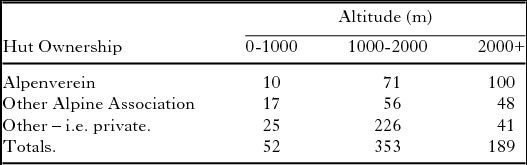
Individuals like Senn and Daimer were rare, and many communities remained distrustful of such developments, but they continued to be the most active advocates of high Alpine huts and paths throughout the 1870s.Footnote 36 In the early years of the Alpenverein after 1874, it was mountain branches, individuals from the Alps, and Alpine community leaders who made the vast majority of applications, around seventy-four per cent, and received the majority of the funding.Footnote 37 To be sure, many of the urban branches and individuals could afford to fund their own projects without recourse to the central association and some, including Senn's friend, the Prague based mountaineer Johannes Studl, were very active.Footnote 38 Yet the applications received from mountain based branches and individuals suggest a willingness and enthusiasm to develop high Alpine regions for tourism that was not matched by urban mountaineers until around 1880.Footnote 39 These applications probably represent no more than a small proportion of local activity in creating mountain infrastructure. In 1897, the Alpenverein commissioned a list of huts in the Eastern Alps, which demonstrated that while the highest regions were indeed populated by the huts of Alpine organisations, accommodation at lower altitudes was effectively dominated by locals (See table 1).Footnote 40
Hut Ownership in the Eastern Alps, 1897.

Source: Karl von Prybila, ‘Verzeichnis der Hütten des D. u. Oe. Alpenvereins, andere Vereine, der Alpenwirthshäuser und Warten nach Special-Kartenblättern’, MDOeA XIII(XXIII):7 (1897), beilage.
The key people involved in these cases suggest that Pieter Judson's claim for the role of local, urban educated elites in tourist development around 1900 can be applied as far back as the 1860s.Footnote 41 ‘Local pioneers’ were relatively young, educated professionals, members of a new Tirolean middle class generation who could expect to spend some time studying in cities such as Munich, Vienna or Milan during the 1848 to 1873 peak of liberal engagement.Footnote 42 Religious workers were well represented. While older colleagues were sometimes suspicious of, or held anti-Semitic or anti-urban attitudes towards, tourists, this new generation set about changing the lives of their communities through a classic practice of landscape ‘improvement’.Footnote 43 In the Ötztal valley, Senn was one of a group of religious workers led by the agricultural improver Adolf Trientl. Amongst Trientl's acolytes, including not only Senn but also Gärtner, and Eller, tourist facilities in the high Alps were presumably understood as equivalent to changes in farming practice and agricultural investment.Footnote 44 Unlike other professionals such as Daimer, religious workers were in a unique position. On the one hand, they understood the demands and customs of the elite tourist, yet unlike doctors or engineers, they possessed the cultural competence to engage the local population in their aims. Far from merely acting as intermediaries, they directed the earliest transformations of Alpine space into a bourgeois leisure arena.Footnote 45
Senn's influence was not restricted to Vent, where his attempts to encourage tourism never achieved the desired success.Footnote 46 By the late 1860s, he had become frustrated at the reluctance of the then Austrian Alpine Association to invest in his projects, which as a consequence, he almost entirely funded himself. In part, this reluctance stemmed from a tension between the roles of religious leaders as intermediaries between local communities and urban Alpinists, and the aims of liberal organisations like the Austrian Alpine Association to create secular Austrian citizens in the image of the Austro-German Bürgertum.Footnote 47 With the beginning of the Austrian Kulturkampf in 1867, in which Jesuits such as Senn were specifically targeted, it is understandable that his attention turned to establishing a new German Alpine Association which would appeal to the greater resources of the emerging, but not yet anti-Catholic, Kaiserreich and remaining independent German states.Footnote 48
Senn lobbied his friends to set up the new organisation whose main aim, he insisted, would be to ‘join the mountain-friends of Germany in joint activity. This activity should encompass everything that can exert a beneficial influence on the advancement of tourism’.Footnote 49 For Senn, who had attended a Catholic German nationalist brotherhood in 1850s Munich, pan-German nationalism would be recruited to bring the resources of the German middle class to the Eastern Alps, precisely the process, in other words, that Munich's museum celebrated in 1911.Footnote 50 While we cannot reduce the founding of the German Alpine Association later in 1869 to Senn's influence, he was certainly responsible for the organisation of resources for investment in infrastructure such as huts and paths that would be transferred to the Alpenverein in 1874. Professional, middle class individuals living in small Alpine villages not only advocated tourist infrastructure earlier than their urban counterparts, and established the forms that that infrastructure would take, they also played a central role in creating an organisation to facilitate the middle class investment in Alpine terrain which would dominate for the next forty years.
Constructing huts and the politics of the high Alpine landscape
While throughout the 1870s investment in high Alpine infrastructure remained piecemeal and led by Tirolean individuals, around 1880 direct investment in the Alps dramatically expanded amongst German elites. Panoramas, landscape reliefs, postcards and illustrated magazines popularised Alpine tourism as an activity of cultured middle class individuals, and by the 1890s, members of the Alpenverein described a ‘Netz’ of huts and paths across the Eastern Alps, rendering them accessible to the praxis of bourgeois pleasure.Footnote 51 From the 1900s, guidebooks appeared that abjured difficult climbs and summits, and encouraged instead journeys ‘from hut to hut’.Footnote 52 Celebrations of construction projects regularly appeared in an increasingly prolific Alpine press, and Alpenverein members expected their branch to claim ownership over part of the mountain chain.Footnote 53 Such was the rapid development of huts in the high Alps that outside the most popular areas, sleeping capacity far exceeded demand and many huts were so poorly visited that it proved impossible to find local hut wardens.Footnote 54 In 1897, the Alpenverein attempted to limit hut construction to halt the mounting debts of the organisation's branches, but this achieved little, and new huts continued to appear until 1914.Footnote 55
The popularisation of mountaineering in the Eastern Alps soon received detractors who claimed that the new participants lacked the culture or sensitivity of the genuine mountaineer, and were harming the experience of true Alpinists.Footnote 56 Their rationale pitted the feckless, loud and vulgar ‘Alpenbummler’ against the supposedly higher values amongst ‘genuine mountaineers’, and called for a halt to large huts, and paths to inaccessible summits, so that the mountains did not ‘lose their magic’. As the Munich mountaineer Heinrich Lieberich continued in 1907:
The real friend of nature gains an untarnished enjoyment not when a summit is achieved through the use of human aids to make it accessible, but when it is overpowered through personal strength set against its natural walls. [. . .] The invasion of nature represented by path-building must be supported only in very specific cases.Footnote 57
These complaints reproduced those of conservationist movements in the Kaiserreich, but replaced a concern for the appearance of the landscape with a preoccupation with the physical experience; huts and paths should be limited, in this rationale, so as to protect the challenge of the terrain for ‘true mountaineers’.
In Munich, mountaineers with views similar to Lieberich congregated around the ‘Bayerland’ branch of the Alpenverein. While critical of ‘commercial mountain inns’ and Alpine paths across demanding terrain, the elite mountaineers of Bayerland advocated simple, non-commercial huts and low altitude paths. In 1897, they constructed the small ‘Meilerhütte’, on the Austro-German border, on an 800 square metre plot provided by the Austrian community of Leutasch.Footnote 58 Bayerland did not offer a radically different vision of Alpine tourism to those who preferred the comfort of the large, commercial hut, but their ‘ideals’ nevertheless collided with the objectives of those concerned with Alpine development near the Meilerhütte. Their relationship with Leutasch residents and mountaineers in Innsbruck reveal how far hut and path construction was entangled in the local politics of Alpine space, from which the leaders of Bayerland failed to extricate themselves.
In April 1909, Dionys Rauth, a cousin of mountain guide Alois Rauth, received a 200 square metre plot of land from Leutasch to build a new hut on the Dreitorspitzgatterl, next to the Meilerhütte.Footnote 59 Before granting permission for the new business, Tirolean state authorities insisted that Rauth should receive the assent of the Innsbruck branch of the Alpenverein, then led by the pan-German nationalist Hanns Forcher-Mayr, who in turn advised Rauth to seek permission from Bayerland.Footnote 60 The chair of Bayerland, the High Court judge Eugen Oertel, returned a forthright letter to all concerned, expressing astonishment that Leutasch had given away land provided to Bayerland in 1897, and threatened legal action against the community.Footnote 61 Bayerland would eventually win the court case which, after numerous hearings across Southern Germany, reached its climax on site in the existing Meilerhütte.
Alongside legal proceedings, the elite mountaineers from Munich were drawn into a local politics of Alpine space which could not tolerate their preference for small ‘mountaineering’ huts. On hearing of Bayerland's position, Forcher-Mayr first suggested, and then demanded, that Bayerland build a new, commercial hut in the area.Footnote 62 He argued that the Dreitorspitzgatterl was ‘too easily accessed, to be claimed, and with any right retained, as the preserve of strictly-principled mountaineers’.Footnote 63 He pointed out that the hut, as Bayerland's reports confirm, was regularly overcrowded, and Forcher-Mayr demanded that Bayerland ‘abandon in this case, their notorious aversion to commercial mountain inns’.Footnote 64 Yet there was more at stake than Bayerland's principles and overcrowded huts. Forcher-Mayr believed that the good will of Tiroleans towards German Alpinists was based on investment in the high Alps. ‘How should an Austrian branch stand before Austrian authorities, against an Austrian entrepreneur, on Austrian ground, and against the constitution of the Alpenverein’ he railed, ‘when the association itself can offer nothing in its place?’ Such a circumstance would ‘gamble with the good credit that the Alpenverein enjoys in the Tirol’, and undermine, Forcher-Mayr implied, the pan-German project of the Deutsche and Oesterreichische Alpenverein.Footnote 65 Worse, he feared the episode could lead to the pro-Habsburg Christian Socialist press attacking ‘unpatriotic’ behaviour by the Alpenverein, as they had in the 1880s and the so-called 1896 ‘Alpine war’, when a number of mountain guide organisations threatened to organise with the rival Oesterreichische Touristenclub.Footnote 66 Where the Alpenverein did not satisfy demand, he continued:
We should not be surprised, nor complain, if private firms take our place – and we do not want the Dreitorspitzgatterl to go the same way as the Oesterreichisches Schneekar [another nearby mountain pass], where the Oesterreichische Touristenclub have stuck a thorn in the side of the Alpenverein with their well-visited Wiener Neustädthütte.Footnote 67
Stefano Morosini has shown how hut construction by German and Italian nationalists constituted a ‘cultural war’ in Southern areas of Tirol and the pan-German Alpenverein competed in the same way with the patriotic Oesterreichische Touristenclub in Alpine regions to the north.Footnote 68 For Forcher-Mayr, Bayerland's refusal to develop huts was tantamount to a surrender of territory, whether to supposedly uncultured local entrepreneurs, or to his political opponents.
The Bayerland branch did not publicly agree to these demands, but soon began building a large, commercial hut on the Bavarian side of the border.Footnote 69 ‘Since the other branches [of the Alpenverein] regard building huts and paths as their main activity, and the needs of the mountaineer are already more than met in this area’, Bayerland's yearly report confirmed in 1909, ‘the branch does not ever take part in their construction’.Footnote 70 Nevertheless, it continued:
Only we possess the property [on the Dreitorspitzgatterl] now, and since Bayerland cannot, for various reasons, give up the land, it must act on the consequences, which have resulted from increasing tourism in the last few years, for better or for worse.Footnote 71
Yet it was only Leutasch's refusal to rescind their gift of land to Dionys Rauth that manoeuvred Bayerland to a new hut and a 1909 newsletter makes it clear that for a few months the two were involved in a construction race at over 2000 metres.Footnote 72 Bayerland had failed to resist the complex politics of space that underscored hut and path development in the Eastern Alps.
The specific circumstances of the Meilerhütte case were unique, but the need to accommodate local politics was universal by 1900. Other episodes suggest a population frustrated at the level of investment, and prepared to challenge the authority of wealthy urban visitors over the high Alps. In 1906, Forcher-Mayr intervened when local business owners left the Alpenverein branch in Bozen/Bolzano, and set up a new ‘Seiser Alpe’ branch in order to promote tourism in an area they felt was neglected.Footnote 73 As Thomas Ebert has shown, the Alpenverein branch in Garmisch-Partenkirchen consistently challenged mountaineers from Munich to invest more in the landscape, and a local newspaper threatened to withdraw the main Munich branch's ‘monopoly’ on the mountains if it did not construct further huts and paths.Footnote 74 In episodes such as these, Alpine residents either forced further investment from external organisations by threatening a loss of control over the high mountains, or simply competed with the Alpenverein and other organisations directly. By the time Munich's Alpine Museum opened in 1911, the reality of a high Alpine landscape dominated by its members was already vanishing.
Backwardness and modernity in Alpine literature
In the following decades, an apocryphal story emerged about the Meilerhütte trial. At a critical point, it was discovered that the judge had not brought a crucifix to the final hearing in the Old Meilerhütte, so that witnesses could not be sworn in. With the court and witnesses crowded into the refuge, a local construction worker from nearby Partenkirchen in Bavaria offered his crucifix to the court in thick Bavarian dialect. The God fearing Leutasch witnesses were thus convinced to tell the truth, and recognised Bayerland's rights to the land.Footnote 75 Whatever its veracity, this story utilised ideas of difference between mountaineers and Alpine people to demonstrate the cultural superiority of the former, and justify their continued control over infrastructure development. In this narrative their case collapsed because of superstitious religious belief and greed-fuelled naivety in challenging Bayerland over Alpine property. The story confirmed stereotypes held by Oertel, the Bayerland leadership and Forcher-Mayr in 1909, and their fears that construction by ‘private speculation’ would harm the experience of the mountaineer, so that ‘only if the branch itself builds, can it retain control of huts on the Dreitorspitzgatterl, and provide the true mountain-friend the forms in which he feels at ease’.Footnote 76 For Oertel, both the villagers of Leutasch and the poorer, potentially working class, tourists that their uncultured infrastructure might attract presented a threat to the high Alps as a bourgeois sphere of physical performance.
In the late nineteenth century the same logic justified continued control over the registration and income of increasingly militant mountain guides. From the late 1870s, and encouraged by the Alpenverein, mountain guides formed associations such as the Verein Katholischer Bergführer Sölden or the Kalser Führerverein.Footnote 77 These acted in part as trade unions, campaigning on issues such as Sunday working and conditions, and in part as cartels, agreeing fixed prices within Alpine valleys.Footnote 78 By the 1890s, guides could threaten collective action, their organisations became sites for collective labour identities, and the Alpenverein found itself reforming its relatively generous insurance, training and accreditation schemes to stave off discontent and imbue mountain guides with the deferential behaviour expected by self-consciously ‘modern’ middle class clients.Footnote 79 Any sense that mountain guides were examples of a naïve and idyllic peasantry was difficult to retain, and satirists exploited the distinction between imagination and reality to great effect in the period.Footnote 80
Accommodating an increasingly militant workforce within an imagination of Alpine regions as primitive backwaters required some rhetorical gymnastics. Ludwig Purtscheller (1849-1900) was well known as perhaps the most accomplished mountaineer of his era. Born to a middle class family in Innsbruck, he was educated in both German (in Innsbruck) and Italian (in Rovereto), and remained bilingual for the rest of his life, most of which was spent in Salzburg.Footnote 81 In an 1891 article in the Alpenverein's newsletter, he railed against what he considered the greed, disrespect and laziness of mountain guides.Footnote 82 ‘Who is it that composed the current guide-tariffs, and who is, in the end, responsible for the increasing tariff scale?’ Purtscheller asked, answering that the ‘guides themselves dictated . . . individual tariffs and their own pay’.Footnote 83 ‘Some guides’, he continued, ‘spoilt and flattered by good-natured and inexperienced tourists, behave so superiorly and inconsiderately in guest-houses and even with their clients, that it is as if the roles of guide and client were fully reversed’.Footnote 84 In order to prevent such class transgressions, Purtscheller advised ‘close surveillance, a strong hand, and disciplinary authority’, and suggested restructured tariffs based on an hourly wage.Footnote 85 Guides, he argued, had fallen victim to the ‘well-known fact’ that ‘when the rural population comes into contact with urbanites, they mainly take on their bad sides, without their good qualities’. He tacitly accepted the capitalism and labour politics at the heart of such disputes, whilst denying that such people could ever be ‘cultured’.Footnote 86 Mountaineers of this period sometimes established friendships with guides with little regard for social distinction. Eleanore Noll-Hasenclever, for example, described the guide Alexander Burgener as her ‘mountain father’. But the reluctance of guides to conform to the social expectations of urban mountaineers attracted similar opprobrium in mountain guidebooks.Footnote 87 In these publications, guides acted out of a deleterious modernity, which reduced their attempts to improve working conditions to naïve degenerate greed, and their tendency to ignore expectations of deference as a loss of primitive innocence. As such, when Alpine residents transgressed the boundaries between scrutinising and benevolent Alpine tourist and naïve, primitive local, they could be imagined as a parable of the ‘bad’ urban and commercial cultures which contemporary culturally-critical Alpinists rejected.Footnote 88
The assertion that Alpine people could not, or should not, be ‘modern’ was apparent in a wider Alpine literature concerned with the impact on tourist experience of a population which did not simply melt into the landscape. The author, pioneering conservationist, and tourism advocate Anna Mayer-Bergwald (1852-1935) wrote that:
For the true friend of nature, the Alpenwelt and the Alpenvolk are inseparable phrases. Progress and culture, whose benedictory influences are not to be denied, would mean a backwards step in those places where it must weaken old and dignified customs, honourable manners, naivity and authentic mentality. From that day on, in which the Bergvolk exchange their outer and inner clothing for a modern one, the Alpenwelt is robbed of its greatest magic, and the spring of indigenous poetry, from which thousands and thousands of the truth- and beauty-starved refresh themselves, will run dry.Footnote 89
The application of turn of the century cultural criticism to Alpine populations could be combined with calls to restrict access to the Alps for what one Alpinist described as ‘city children . . . nervously hasty on the one hand, superficially thoughtless on the other’, reproducing the condescending attitudes that characterised contemporary literature on ‘homeland-protection’.Footnote 90 Yet Mayer-Bergwald showed little concern for the numbers or class of tourists, and instead criticised those who presumed to ‘educate’ Alpine people. The Alpenvolk, she argued, should be encouraged back into their traditional clothes, and thereby customs, through associations such the Volkstrachtenvereine [people's costume associations] which she supported.Footnote 91 Only by keeping the Alpenvolk poor, naïve and primitive could they provide the necessary ‘magic’ to the emotionally impoverished urban tourist.
As the role of Völkisch costume associations suggest, asserting natural antipathy to modernity amongst Alpine populations imbricated with efforts to locate nationalism in supposed aesthetic difference, rather than the more flexible local identities of the Alps.Footnote 92 Edward Ross Dickinson has demonstrated how tourism made the Älpler a focus for racial study, and that in order to ‘Germanise’ Alpine populations, body aesthetics were tied to racial characteristics, and these to the ‘hard’, ‘German’ landscapes of the Eastern Alps.Footnote 93 Dickinson is right to highlight an increased interest in Alpine ‘race’ amongst German and Austrian nationalists, but until at least 1914, these were one element of a wider genre of publications which primitivised Alpine people, some of which accepted, and even celebrated diversity.Footnote 94 In 1910, the racist Deutsche Alpenzeitung published an excursus on ‘The Burggräfler’ by the Alpine guide author Luchner-Egloff, which compared ‘true prototypes of the Germanic tribe’ to the ‘Mongoloid’ racial features of nearby Ladino speakers.Footnote 95 Throughout, the nationalist tourist was encouraged to inspect and scrutinise the aesthetic ‘Germanness’ of Alpine people who ‘carry their nationality unconsciously in the blood, and whose nationality unconsciously protects their blood’.Footnote 96 While the Deutsche Alpenzeitung targeted the population of the Kaiserreich, and focussed almost entirely on supposedly German speaking areas, the publishers of the Illustrierte Oesterreichische Alpenzeitung encouraged tourism in the multilingual Southern parts of the chain. Articles such as Josef Tominšek's ‘Bioscoptics from the Wocheiner Line’ represented Alpine populations as primitive and naïve, and encouraged visual scrutiny, but avoided totalising languages of race.Footnote 97 While Luchner-Egloff's piece was accompanied by a number of photographs of ‘typical’ Burggräflers, editorially positioned as landscape scenes, Tominšek's article included images of porcelain figures in ‘Krainish national dress’, which adjusted focus from personal physical characteristics to that of costume.Footnote 98 Both pieces, along with that of Mayer-Bergwald above, sought to objectify Alpine populations under the gaze of both author and reader, but only Luchner-Egloff demanded that visitors transform aesthetic judgement into racial category. Racial depictions of Alpine people formed one part of a wider effort to deny Alpine communities ‘modernity’, and render them permanently part of a lost, mythic past, a depiction which rendered them the rightful subject of the tourists’ gaze and elided contemporary social tensions within Alpine tourism.
In urban, bourgeois mountaineering publications, authors and editors to varying degrees primitivised, commodified, and racialised Alpine inhabitants. They rendered people in the Alps backward in order to justify their continued dominance over the development of ‘civilised’ tourist infrastructure, and control over high Alpine landscapes. These same middle class, male arbiters of tourist culture commodified Alpine people in order to create a legitimate object of scrutiny for tourists within a wider landscape, as well as to attract greater interest in mountaineering organisations and tourism. Their publications, and the organisations to which many were attached, nationalised the complex identity positions of local populations in order to justify escalating intervention to Germany's middle classes, and so as to establish ‘frontier’ zones as areas of supposedly racial competition and increased investment.
Conclusion
Integrating local people into the story of late nineteenth century Alpine tourism suggests that some central assumptions of tourism history should be questioned, both in the mountains and elsewhere. Local people did more than simply respond to the demands imposed on them by the new visitor to the Eastern Alps. Despite the claims of mountaineering organisations, local people often provided the driving force behind tourist development, challenged attempts to intervene, or not, in their localities, and were instrumental in creating the ‘path-based’ Alpine tourism that continues to characterise tourism in the Alps today. These developments were led by a group of professionals, and especially religious workers, who can be described as operating between and across imaginary borders of the urban/rural, modern/unmodern and active/passive identities asserted by many mountaineers. While the centrality of urban culture in foregrounding the development of Alpine tourism cannot be denied, we also need to recognise that this transformation was hybridised in the context of local communities, resistances and entrepreneurship.
Those living in the Alps were also capable of capitalising on the complex political entanglements that developed around the construction of tourist infrastructure. By the decades that preceded the First World War, politicised national and state landscapes, increasing tourist numbers and confident local communities had eroded the control of urban alpine associations over their own investment in the Alpine terrain. Despite widespread worries over indebtedness and future bankruptcy, as well as an increasing concern amongst elite mountaineers that increasing numbers of tourists harmed the mountain experience, German speaking mountaineers continued to invest in Alpine infrastructure until the eve of the First World War, often under pressure from local communities impatient for investment, and perceived political, national or racial threats. Local people did not necessarily create these tensions, but they were certainly able to take advantage of them, and their insistence that urban mountaineers continue to invest in the Alpine landscape in part explains the continuing drive to ‘develop’ the Eastern Alps to 1914.
Alpine people failed to live up to the imaginations of noble savagery amongst their elite clients in other ways too, and provided a foil on which racial definitions of Alpine residents rapidly came to focus. From the mid 1890s, workers in Alpine tourism became increasingly militant, as mountain guides in particular sought a better and more secure living, and workers in the Alps were increasingly reluctant to accord the deference demanded by wealthy clients. Alpinists explained these transgressions of assigned roles on the part of Alpine people as the pathological impact of ‘modern’ culture on a people already determined as backward and primitive. The content of attempts to define Alpine ‘races’ in the same years drew on this description, and should be understood in the context of these social and political conflicts.
Acknowledgements
I would like to thank the Alpine Museum in Innsbruck and the Ötztaler Heimat- und Freilichtmuseum, as well as the journal's reviewers for their important suggestions.