INTRODUCTION
Tephra layers form unique stratigraphic markers that can be used to synchronize and integrate paleoenvironmental records across a range of terrestrial and marine settings (Lowe, Reference Lowe2011). In particular, studies of cryptotephras (nonvisible tephras) have greatly enhanced the application of tephrochronology, and widespread North American tephras are now known to have intercontinental distributions (Zdanowicz et al., Reference Zdanowicz, Zielinski and Germani1999; Coulter et al., Reference Coulter, Pilcher, Plunkett, Baillie, Hall, Steffensen, Vinther, Clausen and Johnsen2012; Jensen et al., Reference Jensen, Pyne-O’Donnell, Plunkett, Froese, Hughes, Sigl and McConnell2014).
Alaska is frequently affected by explosive volcanism, including at least eight caldera-forming events during the Holocene (Miller and Smith, Reference Miller and Smith1987), and volcanic ash deposits form widespread stratigraphic markers across much of the state (Riehle, Reference Riehle1985). Current understanding of the Alaska Holocene tephrostratigraphy is largely based on the analysis of discrete visible ash layers and near-source exposures, which are mainly studied to determine eruption frequency and volcanic hazards. However, proximal deposits are commonly removed during subsequent eruptions, and very few regionally extensive and well-dated Holocene tephras are known (Davies et al., Reference Davies, Jensen, Froese and Wallace2016). Despite the value of tephrostratigraphy beyond the extent of these observable volcanic ash beds, the cryptotephra record in Alaska is largely undeveloped with few exceptions (e.g., Payne and Blackford, Reference Payne and Blackford2004, Reference Payne and Blackford2008; Payne et al., Reference Payne, Blackford and van der Plicht2008; Zander et al., Reference Zander, Kaufman, Kuehn, Wallace and Anderson2013). Improving the tephrochronological framework, particularly for interior and northern Alaska, will aid the age modeling and correlation of sedimentary sequences that often lack abundant terrestrial plant macrofossils for 14C dating (e.g., Abbott and Stafford, Reference Abbott and Stafford1996). Such sequences record paleoenvironmental features including vegetation responses to climate change (e.g., Brubaker et al., Reference Brubaker, Anderson, Edwards and Lozhkin2005) and the extinction patterns of Pleistocene megafauna (e.g., Guthrie, Reference Guthrie2006; Cooper et al., Reference Cooper, Turney, Hughen, Brook, McDonald and Bradshaw2015).
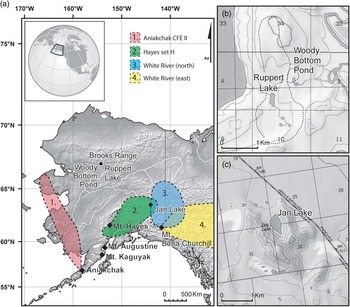
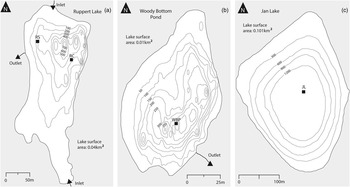
Tephra and cryptotephra layers were examined in lake-sediment cores from two areas in Alaska (Fig. 1) as part of a wider project (Lakes and the Arctic Carbon Cycle). Jan Lake in eastern interior Alaska (63°33.88'N 143°55.02'W) lies downwind of volcanic sources in the Aleutian arc and Alaska Peninsula and preserves two uncorrelated tephra beds dating to 3500–4000 cal yr BP (Carlson and Finney, Reference Carlson and Finney2004). Ruppert Lake (67°4.28'N 154°14.65'W; see Brubaker et al., Reference Brubaker, Garfinkel and Edwards1983; Higuera et al., Reference Higuera, Brubaker, Anderson, Hu and Brown2009) and Woody Bottom Pond (informal name), hereafter referred to as “WBP” (67°4.55'N, 154°13.88'W), are in the southern Brooks Range. Several late Quaternary sediment records exist from the Brooks Range (e.g., Brubaker et al., Reference Brubaker, Garfinkel and Edwards1983; Edwards et al., Reference Edwards, Anderson, Garfinkel and Brubaker1985; Oswald et al., Reference Oswald, Gavin, Anderson, Brubaker and Hu2012); however, no tephra beds have yet been reported from the region despite its relative proximity to volcanoes producing intercontinental cryptotephra horizons (Mackay et al., Reference Mackay, Hughes, Jensen, Langdon, Pyne-O’Donnell, Plunkett, Froese and Coulter2016). Ruppert Lake and WBP lie within 750 m of each other; however, because Ruppert Lake is much larger (3.1 km2) than WBP (0.06 km2) and has inflowing streams (Fig. 2), we expected that the sedimentary sequences from Ruppert Lake would contain a higher abundance of volcanic shards (Mangerud et al., Reference Mangerud, Lie, Furnes, Kristiansen and Lømo1984; de Fontaine et al., Reference de Fontaine, Kaufman, Anderson, Werner, Waythomas and Brown2007; Pyne O’Donnell, Reference Pyne O’Donnell2011). To investigate within-lake variability, we compared a nearshore core (RS) and a central core (RC) section from Ruppert Lake.
(color online) (a) Map of Alaska and the location of study sites shown with volcanic sources. The approximate visible limits of the key tephra beds are redrawn from Davies et al. (Reference Davies, Jensen, Froese and Wallace2016). (b) Surrounding topography and lake catchments (illustrated by dashed line) of Brooks Range sites. (c) Surrounding topography of Jan Lake.

METHODS
Sediment cores were retrieved in July 2013, using a square-rod piston corer (Wright et al., Reference Wright, Mann and Glaser1984). To determine the presence of tephra, amalgamated 5 cm range finder samples were taken throughout the cores and processed following the stepped floatation methodology of Turney (Reference Turney1998) and Blockley et al. (Reference Blockley, Pyne-O’Donnell, Lowe, Matthews, Stone, Pollard, Turney and Molyneux2005). Where tephra layers were identified, additional 1 cm point samples were taken and processed in the same manner to more accurately establish the stratigraphic position of the tephra. Finally, shards were extracted for geochemical analysis following protocols outlined in Blockley et al. (Reference Blockley, Pyne-O’Donnell, Lowe, Matthews, Stone, Pollard, Turney and Molyneux2005).
Glass shards from peak tephra concentrations were first analyzed by electron microprobe (EMPA) at the Department of Earth Sciences, Oxford University, United Kingdom, before further analysis by wavelength-dispersive spectrometry (WDS) at the University of Alberta, Canada. Following identification of the Aniakchak caldera-forming eruption II (CFE II) tephra within samples analyzed at Oxford University, Aniakchak CFE II reference material (UA 1602) was run concurrently during analysis at the University of Alberta.
Glass shards were analyzed by WDS on the Alberta JEOL 8900 superprobe following established protocols (e.g., Jensen et al., Reference Jensen, Froese, Preece, Westgate and Stachel2008). Shards were mounted in an epoxy puck and polished to expose internal glass surfaces before being carbon coated prior to EMPA. A standard suite of 10 elements (Si, Ti, Al, Fe, Mn, Mg, Ca, Na, K, and Cl) were measured using a 10 μm beam with 15 keV accelerating voltage and 6 nA beam current to minimize Na and K migration during analyses. Two secondary standards of known composition were run concurrently with all volcanic glass samples: (1) 3506, Lipari rhyolitic obsidian; and (2) Old Crow tephra, a well-characterized, secondarily hydrated tephra from an unknown source, but possibly derived from the Alaska Peninsula or Aleutian Islands based on chemical composition (Kuehn et al., Reference Kuehn, Froese and Shane2011). Results were normalized to 100% and presented as weight percent (wt%) oxides. New major element chemistry data and associated standard measurements produced at both institutions are reported in Supplementary Tables 1–3.
Comparison of the glass chemistry data produced at the University of Oxford and the University of Alberta revealed consistent differences between the analytic totals for some minor elements such as CaO and Cl (Supplementary Table 5 and Supplementary Fig. 1). Differences between Alaska glass populations are often subtle (e.g., Preece et al., Reference Preece, McGimsey, Westgate, Pearce, Hart and Perkins2014), and even minor interlab variation can complicate interpretation (Kuehn et al., Reference Kuehn, Froese and Shane2011). To remove this uncertainty between new volcanic glass data and those of previously analyzed samples in the geochemical database at the University of Alberta, data produced at the University of Oxford were excluded from bivariate plots of major and minor element glass chemistry (Figs. 4 and 6).
CHRONOLOGY
New radiocarbon ages derived from plant macrofossils supported the age models presented in Figures 3 and 5. These included 8 from WBP, 13 from RC, 10 from RS, and 2 from Jan Lake (Supplementary Table 4). The two earliest tephra beds in Jan Lake (J118 and J127) were dated on the basis of 22 radiocarbon ages from Carlson and Finney (Reference Carlson and Finney2004), who described the positions of the two oldest Jan Lake tephras discussed here (Supplementary Table 4). The youngest Jan Lake tephra was not noted by Carlson and Finney (Reference Carlson and Finney2004) and so is only loosely constrained by an age model based on two additional radiocarbon ages from our new sediment core (Supplementary Table 4). Age models were produced using Bacon age-modeling software (v. 2.2; Blaauw and Christen, Reference Blaauw and Christen2011), and the IntCal13 calibration data (Reimer et al., Reference Reimer, Bard, Bayliss, Beck, Blackwell, Bronk Ramsey, Buck, Cheng, Edwards and Friedrich2013). Based on low agreement values, three ages from Jan Lake, one from WBP, one from RS, and two from RC were excluded from the age models.
Lake morphology, including bathymetry and coring locations for Ruppert Lake (a), Woody Bottom Pond (b), and Jan Lake (c). Depth isopleths are shown in centimeters and were derived using measurements taken with a depth sounder, with the exception of Jan Lake where bathymetry values were taken from those presented by the Alaska Department of Fish and Game (“Jan Lake: Bathymetric Map and Fishing Information,” http://www.adfg.alaska.gov/index.cfm?adfg=fishingSport.lakeDetail&LakeID=1314 [accessed December 22, 2016]).

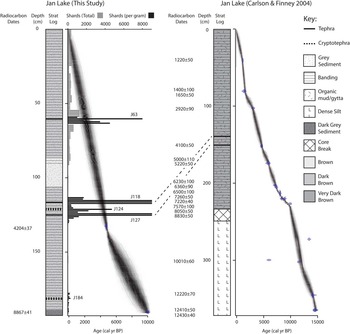
Range finder shard counts and age models produced for the Jan Lake core (this study), and stratigraphy and updated age model from Carlson and Finney (2004). Tephras correlated between sequences based on stratigraphic position are denoted by dotted lines.

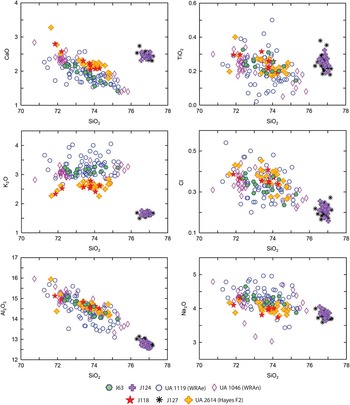
(color online) Bivariate plots of major and minor element glass chemistry from Jan Lake tephras, plotted against White River Ash east (WRAe) (Jensen et al., Reference Jensen, Pyne-O’Donnell, Plunkett, Froese, Hughes, Sigl and McConnell2014), White River Ash north (WRAn), and the Hayes F2 tephra (Davies et al., Reference Davies, Jensen, Froese and Wallace2016).

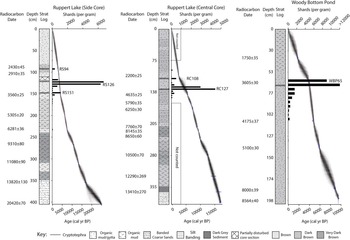
Range finder shard counts and age models produced for Brooks Range cores. Sections of RC (a central core section from Ruppert Lake) that were unlikely to contain tephra based on results from RS (a nearshore core from Ruppert Lake) and Woody Bottom Pond were not counted as all available material was consumed for use in other analyses as part of the Lakes and the Arctic Carbon Cycle project (Natural Environment Research Council no. NE/K000233/1).

TEPHRA DESCRIPTIONS, GEOCHEMISTRY, AND GEOCHRONOLOGY
Eastern Interior—Jan Lake
Cryptotephra
Volcanic glass was present throughout the Jan Lake core in high concentrations, and three discrete visible tephra beds were noted at 63, 118, and 127cm (Fig. 3). The background levels of volcanic glass were too high to identify cryptotephra horizons for large sections of the Jan Lake core, and only two possible cryptotephra layers were targeted for chemical analyses (124 and 184 cm). The cryptotephra at 124 cm was found to be chemically indistinguishable from the tephra layer at 127 cm (Fig. 4) and likely represents reworking. Glass chemistry analyses from the cryptotephra at 184 cm, produced at the University of Oxford, covered a wide range of compositions suggesting no primary air fall tephra was present (Supplementary Fig. 3).
Tephra J63
Tephra J63 consists of clear, highly vesicular, blocky, and pumiceous shards that form a discreet bed <1 mm thick. Glass chemistry is composed of a rhyolitic population (72.38–75.27 wt% SiO2) with K2O values higher than other tephras observed in Jan Lake (2.97–3.24 wt% K2O; Fig. 4). The 2-sigma modeled age range is 3010–1470 cal yr BP.
Glass chemistry from J63 is similar to the White River Ash tephras originating from Mt. Bona-Churchill (Fig. 4). The White River Ash tephras are composed of two widespread tephra beds, the White River Ash north (1900 cal yr BP) and the volumetrically larger White River Ash east (AD 833–850) (Lerbekmo, Reference Lerbekmo2008). Although the location and modeled age range of J63 agree better with the White River Ash north, glass chemistry is more similar to the White River Ash east. SiO2 values of J63 (72.38–75.27 wt%) are in close agreement with those found in the White River Ash east (~72.5–76.5 wt%). In contrast, they fall within a common compositional gap spanning 73.5 to 75.9 wt% observed in the White River Ash north, which includes a wider chemical range (71 to 78 wt% SiO2; Preece et al., Reference Preece, McGimsey, Westgate, Pearce, Hart and Perkins2014). However, differences between the glass chemistry compositions of the White River Ash east and White River Ash north are subtle, and Preece et al. (Reference Preece, McGimsey, Westgate, Pearce, Hart and Perkins2014) conclude major element glass chemistry alone cannot consistently discriminate between the White River Ash east and White River Ash north. As such, J63 cannot yet be securely correlated to either the White River Ash east or White River Ash north.
Tephra J118
Sample J118 consists of clear, highly vesicular, blocky, and pumiceous shards, forming a pale yellow layer <1 mm thick. Glass chemistry is rhyolitic with high Cl values (0.34–0.41 wt%; Fig. 4). The modeled age range is 4580–3740 cal yr BP, based on the tephra bed’s position in the record of Carlson and Finney (Reference Carlson and Finney2004), who noted J118 at a depth of 138 cm (Fig. 3). They attributed it to the Jarvis Creek tephra set.
Glass chemistry from J118 is similar to that of the Hayes tephra set H, particularly layer F2 (Fig. 4). The Hayes tephra set H is formed of seven to eight closely spaced ash layers originating from Mt. Hayes between ~4200 and 3700 cal yr BP and includes the Jarvis Creek tephra set (Riehle, Reference Riehle1985; Wallace et al., Reference Wallace, Coombs, Hayden and Waythomas2014). Layer F2, also known as Jarvis Ash/unit G (Riehle, Reference Riehle1994), is the only Holocene tephra previously found in interior Alaska and has an estimated age range of 4205–3910 cal yr BP (Davies et al., Reference Davies, Jensen, Froese and Wallace2016). This is within the modeled age range of J118 from this study.
Tephra J127
Sample J127 consists of vesicular, blocky, and pumiceous shards, commonly with mineral inclusions, forming a discrete layer <1 mm thick. Glass chemistry has a high and narrow range of SiO2 (76.32–77.20 wt%) and distinctively low K2O values (0.17–0.27 wt%; Fig. 4). The modeled age range is 4820–4240 cal yr BP, based on the tephra bed’s position in the record of Carlson and Finney (Reference Carlson and Finney2004), who noted J127 at a depth of 149 cm where it is attributed to the Jarvis Creek tephra set (Fig. 3).
The modeled age range for J127 (4820–4240 cal yr BP) predates both the reported age of the Hayes tephra set H and basal dates from proximal tephra fall deposits on the Hayes River (Reihle, 1994; Wallace et al., Reference Wallace, Coombs, Hayden and Waythomas2014). Glass chemistry of J127 shows limited overlap with Mt. Hayes reference material (UA 2614 Hayes F2) and a different abundance of major elements, including higher SiO2 and lower K2O (Fig. 4). Based on whole rock and individual glass shard analyses, Fierstein and Hildreth (Reference Fierstein and Hildreth2008) proposed that this combination of high SiO2 and low K2O is unique to Mt. Augustine and Mt. Kaguyak on the Alaska Peninsula. There are few examples of distal tephra beds linked to either volcano, but proximal deposits indicate Mt. Augustine and Mt. Kaguyak have been active within the modeled age range of J127 (Riehle et al., Reference Riehle, Waitt, Meyer and Calk1998). Thus, it seems likely that J127 is derived from one of these volcanic centers.
Brooks Range—Ruppert Lake and WBP
RS94 and RC108 (Ruppert Tephra)
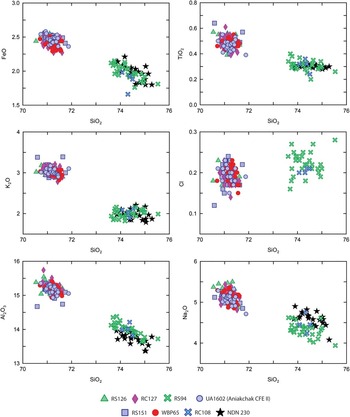
The two sediment cores from Ruppert Lake each contain cryptotephra layers (RC108 and RS94) at similar stratigraphic positions (Fig. 5). Shards from both layers consist of cuspate platy shards, and glass chemistry is rhyolitic with low K2O values with (1.82–2.16 wt%). As these cryptotephras are from similar stratigraphic positions and are chemically indistinguishable (Fig. 6), we consider them to represent the same tephra horizon, which we informally name the “Ruppert tephra.” The modeled age of the Ruppert tephra is 3230–2930 cal yr BP in RS and 2920–2520 cal yr BP in RC (Fig. 5).
The glass chemistry of the Ruppert tephra is similar to the NDN 230 cryptotephra from Nordan’s Bog, Newfoundland (Pyne O’Donnell et al., Reference Pyne O’Donnell, Hughes, Froese, Jensen, Kuehn, Mallon and Amesbury2012; Fig. 6). However, the reported age range for NDN 230 (2320–2110 cal yr BP) is slightly younger than the modeled age of the Ruppert tephra, and it is unclear whether this difference reflects age model errors or if the tephras were produced during separate eruptions. The NDN 230 tephra was initially linked to Augustine unit G; however, as discussed by Mackay et al. (Reference Mackay, Hughes, Jensen, Langdon, Pyne-O’Donnell, Plunkett, Froese and Coulter2016), this correlation is now considered unlikely, and the origin of both tephras remains unclear.
(color online) Bivariate plots of major and minor element glass chemistry from the Brooks Range tephras, plotted against Aniakchak caldera-forming event II (CFE II) reference material (UA 1602) run concurrently during analyses, and the NDN 230 tephra from Nordan’s Bog, Newfoundland (Pyne O’Donnell et al., Reference Pyne O’Donnell, Hughes, Froese, Jensen, Kuehn, Mallon and Amesbury2012) (Cl values were not available for NDN 230).

RS126, RC127, and WBP65 (Aniakchak CFE II)
A cryptotephra layer of clear platy shards is found at similar stratigraphic positions in all three Brooks Range cores (RS126, RC127, and WBP 65 of Fig. 5). The rhyolitic glass chemistry is identical for all three layers. The modeled age ranges are 3670–3200 cal yr BP in RC, 3650–3180 cal yr BP in RS, and 4110–3740 cal yr BP in WBP.
Glass chemistry from all three layers is indistinguishable from the higher SiO2 population of Aniakchak CFE II, reference material UA1602 (Fig. 6), and the modeled age ranges from both Ruppert Lake cores are consistent with the ~3600 cal yr BP caldera-forming event of Aniakchak. However, the modeled age range for the Aniakchak CFE II tephra in WBP is older (4110–3740 cal yr BP). This offset is possibly an artifact of an erroneously older date obtained from a macrofossil at 63 cm that modifies the modeled sedimentation rate (Fig. 5). Nonetheless, this tephra is likely also the Aniakchak CFE II because of the strong geochemical correlation between the WBP tephra and the Ruppert Lake tephras. The Aniakchak CFE II was among the largest eruptions to take place during the Holocene producing an estimated eruptive volume of >50 km3 (Riehle et al., Reference Riehle, Meyer, Ager, Kaufman and Ackerman1987; Neal et al., Reference Neal, McGimsey, Miller, Riehle and Waythomas2001). Volcanic ash layers extend northward from Aniakchak volcano (Beget et al., Reference Begét, Mason and Anderson1992; Kaufman et al., Reference Kaufman, Jensen, Reyes, Schiff, Froese and Pearce2012; Pearce et al., Reference Pearce, Varhelyi, Wastegård, Muschitiello, Barrientos, O’Regan and Cronin2016), and the cryptotephra associated with the eruption is described in several North Atlantic records (Pyne O’Donnell et al., Reference Pyne O’Donnell, Hughes, Froese, Jensen, Kuehn, Mallon and Amesbury2012; Jennings et al., Reference Jennings, Thordarson, Zalzal, Stoner, Hayward, Geirsdóttir and Miller2014), as well as in the Mt. Logan ice core (Zdanowicz et al., Reference Zdanowicz, Fisher, Bourgeois, Demuth, Zheng, Mayewski and Kreutz2014) and Greenland ice cores, where it is dated to 3595 ± 4 cal yr BP (Denton and Pearce, Reference Denton and Pearce2008; Coulter et al., Reference Coulter, Pilcher, Plunkett, Baillie, Hall, Steffensen, Vinther, Clausen and Johnsen2012).
RS151
RS151 consists of clear platy shards with major element geochemistry indistinguishable from the Aniakchak CFE II tephra (Fig. 6). The cryptotephra is only found in RS, where it forms an independent shard peak dated to 4070–3760 cal yr BP.
DISCUSSION
Interpretation of RS151, a precursor to the Aniakchak CFE II eruption
The RS core contains two cryptotephras 25 cm apart with glass chemistry that correlates closely to the Aniakchak CFE II tephra. However, preservation of RS151 in only one of the studied cores, combined with identical glass chemistry and shard morphology with the Aniakchak CFE II preserved above it, complicates description of the tephra as an independent isochron. The Aniakchak CFE II (RS126) and RS151 occur either side of a section break in the core (at 137 cm). However, sediment geochemistry values differ strongly between samples (Supplementary Table 5 and Supplementary Fig. 3) eliminating any possibility of core overlap and hence repeated sampling. One explanation is that RS151 is the result of the downward movement of shards through soft organic sediments, via density-induced displacement or bioturbation. Such postdepositional reworking has been described for discrete visible ash beds (Anderson et al., Reference Anderson, Nuhfer and Dean1984; Beierle and Bond, Reference Beierle and Bond2002) and cryptotephra layers (Davies et al., Reference Davies, Elmquist, Bergman, Wohlfarth and Hammarlund2007). However, the sinking tephra would be expected to produce an evident downward tail of shards that is not observed in RS. In addition, both Ruppert cores contain undisturbed laminations that would be distorted by any bioturbation or slumping, suggesting tephras within Ruppert Lake are preserved in situ. Thus, it seems likely that RS151 is an independent tephra derived from a precaldera eruption of the Aniakchak volcano. Previous studies show that precaldera tephras from the Aniakchak volcano can share similar glass chemistry to the CFE II (Kaufman et al., Reference Kaufman, Jensen, Reyes, Schiff, Froese and Pearce2012). Neal et al. (Reference Neal, McGimsey, Miller, Riehle and Waythomas2001) acknowledged at least 20 explosive Holocene eruptions prior to the ~3600 cal yr BP caldera event, and it is likely that RS151 represents one of these events.
Implications of distal records of Alaska tephra
Discovery of cryptotephras in the Brooks Range and characterization of beds in the eastern interior show the potential of tephrochronology for refining stratigraphic and chronological uncertainties across Alaska. In particular, identification of the Aniakchak CFE II tephra in high concentrations in all three Brooks Range cores shows the tephra to be a regional and precisely dated stratigraphic marker for the mid–late Holocene in northern Alaska. Such well-dated horizons are particularly valuable in Alaska, where reworking of old (Holocene) carbon can reduce the accuracy of radiocarbon dating (Abbott and Stafford, Reference Abbott and Stafford1996).
The geochemical description of the White River Ash and Hayes F2 layer in Jan Lake provide similar correlation opportunities in the eastern interior, and discovery of a new tephra bed linked to an Aleutian arc–Alaska Peninsula source (mostly likely Mt. Augustine or Mt. Kaguyak) may provide a new stratigraphic marker for interior Alaska. Although further work is needed, the potential correlation between the Ruppert tephra in the Brooks Range and the NDN 230 tephra in Newfoundland (Pyne O’Donnell et al., Reference Pyne O’Donnell, Hughes, Froese, Jensen, Kuehn, Mallon and Amesbury2012) may enable correlation between the two regions and across North America.
Tephra preservation in the Brooks Range
The Brooks Range records contain comparatively few tephras given the relative proximity of study sites to volcanic sources in Kamchatka and the Aleutian Arc/Alaska Peninsula. Eruptions from these centers have produced intercontinental cryptotephra horizons (Coulter et al., Reference Coulter, Pilcher, Plunkett, Baillie, Hall, Steffensen, Vinther, Clausen and Johnsen2012; Pyne O’Donnell et al., Reference Pyne O’Donnell, Hughes, Froese, Jensen, Kuehn, Mallon and Amesbury2012; Mackay et al., Reference Mackay, Hughes, Jensen, Langdon, Pyne-O’Donnell, Plunkett, Froese and Coulter2016); however, few of these are found in Ruppert Lake or WBP. This likely reflects prevailing atmospheric circulation, with the Brooks Range situated north of the Arctic front for much of the year and therefore subject to predominately northeasterly winds (Serreze et al., Reference Serreze, Lynch and Clark2001). Although the Brooks Range sites contain fewer tephras, low background levels of volcanic shards facilitate identification of cryptotephras that may be obscured in more proximal localities. These horizons are likely to add to the eruption histories of Alaska, and possibly Kamchatka, volcanoes.
The tephrostratigraphies of all three Brooks Range cores differ, despite the proximity of Ruppert Lake to WBP. Notably, the Ruppert tephra (RC108 and RS94) is absent from WBP, while only RS preserves a tephra predating the Aniakchak CFE II. The hydrologic isolation of WBP means any preserved tephra must be from primary air fall, whereas Ruppert Lake is fed by two inlets draining a much larger catchment (Figs. 1 and 4). Catchment size, surface area, and inlet presence affect the delivery and distribution of volcanic shards across a basin (Mangerud et al., Reference Mangerud, Lie, Furnes, Kristiansen and Lømo1984; de Fontaine et al., Reference de Fontaine, Kaufman, Anderson, Werner, Waythomas and Brown2007; Pyne O’Donnell, Reference Pyne O’Donnell2011), and it is likely that the absence of inlets to WBP, combined with a smaller catchment and surface area, make the lake less effective in entrapping distal tephras where lower volcanic ash concentrations were available.
CONCLUSIONS
Major and minor element analyses of tephra in the Alaska eastern interior document a White River Ash tephra, the Hayes tephra set H (layer F2), and a new ash layer, likely to be associated with Mt. Augustine or Mt. Kaguyak.
At least three cryptotephras are present in the Brooks Range, including the ~3600 cal yr BP Aniakchak CFE II tephra and a late Holocene eruption with similar glass chemistry to the NDN 230 tephra preserved in Newfoundland (Pyne O’Donnell et al., Reference Pyne O’Donnell, Hughes, Froese, Jensen, Kuehn, Mallon and Amesbury2012). The discovery of cryptotephras well beyond the extent of visible ash layers shows the potential for tephrochronology to refine northern Alaska stratigraphy and chronology.
A cryptotephra (RS151) chemically identical to the Aniakchak CFE II but preserved stratigraphically below it was most likely deposited by an explosive eruption of the Aniakchak volcano closely predating the ~3600 cal yr BP caldera event.
SUPPLEMENTARY MATERIAL
To view supplementary material for this article, please visit https://doi.org/10.1017/qua.2017.38
ACKNOWLEDGMENTS
The assistance of Dr. Victoria Smith in the geochemical analyses of tephra at the University of Oxford is greatly appreciated, Charlotte Clarke kindly helped in the preparation of samples, and Mark Dover provided cartographic expertise. An anonymous reviewer, along with Prof. Chris Turney and the Quaternary Research editors, Dr. Jim O’Connor and Prof. Lewis Owen, provided constructive criticisms that improved the manuscript. The support of the Quaternary Research Association in funding initial electron-microprobe analysis at the University of Oxford is also gratefully acknowledged. This work was supported by the Natural Environment Research Council (NERC) Radiocarbon Facility NRCF010001 (allocation numbers 1726.0813, 1847.1014, and 1946.1015) and a Natural Science and Engineering Research Council Discovery Grant to DGF. This research was funded through a grant from the NERC Arctic Research Programme (no. NE/K000233/1), the LAC (Lakes and the Arctic Carbon Cycle) project.