Introduction
When states emerge from civil wars, their societies must confront both the structural damage done to the nation as a whole, as well as the physical and psychological harms that befall individuals. The work of peacebuilding entails repair to the nation’s infrastructure, economy, environment, and most importantly, to the lives of its people. In this analysis, we focus on the reintegration of former non-state armed actors, such as rebel forces and militias, in the post-conflict period. Specifically, we analyze why some former combatants are able to successfully complete a reintegration program, while others are not. These individuals face numerous challenges and hardships that, if not properly addressed, may increase the likelihood that some of them become involved in criminal work, political violence, or other activities that undermine peace, or experience other personal, social, or economic challenges that detract from peacebuilding.Footnote 1 Key to managing effective transitions to civilian life will be government efforts in DDR – disarmament, demobilization, and reintegration. Our focus is on the third element of reintegration, and in particular on the security challenges facing the former, non-state armed actors (henceforth, ANSAs). We develop a theoretical model of the impact of insecurity on the successful completion of a government reintegration program in Colombia, and test our hypotheses on a large database of ANSAs. We also consider and account for the powerful effects of gender and family in the successful completion of a reintegration program.
There has been an increasing interest in understanding what happens to former combatants after a war ends (Theidon, Reference Theidon2007; Villegas de Posada, Reference Villegas de Posada2009; Denissen, Reference Denissen2010; Nussio, Reference Nussio2012; Podder, Reference Podder2012; Nussio and Oppenheim, Reference Nussio, Rettbergþ and Ugarriza2015, Reference Nussio and Oppenheim2014; Phayal et al., Reference Phayal, Khadka and Thyne2015; Nussio and Howe, Reference Nussio and Howe2016; McFee, Reference McFee2016; Firchow, Reference Firchow2017; Daly, Reference Daly2018; Kaplan and Nussio, Reference Kaplan and Nussio2018a, b; Richards, Reference Richards2018; Kreutz and Nussio, Reference Kreutz and Nussio2019). Despite the increased scholarly attention, however, according to Saldner (Reference Saldner2020, 20), reintegration remains the least understood aspect of DDR programs. Nonetheless, in addition to the foregoing work that focuses principally on Colombia, there is an increasing body of literature addressing reintegration challenges faced in a variety of societies, which also delves into subjects like the reintegration of women and child soldiers (Hauge, Reference Hauge2008; Annan et al., Reference Annan, Blattman, Mazurana and Carlson2011; Basini, Reference Basini2013; Veale et al., Reference Veale, McKay, Worthen and Wessells2013; Marks, Reference Marks, Davies and True2018). Our aim is to contribute to the literature that examines the role of violence and insecurity, as well as the impact of gender and family on individuals’ ability to manage their reintegration through a government program.
An abbreviated list of the challenges facing former ANSAs would include psychological adjustment to life outside of war; health concerns resulting from the conflict; the need for gainful employment; political participation; reconciliation with the victims of war; and their safety and security as well as that of their families. The consequences to the individual and to society if this transition is not managed effectively can be substantial. Individuals may take up arms again if they feel betrayed by the peace. They may join criminal gangs as one of the few options for those who often have few job prospects. Without proper efforts to provide the level and type of security needed for the ANSAs’ successful completion of a reintegration program into society, individuals may relapse into violence just as nations may relapse into armed conflict.
Insecurity may be one of the most critical challenges facing former non-state armed actors, yet extant research has reached diverse conclusions. Several authors find that security is not especially predictive of reintegration success (Kaplan and Nussio (Reference Kaplan and Nussio2018a, b). Some scholars have found that ex-combatants are more likely to settle in more dangerous areas (Peña and Dorussen, Reference Peña and Dorussen2021), while others find that the more general security situation in the ANSAs’ region of residence is critical (Nussio and Howe, Reference Nussio and Howe2016). We contend that by incorporating municipal-level data on conflict and criminal violence into our database of over 50,000 former combatants and their gender, social, and family situation, we will be able to arrive at more conclusive answers as to why some individuals are able to complete a reintegration program, while other fail or drop out. We would be remiss, however, if we failed to note that while these data provide us with a window into the experiences of the former combatants regarding a particular program in one country, there are many understandings and definitions of ‘reintegration’. While we focus on one specific program, other scholars consider reintegration more holistically as touching on psychological, social, economic, and political reintegration (Hauge, Reference Hauge2008; Muggah, Reference Muggah2009; Soderstrom, Reference Söderström2013; Marks, Reference Marks, Davies and True2018).
Our analysis focuses on the security experiences of individuals who have demobilized in Colombia since the early 2000s. Colombia has had extensive experience in DDR dating back to the 1980s and early 1990s, but more recently has been involved in two extensive and planned demobilizations. Beginning in 2003 through to 2006, there was a major demobilization of the paramilitary forces that worked together under the banner of the AUC (United Self-Defense Forces of Colombia). The AUC was a pro-government umbrella of regional militias that had been fighting leftist rebels and engaging in other uses of coercive violence since the 1990s. Over 30,000 individuals demobilized, although there have been questions about the accuracy of the accounting of just how many individuals were entitled to benefits.Footnote 2 In 2016, Colombia reached a peace agreement with the leftist FARC rebel group (Revolutionary Armed Forces of Colombia) that has resulted in another massive DDR program. And while there was great hope that the peace agreement would auger a new area of stability and security, former combatants from the FARC have faced an increasingly violent environment in Colombia and many former fighters have been killed in political, criminal, and other types of violence.
Given this extensive experience in DDR, Colombia represents an ideal case within which to analyze the determinants of successful reintegration programs, and the impact of (in)security on individual outcomes. The Colombian government has kept extensive data on the ANSAs and their progress through its DDR programs. Colombia has demobilized leftist and pro-government forces. DDR programs have been used in large-scale programs, but also with individuals who left these groups of their own accord – collective demobilizations and individual desertions. Colombia also can provide us with critical leverage on questions pertaining to gender and family life and their impact on the completion of the reintegration program as a substantial number of female ANSAs have taken part in the Colombian program. Additionally, the security environment varies greatly across the country. There are territories that experienced significant violence during the conflicts, depending on which groups were contesting, and other areas that saw little to no violence. The current security conditions facing ANSAs continues to vary significantly depending on their proximity to coca cultivation zones, mining areas, drug, and weapons transportation routes, and the degree of contestation among the remaining armed actors (criminal bands [‘bacrim’ as they are called in Colombia], splinter factions of the FARC, and other rebel groups such as the ELN (National Liberation Army)) for control over these areas. Hence, there is a great deal of variation in violence levels across Colombia. While we would not wish to overstate the importance of the Colombian case as it is unique like all others, it shares a large number of characteristics with a variety of post-conflict nations and exhibits significant variability across its own territory along these dimensions that make it an especially appropriate case to study. The quantity and quality of the Colombian data, coupled with many pertinent features found in other post-conflict situations make the Colombian case one from which we can learn and generalize.
Our paper is organized as follows. First, we review the growing literature on the experiences of ANSAs and the effectiveness of DDR programs. Second, we propose a model of individual outcomes of the Colombian reintegration program that highlights the important role played by the security conditions, as well as the impact of gender and family on the completion of the Colombian government program. Third, we make use of the extensive data the Colombian government provides on its DDR programs at the level of the individual outcomes, as well as municipal-level data on conditions in the communities in which ANSAs are reintegrated to test our hypotheses. We conclude with several recommendations for future research into the impact of DDR programs.
Literature review
DDR of former non-state, armed actors comprise multiple efforts that are designed to transition former combatants into productive civilian lives and to reduce the likelihood of future violence (United Nations, 2006). In the first stages of DDR, combatants formally lay down their arms to symbolically and practically give up the use of violence to pursue their political objectives. Grandiloquent pronouncements, ceremonies, and other large, public events are intended to exemplify the turn away from the use of violence to resolve political differences, and the reestablishment of the government as the sole, legitimate user of coercive force. Demobilization and disarmament are also intended to demonstrate to former combatants that they are safe and secure in this new environment, and that their renunciation of violence will not leave them vulnerable to attacks by their adversaries. DDR promises security for society and for ANSAs. The reintegration efforts consist of social programs designed to aid former combatants as they transition into civilian life; educational programs that will provide them with the means to improve their skill sets; work programs that assist individuals with finding employment, and counseling and other forms of personal support for individuals dealing with the long-term consequences of their former lives, such as post-traumatic stress disorder. As described by Oppenheim and Soderstrom regarding DDR in Colombia (Reference Oppenheim and Soderstrom2018, 139):
“All combatants receive the same package of benefits, which are delivered by the Agencia Colombiana para la Reintegracíon (ACR). These consist of dedicated support from a social worker, a monthly stipend, access to health, education and psychological counseling services, and training in navigating the daily tasks of civilian life, such as using banking and financial services. The programme also provides several mechanisms for ex-combatants to earn a livelihood, including vocational training and introductions to potential private sector employers, access to apprenticeship programmes, and access to credit for individual small businesses. Lastly, the programme requires that ex-combatants take part in community reintegration and reconciliation activities designed to knit former fighters back into civilian society, including collective public works projects and public dialogues designed to bring ex-combatants and civilians into contact.”
In recent years, there has been an increasing interest in analyzing the effectiveness of these programs, especially through more advanced modeling of the challenges facing the former, non-state armed actors (Hauge, Reference Hauge2008; Muggah, Reference Muggah2009; Theidon, Reference Theidon2009; Themner, Reference Themner2011; Basini, Reference Basini2013; McMullin, Reference McMullin2013a, b; Soderstrom, Reference Söderström2013; Veale et al., Reference Veale, McKay, Worthen and Wessells2013; Kilroy, Reference Kilroy2014; Nussio and Oppenheim, Reference Nussio and Oppenheim2014; Daly, Reference Daly2018; Kaplan and Nussio, Reference Kaplan and Nussio2018a, b; Marks, Reference Marks, Davies and True2018; Oppenheim and Soderstrom, Reference Oppenheim and Soderstrom2018). Research has utilized surveys of former combatants, criminal records, in-depth interviews, and other techniques to conceptualize ‘reintegration’ and to identify key determinants of success. Former combatants must navigate a complex and narrow path to reintegration that is marked both by important personal milestones (e.g. receiving a diploma) and national political changes as well. The significant amount of research in this area also demonstrates that outcomes of these programs can be measured in a great many ways from specific outcomes of specific programs as in our study to the more holistic analyses that consider a range of outcomes and behaviors as indicators of ‘reintegration’ or ‘reintegration success’. Comprehensive analyses that utilize a variety of types of information from data to interviews, to more generally, reflections, can provide us with a more comprehensive view of the struggles faced by ANSAs. Our goal is to add to this literature by accounting for the more precise impact of certain key factors – namely insecurity and gender – in one particular program.
Most especially, one of the more important goals of these programs is to prevent or discourage former combatants from engaging in violent activity, including criminal behavior and the resumption of armed conflict. To the extent DDR programs can prevent such negative outcomes, the individual and society benefit from the lack of violence. While some scholars have concluded that DDR programs are not entirely effective (Humphrey and Weinstein, Reference Humphreys and Weinstein2007; Gilligan et al., Reference Gilligan, Pasquale and Samii2014), most research has identified a number of key determinants of DDR effectiveness (Hauge Reference Hauge2008; Muggah, Reference Muggah2009; Theidon, Reference Theidon2009; Themner, Reference Themner2011; Soderstrom, Reference Söderström2013; McMullin, Reference McMullin2013a, b; Kilroy, Reference Kilroy2014; Nussio and Oppenheim, Reference Nussio and Oppenheim2014; Kaplan and Nussio, Reference Kaplan and Nussio2018a, b; Marks, Reference Marks, Davies and True2018; Oppenheim and Soderstrom, Reference Oppenheim and Soderstrom2018).
In their study of the incidence of criminal behavior by ex-combatants in Colombia, Kaplan and Nussio (Reference Kaplan and Nussio2018a) find, on the one hand, that personal motivations such as a preference for a dangerous and violent lifestyle are associated with an increased risk of former combatants engaging in criminal behavior. On the other hand, they find that aging ex-combatants, especially those with a wife and children, learn to accept that they are no longer young men without care and are less likely to become involved in crime. Kaplan and Nussio also find evidence that former FARC guerillas and those who take part in educational programs are less likely to engage in criminal activity. Another finding by Kaplan and Nussio (Reference Kaplan and Nussio2018b) is that the social context in which ANSAs attempt to reintegrate matters a great deal in facilitating positive outcomes for these individuals. Where ANSAs’ transition to civilian life in communities that are prepared to receive them and provide the social supports necessary for their transition, both in terms of government programs and opportunities for social interaction in the community, the likelihood of recidivism is low. Nussio and Oppenheim (Reference Nussio and Oppenheim2014) find that one significant hurdle to overcome in efforts at social reintegration is ‘anti-social capital’ among ex-combatants. Nussio and Oppenheim suggest that among ANSAs, belief systems develop and take root when individuals conclude that government and society cannot be trusted, and that the only method of creating change is through the coercive use of violence. This lack of trust in reintegration and acceptance can persist for many years, although Nussio and Oppenheim (Reference Nussio and Oppenheim2014) find that eventually their effects deteriorate over time.
Educational programs are often among the more effective features of DDR. Kaplan and Nussio (Reference Kaplan and Nussio2018a, 84) observe that,
“When asked, ‘‘what part of the program has been most helpful for your reintegration?’’, a plurality of 28 percent cited the ACR’s basic education program (an additional 11 percent cited technical training). Similarly, a majority of ex-combatants (56 percent) stated that a main advantage of demobilizing is being able to study (more than any other response)”.
Researchers have also found that program delivery and effectiveness are critical determinants of success (Oppenheim and Soderstrom, Reference Oppenheim and Soderstrom2018). A number of scholars have found that DDR programs that encourage the active participation of ANSAs in their reintegration, and share information with them, are more effective (Soderstrom, Reference Söderström2013; Veale et al., Reference Veale, McKay, Worthen and Wessells2013; Kilroy, Reference Kilroy2014). Other scholars have highlighted the challenges many ANSAs face when seeking to join and belong to communities, such as maintaining some degree of anonymity about their past (McFee, Reference McFee2016) and dealing with the emotional legacies of their lives under arms (Nussio, Reference Nussio2012; Soderstrom, 2020). In keeping with these findings, scholars have also noted a linkage between the receptivity of local communities in which the former combatants settle, and their level of social engagement and successful reintegration (Rozema, Reference Rozema2008; Denissen, Reference Denissen2010; McMullin, Reference McMullin2013a; Kaplan and Nussio, Reference Kaplan and Nussio2018b). The willingness to embrace the ANSAs may also be affected by the types of crimes committed in the receiving community by the former combatant (Podder, Reference Podder2012).
The findings regarding the impact of personal and community security and other factors related to the security of ANSAs have been mixed. Kaplan and Nussio (Reference Kaplan and Nussio2018a, b) find that the security environment does not exercise an appreciable impact on either recidivism or ex-combatants’ social integration into their communities. Others, however, have found linkages between the security situation confronting ANSAs and successful reintegration outcomes that focus more on the security context of the geographical area in which former combatants resettle rather than their personal security situation (Nussio and Howe, Reference Nussio and Howe2016; Kaplan and Nussio, Reference Kaplan and Nussio2018a). Some research has discovered that there may be selection effects influencing the impact of security and violence on successful reintegration. Since many ANSAs return to their home regions when they are able, if they are returning to communities that exhibit many of the same indicators of violence that initially pushed these individuals toward taking up arms, they may face significant challenges. Even if these home communities are the site of family and friends, they may still exhibit the hallmarks of unstable and war-afflicted regions (Peña and Dorussen, Reference Peña and Dorussen2021).
There is also a burgeoning research agenda on the role and impact of gender, as well as family life more generally on the DDR process (e.g. Hauge, Reference Hauge2008; Podder, Reference Podder2012; Basini, Reference Basini2013; Veale et al., Reference Veale, McKay, Worthen and Wessells2013; Marks, Reference Marks, Davies and True2018). There seems to be little doubt among scholars that the experiences of women as former combatants differ considerably from those of men. During the reintegration phase, research has shown that there is reason to believe female ANSAs utilize social bonds developed during the combat to aid their reintegration. As Hauge (Reference Hauge2008, 295) writes, ‘the war experiences represented an asset for social and political participation to those of the female ex-fighters that reintegrated collectively—together with their male ex-combatants.’ Their involvement and participation in these DDR activities are key to engaging women in DDR processes and helping them utilize the skills developed in tight-knit groups to succeed when peace is at hand. Therefore, it is vital that the pervasive impact of gender on experiences during the post-conflict phase more generally, and reintegration processes more specifically, are addressed when we seek to explain the successful passage of ANSAs through government reconciliation programs like those in Colombia.
Despite the lack of consistent and theoretically supported findings regarding a linkage between security conditions and the success of ANSAs in reintegration programs, we argue that a more dedicated effort to understand these relationships is needed (Saldner, Reference Saldner2020). Indeed, Kaplan and Nussio (Reference Kaplan and Nussio2018a, 65) point out that, ‘Although the international community has accompanied over sixty such processes since the late 1980s (Muggah, Reference Muggah2009), with $630 million USD spent on programs worldwide for around 1 million ex-combatants in 2007 alone, there is little systematic evidence about who decides to “go bad.”’ We argue there is a need to develop a theory that considers the impact of security conditions as well as the role of gender to account for their role in explaining DDR effectiveness.
Theory
Previous research has found some indication that violence and insecurity influence the effectiveness of reintegration programs, but the evidence has been inconsistent and often researchers find that other factors are more influential in shaping outcomes (Nussio and Howe, Reference Nussio and Howe2016; Kaplan and Nussio, Reference Kaplan and Nussio2018a, b; Peña and Dorussen, Reference Peña and Dorussen2021). We neither dispute these findings nor question the research methodologies that lead to these conclusions. Rather, we make two assumptions about the impact of violence and insecurity on successful, individual conclusions to reintegration programs. First, we posit that personal security and freedom from violence is likely a necessary, but not sufficient condition for the successful completion of government programs. Individuals, who reside in communities where threats to their physical integrity are frequent and where they are incapable of moving about the community like an average person, will be substantially challenged in finding employment, protecting their family, or even going to the grocery store. Where previous research has found the impact of violence to be weak (Kaplan and Nussio (Reference Kaplan and Nussio2018a, b), we suggest, as do others, that the security context in the ANSAs’ area of resettlement can be a critical factor in their ability to complete the Colombian government’s reintegration program (Nussio and Howe, Reference Nussio and Howe2016; Peña and Dorussen, Reference Peña and Dorussen2021). Second, we propose that security threats are multifaceted, especially in the context of the areas in which ANSAs resettle. That is, we assume that the ability of ANSAs to complete the Colombian government’s program will be affected by diverse forms of insecurity and violence and the extent to which they vary across Colombian municipalities.
We begin by recognizing the importance of the security context within which ANSAs reside and their impact on the completion of the government program. Kaplan and Nussio (Reference Kaplan and Nussio2018a) find while the individual’s personal security situation is not a critical factor in explaining program success, they also find that where conflict violence was low in the past, ANSAs are better able to make a successful transition. In a novel study of the impact of resettlement of ANSAs into their new communities, Peña and Dorussen (Reference Peña and Dorussen2021, 3) find, ‘that ex-combatants are more likely to have settled in municipalities with high crime rates. Controlling for reverse causality, the robust finding is that only former combatants who are not in reintegration increase crime rates, while ex-combatants in reintegration tend to decrease crime rates’. This type of selection effect may be due to ANSAs returning to the very same communities that proved to be fertile ground for recruitment of fighters, and thus may retain many of these features, such as a higher level of violence and perhaps criminal activity. Some ANSAs may be unable to find places to live in safer and more inviting communities and thus are driven to resettle in dangerous, but less expensive communities Furthermore, residing in less desirable, high-crime areas may help ANSAs remain anonymous, which is often an important concern. Nussio and Howe (Reference Nussio and Howe2016, 849) point to the importance of the overall security situation in a region and find that when preexisting orders, whether enforced by paramilitaries or rebels (Arjona, Reference Arjona2016) are disrupted with the conclusion of peace, there is increased contestation over the territory that is now fought over by other ANSAs. Such contestation among armed actors inevitably leads to a more insecure community and increased challenges in completing the Colombian government’s program of reintegration.
What are these specific challenges that ANSAs face when there is a lack of security in their municipality? First, there is large-scale violent action that may be local, regional or national in origin. By large-scale violence, and the concomitant threat of insecurity it brings, we mean violence between organized groups including criminal bands, rebel forces (e.g. the ELN or National Liberation Army), narco-traffickers, and even government forces. This type of violence and insecurity tends to be more widespread, destructive, and injurious to civil society. Violence among organized actors, whether labeled conflict or war, damages or prevents normal social and economic activity. Such violence affects not just ANSAs but entire communities. This type of insecurity raises multiple risks for ANSAs. They may be enticed into utilizing their war-fighting skills in one of these armed groups. They may find that such violence disrupts their ability to carry out the requirements of the Colombian government program because the necessary movement across the community and interactions with community members is difficult and dangerous. When such large-scale political and/or criminal violence occurs in the area of resettlement, ANSAs will face significant difficulties in successfully completing the Colombian government’s program.
In addition to such systemic violence, there is more localized violence that may involve the community, neighborhood, or even a particular street (Peña and Dorussen, Reference Peña and Dorussen2021). Much of this may, in fact, be linked to these larger armed groups. Criminal gangs may offer incentives for individuals trained in combat to join, while rival gangs may threaten retaliation for those who do. ANSAs may be targeted with criminal violence, especially if they are leading more of a marginal existence, socially and/or economically in a community. ANSAs may be uniquely vulnerable to this type of predation as fellow community members may be fearful of interacting with them and helping them address these threats. ANSAs, who are under threat of violence, likely find that many facets of their life become more difficult because of this ever-present insecurity. Addressing their own mental health challenges, such as post-traumatic stress disorder, depression or other issues, is made worse by new types of dangers, which create new problems while at the same time making treatment of preexisting conditions all the more arduous. Some ANSAs may struggle with issues of domestic violence – either as perpetrator or victim – that becomes even more problematic given the stress and fear that is already present in their lives. ANSAs who have left an existence fraught with peril and uncertainty must now navigate a new type of life as a civilian, but with many of these same hallmarks of their previous life.
Furthermore, research has shown that successful completion of government reintegration programs is advanced when ANSAs are provided with opportunities to further their education and/or receive vocational training to help them become productive members of the community (Kaplan and Nussio, Reference Kaplan and Nussio2018a, b; Oppenheim and Soderstrom, Reference Oppenheim and Soderstrom2018). To the extent that ongoing violence, threats of violence, and crime make it more difficult for ANSAs to move about freely in their communities, their ability to take advantage of these opportunities is undermined. If their attention is diverted to addressing the urgent lack of security in their personal lives, they will have less ability to complete this training and ultimately to maintain a regular work schedule. Therefore, the numerous challenges involved in leading a normal life under conditions of abnormal security will likely make the successful completion of government reintegration programs more difficult for ANSAs. Based on these arguments, we posit the following hypotheses:
Hypothesis 1: ANSAs who reside in municipalities where there have been higher levels of victimization by actors during the armed conflict will be less likely to complete the Colombian government’s reintegration program.
Hypothesis 2: ANSAs who reside in municipalities where greater numbers of actors contested for power during the armed conflict will be less likely to complete the Colombian government’s reintegration program.
Hypothesis 3: ANSAs who reside in municipalities where there are higher levels of homicides and robberies will be less likely to complete the Colombian government’s reintegration program.
Gender and the family situation of the former combatants are especially critical in explaining their completion of the Colombian government’s reintegration program (e.g. Hauge, Reference Hauge2008; Basini, Reference Basini2013; Veale et al., Reference Veale, McKay, Worthen and Wessells2013; Marks, Reference Marks, Davies and True2018). Researchers have recognized the different roles assigned to women during and after conflict. Scholars have found evidence that the challenges confronting female ANSAs after conflict are often exacerbated by biases and impediments that make it more difficult to participate in their reintegration process and their involvement in politics (Hauge, Reference Hauge2008; Veale et al., Reference Veale, McKay, Worthen and Wessells2013; Kilroy, Reference Kilroy2014; Marks, Reference Marks, Davies and True2018). Women report more positive experiences and outcomes when they are given more agencies in the DDR process. Interestingly, Annan et al. (Reference Annan, Blattman, Mazurana and Carlson2009, 2) ‘While almost all females report serious family and community problems upon return, the vast majority is accepted by their families, and relations improve further over time. Meanwhile, in education and economic activity, women and girls returning from the LRA look similar to their non-abducted peers’. While this study was confined to Uganda, it may be possible that the relative success of women after conflict may be due to the greater ease with which they return to their families and the mentoring they receive from family members and others in their community. Women may be making better choices in their selection of associates after war, and hence fewer opportunities for recidivism present themselves. We also suggest that all ANSAs who have children will be more likely to complete the Colombian government’s reintegration program. Ties that bind individuals to people and places – and children are among the most powerful – may help encourage individuals to commit to completing this program. We suggest two hypotheses:
Hypothesis 4: Female ANSAs will be more likely to complete the Colombian government’s reintegration program.
Hypothesis 5: ANSAs with children will be more likely to complete the Colombian government’s reintegration program.
Background on demobilization processes in Colombia
In order to understand the process of reintegration of ANSAs, it is necessary to briefly review the key policies and strategies different national governments have implemented since the 1980s to support those who have voluntarily laid down their arms. The process of reintegration begun under President Belisario Betancur (1982–1986), who recognized the political character of guerrilla groups, which made possible the political negotiation with these armed groups. The Amnesty Law or Law 35 of 1982 established the procedure under which the process of reincorporation of former combatants to civil life was advanced, which included programs focused on land, housing, credit, and micro-enterprises, health, employment, and education. Likewise, rural housing loans and reforestation and technology transfer programs were organized. In the educational field, the organization of a special system for validating courses and obtaining degrees was ordered. Each individual who was amnestied was granted aid of 9000 COP per month, for 6 months, plus 600 COP for each minor in the household. This allowed the return to legality of 1423 guerrillas from the different insurgent groups active in the 1980s. All these programs were coordinated and executed under the already created National Rehabilitation Plan (PNR) (Turriago and Bustamante, Reference Turriago and Bustamante2003).
The second benchmark regarding DDR was presented during the governments of Virgilio Barco (1986–1990) and César Gaviria (1990–1994). With the intention of continuing with the progress made with other guerrilla groups, César Gaviria Trujillo created the National Reintegration Office from which peace agreements were concluded with the Revolutionary Workers Party (PRT), the M-19 movement, the Quintín Lame Armed Movement (MAQL), the People’s Liberation Army (EPL) in 1991; with the Ernesto Rojas Command (CER) in 1992, with the Socialist Renewal Current (CRS), the Popular Militias and the Fernando Garnica Front (FFG) in 1994. These agreements resulted in the demobilization of 5536 combatants. The demobilization of these guerrilla groups was accompanied by a process of political reintegration in which the state undertook to guarantee the political participation of ex-combatants and the existence of alternative political parties to the traditional political groups. Consequently, the main characteristic of all the peace accords signed in the 1990s is that they included a component of political participation that became, for the guerrilla groups, ‘the fundamental motivation that led most of the combatants to lay down their arms’ (Giha et al., Reference Giha, Morales and Arias2006).
However, the reincorporation processes of the 1990s were designed to last approximately two years, which led to periodic restructuring and serious security problems. A study by Franco (Reference Franco and Franco2000) revealed that 9% of the demobilized had died and there was no information on 20% of them. For his part, León Valencia, demobilized from the Socialist Renewal Current, said that more than a thousand ex-combatants from all the groups that signed peace agreements with the National Government were killed, that is, 15% of the ex-combatants who voluntarily surrendered weapons (Valencia, Reference Valencia Agudelo2005, 16). In this way, it is evident that the State could not guarantee the safety of the ex-combatants. Likewise, we note that there is no precise data on these processes on the percentage of recidivism, as information is only obtained on some isolated cases of former EPL combatants who rearmed in alliance with paramilitary blocs, and former M-19 combatants in the Cauca who were linked to the FARC-EP.
After the collective DDR processes of the late eighties and early nineties, Decree 1385 of 1994 was enacted, through which benefits were granted to members of illegal armed groups who individually decided to leave. According to the Office of the Comptroller General of the Republic, since 1998, 29,524 combatants have been individually demobilized, registering an upward trend until 2008 and a decrease from that year to the present. During Andrés Pastrana’s government (1998–2002) around 2600 people were individually demobilized. In the two presidential terms of Álvaro Uribe (2002–2006/2006–2010) around 21,000 people were demobilized individually, while during the first term of President Juan Manuel Santos, approximately 6464 combatants did so.Footnote 3
We highlight two characteristics of individual demobilization. The first is the depoliticization of the reintegration process. From the moment the deserting guerrilla decided to enter the verification and certification processes as a combatant, he was pardoned for political crimes related to belonging to the illegal armed group and recognized as a political actor by the Government. However, the Program for the Reincorporation to Civil Life did not contemplate the political participation of the demobilized. Indeed, during Álvaro Uribe Vélez’s period, the reintegration process focused on legal and socioeconomic benefits, privileging the individual as a unit of attention and analysis. The absence of the political component can be explained, in part, by what Rubio and Vargas (Reference Rubio and Vargas2004) described as ‘criteria of negotiation’, that is, political participation was not part of the discussion for the signing of a peace agreement. The second characteristic was the insecurity of the demobilized. Because they were required to provide information on their prior activities that could implicate their former comrades, the process was marked by a high level of risk to the lives of the ex-combatants. Consequently, on many occasions, the demobilized had to relocate to cities where they were not known in order to guarantee their anonymity as a method to guarantee their safety (Nussio, Reference Nussio2012).
Paramilitaries and the process of disarmament, demobilization, and reintegration
In an effort to establish a dialogue with the self-defense groups and make viable the possibility of jointly establishing the conditions for the DDR of their military structures, during the first term of Álvaro Uribe Vélez (2002–2006), the Law of Public Order was modified. The result of this maneuver was Law 782 of 2002. One of the fundamental changes in this law was to eliminate the need to recognize the political character of the illegal armed groups to initiate a negotiation process. This reform made possible the dialogues with the United Self-Defense Forces of Colombia (AUC), because the main problem that the government had was to recognize a ‘political status’ even though these groups were not trying to ‘establish a revolutionary order’ (Centro Nacional de Memoria Histórica, 2015).
After the leaders of the AUC announced, at the end of 2002, the unilateral cessation of hostilities, the Government constituted a Peace Commission to negotiate the process of laying down arms. Six months after the commission was formed on 15 July 2003, the Santa Fe Ralito Agreement was signed, marking the formal beginning of the negotiation phase. This agreement established the conditions under which the gradual and phased demobilization of the armed structures would be carried out, without setting an action plan for reintegration.
In July 2005, Congress approved Law 975, also called Justice and Peace that met international standards in matters of justice, truth, and reparation. At the same time that the discussion on the Law took place, the United Self-Defense Forces of Colombia gradually demobilized: the first bloc did so in 2003 and the last in April 2006. In total, over 3 years, they demobilized 37 self-defense blocks made up of 31,671 paramilitaries. It is appropriate to recall that the conditions for reintegration were marginalized from the negotiation and agreements were never formalized on how the process of social, political, and economic inclusion of ex-combatants would be carried out.
Indeed, the peace accords discuss the conditions for the transformation of the illegal armed group into a legal political organization, the rules of the DDR process, the legal benefits and, in some cases, the reforms to the state. In contrast, the dialogues with the self-defense groups were not conceived in this way, but rather focused mainly on legal benefits for ex-combatants and the suspension of the extradition of their top leaders. In this scenario, the transformation of the self-defense groups into a political organization was perceived as unconstitutional and dangerous due to the precedent that it was going to establish for future negotiations with other illegal armed groups. In this way, the peace process with the United Self-Defense Forces of Colombia (AUC) was really a process of submission to justice, which had an impact on the reintegration model implemented.
The FARC and reintegration
The international standards for DDR are recommendations made by the United Nations for the design and implementation of reintegration models, which must be adapted taking into account the particular characteristics of each country and context. In Colombia, they are currently applied in the implementation of the peace agreement between the National Government and the FARC-EP, with the aim of reincorporating more than 13,000 ex-combatants into civil life. The Agency for Reincorporation and Normalization (ARN) divides the reincorporation process into eight dimensions: personal, productive, family, habitat, health, citizen, educational, and security. The National Reincorporation Council (CNR), which is composed of two members of the National Government and two members of the FARC-EP was established to ‘define activities, establish the schedule and advance the monitoring of the reincorporation process’ (Colombia, 2017. p.103).
The agreement between the National Government and the FARC-EP establishes the creation of the Special Jurisdiction for Peace (JEP), whose function is to “administer transitional justice and learn about the crimes committed in the framework of the armed conflict that were committed before December 1, 2016”. The existence of the JEP may not exceed 20 years. The JEP was created to satisfy the victims’ rights to justice, offer them the truth and contribute to their reparations, with the purpose of building a stable and lasting peace. The work of the JEP will focus on the most serious and representative crimes of the armed conflict, in accordance with the selection and prioritization criteria defined by the law and the magistrates. In particular, it will be able to learn of the crimes that ex-combatants of the FARC-EP, members of the Public Force, other agents of the state and civil third parties have committed. Regarding the latter two, the Constitutional Court clarified that their participation in the JEP would be ‘voluntary’.Footnote 4
The question of who qualifies as subject to the ARN and the JEP is complex as the JEP will have jurisdiction ‘with respect to all those who have participated directly or indirectly in the internal armed conflict, including to the FARC-EP and State agents, for the crimes committed in the context and due to the conflict’.Footnote 5 It is important to emphasize that when the JEP includes in its definition, ‘all those who directly or indirectly participated in the conflict,’ it includes the criminal behaviors of those who, without directly participating in the armed confrontation, promoted it and benefited from it. Furthermore, the agreement includes members of the FARC-EP and representatives of the State who committed criminal acts in the context of the armed conflict, which implies that the implementation stage seeks not only to identify and accuse all actors in the conflict, but to guarantee the rights of all victims. The foregoing includes civilian third parties, companies, and social organizations that, without being an organic part of the armed structures, voluntarily contributed to their financing and support.
A fundamental point of the agreement is the requirement that all the actors in the conflict assume responsibility, and this includes those who have committed crimes against humanity and war crimes from the state (Martínez Volkmar, Reference Martínez Volkmar2018). This is one of the most significant elements of the agreement, not only because it goes beyond the principle of FARC-EP guerrillas assuming responsibility for their actions, but also because the goal was the pursuit of the whole truth of the conflict. In other words, all the actors in the conflict, including the state, are responsible for telling the truth and recognizing their responsibility, not only before the direct victims, but before the whole of society to understand what the motivations and causes of the present war have been and prevent it from happening again. Sanctions are applied to ANSAs and civilian third parties who do not recognize their responsibilities in the crimes that are the competence of the Special Justice for Peace (JEP), which may result in a custodial sentence of up to 20 years.
Throughout these, nearly 40 years that Colombia has been carrying out peace processes as a strategy to end the armed conflict, international organizations such as the UN Security Council and the Organization of American States (OAS) have expressed their deep concern about the security of those individuals who have voluntarily abandoned their activities as members of armed organizations outside the law (guerrilla groups and self-defense groups) and have turned themselves into the competent authorities. Systematic killings of former AUC and FARC-EP combatants have set off alarms and led the National Government to develop actions aimed at strengthening security measures to protect them.
According to the Colombian Agency for Reincorporation (ACR), of the 30,688 former members of the AUC who demobilized and were linked to the reintegration process since 2003, more than 2000 have been killed. The figure, say sources of the entity, would be higher because this report corresponds only to the cards that have been canceled at the Registry. According to a report revealed by the national government, during the period 2003–2019, more than 2000 former AUC combatants were killedFootnote 6 . The most critical wave of violence occurred between 2008 and 2010, when 1069 members of the AUC were assassinated. The numbers of former combatants killed shows that security responses have been clearly insufficient. In total, 3094 former AUC combatants have died since the moment they signed the peace agreement with the National Government; 39 of them due to natural death and the rest due to violent acts; 37 due to accidental deaths, 42 have committed suicide, 76 have died in the middle of traffic accidents; and another 2202 have been murdered. There are still 698 deaths to be established.Footnote 7
Precisely, recidivism is one of the reasons, according to some analysts, why the number of murders of demobilized AUC members was high, and why the FARC-EP has also been subject to a great many killings.
Regarding the murders of former FARC-EP combatants, ‘through careful monitoring of the press in the framework of the implementation of the Peace Accords, since January 2017, the Ideas for Peace Foundation (FIP) has identified 50 homicides of people who belonged to this guerrilla’.Footnote 8 In the first half of 2018, the number of murders of demobilized persons (24) almost reached the total figure registered during 2017 (26)Footnote 9 . The murder of former FARC-EP combatants has mostly occurred in Nariño (17), Antioquia (13), and Cauca (9). It is important to note that 50% of the victims were murdered in six municipalities: in Ituango and Peque, in Antioquia, and in El Charco, Tumaco, Santa Cruz, and Ricaurte, in Nariño.Footnote 10 Other sources would put the number of former FARC victims at much higher levels.Footnote 11 It is our central argument that this violence is one of the principal reasons why some former combatants are more likely to be targeted with violence, and less likely to successfully complete their reintegration program.
Data and analysis
We utilize data from the Colombian government’s Agency for Reincorporation and Normalization, which makes its data available on the Colombian government data warehouse website.Footnote 12 In these data, the individual ANSAs who begin the government program of reintegration are the unit of analysis. There are over 55,000 such cases in the time period of our analysis 2001–2020. Our dependent variable is a dichotomous measure of whether the individual completed the government’s reintegration program or was in the reintegration process at the time at which the data were measured (coded ‘1’), while those who did not complete the reintegration process are coded as ‘0’. The reintegration process is voluntary and includes some hours of social work, professional training, and psychological support. The ex-combatant who accepts the government’s offer cannot commit a crime again and must comply with a strict work plan, which includes being in contact with the ARN at least twice a month and contributing to the construction of the historical truth. It is a comprehensive commitment that lasts approximately six and a half years (Gómez, Reference Gómez Isa2014).
We must add, however, that while every individual who begins this process does not necessarily complete the government program of reintegration, it is certainly possible some individuals successfully reintegrated on their own without or in spite of the government’s formal program. In future research, we should like to explore the creation of a more holistic analysis of reintegration that would consider not just the government’s official position on the outcome of a government program, but also the individual’s belief in the success of his/her reintegration. Some ANSAs may find a job, raise a family and become community members without the government program, while others may complete the program, but still personally consider their efforts at reintegration as unsuccessful. Hence, incorporating both government and individual perspectives on successful reintegration would be an important next step.
Our principal independent variables are measures of violence at the local level. Data on the ANSAs are organized at the individual level, but each individual’s municipality of residence is provided in the ARN data, which allows us to merge municipal-level data with individual-level data. First, we use the total number of individuals victimized by internal strife to measure the level of past conflict violence in a municipality. These data are obtained through the Colombian government data portal as referenced above. We use the total number of incidents of civilian victimization in each municipality for every year for which data are available for use in our analysis. We lag the data 1 year, and also include a control variable for the population size of the municipality. Second, we use data from the Basta Ya database to measure the activity of the major armed actors in Colombia over time (FARC, the paramilitaries, the Colombian military, and criminal entities).Footnote 13 Each municipality is given a score between 0 and 4 to measure the number of groups active. Because these data end in 2012, we use a 5-year lag of this measure. We also use a measure of the number of homicides and the number of robberies in a municipality to gauge the impact of criminal violence on reintegration.
We include our gender measure (Female = 1), as well as a variable for marriage (Yes = 1; No = 0) and the number of children each ANSA has. We expect these family characteristics will play a critical role in the reintegration process by providing the support and stability for the ANSAs.
We also employ a series of control variables, although we have reason to believe they will trend in a certain direction. First, we include a measure from the Colombian ARN data measuring whether the individual demobilized with a group or individually, typically through desertion (Yes = 1; No = 0). We would expect that those who demobilize with their comrades would find a stronger social network of support as they seek to complete the reintegration program, while those who desert will likely find little support among their former comrades. We also include a control measure to distinguish between the two dominant groups that demobilized – the FARC and the AUC. We include a measure of whether the individual was a member of the AUC (Yes = 1; No = 0). We include measures university education (Yes = 1; No = 0) and high school education (Yes = 1; No = 0) with the expectation that those ANSAs who have advanced education will be more likely to complete the Colombian government’s reintegration program. We also include employment in the formal sector of the economy (Yes = 1; No = 0) and employment in the informal sector of the economy (Yes = 1; No = 0) with the expectation that having some type of employment will make ANSAs less likely to resort to other means to support themselves that could run afoul of the Colombian reintegration program. Finally, we include the ordinal measure of age provided in the ARN database.Footnote 14
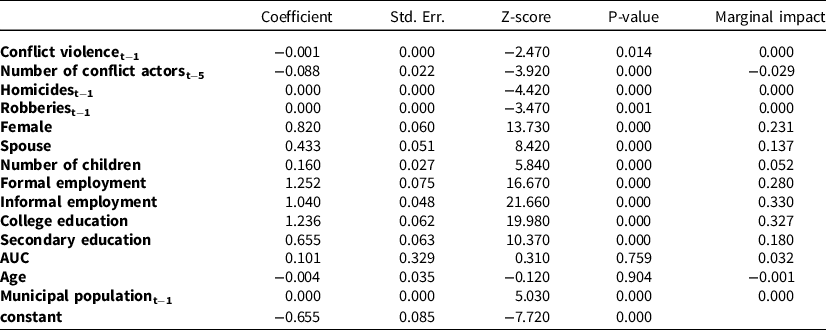
Because the dependent variable is dichotomous, we use probit analysis for our model estimation. The results are found in Table 1. The model fit is outstanding. There are slightly over 50,000 cases, as missing values forced us to drop approximately 4000 cases. The pseudo R2 is fairly large at .43, while the percentage of correctly predicted cases is also excellent at 83.6%. We note that the proportionate reduction of error, which considers the model’s improvement over predicting the modal category in every instance (successful completion of the government program occurred 56% of the time) is also excellent at 62.4%. The coefficients for all of the independent variables are statistically significant at the .001. We present these results without our variables for homicides and robberies as there is a significant loss of cases when using those factors. We provide the estimates with the crime variables in the model in a subsequent table.
Probit estimates of successful reintegration of ANSAs in Colombia, 2001−2020

N = 53,790.
Pseudo R2 = .43.
Percent correctly predicted = 83.6%.
We note first that both of our measures of conflict violence are statistically significant predictors of successful reintegration. When ANSAs reside in municipalities characterized by greater levels of conflict victimization in the previous year (including torture, use of landmines, sexual assault, displacement, etc.), the likelihood of a successful completion of the Colombian government program declines. This variable ranges from 1 to 407, with an average of 105 incidents per municipality in any given year, while the standard deviation is 55. Hence, according to the marginal impact coefficient (−.00036, in this case), which tells us the percentage impact of an independent variable conditional on all other variables held constant at their mean value, the impact of a one standard deviation change in this variable would lead to a 2.2% decrease in the likelihood of successful completion of the government program. Individuals, who were reintegrating in areas where previous levels of contestation for control of a municipality were higher, faced more daunting prospects than those who integrated into locales where there was less of a history of violence among the conflict actors. With every one unit increase in this variable (which ranges from ‘0’, or no recent history of contestation among armed actors to ‘4’ in which all four conflict actors were active in the municipality), ceteris paribus, the probability of completion of the Colombian government program drops by approximately 1.5%.
We were not able to utilize our measures of criminal violence – homicides and robberies – because of a lack of consistent data availability prior to 2010. We reran the model with those variables included (Table 2). The results demonstrate that nearly all of the coefficients that were statistically significant retain the significance in this version, despite losing thousands of observations in the earlier time period in these data. We do find that individuals who reside in areas with higher levels of homicides are less likely to successfully complete the reintegration process. The incidence of robberies is also statistically significant and negative, indicating that in these areas as well, ANSAs are less likely to successfully complete their reintegration. Greater levels of criminality create insecurity, distractions, and temptations that can interfere with the individual’s ability to complete the government program. As we argued earlier, some ANSAs may settle in these high-crime areas because of family ties, cheaper cost of living, and some degree of anonymity.
Probit estimates of successful reintegration of ANSAs in Colombia, 2001–2020, with crime measures

N = 5135.
Pseudo R2 = .32.
Percent correctly predicted = 80.4%.
In Table 1, we see that the most powerful factors in the model pertain to the characteristics of the ANSA’s life. We note that female ANSAs are substantially more successful – women are approximately 27% more likely to complete the program. Indeed, this is one of the most powerful variables in the model. We had argued that female combatants would be more likely to complete the Colombian government program as previously scholars had found female ANSAs were more likely to find supportive families, or at least, families with whom they would eventually reconcile (Annan et al. (Reference Annan, Blattman, Mazurana and Carlson2009). For female former combatants, their close social bonds at home and in the community, despite having to confront the usual array of biases and sexism (Hauge, Reference Hauge2008; Veale et al., Reference Veale, McKay, Worthen and Wessells2013; Kilroy, Reference Kilroy2014; Marks, Reference Marks, Davies and True2018) enable them to find the wherewithal to complete the Colombian government’s program. We note as well that the presence of children has a positive impact on an individual’s likelihood of completing the program. The greater the number of children an ANSA has the more s/he is likely to be successful according to the Colombian government’s ARN office. For every one child the ANSA is responsible for, the likelihood of successful program completion increases by 6%. We also tested for the potential interactive effects between gender and children to determine if female ANSAs with children were more likely to complete the program (results are not shown). The interactive effect was small, but statistically significant. Female ANSAs with children are even more likely to complete the government program. Finally, we also find that those former combatants who have a spouse are 25% more likely to successfully integrate. The evidence here indicates that the comprehensive impact of gender and family on the ability of ANSAs to successfully complete the reintegration program is powerful. While there are many potential reasons for these relationships, from anchoring the individual in a stable living situation to providing emotional and practical support to help complete the program, family life may also help prevent ANSAs from developing the ‘negative’ social capital that leads to a destructive loss of trust in society and its institutions (Nussio and Oppenheim, Reference Nussio and Oppenheim2014).
The results demonstrate the critical importance of work and education. While it should come as no surprise that completion of high school, completion of college, and employment are highly related to the likelihood an individual will complete or remain within the Colombian government’s reintegration program, the substantive impact is powerful. Individuals who find gainful employment in the formal sector are 36.6% more likely to remain in or complete the program, while those who find work in the informal sector are 50% more likely. Among the ANSAs who have completed high school, the likelihood of success in the reintegration program is 17% higher, while the corresponding figure for college graduates is 40%. We must acknowledge, however, that these factors may have more of a correlative relationship than a causal one with the successful completion. That is, individuals who seek and achieve secondary and higher education may possess a number of personality and behavioral traits that predispose them toward success in many personal and professional efforts. The same personal and social circumstances that allow or encourage their involvement in the economy or their attainment of educational degrees may be the very same characteristics that make them more likely to be successful in the Colombian government’s program. Nonetheless, these results certainly illustrate the critical, if not vital importance of these elements of successful reintegration.
Lastly, we note that the coefficients for our control variables are also statistically significant. Individuals who were members of the AUC [United Self-Defense Forces of Colombia (Autodefensas Unidas de Colombia)] were slightly less likely to complete the program. However, because the vast majority of former AUC members demobilized en masse, and given that the coefficient for the collective demobilization is positive and statistically significant, it would appear that most former AUC members have successfully reintegrated. In fact, when we drop the collective demobilization variable from the model, the coefficient for the AUC variable becomes positive. AUC members are 6% more likely to complete the Colombian government’s program, according to the marginal impact coefficient (results are not shown).Footnote 15 We note that we also tested to determine if former members of the FARC and ELN were more or less likely to successfully complete the program, but neither coefficient was statistically significant in our model. Age is also positively related to the completion of the Colombian government’s reintegration program. We see that with each increase in the four-value ordinal scale of age, there is a corresponding 10% increase in the likelihood the individual will complete the government program.
Conclusions
Sustaining a peace can be almost as difficult as waging a war. Making certain that those who have done the fighting are given a chance to reintegrate into society even as they submit to justice is a necessary part of the foundation of peace. Our results have shown that there are numerous obstacles on the path to reintegration of former combatants – the ANSAs – such as political and criminal violence. The constant threat of violence from criminal elements in society, those seeking to draw the ANSAs back to fighting alongside their former comrades, and individuals seeking revenge for the violence of the past, constitute a set of obstacles the ANSAs must navigate on a daily basis. Unfortunately, the aftermath of the 2016 peace agreement with the FARC has not yet brought security and stability to former combatants or to those in the war-ravaged countryside as former guerillas as well as human rights, indigenous, Afro Colombian, and environmental activists have been targeted with violence. The ANSAs exist in this same precarious environment in which the risks of recidivism are almost always present.
Yet, the results also provided evidence of powerful forces that can help ANSAs complete the Colombian government’s program of reintegration. The data analyses clearly show that the family situation of the former combatants is especially powerful in predicting the successful completion of the Colombian government’s reintegration program. Female ANSAs are more likely to complete the program, as are those former combatants who are married and had children. The powerful social force that is the family can provide the anchoring and stability ANSAs may need to persevere with such a government program and complete it. Individuals who completed secondary or higher education and those who found employment were also much more likely to make it through the government’s reintegration program. To be sure, the political winds and the temptations facing those who are susceptible to the allure of dangerous lifestyles are considerable. For those ANSAs who are ready to move on and are ready to accept the responsibilities that come with age, the Colombian government’s reintegration program is providing some of the necessary tools for success. Future research should investigate more precisely how these factors influence the behavior of former combatants. Is it the claim on the ANSA’s time that is most important because it hinders ANSAs from temptations that may also be present in their environment? Is it the psychological sense of accomplishment and need for belonging that is key in deterring recidivism? Or is it the income that allows ANSAs to lead a normal existence that helps reduce the attraction of criminal wealth?
Our research adds to a growing body of research on DDR, the impact of violence on reintegration, and the effects of gender in these processes (Theidon, Reference Theidon2007; Villegas de Posada, Reference Villegas de Posada2009; Denissen, Reference Denissen2010; Nussio, Reference Nussio2012; Nussio and Oppenheim, Reference Nussio and Oppenheim2014; Phayal et al., Reference Phayal, Khadka and Thyne2015; McFee, Reference McFee2016; Nussio and Howe, Reference Nussio and Howe2016; Firchow, Reference Firchow2017; Daly, Reference Daly2018; Kaplan and Nussio, Reference Kaplan and Nussio2018a, b; Kreutz and Nussio, Reference Kreutz and Nussio2019). Where previous research found that the security situation facing former ANSAs was not particularly critical in explaining reintegration success, we show that there is evidence that both security from political violence and criminal violence helps improve the likelihood of completion of the Colombian government program. Our findings on the critical role played by gender are in line with previous research on gender and how women are treated in the post-conflict peace (Hauge, Reference Hauge2008; Annan et al., Reference Annan, Blattman, Mazurana and Carlson2011; Basini, Reference Basini2013; Veale et al., Reference Veale, McKay, Worthen and Wessells2013; Marks, Reference Marks, Davies and True2018). Overall, our findings provide a very comprehensive view of the correlates of success that determine whether an individual completes the government program of reintegration. Successful program completion is greatly aided by (1) a secure and safe environment; (2) a supportive family/social situation; (3) education; and (4) employment.
We suggest that future research should utilize surveys as well as more in-depth interviews to help us better understand what reintegration success means from the perspective of the former combatant. We should explore what conditions, relationships, and political opportunities help explain why some individuals commit violent acts that are contrary to international laws against war crimes and crimes against humanity. What are the psychological, social, and political factors that make individuals more likely to perpetrate human rights abuses? We are also interested in learning more about the best mechanisms by which to promote truth telling and reconciliation among the ANSAs their victims and the communities they fought in and over. What types of transitional justice mechanisms will have the greatest positive impact in the successful reintegration of ANSAs? And finally, we suggest that future research should explore the reasons why some ANSAs return to a life characterized by violence, why some are able to settle down and take care of their family, and how some individuals even become leaders in their community.
There is a great deal that we must yet explore regarding the lives of ANSAs in the post-conflict environment. Most especially, we should like to know why and how some individuals are better positioned to do those things and complete those aspects of training for their new lifestyle that makes them more likely to have a successful transition. Do their experiences before, during, or immediately after the conflict violence has ended make a bigger difference? Is there a kind of psychological profile of the individuals who are best positioned to be successful at reintegration? What type of government interventions is most effective and what role is played by mentors, social workers, and others with whom ANSAs chiefly interact on their path to reintegration? There is much to learn about building a sustainable peace after the war that integrates the former instruments of violence into tools of peace.