


1. INTRODUCTION
Guiding of intense laser pulses in plasma channels (Davis et al., Reference Davis, Petrov and Velikovich2005; Liu et al., Reference Liu, Guo, Zhou, Tang, Liu and Yi2006) is beneficial to various applications (Chen et al., Reference Chen, Unick, Vafaei-Najafabadi, Tsui, Fedosejevs, Naseri, Masson-Laborde and Rozmus2008; Yu et al., Reference Yu, Yu, Xu, Tian, Chen and Wong2007; Neff et al., Reference Neff, Knobloch, Hoffmann, Tauschwitz and Yu2006), including harmonic generation (Hafeez et al., Reference Hafeez, Shaikh and Baig2008; Ozaki et al., Reference Ozaki, Bom, Ganeev, Kieffer, Suzuki and Kuroda2007, Reference Ozaki, Bom and Ganeev2008; Liu et al.,Reference Liu, Umstadter, Esarey and Ting1993; Huillier & Balcou, Reference Huillier and Balcou1993; Gibbon, Reference Gibbon1997), X-ray lasers (Solem et al.,Reference Solem, Luk, Boyer and Rhodes1989; Amendt et al.,Reference Amendt, Eder and Wilks1991; Lemoff et al.,Reference Lemoff, Yin, Gordan, Barty and Harris1995; Kuehl et al., Reference Kuehl, Ursescu, Bagnoud, Javorkova, Rosmej, Cassou, Kazamias, Klisnick, Ros, Nickles, Zielbauer, Dunn, Neumayer, Pert and Team2007; Neumayer et al., Reference Neumayer, Bock, Borneis, Brambrink, Brand, Caird, Campbell, Gaul, Goette, Haefner, Hahn, Heuck, Hoffmann, Javorkova, Kluge, Kuehl, Kunzer, Merz, Onkels, Perry, Reemts, Roth, Samek, Schaumann, Schrader, Seelig, Tauschwitz, Thiel, Ursescu, Wiewior, Wittrock and Zielbauer2005), advanced laser-fusion schemes (Canaud et al., Reference Canaud, Fortin, Garaude, Meyer and Philippe2004; Deutsch et al.,Reference Deutsch, Furukawa, Mima, Murakami and Nishihara1996; Regan et al., Reference Regan, Bradley, Chirokikh, Craxton, Meyerhofer, Seka, Short, Simon, Town, Yaakobi, Carill and Drake1999; Hora, Reference Hora2007; Imasaki & Li, Reference Imasaki and Li2008), and plasma-based accelerators (Tajima & Dawson, Reference Tajima and Dawson1979; Baiwen et al., Reference Baiwen, Ishiguro, Škoric, Takamaru and Sato2004; Giulietti et al., Reference Giulietti, Galimberti, Giulietti, Gizzi, Labate and Tomassini2005; Kruer, Reference Kruer1988; Shi, Reference Shi2007; Karmakar & Pukhov, Reference Karmakar and Pukhov2007). The process of harmonic generation (Nuzzo et al., Reference Nuzzo, Zarcone, Ferrante and Basile2000) has a strong influence on the nature of laser propagation through the plasma. It allows the penetration of laser power to the overdense region and provides a valuable diagnostics (Merdji et al., Reference Merdji, Guizard, Martin, Petite, Quéré, Carré, Hergott, Déroff, Salières, Gobert, Meynadier and Perdrix2000) of various plasma processes. Second harmonic generation, for instance, provides information about the linear mode conversion of the laser into a plasma wave near the critical layer. In most laser interactions with homogeneous plasma, odd harmonics of laser frequency are generated (Mori et al., Reference Mori, Decker and Leemans1993; Zeng et al., Reference Zeng, Shen, Yu and Xu1996). However, second harmonics have been observed in the presence of density gradients (Esaray et al., 1993; Malka et al., Reference Malka, Modena, Najmudin, Dangor, Clayton, Marsh, Joshi, Danson, Neely and Walsh1997). This is due to the laser-induced quiver motion of the electrons across a density gradient, which gives rise to a perturbation in the electron density at the laser frequency. This density perturbation, coupled with the quiver motion of the electrons, produces a source current at the second harmonic frequency. Second harmonic generation has also been related to filamentation (Stamper et al., Reference Stamper, Lehmberg, Schmitt, Herbst, Young, Gardener and Obenschain1985; Meyer & Zhu, Reference Meyer and Zhu1987), so, second harmonic radiation was shown to be emitted in a direction perpendicular to the laser beam from filamentary structures in the underdense target corona.
Harmonic generation occurs in the intense short-pulse relativistic regime (at intensities 3 × 10¹⁸ W cm−2) as well as in the long-pulse regime (at intensities 1018–1017 Wcm−2). In the short-pulse regime, the generation of harmonic radiation via nonlinear mechanism is a topic of growing interest, both from theoretical and from applicative viewpoints. Malka et al. (Reference Malka, Modena, Najmudin, Dangor, Clayton, Marsh, Joshi, Danson, Neely and Walsh1997) have observed 0.1% conversion efficiency into the second harmonic in plasma created by optical field ionization. Schifano et al. (Reference Schifano, Baton, Biancalana, Giuletti, Giuletti, Labaune and Renard1994) experimentally investigated the properties of the second harmonic emission and tested the effectiveness of this emission as a diagnostics for plasma inhomogenities induced by filamentation. Esarey et al. (Reference Esarey, Ting, Sprangle, Umstadter and Liu1993) studied the relativistic harmonic generation by intense lasers. The effect of diffraction on the harmonic generation in the forward direction was considered. Baton et al. (Reference Baton, Baldis, Jalinaud and Labaune1993) observed the second-harmonic generation in the forward direction in underdense plasma. Brandi et al. (Reference Brandi, Giammanco and Ubachs2006) studied the spectral red shift in the harmonic emissions during the plasma dynamics in the laser focus. Ganeev et al. (Reference Ganeev, Suzuki, Baba and Kuroda2007) reported about high order harmonic generation in plasma plumes. Gupta et al. (Reference Gupta, Sharma and Mahmoud2007) studied the third harmonic generation at ultra relativistic laser powers. Ozaki et al. (Reference Ozaki, Kieffer, Toth, Fourmaux and Bandulet2006) studied intense harmonic generation at silver ablation. Most of the above mentioned works on harmonic generation deals with the propagation and transmission of laser beams in the paraxial approximation, because in most cases, the divergence angles of the investigated laser beams are very small, and the beam widths of the investigated laser beams are far greater than the wavelength. Therefore, the paraxial wave equation gives an accurate description for wave beams near the axis as long as the beam width remains larger than the radiation wavelength λ throughout the propagation. However, in some experimental situations, it is necessary to go beyond the paraxial approximation, e.g., when working with solid-state lasers or semiconductor injection lasers, which generate wide-angle beams for which the paraxial approximation is not applicable and some corrections are necessary.
In this paper, by considering nonparaxial propagation of the Gaussian laser beam in the plasma, we examine the effect of the relativistic and ponderomotive nonlinearity on the second-harmonic generation. The laser exerts a radial ponderomotive force on the electrons and causes a redistribution of the plasma density. The plasma channel, thus produced, guides the laser beam. Moreover, these nonlinear effects will break the laser pulse into small filamentary structures. As the nonparaxial method has been used here, therefore due to the contribution of the off-axial rays, these main filaments get further divided. Several nonlinear optical processes can be induced inside these divided filaments that affect the process of harmonic generation. Here, we first studied the filamentation of the laser beam by considering the nonparaxial propagation, and then investigated the generation of EPW at pump wave frequency, and the second harmonic generation, when relativistic and ponderomotive nonlinearities are operative. We also studied the spectrum of the second harmonic of the ultra intense laser pulse. The paper is organized as follows. In Section 2, we derived the expression for the effective dielectric constant of the plasma and studied the solution for laser beam propagation. Numerical results are shown for the laser intensity evolution in axial and transverse directions, when relativistic and ponderomotive nonlinearities are operative. In Section 3, we derived the dynamical equation governing the generation of the plasma wave at pump wave frequency. Section 4 is devoted to the study of second harmonic generation, with the power spectrum of second harmonics on account of localization. In the last section, some conclusive comments are given.
2. LASER BEAM PROPAGATION
The wave equation governing the electric field of the laser beam in plasma can be written as

here  is the high-frequency total current density. In writing Eq. (1), we neglected the term ∇(E·∇lnɛ) which is justified as ωp2/ω02 1/ɛ ln ɛ = 1. Substituting in Eq. (1) the value of
 and the variation of the electric field in the form

one obtains the following relation

here ɛ is the intensity dependent effective dielectric constant of the plasma (as given in Eq. (8) below), k 0 = (ω0/c)ɛ01/2 is the wave number, and A is a complex function of space. We used (following Akhamanov et al., 1968),

where A 0 and s 0 are real functions of space, and the dielectric constant of the plasma is given by

where ωp0 is the plasma frequency given by ωp02 = 4πn 0e 2/m 0γ (e is the charge of an electron, m 0 its rest mass, and n 0 is the density of the plasma electrons in the absence of the laser beam). The relativistic factor can be written as
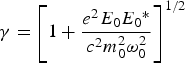
Eq. (3) is valid when there is no change in the plasma density. Following Brandi et al. (Reference Brandi, Manus and Mainfray1993), the relativistic ponderomotive force can be given by

Using the electron continuity equation and the current density equation for the second order correction in the electron density equation (with the help of ponderomotive force), the total density can be expressed as

Therefore, the effective intensity dependent dielectric constant of the plasma at pump frequency ω0 is

where

Expending the dielectric constant in Eq. (8) around r = 0 by a Taylor expansion, one can write

where
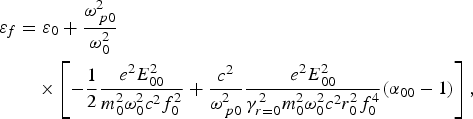
and
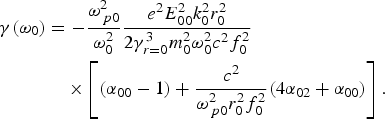
Here r 0 is the beam radius, and f 0 is the dimensionless beam width parameter given by Eq. (13) below. Substituting Eq. (4) into Eq. (3) and separating the real and imaginary parts, we get


To solve the coupled Eqs. (11a) and (11b), we assume

and

Further, substituting Eqs. (12a) and (12b) into Eq. (11a), equating the coefficients of r 2 on both sides of the resulting equation, and introducing the normalization distance π = zc/ωor o2, we get the following equation for the beam width parameter:
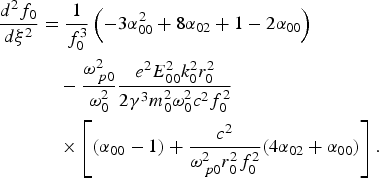
Analogously equating the coefficients of r 4 on both sides of the resulting equation, we obtain the following equation

Substituting Eqs. (12a) and (12b) into Eq. (11b) for the imaginary part and finding the coefficients of r 2 on both sides of the resulting equation, we obtain the equation for the coefficient α00 as

Analogously, the coefficient of r 4 gives equation for α02

Eqs. (12a) and (12b) describe the intensity profile of the laser beams in the plasma along the radial direction when relativistic and ponderomotive nonlinearities are operative. The intensity profile of both laser beams depends on the beam width parameters f 0 and the coefficients (α00 and α02) of r 2 and r 4 in the non-paraxial region. Eq. 13 determines the focusing/defocusing of the laser beams along the distance of propagation in the plasma. In order to have a numerical evaluation of the relativistic and ponderomotive filamentation, in this case, and to evaluate the effect of the change of the parameters of the plasma and the laser beam in the non-paraxial region, the numerical computation of Eqs (13), (14), (15a), and (15b) has been performed. The coupled equations have been solved for an initially plain wave front, and the numerical results are presented in Figures 1 and 2.
Variation of laser beam intensity with normalized distance (π) and radial distance (r), when relativistic and ponderomotive nonlinearities are operative in the non-paraxial region. Keeping ωp = 0.03 ω0 constant (a) for α E 002 = 1.0 (b) for α E 002 = 1.5.

Variation of laser beam intensity with normalized distance (π) and radial distance (r), when relativistic and ponderomotive nonlinearities are operative in the non-paraxial region. Keeping α E 002 = 1.0 constant (a) for ωp = 0.03 ω0 (b) for ωp = 0.035 ω0.

When a laser beam propagates through the plasma, then the density of the plasma will be varying in the channel due to the occurring ponderomotive force. The ponderomotive force results from the lowering of the channel density, therefore the refractive index of the plasma increases and the laser gets focused in the plasma. In Eq. (13), the first term is responsible for the diffraction, while the second and third terms (non-linear terms) on the right-hand side of the equation are responsible for the converging behavior of the beams during the propagation in the plasma. These three terms describe the filament formation and the laser beam propagation in the plasma. Figures 1 and 2 shows the intensity profile in the non-paraxial region. They clearly exhibit the generated filaments of the laser beam in the presence of ponderomotive and relativistic nonlinearity. The following set of laser beam parameters have been used in the numerical calculation: the vacuum wavelength of the laser beam was λ = 1064 nm, the initial radius of the laser beam was equal to 30 µm; laser power flux equaled 1018 W/cm2. Further ωp = 0.03ω0 and νth = 0.1c were satisfied. For the initial wave front of the beam, the initial conditions used here were f 0 = 1 and df 0/dz = 0 at z - = 0 and S 00 = S 02 = 0 at z = 0. We have performed numerical calculation for different laser and plasma parameters; Figure 2 gives the intensity profile of the laser beam for different values of the initial laser beam intensity α E 002 at a constant value of ωp. Figure 2 gives the intensity profile of the laser beam at different values of ωp at a constant value of αE 002.
3. PLASMA WAVE GENERATION
On account of the change in the background density due to the ponderomotive force and the relativistic effects, the laser beam gets filamented as discussed above. In these filaments, the laser beam intensity is very intense and the plasma density is also changed due to the ponderomotive force. Following the standard procedure, the equation governing the electron plasma wave generation can be written as
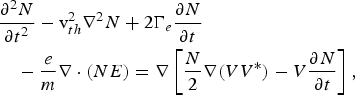
where 2Γe is the Landau damping factor, vth2 is the square of the electron thermal speed, E is the sum of the electric vectors of the electromagnetic wave and the self-consistent field, V is the sum of the drift velocities of the electron in the electromagnetic field and the self-consistent field, and m is the relativistic mass of the electrons. The density component varying at the pump wave frequency (N 1) can be written as

where n 0 is the equilibrium electron density, and V 0 is the oscillation velocity of the electron in the pump wave field, and n is the time independent component of the electron density. It is obvious from the source term of Eq. (16b) that the component of N 1 varies when E 0 changes. Therefore N 1 can be written as

where

N′10 (r, z) and N′20 (r, z) are complex functions of their arguments and satisfy the equations,
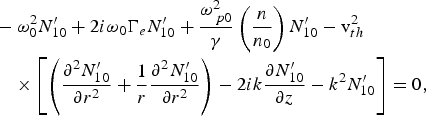
and

Let the solution of Eqs (18a) and (18b) be written as N′10 = N 10(r, z)e -iks and N′20 = N 20 (r, z)e -ik 0s 0. Substituting these N′10 and N′20 in Eqs. (18a) and (18b), respectively, we obtain, after separating the real and imaginary parts


and
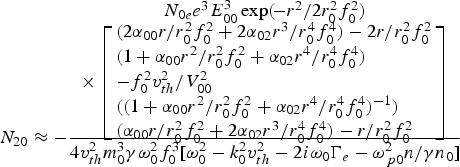
Following Akhmanov et al. (Reference Akhmanov, Sukhorukov and Khokhlov1968), the solution of Eqs (19a) and (19b) can be written as


where k i = 2Γeω/kv th2, and f is the dimensionless width parameter of the plasma wave governed by
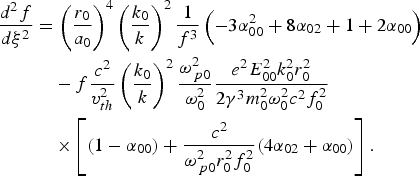
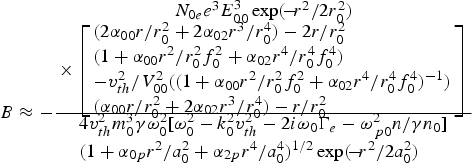
B and a 0 are constants to be determined by the boundary conditions when the amplitude of the generated plasma wave at z = 0 is zero. Thus
and

In a similar way using Eqs (21) and (22) in Eq. (19a) and equating the coefficients of r 4 on both sides of the equation, we obtain the following equation

By substituting Eqs (21) and (22) into Eq. (19b) and equating the coefficients of r 2 on both sides of the equation, we obtain the equation for the coefficient α0p as

In a similar way, the coefficient of r 4 gives the α2p equation

The initial conditions for f are f = 1 and df/dz = 0 (plane wave front) at z = 0, and S 0p = S 2p = 0 at z = 0. Using Poisson's Equation ▿E 1 = 4πeN 1 one can obtain the electric field vector (E 1) of the plasma wave generated at the frequency ω0

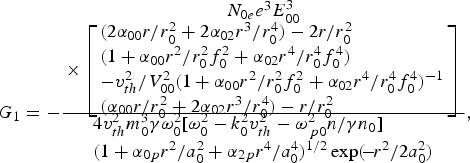
where
and
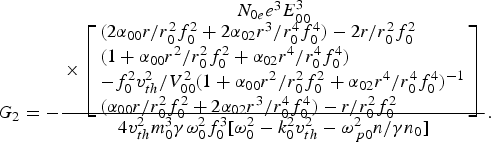
Eq. (28) gives the expression for the electric field of the excited plasma wave at pump wave frequency (ω0) in the non-paraxial region. We solved Eq. (28) numerically along with the numerical computation of Eqs (23), (24), (25), (26), (27) to obtain the variation in electric field at finite z. For the calculations, the same set of parameters has been used as was chosen in Section 2, to study the effect of both nonlinearities on the EPW in the non-paraxial region. The results are presented in Figures 3 and 4. Eq. (28) clearly shows that the electric field of the EPW not only depends on the parameters of the laser beams and their beam width parameters, but also on the coefficients of r 2 and r 4 (α00, α02) and (α0p, α2p). Figure 3 displays the variation of the electric field of the EPW with the distance of propagation and the radial distance in the non-paraxial region with different value of αE 002 at a constant value of ωp and Figure 4 gives the EPW profile for different value of ωp at a constant value of αE 002. It depicts that the EPW has also a spitted profile with minimum power on the axis.
Variation of the electric field of the electron plasma wave  with normalized distance (π) and radial distance (r), when relativistic and ponderomotive nonlinearities are operative in the non-paraxial region. Keeping ωp = 0.03 ω0 constant (a) for α E 002 = 1.0 (b) for α E 002 = 1.5.

Variation of the electric field of the electron plasma wave  with normalized distance (π) and radial distance (r), when relativistic and ponderomotive nonlinearities are operative in the non-paraxial region. Keeping α E 002 = 1.0 constant (a) for ωp = 0.03 ω0 (b) for ωp = 0.035 ω0.

The dependence of E(ω0) on the coefficient of r 2 and r 4 gives the spitted profile of the power of the excited EPW in the non-paraxial region. Figures 3 and 4 shows the variation of the electric field of the plasma wave |E|2/|E 00|2 with the distance of propagation and the radial distance. It is evident from the figures that the EPW gets excited due to nonlinear coupling with the high power laser beam because of the ponderomotive and relativistic nonlinearity. This coupling is so strong that the initial plasma wave becomes highly localized as shown in Figures 3 and 4; it is obvious from Eq. (16b) that the plasma wave amplitude at pump wave frequency depends upon (1) the transverse gradient of the pump wave intensity and (2) the transverse density gradient. For an initially Gaussian laser beam, the transverse intensity gradient is negative while, on account of redistribution of electrons by the ponderomotive force, the density gradient is positive. When the scale of the transverse density gradient is equal in magnitude to the scale of the intensity gradient, the source term of Eq. (16b) becomes zero and one does not expect any plasma wave generation, as it is clear by Eq. (22) with the expression of B. When z > 0 is satisfied, the intensity of the laser beam is changing due to filamentation and hence, the density gradient also changes when the laser beam propagates.
4. SECOND HARMONIC GENERATION
Using Eq. (1), one can obtain the second harmonic field by the laser beam. Eq. (1) may be spitted into formulae for the vector potentials of the fundamental mode (A 0) and the second harmonic (A 2),

and

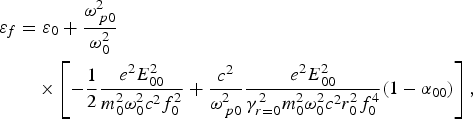
where ω2 = 2ω0, ɛF(ω0) and ɛ2(ω2) are the effective dielectric constants of the plasma at the fundamental and second harmonic frequency, respectively. The dielectric constant at the fundamental mode reads

where
and
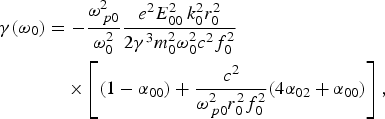
The dielectric constant at the generation of the second harmonic is

Here
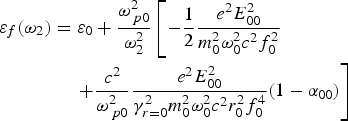
and
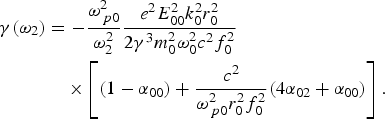
The solution for the fundamental Eq. (29) can be written as A 0 = A 0′ exp (−i(k 0z + S 0)),

where f 0 is described by Eq (13) with the initial condition given in Section 2. The solution of Eq. (30) can be written as

Using this, we obtain after separating the real and imaginary parts

and

It must be mentioned here that in writing Eq. (34b) we have taken only that component of N 1 which arises on account of the source term of Eq. (16b) because it is not Landau damped. Furthermore we write

To analyze Eq. (34a), we use Eq. (35), and we get
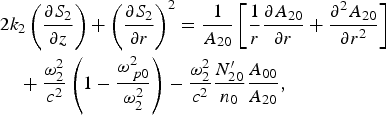

Considering Eq. (34b), using A 21′ = A 21e −2ik 0S 0, we find

Let the solution of Eqs (36a) and (36b) be

Here b 0 is the second harmonic beam width. Further we use the initial conditions df 2/dz = 0, f 2 = 1 at z = 0, and S 0h = S 2h = 0 at z = 0. f 2 is the dimensionless width parameter of the second harmonic radiation, given by
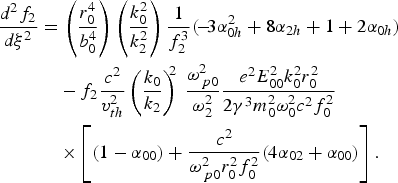
Similarly, using Eq. (37) in Eq. (36a) and equating the coefficients of r 4 on both sides of the equation, we obtain the following equation

By substituting Eq. (37) into Eq. (36b) and equating the coefficients of r 2 on both sides of equation, we obtain the equation for the coefficient α0h as

In a similar way, the coefficient of r 4 gives the equation for α2h.

The constants B ′ and b 0 are also determined by the boundary condition that the second harmonic generation is zero at z = 0
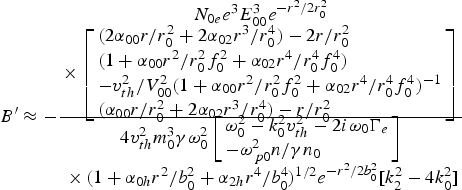
and b 0 = r 0
Using Eqs (36c), (37), (38), and (39) in Eq. (33), we get
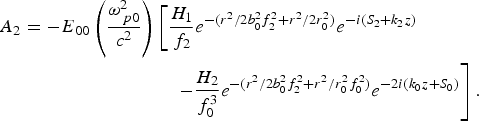
Here
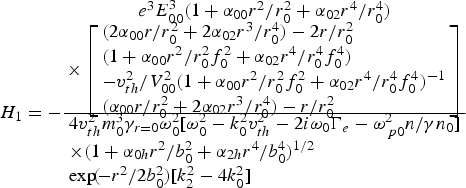
and
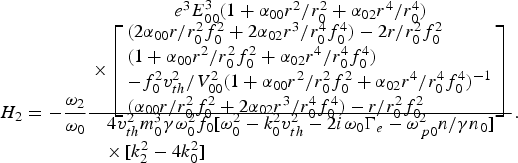
We have developed the theory of second harmonic generation and derived the expression for the electric field of the second harmonic when relativistic and ponderomotive nonlinearities are operative. Figure 5 shows the variation of the electric field of the second harmonic with normalized distance and radial distance for different values of αE 002 at a constant value of ωp, and Figure 6 gives the second harmonics' profile with different value of ωp at a constant value of αE 002.
Variation of the electric field of the generated second harmonic  with normalized distance (π) and radial distance (r), when relativistic and ponderomotive nonlinearities are operative in the non-paraxial region. Keeping ωp = 0.03 ω0 constant (a) for α E 002 = 1.0 (b) for α E 002 = 1.5.

Variation of the electric field of the generated second harmonic  with normalized distance (π) and radial distance (r), when relativistic and ponderomotive nonlinearities are operative in the non-paraxial region. Keeping α E 002 = 1.0 constant (a) for ωp = 0.03 ω0 (b) for ωp = 0.035 ω0.

We have also studied the spectrum of the second harmonic generated by the ultra intense laser pulse. This  versus k plot clearly shows the broadened spectra of the generated harmonic. As it is clear from the power spectrum of the second harmonic, in the initial stages of laser beam propagation a single line is obtained (Fig. 7a). As expected, the main harmonic line is at k 2 – 2k 0. For the typical laser parameters, a normalized value of k 2 – 2k 0 comes out to be; 1.24. In the wave number spectrum (Fig. 7b) this line is clearly visible. As the wave starts propagating further and filament formation is taking place, the second harmonic spectrum starts becoming broadened, which means new k components are also generated. This is on account of the localization of the second harmonic. As one can see in the initial stages of the laser beam propagation, the generated second harmonic is almost a plane wave but after the filament formation of the laser beam, the spectrum starts broadening.
Power spectrum ( vs. k) of the second harmonic generated, when relativistic and ponderomotive nonlinearities are operative in the non-paraxial region. (a) In early stages of laser beam propagation, i.e., before filament formation (b) after laser beam filament formation.

6. CONCLUSION
In this work, the theory of filamentation of the high power laser beam when relativistic and ponderomotive nonlinearities are operative has been developed by considering the nonparaxial part of the beam. In the presence of these modified filamentary structures, the plasma wave localization at pump wave frequency has been studied. In case of an ultra intense Gaussian laser beam, the plasma gets depleted from the high field region to the low field region, on account of the relativistic and ponderomotive nonlinearity, and hence a transverse (with respect to the direction of propagation) density gradient is established. When the electric vector of the laser beam is parallel to this density gradient, an EPW at pump wave frequency is generated. In addition to this, the transverse intensity gradient of the laser beam also contributes significantly to the EPW generation. The plasma wave at pump wave frequency has two components; one has the propagation vector k 0 = ω0/c and the second has its propagation vector 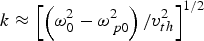 , the phase velocity of the second component depends on ωp0/ω0; this may be comparable to the thermal speed of the electron and hence this component can undergo Landau damping. But the phase velocity of the first component is the same as that of the pump wave and hence, its Landau damping is negligible. This component contributes significantly to the second harmonic generation on account of its interaction with the pump laser beam. Therefore, it is concluded that at those positions, where the laser beam intensity gradient and the density gradient balance each other, there is no plasma wave generation, but when the intensity gradient dominates over the density gradient then the EPW is generated, as it is shown by the electric field variation of this EPW with normalized distance and radial distance in Figure 3 and 4. Interaction of this plasma wave with the incident laser beam leads to second harmonic generation. We have also studied the spectrum of second harmonics generated by the ultra intense laser pulse. It is seen that in the initial stages of the laser beam propagation, the generated second harmonic is almost a plane wave, but after the filament formation of the laser beam, the spectrum of the second harmonics starts broadening. Therefore, this mechanism may be a good source of second harmonic generation and the spectral features mentioned here may be used for diagnostics of laser produced plasmas.
ACKNOWLEDGMENTS
This work was partially supported by DST, Government of India. One of the authors (Prerana Sharma) is grateful to AICTE for providing the assistance for the present work.



