INTRODUCTION
The introduction of invasive marine algae can have substantial negative impacts upon native communities in their newly established range (Williams & Smith, Reference Williams and Smith2007; Thomsen et al., Reference Thomsen, Wernberg, Tuya and Silliman2009). When an invasive plant or alga begins to proliferate in a new range, it presents a novel food source to native consumers. Although specialists may avoid the invasive organism, generalist consumers can be attracted to such species and even prefer to consume them over native species (Parker & Hay, Reference Parker and Hay2005; Parker et al., Reference Parker, Burkepile and Hay2006). However, this is not always the case and in many instances both plants (e.g. Jogesh et al., Reference Jogesh, Carpenter and Cappuccino2008) and algae (e.g. Davis et al., Reference Davis, Benkendorff and Ward2005) have been shown to be avoided by generalist consumers. Herbivore preference may therefore account for the invasibility of some species, a scenario described by the Enemy Release Hypothesis (ERH) (Keane & Crawley, Reference Keane and Crawley2002).
Sargassum muticum Yendo (Fensholt) is a highly invasive marine alga which is not controlled by large herbivores such as fish and urchins (Britton-Simmons, Reference Britton-Simmons2004; Thomsen et al., Reference Thomsen, Wernberg, Stæhr and Pedersen2006; Engelen et al., Reference Engelen, Serebryakova, Ang, Britton-Simmons, Mineur, Pedersen, Arenas, Fernández, Steen, Svenson, Pavia and Toth2015). Although it attracts a range of mesoherbivores (Strong et al., Reference Strong, Maggs and Johnson2009), many of these still prefer to feed upon native algae or the epiphytes on S. muticum (Norton & Benson, Reference Norton and Benson1983; Critchley et al., Reference Critchley, Farnham and Morrell1986; Viejo, Reference Viejo1999; Britton-Simmons, Reference Britton-Simmons2004; Monteiro et al., Reference Monteiro, Engelen and Santos2009; Cacabelos et al., Reference Cacabelos, Olabarria, Incera and Troncoso2010a; Rossi et al., Reference Rossi, Olabarria, Incera and Garrido2010; Engelen et al., Reference Engelen, Henriques, Monteiro and Santos2011). Because of their size, mesoherbivores are less mobile than large herbivores, and individuals or localized populations can display strong host-plant specificity, even when the species as a whole does not (Vesakoski et al., Reference Vesakoski, Rautanen, Jormalainen and Ramsay2009; Bell & Sotka, Reference Bell and Sotka2012; Mattila et al., Reference Mattila, Zimmer, Vesakoski and Jormalainen2014). Specificity is particularly evident in species that are slow-moving or brood their young (Sotka, Reference Sotka2005), and may be because the host alga of a mesoherbivore is both its food and habitat, and some algal species can provide better protection from predators (Watanabe, Reference Watanabe1984; Jormalainen et al., Reference Jormalainen, Honkanen, Mäkinen, Hemmi and Vesakoski2001). As such it can be hypothesized that mesoherbivores, particularly species that are less mobile, will establish a feeding preference for an invasive species such as S. muticum when exposed to it, but the time scales involved in such development are unclear.
Optimally foraging animals are expected to prefer readily available sources of food, and in cases where host specificity is strong, an invasive population may therefore escape local herbivores when it is first introduced to a new range (Maron & Vilá, Reference Maron and Vilá2001). However, once an invasive species proliferates, encounter rates with local consumers will increase and these may then accept it as a food source. Therefore, it is likely that the longer such a species has been present in an environment, the greater the propensity of local consumers to feed on it will be (Schultheis et al., Reference Schultheis, Berardi and Lau2015). This has been shown to take as little as 20 years in beetles that consume the leaves of invasive trees (Auerbach & Simberloff, Reference Auerbach and Simberloff1988), and data on introduced crops shows that species diversity can be as rich as that found in native controphics after less than 200 years (Strong et al., Reference Strong, McCoy and Rey1977). However, little is known about the lengths of time it might take marine mesoherbivores to consume a species such as S. muticum, and few studies that specifically incorporate time-since-invasion as a variable utilize behavioural experiments (e.g. Trowbridge, Reference Trowbridge2004). Most opt instead for observational surveys of abundance or diversity to infer consumer choice (sensu Maron & Vilá, Reference Maron, Vilá, Kelley and Tilmon2007). Time-since-invasion is a vital and understudied element of invasive ecology, since both the invader and the local community change the longer an invasive population has been established (Strayer et al., Reference Strayer, Eviner, Jeschke and Pace2006).
This study aimed to enhance our understanding of the ERH by investigating the feeding behaviours of slow-moving mesoherbivore grazers, taken from stands of S. muticum that have been established for different lengths of time. The Space-for-Time Substitution methodology is well established in invasive ecology and climate change studies, and although it is not fool-proof it provides a convenient alternative to the time-for-time approach which is often not viable (Pickett, Reference Pickett and Lickens1989; Thomaz et al., Reference Thomaz, Agostinho, Gomes, Silveira, Rejmanek, Aslan and Chow2012; Blois et al., Reference Blois, Williams, Fitzpatrick, Jackson and Ferrier2013). Sargassum muticum is an ideal species with which to investigate mesoherbivore responses with this approach, because it is well known beyond the scientific community as a pest. It is large, conspicuous, intertidal and prefers sheltered habitats, so is quickly reported when it spreads to harbours and inlets frequented by fishermen and sailors. As such, and in contrast to many other marine invasions, a detailed and reliable chronology of its spread around western Europe and the British Isles exists (Davison, Reference Davison2009). As a brown alga, S. muticum produces quantifiable polyphenolic chemicals as a defence against herbivory (Van Alstyne & Paul, Reference Van Alstyne and Paul1990; Pavia & Toth, Reference Pavia and Toth2000). Although not deterrent against all species, these phlorotannins impede herbivory by a broad range of mesoherbivores, particularly slow-moving generalist gastropod grazers (Pavia & Toth, Reference Pavia, Toth and Amsler2008). Brown algae have been shown to increase phlorotannin production in response to increased herbivory, making themselves less palatable (Van Alstyne & Paul, Reference Van Alstyne and Paul1990; Pavia & Toth, Reference Pavia, Toth and Amsler2008), although investigations into invasive plants have shown variable responses in the production of chemical defences in their invaded ranges (i.e. increases: Caño et al., Reference Caño, Escarré, Vrieling and Sans2009; decreases: Willis et al., Reference Willis, Thomas and Lawton1999; no recorded change, but still lowered palatability (i.e. the attractiveness of the food in the absence of others) in herbivore performance trials: Hull-Sanders et al., Reference Hull-Sanders, Clare, Johnson and Meyer2007). Using laboratory-based feeding experiments with S. muticum and two species of common generalist gastropod grazers, this study tested two hypotheses. Firstly, generalist gastropods are more likely to accept S. muticum as a food source the longer it has been present in their local habitat. Secondly, the palatability of S. muticum will be lower in long-established populations, compared with those recently established. Testing these hypotheses furthers our knowledge of invasive ecology and time-since-invasion effects, specifically with respect to the ERH.
MATERIALS AND METHODS
Study organisms
Sargassum muticum was used as a model invader because it bears all of the hallmarks of a classic invasive marine species, being temperate, pseudo-annual, fast-growing and r-selected, with broad physiological tolerances and a propensity for high dispersal rates and rapid growth in areas of strong anthropogenic influences, such as harbours (Norton, Reference Norton1977; Critchley et al., Reference Critchley, Farnham and Morrell1986; Arenas et al., Reference Arenas, Fernandez, Rico, Fernandez and Haya1995; Andrew & Viejo, Reference Andrew and Viejo1998; Claridge & Franklin, Reference Claridge and Franklin2002; Engelen & Santos, Reference Engelen and Santos2009). Sargassum muticum was first sighted in the British Isles in 1973, on the eastern coast of the Isle of Wight, and has subsequently spread as far east as Kent, and as far north-west as the Firth of Clyde.
Ascophyllum nodosum (L.) Le Jolis and Fucus serratus (L.) were used as control organisms to assess typical feeding rates of snails from the different sites. Both are common native intertidal algal species, which are closely related to S. muticum. These three species are all fucoids and as such, they bear a similar chemical composition (Davis et al., Reference Davis, Volesky and Mucci2003), grow well on sheltered shores, and are often found attached to hard substratum in the mid to lower intertidal (Boaden et al., Reference Boaden, O'Connor and Seed1975; Dudgeon & Petraitis, Reference Dudgeon and Petraitis2005). The two native control species are consumed by the selected grazers, Littorina obtusata (L.) and Littorina fabalis (Turton), which are common herbivores of seaweeds throughout western Europe (Watson & Norton, Reference Watson and Norton1987; Hayward & Ryland, Reference Hayward and Ryland2006). Both grazers can be found on Fucus spiralis, F. vesiculosus, A. nodosum, F. serratus, S. muticum, Halidrys siliquosa, Ulva lactuca and U. intestinalis in high abundances on sheltered shores, both in the intertidal and shallow subtidal (Kurr, unpublished data). Littorina obtusata lives for 2–3 years and is therefore often slightly larger than the annual L. fabalis, both of which spawn in late winter (Williams & Brailsford, Reference Williams and Brailsford1998). Although L. obtusata is slightly more common on the mid-shore and L. fabalis more common on the low shore, both species share near-identical habitat preferences and distributions (Hayward & Ryland, Reference Hayward and Ryland2006). Adults of both species have similar preferences for macroalgae, although epiphytic microalgae probably accounts for a larger component of the diet of L. fabalis than L. obtusata, owing to the weaker buccal musculature and more ‘comb-like’ radula of the former (Watson & Norton, Reference Watson and Norton1987). Both show an aversion towards algal tissues containing high levels of phlorotannins, making them viable indicators for ecologically relevant differences in algal defensive investment (Pavia & Toth, Reference Pavia and Toth2000; Pavia et al., Reference Pavia, Toth and Åberg2002).
Study sites
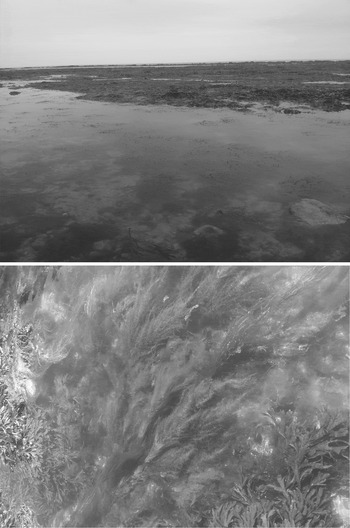
Multiple potential sites were initially identified based on public records of first reported S. muticum establishment. The suitability and comparability of these sites was estimated as far as possible remotely, before being visited in July. Samples of S. muticum, the most abundant native fucoid in close proximity to the S. muticum stands, and a suitable number of whichever littorinid was most common in the area were taken from each location. The experimental designs and decisions about which grazer and native fucoid were to be used were site-specific, constrained predominantly by the necessity to find sites with comparable topography and suitable time-since-invasion. Material from four S. muticum populations was used in feeding trials (Figure 1). All stands of S. muticum grew on the upper sub-tidal of moderately exposed sandy shores, in lagoons formed in the lee of rock formations or sandbars (Figure 2). Salinity and temperature differences at time-of-sampling were minimal (salinity within 1 unit, and temperature within 2°C), and all populations were amongst or very near to common native algae such as F. serratus, A. nodosum and/or F. vesiculosus (Figure 2). The northernmost and southernmost sites differed by 3° of latitude, and whilst UV exposure causes induction of phlorotannins (Pavia et al., Reference Pavia, Cervin, Lindgren and Aberg1998), UV-R levels (which account for a small percentage of total solar irradiance) differ by only 0.72% (estimated from Šúri et al., Reference Šúri, Huld and Dunlop2007; Escobedo et al., Reference Escobedo, Gomes, Oliveira and Soares2009). If S. muticum responds to UV in the same way as other fucoids, this would equate to an approximate difference of 0.4% in phlorotannin abundance between the northernmost and southernmost sites (Pavia et al., Reference Pavia, Cervin, Lindgren and Aberg1998), a negligible amount, considering that herbivory can induce phlorotannin production by 70% (Pavia & Toth, Reference Pavia and Toth2000).
Locations of Sargassum muticum populations sampled for algal material and mesoherbivores. Sites are named by the time-since-invasion of S. muticum. Grey arrows represent general invasion path from first observed occurrence. Site 40YR: Bembridge Ledge (50.680466°N 1.072554°W). Site 35YR: Eastbourne (50.750541°N 0.270442°E). Site 19YR: West Angle Bay, near Milford Haven (51.688676°N 5.110854°W). Site 10YR: The northern shore of the Foryd estuary near Caernarfon (53.131581°N 4.304016°W).

The lagoonal system at Site 35YR: Eastbourne showing the typical topography (upper plate), and the typical position of Sargassum muticum individuals in relation to native algae (lower plate), at the four sites sampled. Sargassum muticum fronds can be seen floating on the surface waters close to Fucus serratus, Ascophyllum nodosum, Ulva spp., and a number of rhodophytes including Heterosiphonia plumosa and Plumaria plumosa.

For clarity, locations have been named by the length of time since the first observation of S. muticum (Davison, Reference Davison2009), as follows; ‘40YR’: Bembridge Ledge, on the eastern coast of the Isle of Wight. ‘35YR’: Eastbourne on the south eastern coast of England. ‘19YR’: West Angle Bay, near Milford Haven in south Wales. ‘10YR’: The northern shore of the Foryd estuary near Caernarfon in North Wales (Figure 1). It can be assumed that the first observation equates to time-since-invasion in S. muticum populations as it expresses limited DNA polymorphism within UK and European populations, suggesting that it has spread from a single point of invasion (Hallas, Reference Hallas2012; Le Cam et al., Reference Le Cam, Thiebaut, Bouchemousse and Viard2015). Communities impacted by an invasive population with a time-since-invasion of 10 years or less, are expected to experience considerably different effects to those exposed for 30 years or more, making the timescale investigated here valid for detecting shifts in behaviour (see Strayer et al., Reference Strayer, Eviner, Jeschke and Pace2006).
Feeding trials
Four experiments were conducted: (1) Sargassum muticum from stands of different ages were presented to L. obtusata collected from a site where S. muticum has not been recorded, to assess the palatability of the algae (i.e. the attractiveness of the food in the absence of other foods). (2) Littorina obtusata from S. muticum stands of different ages were presented with S. muticum and F. serratus from one site, to assess the willingness-to-feed of the snails (i.e. how eager the animals are to feed in the material in the absence of others). Finally, L. fabalis from an ‘old’ and a ‘young’ S. muticum stand were presented with S. muticum, and the common native alga A. nodosum from both sites in (3) no-choice trials to assess the willingness-to-feed of grazers, and with S. muticum from the ‘young’ and ‘old’ stands in (4) choice trials to determine feeding preferences of the snails (i.e. which material will be selected when given a choice).
For each experiment, a standardized protocol was used. Firstly, all algae were collected within 1 week of being used in trials, and maintained in ambient seawater (~19°C, salinity 34) within the same outdoor aquaria used for feeding trials. Sargassum muticum is notoriously fragile, and difficult to maintain in the laboratory. To minimize the degradation of the fronds, whole individuals were collected by pulling the holdfast from the substrata. Epiphytized fronds were removed, and all individuals were returned to the laboratory within cool-boxes, inside of 1 day. Algae were inspected daily and gently washed with seawater. Material showing signs of degradation was removed, and the whole individual was rotated in the aquaria to limit self-shading. Only healthy material was used for feeding trials. From each alga used, 500 mg (±50 mg) blotted-wet-weight clippings were taken from the apical region (one clipping per apex) and autogenic changes in algal mass were corrected for by taking control clippings and maintaining these in parallel to the experimental trials. For no-choice trials, mean autogenic changes in mass were calculated and subtracted from the change in mass in experimental trials to estimate change in mass due to consumption (Toth et al., Reference Toth, Karlsson and Pavia2007). Additionally, ~5 clippings were taken for phlorotannin analysis in palatability trials. Handling of algae was kept to a minimum, and great care was taken during blotting of fronds to avoid dislodging vesicles or causing other damage. To further limit degradation, midway through the trials aquaria were carefully upturned into a 1 mm sieve to remove snails and algal material, the aquaria were cleaned using an abrasive pad, and all material was then returned for the remainder of the experiment. Some, but not all, of the S. muticum clippings used in autogenic trials lost mass, notably those used in Experiment 4 (Section ‘L. fabalis preference for S. muticum from sites with different time-since-invasion’, Figure 5). This was probably due to loss of vesicles over the course of the trial because the clippings appeared to be in generally good condition. However some necrosis was evident near to the clipping site at the base of some replicates in both experimental and control trials.
Secondly, all animals used in the trials were collected 1 week prior to experiments and maintained as above, without food to ensure even levels of hunger. Because starved herbivores can display compensatory feeding for the first 2 days (Cronin & Hay, Reference Cronin and Hay1996) change in algal masses were only recorded after 7 days. Change in algal mass was corrected for snail ash-free dry mass and compared with autogenic changes in the controls (identical treatments without grazers) (Monteiro et al., Reference Monteiro, Engelen and Santos2009; Forslund et al., Reference Forslund, Wikström and Pavia2010). All trials were conducted in separate 250 ml aquaria with an individual water-line providing a flushing time of around 30 s.
THE PALATABILITY OF S. MUTICUM TO NAÏVE GRAZERS
To determine whether S. muticum’s palatability was different depending on time-since-invasion, six algal individuals were collected at random from each of the 35YR, 19YR and 10YR populations (N = 18). To capture individual S. muticum variation, three clippings from each individual were provided to three L. obtusata (N = 54) collected from Bull Bay in North Wales (53.422543°N 4.368959°W) in a no-choice trial. Sargassum muticum does not grow at Bull Bay, nor on the adjacent coastline, and so these individuals were extremely likely to be naïve to this food source. This was done to avoid biasing the study by using mesoherbivores with a history of S. muticum consumption, thereby ensuring differences in feeding responses were a product of the algal condition, and not that of the consumer. Although the no-choice technique has been criticized for not producing ‘true’ feeding responses (Roa, Reference Roa1992), no-choice trials were used for two reasons. Firstly, S. muticum fragments as it is fed upon, making it impossible to differentiate between algae from most sites at the end of the trials. Secondly, the technique still holds value when determining the ‘willingness-to-feed’ of a particular herbivore on a plant or alga (i.e. how much material are herbivores willing to consume; sensu Jogesh et al., Reference Jogesh, Carpenter and Cappuccino2008), or ‘palatability’ of a particular plant or alga (i.e. how easy the material is to consume; sensu Toth et al., Reference Toth, Karlsson and Pavia2007), as opposed to purely ‘preference’ of consumers, which requires that a choice be offered. No-choice trials can therefore be useful in predicting the results of direct interaction between grazers and hosts (Pearse et al., Reference Pearse, Harris, Karban and Sih2013). Data were analysed in a one-way ANOVA, with site as a fixed factor, the response variable was the mean of the three clippings (minus mean autogenic mass-change in controls) from each individual alga to provide a better estimate of the palatability of an individual S. muticum and to avoid non-independence arising from using clippings from individual alga in the analysis (N = 18).
Phlorotannin abundances in each of the six S. muticum individuals were determined. Samples from the upper frond were washed in distilled water, frozen at −20°C, and then freeze-dried to constant weight. These were ground until homogeneous, and 0.2 g subsampled for chemical assay. 60% aqueous acetone was used to extract phlorotannins over 1 h under constant agitation, in the dark. The algal pulp was separated by centrifugation (5300 rpm for 10 min) and the acetone removed using in-vacuo cold-distillation (80 kPa, 38°C). Lipophilic compounds were filtered from this extract (Pavia & Toth, Reference Pavia and Toth2000) and 40% Folin-Ciocalteu's phenol reagent (Sigma-Aldrich F9252) was used in conjunction with 1 M aqueous sodium carbonate decahydrate solution (Sigma-Aldrich 71360) to act as a buffer. The resultant solution was incubated in the dark for 30 min and analysed by spectrophotometry at 760 nM, using phloroglucinol (1,3,5-trihydroxybenzene, Sigma-Aldrich P3502) as a standard (Van Alstyne, Reference Van Alstyne1995). Replicates were run in triplicate and phlorotannin abundances compared with a one-way analysis of variance (ANOVA) with ‘site’ as a fixed factor. Differences in means were compared using Tukey's post-hoc tests.
WILLINGNESS OF GRAZERS EXPERIENCED WITH S. MUTICUM TO FEED UPON IT
To determine whether L. obtusata consumed more S. muticum when their population had been exposed to it for longer, 30 individuals were collected at random from each of the 35YR, 19YR and 10YR sites (N = 90). One S. muticum individual and one F. serratus individual were collected from the 10YR site. Apex material from one large individual was used for each algal species to keep phlorotannin abundances, algal condition, and any other variables that may influence palatability, as constant as possible between treatments, given that the focus in this experiment was on the grazers. Fifteen L. obtusata individuals were provided with one clipping of the S. muticum individual each, and the other 15 were provided with one clipping of the F. serratus individual each to gauge for population-specific differences in feeding-rates on a typical sympatric native alga. Mass change at the end of trials was corrected for mean autogenic change in control clippings to estimate change in mass due to consumption. Differences in ‘willingness-to-feed’ did not conform to the assumption of homogeneity of variance because the variability in F. serratus consumption was greater than that for S. muticum consumption. Therefore, means were compared using a Kruskal–Wallis test, and paired Mann–Whitney U tests for post-hoc analysis.
THE WILLINGNESS TO CONSUME S. MUTICUM AND A NATIVE ALGA BY L. FABALIS
To compare willingness-to-feed on S. muticum and a native sympatric alga by mesoherbivores (L. fabalis) from a site invaded by S. muticum 40 years prior, to grazers from a site invaded 10 years prior, three S. muticum and three Ascophyllum nodosum individuals were collected at random from 40YR and 10YR sites (N = 6 of each species). Littorina fabalis were collected at random from adjacent stands of fucoids, and from the substrata nearby to the S. muticum and A. nodosum stands at these locations. One clipping of each alga was provided to three randomly assigned L. fabalis from each site, and all trials were run in triplicate (N = 72). Changes in algal mass were analysed using a three-way nested-ANOVA with ‘algal species’, ‘algal origin' and ‘grazer origin’ as fixed orthogonal factors, and ‘individual’ (alga) nested in the interaction between ‘algal species’ and ‘algal origin’. Differences in means were compared using Tukey's post-hoc tests.
L. FABALIS PREFERENCE FOR S. MUTICUM FROM SITES WITH DIFFERENT TIME-SINCE-INVASION
Clippings from the same algal individuals used for the willingness to feed experiment (Experiment 3) were used to compare the preference of L. fabalis collected from the 40YR and 10YR sites when offered S. muticum from their site of origin, against algae collected from the other site. Each treatment was allocated to six L. fabalis individuals in the following randomly assigned treatments: (1) 40YR L. fabalis with 40YR S. muticum and 10YR S. muticum, and (2) 10YR L. fabalis with 40YR S. muticum and 10YR S muticum. All trials were run in triplicate (N = 18). To capture autogenic changes in algal mass each experimental aquarium (i.e. with grazers) was paired with a control aquarium containing the same algal combination but no grazers. Following Forslund et al. (Reference Forslund, Wikström and Pavia2010), a paired t test approach was used to compare the differences in algal mass-change between clippings in both the experimental and control aquaria, whereby, a significant result indicates that one clipping has changed mass more than the other in the presence of grazers.
RESULTS
The palatability of S. muticum to naïve grazers
Sargassum muticum from 35YR contained the highest abundance of phlorotannins (5.0% DW, SE = 0.15), and that from 19YR (3.6% DW, SE = 0.23) and 10YR (3.8%, SE = 0.14) bore similar concentrations (ANOVA F 2,15 = 18.66, SS = 7.07, P < 0.001, Tukey's HSD; 35YR > 19YR = 10YR). However, the consumption of S. muticum tissue from different sites was not significantly different (ANOVA F 2,15 = 0.0741, SS = 1902, P = 0.929; Figure 3A), suggesting that naïve L. obtusata taken from Bull Bay did not respond to differences in phlorotannins and/or any differing palatability of S. muticum from sites with different time-since-invasion.
Algal consumption by native herbivores: (A) Change in algal mass per unit ash-free-dry-mass of herbivore (mg mg−1) after 7 days of Sargassum muticum fronds collected from populations established for different lengths of time (named by reported time-since-invasion), by Littorina obtusata naïve to S. muticum. (B) Change in algal mass per unit ash-free-dry-mass of herbivore (mg mg−1) of Fucus serratus (white bars) and Sargassum muticum (grey bars) after 7 days in the presence of Littorina obtusata collected from S. muticum populations established for different lengths of time (named by reported time-since-invasion). Letters indicate groupings in consumption by each algal species and site, and * differences between algal species within a site based on Mann–Whitney U tests. All data are adjusted for autogenic changes in algal mass and error bars show ±1 SE.

Willingness of grazers experienced with S. muticum to feed upon it
There were significant differences between the willingness-to-feed on the S. muticum individual by L. obtusata from all three sites (Kruskal–Wallis, H = 28.69, P < 0.001; Figure 3B). Littorina obtusata consumed broadly similar amounts of the F. serratus individual per mg of animal dry mass regardless of site, although those from 19YR consumed more F. serratus than those from 35YR. Consumption of the S. muticum individual relative to the F. serratus individual showed an incremental increase with time-since-invasion. The 10YR grazers consumed less of the S. muticum individual than those from the other populations, and more of the F. serratus individual. The 19YR grazers consumed as much of the S. muticum as those from 35YR, but consumed more of the F. serratus than the S. muticum. The 35YR grazers consumed as much of the S. muticum as they did the F. serratus individual, indicating that they were equally willing to feed on the invasive and native algae.
The willingness-to-feed on S. muticum and a native alga, by L. fabalis
Willingness to feed differed between species and grazer origin (Table 1, Figure 4). 40YR S. muticum was the most readily consumed by both groups of grazers, however the 40YR grazers consumed more of the invasive overall. Additionally, whilst the 10YR grazers were willing to consume 10YR A. nodosum in similar quantities to 40YR S. muticum, 40YR grazers consumed more of the invasive. No differences in consumption of the native A. nodosum were detected between grazer populations, both consuming more of that from the 10YR site.
Change in algal mass (mg mg−1) of Sargassum muticum and Ascophyllum nodosum fronds collected from populations established for different lengths of time (named by reported time-since-invasion of S. muticum), after 7 days of exposure to Littorina fabalis collected from those same sites in no-choice feeding trials. All data are adjusted for autogenic changes in algal mass. Post hoc analysis is presented in Table 1, and error bars show ±1 SE.

Three-way nested ANOVA for the change in mass of algal individuals exposed to Littorina fabalis collected from two sites, one bearing Sargassum muticum for 40 years, and one for 10 years, in no-choice feeding trials on Sargassum muticum and Ascophyllum nodosum.

Tukey's post-hoc analysis:
Algal Species × Algal Origin; 10YR S. muticum (A), 40YR A. nodosum (A), 10YR A. nodosum (B), 40YR S. muticum (C).
Algal Species × Grazer Origin; A nodosum and 40YR grazers (A), S. muticum and 10YR Grazers (A), A. nodosum and 10YR Grazers (A), S. muticum and 40YR Grazers (B).
Algal Origin × Grazer Origin; 10YR Algae with 10YR Grazers (A), 10YR Algae with 40YR Grazers (AB), 40YR Algae with 10YR Grazers (AB), 40YR Algae with 40YR Grazers (B).
P values in bold are significant (< 0.05).
Littorina fabalis preference for S. muticum from sites with different time-since-invasion
The experienced grazers demonstrated a clear preference for S. muticum from one location, but these preferences were not evident in the more naïve group. 40YR L. fabalis preferred 40YR S. muticum to 10YR S. muticum (t 9 = 2.44, P = 0.041, Figure 5A), whereas no preferences were observed for S. muticum from either site by 10YR grazers (t 9 = 0.87, P = 0.411, Figure 5B).
Change in algal mass of Sargassum muticum collected from sites bearing S. muticum populations of different ages (named by reported time-since-invasion of S. muticum), after 7 days of exposure to Littorina fabalis collected from the same sites in choice feeding trials (grey bars), and autogenic controls that did not contain grazers (white bars). A) 40YR L. fabalis and B) 10YR L. fabalis, each treatment contained S. muticum from both sites. Error bars show ±1 SE.

DISCUSSION
There were considerable differences in the acceptance and selection of Sargassum muticum as a food source, by mesoherbivores from populations exposed to it for different lengths of time. Overall, the greater the time-since-invasion, the greater the feeding rates on S. muticum by grazers from those sites (Hypothesis 1, Experiments 2, 3 and 4). Chemical defences in S. muticum were highest at the site with greatest time-since-invasion (Hypothesis 2, Experiment 1), although palatability, when tested by naïve grazers, did not differ (Hypothesis 2, Experiment 1). Likewise, more experienced grazers demonstrated a clear preference for S. muticum from one site when offered a choice, whereas naïve conspecifics consumed indiscriminately (Hypothesis 1, Experiment 4). This suggests that some exposure to an alga may be required to develop subjectivities based on chemical defence or condition (Hypothesis 1, Experiment 1 and 4).
It is unclear whether the increased acceptance of S. muticum as a food source is the result of exposure over decadal timescales, or differences in encounter rate because of greater proliferation of the alga in older populations. However this point is probably moot, since the abundance of a non-native species in an introduced range is also dependent on time (Bennett et al., Reference Bennett, Vellend, Lilley, Cornwell and Arcese2013; Vicente et al., Reference Vicente, Pereira, Randin, Goncalves, Lomba, Alves, Metzger, Cezar, Guisan and Honrado2014; Byers et al., Reference Byers, Smith, Pringle, Clark, Gribben, Hewitt, Inglis, Johnston, Ruiz, Stachowicz and Bishop2015). Therefore the longer S. muticum has been present, the more the local population of grazers will encounter it, and therefore the more likely they will be to consume it. These results provide evidence in support of the Enemy Release Hypothesis (ERH), which posits that non-native species experience lower herbivore pressures in their introduced ranges because local consumers are unfamiliar with them (Keane & Crawley, Reference Keane and Crawley2002). The ERH is a popular and widely cited explanation for the invasibility of many photoautotrophs, but it is now apparent that the hypothesis typically fails verification (Parker & Hay, Reference Parker and Hay2005; Parker et al., Reference Parker, Burkepile and Hay2006). Only a few studies have specifically tested the ERH with respect to time-since-invasion (Strayer et al., Reference Strayer, Eviner, Jeschke and Pace2006; Heger & Jeschke, Reference Heger and Jeschke2014; Schultheis et al., Reference Schultheis, Berardi and Lau2015), and fewer still incorporate feeding trials to directly assess preferences or willingness-to-feed of consumers with TSI, particularly in the marine environment (Trowbridge, Reference Trowbridge2004).
Despite our findings, the question of whether or not the ERH applies to S. muticum remains unclear since top-down control by specialist grazers in its native range has never been demonstrated. Certainly the impacts of any increase in grazer preference have not been sufficient to limit the spread of this species around the UK. Evidence for the ERH in S. muticum can be divided into those studies that assessed grazer abundance and diversity (e.g. Withers et al., Reference Withers, Farnham, Lewey, Jephson, Haythorn and Gray1975; Norton & Benson, Reference Norton and Benson1983; Viejo, Reference Viejo1999; Wernberg et al., Reference Wernberg, Thomsen, Staehr and Pedersen2004; Strong et al., Reference Strong, Maggs and Johnson2009; Cacabelos et al., Reference Cacabelos, Olabarria, Incera and Troncoso2010a; Engelen et al., Reference Engelen, Primo, Cruz and Santos2013) and those like the current study that assessed feeding by grazers (e.g. Norton & Benson, Reference Norton and Benson1983; Critchley et al., Reference Critchley, Farnham and Morrell1986; Pedersen et al., Reference Pedersen, Stæhr, Wernberg and Thomsen2005; Monteiro et al., Reference Monteiro, Engelen and Santos2009; Strong et al., Reference Strong, Maggs and Johnson2009; Cacabelos et al., Reference Cacabelos, Olabarria, Incera and Troncoso2010b; Engelen et al., Reference Engelen, Henriques, Monteiro and Santos2011). Typically, observational studies on faunal abundance and diversity demonstrated similar patterns between S. muticum and sympatric native algae, and therefore show evidence against the ERH (e.g. Cacabelos et al., Reference Cacabelos, Olabarria, Incera and Troncoso2010a; Engelen et al., Reference Engelen, Primo, Cruz and Santos2013) However, the results of feeding trials usually show an aversion towards S. muticum or a preference for native species in feeding trials, in support of the ERH (e.g. Monteiro et al., Reference Monteiro, Engelen and Santos2009; Cacabelos et al., Reference Cacabelos, Olabarria, Incera and Troncoso2010b). Although different to previous feeding trials because of the incorporation of time-since-invasion, the present study also supports the ERH. These apparently contradictory conclusions may be the result of animals moving into S. muticum stands during the day for protection against visual predators, but then returning to native alga to feed during the night (Buschmann, Reference Buschmann1990; Machado et al., Reference Machado, Neufeld, Dena, Siqueira and Leite2015). Alternatively, grazers on S. muticum could be feeding mainly on epiphytic material and detritus in the field (Viejo, Reference Viejo1999; Cacabelos et al., Reference Cacabelos, Olabarria, Incera and Troncoso2010b), and may therefore avoid S. muticum under laboratory conditions due to experimental removal of epiphytes or the selection of individuals that are relatively epiphyte free.
However, a small number of previous studies have found preferences for S. muticum over native algae (e.g. Pedersen et al., Reference Pedersen, Stæhr, Wernberg and Thomsen2005), or a lack of preference for native algae when paired with it (e.g. Engelen et al., Reference Engelen, Henriques, Monteiro and Santos2011). Strong et al. (Reference Strong, Maggs and Johnson2009) demonstrated that the amphipod Dexamine spinosa from Strangford Lough in Northern Ireland, exhibited a clear preference for S. muticum in feeding trials. The amphipod fed directly upon S. muticum’s fronds even when they were epiphytized, showing neither the preference for, nor the aversion towards, epiphytes seen in other species of crustacean (Karez et al., Reference Karez, Engelbert and Sommer2000). Sargassum muticum was present in Strangford Lough for 8 years prior to these feeding trials, although it was probably abundant for less than five (Davison, Reference Davison2009). These preferences therefore developed quickly, far less than the 23 years Cacabelos et al. (Reference Cacabelos, Olabarria, Incera and Troncoso2010a) show it took for grazers to adapt to S. muticum, or the 19–35 years in this study. The findings by Strong et al. (Reference Strong, Maggs and Johnson2009) may be due to the grazer studied, as swimming crustaceans are more mobile than benthic gastropods and their feeding modes differ, making it easier for them to feed on thinner algal fronds (Pavia & Toth, Reference Pavia and Toth2000) such as those of S. muticum. In addition, the gastropods in Monteiro et al. (Reference Monteiro, Engelen and Santos2009) exhibited preference for native algae, whereas the crustaceans (both amphipods and isopods) in Engelen et al. (Reference Engelen, Henriques, Monteiro and Santos2011) did not. These studies therefore arrive at different conclusions for the ERH, possibly because of the capabilities of the grazers used.
Engelen et al. (Reference Engelen, Primo, Cruz and Santos2013) did not specifically test time-since-invasion in field observations, but noted that the older S. muticum populations sampled had greater faunal diversity with respect to sympatric native algae. Had the experiment been undertaken at the older sites only, the ERH would also have appeared not to apply. Likewise, Monteiro et al. (Reference Monteiro, Engelen and Santos2009) discuss that the feeding preferences for native algae over S. muticum in the grazers they assayed, did not differ with time-since-invasions of 22, 12 and 7 years. However, the results presented here suggest modifications of gastropod preferences do not begin until somewhere between 19 and 35 years after invasion. Therefore, when drawing conclusions from both field observations and feeding trials with a view to testing the ERH, the nature of the grazers included (their relative mobility, feeding modes and diet), and the time-since-invasion at the site or sites being sampled (Strayer et al., Reference Strayer, Eviner, Jeschke and Pace2006; Schultheis et al., Reference Schultheis, Berardi and Lau2015) must be taken into consideration.
It is curious that despite differences in phlorotannin concentration in the S. muticum sampled, palatability appeared unaffected in the first experiment. The younger two populations bore similar abundances of phlorotannins, but the older population had around 1.5% more phlorotannin by dry mass. Littorina obtusata responds to differences in phlorotannin of around 1% DM when feeding on A. nodosum (Pavia et al., Reference Pavia, Toth and Åberg2002). The lack of differences in feeding response could have arisen because the animals used were entirely naïve to S. muticum, since gastropods may display high rates of indiscriminate feeding on novel foods (e.g. Whelan, Reference Whelan1982; Morrison & Hay, Reference Morrison and Hay2011). The naïve L. obtusata in the palatability trials (experiment 1) consumed much more S. muticum material than the experienced L. obtusata in the willingness-to-feed trials (experiment 2). These findings suggest that biotic resistance in the very early stages of an invasion may be exceptionally high (Parker & Hay, Reference Parker and Hay2005), albeit temporary if the invasive species proves unpalatable (see Whelan, Reference Whelan1982).
These results represent a preliminary assessment of grazing preference with time-since-invasion. Sampling a greater number of both sites and grazers would permit a more concrete understanding of the potential behavioural shifts undertaken by these consumers, in response to invasions. The logistical constraints of including time-since-invasion are notably restrictive. Even equipped with the chronology of S. muticum’s spread, selecting sites similar to one another proved to be difficult. Sites differed in terms of species composition and compromises had to be made in the design of experiments. Caution must also be applied in interpreting the broader ecological significance of these trials, since mesoherbivore feeding behaviours in the laboratory are not necessarily reflected in the field (Monteiro et al., Reference Monteiro, Engelen and Santos2009), and presence of grazers on algae in the field does not necessarily indicate direct herbivory on the tissues of the macrophyte (Viejo, Reference Viejo1999; Pearse et al., Reference Pearse, Harris, Karban and Sih2013). It is worth noting that S. muticum is vastly more abundant at both of the ‘older’ sites sampled (35YR and 40YR), and although grazing marks are visible upon the fronds, they grew to similar thallus lengths as observed from other sites elsewhere (Kurr, unpublished data). However, these findings do suggest that native marine mesoherbivores have the potential to alter their behaviour in the presence of non-native species, developing an ability to feed on novel foods over time (Trowbridge, Reference Trowbridge2004). This adds to the growing body of literature (e.g. Dostál et al., Reference Dostál, Müllerová, Pyšek, Pergl and Klinerová2013; Harvey et al., Reference Harvey, Nipperess, Britton and Hughes2013; Byers et al., Reference Byers, Smith, Pringle, Clark, Gribben, Hewitt, Inglis, Johnston, Ruiz, Stachowicz and Bishop2015; Schultheis et al., Reference Schultheis, Berardi and Lau2015, and references therein) which shows that time-since-invasion is a fundamental component of invasive ecology.
ACKNOWLEDGEMENTS
Thanks are given to Professor Jan Hiddink for valuable advice in experimental design, and to Rachel Armer and Harry Burgis for assistance with fieldwork.
FINANCIAL SUPPORT
This work was funded by a Natural Environment Research Council (NERC) doctoral studentship awarded to MK (NE/J500203/1).