Introduction
Fruit flies (Diptera: Tephritidae) are among the most destructive pests of fruits and vegetables in temperate, tropical and sub-tropical areas of the world (Christenson & Foote, Reference Christenson and Foote1960; White & Elson-Harris, Reference White and Elson-Harris1992). For several decades, efforts to suppress pestiferous fruit fly populations around the globe relied heavily on the application of protein baits mixed with highly toxic organophosphate insecticides such as malathion (Steiner, Reference Steiner1955; Roessler, Reference Roessler, Robinson and Hooper1989; Vargas et al., Reference Vargas, Peck, McQuate, Jackson, Stark and Armstrong2001). Recently, more environmentally friendly approaches to fruit fly management that use less toxic insecticides and improved lures, as well as more efficient ways of applying lures and other semiochemicals, have been developed (e.g. Heath et al., Reference Heath, Lavallee, Schnell, Midgarden and Epsky2009; Piñero et al., Reference Piñero, Mau and Vargas2009a; Vargas et al., Reference Vargas, Piñero, Mau, Stark, Hertlein, Mafra-Neto, Coler and Getchell2009, Reference Vargas, Piñero, Jang, Mau, Stark, Gomez, Stoltman and Mafra-Netoin press).
In the context of fruit fly attractants, the important role that ammonia derivatives play in fruit fly attraction to food and/or oviposition sources (Bateman & Morton, Reference Bateman and Morton1981; Mazor et al., Reference Mazor, Gothilf and Galun1987; Epsky & Heath, Reference Epsky and Heath1998; Hull & Cribb, Reference Hull and Cribb2001) has been exploited successfully for the development of effective synthetic lures such as Biolure© (Suterra LLC, Bend, OR) and insecticidal baits such as GF-120 NF Naturalyte Fruit Fly Bait© (Dow AgroSciences, Indianapolis, IN). These two baits contain ammonium acetate in their formulations (Epsky et al., Reference Epsky, Hendrichs, Katsoyannos, Vasquez, Ros, Zumreoglu, Pereira, Seewooruthun and Heath1999; Peck & McQuate, Reference Peck and McQuate2000).
GF-120 Fruit Fly Bait (hereafter referred to as GF-120) is a mixture of the toxicant spinosad (DowAgroSciences, Indianapolis, IN) and a protein-based feeding attractant for control of fruit fly (Tephritidae) populations (Mangan & Moreno, Reference Mangan, Moreno and Barnes2004; Mangan et al., Reference Mangan, Moreno and Thompson2006). The original bait matrix is referred to as Solbait and is based on Solulys, a spray-dried enzymatically hydrolyzed protein that is produced from the industrial processing of corn for recovery of sugars and oil (Moreno & Mangan, Reference Moreno, Mangan, Hallman and Schwalbe2002). The Solbait formulation contains 1% ammonium acetate, 1% polyethylene glycol 200, 1% polysorbate 60, 0.25% soybean oil, 15% invertose, 2% active ingredient (AI) Solulys (proteinaceous component), 0.4% xanthan gum and water. In addition to the Solbait matrix, GF-120 contains 0.02% of the reduced-risk natural insecticide spinosad (DowElanco, 1994), as well as further proprietary refinements that improve the overall effectiveness. More recently, Mangan & Moreno (Reference Mangan, Moreno and Barnes2004) demonstrated that an antimicrobial additive could be removed from the GF-120 matrix, and the resulting formulation GF-120 NF Naturalyte Fruit Fly Bait is now registered as organic fruit fly bait. GF-120 was used for almost a decade with great success in the Hawaii Area Wide Pest Management (HAWPM) program to suppress multiple species of introduced fruit flies (Vargas et al., Reference Vargas, Mau, Jang, Faust, Wong, Koul, Cuperus and Elliott2008). Examples of fly species successfully suppressed in selected areas of Hawaii include Mediterranean fruit fly, Ceratitis capitata (Wiedemann) (McQuate et al., Reference McQuate, Sylva and Jang2005; Vargas et al., Reference Vargas, Piñero, Mau, Jang, Klungness, McInnis, Harris, McQuate, Bautista and Wong2010); melon fly, Bactrocera cucurbitae (Coquillett) (Jang et al., Reference Jang, McQuate, McInnis, Harris, Vargas, Bautista and Mau2008); and oriental fruit fly, B. dorsalis (Hendel) (Piñero et al., Reference Piñero, Mau and Vargas2009a, Reference Piñero, Mau and Vargas2010).
The level of fruit fly response to food baits can be affected by insect-related factors, such as age (an indicator of reproductive stage) and sex. For the few comparative studies that are available (e.g. Piñero et al., Reference Piñero, Aluja, Equihua and Ojeda2002; Barry et al., Reference Barry, Miller, Piñero, Tuttle, Mau and Vargas2006; Díaz-Fleischer et al., Reference Díaz-Fleischer, Arredondo, Flores, Montoya and Aluja2009), important variations in response across fruit fly species to the same food-based baits have been documented. From a methodological standpoint, research aimed at assessing the effectiveness of baits such as GF-120 has been conducted at various levels of evaluation, such as direct observations of fly behaviour in the laboratory (e.g. Yee, Reference Yee2008), in field cages (e.g. Miller et al., Reference Miller, Vargas, Prokopy and Mackey2004; Barry et al., Reference Barry, Miller, Piñero, Tuttle, Mau and Vargas2006; Mangan et al., Reference Mangan, Moreno and Thompson2006; Vargas & Prokopy, Reference Vargas and Prokopy2006), in small plot trials (Prokopy et al., Reference Prokopy, Miller, Piñero, Barry, Tran, Oride and Vargas2003, Reference Prokopy, Miller, Piñero, Oride, Chaney, Revis and Vargas2004), in the field either by directly applying droplets of this bait onto host tree leaves (e.g. Pelz-Stelinski et al., Reference Pelz-Stelinski, Gut and Isaacs2006), by using traps such as sticky yellow panel traps (e.g. Yee, Reference Yee2007) or through foliar bait sprays (e.g. Piñero et al., Reference Piñero, Mau and Vargas2009a). Some of the variability in bait attractiveness and toxicity reported from these studies, even for the same fly species, may be partially due to the different experimental methods used. Recently, Piñero et al. (Reference Piñero, Mau, McQuate and Vargas2009b) developed a visually attractive attract-and-kill rain-fast bait station. This yellow bait station has been termed a Papaya Leaf Mimic (PLM) because it represents a supernormal visual stimulus (Prokopy, Reference Prokopy1972; Prokopy & Owens, Reference Prokopy and Owens1983) of papaya foliage and serves as an open system onto which insecticidal baits can be applied. PLMs have proven valuable in providing a standardized way of evaluating bait spray formulations and allowing for proper comparisons across fruit fly species. For example, they have been used in comparative studies to test the effects of bait dilution and weathering on the response of wild B. dorsalis and B. cucurbitae in papaya orchards in Hawaii (Piñero et al., Reference Piñero, Mau, McQuate and Vargas2009b).
The objective of this study was to assess, using a comparative approach, the relative attractiveness of three formulations of GF-120 with various amounts of ammonium acetate to wild female B. cucurbitae, B. dorsalis and C. capitata under Hawaii field conditions and to F1 generation female B. cucurbitae and B. dorsalis in field cages. In particular, for B. cucurbitae and B. dorsalis, we compared the effects of female age and protein starvation on the subsequent field cage response to the three bait formulations. Information gained from this comparative study was expected to unify criteria concerning the effect of ammonium acetate present in protein baits, in this case GF-120, on the behavioural response of the species evaluated.
Material and methods
Bait formulations
For the field and field cage studies (described below), three different formulations of GF-120 that varied in their relative amounts of ammonium acetate (AA) were evaluated: (1) GF-120 concentrate containing no AA; (2) GF-120 containing 30 g AA l−1 of GF-120 concentrate; and (3) GF-120 containing 60 g AA l−1 of GF-120 concentrate. Each of these three GF-120 formulations was diluted in water to 1:1.5 (vol:vol), the recommended application rate (Dow AgroSciences, 2006). The resulting percentages of AA in the diluted, sprayable GF-120 formulations were 0% (henceforth referred to as 0% AA), 1%, which is the amount of AA that is present in the current commercial formulation of GF-120 (henceforth referred to as 1% AA), and 2% (henceforth referred to as 2% AA) for treatments (1), (2) and (3), respectively. All GF-120 formulations were prepared for the study by Dow AgroSciences (Indianapolis, Indiana, USA).
Field studies
Study sites
The response of wild female B. cucurbitae and B. dorsalis was quantified from 8 September to 27 October 2008 in an unsprayed commercial papaya orchard located near Keaau, Hawaii Island (19°37′15″ N, 155°04′22″ W, avg. elevation: 208 m). One orchard block of about 1 ha was selected for the observations. Papaya trees were about 2.5–3.0 m tall. The response of wild female C. capitata was assessed 1–26 February, 2010 in a very large (>1200 ha) unsprayed coffee (Coffea arabica L. cv. Arabica) plantation in Kalaheo, Kauai Island (21°54′36″ N, 159°32′54″ W, avg. elevation: 122 m). One 1-ha block that had a perimeter row of at least 300 m was selected for the observations. Coffee plants were about 2 m tall, and some branches from the top portion of the canopy were clipped to permit PLM (described below) attachment using zip ties.
Olfactory treatments
Four olfactory treatments were evaluated in the field studies in association with yellow-painted PLMs (see description below): (i) GF-120 0% AA, (ii) GF-120 1% AA, (iii) GF-120 2% AA, and (iv) 20% sugar/water solution (wt/vol). For each fly species, the response of females to the control (sugar/water) treatment was expected to reflect the response to the yellow colour (Piñero et al., Reference Piñero, Mau, McQuate and Vargas2009b). The application of sugar/water solution to the interior surface of PLMs in the control treatment was needed in order to increase arrestment time of the responding flies. Preliminary observations (J.C. Piñero, unpublished data) indicated that use of yellow PLMs that did not contain sugars resulted in almost immediate fly departure. GF-120 also contains sugars as phagostimulants; therefore, each of the four olfactory treatments contained phagostimulants that allowed for the accumulation of flies without affecting settling by subsequent responders during the 15-min censuses (J.C. Piñero, unpublished data). Olfactory treatments were prepared in the field and applied to PLMs using different hand-held spray bottles (500 ml in capacity) (ACE hardware, Oak Brook, IL), calibrated to apply 10 ml of each material.
Bait stations
PLMs were constructed with inverted plant pot saucers (36 cm outer diameter; 5 cm deep) to which a metal shelf bracket (20.3×25.4 cm) was attached with screws and glue (Gorilla Glue, Cincinnati, OH). PLMs were painted yellow using spray paint (Krylon Products Group, Cleveland, OH). Further details of PLM characteristics and field deployment are provided in Piñero et al. (Reference Piñero, Mau, McQuate and Vargas2009b, Reference Piñero, Mau and Vargas2010).
Observation protocol
For each test day, each of the four treated PLMs was attached using zip ties to the tree trunk of perimeter-row papaya trees for observations with wild B. dorsalis and B. cucurbitae, or perimeter-row coffee plants for observations with wild C. capitata. PLMs were 10 m apart and the initial position of each olfactory treatment was assigned randomly. Observations usually started between 09:00 and 12:00 h and lasted two hours. Every 15 min, an observer cautiously approached each of the four PLMs on a row and recorded the number of male and female flies that were present on the PLM interior surface. Subsequently, the observer rapidly superimposed another PLM whose interior side was coated with Tangletrap glue (Great Lakes IPM, Vestaburg, MI) to each experimental PLM to capture all responding flies. This procedure ensured that all responders were counted only once. To compensate for position effects, the location of each PLM within a row was moved clockwise one position at every inspection session.
Observations with B. dorsalis and B. cucurbitae were made once a week, on sunny days, for a total of eight replicate weeks; whereas, for C. capitata, 1–2 replicates were done simultaneously on sunny days for a total of 14 replicates. Mean (±SEM) daily air temperature and relative humidity (r.h.) values were 23.1±0.3°C and 55.5±1.2%, and 21.1±0.2°C and 62.1±3.2% for the observations in the papaya orchard and in the coffee plantation, respectively.
Field cage studies
The relative attractiveness of each of the three bait formulations to laboratory-reared female B. dorsalis and B. cucurbitae was compared, in paired tests, to that shown to a sugar/water solution (control) using 1 m3 cages. This behavioural methodology has proven useful in previous studies involving GF-120 (Prokopy et al., Reference Prokopy, Miller, Piñero, Barry, Tran, Oride and Vargas2003; Miller et al., Reference Miller, Vargas, Prokopy and Mackey2004; Barry et al., Reference Barry, Miller, Piñero, Tuttle, Mau and Vargas2006). Cages were constructed of wooden frames (1×1×1 m) covered with a 16-mesh black nylon screen and were set up in a 0.5 ha mowed field at the University of Hawaii Waiakea Experiment Station, under a tent canopy (10×10 m). The four sides of the tent were surrounded with light brown plastic mesh to minimize the impact of direct solar radiation on cages, potentially affecting the flies’ response to the baits. Five potted, non-fruiting coffee plants, Coffea arabica L. (ca. 80–90 cm in height), were arranged in a circular formation along the perimeter of the cage floor. All leaves were rinsed with water and dried before use.
Fly source
All female B. dorsalis and B. cucurbitae used in this experiment were F1 generation reared on a common host, papaya (Carica papaya L.), at the USDA-ARS, United States Pacific Basin Agricultural Research Centre in Hilo, Hawaii. The parental colonies of each species were established from field-infested papayas. Adult flies were allowed to emerge inside cubical screen cages (30 cm3) and were fed with a full diet consisting of a volumetric 3:1 mixture of sucrose and USB enzymatic yeast hydrolysate (United States Biochemical, Cleveland, OH). This will be referred hereafter as ‘full diet’. Water was dispensed ad libitum from 200 ml bottles with a cotton wick inserted through the lid. Male and female fruit flies were kept together; thus, females had the opportunity to mate before the tests. Both pupae and experimental flies were held in a laboratory maintained at 24±2°C and 60–80% r.h. under a L12:D12 photoperiod.
Effects of female age and protein starvation
We assessed the effects of age on the subsequent response to the different GF-120 formulations by testing females that were either young (7–8 days old; sexually immature) or old (35–38 days old; sexually mature). For each of the two age groups, the effects of protein starvation were examined by contrasting two protein starvation regimes. Young females were fed on either sugar plus water for their entire lives, or fed on the full diet from the moment of their emergence and protein was removed three days before testing. Old females had continuous access to the full diet, and protein was removed either seven days (comparatively long protein starvation period) or 15 h (comparatively short starvation period) before testing. On a given observation day, both fly species of one particular age group and the two starvation regimes that corresponded to that age were evaluated.
On the early morning of a test day, ten B. dorsalis and ten B. cucurbitae females (either young or old) of one protein starvation regime were marked on the pronotum with a dot of paint (Gloss Enamel, The Testor Corp., Rockford, IL) and kept inside separate release polyethylene boxes (12 cm wide×18 cm tall×5 cm deep) along with ten unmarked conspecific females of the accompanying starvation regime. An 8×8-cm opening was cut into the lid of the box and covered with removable netting using Velcro to permit introduction flies and their departure after release. Thus, for each observation day there were three release boxes containing 20 B. dorsalis females of a particular age and three release boxes with 20 same-age B. cucurbitae females. The order in which each species was evaluated on each observation day was initially chosen at random and then alternated. Each of the three release boxes were introduced into a different field cage (one cage per bait treatment, see below) and the lid was opened to allow females to disperse within the cage and acclimatize to cage conditions. Observations started about 20 min after fly release, as soon as the olfactory treatments were prepared.
Bait treatments
Each bait treatment was applied as ten 100 μl droplets to the upper surface of circular discs made of coffee leaves that were rinsed, dried and cut to cover the bottom of a Petri dish (10 mm in height, 9 cm in diameter). This application procedure was intended to mimic bait spray application. Each cage was assigned a particular GF-120 formulation (either O% AA, 1% AA or 2% AA). Two dishes bearing a particular bait treatment were hung from wire suspended at each of the two diagonally opposite corners in the cage. The other two corners received a Petri dish with ten 100 μl droplets of sugar/water solution. This approach allowed for the determination of preference for each GF-120 formulation over the water control and also for statistical comparisons of rates of response across the three GF-120 formulations.
Observation protocol
Observations were initiated immediately after introducing the bait treatments. Three observers (one per cage) quantified the number of females that landed on a given Petri dish for a 20-min period. Each responder was removed with an aspirator. During the observations, cages were rotated 90° every 4 min. With this approach, we were able to minimize the tendency of females to accumulate on the cage wall receiving highest light intensity, which could have biased females in favour of alighting on the nearest dish. One replicate consisted of testing 20 females (ten per starvation regime) of a particular species and a particular age per bait treatment (i.e. cage). In total, ten replicates were completed for the young age, and nine replicates for the old age. After observations for the first species were completed, all flies were removed; release boxes with the second species were introduced into the cages; and flies were released. Observations with the second species started as soon as the new freshly prepared baits were introduced into the cage. Mean daily temperature and relative humidity values during the observations were 22.3±0.23°C and 76.8±2.1%, respectively.
Statistical analysis
For the field tests, data on the number of females responding to the olfactory treatments were analyzed for each fly species using an analysis of variance (ANOVA). Data were transformed to √(x+0.5) prior to analysis to stabilize variances and means were separated, whenever appropriate, by a Fisher-protected Least Significant Differences (LSD) test at the P=0.05 level. For the field cage tests, the proportions of released flies responding to the AA treatments were arcsine square root-transformed before the analyses. Because a preliminary analysis revealed a significant interaction between ‘fly species’ and ‘age’, and a significant effect of ‘starvation regime’ on the response of females to the various GF-120 formulations, we conducted two types of analyses. In the first analysis, we compared, for each of the 12 possible combinations of ‘fly species’, ‘age’ and ‘starvation regime’, the relative attractiveness of each formulation of GF-120 versus that of water (i.e. within-cage response) using a Wilcoxon Matched Pairs Test. For the second analysis we tested, for each fly species and females’ age, the effects of protein starvation and amounts of AA present on GF-120 on the response (i.e. across-cage response) using two-way ANOVAS. As for the field tests, mean separation was made using Fisher-protected least significant difference (LSD) test at the P=0.05 level whenever appropriate. All figures and table 1 show untransformed data. Statistical analyses were conducted using STATISTICA (StatSoft, 2001).
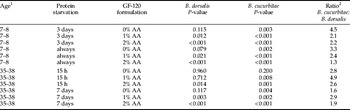
For each fly species, relative attractiveness of three formulations of GF-120 NF Naturalyte Fruit Fly Bait© that varied in their relative amounts of ammonium acetate (0% AA, no AA; 1% AA, commercial formulation; and 2% AA) when compared to sugar/water solution (control) in field-cage paired tests according to age and protein starvation regime.

1, days since adult emergence
2, determined as ‘no. B. cucurbitae females that responded to a particular GF-120 formulation/no. B. dorsalis that responded to the same GF-120 formulation’.
For each fly species, data (proportions of released females that responded in a 20-min period) were transformed to arc-sin before analysis (Wilcoxon Matched Pairs Tests at P=0.05 with N=9 for 7–8 days old females and N=10 for 35–38 days old females).
Results
Field tests
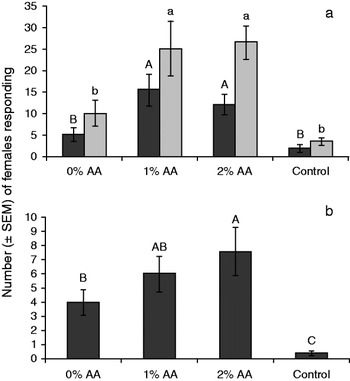
For both B. dorsalis (ANOVA df=3, 28; F=8.04; P<0.001) and B. cucurbitae (ANOVA df=3, 28; F=10.09; P<0.001), addition of AA to GF-120 exerted a significant positive effect on the response of females to this bait. For both species, GF-120 containing either 1% or 2% AA attracted significantly more females to yellow PLMs, regardless of the relative amount, than did the 0% AA GF-120 formulation. For both species, female response to yellow bait stations that were sprayed with sugar/water did not differ significantly from that recorded in bait stations sprayed with GF-120 0% AA (fig. 1a).
Field response of female (a) B. dorsalis and B. cucurbitae and (b) C. capitata to PLMs baited with GF-120 NF Naturalyte Fruit Fly Bait© containing various amounts of ammonium acetate (AA). The three bait formulations were: (i) no AA in the bait (0% AA); (ii) 1% AA (the standard amount of AA in the commercial formulation); and (iii) 2% AA (twice as much AA as the commercial formulation). For each species, PLMs baited with a sugar/water solution served as controls for the yellow color. For each fly species, different letters indicate significant differences according to ANOVA and Fisher-protected LSD tests at P=0.05 (▪, B. dorsalis;  B. cucurbitae).

For C. capitata, there was a significant effect of the amount of AA present in GF-120 (ANOVA df=3, 51; F=9.95; P<0.001). The GF-120 2% AA formulation attracted significantly more females in a 2-h period than GF-120 0% AA and than the control treatment, and responses recorded for GF-120 1% AA were intermediate (fig. 1b). GF-120 0% AA was attractive to female C. capitata when compared to the control treatment.
Field cage tests
The attractiveness of each formulation of GF-120 relative to that of the sugar/water solution (control) in paired tests (i.e. within-cage response) is presented in table 1 for each of the 12 possible combinations of ‘fly species’, ‘age’ and ‘starvation regime’. For B. cucurbitae all GF-120 formulations were significantly more attractive to females than sugar/water control regardless of female age and level of protein hunger, except for sexually mature (35–38 days old) females that were protein starved for 15 h, which showed no preference for GF-120 0% AA. In contrast, GF-120 formulations were unattractive (relative to sugar/water) to female B. dorsalis in nearly 42% (5/12) of the comparisons made. Table 1 also shows that, when tested under the same conditions, the response of B. cucurbitae to GF-120 was consistently greater than that of B. dorsalis, as shown in the column expressing the ratio of response of B. cucurbitae to B. dorsalis.
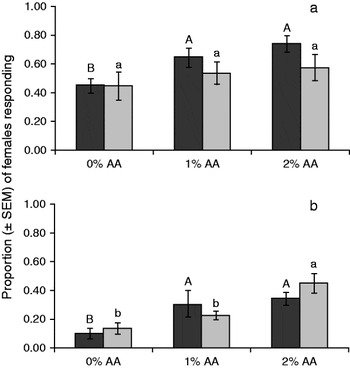
As for the across-cage responses, protein starvation regime exerted no significant effect (ANOVA df=1, 48; F=0.05; P=0.822) on the subsequent response of young, sexually immature (7–8 days old) B. cucurbitae females to the baits. In turn, the effect of the amount of AA present in GF-120 was significant (ANOVA df=2, 48; F=5.92; P=0.005). For females that were deprived from protein for three days, the response was significantly greater to GF-120 that had AA, independently of the relative amount, than to GF-120 that did not contain AA (fig. 2a). In contrast, young B. cucurbitae females that had no access to protein since the moment of the emergence responded in similar numbers to the three GF-120 formulations.
Response, expressed as mean proportion of responding females released in field cages, of young (7–8 days) (a) B. cucurbitae and (b) B. dorsalis to three GF-120 formulations that varied in the relative amounts of AA, according to level of protein starvation. For each fly species, different letters indicate significant differences according to two-way ANOVA and Fisher-protected LSD tests at P=0.05 (▪, starved 3 days; , always starved).

For young, sexually immature (7–8 days old) B. dorsalis the effects of starvation (ANOVA df=1, 48; F=5.33; P=0.025) and amount of AA present in GF-120 (df=2, 48; F=12.77; P< 0.001) were significant. When deprived from protein for three days, significantly more females responded to GF-120 that had AA, regardless of the relative amount, than to GF-120 that did not contain AA. For females that were always starved, the response to GF-120 with the highest amount of AA added (2% AA) was significantly greater than that shown to the other two GF-120 formulations (fig. 2b).
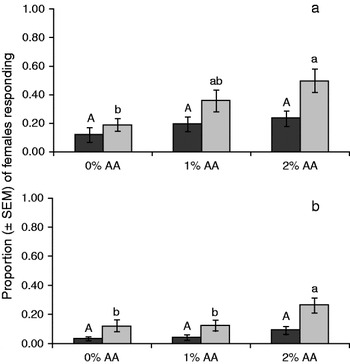
For older, sexually mature (35–38 days old) B. cucurbitae females, the effects of starvation (ANOVA df=1, 54; F=11.28; P=0.001) and amount of AA present in GF-120 (df=2, 54; F=5.94; P=0.005) were significant. For females that were protein starved for seven days, the level of response to GF-120 increased as the amount of AA was increased from 0% AA to 2% AA, and these two formulations differed significantly in attractiveness (fig. 3a). In contrast, sexually mature females that were starved for only 15 h responded in similar numbers to the three different GF-120 formulations evaluated.
Response, expressed as mean proportion of responding females released in field cages, of old (35–38 days) (a) B. cucurbitae and (b) B. dorsalis to three GF-120 formulations that varied in the relative amounts of AA, according to level of protein starvation. For each fly species, different letters indicate significant differences according to two-way ANOVA and Fisher-protected LSD tests at P=0.05 (▪, starved 15 hours; , starved 7 days).

Overall, the response of older, sexually mature (35–38 days old) B. dorsalis females was comparatively low. Both protein starvation (ANOVA df=1, 54; F=15.14; P< 0.001) and amount of AA present in GF-120 (df=2, 54; F=4.94; P=0.011) exerted a significant effect on the level of response of the test females. For females that were protein starved for seven days, the strongest response to GF-120 was recorded for the 2% AA formulation, which differed significantly from the other two formulations. No significant differences in the levels of response to the three GF-120 formulations were recorded for females that were deprived from protein for 15 h (fig. 3b).
Discussion
For effective fruit fly control, food-based bait formulations ought to induce both good levels of attraction to the source and stimulate flies to ingest a lethal dose of the toxicant upon contact (Mangan et al., Reference Mangan, Moreno and Thompson2006; Mangan, Reference Mangan2009). A variety of baits, such as Biolure and GF-120 NF Naturalyte Fruit Fly Bait, take advantage of the key role that ammonia plays in fruit fly attraction to food baits by including AA in their formulations. AA has been shown to be the most attractive compound of Biolure for C. capitata (Heath et al., Reference Heath, Epsky, Midgarden and Katsoyannos2004; Leblanc et al., Reference Leblanc, Vargas and Rubinoff2010).
Our field tests revealed a significant effect of addition of AA to GF-120, regardless of the amount added, for B. cucurbitae and B. dorsalis, and a significant positive relationship between relative amounts of AA in bait and the numbers of C. capitata females responding. Our field cage tests revealed a significant effect of age for both B. dorsalis and B. cucurbitae (F1 generation) and species-specific effects of levels of protein starvation on the response to the various AA treatments. For instance, B. cucurbitae females were consistently attracted to GF-120, even for GF-120 that lacked AA (0% AA) when compared to a sugar/water control whereas B. dorsalis showed an overall reduced response to the baits. Overall, our results indicate, when tested under the same conditions, the response of B. cucurbitae to GF-120 is consistently greater than that of B. dorsalis.
Our experimental approach involving use of standardized protocols, such as PLMs in the field, and a field cage bioassay that has been previously utilized in numerous studies by our group (e.g. Prokopy et al., Reference Prokopy, Miller, Piñero, Barry, Tran, Oride and Vargas2003; Miller et al., Reference Miller, Vargas, Prokopy and Mackey2004; Barry et al., Reference Barry, Miller, Piñero, Tuttle, Mau and Vargas2006; Piñero et al., Reference Piñero, Jácome, Vargas and Prokopy2006; Vargas & Prokopy, Reference Vargas and Prokopy2006) enabled us to establish proper comparisons within and across fly species. As stated in the Introduction, discrepancies in results from several studies concerning the attractiveness of GF-120 to different fruit fly species may be in part due to differences in methodologies used for the evaluations of attraction and toxicity (Mangan, Reference Mangan2009; Piñero et al., Reference Piñero, Mau and Vargas2009a). Our field cage bioassay avoided potential interactions between baits that were reported by Barry et al. (Reference Barry, Miller, Piñero, Tuttle, Mau and Vargas2006) owing to the simultaneous use of three cages that contained a particular GF-120 formulation, each of which was paired against a water control.
Previous studies have shown that the amount AA present in GF-120 and other protein baits affects the response of various fruit fly species, including C. capitata. For example, Bateman & Morton (Reference Bateman and Morton1981) demonstrated that increases in ammonia, produced as a consequence of bacterial degradation of protein, were associated with increases in bait attractiveness to female C. capitata. More recently, Mazor (Reference Mazor2009) documented low attractiveness of proteinaceous baits that were associated with low release rates of ammonia, whereas other sources of ammonia, such as fertilizers (e.g. ammonium nitrate) and manure, were found to release much higher rates of gaseous ammonia. This resulted in much higher attractiveness to female C. capitata under laboratory conditions. The present study conclusively documents that a comparatively small increase in the amount of AA in GF-120 was associated with an increase in the number of female C. capitata responding under field conditions. In contrast, for wild B. dorsalis and B. cucurbitae, we found that an increase in the amount of AA from 1% to 2% did not result in an increase of the number of females responding to GF-120. An unexpected result in the field study was the attractiveness of GF-120 that did not contain AA to female C. capitata when compared with the sugar/water control, a result not found with either B. dorsalis or B. cucurbitae. For the latter two species, GF-120 0% AA was not significantly more attractive than the sugar/water control. Thus, other volatile attractant components in GF-120 other than AA seem to elicit positive responses in wild C. capitata.
Two key components of insect physiological state known to influence the foraging behaviour of an individual and its propensity to seek and accept resources of varying nutritional resources are egg load and degree of protein hunger (Prokopy et al., Reference Prokopy, Cooley, Luna and Duan1995). The effects of both of these components were evaluated in the present study using field cages. In these tests, female age was considered an approximation of sexual reproductive stage. In general, our results concerning the effects of age and protein deprivation were as expected, with younger females responding in significantly greater numbers than older, gravid females. For example, in the case of B. cucurbitae, 74% of young females that were deprived from protein for three days responded, on average, to GF-120 that had the highest amount of AA (2%) in a 20-min period.
Our field cage results also indicate that the effects of amounts of AA present in GF-120 can be modulated by factors, such as age and level of protein starvation, and that these effects may differ between fly species. For instance, female B. cucurbitae that were always deprived of protein, and therefore very hungry, responded in similar numbers to GF-120 regardless of the presence or amount of AA. For instance, for females that were protein deprived since the moment of adult emergence, the highest response recorded was to GF-120 2% AA; whereas, for young females that were deprived from protein for three days, there was a significant effect of the presence, regardless of amount, of AA. When compared to water (i.e. for the within cage comparisons; table 1), the commercial (1% AA) formulation of GF-120 was found to be unattractive to old (35–38 days old) female B. dorsalis that were protein deprived for only 15 h. In contrast, for B. cucurbitae, all GF-120 formulations were significantly more attractive to females than sugar/water control, regardless of female age and level of protein hunger, except for the specific case of old females that were protein starved for 15 h, which showed no preference for GF-120 0% AA over the sugar/water control. From a methodological perspective, future studies aimed at evaluating the effects of AA in protein baits ought to consider the physiological state of the female flies as an important factor influencing the behavioural response.
Our findings have implications for integrated pest management of tephritid flies concerning the effectiveness of the application of insecticidal baits such as GF-120. For instance, the stronger response of female B. cucurbitae to GF-120 compared to B. dorsalis over the various ages and levels of protein starvation regimes documented in field cages may result in better level of control of the former species. We postulate that an increase in the amount of AA in protein baits such as GF-120 is likely to result in increased responses of female B. dorsalis and C. capitata and potentially in better fruit fly suppression.
Acknowledgements
We thank Nicholle Konanui, Les Oride and Steven Souder for important technical assistance and Luc Leblanc (University of Hawaii at Manoa) and two anonymous reviewers for very useful comments to earlier versions of this manuscript. We are grateful to Ray Boucher (Dow AgroSciences, Indianapolis, IN) for kindly formulating the test materials specifically for our lab and to Neil Miller (USDA ARS) for suggestions and important organizational help. This research was partially supported by a USDA-ARS agreement for fruit fly research administered by the college of Tropical Agriculture and Human Resources, University of Hawaii at Manoa.