

INTRODUCTION
Longan (Dimocarpus longan) is a member of the Sapindaceae family and along with other important tropical fruit crops, such as lychee and rambutan, is native to southern China (Zee et al., Reference Zee, Chan, Yen, Shaw, Chen and Nagy1998). The edible portion of the longan fruit is a fleshy, translucent white sarcotesta, which contains 15–25% total soluble solids surrounding a single round to ovoid glossy red-brown seed (Subhadrabandhu and Stern, Reference Subhadrabandhu, Stern, Menzel and Waite2005). China is the largest producer of longan worldwide but the demand is so strong that the country is a net importer (Huang, et. al., Reference Huang, Subhadrabandhu, Mitra, Ben-Arie, Stern, Menzel and Waite2005); other countries such as Thailand, Taiwan, India, Australia, Israel and South Africa also produce this fruit commercially for the export market. As with many other tropical fruit crops, there is a scarcity of information on the best management practices and optimum growing conditions for longan. For example, little is known about the adaptability of longan to high acidic soils. The most productive soils of the world are already under cultivation, and those available for agricultural expansion, particularly in the tropics, are often strongly acidic, possessing toxic levels of soil aluminum (Al) (Kamprath, Reference Kamprath and Adams1984; Samac and Tesfaye, Reference Samac and Tesfaye2003). The mechanism by which soil acidity reduces the yield of many crops has been studied extensively (Foy, Reference Foy and Adams1984; Kochian et al., Reference Kochian, Pence, Letham, Pineros, Magalhaes, Hoekenga and Garvin2002). A high concentration of Al restricts root growth and hence exploitation of soil/subsoil by roots for moisture and nutrients. Soil Al concentrations of as high as 15 cmol kg−1 can be found in tropical acid soils; in the tropical Americas, about 50% of the soils with potential for agricultural use have been diagnosed with Al toxicity problems (Committee on Sustainable Agriculture and the Environment in the Humid Tropics, National Research Council, 1993; Hoekenga et al., Reference Hoekenga, Maron, Pineros, Cancado, Shaff, Kobayashi, Ryan, Dong, Delhaize, Sasaki, Matsumoto, Koyama and Kochian2006; Villagarcia et al., Reference Villagarcia, Carter, Rufty, Niewoehner, Jennette and Arellano2001). Few studies, if any, have been conducted to screen longan germplasm for acid soil tolerance under field conditions. The objective of this investigation was to determine the critical soil Al concentrations that affect growth of longan germplasm under field conditions and to identify potential sources of tolerance to this stress.
MATERIALS AND METHODS
Field experiments were established from 10 July 2003 to 20 September 2004 at the Corozal Research Station of the University of Puerto Rico. The study was conducted on a deep, well-drained Ultisol (Aquic Tropudult) in 25 blocks of 3.65 × 3.65 m arranged in a randomized complete block design. Blocks differed in soil acidity due to differential applications of calcitic limestone many years prior to the experiment to achieve levels of soil Al. Soil from each block was sampled before planting by taking 15 borings at a depth of 0–20 cm from each plot. The samples were air-dried and passed through a 20-mesh screen. Soil pH in water and 0.01-M calcium chloride (CaCl2) (soil–water ratio = 1:2) was measured with a glass electrode. Potassium chloride (KCl) extractable Al was determined using an atomic absorption spectrophotometer, and exchangeable cations, extracted with neutral 1-M ammonium acetate (NH4OAc), were also determined similarly. Percentage Al saturation of the soil was calculated on the assumption that exchangeable calcium (Ca) + magnesium (Mg) + potassium (K) + Al + hydrogen (H) was the effective cation exchange capacity of the soil (Kamprath, Reference Kamprath and Adams1984). All plots were planted to open-pollinated seedlings of longan clones, i.e. ‘Biew Kiew’, ‘Illiau’, ‘Sri-Chompoo’ and ‘Tiger's Eye’. Seedlings were approximately 2.5-month old and had an average height, stem diameter and leaf number of 17.2 cm, 2.6 mm and 16.8 leaves, respectively, when transplanted to the field. ‘Biew Kiew’ and ‘Sri-Chompoo’ are cultivars from Thailand, ‘Illiau’ is a selection from Hawaii and ‘Tiger's Eye’ is from China. To our knowledge, these cultivars have never been field-tested under a wide range of soil Al concentrations, which in this study ranged from 5.1 to 12.2 cmol kg−1. The pHH2O and pHCaCl2 in these plots ranged from 4.15 to 5.12 and 3.25 to 4.14 respectively. Soil Ca ranged from 64 to 851 mg kg−1 and soil Mg from 27 to 135 mg kg−1. A 3-m row (10 plants row−1) of each cultivar was planted in each block. Rows were 91 cm apart with plants being 30.5 cm apart within the row. Plants in each row were side-dressed with a commercial mixture of nitrogen (N)–phosphorus (P)–K–Mg (10–2.2–12.5–1.8 respectively) applied at a rate of 670 kg ha−1 two weeks after planting. Trees were harvested for biomass accumulation about 14 months after field transplanting during the weeks of 20 September 2004 in experiment 1 and 6 December 2005 in experiment 2. At each harvest, plant height was measured with a ruler and stem diameter with a digital caliper at 25 cm from the soil. Soil was then loosened with a garden fork, and eight plants from each cultivar in each row were pulled from the soil, washed and separated into leaves, petioles, stem and roots. Plant parts from each variety were dried at 70 °C to constant weight for dry matter determination. The dry samples were ground to pass a 1.0-mesh screen and analysed for N, P, K, Ca, Mg, iron (Fe), Al and manganese (Mn). Nitrogen was determined by the micro-Kjeldahl procedure (IBSNAT, 1987), P was determined by the molybdovanadophosphoric acid method (IBSNAT, 1987) and K, Ca, Mg, Fe, Al and Mn were determined by atomic absorption spectrometry (Perkin-Elmer, Reference Perkin-Elmer1994). Because of the difficulty in complete washing out from roots soil clay particles that could interfere with elemental analyses, nutrient uptake is reported as the sum of the nutrients taken up by the aerial parts of the plants (i.e. stem, petioles and leaves). Analyses of variance and regression analyses were determined using the GLM procedure of the SAS program package (version 9.2, SAS Institute, Inc., Cary, NC, USA). Only coefficients at p ≤ 0.05 were retained in the models.
RESULTS AND DISCUSSION
Differences between soil Al treatments and cultivars were highly significant (p ≤ 0.01) for total leaf, stem, petiole and root dry weight measured at the end of the experimental period (analysis of variance not shown). Therefore, results were analysed separately by cultivars.
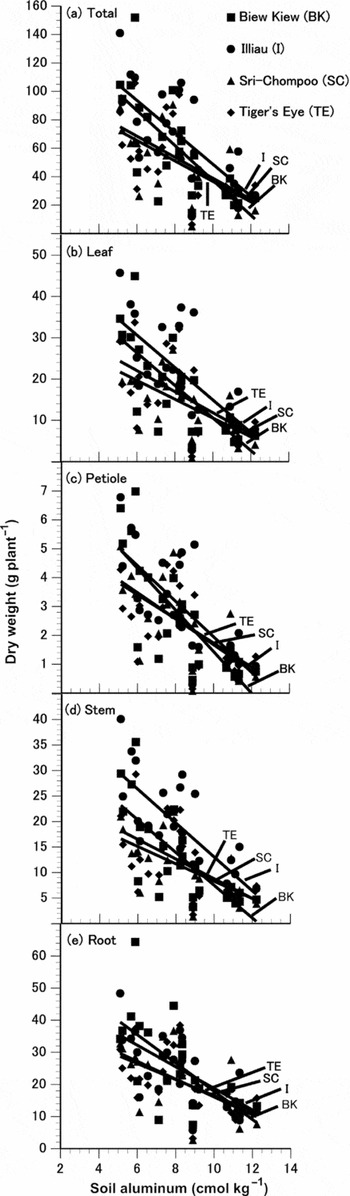
Increasing the concentration of soil Al caused a significant decline in the total dry weight of all cultivars (Figure 1a). Overall, cultivars Illiau and Biew Kiew showed significantly higher total dry weight than cultivars Sri-Chompoo and Tiger's Eye. At the lowest soil Al concentration (5.1 cmol kg−1), the highest total dry weight (104 g plant−1) was obtained by cultivar Illiau. The lowest total dry weight (75 g plant−1) at this Al concentration was obtained in cultivar Tiger's Eye (Figure 1a).
Dry weight of plant organs of longan as influenced by soil aluminum.

Increasing the soil Al concentration from 5.1 cmol kg −1 to just 6.5 cmol kg−1 reduced the total dry weight of all cultivars between 15% and 19% (Figure 1a). When the soil Al concentration was increased to 12.2 cmol kg−1, the total dry weight of cultivars declined between 68% and 87% (Figure 1a). Overall, cultivar Illiau had higher dry matter content in all plant parts at all Al concentrations than other cultivars (Figures 1a–e). Still, this cultivar was severely affected by soil Al concentrations exceeding 5.1 cmol kg−1, a relatively low Al concentration in soils of the humid tropics. Therefore, the higher dry matter content of Illiau, even at the lower Al concentrations used in this study, may be of little value under higher soil Al concentrations found in the humid tropics (Kamprath, Reference Kamprath and Adams1984). These results greatly contrast the results obtained with rambutan (Nephelium lappaceum), which as longan is also a member of the Sapindaceae family and which showed that the total plant dry weight increased by more than 145% when soil Al concentration was increased from 0.70 to 11.0 cmol kg−1 (Goenaga, Reference Goenaga2011).
Soil Al significantly reduced the dry weight of all plant organs (Figures 1a–e). At a soil Al concentration of 5.1 cmol kg−1, average leaf, stem, petiole and root dry weights accounted for 32%, 25%, 5% and 38%, respectively, of the total dry weight of each cultivar. At the highest soil Al concentration (12.2 cmol kg−1), these proportions changed to 25%, 17%, 2% and 56% respectively. Therefore, although high soil Al significantly reduced the dry weight of all plant parts, root dry weight was less affected than that of other plant organs (Figures 1a–e). Similar responses in shoot–root ratios have been found with other crops subjected to acid soil conditions (Bates, et al., Reference Bates, Dunst, Taft and Vercant2002; Goenaga, Reference Goenaga2011; Himelrick, Reference Himelrick1991) and may be indicative of plants translocating metabolites to maintain root function at the expense of shoot growth.
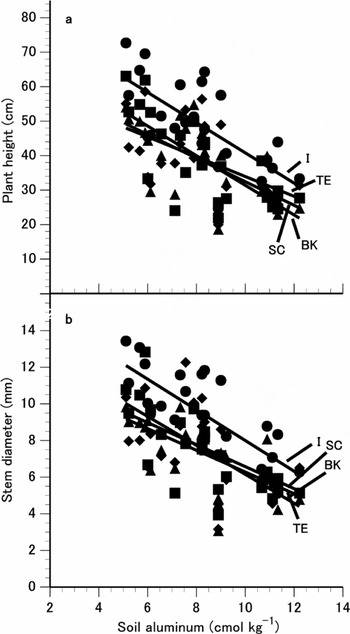
The results obtained in this study are similar to the results obtained with corn, wheat, soybean, sweet potato and Brachiaria grown on acid soils with Al saturation greater than 60% which showed that plant growth was reduced to half when compared to plants grown in limed soils (Kamprath, Reference Kamprath and Adams1984). In this experiment, plants growing at an Al concentration of 12.2 cmol kg−1 (77% Al saturation, data not shown) had their leaf, stem, petiole and root dry weight reduced by an average of 82%, 82%, 88%, and 70%, respectively, below the values obtained at an Al concentration of 5.1 cmol kg −1 (47% Al saturation) (Figures 1a–e). Plant height and stem diameter showed a reduction of 49% and 50%, respectively, when soil Al was increased from 5.1 to 12.2 cmol kg−1, further demonstrating the susceptibility of this crop to high soil Al (Figures 2a and b). Studies with rambutan (Goenaga, Reference Goenaga2011) showed an increase in dry weight, plant height and stem diameter with increasing levels of soil Al up to 11.0 cmol kg−1 of soil Al and then declined.
(a) Stem diameter, and (b) plant height as influenced by soil aluminum. Symbols as in Figure 1.

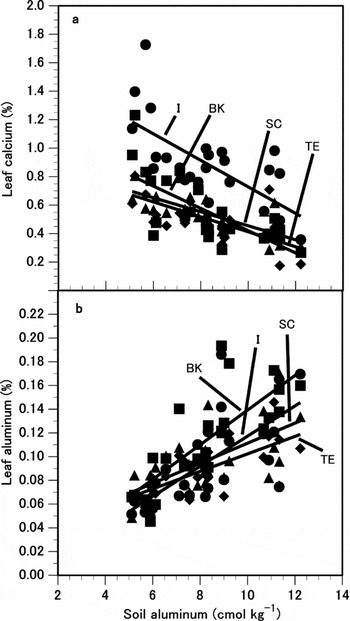
Increasing the concentration of soil Al had little effect on the concentration of most nutrients in leaves of all cultivars. Concentrations of leaf N, P and zinc (Zn) were not significantly affected by the levels of soil Al in any of the cultivars (data not shown). However, increments in soil Al resulted in a significant reduction in the concentration of leaf Ca and a significant increase in the concentration of leaf Al in all cultivars (Figures 3a –and b). High concentration of tissue Al can limit plant growth and development (Fageria et al., Reference Fageria, Baligar and Clark2006; George et al., Reference George, Horst, Neumann and Marschner2012; Kochian et al., Reference Kochian, Pence, Letham, Pineros, Magalhaes, Hoekenga and Garvin2002). Results from this study are similar to those obtained in nutrient culture, which showed significant reductions in biomass production when longan seedlings were exposed to increasing concentrations of Al in the solution (Xiao et al., Reference Xiao, Liu, Zhang, Yang, Chen and Xie2002). Factors such as root membrane leakage of solutes (Wan, Reference Wan2007) and increased proteolysis in roots and leaves (Xiao et al., Reference Xiao, Liu, Yang, Wan, Zheng and Wan2006) have been shown to increase in longan seedlings when exposed to high concentrations of Al in the nutrient solution.
Leaf nutrient concentration of (a) calcium, and (b) aluminum in longan as influenced by soil aluminum. Symbols as in Figure 1.

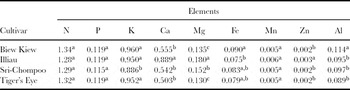
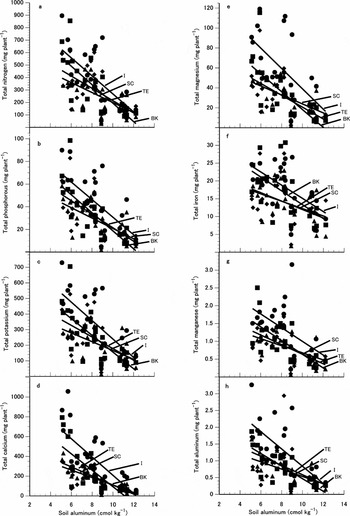
Figures 4a–h show that content of all nutrients declined significantly in all cultivars with increase in soil Al. Lower nutrient content at high soil Al concentrations was mainly the result of lower production of dry matter rather than by the reduced concentration of nutrients in tissues (Figures 1a–h and Table 1). Nevertheless, averaged across soil Al levels, there were differential responses for some nutrients among cultivars. For example, the concentration of leaf Ca, Mg and Zn in cultivar Illiau was significantly higher than in other cultivars whereas higher concentration of Al was found in leaves of cultivar Biew Kiew (Table 1).
Nutrient concentration in leaves of four longan cultivars averaged over soil aluminum treatments.

Means followed by the same superscript letter within a column are not significantly different using Tukey's Studentized range test at p ≤ 0.05.
Shoot (leaf + petiole + stem) nutrient content as influenced by soil aluminum. Symbols as in Figure 1.

The results of this study demonstrated no cultivar differences for dry matter production in longan trees grown under Al stress. On average, increasing the soil Al concentration from 5.1 to 12.2 cmol kg−1 resulted in a 75% reduction in total dry matter production, which is indicative of the sensitivity of this crop to high soil Al. Future studies should be directed to the screening of a wider pool of genotypes as an effort to identify Al-tolerant longan which could be used as rootstocks in acid soils in the tropics.
Disclaimer: Mention of trade names or commercial products in this paper is solely for the purpose of providing specific information and does not imply recommendation or endorsement of the US Department of Agriculture.
Acknowledgements
Appreciation is expressed to Jose Luis Rodriguez, Angel Marrero and Delvis Perez for assistance in data collection, tissue processing and chemical analyses of samples and to Dr. Francis Zee, USDA-ARS, Hilo, Hawaii for assistance in obtaining longan germplasm.