Introduction
The success of poultry production depends primarily on three factors; the quality of the bird, the environment and the provision of a balanced feed. Feed is the most expensive input in poultry and accounts for 65-70% of broiler and 75-80% of layer production costs. Success of feed formulation is measured by the accuracy with which nutrient requirements can be met by nutrients supplied to achieve a target performance (Williams, Reference WILLIAMS1995). Cereal grains are the main source of dietary energy and maize is the most preferred energy source in poultry because of its high energy, low fibre, better palatability, and fact that it contains pigments and essential fatty acids. Although marginally lower in protein, due to higher levels of inclusion (50-70%), maize contributes to about one third of the protein requirement of poultry. However, maize like other cereals is deficient in certain essential amino acids, particularly lysine (Lys) and tryptophan (Try) (NRC, 1994).
Structurally, the maize grain includes the pericarp (6%), endosperm (82%) and germ (12%) (Watson, Reference WATSON1987). The main structural component of the endosperm is starch, a complex carbohydrate that constitutes on an average 71% of the grain and is a source of energy. The majority of the protein in mature maize grain is in the endosperm and germ, however, the germ protein is superior in both quantity and nutritional quality (Vasal, Reference VASAL2000). The endosperm of maize contains a group of four structurally distinct alcohol-soluble proteins called zeins (Esen and Stetler, Reference ESEN and STETLER1987). In normal maize (NM), zeins usually account for 50-70% of the endosperm protein and are rich in glutamine, leucine and proline. Zeins are essentially devoid of Lys and Try (Nelson, Reference NELSON1969) and thus, maize proteins have poor nutritional value for monogastric animals.
The need to enhance the protein quality of NM through genetic selection has been recognised for a long time (Osborne and Mendel, Reference OSBORNE and MENDEL1914). Breeding for improved protein quality in maize began in the mid-1960s with the discovery of mutants, such as opaque-2 (Mertz et al., Reference MERTZ, BATES and NELSON1964) and floury-2 (Nelson et al., Reference NELSON, MERTZ and BATES1965), which produced higher levels of Lys and Try, the two amino acids deficient in maize proteins. However, adverse pleiotropic effects of this mutation, such as a soft endosperm that results in damaged kernels, increased susceptibility to pests and fungal diseases, inferior food processing and reduced yields, imposed severe constraints on successful exploitation of these mutants (Bjarnason and Vasal, Reference BJARNASON and VASAL1992).
The search has since continued for new mutants that could alter the amino acid profile of maize endosperm protein which resulted in the development of quality protein maize (QPM) in which all the problems associated with earlier mutants were overcome (Vasal, Reference VASAL2000). Whilst no different from that of NM in terms of the quantity of energy and protein it contains, QPM differs in protein quality because it contains double the amount of Lys and Try in comparison to normal maize (Prasanna et al., Reference PRASANNA, VASAL, KASSAHUN and SINGH2001; Panda et al., Reference PANDA, RAJU, RAMA RAO, LAVANYA, PRADEEP KUMAR REDDY and SHYAM SUNDER2010) and is essentially interchangeable with NM in cultivation and kernel phenotype (Vasal, Reference VASAL2000). QPM is currently grown on around 3.6 million hectares of land worldwide and around 2 lakh hectares in India (Agrawal and Gupta, Reference AGRAWAL and GUPTA2010).
In practical poultry diets, methionine is the first limiting amino acid followed by lysine, threonine, and tryptophan (Liu et al., Reference LIU, BRYANT and ROLAND2004), thus dietary supplementation is required. These problems have long been dealt with by supplementing diets with crystalline amino acids. Although this approach works well for feeding poultry, it is highly expensive and, additionally, supplemental amino acids are often lost from the feed during processing. As QPM contains higher lysine and tryptophan compared to NM (Prasanna et al., Reference PRASANNA, VASAL, KASSAHUN and SINGH2001), it is assumed that the use of such maize will enable the feed manufacturer to produce poultry feeds with no additional or minimal supplementation of crystalline amino acids, particularly lysine and tryptophan. Thus, the review herein discusses the nutritional value of QPM and the scope of its utilisation as a poultry feed.
Nutrient composition of NM vs. QPM
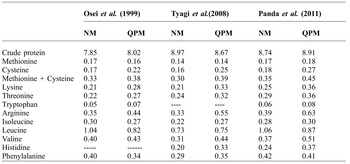
A few researchers have compared the chemical composition (Table 1) of QPM with NM (Ortega et al., Reference ORTEGA, VILLEGAS and VASAL1986; Sproule et al., Reference SPROULE, SALDIVAR and A.J. ROONEY1988; Osei et al., Reference OSEI, DEI and TUAH1999; Onimisi et al., Reference ONIMISI, DAFWANG, OMAGE and ONYIBE2008; Tyagi et al., Reference TYAGI, SHRIVASTAV, MANDAL, TYAGI, ELANGOVAN and DEO2008; Panda et al., Reference PANDA, RAJU, RAMA RAO, LAVANYA, PRADEEP KUMAR REDDY and SHYAM SUNDER2011). Although there was a reported variation in the crude protein (CP) content of NM and QPM, the CP content was similar between NM and QPM. However, the Lys and Try content of QPM was 33-57% and 33-40% higher respectively than that of NM. Prasanna et al. (Reference PRASANNA, VASAL, KASSAHUN and SINGH2001) reported that, in addition to changes in the content of Lys and Try, QPM contained some unintended compositional changes. Besides 55% more tryptophan and 30% more lysine, they reported 38% less leucine in QPM compared to NM. Similarly, Osei et al. (Reference OSEI, DEI and TUAH1999) and Panda et al. (Reference PANDA, RAJU, RAMA RAO, LAVANYA, PRADEEP KUMAR REDDY and SHYAM SUNDER2011) reported 20-22% lower leucine in QPM compared to NM. The excess leucine in NM is known to cause amino acid imbalances which impairs protein synthesis and reduces the conversion of tryptophan to niacin (Onimisi et al., Reference ONIMISI, DAFWANG, OMAGE and ONYIBE2008). Thus the reduced level of leucine in QPM is of significant importance and is considered to be desirable as it makes the leucine to isoleucine ratio more balanced, which in turn helps to liberate more tryptophan for niacin biosynthesis.
Crude protein and amino acid profile (%) in normal and quality protein maize.

Data standardised to a dry matter content of 88%
Apparent amino acid digestibility of NM vs. QPM
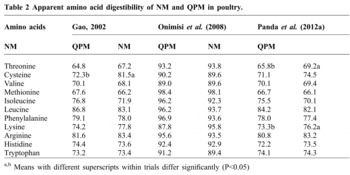
Besides dietary nutrient composition, its availability is crucial for regulation of metabolism and tissue function. Knowledge of the availability of amino acids in feedstuffs is important for accurate feed formulation of diets that meet the bird's amino acid requirements. Few researchers have conducted apparent amino acid digestibility studies (Table 2) on NM and QPM in poultry (Gao, Reference GAO2002; Onimisi et al., Reference ONIMISI, DAFWANG, OMAGE and ONYIBE2008; Panda et al., Reference PANDA, RAJU, RAMA RAO, LAVANYA, PRADEEP KUMAR REDDY and SHYAM SUNDER2011). No variation in the digestibility of the majority of the amino acid between NM and QPM was seen, except for cysteine (Gao, Reference GAO2002), lysine (Onimisi et al., Reference ONIMISI, DAFWANG, OMAGE and ONYIBE2008; Panda et al., Reference PANDA, RAJU, RAMA RAO, LAVANYA, PRADEEP KUMAR REDDY and SHYAM SUNDER2011) and threonine (Panda et al., Reference PANDA, RAJU, RAMA RAO, LAVANYA, PRADEEP KUMAR REDDY and SHYAM SUNDER2011) whereby digestibility was higher in QPM than NM. Lysine and threonine have no intermediary precursors; hence 100% of their need must be supplied by the diet (Scott et al., Reference SCOTT, NESHEIM and YOUNG2001). Thus, the higher digestibility of Lys and threonine in QPM is of significant importance to poultry.
Besides protein quality, another important factor is ‘biological value’ which is defined as the percentage of digested and absorbed nitrogen that is retained by the body. It determines biologically how closely the pattern of amino acids in a particular feed protein will satisfy the needs of the growing individual. It has been reported that the biological value of NM is 45% compared to 80% in QPM (Prasanna et al., Reference PRASANNA, VASAL, KASSAHUN and SINGH2001). Only 37% of protein intake from NM is utilised, compared to 74% of the same amount of QPM protein. The other advantage of QPM includes higher niacin availability due to a higher tryptophan and lower leucine content (Onimisi et al., Reference ONIMISI, OMAGE, DAFWANG and BAWA2009) and higher carotene utilisation (Prasanna et al., Reference PRASANNA, VASAL, KASSAHUN and SINGH2001). It is further reported that high QPM can be transformed into edible products without deterioration of its quality or acceptability and can be used in conventional and new products (Graham et al., Reference GRAHAM, LEMBAKE, LANCHO and MORALES1989).
Apparent amino acid digestibility of NM and QPM in poultry.

a,b Means with different superscripts within trials differ significantly (P<0.05)
Apparent metabolisable energy of NM vs. QPM
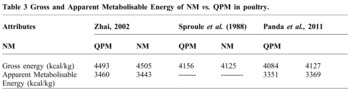
The gross energy content of QPM is reported to be similar to NM (Table 3) (Sproule et al., Reference SPROULE, SALDIVAR and A.J. ROONEY1988; Zhai, Reference ZHAI2002; Panda et al., Reference PANDA, RAJU, RAMA RAO, LAVANYA, PRADEEP KUMAR REDDY and SHYAM SUNDER2011). No significant differences in the apparent metabolisable energy (AME) content (single ingredient assay) of the two varieties could be seen for poultry (Zhai, Reference ZHAI2002; Panda et al., Reference PANDA, RAJU, RAMA RAO, LAVANYA, PRADEEP KUMAR REDDY and SHYAM SUNDER2011). In another study, Tyagi et al. (Reference TYAGI, SHRIVASTAV, MANDAL, TYAGI, ELANGOVAN and DEO2008) did not find any difference in the AME content of QPM and NM following traditional diet substitution and the Sibbald method of total excreta collection (Sibbald and Slinger, Reference SIBBALD and SLINGER1963).
Gross and Apparent Metabolisable Energy of NM vs. QPM in poultry.

Quality protein maize for broilers
Genetic selection for fast growth is a continuous process in the broiler industry and chicks which weigh 40-45 g at day-old currently grow to about 2.2–2.4 kg by 40 days of age. The fast growth in today's broiler possesses a challenge to the nutritionist to formulate high nutrient density diets that are well balanced in essential nutrients to meet the bird's genetic potential. Maize is a popular energy cereal used in combination with protein meal, such as soybean meal, in the formulation of broiler chicken diets world-wide. In maize-soybean meal based diets, methionine is the first limiting amino acid, followed by lysine, threonine, and tryptophan, and these amino acids are added separately to the diets to meet requirements. Many attempts have been made by various researchers to replace NM by QPM (with or without synthetic Lys supplementation to evaluate the added advantage of higher amino acid contents in QPM on broiler chicken performance).
Growth performance
Osei et al. (Reference OSEI, ATUAHENE, OKAI, DONKOH and TUAH1998) conducted a six week trial to evaluate QPM as a feed ingredient for broiler chickens. When QPM was replaced with NM (weight for weight) in practical broiler diets, significantly higher weight gain was noticed in the QPM diet (1944 g) compared to the NM diet (1904 g) at six weeks of age. Dietary replacement of NM with QPM (weight for weight, without balancing amino acids) significantly improved body weight gain (2.23 kg in NM vs. 2.26 kg in QPM) and feed conversion ratio (2.07 vs. 2.03) in broilers (Bai, Reference BAI2002). When the same researcher replaced NM by QPM on an iso-caloric and iso-nitrogenous basis in a diet balanced with amino acids, similar trends were observed. Amonelo and Roxas (Reference AMONELO and ROXAS2008) reported higher weight gain and better feed conversion efficiency in broilers on a QPM based diet compared to a NM based diet.
In another study, Onimisi et al. (Reference ONIMISI, OMAGE, DAFWANG and BAWA2009) replaced NM at 0, 25, 50, 75 and 100% with QPM in diets for Ross broiler chicks and compared performance against a group fed a control NM diet balanced with synthetic lysine. The workers reported that 100% dietary replacement of NM by QPM significantly increased body weight gain and FCR during both starter and finisher phases. When compared to the performance of broilers fed the control diet (1.11% Lys), both NM (0.87% Lys) and QPM (0.93% Lys) resulted in significantly lower body weight gain and poorer feed conversion ratio during the starter phase. However, a comparatively similar performance was noticed between the QPM based diet (0.80% Lys) and the NM based diet supplemented with lysine (1.03%) during the finisher phase. From this study, it was inferred that the lysine content of the broiler chicken diet is more important during the initial phase of production (starter) than later (finisher phase).
Using an isocaloric and isonitrogeous diet with balanced amino acids, Tyagi et al. (Reference TYAGI, SHRIVASTAV, MANDAL, TYAGI, ELANGOVAN and DEO2008) found comparable body weight gain, feed conversion and nutrient utilisation efficiencies between QPM and NM based diets in broiler chickens. Although, no difference on performance was observed in this study, it is important to mention here that no synthetic Lys supplementation was made in the QPM based diet compared to 0.09% (7.5% higher supplementation) in the NM based diet. Thus, it could be inferred from the above study that a QPM based diet in broiler chickens requires no or minimal supplementation of synthetic amino acid(s).
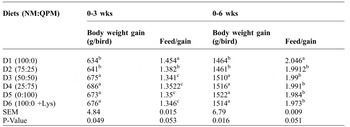
A series of trials on the utilisation of QPM in broiler chickens was conducted by Panda et al. (Reference PANDA, RAJU, RAMA RAO, LAVANYA, PRADEEP KUMAR REDDY and SHYAM SUNDER2010; Reference PANDA, RAJU, RAMA RAO, LAVANYA, PRADEEP KUMAR REDDY and SHYAM SUNDER2011; Reference PANDA, RAJU, RAMA RAO, LAVANYA, PRADEEP KUMAR REDDY and SHYAM SUNDER2012c). In the first experiment with broilers (Table 4), NM was replaced with QPM (part by part) at 0, 25, 50, 75 and 100%, respectively (Panda et al., Reference PANDA, RAJU, RAMA RAO, LAVANYA, PRADEEP KUMAR REDDY and SHYAM SUNDER2010). Another diet the same as the control diet was formulated, but supplemented with synthetic lysine to meet requirements (1.3% Lys during starter, 1-3 wk; 1.15% Lys during finisher, 4-6 wk). Dietary replacement of NM with QPM at 50% significantly improved the body weight gain of broilers compared to those fed the control or 25% QPM diet, in both the third and sixth week of age (P<0.05). No further improvement in weight gain was noticed with higher levels of replacement of NM with QPM (75 or 100%). The weight gain of broilers fed 50% QPM diet was comparable with the diet containing NM supplemented with synthetic lysine. FCR improved progressively with increasing levels of QPM up to 50%, but further improvement was not observed at higher levels of QPM in the diet after the third week. At six weeks of age, an improvement in FCR was observed at ≥ 25% QPM, although the levels of QPM in the diet did not influence FCR. Lysine fortification to the control NM diet significantly improved the feed efficiency compared to those fed the QPM diets.
Dietary replacement of NM with QPM on body weight gain and feed per gain of broiler chickens (Panda et al., Reference PANDA, RAJU, RAMA RAO, LAVANYA, PRADEEP KUMAR REDDY and SHYAM SUNDER2010).

a,b,c Means with different superscripts in column differ significantly (P≤0.05)
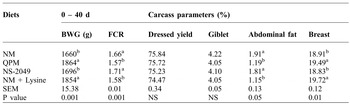
In another study (Table 5), Panda et al. (Reference PANDA, RAJU, RAMA RAO, LAVANYA, PRADEEP KUMAR REDDY and SHYAM SUNDER2011) evaluated QPM against another high lysine maize variety (Nityashree-NS-2049, developed by University of Agricultural Sciences, Bangalore, India) in broiler chickens (Vencobb 400, Venkateswar Hatcheries Private Limited, India). Dietary replacement of NM with Nityashree-NS-2049, gave no additional advantage in performance (Panda et al., Reference PANDA, RAJU, RAMA RAO, LAVANYA, PRADEEP KUMAR REDDY and SHYAM SUNDER2011). The non-improvement in Nityashree-NS-2049 diet was due to marginal higher lysine content (5%) compared to NM. However, dietary replacement of NM or NS-2049 by QPM significantly improved the body weight gain and feed conversion efficiency (P<0.001) at 40 days of age. The performance of the QPM fed group was similar to those fed NM based diets supplemented with synthetic Lys. The same experiment was repeated again in local, coloured broilers (medium growing strains reaching 1500 g at six weeks of age) and a similar trend was observed (Panda et al., Reference PANDA, RAJU, RAMA RAO, LAVANYA, PRADEEP KUMAR REDDY and SHYAM SUNDER2012c).
Performance and carcass characteristics of broiler chickens fed diets containing different varieties of maize (Panda et al., Reference PANDA, RAJU, RAMA RAO, LAVANYA, PRADEEP KUMAR REDDY and SHYAM SUNDER2011).

a, bMeans with different superscripts in a column differ significantly (P < 0.05).
NM – Normal maize; QPM – Quality protein maize; NS-2049 –Nityashree maize
BWG – Body weight gain, FCR - Feed conversion ratio
Various reasons have been attributed to the beneficial effects of QPM on the performance of broilers. Onimisi et al. (Reference ONIMISI, OMAGE, DAFWANG and BAWA2009) reported that a QPM based diet increased Lys concentration in feed compared to a NM based diet, as discussed above. Lysine is known to be the first critical and limiting amino acid in maize and second limiting amino acid in broiler chicken diets based on maize-soybean meal. Lysine is crucial in protein synthesis for the growth of tissues. It is also found to be important in the absorption of calcium from the intestinal mucosa (Civitelli et al., Reference CIVITELLI, VILLAREAL, AGNUSDEI, NARDI, AVIOLI and GENNARI1992) and is involved in the cross linking process of bone collagen and in the biosynthesis of carnitine and elastin (Flodin, Reference FLODIN1997). Additionally, tryptophan increased in diets formulated with QPM, and is not only an essential amino acid, but provides the biological precursor of the B-vitamin, niacin. Besides dietary nutrient composition, its availability is crucial for regulation of muscle metabolism and development, which in turn influences growth (Grizard et al., Reference GRIZARD, DARDEVET, PAPET, MOSONI, PATUREAU-MIRAND, ATTAIX, TAUVERON, BONIN and ARNAL1995). It has been reported that the apparent digestibility of Lys and Thr in QPM is significantly higher than NM (Panda et al., Reference PANDA, RAJU, RAMA RAO, LAVANYA, PRADEEP KUMAR REDDY and SHYAM SUNDER2011), and that the biological value of NM protein is 45% compared to 80% in QPM (Graham et al., Reference GRAHAM, PLACKU and MACLEAN1980). Panda et al. (Reference PANDA, RAJU, RAMA RAO, LAVANYA, PRADEEP KUMAR REDDY and SHYAM SUNDER2012c) reported significantly higher digestibility of crude protein (60.19% in NM vs. 63.96% in QPM) and calcium (43.08% in NM vs. 44.24% in QPM) in broiler chicken diets. Thus, improved performance from the above studies may be attributed not only to higher amino acid content, but also to higher bioavailability of nutrients, resulting in better performance (Onimisi et al., Reference ONIMISI, OMAGE, DAFWANG and BAWA2009; Panda et al., Reference PANDA, RAJU, RAMA RAO, LAVANYA, PRADEEP KUMAR REDDY and SHYAM SUNDER2012c). The higher levels of leucine and isoleucine in NM are known to interfere in protein synthesis (Onimisi et al., Reference ONIMISI, OMAGE, DAFWANG and BAWA2009). QPM has less leucine and isoleucine than NM, which reduces the preponderance of leucine, and may contribute to the better broiler performance observed from QPM diets.
Carcass characteristics
Most researchers did not find any difference on carcass characteristics (dressed meat yield, giblet, abdominal fat and cutoff parts) in broiler chickens in response to dietary replacement of NM by QPM (Osei et al., Reference OSEI, ATUAHENE, OKAI, DONKOH and TUAH1998; Tyagi et al., Reference TYAGI, SHRIVASTAV, MANDAL, TYAGI, ELANGOVAN and DEO2008; Onimisi et al., Reference ONIMISI, OMAGE, DAFWANG and BAWA2009). However, Bai (Reference BAI2002) reported significantly higher dressed yield and lower abdominal fat content in broiler chickens fed QPM based diet compared to NM based diets. Breast meat in chickens has become a variable of interest in recent years because of its high economic value (Tang et al., Reference TANG, MA, CHEN and JI2007). Dietary lysine concentrations have a large influence on breast muscle development (Kerr et al., Reference KERR, KIDD, HALPIN, MCWARD and QUARLES1999) and low lysine diets not only lead to poorer performance, but reduced breast muscle yield (Kidd et al., Reference KIDD, KERR and ANTHONY1998; Bastianelli et al., Reference BASTIANELLI, QUENTIN, BOUVAREL, RELANDEAU, LESCOAT, PICARD and TESSERAUD2007). Renden et al. (Reference RENDEN, MOREN and KINCAID1994) reported improved performance and breast muscle yield and reduced abdominal fat content with elevated lysine concentrations in the diet. However, no difference in dressing meat yield and giblet portions of broilers fed diets where NM was replaced by QPM, significantly higher breast meat yield and lower abdominal fat content (Table 5) was observed in the broilers fed the QPM diet (Panda et al., Reference PANDA, RAJU, RAMA RAO, LAVANYA, PRADEEP KUMAR REDDY and SHYAM SUNDER2010; Reference PANDA, RAJU, RAMA RAO, LAVANYA, PRADEEP KUMAR REDDY and SHYAM SUNDER2011). The breast meat yield of the QPM based diet (without synthetic Lys supplementation) was similar to that of the nutritionally balanced diet supplemented with synthetic Lys.
Immune response
To the authors’ knowledge, no information in the literature is available on the effects of feeding QPM on the immune response of broilers, except those reported by Panda et al. (Reference PANDA, RAJU, RAMA RAO, LAVANYA, PRADEEP KUMAR REDDY and SHYAM SUNDER2010). Antibodies are proteins, therefore any deficiency in essential amino acids, particularly during rapid growth in the chicken, results in poor immune competence (Latshaw, Reference LATSHAW1991). Lysine is one of the amino acids which can influence the magnitude of the antibody response (Praharaj et al., Reference PRAHARAJ, REDDY, PANDA and SHARMA2002; Kidd, Reference KIDD2004). As Lys content is higher in QPM, it may influence the immune response. In our study, the lowest humoral immune response (as measured by antibody titres (log2) to sheep red blood cell inoculation) was observed in the NM based control diet. However, when NM was either replaced by QPM or supplemented with Lys, the humoral immune response significantly increased (P<0.05). The humoral immune response to the QPM based diet was similar to that of the anutritionally balanced, NM diet (supplemented with Lys).
Quality protein maize in layers
starter and grower chicks
Osei et al. (Reference OSEI, DEI and TUAH1999) reported that QPM based diets in growing pullets (8-18 weeks) resulted in higher performance compared to NM feeds, and the crude protein levels in QPM diet could be reduced to 14% without any adverse effects on performance. Eshetie et al. (Reference ESHETIE, MOGES and ZELEKE2011) observed no difference on body weight gain in RIR starter chicks (0-8 weeks) fed diets containing either QPM or NM. However, feed conversion efficiency was significantly (P<0.05) improved in the QPM diet. When QPM was included in the diet of grower chicks (9-16 weeks), significantly (P<0.05) higher body weight gain and improved feed conversion ratio was seen compared to those fed the NM diet. In another study, Panda et al. (Reference PANDA, LAVANYA, PRADEEP KUMAR REDDY, RAMA RAO, RAJU and SHYAM SUNDER2012b) did not find any significant effect on body weight gain of White Leghorn (WL) starter chicks (0-8 weeks) with dietary replacement of NM by QPM. However, a significant improvement in FCR was noticed, whereby FCR was significantly (P < 0.01) improved by substituting NM by either QPM or by supplementing NM with Lys. The humoral immune response as measured by antibody titre to SRBC inoculation was significantly (P < 0.05) higher in QPM based diet compared to NM.
laying hens
Production performance
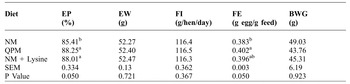
Dietary replacement of NM by QPM significantly (P<0.001) increased per hen-housed egg production (HHEP) in layer chickens (88% in NM vs. 91% in QPM) as reported by Osei et al. (Reference OSEI, DEI and TUAH1999). In another trial with laying hens, Zhai (Reference ZHAI2002) showed significantly higher HHEP (89.63% in NM vs. 90.97% in QPM) and feed consumption due to the complete dietary replacement of NM by QPM, however, feed conversion ratio (feed/egg) and egg weight was not affected. Panda et al. (Reference PANDA, LAVANYA, PRADEEP KUMAR REDDY, RAMA RAO, RAJU and SHYAM SUNDER2012a) studied the utilisation of QPM in the diet of White Leghorn layers (28-44 weeks of age) and found that replacement of NM with QPM not only increased HHEP but also improved feed efficiency (Table 6). However, feed consumption, egg weight, body weight gain and mortality were not affected. Supplementation of Lys to an NM based diet significantly increased egg production in this study, which was comparable to that of a QPM based diet without supplemental Lys. Tyagi et al. (Reference TYAGI, SHRIVASTAV, MANDAL, TYAGI and ELANGOVAN2011) reported similar egg production and feed efficiency in White Leghorn layers between the birds fed QPM diets (without Lys supplementation) and NM diets (supplemented with Lys to meet the requirement). From this, it may be inferred that synthetic Lys supplementation can be minimised in the QPM based layer feed.
Effect of dietary replacement of normal maize with quality protein maize on production performance of White Leghorn layers (28-44 wk), (Panda et al., Reference PANDA, LAVANYA, PRADEEP KUMAR REDDY, RAMA RAO, RAJU and SHYAM SUNDER2012a).

a,b Means with different superscripts in a column differ significantly (P < 0.05).
EP – egg production; EW – egg weight; FI – feed intake; FE – feed efficiency; BWG – body weight gain
Egg quality
Dietary replacement of NM by QPM, or supplementing Lys to a NM based diet, had no influence on egg components such as albumen, yolk or shell; shell weight or shell thickness (Table 6), however, QPM did significantly (P<0.05) improve Haugh units and yolk colour index (Panda et al., Reference PANDA, LAVANYA, PRADEEP KUMAR REDDY, RAMA RAO, RAJU and SHYAM SUNDER2012a). Similar to the above study, Zhai (Reference ZHAI2002) reported enhanced yolk pigmentation in hens fed a QPM based diet compared to their NM-fed counterparts. On the other hand Tyagi et al. (Reference TYAGI, SHRIVASTAV, MANDAL, TYAGI and ELANGOVAN2011) reported a significantly lower yolk colour index in QPM base diet which was restored after supplementation with marigold petals. It is worth mentioning here that Tyagi et al. (Reference TYAGI, SHRIVASTAV, MANDAL, TYAGI and ELANGOVAN2011) used white varieties of QPM (no xanthophylls) which could be the reason for poorer yolk colour. No further literature on the effect of QPM on egg quality was noticed, which suggests further research.
Conclusions
Most of the nutritional studies conducted to investigate the feeding value of QPM have shown beneficial effects on performance in both broilers and layers. Furthermore, poultry diets based on QPM needed minimal or no synthetic Lys supplementation to elicit a similar performance as those birds fed nutritionally balanced NM based diets supplemented with synthetic Lys. However, only limited information is available on the utilisation of QPM in poultry focused on performance criteria (body weight, egg production and feed conversion). Moreover, all the research reports were restricted to chickens only, and the experiments were conducted at targeting Lys but not tryptophan in QPM, even though it is higher in both Lys and Try. Therefore, further research on QPM is needed before its commercial exploitation as a poultry feed material can be fully realised.