1. INTRODUCTION
With the development and utilisation of the ocean spreading to deep and distant seas, traditional anchoring systems can no longer meet the requirements of deep-sea positioning and the advanced Dynamic Positioning (DP) system has emerged. DP systems are intended to regulate the vessels’ horizontal motions (surge, sway and yaw) by using their thruster systems against ocean disturbances induced by currents, waves and wind (Daniel, Reference Daniel1984). DP systems have the advantages of high positioning accuracy and no limitation of water depth. Since the ocean environment is unpredictable and changeable, the external disturbances acting on vessels are obviously uncertain. In addition, there exist uncertainties in the vessel dynamics because the vessel dynamics depend on constantly changing operating conditions. Therefore, the DP controller is required to be robust against uncertain external disturbances and dynamics of vessels.
Chang et al. (Reference Chang, Chen and Yeh2002) designed a nonlinear DP control law with asymptotic stability using Takagi-Sugeno (T-S)-type fuzzy models and the linear matrix inequality technique without considering ocean disturbances, which is restrictive in practice. Considering unknown constant disturbances, Bertin et al. (Reference Bertin, Bittanti, Meron and Savaresi2000) developed a nonlinear DP control law for under-actuated vessels with the feedback linearization technique. Under the condition that the sea states are known, Fossen and Strand (Reference Fossen and Strand1999) constructed a passive observer with wave filtering capability to provide estimates of low-frequency position and velocity as well as slowly-varying disturbances from the vessel's position and heading measurements; based on this passive observer, Loria et al. (Reference Loria, Fossen and Panteley2000) proposed a DP proportional-derivative-type control law, whose effectiveness was verified through experiments on a 1:70 scale model of a supply vessel. Considering unknown time-varying ocean disturbances, Nguyen et al. (Reference Nguyen, Sorensen and Quek2007) presented a hybrid DP control scheme with supervisory switching logic, where different wave filters and control laws were automatically switched according to sea states; Hu et al. (Reference Hu, Du and Sun2017) developed a robust DP adaptive asymptotic regulating control law combining the adaptive disturbance observer with the vectorial Backstepping (BS) technique and Du et al. (Reference Du, Hu, Krstić and Sun2016) developed a robust DP nonlinear control law, where the disturbance observer and the auxiliary dynamic system addressed the unknown time-varying external disturbances and the input saturation, respectively. However, a priori knowledge of the parameters in vessel dynamics equations is required in all of this work.
In the presence of model parametric uncertainties and unknown constant disturbances, Do (Reference Do2011) developed a robust DP adaptive output feedback control approach incorporating an adaptive velocity observer into the adaptive vectorial BS technique. In the case of model parameter perturbations and unknown time-varying ocean disturbances, Tannuri et al. (Reference Tannuri, Agostinho, Morishita and Moratelli2010) developed a sliding mode DP control law, whose control performance was validated both numerically and experimentally on a 1:150 scale model of a shuttle tanker; Hassani et al. (Reference Hassani, Sorensen, Pascoal and Athans2017) developed a robust DP control law using the H ∞ and mixed-μ techniques, whose effectiveness was verified by experiments with a 1:30 scaled model of a supply vessel. Under the model parameter perturbations, external multiplicative disturbances and actuator saturation, Chang et al. (Reference Chang, Liang and Ku2010) dealt with the robust DP fuzzy controller design problem for vessels using T-S fuzzy models, the linear matrix inequality and the parallel distributed compensation technique. Considering unknown vessel dynamics and unknown time-varying external disturbances, Hu et al. (Reference Hu, Du and Shi2015) designed a robust DP adaptive fuzzy control law incorporating Fuzzy Logic Systems (FLSs) into the vectorial BS technique, where the uniform ultimate boundedness of positioning errors is guaranteed because the leakage terms based on a variation of σ-modification were incorporated into the update laws of the unknown fuzzy weight vectors. However, the fuzzy approximation error vectors were not addressed in the control design.
In order to overcome the above problems, in this work, we design update laws based on the projection operators to update the fuzzy weight vectors online and construct a “robustifying” term to deal with the unknown time-varying external disturbance and the fuzzy approximation errors. Incorporating the above techniques into the vectorial BS technique, the asymptotic regulation control of the vessel's position and heading is achieved for the first time in the simultaneous presence of unknown vessel dynamics and unknown time-varying external disturbances.
2. PROBLEM FORMULATION AND PRELIMINARIES
2.1. Problem formulation
The kinematics and dynamics of dynamically positioned vessels in the horizontal plane are as follows (Fossen and Strand, Reference Fossen and Strand1999):
 $$\bi{\dot{\eta}} = \bi{J}(\psi) \bi{\upsilon}$$
 $$\bi{M}\bi{\dot{\upsilon}}=-\bi{D}\bi{\upsilon}+\bi{\tau}+\bi{d}(t)$$
where η = [x, y, ψ]T denotes the vessel position (x, y) and heading ψ in the north-east frame. υ = [u, ν, r]T denotes the vessel surge velocity u, sway velocity ν and yaw rate r in the body-fixed frame. M = MT ∈ R3×3 is the positive-definite inertia matrix. D ∈ R3×3 is the linear damping matrix. In this paper, both M and D are assumed to be unknown. The rotation matrix J(ψ) ∈ R3×3 is given as follows:
 $$\bi{J}(\psi)=\left[\matrix{\cos(\psi)& -\sin(\psi)&0 \cr \sin(\psi)&\cos(\psi)& 0 \cr 0&0&1 }\right]$$
satisfying JT(ψ)J(ψ) = I3×3. τ = [τ1, τ2, τ3]T denotes the control vector consisting of equivalent control forces τ1, τ2, and moment τ3 produced by the vessel's thruster system. d(t) = [d 1(t), d 2(t), d 3(t)]T denotes the disturbance vector consisting of equivalent Low-Frequency (LF) disturbance forces d 1(t), d 2(t) and moment d 3(t). The ocean disturbances consist of LF disturbances induced by second-order waves, currents and wind and Wave-Frequency (WF) disturbances induced by first-order waves. Only LF disturbances should be addressed by the DP controller, while the wave-disturbance-induced motions should be filtered out from the position and heading measurements before they are sent to the DP control system through wave-filtering techniques (Veksler et al., Reference Veksler, Johansen, Borrelli and Realfsen2016; Hassani et al., Reference Hassani, Sørensen, Pascoal and Aguiar2012). In this paper, the DP control law will be designed later under the premise that the wave filtering has been done. The LF disturbances are assumed to be unknown time-varying and bounded. Define:
 $$||\bi{d}(t)||\leq d^{*} \lt \infty$$
where d *>0 is an unknown constant. ||·||denotes the two-norm of a vector or a matrix.
Our control objective is to design a robust DP adaptive control law for the vessel dynamic Equations (1) and (2) with unknown dynamics and unknown time-varying LF disturbances so that the vessel position vector η(t) is asymptotically regulated to the desired position vector ηd = [x d, y d, ψd]T and the other signals in the closed-loop DP control system are guaranteed to be Uniformly Ultimately Bounded (UUB).
2.2. Preliminaries. Fuzzy logic system (FLS)
The FLS consists of the fuzzy rule base, the fuzzifier, the fuzzy inference engine and the defuzzifier (Wang, Reference Wang1997; Yu et al., Reference Yu, Xiang, Zhang and Xu2018; Xiang et al., Reference Xiang, Yu and Zhang2017; Li and Tong, Reference Li and Tong2016). The fuzzy rule base comprises fuzzy IF-THEN rules which are represented as follows:
 $${\rm If\ } \chi_{1}\ {\rm is\ } F_{1}^{l_{1}}, \chi_{2}\ {\rm is\ } F_{2}^{l_{2}}, \cdots, \chi_{n}{\rm \ is\ } F_{n}^{l_{n}}, {\rm then\ } g\ {\rm is\ } E^{l_{1}\cdots l_{n}}$$
where χ = [χ1, · · · , χn] and g denote the FLS's inputs and the output, respectively,  $F_{i}^{l_{i}} (i=1,2,\cdots,n \ {\rm and\ } l_{i}=1,2,\cdots,p_{i})$ denotes the fuzzy set for the input χi, p i denotes the number of fuzzy sets,
 $E^{l_{1}\cdots l_{n}} (l_{1} \cdots l_{n} =1,2,\cdots, Q \ {\rm and\ } Q=\prod_{i=1}^{n} p_{i})$ denotes the fuzzy set for the output g and Q denotes the total number of fuzzy rules.
According to the singleton fuzzification, the centre-average defuzzification as well as the product inference, we express the FLS as follows:
 $$g(\chi)={{\sum_{l_{1}=1}^{p_{1}}\cdots\sum_{l_{n}=1}^{p_{n}}\bar{g}^{l_{1}\cdots l_{n}}\prod_{i=1}^{n}\mu_{F_{i}^{l_{i}}}(\chi_{i})}\over {\sum_{l_{1}=1}^{p_{1}}\cdots\sum_{l_{n}=1}^{p_{n}}(\prod_{i=1}^{n}\mu_{F_{i}^{l_{i}}}(\chi_{i}))}}$$
where  $\bar{g}^{l_{1}\cdots l_{n}}=\arg\mathop{\max}\limits_{g\in R} \mu_{E^{l_{1}\cdots l_{n}}}(g)$ with
 $\mu_{E^{l_{1}\cdots l_{n}}}(g)$ and
 $\mu_{F_{i}^{l_{i}}}(\chi_{i})$ being the membership functions. Herein, we take
 $\mu_{F_{i}^{l_{i}}}(\chi_{i}) (i=1,2,\cdots,n\ {\rm and\ }l_{i}=1,2,\cdots,p_{i})$ as the following Gaussian functions:
 $$\mu_{F_{i}^{l_{i}}}(\chi_{i})={\rm exp}\left[-\left({\chi_{i}-\kappa_{i}^{l_{i}}\over \gamma_{i}^{l_{i}}}\right)^{2}\right]$$
where  $\kappa_{i}^{l_{i}}$ and
 $\gamma_{i}^{l_{i}}>0 $ denotes the Gaussian function's centres and widths, respectively.
Define:
 $$\bi{G}=[\bar{g}^{1},\bar{g}^{2},\cdots, \bar{g}^{Q}]^{{\rm T}}$$
as the constant weight vector. Furthermore, we define the fuzzy basis functions as follows:
 $$\varphi_{l_{1}\cdots l_{1}}(\bi{\chi})={\prod_{i=1}^{n}\mu_{F_{i}^{l_{i}}}(\chi_{i})\over\sum_{l_{1}=1}^{p_{1}}\cdots\sum_{l_{n}=1}^{p_{n}}(\prod_{i=1}^{n}\mu_{F_{i}^{l_{i}}}(\chi_{i}))}, l_{1}\cdots l_{n}=1,2,\cdots,Q$$
and define:
 $$\bi{\phi}(\bi{\chi})=[\phi_{1}(\chi),\phi_{2}(\chi),\cdots,\phi_{Q}(\chi)]^{{\rm T}}$$
as the fuzzy basis function vector. As such, the FLS Equation (6) can be rewritten as the following linearization parametric form:
 $$g(\bi{\chi})=\bi{G}^{{\rm T}} \bi{\varphi}(\bi{\chi})$$
Universal approximation results indicate that the FLS can approximate any continuous function f(χ) defined on a compact set Ω ⊂ R n to any arbitrary accuracy. This is described as follows:
 $$f(\bi{\chi})=\bi{G}^{\ast{\rm T}} \bi{\varphi}(\bi{\chi})+\delta(\bi{\chi})$$
where G* ∈ RQ is the ideal constant weight vector and δ(χ) is the bounded approximation error.
Barbalat's Lemma (Gang, Reference Gang1997): Considering the vector β(t) ∈ Rn. If  $\int_{0}^{\infty}||\bi{\beta}(t)||^{2} dt\leq c_{1}$ and
 $\mathop{{\rm sup}}\limits_{t\geq 0}||\dot{\bi{\beta}}(t)||^{2}\leq c_{2}$ hold for positive constants c 1 and c 2, then
 $\mathop{\lim}\limits_{t\rightarrow\infty} \bi{\beta}(t)={\bi{0}}_{n\times 1}$ holds.
3. ROBUST DP ADAPTIVE ASYMPTOTIC REGULATING CONTROL DESIGN
In this section, a robust DP adaptive asymptotic regulating control law will be designed through incorporating the FLSs, the projection operators, and the robustifying term (Kwan et al., Reference Kwan, Dawson and Lewis1995) into the vectorial BS technique (Krstić et al., Reference Krstić, Kanellakopoulos and Kokotović1995).
Define the following changes of coordinate:
 $${\bf z}_{1}=\bi{\eta}-\bi{\eta}_{d}$$
 $${\bf z}_{2}=\bi{\upsilon}-\bi{\alpha}_{1}$$
where α1 ∈ R3 is the virtual stabilising control function vector to be designed later.
Step 1: Based on Equation (1), taking the time derivative of Equation (13) gives:
 $$\bi{\dot{z}}_{1}=\bi{J}(\psi)\bi{\upsilon}$$
Select the Lyapunov function candidate  $V_{1}={1\over 2}\bi{z}_{1}^{{\rm T}}\bi{z}_{1}$. According to Equations (15) and (14), the time derivative of V 1 is:
 $$\dot{V}_{1}=\bi{z}_{1}^{{\rm T}} \bi{J}(\psi)(\bi{z}_{2}+\bi{\alpha}_{1})$$
Design the virtual stabilising control function vector:
 $$\bi{\alpha}_{1}=-\bi{J}^{{\rm T}}(\psi)\bi{K}_{1}\bi{z}_{1}$$
where  $\bi{K}_{1}=\bi{K}_{1}^{{\rm T}}$ is the 3×3 positive-definite design matrix.
Substituting Equation (17) into Equation (16) and using the property JT(ψ)J(ψ) = I3×3 gives:
 $$\dot{V}_{1}=-\bi{z}_{1}^{{\rm T}} \bi{K}_{1} \bi{z}_{1} +\bi{z}_{1}^{{\rm T}} \bi{J}(\psi)\bi{z}_{2}$$
Step 2: According to Equation (2), taking the time derivative of Equation (14) gives:
 $$\bi{\dot{z}}=\bi{M}^{-1}(\bi{\tau}+d-\bi{D}\bi{\upsilon}-\bi{M}\bi{\dot{\alpha}}_{1})$$
Select the Lyapunov function candidate  $V_{2}=V_{1}+{1\over2}\bi{z}_{2}^{{\rm T}} \bi{Mz}_{2}$. From the solutions of Equations (18) and (19), the time derivative of V 2 is:
 $$\dot{V}_{2}=-\bi{z}_{1}^{{\rm T}} \bi{K}_{1} \bi{z}_{1}+\bi{z}_{1}^{{\rm T}} \bi{J}(\psi)\bi{z}_{2} +\bi{z}_{2}^{{\rm T}}(\bi{\tau}+\bi{d}-\bi{D}\bi{\upsilon}-\bi{M}\bi{\dot{\alpha}}_{1})$$
Noting that both M and D are unknown, we employ the FLSs to approximate  $\bi{D}\bi{\upsilon}+\bi{M}\bi{\dot{\alpha}}$ as follows:
 $$\bi{\Theta}^{\ast{\rm T}} \bi{\varsigma}(\underline{\bi{x}})+ \bi{e}(\underline{\bi{x}})=\bi{D}\bi{\upsilon}+\bi{M}\bi{\dot{\alpha}}_{1}$$
where x = [x1, x2, · · · , x6]T = [x, y, ψ, u, v, r]T denotes the fuzzy input vector, Θ* = [θ1*, θ2*, θ3*] ∈ RQ×3 with  $\bi{\theta}_{i}^{\ast}=[\theta_{i}^{\ast 1}, \theta_{i}^{\ast 2},\cdots,\theta_{i}^{\ast Q}]^{{\rm T}}(i=1,2,3)$ as the ideal constant weight vectors and Q as the total number of the fuzzy rules.
 $\varsigma(\bi{x})=[\varsigma_{1}(\bi{x}),\varsigma_{2}(\bi{x}),\cdots,\varsigma_{Q}(\bi{x})]^{{\rm T}}$ is the fuzzy basis function vector. e(x) ∈ R3 is the bounded approximation error vector. Define
 $||\bi{e}(\underline{\bi{x}})||\leq \bar{\varepsilon}^{\ast}$ with
 $\bar{\varepsilon}^{\ast}>0$ being an unknown constant. Furthermore, define the unknown parameter:
 $$\delta=d^{\ast}+\bar{\varepsilon}^\ast$$
Substituting Equation (21) into Equation (20) gives:
 $$\dot{V}_{2}=-\bi{z}_{1}^{{\rm T}}\bi{K}_{1}\bi{z}_{1}+\bi{z}_{1}^{{\rm T}} \bi{J}(\psi)\bi{z}_{2}+\bi{z}_{2}^{{\rm T}}[\bi{\tau}+\bi{d}-\bi{\Theta}^{\ast{\rm T}} \varsigma(\underline{\bi{x}})-\bi{e}(\underline{\bi{x}})]$$
Let the robust DP adaptive asymptotic regulating control law be:
 $$\bi{\tau}=-\bi{J}^{{\rm T}}(\psi)\bi{z}_{1}-\bi{K}_{2}\bi{z}_{2}+\bi{\hat{\Theta}}^{{\rm T}}\varsigma(\underline{\bi{x}})+ \bi{h}_{r}$$
where  $\bi{K}_{2}=\bi{K}_{2}^{{\rm T}}$ is a 3×3 positive-definite design matrix,
 $\bi{\hat{\Theta}}=[\bi{\hat{\theta}}_{1}, \bi{\hat{\theta}}_{2}, \bi{\hat{\theta}}_{3}]\in \bi{R}^{Q\times 3}$ with
 $\bi{\hat{\theta}}_{i}=[\hat{\theta}_{i}^{1},\hat{\theta}_{i}^{2},\cdots,\hat{\theta}_{i}^{Q}]^{{\rm T}}(i=1,2,3) $ as the estimate matrix of Θ*, and hr ∈ R3 is the robustifying term.
The update laws based on the projection operators are designed as follows:
 $$\dot{\hat{\bi{\theta}}}=\bi{\Gamma}_{i}\ {\rm Proj}(-\varsigma(\underline{\bi{x}})z_{2_{i}},\bi{\hat{\theta}}_{i}), \quad i=1,2,3$$
where  $\bi{\Gamma}_{i}=\bi{\Gamma}_{i}^{{\rm T}}$ is the l×l positive-definite design matrix and Proj( · ) is the projection operator defined as follows:
 $${\rm Proj}(w,\hat{\theta}_{a})=\left\{\eqalign{& w, \,\,\,\,\,\,\,\,\,\,\,\,\,\,\,\,\,\,\,\,\,\,\,\,\,\,\,\,\,\,\,\,\,\,\,\,\,\,\,\,\,\,\, {\rm if\ } p(\hat{\theta}_{a})< 0 \cr & w, \,\,\,\,\,\,\,\,\,\,\,\,\,\,\,\,\,\,\,\,\,\,\,\,\,\,\,\,\,\,\,\,\,\,\,\,\,\,\,\,\,\,\, {\rm if\ }\left(p(\hat{\theta}_{a})\geq 0 {\rm \ and\ } {\partial p(\hat{\theta}_{a})^{\rm T}\over \partial\hat{\theta}_{a}} w\leq 0\right)\cr & w{p(\hat{\theta}_{a}){\partial p \over \partial\hat{\theta}_{a}} {\partial p^{\rm T}\over \partial\hat{\theta}_{a}}\over\left\|{\partial p \over \partial\hat{\theta}_{a}}\right\|^{2}} w, \,\,\,\,\,{\rm otherwise}}\right.$$
where  $p(\hat{\bi{\theta}}_{a})={||\hat{\bi{\theta}}_{a}||^{2}-r_{\Omega}^{2}\over \varepsilon^{2}+2\varepsilon r_{\Omega}}$ with r Ω and ε being positive design constants. If
 $||\hat{\bi{\theta}}_{a}(0)||\leq r_{\Omega}$, the following properties hold (Krstić et al., Reference Krstić, Kanellakopoulos and Kokotović1995):
 $$||\hat{\bi{\theta}}_{a}(t)||\leq r_{\Omega}+\varepsilon, \forall t\geq 0$$
 $$\tilde{\bi{\theta}}_{a}^{T} \ {\rm Proj}(\bi{w},\hat{\bi{\theta}}_{a})\leq \tilde{\bi{\theta}}_{a}^{T} \bi{w}, \tilde{\bi{\theta}}_{a}=\hat{\bi{\theta}}_{a}-\bi{\theta}_{a}$$
The robustifying term is designed as follows:
 $$\bi{h}_{r}=-{\bi{z}_{2}\hat{\delta}^{2}\over \hat{\delta}||\bi{z}_{2}||+p(t)}$$
 $$\dot{\hat{\delta}}=\gamma_{1}||\bi{z}_{2}||, \hat{\delta}(0)>0$$
 $$\dot{\rho}(t)=-\gamma_{2}\rho(t),\rho(0)>0$$
where  $\hat{\delta}$ is the estimate of δ, ρ(t) is a positive time-varying function, and γ1>0 and γ2>0 are design constants.
Theorem 1
For the vessel dynamic Equations (1) and (2) with unknown dynamics and unknown time-varying external disturbances, the robust DP adaptive control law Equation (24) based on the virtual stabilising control function vector Equation (17), the update laws Equation (25) and the robustifying term Equations (29)–(31) achieves the asymptotic regulation of the vessel's position and heading and makes the other signals in the closed-loop DP control system be UUB through appropriately choosing the design constants r Ωi (i = 1, 2, 3), εi, γ1, γ2 and the design matrices Γi, K1, K2.
Proof. Select the augmented Lyapunov function candidate as follows:
 $$V_{2a}=V_2+{1\over 2}\sum_{i=1}^{3}\tilde{\bi{\theta}}_i^{\rm T}\bi{\Gamma}_i^{-1} \tilde{\bi{\theta}}_i+{1\over 2\gamma_1}\tilde{\delta}^2+{1\over \gamma_2}\rho(t)$$
where  $\tilde{\bi{\theta}}_{i} =\hat{\bi{\theta}}_{i}-\bi{\theta}_{i}^{\ast}\ (i=1,2,3)$ and
 $\tilde{\delta}=\hat{\delta}-\delta$.
According to Equations (23), (24), (30)–(31), (25) and (28), taking the time derivative of Equation (32) yields:
 $$\eqalign{& \dot{V}_{2a} \le -{\bi{z}}_{1}^{{\rm T}} {\bi{K}}_{1} {\bi{z}}_{1} -{\bi{z}}_{2}^{{\rm T}} {\bi{K}}_{2} {\bi{z}}_{2}+{\bi{z}}_{2}^{{\rm T}} \tilde{\bi{\Theta}}^{{\rm T}} \bi{\varsigma} (\underline{{\bi{x}}})+{\bi{z}}_{2}^{{\rm T}} [{\bi{h}}_{{\bi{r}}} +{\bi{d}}(t)-{\bi{e}}(\underline{{\bi{x}}})]\cr & \quad\quad\quad -\sum_{i=1}^{3}\tilde{\bi{\theta}}^{{\rm T}}_i\bi{\varsigma}(\underline{{\bi{x}}})z_{2_i}+ \tilde{\delta}\|{\bi{z}}_{2}\|-\rho(t)\cr & \quad\quad \le-{\bi{z}}_{1}^{{\rm T}} {\bi{K}}_{1} {\bi{z}}_{1} -{\bi{z}}_{2}^{{\rm T}} {\bi{K}}_{2} {\bi{z}}_{2} +{\bi{z}}_{2}^{{\rm T}} [{\bi{h}}_{{\bi{r}}} +{\bi{d}}(t)- {\bi{e}}(\underline{{\bi{x}}})]+\tilde{\delta}\|{\bi{z}}_{2}\|-\rho (t)}$$
From Equations (29), (4),  $\|{\bi{e}}(\underline{{\bi{x}}})\|\leq \bar{\varepsilon}^{\ast}$, (22) and
 $\tilde{\delta}=\hat{\delta}-\delta$, it is obtained that:
 $$\eqalign{&{\bi{z}}_{2}^{{\rm T}} [{\bi{h}}_{{\bi{r}}} +{\bi{d}}- {\bi{e}}(\underline{{\bi{x}}})]+\tilde{\delta}\|{\bi{z}}_{2}\|-\rho (t)\cr & \quad =-{{\bi{z}}_2^{{\rm T}}{\bi{z}}_2\hat{\delta}^2\over \hat{\delta}\|{\bi{z}}_{2}\|+\rho(t)} +{\bi{z}}_{2}^{{\rm T}}[{\bi{d}}-{\bi{e}}(\underline{{\bi{x}}})]+ \tilde{\delta}\|{\bi{z}}_{2}\|-\rho (t)\cr & \quad \le -{{\bi{z}}_{2}^{{\rm T}} {\bi{z}}_{2} \hat{\delta}^{2}\over \hat{\delta}\|{\bi{z}}_{2}\|+\rho(t)}+\delta \|{\bi{z}}_{2}\| +(\hat{\delta}-\delta)\|{\bi{z}}_{2}\| -\rho (t)\cr & \quad =-{\hat{\delta}^{2}\|{\bi{z}}_{2}\|^2\over\hat{\delta}\|{\bi{z}}_{2}\|+\rho (t)}+ {\hat{\delta}^{2}\|{\bi{z}}_{2}\|^2+\rho (t)\hat{\delta}\|{\bi{z}}_{2}\|\over \hat{\delta}\|{\bi{z}}_{2}\|+\rho (t)}-\rho (t)\cr & \quad =\rho (t)\left[{\hat{\delta}\|{\bi{z}}_{2}\|\over\hat{\delta}\|{\bi{z}}_{2}\|+\rho (t)}-1\right]\cr & \quad < 0}$$
Substituting Equation (34) into Equation (33) yields:
 $$\dot{V}_{2a}\le -{\bi{z}}_{1}^{{\rm T}}{\bi{K}}_1{\bi{z}}_{1}- {\bi{z}}_{2}^{{\rm T}}{\bi{K}}_2{\bi{z}}_{2}\leq -\mu ({\bi{z}}_{1}^{{\rm T}}{\bi{z}}_{1}+{\bi{z}}_{2}^{{\rm T}}{\bi{z}}_{2})$$
where μ = min{λmin(K1), λmin(K2)} with λmin( · ) being the minimum eigenvalue of a matrix.
It is shown from Equations (35) and (32) that  $\dot{V}_{2a}(t)$ is negative semi-definite and V 2a(t) is positive definite, respectively. Thus, V 2a(t) is bounded. This means
 $\|{\bi{z}}_{1}\|$,
 $\|{\bi{z}}_{2}\|$,
 $\|\tilde{\bi{\theta}}_{i}\|\ (i=1,2,3)$,
 $|\tilde{\delta}|$ and |ρ| are bounded. From Equation (13), the boundedness of
 $\|\bi{\eta}_{d}\|$, Equations (17), (14), we know that
 $\|\bi{\eta}|$,
 $\|\bi{\alpha}_{1}\|$,
 $\|\bi{\nu}\|$ are UUB, respectively. Therefore, all signals in the closed-loop DP control system are guaranteed to be UUB.
Furthermore, integrating Equation (35) over [0, t] gives:
 $$\int_0^t\mu[{\bi{z}}_1^{{\rm T}}(\tau_t){\bi{z}}_1(\tau_t)+{\bi{z}}_2^{{\rm T}}(\tau_t){\bi{z}}_2(\tau_t)] d\tau_t\le V(0)-V(t)$$
In the light of the boundedness of V(t), we have:
 $$\lim_{t\to\infty}\int_0^t[{\bi{z}}_1^{{\rm T}}(\tau_t){\bi{z}}_1(\tau_t)+ {\bi{z}}_2^{{\rm T}}(\tau_t){\bi{z}}_2(\tau_t)]d\tau_t\le {1\over\mu}[V(0)-V(\infty)]< {1\over\mu}V(0)< \infty$$
This means ‖z1‖ and ‖z2‖ are square integrable on [0, ∞). Moreover, it is obtained from Equations (15) and (19) that  $\Vert \dot{{\bi{z}}}_{1}\Vert$ and
 $\Vert \dot{{\bi{z}}}_{2}\Vert$ are bounded. Applying Barbalat's lemma, we conclude that
 $\lim\limits_{t\to\infty} {\bi{z}}_{1}={\bi{0}}_{3\times 1}$, that is,
 $\lim\limits_{t\to\infty}\bi{\eta}(t)=\bi{\eta}_{d}$ from Equation (13). This completes the proof.
4. SIMULATIONS AND COMPARISON
The Marine System Simulator (MSS) toolbox (Fossen, Reference Fossen2011) is a Matlab/Simulink-based modular simulator incorporating high-fidelity models. In this section, simulations are conducted based on a MSS\MSS Hydro\Vessel Templates\DP MotionRAO Model, which is a vessel motion simulator for low-speed manoeuvring and station-keeping in six degrees of freedom, to validate the designed robust DP adaptive asymptotic regulating control law. Furthermore, a comparison between the designed robust DP adaptive asymptotic regulating control law and the DP adaptive fuzzy control law from Hu et al. (Reference Hu, Du and Shi2015) is conducted to show the superiority of the designed DP control law.
4.1. Performance of robust DP adaptive asymptotic regulating control law
In the following, the simulations are done on supply vessel and semi-submersible vessel models from the DP MotionRAO Model data set to validate the designed DP control method.
Example 1
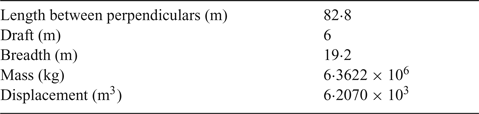
This example is a supply vessel of 82.8m in length, whose data is included in MSS and whose main particulars are listed in Table 1.
Main particulars of Example 1 (Fossen, Reference Fossen2011).

The wave spectrum type is Joint North Sea Wave Project (JONSWAP) (Fossen, Reference Fossen2011), the significant wave height is 0·15 m, the peak frequency is 1·07 rad/s, and the mean wave direction is (35°/180°) × π rad in the north-east frame, corresponding to sea state 2. The wind speed is 2·65 m/s and the mean wind angle is (30°/180°) × π rad. The current speed is 0·1 m/s and the current direction is (35°/180°) × π rad.
Let the coordinate origin of the north-east frame be taken as the desired vessel position and heading, that is ηd = [0 m, 0 m, 0 rad]T. Let p i = 3(i = 1, 2, …, 6) and Q=36. The centres  $\bi{\kappa}_{i}^{l_{i}}$ (i=1, 2, …, 6 and l i=1, 2, 3) of the Gaussian functions Equation (7) are evenly spaced at [ − 30, 30] × [ − 30, 30] × [ − 3 · 14, 3 · 14] × [ − 2, 2] × [ − 2, 2] × [ − 0 · 785, 0 · 785]. The widths
 $\gamma_{i}^{l_{i}}$ (i=1, 2, …, 6 and l i=1, 2, 3) are chosen as
 $\gamma_{1}^{1}=\gamma_{1}^{2}=\gamma_{1}^{3}=30$,
 $\gamma_{2}^{1}=\gamma_{2}^{2}=\gamma_{2}^{3}=30$,
 $\gamma_{3}^{1}=\gamma_{3}^{2}=\gamma_{3}^{3}=3.14$,
 $\gamma_{4}^{1}=\gamma_{4}^{2}=\gamma_{4}^{3}=2$,
 $\gamma_{5}^{1}=\gamma_{5}^{2}=\gamma_{5}^{3}=2$ and
 $\gamma_{6}^{1}=\gamma_{6}^{2}=\gamma_{6}^{3}=0{\cdot}785$. The following initial conditions are adopted: η(0) = [5 m, 5 m, (5°/180°) × π rad]T,
 $\bi{\upsilon}(0)=[0\,{\rm m/s},\enspace 0\,{\rm m/s},\enspace 0\,{\rm rad/s}]^{{\rm T}}, \hat{\bi{\theta}}_{1}(0)=\hat{\bi{\theta}}_{2}(0)=\hat{\bi{\theta}}_{3}(0)={\bi{0}}_{3^{6}\times 1}$,
 $\hat{\delta}(0)=10$ and ρ(0) = 2 × 10³. The remaining design parameters are r Ω1 = r Ω2 = 108, r Ω3 = 1010, ε1 = ε2 = ε3 = 100,
 $\gamma_{1}=5\times10^{5}$,
 $\gamma_{2}= 1\times10^{-5}$,
 $\bi{\Gamma}_{1}=\bi{\Gamma}_{2}=10^{4}{\bi{I}}_{3^{6}\times 3^{6}}$,
 $\bi{\Gamma}_{3}=10^{6}{\bi{I}}_{3^{6}\times 3^{6}}$, K1 = diag(0.07, 0.07, 0.2) and K2 = diag(1 × 10⁷, 1 × 10⁷, 8 × 10⁹).
In addition, the measurement noise in the position and heading are taken as zero-mean Gaussian white noises with the standard deviations 0·05 m, 0·05 m and (0 · 1°/180°) × π rad, respectively.
To filter out the first-order wave-induced motions and the measurement noises from the vessel position and heading, the low-pass filter Equation (38) and the notch filter Equation (39) are given by (Fossen, Reference Fossen2011):
 $$h_{LF}(s)={1\over 1+T_fs}$$
 $$h_{NF}(s)={s^2+2\varsigma_w\omega_ns+\omega_n^2\over s^2+2\omega_ns+\omega_n^2}$$
where T f is the time constant, ωn is the natural frequency and ςw is the relative damping factor. Here, we take T f=10 and 1·2 for position and velocity signals, respectively, and take ωn = 0 · 83 and  $\varsigma_{w}=0{\cdot}1$ for both position and velocity signals.
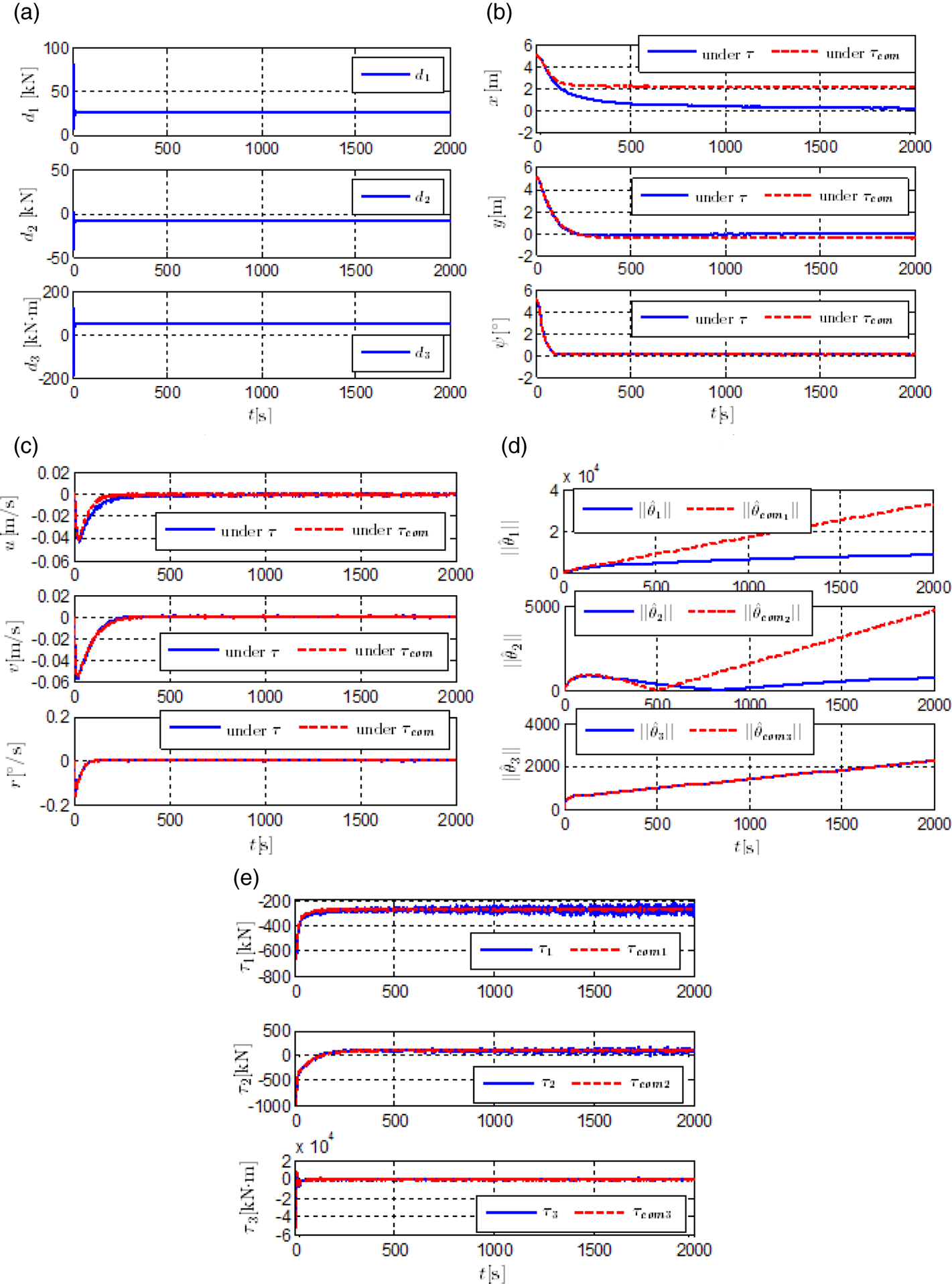
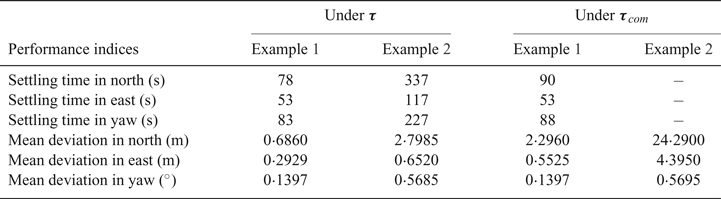
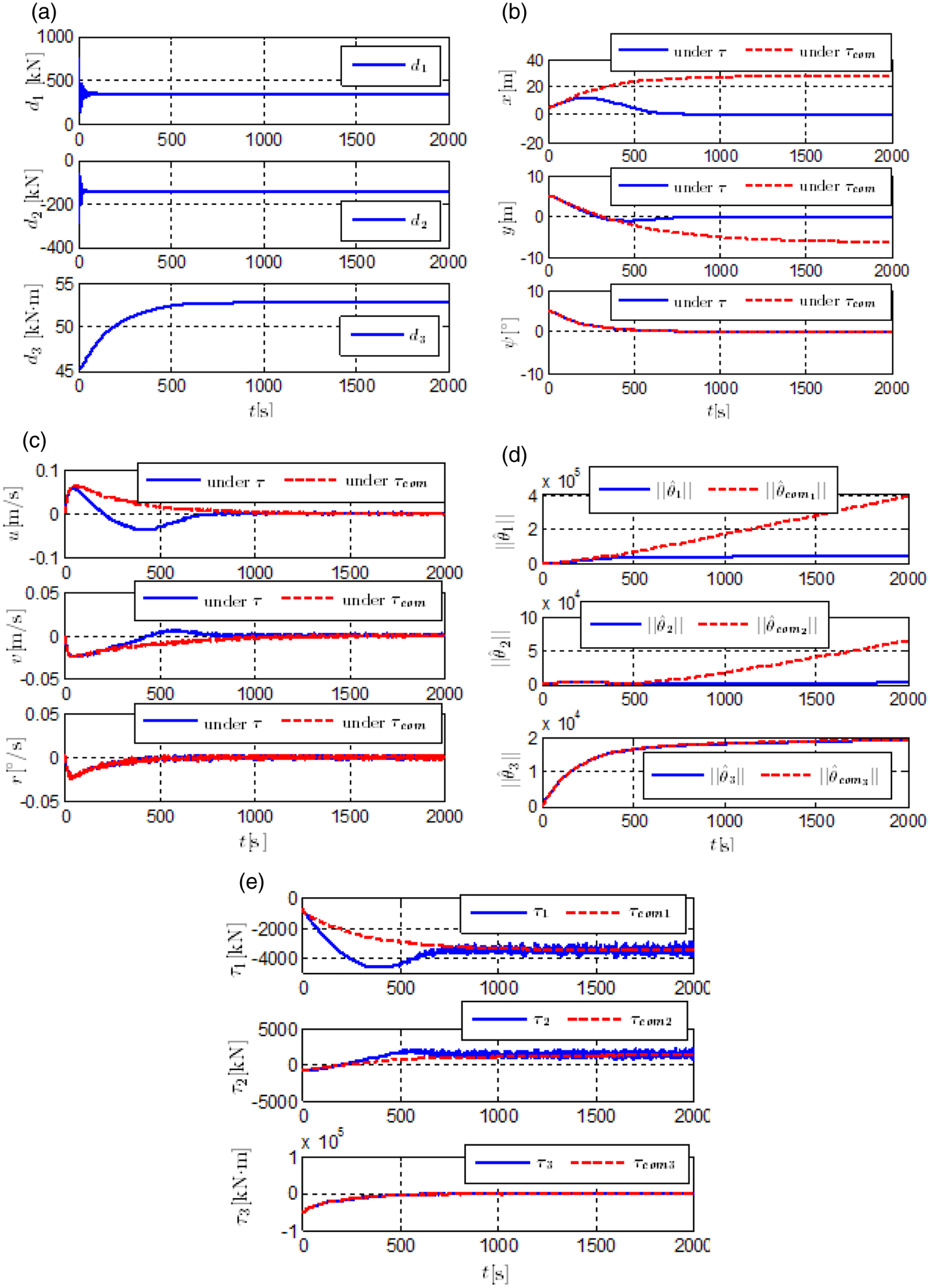
Simulation results for Example 1 are presented using the solid lines in Figures 1(a)–1(e). Furthermore, to quantitatively evaluate the robust DP adaptive fuzzy control law, the performance indices are listed in Table 2, in which the settling time denotes the required time for all the vessel positions (x, y) and heading ψ to arrive at and remain within the specified error bands (3 m, 3 m) and (1°/180°) × π rad, respectively, and the symbol “–” represents that a settling time does not exist. The curves versus time of LF disturbances acting on the vessel are illustrated in Figure 1(a). It can be seen from Figure 1(b) that the vessel position (x, y) and heading ψ are asymptotically regulated to ηd = [0m, 0m, 0rad]T. It is observed from Figure 1(c) that the surge velocity u, sway velocity v and yaw rate r of the vessel are all bounded. Figure 1(d) shows the boundedness of  $\Vert\hat{\bi{\theta}}_{1}\Vert$,
 $\Vert\hat{\bi{\theta}}_{2}\Vert$,
 $\Vert\hat{\bi{\theta}}_{3}\Vert$. Figure 1(e) shows that the control forces and moment are reasonable and bounded.
Simulation results for Example 1 under τ and τcom. (a) LF disturbances d 1, d 2 and d 3 acting on the vessel. (b) Vessel position (x, y) and heading ψ. (c) Vessel surge velocity u, sway velocity v and yaw rate r. (d) Two-norms  $\Vert\hat{\bi{\theta}}_{1}\Vert$,
 $\Vert\hat{\bi{\theta}}_{2}\Vert$,
 $\Vert\hat{\bi{\theta}}_{3}\Vert$ and
 $\Vert\hat{\bi{\theta}}_{com_{1}}\Vert$,
 $\Vert\hat{\bi{\theta}}_{com_{2}}\Vert$,
 $\Vert\hat{\bi{\theta}}_{com_{3}}\Vert$. (e) Control inputs τ1, τ2, τ3 and
 $\tau_{com_{1}}$,
 $\tau_{com_{2}}$,
 $\tau_{com_{3}}$.

Performance index comparison.

Example 2
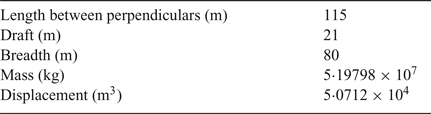
A semi-submersible vessel of 115·0 m in length is taken as another simulation example, whose data is included in MSS and main particulars are listed in Table 3.
Main particulars of Example 2 (Fossen, Reference Fossen2011).

The significant wave height is changed to be 0·55 m, the peak frequency becomes 0·92 rad/s, and the mean wave direction is (35°/180°) × π rad, corresponding to sea state 3. The wind speed, mean wind angle, current speed, current direction, desired position and heading of the vessel, initial conditions, and the design parameters of the control law are identical to the counterparts for Example 1. This means that the same robust DP adaptive fuzzy control law is adopted for Examples 1 and 2.
Simulation results for Example 2 are presented with the solid lines in Figures 2(a)–(e). The performance indices of the developed DP fuzzy control law for Example 2 are also listed in Table 2. The curves versus time of LF disturbances acting on the vessel are illustrated in Figure 2(a). It can be clearly observed from Figures 1(b)–1(e), 2(b)–2(e) and Table 2 that our developed robust DP adaptive fuzzy control law results in satisfactory control performance for both Example 1 and Example 2 under different LF disturbance conditions, which shows that our developed robust DP adaptive fuzzy control law possesses adaptability to vessel dynamic model parameter changes and robustness against unknown time-varying external disturbances.
Simulation results for Example 2 under τ and τcom. (a) LF disturbances d 1, d 2 and d 3 acting on the vessel. (b) Vessel position (x, y) and heading ψ. (c) Vessel surge velocity u, sway velocity v and yaw rate r. (d) Two-norms  $\Vert\hat{\bi{\theta}}_{1}\Vert$,
 $\Vert\hat{\bi{\theta}}_{2}\Vert$,
 $\Vert\hat{\bi{\theta}}_{3}\Vert$ and
 $\Vert\hat{\bi{\theta}}_{com_{1}}\Vert$,
 $\Vert\hat{\bi{\theta}}_{com_{2}}\Vert$,
 $\Vert\hat{\bi{\theta}}_{com_{3}}\Vert$. (e) Control inputs τ1, τ2, τ3 and
 $\tau_{com_{1}}$,
 $\tau_{com_{2}}$,
 $\tau_{com_{3}}$.

4.2 Comparison with existing DP adaptive fuzzy control law
In the following, we present a performance comparison between the designed robust DP adaptive fuzzy control law and the existing DP adaptive fuzzy control law from Hu et al. (Reference Hu, Du and Shi2015).
 $$\bi{\tau}_{com}=-{\bi{J}}^{\rm T}(\psi){\bi{z}}_1- {\bi{K}}_2{\bi{z}}_2+\hat{\bi{\Theta}}^{{\rm T}}\varsigma(\underline{{\bi{x}}})$$
 $$\dot{\hat{\bi{\theta}}}_{comi}=\bi{\Gamma}_i[z_{2,i} \hat{\varsigma}(\underline{{\bi{x}}})+\sigma_i\hat{\bi{\theta}}_{comi}],\quad i=1,2,3$$
where the design parameters σi (i=1, 2, 3) are σ1 = σ2 = 10−4 and σ1 = σ2 = 10−6. The remaining design parameter values in Equations (40)–(41) are taken as the same as those of the counterparts of our designed DP robust adaptive fuzzy control law.
The simulation results on Example 1 and Example 2 are presented using dashed lines in Figures 1(b)–1(e) and 2(b)–2(e), respectively. The DP control performance indices are listed in Table 2. It is observed from Figures 1(b), 2(b) and Table 2 that the control law τ presents a better control performance than the control law τcom for both Example 1 and Example 2. These simulation results show that the developed DP control law τ is superior to τcom.
5. CONCLUSIONS
In this work, we have developed a robust adaptive nonlinear asymptotic regulating control law for dynamically positioned vessels with unknown dynamics and unknown time-varying external disturbances. The DP control law is designed incorporating the FLSs, the projection operators and the “robustifying” term into the vectorial BS technique. By means of the FLS's universal approximation ability, the robust DP adaptive fuzzy control law does not require any a priori knowledge of vessel dynamics. The update laws based on the projection operators have been derived to update the fuzzy weight vectors online. The effects of approximation errors and external disturbances are compensated by introducing the robustifying term into the control law. The asymptotic regulation of the vessel's position and heading has been achieved and the other signals in the DP closed-loop control system have been guaranteed to be UUB. Simulation results based on the MSS toolbox have validated the designed DP control method.
FINANCIAL SUPPORT
This work was supported by the National Natural Science Foundation of China (grant number 51079013); the Technology Foundation for Selected Overseas Chinese Scholars, the Ministry of Human Resources and Social Security of the People's Republic of China; the Program for Liaoning Excellent Talents in University (grant number LR2015007); and the Fundamental Research Funds for the Central Universities (grant number 3132017302).