1. Introduction
Sedimentary deposits of the Palaeoarchaean greenstones of the East Pilbara Craton, Western Australia, are of particular geological significance for hosting the oldest putative microfossils (Schopf, Reference Schopf1993; Schopf et al. Reference Schopf, Kudryavtsev, Agresti, Wdowiak and Czaja2002), the oldest stromatolites (Allwood et al. Reference Allwood, Walter, Kamber, Marshall and Burch2006; Van Kranendonk, Reference Van Kranendonk2006) and preserving evidence of the environmental conditions of the Early Earth (Robert & Chaussidon, Reference Robert and Chaussidon2006; Hoashi et al. Reference Hoashi, Bevacqua, Otake, Watanabe, Hickman, Utsunomiya and Ohmoto2009; van den Boorn et al. Reference van den Boorn, van Bergen, Vroon, de Vries and Nijman2010). Among these rocks, the c. 3460 Ma Marble Bar Chert Member of the Duffer Formation (Warrawoona Group) is a typical Archaean red-white-grey banded chert remarkably exposed at the Marble Bar Pool and Chinaman Pool localities (Fig. 1; Buick & Barns, Reference Buick and Barns1984; Van Kranendonk, Reference Van Kranendonk2006). Previous studies on the sedimentary rocks of the Marble Bar Chert Member focused on the chemical and thermal conditions associated with the precipitation of these cherts (Sugitani, Reference Sugitani1992; Minami et al. Reference Minami, Shimizu, Masuda and Adachi1995; Kojima et al. Reference Kojima, Hanamuro, Hayashi, Haruna and Ohmoto1998; Orberger et al. Reference Orberger, Rouchon, Westall, de Vries, Pinti, Wagner, Wirth, Hashizume, Reimold and Gibson2006; van den Boorn et al. Reference van den Boorn, van Bergen, Nijman and Vroon2007, Reference van den Boorn, van Bergen, Vroon, de Vries and Nijman2010). However, the depositional environment and the mode of formation of the Marble Bar Cherts remain subject to debate, and both hydrothermal environments on a mid-oceanic ridge and large submarine caldera settings have been proposed (Oliver & Cawood, Reference Oliver and Cawood2001; Kato & Nakamura, Reference Kato and Nakamura2003; Van Kranendonk, Reference Van Kranendonk2006; Hoashi et al. Reference Hoashi, Bevacqua, Otake, Watanabe, Hickman, Utsunomiya and Ohmoto2009; van den Boorn et al. Reference van den Boorn, van Bergen, Vroon, de Vries and Nijman2010). Hoashi et al. (Reference Hoashi, Bevacqua, Otake, Watanabe, Hickman, Utsunomiya and Ohmoto2009) argued that the haematite grains in the Marble Bar Cherts precipitated directly when hydrothermal fluids of temperature greater than 60°C and rich in reduced iron mixed rapidly with seawater containing oxygen in a submarine volcanic depression at depths between 200 m and 1000 m. Supporting evidence for such a deep environment for the Marble Bar Chert Member is at best indirect, based on the absence of sedimentological or volcanic features characteristic of shallow water settings (Hoashi et al. Reference Hoashi, Bevacqua, Otake, Watanabe, Hickman, Utsunomiya and Ohmoto2009). The presence of oxygen in deep water strongly questions current thinking about anoxia throughout the Archaean, making essential the scrutiny of the Marble Bar Chert Member depositional setting (Konhauser, Reference Konhauser2009). The present contribution provides a comprehensive description of the sedimentary facies and structures of the Marble Bar Chert Member, along with a depositional model to identify the environmental setting of these ancient rocks. We conclude that the sedimentary rocks of the Marble Bar Chert Member were deposited in a deep-sea fan at the toe of an emerged continental mass and that most of these ancient sediments were subjected to short- to long-distance transport.
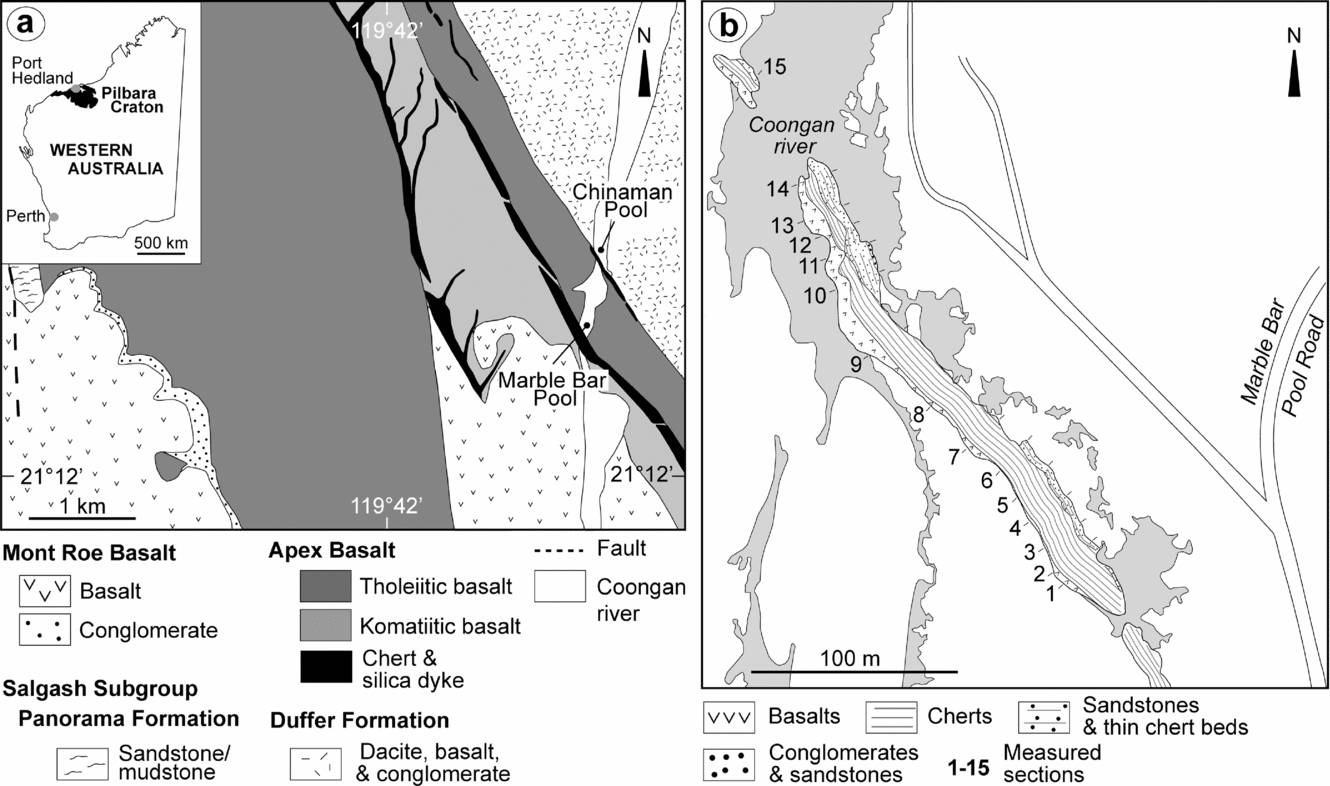
Exposure of the Marble Bar Cherts at Chinaman and Marble Bar pools. (a) Geological map of the Marble Bar area (simplified after Kato & Nakamura, Reference Kato and Nakamura2003). (b) Simplified geological map of the Chinaman Pool area showing locations of measured sections.

2. Geological setting
The Pilbara Block (Western Australia) consists of a granite-gneiss complex and surrounding greenstone belt (Hickman, Reference Hickman1983). The 3.53–3.165 Ga East Pilbara Terrane, i.e. the ancient nucleus of the Pilbara Craton, is composed of the Pilbara Supergroup, which consists of four volcano-sedimentary groups (Van Kranendonk et al. Reference Van Kranendonk, Smithies, Hickman and Champion2007). The lower part of the Pilbara Supergroup is represented by the 3.515–3.427 Ga Warrawoona Group, which recorded prehnite-pumpellyite to greenschist-facies metamorphism (Hickman, Reference Hickman1983; Van Kranendonk et al. Reference Van Kranendonk, Smithies, Hickman and Champion2007). This Group consists of ultramafic, tholeiitic, felsic lavas and volcaniclastic rocks with subordinate cherts. The Marble Bar Chert Member occurs at the top of the 3.472–3.465 Ga Duffer Formation and is overlain by the Apex Basalt Formation (Van Kranendonk, Reference Van Kranendonk2006). This Member is best exposed at the Marble Bar Pool and Chinaman Pool localities (Fig. 1), 0.5 km away from one another, about 3 km west of Marble Bar.
The Marble Bar Chert Member is a well-preserved unit of centimetre-scale layered red, white and dark-blue chert up to 200 m thick (Hickman, Reference Hickman1983; Van Kranendonk, Reference Van Kranendonk2006). This Member displays important thickness variations that repeat at regular intervals over the 30 km long band along which it crops out (Hoashi et al. Reference Hoashi, Bevacqua, Otake, Watanabe, Hickman, Utsunomiya and Ohmoto2009). At the Chinaman Pool and Marble Bar Pool localities, the deposits of the Marble Bar Chert Member, preserved between units of pillow basalt and dipping 70° E, are interpreted as being overturned (Van Kranendonk, Reference Van Kranendonk2006). The Marble Bar Chert Member displays a well-marked stratigraphic zoning with predominant white and dark-blue chert in the lower part of the unit whereas the uppermost third of the unit displays more dominant red cherts (Kato & Nakamura, Reference Kato and Nakamura2003; Van Kranendonk, Reference Van Kranendonk2006; Hoashi et al. Reference Hoashi, Bevacqua, Otake, Watanabe, Hickman, Utsunomiya and Ohmoto2009).
3. Chinaman Pool and Marble Bar Pool chert facies
A spectacular colour banding is exposed throughout the c. 50 m thick lower Marble Bar Pool section, with the alternation of red, white and dark-blue cherts (Kato & Nakamura, Reference Kato and Nakamura2003; Van Kranendonk, Reference Van Kranendonk2006). Red and dark-blue coloured bands are largely dominant over milky white horizons. These contrasting colourations are due to differing amount of minute haematite inclusions in the microquartz matrix of the chert (Buick & Barns, Reference Buick and Barns1984), with some subtle grain size variation of the microquartz visible microscopically (Oliver & Cawood, Reference Oliver and Cawood2001). Red bands are dusted throughout by tiny specks of haematite, goethite, opaque minerals and rhombic carbonate and possible altered bands of pyrite and magnetite (Sugitani, Reference Sugitani1992). Haematite-rich microbands of the uppermost section, i.e. Zones IV and V of Archaean Biosphere Drilling Project (ABDP) site 1 (Hoashi et al. Reference Hoashi, Bevacqua, Otake, Watanabe, Hickman, Utsunomiya and Ohmoto2009), are parallel to the bedding plane and vary from ~ 0.01 mm to ~ 1 mm in thickness and < 1 cm to > 10 m in lateral extent. The microbands are composed of discrete particles (0.1–0.6 μm in diameter) and clusters (0.001–0.1 mm in diameter) of haematite. Dark-blue bands, which are common in the lower section, contain microscopic carbonaceous material (kerogen; Sugitani, Reference Sugitani1992). The siderite-rich, lowermost zone described by Hoashi et al. (Reference Hoashi, Bevacqua, Otake, Watanabe, Hickman, Utsunomiya and Ohmoto2009) in ABDP site 1 is not exposed at the surface. The most complete section of the Marble Bar Chert Member is located at Chinaman Pool. It is composed of two very distinctive sub-units: (1) a well-bedded, evenly and finely flat-laminated lower section characterized by a conspicuous red-white-dark-blue banded facies, and prominent brecciated beds locally referred to as ‘stick beds’ (Hickman & Lipple, Reference Hickman and Lipple1978; Hickman, Reference Hickman1983); and (2) an upper section composed of interbedded chert layers and clastic deposits made of coarse felsic grains (Fig. 1b). At Marble Bar Pool, there is a unique chert unit preserved between two pillow basalt units. It is not clear whether the Marble Bar Chert Member of Chinaman Pool and Marble Bar Pool are part of the same chronostratigraphic unit. Nevertheless, the comparison of lithologies, fabrics and facies at both sites points to comparable depositional environments.
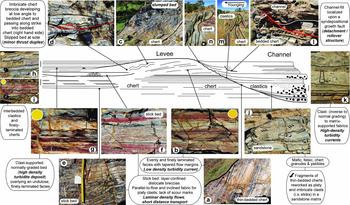
The thin-bedded chert facies consist of 0.05–0.40 m thick, evenly and finely laminated beds of dark-blue or red cherts (Fig. 2a, b). Lamination is only observed in red and dark-blue cherts and is defined by millimetre-scale variations in granularity and colour (Sugitani, Reference Sugitani1992; Van Kranendonk, Reference Van Kranendonk2006). Beds of red and dark-blue cherts laterally pinch out as tapered flow margins and sometimes overlie clast-supported layers. Sub-planar, undulose, parallel laminations of red and dark-blue cherts are characteristic of tracted and suspended-load flows of low-density currents. The thin-bedded chert facies are interpreted as fine-grained turbidites (e.g. Piper & Stow, Reference Piper, Stow, Einsele, Ricken and Seilacher1991). They make up most of the lower Marble Bar Chert Member and are only sporadically present in the upper Marble Bar Chert Member.
The channel-levee depositional model for the Marble Bar Chert Member showing illustrations of the associated depositional facies. Orange dots are 5 cm across.

The beds of the lower Marble Bar Chert Member, up to a few metres thick, contain bed-confined asymmetric folds, disharmonic folds and typical slump boudins (Fig. 2c). Folds are not recumbent and trains have not been observed. Locally, beds either pinch out laterally over a distance of a few metres or display thickening due to minor thrust duplexes (Fig. 2d). All of these features are indicative of post-depositional, layer-confined deformation of semi-consolidated sediments related to cohesive, gravity-driven mass-transports. Slumped beds are restricted to the lower Marble Bar Chert Member.
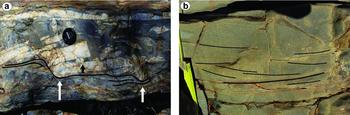
There are two modes of formation for chert breccia material in the lower Marble Bar Chert Member: (1) late breccia bands and hydrothermal fault arrays at high angles to the bedding (Oliver & Cawood, Reference Oliver and Cawood2001); (2) breccia beds conformable or at a low angle to bedded chert and referred to as ‘stick beds’. The ‘stick beds’ of the Marble Bar Chert Member are typically 0.1–0.5 m thick (Fig. 2e–g). Some beds display marked changes in thickness, pinching and swelling at irregular intervals. Bed thickness commonly doubles at swells. The ‘stick beds’ are completely layer-confined (Fig. 2f). They commonly exhibit sharp and conformable basal boundaries with local compaction of underlying lithologies by clasts (Fig. 3a). The ‘sticks’ are angular, sharp-edged, elongated and platy clasts (L/H > 10) of milky white chert. They are monogenic, of a lithology similar to the underlying ribbon chert. Clasts are typically arranged in spectacular shingle-like imbrications (long axis sub-parallel to the bedding or inclined 15–35°) and locally in angular folds (Fig. 2e). Some of the ‘stick beds’ show normal grading (Fig. 2f, g). The ‘stick beds’ are intra-formational breccias, resulting from the fragmentation of shallow-buried, early-lithified beds with limited displacement of clasts. In addition to slump folds and boudins, the textural gradation from slumps to breccia beds suggests that the breccia beds are dismembered slumps. The fabric of the ‘stick beds’ is strikingly similar to that of carbonate breccia beds of deep-water slope environments in Phanerozoic sequences (Dromart, Ferry & Atrops, Reference Dromart, Ferry, Atrops, Posamentier, Summerhayes and Allen1993; Robin et al. Reference Robin, Gorican, Guillocheau, Razin, Dromart, Mosaffa, Leturmy and Robin2010). The ‘stick beds’ are mainly observed in the uppermost section of the lower Marble Bar Chert Member. Other types of breccia beds have been recognized in the Marble Bar Chert Member. They consist of layers of variably elongated (1 ≤ L/H < 10) pebble- to granule-sized intra-formational white chert clasts locally displaying normal grading, and locally capped by thin-bedded cherts (i.e. finely laminated beds of red and dark-blue cherts). These observations suggest that depositional processes for chert breccia beds, including ‘stick beds’, vary from: (1) slumps to, (2) unchannelized mass transport complexes (i.e. cohesive debris flows with only minor evidence of erosion and sporadic evidence of organization as clast imbrications), to, (3) high-density turbidity currents (i.e. non-graded to graded, clast-supported layers overlain by laminated, turbulent flow fabrics).
(a) Intra-formational breccia from the Chinaman Pool section: monogenic, early-lithified chert clasts inducing load casts during differential compaction (arrows). (b) Trough cross-bedding in a coarse sand- to granule-size clastic deposit (upper section of the Marble Bar Chert Member at Chinaman Pool).

The upper section of the Marble Bar Chert Member at Chinaman Pool consists of coarse-grained siliciclastic sequences with recurrent thin-bedded cherts (Fig. 2h, i). ‘Sticks’ of typical milky white chert are observed as floating clasts in a coarse-grained siliciclastic matrix (Fig. 2j). Other lithoclasts of these mixed conglomeratic beds consist of mixed granule- to pebble-sized rounded fragments of mafic (basalt) and felsic (granodiorite) rocks. Sedimentary structures include metre-scale moderately incised channels and some trough cross-beds (Figs 2n, 3b). Inverse to normal grading, multilayering, clast imbrication and outsized clasts are common features (Fig. 2k). We interpret these deposits, except the thin-bedded cherts, to be typical high-density turbidites.
An unambiguous metre-scale syn-depositional growth fault is located in the upper section of Chinaman Pool. It consists of a normal, listric fault sealed upwards by chert beds and passing downwards to a sub-horizontal shear zone (Fig. 2l). The hanging wall block is affected by a typical rollover anticline and supports a sand-filled channel created by the listric fault collapse. This syn-depositional feature makes it an unmistakable stratigraphic polarity criterion. In addition, it suggests that the unconformable surface that bounds the lower and upper Marble Bar Chert Member and shows truncation and onlap stratal termination features (Fig. 2m) was generated by the collapse of a much larger listric fault.
4. A channel-levee depositional model for the Marble Bar Chert Member
The set of facies and sedimentary structures, including unconformable surfaces, observed in the Marble Bar Chert Member describes a general channel-levee depositional system (Fig. 2), such as originally described by Mutti (Reference Mutti1977). In these gravity-driven depositional systems, the levees of the subaqueous channel-levee systems form from the overbanking of predominantly fine-grained sediment (silts and clays) because of the spillover of turbulent flows as they move down the channel system (Mutti & Normark, Reference Mutti, Normark, Legett and Zuffa1987; Piper & Deptuck, Reference Piper, Deptuck, Flood, Piper, Klaus and Peterson1997). Colour-banded mud and clay are the most common sedimentary facies within the overbank deposits, with rare interbeds of coarser sediment composed of silt-size particles occurring in laminae and sharp-based thin beds (Normark & Damuth, Reference Normark, Damuth, Flood, Piper, Klaus and Peterson1997). Conversely, channel deposits consist of thick-bedded coarse facies including structureless to chaotic sand beds, graded and cross-bedded sand beds (normal grain size grading is predominant and many graded sand beds grade upwards through silt to clay at the top), plus chaotic mud (mud clasts deriving from localized sediment failure from inner levees). The channel deposits of the Marble Bar Chert Member are dominated by coarse-grained siliciclastic rocks. The internal geometry of the channel-fill deposits indicates that the channels were cut prior to and during their infilling. The bedding surfaces of the upper and lower channel deposits tend to be parallel to the flat channel tops and to the irregular channel floors, respectively. Bedding surfaces of lower channel deposits gradually onlap the basal channel surface. Slumping, other mass-flows and late fracture-related deformation have removed the original dip of the levee beds. The bedded cherts of the Marble Bar Chert Member appear to have been indurated before burial compaction, probably very early, at the time of sea-floor exposure. The best supportive evidence for early lithification of these cherts comes from the occurrence of cherts as reworked clasts in the mixed conglomeratic facies (Fig. 2j) and from load cast features due to differential compaction of distinctively indurated material (Fig. 3a). Owing to early lithification, siliceous levee slopes may display a higher angle of repose than typical modern siliciclastic subaqueous levees do (5° at best; e.g. Gervais et al. Reference Gervais, Mulder, Savoye, Migeon and Cremer2001; Migeon et al. Reference Migeon, Savoye, Zanella, Mulder, Faugères and Weber2001; Broucke et al. Reference Broucke, Temple, Rouby, Robin, Calassou, Nalpas and Guillocheau2004). Slope over-steepening by early lithification combined with slope overloading by high sediment flux on the channel levee would explain the frequent occurrence of slumping and other mass gravity flows observed in the lower Marble Bar Chert Member sequence. Hence, the slumped beds, mass-flow deposits, turbidite beds and growth faults make a comprehensive assortment of gravity-driven sedimentary processes in a slope environment.
5. Discussion
In the Marble Bar Chert Member, polymictic conglomeratic and pebbly-sandstone units, including granodiorite and basaltic sources, characterize the channel deposits of the channel-levee depositional model (Fig. 2). This suggests that these 3.456 Ga sediments were deposited at the toe of emerged and differentiated continental lands, which is consistent with the oldest angular unconformity reported in the East Pilbara Craton (Buick et al. Reference Buick, Thornett, McNaughton, Smith, Barley and Savage1995). Thus, the deposits of the Marble Bar Chert Member were not related to a mantle plume as suggested by Kato & Nakamura (Reference Kato and Nakamura2003), nor to mid-ocean ridges and active spreading centres, as proposed by Lascelles (Reference Lascelles2007). In the northern part of the Marble Bar greenstone belt (Fig. 1), the youngest 3.458–3.427 Ga Panorama Formation consists of mudstones and sandstones also interpreted as representing turbidites near a continental margin of a differentiated and evolved continent (Kato & Nakamura, Reference Kato and Nakamura2003). The only known deep gravity-driven deposits on Earth older than that of the Marble Bar Chert Member are 3700 to 3800 Ma normally graded sandstone layers interpreted as turbidites from the Isua greenstone belt (Rosing, Reference Rosing1999). These sedimentary rocks have been strongly metamorphosed to at least amphibolite-facies conditions and are strongly deformed (Nutman, Reference Nutman2006). Thus, complete turbiditic sequences at Isua remain rare and could result from depositional mechanisms other than turbidity flows (Fedo, Myers & Appel, Reference Fedo, Myers and Appel2001). These putative Isua turbidites are devoid of terrigenous clastic sediments, implying deposition in an oceanic environment in the vicinity of volcanic edifices (Rosing, Reference Rosing1999). Because the Marble Bar Chert Member yields a low-grade metamorphism (Van Kranendonk et al. Reference Van Kranendonk, Smithies, Hickman and Champion2007), it preserves a unique set of facies documenting the earliest deep-sea fan on Earth.
Modern channel-levee complexes are observed in the middle section of deep-water fans downstream of the continental slope break, at very variable water depth (500–3000 m; Richards, Bowman & Reading, Reference Richards, Bowman and Reading1998). Additional sedimentary structures, e.g. wave-driven deposits such as hummocky and swaley cross-beds, that would further constrain the water depth were not observed. Thus, a depth range of 200 to 1000 m proposed for the depositional setting of the Marble Bar Chert Member (Hoashi et al. Reference Hoashi, Bevacqua, Otake, Watanabe, Hickman, Utsunomiya and Ohmoto2009) appears to be minimal.
The red cherts of the Marble Bar Chert Member are made of silt-sized clusters of haematite crystals (Sugitani, Reference Sugitani1992; Hoashi et al. Reference Hoashi, Bevacqua, Otake, Watanabe, Hickman, Utsunomiya and Ohmoto2009). Hoashi et al. (Reference Hoashi, Bevacqua, Otake, Watanabe, Hickman, Utsunomiya and Ohmoto2009) argued that these haematite crystals are primary and precipitated when hot hydrothermal fluids (> 60°C), rich in reduced iron, mixed rapidly with seawater containing oxygen. Such a process for the oxidation of dissolved ferrous (reduced) iron, entering the oceans from hydrothermal vents, questions the common view of widespread anoxia throughout the early Archaean (Konhauser, Reference Konhauser2009). In our proposed deep subaqueous depositional model for the Marble Bar Chert Member, these haematite particles may not be in situ sediments. Whatever their mechanism of formation, i.e. transformation of a precursor lithology or direct precipitation from a silica-rich fluid (cf. Van den Boorn et al. Reference van den Boorn, van Bergen, Nijman and Vroon2007), dark-blue and red cherts were formed in superficial environments and transported downslope by density currents. This challenges the view of Hoashi et al. (Reference Hoashi, Bevacqua, Otake, Watanabe, Hickman, Utsunomiya and Ohmoto2009) that Palaeoarchaean deep (> 200 m) bottom ocean waters were at least locally oxidizing.
Acknowledgements
This work was supported by a grant from CNRS-PID OPV and the ChemCam program, Mars Science Laboratory project. NF acknowledges a Lavoisier grant from the French Ministry of Foreign and European Affairs. PR, NF and NC acknowledge an IPDF grant from the University of Sydney. The careful reviews of two anonymous reviewers greatly improved this manuscript.