Foreign direct investment (FDI) is thought to be an especially risky form of investment because its ex post illiquidity allows host-state governments to renegotiate the terms of an investment without triggering capital flight.Footnote 1 This dynamic is often referred to as the ‘obsolescing bargain’, or, more generally, ‘political risk’.Footnote 2 Political scientists often ask whether certain institutional arrangements can alleviate political risk (and increase FDI) by rendering such renegotiations procedurally difficult or politically unwise.Footnote 3 Knowing whether or not political institutions have this effect is an important research agenda, not only for what it reveals about the effects of political institutions, but because institutional environments that fail to provide adequate checks against predatory behaviour by host governments lead to less FDI, with the attendant detrimental effects on capital accumulation, employment and economic growth.
Bilateral investment treaties (BITs) have received particular attention in this literature. BITs secure a set of clearly defined rights for multinational investors and subject host country governments to international arbitration if those rights are violated.Footnote 4 Over 2,750 BITs have been ratified worldwide and many investors have won substantial awards through the international arbitration opportunities that BITs create.Footnote 5 But do BITs actually increase FDI? It stands to reason that if BITs reduce the risks associated with FDI we should expect to see more FDI where BITs exist. The vast majority of empirical works on this topic use balance of payment based FDI data (such as FDI flow and stock data provided by UNCTAD, the IMF and OECD) to answer this question. These efforts have achieved decidedly mixed results, alternatively finding no relationship between BITs and FDI,Footnote 6 that BITs attract FDI,Footnote 7 that BITs sometimes attract FDI,Footnote 8 and that BITs repel FDI.Footnote 9 The inconsistency of these results strikes us as ostensibly surprising in light of BITs’ evident popularity and singularity of purpose.
We argue that balance of payment data are, for a variety of reasons, poorly suited to testing theories of political risk and that this misapplication of data to theory may be driving some of the inconsistencies in the empirical literature. We focus in particular on the implicit assumptions about asset illiquidity that analysts make by using balance of payment data to test theories of political risk. Theory suggests that political risk is a creature of illiquidity. Without illiquidity, there is no obsolescing bargain and, therefore, no political risk. Balance of payment data aim to capture all capital flows between MNCs and their foreign affiliates. These data do not, and cannot, say anything about the form that this capital takes on once inside the affiliate. Accepting balance of payment data as indicators of illiquid assets sensitive to political risk is tantamount to assuming that illiquidity and risk are a necessary consequence of an MNC owning a foreign affiliate rather than an attribute of the asset itself.Footnote 10
We argue that the nature of the owned asset and not the identity of the owner determine political risk. A controlling share in a foreign investment project whose assets can be liquidated or repatriated quickly and with little cost poses less political risk than a controlling share in a foreign investment project whose assets do not have those attributes. Both projects count equally as FDI, but only one is truly generating political risk. Conversely, cash is no less liquid if owned by the foreign affiliate of an MNC than if it is owned by any other type of firm or individual, and not particularly subject to political risk either way. Using the scale of multinational investment as an indicator of revealed political risk requires knowing the form that foreign controlled capital takes, not just that it exists.Footnote 11
While less than ideal from a conceptual standpoint, balance of payment data have at least one great attribute: they are readily available from various sources for a large cross-section of countries over long time-frames. Therefore, using balance of payment data for the purposes of measuring revealed political risk represents a tradeoff between conceptual validity and availability. This is a reasonable tradeoff to make if (1) foreign affiliates of MNCs’ balance sheets are sufficiently dominated by illiquid assets, and (2) the gap between total assets and illiquid assets for any country-year is uncorrelated with institutional variables under consideration. Neither condition holds in practice. According to the most recent benchmark survey of US MNCs released by the US Bureau of Economic Analysis (BEA), current assets (the most liquid part of the corporate balance sheet) accounted for 43 per cent of total assets for the average non-financial foreign affiliate of a US MNC while 24 per cent of assets were invested in plant, property and equipment. Thus, there is a significant amount of measurement error if measures of total assets are meant to proxy for the presence of fixed capital. Moreover, the gap between total assets and fixed capital varies wildly by industrial sector; utilities and extractive industries have the highest ratio of fixed capital/total assets, service sector affiliates the least. This creates bias to the (probably large) extent that the sectoral composition of FDI is correlated with institutions that are thought to mitigate political risk.
The remainder of this article is presented in two parts. In the following section, we expand on our argument that data based on balance of payments (BOP) statistics are deeply problematic for testing theories of political risk and not obviously justifiable on the basis of their availability. Our primary focus is on the problems associated with asset illiquidity, though we note other problems associated with using data based on balance of payment statistics to address questions of political risk that are arguably just as damning.
The following section describes and presents the empirical contribution of this article, which is to estimate a simple statistical model of BITs’ impact on MNC behaviour using data made available by the BEA's survey of US MNCs. Our primary innovation is that this data allows us to separate investments in fixed capital from other types of investment and to analyse BITs’ effects on the allocation of each form of capital separately. We find that BITs increase investment in illiquid fixed capital overall and as a percentage of total assets, though the substantive effects are relatively small. We fail to find evidence that BITs affect the value of total assets held by those enterprises or the accumulation of liquid assets. While there is a caveat that these results are based on a test with a relatively small sample size imposed by data availability, they are generally in line with our expectations and underline our concerns surrounding the use of flow and stock data. The conclusions follow in a final section.
The Problem of Measuring Foreign Direct Investment
MNCs do many things and there are many ways to measure the scale of their activities. MNCs employ people, produce goods and services, earn revenue, control different kinds of capital in different countries, borrow locally and move capital across borders. No measure of MNC activity is all encompassing; each measures some activities and leaves out others. The appropriate measure of MNC activity depends on the research question being asked. Testing whether or not BITs or any other institutional arrangement affects politically risky investment by MNCs requires a measure that captures the scale of politically risky investments. In this section we discuss commonly used balance of payment data, the extent to which they are appropriate to test theories of political risk, and contrast it to our preferred data.Footnote 12
Balance of Payments Data
Balance of payments data set out to measure all capital transactions between the MNC parent and the foreign affiliate. Capital transactions are classified into three categories: (1) equity investment, i.e. the purchase of shares and other capital transfers such as the provision of machinery; (2) reinvested earning, i.e. the money earned by the foreign affiliate but not remitted to the parent MNC; and (3) other capital transactions, mainly inter-company debt flows.Footnote 13 The sum of these transactions is then netted against repatriated earnings and debt repayment back to the parent company. Repatriated earnings and reverse debt flow occasionally outweigh other capital transactions, resulting in negative FDI inflows. Two types of these data are typically reported and used in the literature: flow data and stock data. Flow data capture the net value of the above-described capital transactions that take place in a given year. Stock data capture the accumulation of flows over time in the host country. Much of these data are gathered by central banks as a byproduct of tracking the balance of payments. These methods capture equity investments, debt flow and repatriated income that cross borders between parent MNCs and their foreign affiliates. Reinvested earnings do not cross a border and data collected by central banks do not pick it up.Footnote 14 These data are gathered through surveys of MNCs and their affiliates and added to the data collected by the central bank.
To our knowledge, balance of payment data are the only data available for a large set of countries over long time-periods, leaving an analyst intent on employing data from a comprehensive number of source and/or host countries over multiple decades with little choice but to use them. There are, however, some problems associated with these data. Some of these problems are tangential to the issue of liquid versus illiquid assets that is the focus of this article, so we touch on them only briefly. We stress that this brief treatment is not motivated by a belief that these problems with BOP data are trivial. To the contrary, we believe that these problems alone strongly caution against the use of BOP data for testing theories of political risk.
Problem 1: Inconsistent reporting standards, particular on reinvested earnings
Several large-scale studies of reporting standards for balance of payments FDI statistics have been carried out, notably the IMF's (1992) Report on the Measurement of International Capital Flows (Godeaux Report) and subsequent reports associated with the Survey of Implementation of Methodological Standards for Direct Investment, jointly administered by the IMF and OECD in 1997 and 2001.Footnote 15 The results of the surveys suggest an improving, but nonetheless sobering reality. Inconsistencies abound across countries and within countries over time with respect to reporting methodologies. There are differences across time and space in the sort of data collected, the manner of collection and even things as basic as the definition of foreign direct investors. One of the most problematic aspects of these reporting inconsistencies is the treatment of reinvested earnings, which constitute a significant portion of FDI flows.Footnote 16 Roughly one third of non-OECD countries in the most comprehensive survey (administered in 1997) either did not perform the surveys necessary to collect data on reinvested earnings or did not report the data and, therefore, did not include reinvested earnings in their FDI totals. Several OECD countries fail to provide these data as well. While data collection appears to be improving, significant divergences in reporting standards persisted as recently as the 2001 survey.Footnote 17 Given that many studies of political risk and institutions employ balance of payment data as far back to 1970, a substantial portion of these data is potentially suspect. It is entirely possible that failure to conduct the required surveys or report data that conform with the IMF's guidelines is correlated with some of the same political and institutional factors that are thought to affect political risk, suggesting that the failure of some countries to report data on reinvested earning is a source of both random and systematic error.Footnote 18
Problem 2: Offshore holding companies
Another problem with balance of payment-based data, highlighted by Lipsey and others, is that it reflects the immediate source and the immediate recipient of FDI.Footnote 19 This makes sense because the data are collected primarily in order to monitor balance of payments and the ultimate beneficial owner or recipient of capital is irrelevant for these purposes. Ultimate beneficial ownership is very important for FDI data, however. One consequence of the focus on the immediate source and recipient of FDI in balance of payment data is BOP data are particularly bad at dealing with financial holding companies, which are often located in tax havens.Footnote 20 As UNCTAD notes, ‘Where funds are channeled through holding companies, major problems may be created in the compilation of an accurate geographical or industrial distribution of FDI.’Footnote 21 This is a big problem: holding companies accounted for 36 per cent of the United States direct investment position abroad in 2008.Footnote 22 This is why, according to the World Development Indicators, which use BOP-based data provided by the IMF and UNCTAD, Luxembourg (a tax haven par excellence) recorded FDI inflows of 373 per cent of gross domestic product (GDP) in 2009, over ten times higher than the second-place country, the Seychelles, or the third-place country, Montenegro, both of which are also (in)famous tax havens. These numbers are nonsensical if they are meant to proxy for capital that is in productive use in the host state (or was ever even there in any meaningful sense), or as an indicator of investment risk. Perhaps the most pernicious consequence of this feature of BOP data for our purposes is that the use of holding companies often obscures the source country of FDI, making it difficult to say with any confidence which FDI flows are protected by BITs and which are not.
Problem 3: Local financing by foreign affiliates
Many foreign affiliates rely on local financial markets to meet their financing needs and this capital is not included in the BOP-based FDI statistics.Footnote 23 This is not a problem with the data per se. No foreign capital is introduced to the host country when MNCs tap local financial markets; it is not clear to us that it should count as FDI. Indeed, a measure that excludes locally raised capital is probably preferable for many questions relating to the impact of FDI. However, the prevalence of local financing as a source of capital raises several questions with respect to the application of BOP data to questions about political risk and MNC activity. Whether or not an affiliate's assets are at risk should be reflected in the amount of capital it controls in a country, regardless of how it is financed. As it pertains to bilateral investment treaties, there is nothing in the US model BIT, nor, to our knowledge, in the extant case law, to suggest that protection BITs provide is sensitive to the choice of internal vs. external financing. Moreover, the extent to which BOP data understate the scale of MNC investments by ignoring assets acquired via local financing is not random. Firms make more use of external financial markets in countries with strong creditor rights, while they rely more on parent company loans in countries with weak creditor's rights.Footnote 24 The extent of creditor's rights – effectively, a distribution of rents between creditors and borrowers – is assuredly endogenous to politics and political institutions.
All of the above problems with BOP data are considerable and worthy of the attention of scholars using them. For our purposes, the key feature of BOP data is that they fail to discriminate between liquid and illiquid assets. We return to this issue below.
The US Bureau of Economic Analysis Data
The above noted problems can be avoided by using data collected by the US Bureau of Economic Analysis (BEA) in their annual and benchmark (conducted every five years) surveys of American MNCs. These surveys provide as comprehensive a view of MNC activities as exists. Firms are required to report on the operations of the parent company and all overseas affiliates with sufficient assets.Footnote 25 The firm-level data is kept confidential (and is therefore considered reliable), but several aggregates are publicly available. These data provide unique insights into the operations of foreign direct investors, though it does require a singular focus on the operations of affiliates of US based MNCs. The firms themselves report the data according to a single standard set by the BEA, which avoids the problems of non-random missing data on reinvested earnings or other non-random irregularities in reporting standards and methods. By focusing on the assets and activities of the affiliates, rather than on transactions between affiliate and parent, these data sidestep problems related to holding companies and local financing.
Importantly for our purposes, the fine-grained nature of the data allows us to observe and separate liquid and illiquid assets better. Figure 1 shows the aggregate balance sheet for foreign affiliates (excluding financial industry firms and holding companies) of US MNCs based on the 2004 benchmark survey.Footnote 26 The striking thing about these data is that 43 per cent of US MNCs’ balance sheets are accounted for by current assets – i.e. highly liquid assets that are expected to be converted into cash within a year under normal operating conditions; 6 per cent of assets are held in cash; another 24 per cent of assets are held in receivables, which are highly liquid and can typically be converted into cash via factoring. ‘Other current assets’, a category which includes liquid marketable securities and pre-paid expenses makes up another 6 per cent; inventories make up another 7 per cent of assets, and are often, but not always, fairly liquid.
Balance sheet of non-bank affiliates of US MNCs Source: US Bureau of Economic Analysis, 2004

Non-current assets – i.e. assets not intended to be liquidated in the coming year under normal business operations – make up 57 per cent of foreign affiliate assets; of these, 9 per cent are equity investments in other foreign affiliates owned by the parent company; 24 per cent are ‘other non-current assets’, a category which includes the value of intangible assets – such as brand names, trademarks or patents – and securities not intended to be liquidated within the year. Plant, Property and Equipment, net of depreciation and depletion (net PPE), which includes the value of physical structures, land, machinery, equipment and the book value of land, timber, mineral and similar rights owned by the foreign affiliate, make up 24 per cent of assets.
The lesson we draw from the data in Figure 1 is that a substantial portion of the assets held by the foreign affiliates of US MNCs – and certainly assets held in cash, receivables and investments in marketable securities – are at least as liquid as typical forms of portfolio investment. Their accumulation is unlikely to affect the level of political risk that foreign direct investors face. A very large portion of the average foreign affiliate's assets are irrelevant to questions of political risk if, as is in keeping with the logic of the obsolescing bargain, such risk is primarily a function of asset illiquidity.
At a minimum, the prevalence of relatively liquid capital on the balance sheets of foreign affiliates of US MNCs introduces some noise into estimations of the relationship between political risk and MNC behaviour. However, some projects’ assets are far more concentrated in fixed capital than others and this has the capacity to introduce bias. Figure 2 shows the same balance sheet data as Figure 1, but separates affiliates by several (broad) industrial aggregates. Net PPE constitutes over 50 per cent of assets in the mining and utilities industries, is closer to 20 per cent of assets in the information and manufacturing industries, and less than 10 per cent in services and wholesale trade. The combined value of cash, receivables and other non-current assets varies similarly. The gap between what is being measured in BOP data and illiquid capital will be largest in countries that are dominated by service sector and manufacturing investments and smallest in countries that are dominated by investments in resources extraction. Industrial makeup is in practice correlated with many of the same political institutions used to explain FDI allocation. This has the capacity to introduce bias in pooled estimates of political institutions’ effects on FDI, though country fixed effects are likely to diminish this bias to the extent that industrial composition stays relatively constant within countries over the duration of the observation period.
Balance sheet of non-bank affiliates of US MNCs by industry Source: US Bureau of Economic Analysis, 2004. Note: Services refers to ‘Professional, scientific, and technical services’.
In sum, there are reasons to be wary of using BOP- based flow and stock data in analyses of FDI allocation, particularly in analyses that relate the deployment of illiquid capital to levels of political risk embodied in political institutions. Such analyses will unavoidably be riddled with excessive noise and possibly bias. The vast majority of work relating BITs to FDI relies on BOP-based flow and stock data. Whether and how BITs impact MNC behaviour therefore remains an open question that we address in the following section.
Empirical Test: Foreign Direct Investment and Bilateral Investment Treaties
Research Design and Dependent Variables
We test BITs’ effect on MNC behaviour through a series of regression analyses relating different measures of US MNC activities to the presence or absence of a US BIT with the host-country. The measures of MNC activity that we use as dependent variables are: (1) The log of the value of total assets held by foreign affiliates of US MNCs (lnTotal Assets); (2) the log of the value of fixed capital held by US MNCs (lnPPE); (3) the log of the value on non-fixed capital assets held by US MNCs (lnnon-PPE); and (4) plant, property and equipment as a percentage of total assets (PPE/Total Assets).Footnote 27
All of these data are measured at the country-year level and are taken from the publicly available aggregates of BEA's annual surveys of US MNCs. These data exclude investments in financial sector firms and holding companies. All measures are expressed in millions of constant US dollars. We expect that BITs will be positively and most clearly related to lnPPE. We also expect to see a positive relationship between BITs and PPE/Total Assets, indicating a higher fixed capital intensity where BITs are in place. We are agnostic about BITs’ effect on the other variables.Footnote 28
Our estimating equation is as follows:
 $$\ln \!FD{{{\rm{I}}}_{{\rm{it}}}}\,{\rm{ = }}\,\alpha \:{\rm{ + }}\:{{\beta }_{\rm{1}}}\,{\rm{\ast}}\,USBI{{T}_{it\,{\rm{ - }}\,{\rm{1}}}}\:{\rm{ + }}\:{{\beta }_{\rm{2}}}\,{\rm{\ast}}\,{{Z}_{it\,{\rm{ - }}\,{\rm{1}}}}\:{\rm{ + }}\:{{Y}_t}\:{\rm{ + }}\:{{V}_i}\,{\rm{ + }}\,{{{\epsilon}}_{it}}{\rm{,}}$$
where i indexes the host country, t indexes the year, USBITit −1indicates the existence of BIT with the United States at time t−1 and Zit −1 represents a vector of country-level control variables, Yt represents year fixed effects and Vi represents country fixed effects. All models are estimated with Driscoll–Kraay standard errors to correct for autocorrelation, heteroscedasticity and correlations across panels.Footnote 29 All results are robust to estimation with panel corrected standard errors.Footnote 30
The Sample
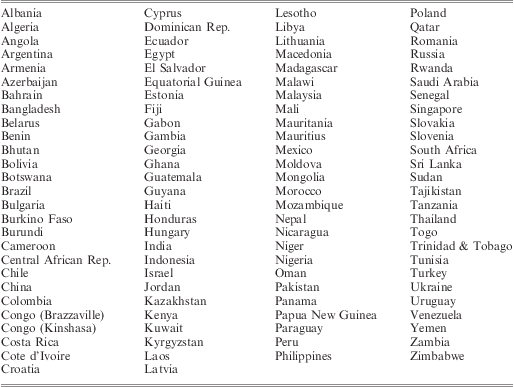
Our sample includes every developing country-year observation for which data is publicly available from the BEA. We define developing countries as all non-OECD countries as of 1995, plus Mexico and Turkey.Footnote 31 This results in samples of between ninety-four and ninety-nine countries, depending on the dependent variable being used. A list of the countries included in the most expansive model is available in the Appendix. Our data includes observations from 1997 to 2007, which is determined by availability of BEA data.
All of the FDI figures that the BEA makes available contain a considerable amount of missing data. Some instances of missing data occur because the amount of money is so small (between −$500,000 and $500,000) that the BEA does not record it (but notes the reason for its being missing). In these cases, we replace the missing value with 0. In the remaining cases, we count missing data as ‘missing’.Footnote 32
Our use of panel fixed-effects in a short sample means that the coefficient on USBIT reflects the impact of the nineteen investment treaties that were ratified by the United States over the ten-year window and are included in this sample. Relative to the larger universe of US BITs in force, our estimates are disproportionately reflective of data from Latin America and under-represent data from Africa. European BITs and Asian BITs are represented in our sample in rough proportion to their representation in the larger universe of US BITs. One result of this is that our estimates rely on a sample of BITs with countries that are, among other things, somewhat richer and more democratic than is true of the universe of countries with which the United States has BITs. To the extent that BITs work better (worse) in richer or more democratic countries, our estimates overstate (understate) their effectiveness. We do not see any obvious reasons why this sample should bias us towards or away from finding that BITs are more closely correlated with investments in fixed capital than other forms of FDI. Nonetheless, we readily point out the potential threat to external validity presented by this sample.
Independent Variables
Our measure of BITs is taken primarily from UNCTAD and is coded 1 if a country has a BIT in force with the United States in year t and 0 otherwise. We code countries that have free trade agreements in force with the United States that include an investment chapter as having a BIT.
We do not have any theoretical expectations over the time lag through which a BIT is likely to affect MNC behaviour. On one hand, fixed capital cannot be accumulated instantaneously, which suggests a lagged effect. On the other hand, US BITs cover pre-existing investments and, given the delay between the signing of a BIT, its ratification and entry into force, an impending BIT should be easy for firms to anticipate.Footnote 33 There may be little incentive for firms to postpone planned investments in order to wait for the BIT to come into force officially, suggesting a lead effect. In practice we found that including our BIT variable at a one-year forward lag provides the best model fit (which we adjudicated by comparing AIC statistics), though specifications that measure BITs with the United States at a one-year lag go farther to mitigate reverse causality and are more in keeping with the extant literature. We report models using the traditional one-year lag of the BIT variable, the results of which are generally consistent with models estimated using alternative lag lengths.Footnote 34
BITs are clearly not randomly assigned and are almost certainly more likely to arise between countries that are structurally predisposed to having FDI flowing from one country to the other, either by virtue of proximity, size, history, commercial relationships or some other feature. Our use of country fixed effects in combination with time varying controls such as GDP, GDP per capita and trade flows is likely to reduce the degree of this endogeneity substantially, particularly over a panel period as short as this. Some endogeneity may remain to the extent that the timing of BITs’ entry into force in a given country reflects lobbying by investors who were already planning on future investments. The BIT and the investment may show up at roughly the same time, but both are being caused by investors’ otherwise determined intentions. Measuring BITs at a one-year lag mitigates this endogeneity to some degree, but not entirely.
Ideally, we would address this endogeneity with an instrument that is correlated with BITs but otherwise unrelated to FDI. Such an instrument would have to vary within countries over time in order to be effective in our fixed effects specification. We do not have such an instrument at our disposal and, therefore, do not offer any methodological innovation to deal with endogeneity beyond what is already available in the extant literature. However, the basic goal of this empirical exercise – determining whether or not BITs are more relevant for investments in fixed capital than for other forms of investment – is not greatly undermined by this form of endogeneity. Even if FDI and BITs are in part jointly determined by investors’ future intentions, it remains to be seen whether the entangled relationship exists more strongly between BITs and investments in fixed capital than between BITs and investments in liquid capital or between BITs and total FDI. While we would naturally prefer a research design that precisely establishes the direction of causality, the critical point for our purposes is to establish that the correlation exists differently across different types of investment and our research design is capable of doing that.
Control Variables
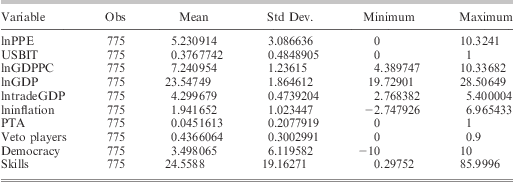
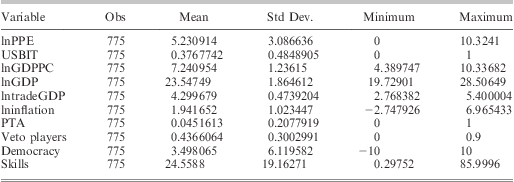
Our models include standard country-level variables and largely mirror those used elsewhere in the literature. These are: the log of GDP, the log of GDP per capita, host country trade as a percentage of GDP, host country skill levels (which we proxy with the tertiary school enrolment share), the log of inflation, the presence of a preferential trade agreement (PTA) with the United States, the number of veto players (measured using Henisz's POLCON dataset) and the level of democracy (taken from the Polity IV dataset). Unless otherwise noted, all of the data is taken from the World Development Indicators. As noted, we include year and country fixed effects in all models. Descriptive statistics for all variables can be found in the appendix.
Results
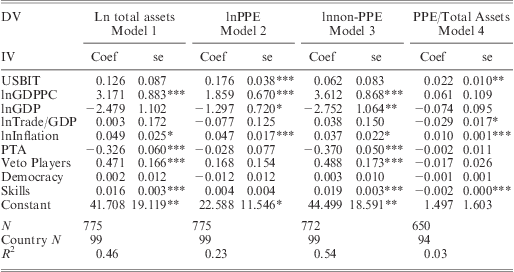
The results of our models are listed in Table 1. Model 1 uses lnTotal Assets as the dependent variable. The results of Model 1 suggest that the ratification of a BIT is positively correlated with the total value of assets held in foreign affiliates of US MNCs, though this correlation is statistically insignificant.
Responsiveness of Various FDI Measures to BIT Ratification
Note: All models estimate with Driscoll–Kraay standard errors. All independent variables measured at a 1 year lag. All models include country and year fixed effects. Significance levels: *0.1, **0.05, ***0.01.
Model 2 uses lnPPE as the dependent variable. This is the model where we expected BITs to have the largest and most statistically significant relationship with MNC behaviour, and that is indeed what we find. On one hand, the coefficient on USBIT is positive and highly statistically significant, indicating that investments in fixed capital increase if a BIT has been ratified. On the other hand, the substantive effect is rather small: moving from 0 to 1 on USBIT increases the dependent variable by only 5 per cent of a standard deviation. By comparison, a one standard deviation increase in the log of GDP per capita corresponds to a 74.4 per cent of a standard deviation increase in the amount of fixed capital in place. The small effect seems plausible to us, particularly in light of Yackee's finding that the general counsels at MNCs are often unfamiliar with BITs. Nonetheless, this is a strikingly smaller figure than is reported elsewhere in the literature.Footnote 35
Model 3 uses ln non-PPE as the dependent variable. Non-PPE naturally captures a lot of different assets, some of which might be expected to co-vary positively with fixed capital, others negatively. As noted above, we do not have strong a priori expectations about its relationship with USBIT. In practice, there is a slightly positive but statistically insignificant relationship. This could be the result of positive and negative relationships on different assets cancelling out, or it could be that there really is no impact at all. In the absence of more finely grained data, it is impossible to say.
Interestingly, the R 2 of Model 2 is much smaller than the R 2 in Model 1 and, especially, than in Model 3. We do not have any strong intuitions for why this is the case. However, because our model is designed to resemble the modal set of covariates used in the political science literature on FDI allocation, it appears that what we ‘know’ about FDI pertains more to the allocation of liquid forms of capital than to the allocation of fixed capital. Given the centrality of fixed capital investments to political theories of FDI, as well as to commonly used heuristics of FDI, we find this result somewhat distressing.
Model 4 uses PPE/Total Assets as the dependent variable, which speaks to the fixed capital intensity of the assets held by the foreign affiliates of US MNCs. The results of Model 4 suggest an increase in the fixed capital-intensity of US foreign affiliates when a BIT is in place. This effect is statistically significant and the substantive impact, while still relatively small, is quite a bit larger than the effect on the amount of fixed capital present in a country year: moving from 0 to 1 on USBIT corresponds to a increase in lnPPE/TotalAssets of 35 per cent of a standard deviation. The results of Model 4 are the logical extension of the results in Models 1–3. New investments in fixed capital coupled with stagnant levels of total investment imply that the FDI stock is becoming more fixed capital intensive. It may be that pre-existing MNCS are financing new investments in fixed capital by reallocating assets that would have otherwise been held in a liquid form. It may also be that new firms that naturally carry larger fixed to liquid capital ratios are entering the market. Either would be broadly consistent with our theory, but it is impossible to know which is occurring with these data.
The control variables are largely in line with previously published fixed effects studies, though a few interesting findings are worth pointing out. First, the persistently negative coefficient on lnGDP is surprising, though we note that this appears to be an artefact of the variable being logged. In unreported robustness checks the coefficient takes on the more intuitive positive sign in its unlogged form. Also of note, we never find that democracy impacts FDI in any way.
Conclusion
Political institutions of various sorts have been suggested as solutions to the political risk associated with FDI. These suggestions have a clear prescriptive quality to them: if a country can manage to get the institutions right, they can expect more FDI, and with it more and more stable capital inflows, higher employment levels, modernization of domestic industry and improved skills in the domestic labour force and, consequently, higher growth rates. The rapid rise in BITs since 1990 suggests that policy makers across the world have heard this message. BITs carry great promise, but they come at a significant cost to a host country's sovereignty. Many policies that the government might seem to have a natural right to enact, and which may very well serve the public interest, might nonetheless run foul of a BIT's various prohibitions and expose the host-state government to costly litigation. BITs are not a free lunch. It is, therefore, critically important that we know whether or not BITs actually increase FDI. The extant literature is decidedly mixed on this question, suggesting little empirical basis on which countries, particularly developing countries, have been curtailing their own sovereignty.
We have argued that the data commonly used in the literature is poorly suited to test whether or not BITs increase FDI by mitigating political risk, particularly because they conflate liquid forms of capital with illiquid forms of capital. Measures of FDI that can isolate relatively risky investments in fixed capital from relatively less risky investments in liquid capital are a better conceptual fit and present fewer (though still some) statistical and inferential problems. The results of our empirical tests suggest that BITs correlate closely and positively with fixed capital allocation and fixed capital intensity, but much more weakly with more highly aggregated measures of FDI or measures of FDI that focus on investments in liquid capital. These findings are in line with our expectations and hew quite closely to the prevailing theories about political risk.
Our findings with respect to BITs are thought provoking. BITs seem to work, and they do so in exactly the way they are supposed to: by promoting the sorts of investments that would otherwise bear political risk. BITs do not seem to have much of an effect on investments that are not particularly risky, which is also to be expected. In that sense these findings are something of a victory for theories that relate BITs to FDI. As for BITs themselves, the results are far more modest given the rather small size of the effect in substantive terms. All of this said, these results are in no sense the final word on the matter of BITs’ effects. We have addressed one problem –the poor conceptual fit between balance of payment measures of FDI and theories of political risk – but introduced another (external validity, by way of our small sample size) and done very little more than the extant literature has already done to address endogeneity concerns. Thus, this article should be seen as an incremental step towards statistically recovering BITs’ true effects.
We think that this article has a much larger contribution to make to the literature relating FDI to political risk generally. Using FDI flow and stock data represents one of many possible ways to measure MNC activity. They may not always be the most conceptually appropriate way to measure MNC behaviour, particularly for questions pertaining to political risk. We suggest that they should be used with far more caution and with more discussion of the potential mismatches between theory and measure than is currently the practice.
List of Countries Included (Model 1)
Descriptive Statistics