Introduction
Important objectives of heart failure (HF) treatment are symptom relief and improvement of health-related quality of life (HR-QoL) (McMurray et al., Reference McMurray, Adamopoulos and Anker2012). Despite these objectives, HR-QoL of HF patients is seriously reduced compared with both a normative population (Lesman-Leegte et al., Reference Lesman-Leegte, Jaarsma and Coyne2009a) and patients suffering from other diseases (Juenger et al., Reference Juenger, Schellberg and Kraemer2002). Because of an increasing body of research on HR-QoL, more knowledge of how to improve HR-QoL is available. Previous research has focused mainly on medical and physical factors related to HR-QoL (Flynn et al., Reference Flynn, Lin and Ellis2009; Mommersteeg et al., Reference Mommersteeg, Denollet, Spertus and Pedersen2009; Rahimi et al., Reference Rahimi, Malhotra, Banning and Jenkinson2010; Hoekstra et al., Reference Hoekstra, Lesman-Leegte, van Veldhuisen, Sanderman and Jaarsma2011; Kraai et al., Reference Kraai, Luttik and Johansson2012; Hoekstra et al., Reference Hoekstra, Jaarsma and van Veldhuisen2013); however, emotional factors (Guyatt et al., Reference Guyatt, Feeny and Patrick1993) such as depressive symptoms are also highly prevalent in patients with HF (Lesman-Leegte et al., Reference Lesman-Leegte, Jaarsma, Sanderman, Linssen and van Veldhuisen2006; Lesman-Leegte et al., Reference Lesman-Leegte, van Veldhuisen and Hillege2009b) and are related to HR-QoL (Schowalter et al., Reference Schowalter, Gelbrich and Stork2013). HF patients with a comorbid depressive disorder, for example, have a lower HR-QoL compared with HF patients without a comorbid depressive disorder. Interventions that aim to improve the depressive disorder are able to increase HR-QoL of these HF patients (Schowalter et al., Reference Schowalter, Gelbrich and Stork2013). Psychosocial and existential concerns are important aspects of the lives of patients suffering from HF (Leeming et al., Reference Leeming, Murray and Kendall2014). Personality factors, including dispositional optimism, can therefore affect how patients report on their health status (Steptoe et al., Reference Steptoe, Wright, Kunz-Ebrecht and Iliffe2006) and HR-QoL (Steel et al., Reference Steel, Schmidt and Shultz2008). Dispositional optimism can be defined as the tendency to expect positive outcomes across a variety of life domains (Steptoe et al., Reference Steptoe, Wright, Kunz-Ebrecht and Iliffe2006). Common definitions indicate that pessimism is an antonym for optimism. Some investigators agree with this view, and tend to adopt optimism as a unidimensional, classifying pessimism as the opposite end of optimism (Scheier & Carver, Reference Scheier and Carver1985). Within this context, the measure of optimism is constructed so that an optimistic outlook necessarily precludes a pessimistic outlook, and vice versa (Kubzansky et al., Reference Kubzansky, Kubzansky and Maselko2004). However, other researchers suggest that endorsing items reflecting an optimistic perspective is substantively different from disagreeing with items that reflect a pessimistic outlook (Chang et al., Reference Chang, D'Zurilla and Maydey-Olivares1994). If this is true, then optimism and pessimism would not represent opposite ends of a single continuum, but should be considered separate and, to some meaningful extent, independent constructs. Until today, there has been little consensus on the issue of pessimism being the opposite of optimism or being an independent construct (Kubzansky et al., Reference Kubzansky, Kubzansky and Maselko2004).
Optimism has been associated with favorable health outcomes and quality of life (Scheier & Carver, Reference Scheier and Carver1992). Pessimism, on the other hand, has shown to be prospectively related to poor self-rated health and impaired psychological well-being (Robinson-Whelen et al., Reference Robinson-Whelen, Kim, MacCallum and Kiecolt-Glaser1997). In addition, a recent study showed that optimism is associated with a lower risk of developing HF (Kim et al., Reference Kim, Smith and Kubzansky2014). The relation between optimism and pessimism and HR-QoL has not yet been examined in HF patients, however.
Although dispositional optimism is supposed to be a relatively stable construct, several studies have found that dispositional optimism is a modifiable condition (Chang et al., Reference Chang, D'Zurilla and Maydey-Olivares1994; Scheier & Carver, Reference Scheier and Carver1992; Kubzansky et al., Reference Kubzansky, Kubzansky and Maselko2004). Higher levels of dispositional optimism can be achieved by means of psychological interventions (Epping-Jordan et al., Reference Epping-Jordan, Compas and Osowiecki1999; Lee et al., Reference Lee, Robin Cohen, Edgar, Laizner and Gagnon2006; Tusaie & Patterson, Reference Tusaie and Patterson2006), and such interventions may also improve HR-QoL of HF patients. In addition, there is a considerable amount of data on dispositional optimism in cancer patients showing that optimists have a better global HR-QoL than pessimists (Carver et al., Reference Carver, Pozo-Kaderman and Harris1994, Reference Carver, Smith, Petronis and Antoni2006; Epping-Jordan et al., Reference Epping-Jordan, Compas and Osowiecki1999; Allison et al., Reference Allison, Guichard and Gilain2000). Several studies that examined how patients cope with a life-threatening disease such as cancer found remarkable differences between individuals regarding health outcomes and HR-QoL, depending on their psychological adjustment to stress (Schou et al., Reference Schou, Ekeberg, Sandvik, Hjermstad and Ruland2005; Blank & Bellizzi, Reference Blank and Bellizzi2006). Older HF patients, for example, were found to be able to adapt their personal expectations to such an extent that they positively influenced their HR-QoL (Moser et al., Reference Moser, Heo and Lee2013).
To develop new interventions to improve HR-QoL of HF patients, it is important to examine the relationship between optimism and pessimism and HR-QoL of HF patients. Therefore, the present study aims to (1) describe the prevalence of optimism and pessimism in HF patients, (2) examine the association between clinical and demographic patient characteristics and optimism and pessimism, and (3) describe the relationship between optimism and pessimism and HR-QoL of HF patients.
Methods
Study Population
A descriptive cross-sectional study was performed. In total, 159 outpatients who visited the HF clinic of the University Medical Center Groningen in the Netherlands between January 2012 and July 2012 were asked to participate in the study. Inclusion criteria were having a diagnosis of HF (independent of left ventricular ejection fraction [LVEF]) New York Heart Association functional (NYHA) classification I-IV and being age 50 or older. Patients with impaired cognition, inability to speak the Dutch language, or inability to understand informed consent as determined by the HF nurse were excluded from participation. Fifty-six patients declined participation in the study. Of the enrolled patients, a further three patients were excluded from the analysis because they were not able to pass a test question necessary to complete a study assessment on patients’ preferences that was also part of the data collection (Kraai et al., Reference Kraai, Vermeulen and Luttik2013). The study activities were combined with routine visits to the HF outpatient clinic; questionnaires were administrated by trained researchers who were not involved in the treatment of the included patients. The study was part of a larger study on HF patients’ preferences (Kraai et al., Reference Kraai, Vermeulen and Luttik2013) and conforms to the principles outlined in the Declaration of Helsinki. The Medical Ethics Committee approved the study protocol, and all enrolled patients provided their written informed consent.
Measurements
Dispositional Optimism
Dispositional optimism was assessed with the Revised Life Orientation Test (LOT-R) (Scheier et al., Reference Scheier, Carver and Bridges1994), which is a widely used instrument in psychological research and which has good psychometric properties (e.g., Cronbach alpha of .71 for the total score and of .64 and .77 for the optimism and pessimism subscale scores) (Scheier et al., Reference Scheier, Carver and Bridges1994; Herzberg et al., Reference Herzberg, Glaesmer and Hoyer2006; Steptoe et al., Reference Steptoe, Wright, Kunz-Ebrecht and Iliffe2006). The LOT-R consists of 10 items: three items are positively worded, three items are negatively worded, and four items are filler items. The respondents are asked to indicate their agreement on a 5-point Likert scale with response categories ranging from strongly agree to strongly disagree. Although originally composed as a unidimensional scale, some studies suggest a bidimensionality of two independent factors: optimism and pessimism (Robinson-Whelen et al., Reference Robinson-Whelen, Kim, MacCallum and Kiecolt-Glaser1997; Herzberg et al., Reference Herzberg, Glaesmer and Hoyer2006; Zenger et al., Reference Zenger, Brix, Borowski, Stolzenburg and Hinz2010; Sulkers et al., Reference Sulkers, Fleer and Brinksma2013). Therefore, in this study, both the total score and the subscale scores on optimism and pessimism were used. The total score was calculated by summing the three positively worded items and the reverse-coded, negatively worded items. Scores on the LOT-R range from 0 to 24, with higher scores indicating more optimism. The optimism subscale score was calculated by summing the three positively worded items; the pessimism subscale score was calculated by summing the raw scores on the negatively worded items. Both subscales have a scoring range of 0 to 12, with higher scores indicating more optimism or more pessimism. Norm scores are not available for the LOT-R. The Cronbach alpha in our study sample was .33 for the total score, .40 for the optimism subscale score, and .60 for the pessimism subscale score.
HR-QoL
HR-QoL was assessed with a disease-specific (the Minnesota Living with Heart Failure Questionnaire [MLHFQ]) and a generic instrument (EuroQol [EQ-5D]). The MLHFQ is a widely used disease-specific questionnaire in HF research (Johansson et al., Reference Johansson, Agnebrink, Dahlstrom and Brostrom2004; Garin et al., Reference Garin, Ferrer and Pont2009) with good psychometric properties (Garin et al., Reference Garin, Ferrer and Pont2009). The MLHFQ has a total score ranging from 0 to a maximum of 105 and consists of two domains: a physical component and an emotional component, with 40 and 25 as maximum possible scores, respectively. Lower scores on the MLFHQ reflect better HR-QoL (Rector & Cohn, Reference Rector and Cohn1992). Norm scores are not available for the MLHFQ.
The EQ-5D is designed for use across a wide range of health interventions (Brooks, Reference Brooks1996) and is frequently used in cardiovascular trials (Dyer et al., Reference Dyer, Goldsmith, Sharples and Buxton2010). The EQ-5D consists of five domains: mobility, self-care, usual activities, pain/discomfort, and anxiety/depression. Each domain has three levels: no problems, some problems, and severe problems. The scoring is based on the British tariff (Dolan & Gudex, Reference Dolan and Gudex1995) and values theoretically fall on the 0.0 (dead) to 1.0 (perfect health) value scale. Negative scores may occur, meaning that a particular health state is valued as worse than dead (from a societal perspective). Norm scores are available for the EQ-5D: male (70–74 years) +0.77 and female + 0.75 (Kind et al., Reference Kind, Hardman and Macran1999). Higher scores reflect better HR-QoL. In addition to the five domains, the EQ-5D contains an EQ visual analog scale (EQ VAS) that records the respondent's self-rated health on a vertical scale from 0 to 100. Norm scores for the EQ VAS are 77.70 for males and 74.05 for females (Kind et al., Reference Kind, Hardman and Macran1999).
Background Characteristics
Demographic (age, gender, education) and clinical (medical history, disease state) data were collected from patient interviews and patients’ medical charts.
Statistical Analyses
Descriptive analyses were used to characterize the patient sample. Data are presented as means ± standard deviations or frequencies (percentages). Bivariate analyses, Mann-Whitney U test, and Spearman correlation coefficient, as appropriate, were performed to evaluate the relationship between background characteristics and the LOT-R (total and subscale) scores. Linear multiple regression analyses per subscale and total score were performed to determine whether the total score of the LOT-R, the optimism subscale, and the pessimism subscale as independent variables were associated with quality of life as a dependent variable. In the first block, only the LOT-R (total or subscale) score and HR-QoL scores were entered using the enter method. Based on univariate associations with p < 0.10 between the background characteristics and the LOT-R (total and subscale) scores, background characteristic variables were inserted in the final adjusted regression model in addition to the HR-QoL scores. This resulted in adding the variables “living alone” and “being religious” in the adjusted model for the LOT-R total score, the variables “age” and “having had a resuscitation in the past” in the adjusted model for the LOT-R optimism subscale score and the variables “COPD” (chronic obstructive pulmonary disease) and “hypertension” in the adjusted model for the LOT-R pessimism subscale score.
Analyses were performed using SPSS, version 18.0.3, for Windows. Outcomes were considered statistically significant when p < 0.05.
Results
Patient Characteristics
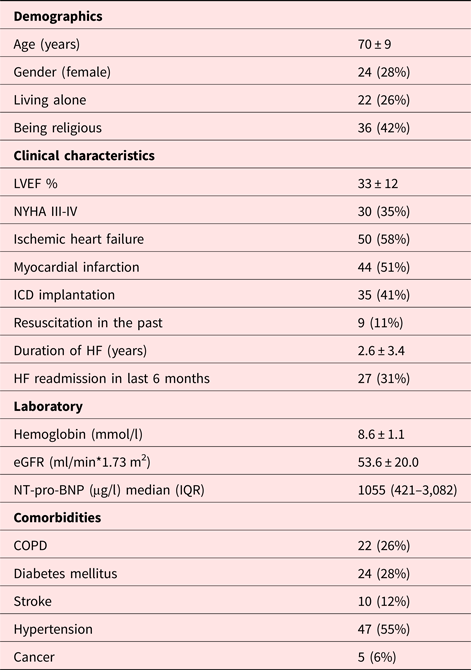
A total of 100 patients were included in this study. Fourteen patients were excluded from the analysis because they could not complete the questionnaire in time during the interview. The mean age of the patients was 70 ± 9 years, and 28% (n = 24) of the patients were female (Table 1). Patients had a mean LVEF of 33% ± 12%, and 35% (n = 30) of the patients were classified as NYHA functional class III-IV.
Demographic characteristics and clinical characteristics of the study population (N = 86)

eGFR = estimated globular filtration rate; ICD = internal cardiac defibrillator; IQR = interquartile range NT-pro-BNP = N-terminal prohormone of brain natriuretic peptide.
Dispositional Optimism and HRQoL
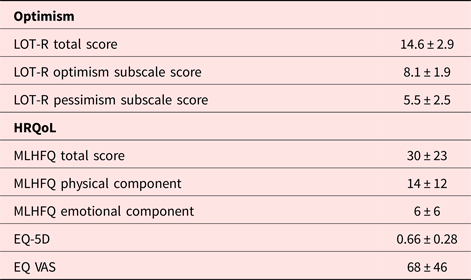
The mean total score on the LOT-R was 14.6 ± 2.9. The mean scores on the LOT-R optimism subscale and pessimism subscale were 8.1 ± 1.9 and 5.5 ± 2.5, respectively (Table 2).
Optimism and HR-QoL scores of the study population (N = 86)
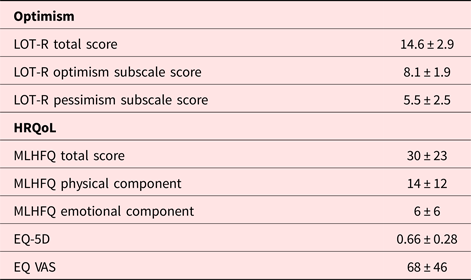
Optimism total score/optimism subscale/pessimism subscale: higher scores reflecting more dispositional optimism/optimism/pessimism.
MLHFQ total score and subscales: lower scores reflecting better HR-QoL.
EQ-5D and EQ VAS: higher score reflecting better HR-QoL.
The mean total score on the MLHFQ was 30 ± 23. The mean scores on the physical and emotional components were 14 ± 12 and 6 ± 6, respectively. The mean score on the EQ-5D was 0.66 ± 0.28 and the EQ VAS was 68 ± 46 (Table 2).
Relationship Between Dispositional Optimism and Pessimism and Demographic and Clinical Variables
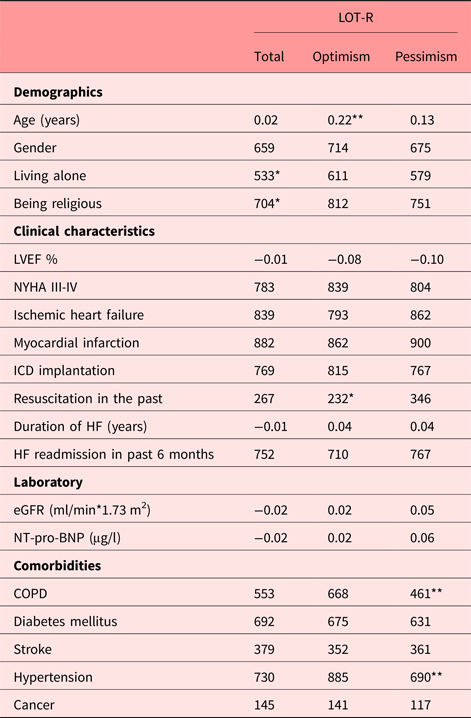
None of the independent variables were significantly related to the LOT-R total score (p < 0.05); however, there was a nonsignificant trend that not living alone and being religious were related to more dispositional optimism (patients who live alone [mean score 13.7] vs. patients who do not live alone [mean score 14.9] U = 533, p < 0.10 and patients who are religious [mean score 15.2] vs. patients who are not religious [mean score 14.2] U = 704, p < 0.10). Regarding the optimism subscale, having a higher age was related to more optimism (r = 0.22, p < 0.05). Regarding the pessimism subscale, having COPD or hypertension as a comorbidity was associated with more pessimism (having COPD [mean score 6.6] vs. not having COPD [mean score 5.1], U = 461, p < 0.05 and having hypertension (mean score 6.0) vs. not having hypertension [mean score 5.0], U = 690, p < 0.05) (Table 3).
Univariate associations between optimism and pessimism and demographic and clinical characteristics (N = 86)
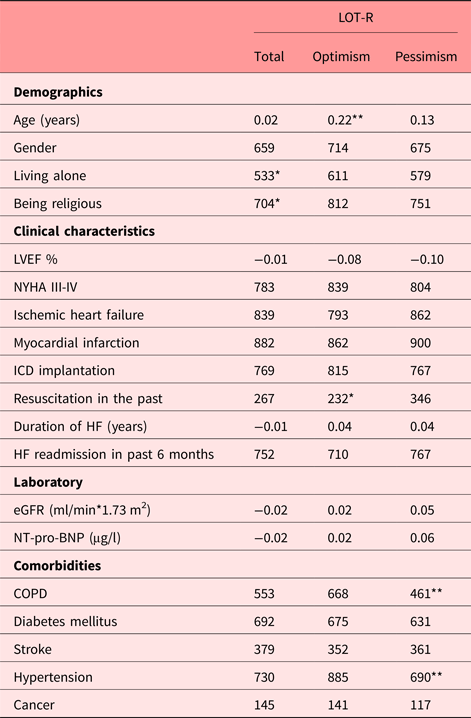
Data are presented as U for categorical independent variables and r for continues independent variables.
*p < 0.10, **p < 0.05.
ICD = internal cardiac defibrillator; eGFR = estimated globular filtration rate; NT-pro-BNP = N-terminal prohormone of brain natriuretic peptide.
Relationship Between Dispositional Optimism and Pessimism and HRQoL
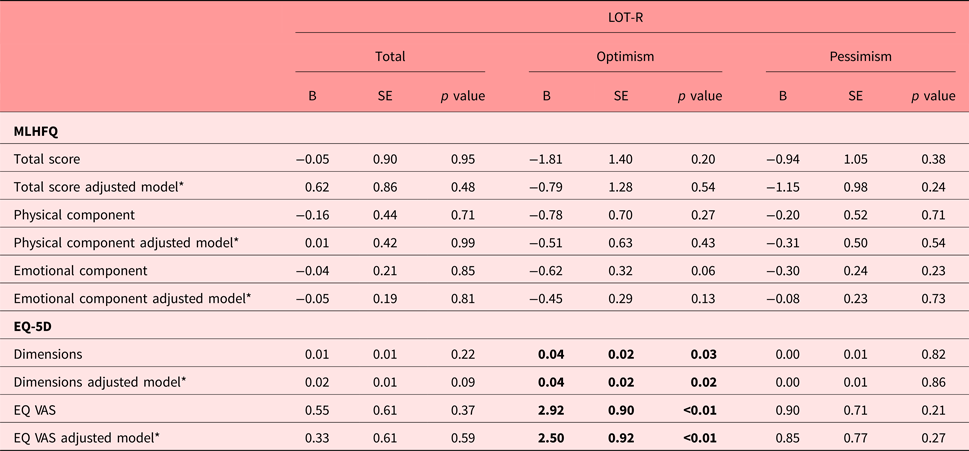
The optimism subscale of the LOT-R was significantly associated with HR-QoL when measured with the generic EQ-5D, but it was not significantly associated with HRQL when measured with the disease-specific MLHFQ. In the adjusted model (adjusted for variables associated with the LOT-R scores with a p value <0.10), the optimism subscale score remained significantly associated with the dimensions of the EQ-5D and the EQ-VAS score. The score on the pessimism subscale and total score on the LOT-R were not associated with the EQ-5D or the MLHFQ (Table 4).
Multivariate associations between optimism, pessimism, and HR-QoL (N = 86)
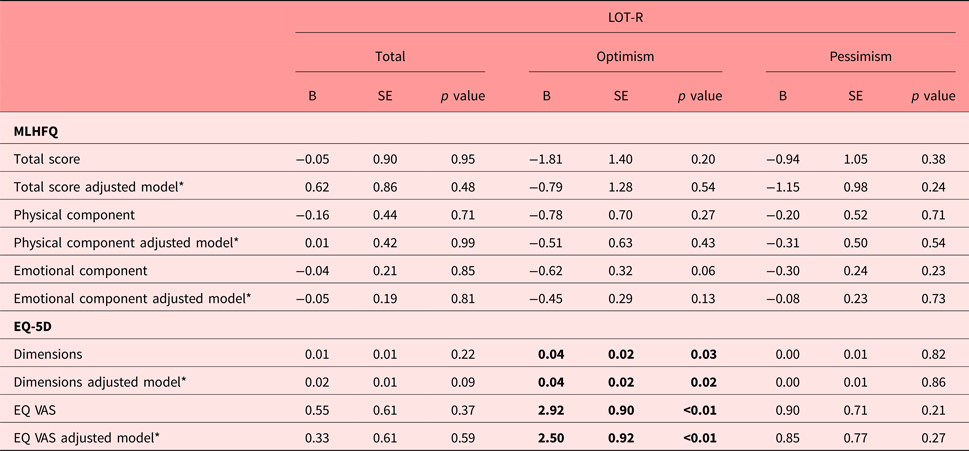
*Adjusted for demographical and clinical characteristics significantly (p < 0.010) associated with the specific HR-QOL score or LOT-R score.
Discussion
This is the first study to examine the relationship between dispositional optimism and HR-QoL of outpatients with HF. We found that higher age was associated with more optimism and that having COPD or hypertension was associated with more pessimism, as measured with the subscales of the LOT-R. In addition, we found independent associations between optimism and generic HR-QoL and between optimism and EQ-VAS, indicating that being more optimistic is related to a better HR-QoL. Independent associations were only found between generic HR-QoL and optimism, not between disease-specific HR-QoL and optimism. It could be that the MLFHQ was not sensitive enough in this population because of the small sample size of the study population (Sneed et al., Reference Sneed, Paul, Michel, Vanbakel and Hendrix2001).
The scores on the LOT-R of our study population are difficult to compare with the scores reported in other studies because only one study has used the LOT-R in HF patients (Giardini et al., Reference Giardini, Pierobon and Majani2012). The levels of optimism in our study population were lower than those found in the study of Giardini et al. (Reference Giardini, Pierobon and Majani2012), which might be explained by the higher age of the patients in our study. The HF patients in our study were slightly less optimistic compared with coronary bypass surgery (Scheier et al., Reference Scheier, Carver and Bridges1994) patients and urogenital cancer patients (Zenger et al. Reference Zenger, Brix, Borowski, Stolzenburg and Hinz2010); however, they were less pessimistic compared with patients with urogenital cancer.
Optimism is related to quality of life, which may be useful for future interventions. Because HF has a poor prognosis and causes severe symptoms, alternative ways to improve the HR-QoL of HF patients need to be further explored. Several studies in cancer patients found that optimists had a better global HR-QoL than pessimists (Carver et al., Reference Carver, Pozo-Kaderman and Harris1994, Reference Carver, Smith, Petronis and Antoni2006; Epping-Jordan et al., Reference Epping-Jordan, Compas and Osowiecki1999; Allison et al., Reference Allison, Guichard and Gilain2000). A systematic review on psychosocial interventions for cancer patients (Tamagawa et al., Reference Tamagawa, Garland, Vaska and Carlson2012) found two intervention studies with a moderating effect on dispositional optimism. After a cognitive-behavioral stress management intervention, women who showed lower levels of optimism before the intervention reported enhanced optimism relative to those who had higher levels of optimism before the intervention (Antoni et al., Reference Antoni, Lehman and Kilbourn2001). Another study (Scheier et al., Reference Scheier, Helgeson and Schulz2007) found the moderating effect of psychosocial factors, including dispositional optimism, after a nutrition-focused psychoeducation program.
Healthcare providers may wish to identify those patients who are at risk of being pessimistic since this may affect their HR-QoL. We found that the comorbidities COPD or hypertension were associated with more pessimism. The literature suggests that comorbidities also affect HR-QoL of patients with HF (Lesman-Leegte et al., Reference Lesman-Leegte, Jaarsma and Coyne2009a). The comorbidities COPD and hypertension are frequently found in HF patients and treatments are needed that target both these comorbidities and HF (Dahlstrom, Reference Dahlstrom2005). Furthermore, more research is necessary to explore the association between hypertension and pessimism in depth because hypertension is usually a diagnosis with relatively low complaints compared with a COPD diagnosis.
However, we also realize that interventions aimed directly at improving optimism are scarce, which makes it difficult to indicate what psychological care for patients with lower levels of optimism should look like. Applebaum et al. (Reference Applebaum, Stein and Lord-Bessen2014) speculate that the incorporation of screening for optimism, among other variables, into routine clinical care will allow for the prompt identification and referral of patients with low levels of optimism and social support to psychosocial programs that either directly provide (e.g., through group psychotherapy) or facilitate social support and promote the recognition of the possibility of the benefit and growth despite suffering. This may serve as a protective factor against psychopathology. A recent systematic review of the influence of psychological factors on HR-QoL after a stroke also confirms the need for more research on optimism (van Mierlo et al., Reference van Mierlo, Schroder and van Heugten2014).
Because our study is one of the first to address dispositional optimism and HR-QoL, more research is needed to be able to develop promising psychological interventions and to identify those patients who will benefit from these interventions.
Limitations of this study are its cross-sectional nature and small sample size. More noninterventional research on a larger population of patients in routine care is indicated and would strengthen the results of future studies. Furthermore, the independent association between optimism and general HR-QoL could be refined further in a larger study population when the patients are assigned to different groups depending on for example there LVEF and/or severity of HF symptoms (NYHA classification). We could not compare the clinical characteristics of the patients who participated with those who refused to participate because we did not have the latter group's signed informed consent. Nevertheless, the demographic and clinical parameters of our study population are comparable with those of the population in our HF patient clinic and other main studies (Bruggink-Andre de la Porte et al., Reference Bruggink-Andre de la Porte, Lok and van Wijngaarden2005; Jaarsma et al., Reference Jaarsma, van der Wal and Lesman-Leegte2008). In our study, we did not collect information about whether the patients underwent previous coronary artery bypass graft treatment or whether they suffered from dyslipidemia; these factors might also have an impact on the scores of the used instruments and would be a suggestion for further studies on optimism in patients with HF.
Conclusion
This study provides new insights into dispositional optimism in patients with HF and is, to our knowledge, the first study to explore the relationship between dispositional optimism and HR-QoL of patients with HF. This study found a relationship between optimism and HR-QoL of patients with HF. Given that the literature has suggested that optimism is a modifiable condition, improving optimism may be a promising way to improve HR-QoL of HF patients. However, more research is needed to assess which patients may benefit from psychological care and which specific psychological interventions are needed to improve their HR-QoL.
Acknowledgments
This work was supported by the Dutch Ministry of Health, Welfare, and Sport.
Conflicts of interest
None declared.