




No CrossRef data available.
Article contents
Perceptual span deficits in adults with HIV
Published online by Cambridge University Press: 06 February 2004
Abstract
Studies have found that infection with the Human Immunodeficiency Virus (HIV) leads to cognitive dysfunction. In fact, attention problems have been reported to be the most frequent cognitive symptom in HIV-infected adults. One question is how early in the course of information processing can attention impairment be detected? To address this issue, performance on a perceptual span task was examined in 54 HIV-infected adults and 19 seronegative controls. In this task a target had to be identified in a briefly presented (50 ms) array of 1, 4, or 12 letter-characters. Response accuracy was differentially worse in the HIV+ group relative to seronegative controls in the most difficult condition, the 12-item array, but not in the easier conditions. There was no evidence of a group difference in response strategy due to disinhibition or in psychomotor speed. These data suggest that HIV infection leads to a reduction in early visual processing capacity (or span of apprehension). The present results illustrate a new type of attentional deficit in HIV and show the impact of HIV on cognition at an earlier point in information processing than has been previously reported. (JINS, 2004, 10, 135–140.)
Information
- Type
- BRIEF COMMUNICATION
- Information
- Journal of the International Neuropsychological Society , Volume 10 , Issue 1 , January 2004 , pp. 135 - 140
- Copyright
- © 2004 The International Neuropsychological Society
INTRODUCTION
A large number of adults (approximately 30–50%) infected with the Human Immunodeficiency Virus (HIV) experience some degree of cognitive compromise (McArthur & Grant, 1998). The general neuropsychological profile of HIV is relatively well mapped-out (for reviews see Hinkin et al., 1998; McArthur & Grant, 1998), with the most frequent symptoms being grouped under the rubric of attention (Heaton et al., 1995). As we have recently reviewed (Hardy & Hinkin, 2002), in addition to problems with concentration, HIV+ adults show deficits in a variety of specific processing aspects of attention such as set-switching ability (van Gorp et al., 1989), divided attention (Hinkin et al., 2000), spatial orienting (Maruff et al., 1995), inhibition (Martin et al., 1992), and preparatory processing (Law et al., 1995). One important aspect of attention that has not yet been examined in HIV+ adults is perceptual span. Perceptual span tasks, which involve the discrimination of a target letter among briefly presented arrays of varying number of nontargets, were originally used to delineate potential capacity limitations in early visual processing (Estes & Taylor, 1964). This capacity limitation was termed the span of apprehension.
Span of apprehension is a useful concept in the neurocognitive study of HIV because it can delineate a processing deficit (i.e., central nervous system dysfunction) at a very early point in cognition. It is early visual processing (e.g., iconic memory capacity) that is considered with a perceptual span task because of the extreme time constraints that are imposed on stimulus processing. The unusually brief presentation of stimuli (relative to most cognitive tasks) precludes “later” processes that are often involved with standard test performance (e.g., visual search, full rehearsal of stimuli—in larger stimulus arrays there is not enough time for all stimuli information to be transferred to working memory, double-checking information through visual rescanning or matching with working memory information, etc.). Furthermore, if cognition is construed as a series of discrete processing components, which is a standard view from an information processing or cognitive neuroscience perspective (e.g., see Kosslyn & Koenig, 1992, p. 406), then an early processing (span of apprehension) deficit is significant in that it can result in the subsequent disruption of related and/or later processes located further down the processing stream. At a more general conceptual level, the perceptual span task with its severe processing time constraints may be ideal for the neurocognitive assessment of HIV because cognitive slowing is a fundamental symptom in HIV-infected individuals. Perceptual span tasks have also been shown to be highly sensitive to central nervous system dysfunction. For instance, perceptual span decrements are evident not only in actively psychotic schizophrenic adults (Neale et al., 1969), but also in schizophrenic adults in remission (Asarnow & MacCrimmon, 1978) and first-degree relatives of schizophrenic patients (Wagener et al., 1986). This broad range in task sensitivity may be ideal for HIV research given the subtle cognitive symptoms that are frequently observed in HIV-infected individuals. Thus, the perceptual span task appears well suited to detect subtle as well as severe HIV-related changes in cognition and central nervous system functioning.
For the present experiment, a group of HIV+ adults and a control group of HIV-seronegative adults (HIV−) perform a perceptual span task where a target stimulus must be identified among a very briefly presented array of a varying number of nontarget stimuli. The typical performance measure of interest on such a task is response accuracy in identifying the target. Therefore, it is predicted that response accuracy on the perceptual span task will be worse in HIV+ adults relative to HIV− adults, especially when task demands are greater where a target must be discriminated among multiple nontargets. Other aspects of task performance (such as reaction time) will also be examined.
METHODS
Research Participants
Participants for the present study included 54 HIV+ adults and 19 HIV− controls examined at the West Los Angeles VA Medical Center. HIV+ participants were recruited from an infectious disease clinic and from community agencies specializing in services for HIV-infected patients. Seronegative controls were recruited using posted fliers and referrals from these sites. Background information and medical history (including HIV status) of participants was provided through self-report data based on questionnaires and interviews. Exclusionary criteria included history of head injury with loss of consciousness in excess of 10 min, history of learning disability, and adverse neurological history (e.g., stroke or seizure disorder) including secondary HIV-related central nervous system infection or lymphoma. In addition, a structured clinical interview composed of the mood, psychotic spectrum, and substance use sections of the Structured Clinical Interview for the DSM–IV (First et al., 1995) was administered by trained psychologists to exclude those participants with current or past major depression disorder, bipolar disorder, or psychosis, as well as subjects with current drug or alcohol abuse/dependence. As can be seen in Table 1, HIV+ and HIV− groups did not significantly differ in age, education, estimated premorbid IQ as measured by the American Version of the National Adult Reading Test (AMNART), self-reported symptoms on the Beck Depression Inventory, Second Edition (BDI–II), corrected visual acuity, or general cognitive status as measured by the HIV Dementia Scale. Both groups included substantial proportions of women, with significantly more women in the seronegative control group χ2(1, N = 73) = 6.08, p = .014. A large proportion of participants were African American, but there was no significant difference in ethnic composition between subject groups χ2(4, N = 73) = 1.71, p = .789. Past alcohol abusers/dependents and past substance abusers/dependents were present in both groups, with a significant group difference in substance abusers/dependents. Mean CD4 count for the HIV+ group was 367 (SD = 266). Sixty-six percent of HIV+ participants met Centers for Disease Control (CDC, 1992) diagnostic criteria for acquired immunodeficiency syndrome (AIDS) and all HIV+ participants were currently on highly active antiretroviral therapy (HAART). Participants provided written informed consent and were paid 50 dollars for their participation.
Demographics for HIV− and HIV+ Groups

Task and Procedure
Participants completed the perceptual span task (and other parts of the protocol such as the background questionnaires and interviews, etc.) as part of a larger neuropsychological study on medication adherence in HIV-infected adults. All participants completed the entire protocol according to a uniform procedure, which was always completed within a single day. The perceptual span task used in the present study was programmed (by the first author) with SuperLab software (SuperLab Pro Version 2.0, 1999) on a personal microcomputer and was based on a task used by Estes and Taylor (1964, 1965). Each trial of the span task began with the presentation of a central fixation for 1000 ms followed immediately by a stimulus array for a duration of 50 ms. The stimulus array could be either one, four, or 12 black letter-characters on a white background (see Figure 1). The letter-characters T and F were targets and required a left and right button press respectively (with the left or right index finger) on a response box. Nontarget letter-characters included randomized selections from the alphabet with no repeat characters within a single array. Each array included a single target (except for target-absent catch trials). Location of characters was randomly assigned on an invisible 4 × 4 grid subtending approximately 17.0 × 16.2° at the center of the monitor. Each character subtended approximately 2.6 × 2.4°. The trial terminated after either a subject response or 2000 ms. The next trial began 2000 ms after either the subject response or the previous 2000 ms wait period. There were a total of 120 trials with 40 trials (32 target-present trials and 8 target-absent catch trials) per array size. After 20 trials of practice, participants completed 6 blocks of 20 trials each. Each block contained only one stimulus array size and blocks were presented in an alternating sequence (1, 4, 12, 1, 4, 12).

An illustration of stimulus events and array size with three example trials in the perceptual span task. Target = T or F. Array duration = 50 ms.
RESULTS
Response accuracy for target-present trials was analyzed with a 2 × 3 mixed-model analysis of covariance (ANOVA), with subject group (HIV− and HIV+) as a between-subjects variable, stimulus array size (1, 4, and 12) as a within-subjects variable, and history of either alcohol abuse/dependence or substance abuse/dependence as a covariate. Responses faster than 100 ms and slower than 2000 ms were excluded from analyses. A Greenhouse-Geisser correction was applied to within-subjects effects. Post hoc comparisons were examined with three one-way ANCOVAs. Because catch trials (target-absent trials) were presented, an additional 2 × 3 mixed-model ANCOVA was conducted to analyze group differences in false alarm responses. In addition, to account for possible psychomotor speed differences between subject groups, a 2 × 3 mixed-model ANCOVA was conducted on correct reaction times.
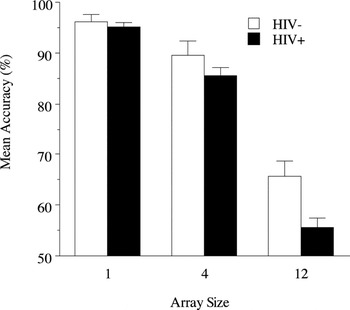
For response accuracy, there was a significant main effect of array size [F(2,140) = 135.5, p < .001], with mean percent accuracy of 95.7% (SE = 0.8) for array size one, 87.6% (SE = 1.6) for array size four, and 60.6% (SE = 1.8) for array size 12. The main effect for group was significant [F(1,70) = 4.1, p = .046], with response accuracy of 83.8% (SE = 2.1) for the HIV− group and 78.8% (SE = 1.3) for the HIV+ group. There was no significant main effect (p = .143) or interaction (p = .239) for history of alcohol or substance abuse/dependence. Most importantly, there was a significant interaction between Group × Array Size [F(2,140) = 5.1, p = .010], and is illustrated in Figure 2. To clarify this interaction, a separate ANCOVA was conducted at each array size to compare the group difference in response accuracy. There was no significant difference between the HIV− group and HIV+ group for array size one (96.2%, SE = 1.4; and 95.1%, SE = 0.8, respectively) or array size four (89.6%, SE = 2.8; and 85.5%, SE = 1.7, respectively). There was a significant difference between groups at array size 12 [65.6%, SE = 3.1; and 55.6%, SE = 1.8, respectively; F(1,70) = 7.5, p = .008]. Because there was a larger percentage of women in the HIV− group relative to the HIV+ group, a series of analyses on response accuracy like those above were conducted but this time including gender of participant (male or female) as an additional between-subjects variable. The inclusion of participant gender had no affect on the pattern of the previously reported results, with no significant main effect or interactions with gender.

Mean percent correct responses (± SE) for target identification on the perceptual span task for HIV+ and HIV− groups.
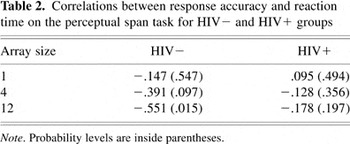
For false alarm responses, there was a significant main effect of array size [F(2,140) = 20.6, p < .001], with mean false alarm rate of 0.08 (SE = 0.05) for array size one, 0.95 (SE = 0.17) for array size four, and 2.28 responses (SE = 0.29) for array size 12. The main effect of group (p = .262) and the interaction between Group × Array Size (p = .419) were not significant. History of alcohol or substance abuse/dependence had no significant effects. For reaction time, there was a significant main effect of array size [F(2,140) = 50.3, p < .001], with a mean reaction time of 588 ms (SE = 19) for array size one, 724 ms (SE = 21) for array size four, and 819 ms (SE = 24) for array size 12. There was no overall reaction time difference between the HIV− group (705 ms, SE = 34) and HIV+ group (716 ms, SE = 20; p = .783) and the interaction between Group × Array Size was not significant (p = .731). Again, history of alcohol or substance abuse/dependence had no significant effects on reaction time. To examine possible speed–accuracy trade-offs, correlation analyses were conducted between response accuracy and reaction time for HIV− and HIV+ groups at each array size. As can be seen in Table 2, there was one significant negative correlation coefficient, in the array size 12 condition for the HIV− group. Thus, there is no evidence for either group for a speed–accuracy tradeoff.
Correlations between response accuracy and reaction time on the perceptual span task for HIV− and HIV+ groups

DISCUSSION
As hypothesized, HIV+ adults were less accurate than HIV− adults in target identification under the most demanding perceptual condition (array size 12) but not when attentional demands were less. A standard interpretation of this group difference in span performance is that HIV+ adults have a restricted span of apprehension, a deficit in the ability to effectively process large amounts of information at an early level of visual processing (perhaps due to reduced iconic storage). This finding is generally compatible with other situations of information overload in HIV+ adults, such as with working memory (Martin et al., 1995; Worth et al., 1993) and divided attention (Hinkin et al., 2000). However, given that perceptual span tasks assess capacity limitations in very early visual processing, these data show that HIV+ adults experience information overload (or a capacity limitation) at an earlier point in processing than previously realized. An important implication of this finding is that such an early information processing deficit could modulate or disrupt subsequent higher-order or more complex levels of cognitive functioning.
Results must be treated with some degree of caution considering the number of analyses that were conducted. At the same time, although alpha inflation is a risk here, the p value of .01 for the interaction between Array Size × Subject Group in the analysis on response accuracy is relatively small. Conversely, the effect size, such as the F value of 5.1, is relatively large considering this is an interaction statistic. In addition, because this is an initial study of the effects of HIV on perceptual span, an aspect of cognition that has not received any attention in HIV research, it was considered important to balance the risks of a type I error with that of a type II error. Also raising interpretational issues are the demographic differences between the groups. The seronegatives included more females than the HIV+ group. In addition, there were more individuals with a history of substance abuse/dependence in the HIV+ group. However, both of these variables had no influence, either as a main effect or interacting with other variables, on perceptual span performance in any of the analyses. Therefore, it is unlikely that the worse performance in the HIV+ group was due to these demographic differences.
The neurophysiological substrate(s) that mediates perceptual span performance is currently unknown and may in fact differ as a function of the population being studied. Span deficits in schizophrenia have been attributed to multiple different, but potentially overlapping, central nervous system substrates including structures such as posterior parietal regions and thalamic structures such as the lateral pulvinar (Asarnow et al., 1991). Given the known affinity of HIV for subcortical structures, and the link between these structures and cognition (Martin, 1994), it may be that span deficits among HIV-infected adults arise as a function of insult to thalamic structures, striatum, or thalamostriatal projections. Obviously, these same circuits are linked to cortical regions, including prefrontal cortex, and HIV has been shown to compromise the integrity of frontal–subcortical circuits. As such, perceptual span performance may be particularly sensitive to frontal–subcortical dysfunction in HIV+ adults.
Other factors that could influence or mediate span performance should also be addressed. For instance, it could be argued that poor span performance does not have to rely on any processing capacity limitation but instead is due to the accumulation of decision processing noise (Duncan, 1980; Pashler, 1998; Tanner, 1961). If the letters in an array are processed individually and independently on separate “channels,” which is a reasonable assumption, and there is a nonzero probability of confusing a nontarget with a target, then the accumulated chance of making a mistake automatically increases as the number of letters in the array increases. Therefore, one possible explanation for the present group difference in span performance is that HIV+ adults have greater difficulty effectively distinguishing signals from noise in determining their response. Another factor that could influence span performance is response strategy. To the degree that HIV infection leads to deficits in response inhibition, perhaps the HIV+ adults responded before they had sufficiently processed the stimulus array information. This is unlikely, however, because there were no group differences in false alarm responses. Furthermore, it was only the HIV− group that demonstrated any significant association between response accuracy and reaction time, a significant negative correlation in the array size 12 condition indicating more accurate responses were associated with faster responses. Although this finding is somewhat counterintuitive, it makes sense when considering that the duration of information in the visual sensory store (iconic memory) is very brief, perhaps no greater than 500 ms (e.g., Sperling, 1960). Thus, responses made before array information rapidly fades away are typically more accurate than slower responses. A group difference in psychomotor speed is also an unlikely contributing factor to the HIV-related deficit in span performance because there were no significant group differences in reaction time. This lack of HIV-related slowing in reaction time is not unseemly; such a finding has been reported several times (e.g., Grassi et al., 1999; Miller et al., 1991; for a review on reaction time in HIV, see Hardy & Hinkin, 2002). In addition, although subjects were instructed to respond quickly, accurate responding was the primary goal of subjects. Traditional “reaction time” tasks are usually easy enough to ensure high levels of accuracy, for ease of interpretation of reaction time or mental chronometric differences. Therefore, the emphasis with perceptual span tasks is typically on response accuracy, as it was in the present study.
In summary, the perceptual span results of the present study support and extend the finding that HIV-infected adults experience problems with neurocognitive processing. Specifically, the data indicate that HIV infection leads to a processing capacity reduction or impairment at a significantly earlier stage of information processing than has previously been reported. Future studies will delineate the processing characteristics of this HIV-related deficit in span of apprehension (e.g., temporal and perceptual load aspects) as well as examine its role as a specific “rate limiting factor” (Green, 1993) or mediator for more complex cognition and behavior in HIV+ adults.
ACKNOWLEDGMENTS
This study was supported by National Institute on Aging Grant No. R03 AG-18549 (awarded to David J. Hardy) and by National Institute of Mental Health Grant No. R01 MH-58552 (awarded to Charles H. Hinkin). We gratefully acknowledge Marta Stefaniak, Mona Lam, Karen Mason, and Bryan Zolnikov for assistance on the present study. Portions of this paper were presented at the 28th Annual Meeting of the International Neuropsychological Society, Denver, Colorado, February 2000 and at the 81st Annual Convention of the Western Psychological Association, Maui, Hawaii, May 2001.
References
REFERENCES
Asarnow, R.F.,
Granholm, E., &
Sherman, T.
(1991).
Span of apprehension in schizophrenia. In
S.R. Steinhauer,
J.H. Gruzelier, &
J. Zubin (Eds.),
Neuropsychology, psychophysiology and information processing (pp.
335–370).
Amsterdam:
Elsevier Science Publishers.
Asarnow, R.F. &
MacCrimmon, D.J.
(1978).
Residual performance deficit in clinically remitted schizophrenics:
A marker for schizophrenia?
Journal of Abnormal Psychology,
87,
597–608.Google Scholar
Centers for Disease Control.
(1992).
1993 revised classification system for HIV infection and expanded
surveillance case definition for AIDS among adolescents and adults. Morbidity and Mortality Weekly Report,
41
(Suppl. 44–17),
1–19.Google Scholar
Duncan, J.
(1980).
The demonstration of capacity limitation.
Cognitive Psychology,
12,
75–96.Google Scholar
Estes, W.K. &
Taylor, H.A.
(1964).
A detection method and probabilistic models for assessing
information processing from brief visual displays.
Proceedings of the National Academy of Science,
52,
446–454.Google Scholar
Estes, W.K. &
Taylor, H.A.
(1965).
Visual detection in relation to display size and redundancy of
critical elements.
Perception and Psychophysics,
1,
9–15.Google Scholar
First, M.B.,
Spitzer, R.L.,
Gibbon, M., &
Williams, J.B.W.
(1995).
Structured Clinical Interview for DSM IV Axis Disorder, Version 2.0.
New York:
Biometrics Research.
Grassi, B.,
Garghentini, G.,
Arturo, C.,
Grassi, E.,
Bertelli, S.,
Cinque, P.,
Epifani, M.,
Lazzarin, A., &
Scarone, S.
(1999).
Spatial working memory in asymptomatic HIV-infected subjects.
The Journal of Neuropsychiatry and Clinical Neurosciences,
11,
387–391.Google Scholar
Green, M.F.
(1993).
Cognitive remediation in schizophrenia: Is it time yet?
American Journal of Psychiatry,
150,
178–187.Google Scholar
Hardy, D.J. &
Hinkin, C.H.
(2002).
Reaction time performance in adults with HIV/AIDS.
Journal of Clinical and Experimental Neuropsychology,
24,
912–929.Google Scholar
Heaton, R.K.,
Grant, I.,
Butters, N.,
White, D.A.,
Kirson, D.,
Atkinson, J.H.,
McCutchan, J.A.,
Taylor, A., &
the HNRC Group.
(1995).
The HNRC 500—Neuropsychology of HIV infection at different
disease stages.
Journal of the International Neuropsychological Society,
1,
231–251.Google Scholar
Hinkin, C.H.,
Castellon, S.A., &
Hardy, D.J.
(2000).
Dual task performance in HIV-1 infection.
Journal of Clinical and Experimental Neuropsychology,
22,
16–24.Google Scholar
Hinkin, C.H.,
Castellon, S.A.,
van Gorp, W.G., &
Satz, P.
(1998).
Neuropsychological features of HIV disease. In
W.G. van Gorp &
S.L. Buckingham (Eds.),
Practitioner's guide to the neuropsychiatry of HIV/AIDS
(pp.
1–41).
New York:
The Guilford Press.
Kosslyn, S.M. &
Koenig, O.
(1992).
Wet mind. The new cognitive neuroscience.
New York:
Free Press.
Law, W.A.,
Mapou, R.L.,
Roller, T.L.,
Martin, A.,
Nannis, E.D., &
Temoshok, L.R.
(1995).
Reaction time slowing in HIV-1-infected individuals: Role of the
preparatory interval.
Journal of Clinical and Experimental Neuropsychology,
17,
122–133.Google Scholar
Martin, A.
(1994).
HIV, cognition, and the basal ganglia. In
I. Grant &
A. Martin (Eds.),
Neuropsychology of HIV infection (pp.
234–259).
New York:
Oxford University Press.
Martin, E.M.,
Pitrak, D.L.,
Pursell, K.J.,
Mullane, K.M., &
Novak, R.M.
(1995).
Delayed recognition memory span in HIV-1 infection.
Journal of the International Neuropsychological Society,
1,
575–580.Google Scholar
Martin, E.M.,
Robertson, L.C.,
Edelstein, H.E.,
Jagust, W.J.,
Sorensen, D.J.,
Giovanni, D.S., &
Chirurgi, V.A.
(1992).
Performance of patients with early HIV-1 infection on the Stroop
task.
Journal of Clinical and Experimental Neuropsychology,
14,
857–868.Google Scholar
Maruff, P.,
Malone, V.,
McArthur-Jackson, C.,
Mulhall, B.,
Benson, E., &
Currie, J.
(1995).
Abnormalities of visual spatial attention in HIV infection and the
HIV-associated dementia complex.
Journal of Neuropsychiatry and Clinical Neurosciences,
7,
325–333.Google Scholar
McArthur, J.C. &
Grant, I.
(1998).
HIV neurocognitive disorders. In
H.E. Gendelman,
S.A. Lipton,
L. Epstein, &
S. Swindells, (Eds.),
The neurology of AIDS (pp.
499–523).
New York:
Chapman & Hall.
Miller, E.N.,
Satz, P., &
Visscher, V.
(1991).
Computerized and conventional neuropsychological assessment of
HIV-1-infected homosexual men.
Neurology,
41,
1608–1616.Google Scholar
Neale, J.M.,
McIntyre, C.W.,
Fox, R., &
Cromwell, R.L.
(1969).
Span of apprehension in acute schizophrenics.
Journal of Abnormal Psychology,
74,
593–596.Google Scholar
Pashler, H.E.
(1998).
The psychology of attention.
Cambridge, MA:
MIT Press.
Sperling, G.
(1960).
The information available in brief visual presentations.
Psychological Monographs,
74
(whole no. 498).Google Scholar
SuperLab Pro Version 2.0 (Computer Software)
(1999).
San Pedro, CA:
Cedrus Corporation.
Tanner, W.P., Jr.
(1961).
Physiological implications of psychophysical data.
Annals of the New York Academy of Science,
89,
752–765.Google Scholar
van Gorp, W.G.,
Miller, E.N.,
Satz, P., &
Visscher, B.
(1989).
Neuropsychological performance in HIV-1 immunocompromised patients:
A preliminary report.
Journal of Clinical and Experimental Neuropsychology,
11,
763–773.CrossRefGoogle Scholar
Wagener, D.K.,
Hogarty, G.E.,
Goldstein, M.J.,
Asarnow, R.F., &
Browne, A.
(1986).
Information processing and communication deviance in schizophrenic
patients and their mothers.
Psychiatry Research,
18,
365–377.CrossRefGoogle Scholar
Worth, J.L.,
Savage, C.R.,
Baer, L.,
Esty, E.K., &
Navia, B.A.
(1993).
Computer-based neuropsychological screening for AIDS dementia
complex.
AIDS,
7,
677–681.Google Scholar

Demographics for HIV− and HIV+ Groups

An illustration of stimulus events and array size with three example trials in the perceptual span task. Target = T or F. Array duration = 50 ms.
Mean percent correct responses (± SE) for target identification on the perceptual span task for HIV+ and HIV− groups.
Correlations between response accuracy and reaction time on the perceptual span task for HIV− and HIV+ groups
 You have
Access
- 10
- Cited by