Introduction
Despite modest efficacy and significant safety risks, antipsychotics and benzodiazepines continue to be prescribed at high rates in nursing homes, both in Australia and internationally (Snowdon et al., Reference Snowdon, Day and Baker2005; Kamble et al., Reference Kamble2008; Valiyeva et al., Reference Valiyeva, Herrmann, Rochon, Gill and Anderson2008; Banerjee, Reference Banerjee2009). These medications are often used to manage the behavior of residents with dementia, treat anxiety and regulate sleep, despite potentially severe adverse effects, including falls and resultant hip fracture with benzodiazepines, and increased risk of cerebrovascular event and death associated with antipsychotic therapy (Glass et al., Reference Glass, Lanctot, Herrmann, Sproule and Busto2005; Ballard et al., Reference Ballard, Waite and Birks2006; Schneider et al., Reference Schneider, Dagerman and Insel2006). The likelihood of adverse effects appears to be dose-related, and some risks, such as mortality associated with antipsychotic use in older people with dementia, appear to increase with longer duration of use (Jeste et al., Reference Jeste2008; Ballard et al., Reference Ballard2009). Practice guidelines consistently state that when these psychotropic medications are used they should be prescribed at the lowest effective dose for the shortest time required (Royal Australian College of General Practitioners, 2000; American Psychiatric Association, 2007; Gauthier et al., Reference Gauthier2010).
“RedUSe” (Reducing Use of Sedatives) was a controlled trial conducted in 25 Tasmanian nursing homes over a period of six months in 2008–9, with 13 intervention and 12 control homes. The main objective of the trial was to promote appropriate usage of antipsychotics and benzodiazepines (Westbury et al., Reference Westbury, Jackson, Gee and Peterson2010). The key strategies of the trial involved regular psychotropic medication audit, benchmarking and feedback, nursing staff education and interdisciplinary medication review. These strategies were coordinated and delivered by community pharmacists and were primarily targeted at nursing home staff, although physicians, residents and relatives were also involved. The RedUSe trial produced a significant reduction in the prevalence of antipsychotic and benzodiazepine usage in intervention homes, and a significant increase in the number of dose reductions of these agents. In contrast, the prevalence of antipsychotic and benzodiazepine use and dose reductions in control homes did not alter throughout the trial.
Two recent reviews of interventions to improve nursing home prescribing have both noted a lack of follow-up studies to assess long-term impact (Nishtala et al., Reference Nishtala, McLachlan, Bell and Chen2008; Zachary et al., Reference Zachary, Handler, Wright and Hanlon2010). One published follow-up study of an intervention to improve psychotropic prescribing in nursing homes was conducted by Schmidt and Fastbom three years after their 1995 controlled intervention study, which involved monthly interdisciplinary meetings over a 12-month period (Schmidt et al., Reference Schmidt, Claesson, Westerholm, Nilsson and Svarstad1998; Schmidt and Fastbom, Reference Schmidt and Fastbom2000). In their follow-up study, Schmidt and Fastbom found that fewer residents in intervention nursing homes received hypnotics than residents in control homes. Several appropriateness of prescribing indicators were also significantly improved, including a reduction in the prescribing of three or more medications that could increase the risk of confusion and fewer non-recommended hypnotics (Schmidt and Fastbom, Reference Schmidt and Fastbom2000). It should be noted, though, that Schmidt and Fastbom conducted their follow-up study three years after the original study, an extended period of time which may, in all probability, have diluted the impact of the intervention. Additionally, dosages of psychotropic medication were not considered.
This study set out to evaluate if the effect of the RedUSe intervention on antipsychotic and benzodiazepine prevalence and dosing was sustained a year after its completion. This was achieved by performing a repeat audit of psychotropic medication use in all nursing homes that participated in the original study, and comparing this prescribing data to baseline and trial endpoint (6-month) data.
Methods
Research design
The study design for the original RedUSe project was a controlled trial conducted in 25 nursing homes in Tasmania. The intervention group included 13 nursing homes in Hobart and 12 control nursing homes in Launceston (the two cities are geographically 180 km apart). The two towns are similar in terms of size, number of general practitioners and degree of urbanization. This trial structure was chosen to avoid contamination, as it was thought if intervention and control homes were in the same locality, pharmacists, nurses and physicians associated with intervention homes may service control homes as well, with the risk of intervention information spreading to control homes.
The primary outcome measure in the RedUSe project was the nursing home prescribing rates of antipsychotics and benzodiazepines. Secondary measures were prevalence of antidepressants and the number of dosage variations of antipsychotics and benzodiazepines. The same outcome measures were used for the 12-month follow-up study; however, as dosing information from individual residents could not be linked to previous data, dose variations could not be evaluated as before. In order to gain an indication of dosage change over time, all antipsychotic and benzodiazepine doses were converted into chlorpromazine and diazepam equivalents, respectively. All equivalent doses were calculated using the WHO International Classification of Primary Care and several other key references (Woods, Reference Woods2003; World Health Organization, 2006; South London and Maudsley NHS Foundation Trust Oxleas NHS Foundation Trust, 2010). Where more than one agent in the same psychotropic class was taken by the same resident, the dose equivalents were added together. Mean daily equivalent doses for each nursing home were calculated by adding the daily equivalent doses of each nursing home resident together and dividing the total by the number of residents taking psychotropic medications from each psychotropic class.
Clonazepam was excluded from our benzodiazepine measures as subsidized supply of this medication is restricted to the management of epilepsy. Similarly, lithium carbonate, clozapine and zuclopenthixol were also excluded as these agents are restricted for the management of schizophrenia or bipolar disorder, where regular dose reductions are not recommended.
Data measurement
The RedUSe medication audit computer program was modified for the follow-up study and installed at each community pharmacy supplying the participating nursing homes. The customized program assimilated community pharmacy prescribing information from nursing home medication packaging programs, such as Manrex-Webstercare®. Community pharmacies supplying nursing homes use these packing programs to prepare and label resident medications into individualized blistered packs, which are delivered to the homes and subsequently administered to residents by nursing staff.
The “data-mined” medication and dosing details were subsequently verified against each resident medication chart by researchers. Psychotropic medication that was not packed, such as antipsychotic wafers or liquid preparations, was added separately to the database, as were all “prn” or “as required” doses. If a “prn” psychotropic agent was administered on four or more days per week over the past month it was considered to be taken regularly and included in prevalence counts. The outcome measures were then calculated utilizing de-identified data obtained from this audit.
Recruitment of participants
After ethical approval for the follow-up study was granted, nursing homes involved in the original RedUSe study were invited to participate. All 25 nursing homes agreed to take part in the re-audit. All community pharmacies supplying these homes also agreed to take part, aside from one pharmacy due to concerns about installing the audit program in their new computer system. In this particular case, psychotropic data for this nursing home was collected via a manual audit of medication charts at the nursing home.
Analysis
The psychotropic prevalence rates and mean daily dosage equivalence of antipsychotics and benzodiazepines of all participant nursing homes at the 18-month follow-up were calculated, grouped and then statistically analyzed. These data was then compared to data collected from the nursing homes at baseline and trial endpoint (time = 6 months).
Antipsychotic and benzodiazepine prevalence and mean daily dosage equivalence outcomes over the three data collection periods (baseline, trial endpoint and follow-up) were analyzed using two-way (group and time) repeated measures analyses of variance (R-ANOVA), with post-hoc analyses to examine any significant differences across individual time points. Analyses were performed using StatView, version 5.0 (SAS Institute Inc., Cary, NC). P-values < 0.05 were considered statistically significant.
The original RedUSe project was registered as a controlled trial at the Australian New Zealand Clinical Trials Registry: registration number: ACTRN12608000221358. Approval for the follow-up trial was granted by the Human Research Ethics Committee (Tasmania) Network: approval number H0009858.
Results
The number of residents in the 13 intervention and 12 control nursing homes in the follow-up (18 month) collection period was 863 and 715, respectively, resulting in a total sample of 1578 residents. This sample is consistent with previous sample sizes of 1575 residents at baseline and 1593 residents at trial endpoint (6-month). The number of residents in each intervention nursing home ranged from 31 to 95, with a mean home size of 66 beds, whereas the number of residents ranged from 20 to 118 in the control nursing homes, with a mean home size of 60 beds.
The overall effect of RedUSe on benzodiazepine rates from baseline to follow-up
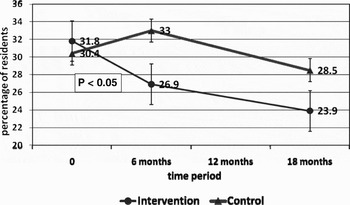
Benzodiazepine prevalence in the nursing home group across the three time points is illustrated in Figure 1. Benzodiazepine prevalence decreased consistently over all time periods in intervention nursing homes. In contrast, mean prevalence increased in control homes during the intervention but then decreased in the 12 months following the RedUSe trial. A two-way repeated measures ANOVA found no significant overall difference in benzodiazepine prevalence between nursing home groups. There was, however, a significant decrease over time in benzodiazepine prevalence (F (2,23) =6.2; P < 0.005). A Fisher's PLSD post-hoc test revealed a significant decrease in overall benzodiazepine prevalence from baseline to the 18-month follow-up and in the 12 months following the RedUSe trial, but there was no significant difference in benzodiazepine prevalence during the trial itself. There was a significant interaction effect between trial group and time (F (2,23) = 3.8; P < 0.05). Individual simple effects analysis of this interaction revealed that benzodiazepine prevalence was significantly reduced in intervention homes when compared to control homes at the end of the RedUSe trial (F (2.23) = 12.1; P < 0.05) but not 12 months after the trial, or the 18 months since RedUSe was initiated.
Mean proportion of benzodiazepine use in intervention vs. control nursing homes from baseline (time 0) to follow-up (time 18 months).
Note: The only significant decrease in benzodiazepine use occurred in intervention nursing homes during the RedUSe trial.

The overall effect of RedUSe on daily diazepam equivalence from baseline to follow-up
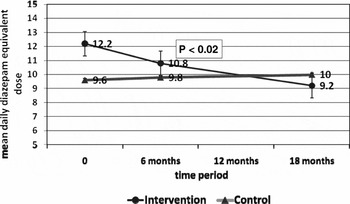
The mean daily diazepam dose equivalence across the three time periods is illustrated in Figure 2. Mean daily diazepam equivalent dose values decreased consistently across all time periods in the intervention nursing home group, whereas daily diazepam equivalence in the control homes increased slightly over the same time periods. A two-way repeated measures ANOVA demonstrated no significant difference overall between nursing home groups or across time; however, there was a significant interaction effect between trial group and time (F (2,23) = 4.7; P < 0.02). This indicates that mean daily diazepam equivalences in the intervention and the control nursing home groups changed differently over the three time periods. Individual simple effects analysis of this interaction revealed that daily diazepam equivalence was not significantly reduced in intervention homes when compared to control homes during the RedUSe trial or in the 12 months following the trial. However, over the 18 months since RedUSe was initiated, the mean daily diazepam equivalence in intervention homes had reduced significantly in comparison to control nursing homes (F (2,23) = 6.3; P < 0.02).
Mean daily diazepam equivalent dose in intervention vs. control nursing homes from baseline (time 0) to follow-up (time 18 months).
Note: A significant decrease in benzodiazepine equivalent dose was observed in intervention nursing home after 18 months.

Overall, when comparing baseline to the 18-month follow-up, the prevalence of benzodiazepine use and mean daily diazepam equivalence in intervention nursing homes had decreased by 25% and 24%, respectively. On the other hand, neither benzodiazepine prevalence nor mean daily diazepam equivalence had altered significantly in control homes.
The overall effect of RedUSe on antipsychotic rates from baseline to follow-up
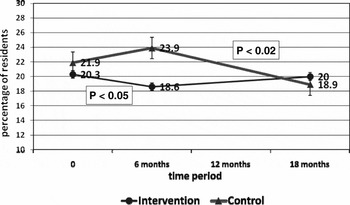
Antipsychotic prevalence across the three data collection points is shown in Figure 3. Following an initial decrease in usage in the intervention homes throughout the RedUSe trial, the antipsychotic prevalence rate returned to baseline level at the 18-month follow-up measure. In control homes antipsychotic use increased throughout the trial period but then decreased markedly during the 12 months following the RedUSe project. The two-way repeated measures ANOVA revealed no significant overall differences between trial groups or across time; however, there was a significant interaction effect on antipsychotic prevalence between nursing home group and time (F (2,23) = 3.9; P < 0.05). Individual simple effects analysis of this interaction revealed that antipsychotic prevalence was significantly reduced in intervention homes when compared to control homes during the RedUSe trial (F (2,23) = 5.0; P < 0.05). Conversely, antipsychotic prevalence was significantly reduced in control homes when compared to intervention nursing homes in the 12 months following the RedUSe project [F (2,23) = 6.8; P < 0.02).
Mean proportion of antipsychotic use in intervention vs. control nursing homes from baseline (time 0) to follow-up (time 18 months).
Note: A significant decrease in antipsychotic use was observed in intervention nursing homes during the RedUSe trial, whereas the control nursing home antipsychotic use decreased significantly in the 12 months following the project.

The overall effect of RedUSe on daily chlorpromazine equivalence from baseline to follow-up
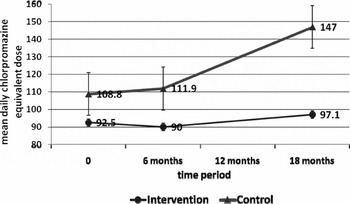
The mean daily chlorpromazine equivalence in intervention and control nursing homes across all time periods is shown in Figure 4. Intervention home daily chlorpromazine equivalence remained relatively constant across all three data collection points. However, mean daily chlorpromazine equivalence in control nursing homes rose sharply in the 12 months following the RedUSe project. A two-way repeated measures ANOVA demonstrated a significant difference between intervention and control nursing home mean daily chlorpromazine equivalence values (F (2,23) = 7.9; P = 0.01), and a significant difference across time (F (2,23) =4.2; P < 0.05). A Fisher's PLSD post-hoc test revealed a significant increase in mean daily chlorpromazine equivalence between baseline and 18-month follow-up and in the 12 months following the RedUSe trial. The increase in mean daily chlorpromazine equivalence during the RedUSe trial was not significant. Finally, no interaction between nursing home group and time was found, meaning that mean daily chlorpromazine equivalence in intervention and control nursing home groups was not affected differently over time.
Mean daily chlorpromazine equivalent dose in intervention vs. control nursing homes from baseline (time 0) to follow-up (time 18 months).
Note: There were no significant changes in mean daily chlorpromazine equivalent dose in either intervention or control nursing homes

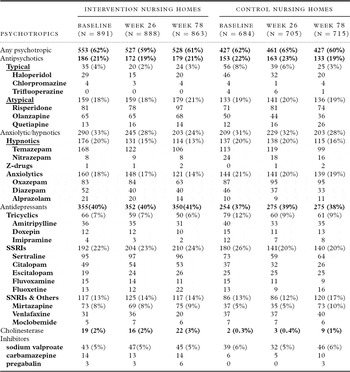
An itemized listing of psychotropics used in intervention and control homes at the three time-point measures is provided as Table 1. Notably, total antidepressant use did not vary significantly in either nursing home group at any time point during and after the RedUSe trial. However, in the 12 months following the RedUSe project, mirtazapine prevalence increased from 5% to 10% in control homes, coinciding with a 4% fall in hypnotic benzodiazepine use. The use of the sedating tricyclic antidepressants and mirtazapine remained constant throughout all time periods in intervention nursing homes.
Number (%) of RACF residents taking psychotropic medication regularly in Intervention and Control nursing homes at Baseline (Aug/Sep 2008), Week 26 (Mar 2009) and Week 78 (Mar 2010)a

a This listing does not include every psychotropic medication prescribed. Other agents used in low quantities were not listed individually but were included in overall psychotropic class tallies.
Discussion
The results of this follow-up study strongly suggest that the RedUSe trial had a sustained effect on both benzodiazepine prevalence and daily diazepam dose equivalence for at least one year. The effect of the intervention on daily diazepam dose equivalence reached statistical significance in the 18-month measure. These findings indicate not only that fewer intervention nursing home residents were prescribed benzodiazepines at the 18-month follow-up, but also that doses of benzodiazepines were lower and/or continued to be reduced. One of the main educational messages of the RedUSe project was to reduce psychotropic doses gradually with the aim of tapering off use so it is pleasing to see that a reduction in dosing was still occurring in the absence of active intervention strategies. Although overall benzodiazepine prevalence had declined slightly in control homes since the start of the RedUSe project, the daily dose equivalence of diazepam increased slightly, a finding which suggests that limited attention was directed towards reducing benzodiazepine doses in control homes.
During the RedUSe trial, antipsychotic prevalence was found to decrease significantly in intervention homes; however, at the 18-month follow-up measure, antipsychotic use had not altered significantly from the baseline level. In a similar fashion, mean daily chlorpromazine doses in intervention homes decreased slightly during the intervention but then increased slightly over the follow-up period, suggesting that limited attention was paid to reducing antipsychotic doses in this period. These findings imply that the effect of the intervention on antipsychotic prescribing and dosing was not sustained, and that continued intervention strategies are needed to help nursing homes maintain low rates of antipsychotic use or reduce antipsychotic use further.
There are several reasons to explain why the impact of RedUSe was sustained with benzodiazepine use but not with antipsychotic use. Compared with other areas of Australia and New Zealand, the prevalence of benzodiazepines is much higher in Tasmania, whereas the use of antipsychotics is lower than that found in other studies (Snowdon et al., Reference Snowdon, Day and Baker2005; Tucker and Hosford, Reference Tucker and Hosford2008). Although the educational sessions, guidelines and audit feedback strategies of the RedUSe project targeted both antipsychotic and benzodiazepine prescribing, there may have been greater scope and capacity for reduction in benzodiazepine use than antipsychotic use, in our Tasmanian nursing homes. It is also relevant that a recent review of interventions to improve psychotropic prescribing in nursing homes reported that educational interventions were more likely to impact hypnotic use positively than antipsychotic use (Nishtala et al., Reference Nishtala, McLachlan, Bell and Chen2008). Nishtala and colleagues attributed this observation to the fact that behavioral disturbances in older people are very difficult to treat, and that antipsychotics, although associated with safety concerns, may be a more viable alternative than other options such as physical restraint (Nishtala et al., Reference Nishtala, McLachlan, Bell and Chen2008). The preferred treatment options to manage behavioral disturbance, anxiety and sleep disorders are non-pharmacological strategies (Royal Australian College of General Practitioners, 2000; International Psychogeriatric Association, 2004; American Psychiatric Association, 2007; Gauthier et al., Reference Gauthier2010). It may be easier for nursing homes to provide non-pharmacological strategies to manage sleep and anxiety (conditions treated by benzodiazepines) than it is to provide non-drug strategies to treat behavioral disturbances of people with dementia. An intervention involving 12 UK nursing homes successfully trialed the use of non-pharmacological strategies delivered by trained clinicians (a psychologist, occupational therapist or nurse) for two days a week for 10 months (Fossey et al., Reference Fossey, Ballard and Juszczak2006). Although antipsychotic prevalence dropped by half in intervention nursing homes when compared to control nursing homes in this study, the majority of Australian nursing homes would not have the resources to provide the same level of psychosocial support to enable similarly effective provision of non-pharmacological strategies (Fossey et al., Reference Fossey, Ballard and Juszczak2006).
In the year following the RedUSe trial, control home benzodiazepine and antipsychotic prevalence measures were found to decline, with antipsychotic use declining significantly. We hypothesize that this reduction is primarily due to a “catch-up” effect. After the RedUSe trial was completed, reports on findings were distributed to all participant homes and there was also considerable media attention directed towards the beneficial results of the trial. Several of the directors of nursing at the control nursing homes requested the educational materials from RedUSe for use in their homes. Another possible contributor to the decline in antipsychotic use in control homes was that a national educational program targeted at ensuring appropriate nursing home antipsychotic use was delivered to the Launceston area mid-2009 (National Prescribing Service, 2008). To our knowledge, this program was not delivered in the Hobart area, the locality of the intervention nursing homes.
Several researchers have suggested that when antipsychotic and benzodiazepines are reduced other agents may be prescribed to produce substitute effects (Ray et al., Reference Ray, Blazer, Schaffner and Federspiel1987; Avorn et al., Reference Avorn1992). For this reason we evaluated the impact of the project on antidepressant prevalence as some of the antidepressant agents can be used for their sedating properties – for example, mirtazapine and tricyclic antidepressants, such as amitriptyline and doxepin (Conn and Madan, Reference Conn and Madan2006). We can report that substitute prescribing of alternate agents in place of antipsychotics and benzodiazepines did not appear to occur in intervention homes as antidepressant use was consistent throughout the trial and follow-up period. On the other hand, mirtazapine use doubled in control nursing homes at the same time that hypnotic benzodiazepine prevalence decreased, suggesting that this antidepressant was prescribed for its sedative effects.
One of the strengths of this follow-up study is that we were able to re-recruit all nursing homes that were involved in the original RedUSe trial, so the psychotropic data from the same homes could be compared over time. As a consequence, this follow-up study provided an accurate reflection of psychotropic use in the 25 sample nursing homes across the whole 18-month period; during and after an intervention project. A limitation of the study is that we are unable to determine if the variations in dose equivalence found in the nursing homes were due to different antipsychotic or benzodiazepine medications with varying equivalences being prescribed or whether variations to existing medication doses were made instead. For example, in the control homes there was a notable increase in the number of residents prescribed high doses of quetiapine in the 12 months following the RedUSe project, which may explain the marked elevation in mean chlorpromazine equivalence in this nursing home group. Another limitation of this study is that clinical outcome measures such as falls rates and levels of disrupted behavior were not assessed. Such data would have allowed direct evaluation of the impact of reducing psychotropic use on nursing home residents. As part of this follow-up study, ethical approval was granted to collect monthly audit data on falls and behavioral incidents from each participant nursing home. This information is routinely collected by Australian nursing homes for accreditation (Aged Care Standards and Accreditation Agency, 2011). Unfortunately, these data could not be utilized due tomajor inconsistencies in recording within the same nursing homes and between homes. There appeared to be no standardized definition of the level of falls or the degree of disrupted behavior that should be documented. In future we hope to extend the RedUSe study to other geographical regions and include clinical outcome measures collected by independent researchers using standardized scales such as the Cohen-Mansfield Agitation Inventory.
Conclusion
In the 12 months after the RedUSe project, benzodiazepine prevalence and mean daily diazepam equivalence continued to decline in intervention nursing homes, resulting in an overall reduction of about 25% from baseline in both values. However, the effect of the RedUSe intervention on antipsychotic prevalence and dosage was not sustained.
Conflict of interest
None.
Description of authors' roles
J. Westbury designed, coordinated and managed the project, collected and analyzed the data, and wrote the paper. L. Tichelaar assisted in the project administration, collection and analysis of data. G. Peterson supervised the project, the statistical analysis and commented on drafts of the paper at all stages. P. Gee developed, trialed and provided support for the computerized medication audit. S. Jackson helped design the study and commented on drafts of the paper.
Acknowledgments
The research team wishes to thank all nursing staff and pharmacists at the participant nursing homes and community pharmacies involved with this follow-up study.