A young child shown a novel solid object and told a novel name (e.g. ‘this is a dax’) will most likely say that only other objects that share the same shape as the exemplar can be called by the same name as the exemplar. Thus, young children are said to show a ‘shape bias’ when generalizing novel names for solid objects (Landau, Smith & Jones, Reference Landau, Smith and Jones1988). This bias has been demonstrated in numerous laboratories with both novel three-dimensional objects (Booth, Waxman & Huang, Reference Booth, Waxman and Huang2005; Diesendruck & Bloom, Reference Diesendruck and Bloom2003; Graham & Poulin-Dubois, Reference Graham and Poulin-Dubois1999; Hupp, Reference Hupp2004; Jones, Smith & Landau, Reference Jones, Smith and Landau1991; Samuelson & Horst, Reference Samuelson and Horst2007; Smith, Jones & Landau, Reference Smith, Jones and Landau1992) and pictures of familiar objects (Imai, Gentner & Uchida, Reference Imai, Gentner and Uchida1994), and has been documented in children's spontaneous naming of novel things (Samuelson & Smith, Reference Samuelson and Smith2005). Cross-linguistic data suggest that children learning Spanish and Japanese also demonstrate this bias, and that its developmental course and the context cues that elicit attention to shape are tuned to the specifics of the language being learned (Colunga & Smith, Reference Colunga and Smith2005; Gathercole & Min, Reference Gathercole and Min1997; Gathercole, Thomas & Evans, Reference Gathercole, Thomas and Evans2000; Imai & Mazuka, Reference Imai and Mazuka2007; Smith & Samuelson, Reference Smith and Samuelson2006; Yoshida & Smith, Reference Yoshida and Smith2003).
There is some debate in the literature concerning the nature and origin of the shape bias (see Samuelson & Bloom-P. Reference Samuelson and Bloomin press). Nevertheless, studies suggest that children's biased attention to shape in noun generalization tasks emerges over the course of early vocabulary development (Gershkoff-Stowe & Smith, Reference Gershkoff-Stowe and Smith2004; Samuelson & Smith, Reference Samuelson and Smith1999), and that development of the shape bias aids early noun learning. In particular, children who learn to attend to shape when naming novel objects subsequently show accelerated vocabulary development (Samuelson, Reference Samuelson2002; Smith, Jones, Landau, Gershkoff-Stowe & Samuelson, Reference Smith, Jones, Landau, Gershkoff-Stowe and Samuelson2002). Finally, recent studies suggest that the shape bias is not as strong in children with language delays, and that lessened attention to shape may serve as a pointer to a potentially significant developmental disorder (Jones, Reference Jones2003; Jones & Smith, Reference Jones and Smith2005; Rescorla, Roberts & Dahlsgaard, Reference Rescorla, Roberts and Dahlsgaard1997; Thal & Katich, Reference Thal, Katich, Cole and Dale1996).
Thus, it is clear that the shape bias children demonstrate in laboratory novel noun generalization tasks is an important strand in the processes that support early noun learning. Yet, shape is certainly not the only object feature to which children attend when learning new names (Bloom-L. Reference Bloom1973; Bowerman, Reference Bowerman, Waterson and Snow1978), and a bias to attend to shape, may only be useful for some of the nouns children acquire early. The shape bias is a useful word-learning strategy for nouns such as table, hammer and key that, according to adult judgments, name solid objects in shape-based categories (Samuelson & Smith, Reference Samuelson and Smith1999). It is not as clear that attending to shape when learning nouns that name deformableFootnote 1 things such as paper, blankets and towels would be helpful, however. While it is true that some deformable things have characteristic shapes, according to adult judgments many deformable things are organized into categories based on similarity of material (Samuelson & Smith, Reference Samuelson and Smith1999, Reference Samuelson and Smith2000). Further, material substance is often critical to what can be done with these things. For example, while both blankets and towels are likely to have a rectangular shape, it is their particular material composition that distinguishes one from the other and that influences what we do with each.
In a recent study, Samuelson & Smith (Reference Samuelson and Smith2000) examined how three-year-old children categorize and name deformable stimuli. In their first experiment, Samuelson & Smith (Reference Samuelson and Smith2000) tested three-year-old children's understanding of the importance of material substance for what can be done with deformable stimuli. Children were asked to generalize properties from rigid and deformable exemplars to test objects that matched the exemplars in shape, color or material. The properties children were asked to generalize were either related to the shape of rigid exemplars or to the material of deformable exemplars, or they were unrelated to the shapes and materials of the exemplars. Samuelson & Smith (Reference Samuelson and Smith2000) found that the rigidity of the exemplar influenced children's categorizations: three-year-old children generalized properties to other objects of the same shape when exemplars were rigid but to other objects made from the same material when exemplars were deformable. When children were asked to generalize names from these same exemplars, however, they did so by shape, saying that only test objects that matched both rigid and deformable exemplars in shape could be called by the same name. In a final critical experiment, Samuelson a& Smith pitted the salient properties demonstrated in Experiment 1 against the naming bias demonstrated in Experiment 2. When demonstrations of the properties used in the initial experiment were added to the name generalization task, three-year-old children again generalized names by similarity in shape. These results indicate that three-year-old children understand the importance of material substance for categorizing deformable things in non-naming tasks, yet name these same objects by similarity in shape – even after seeing a demonstration that highlighted the object's material.
Why did the three-year-old children in Samuelson & Smith's (Reference Samuelson and Smith2000) study generalize novel names for deformable stimuli by similarity in shape? In the current study, we investigated this question in order to understand the mechanisms that support the shape bias, thereby moving closer to understanding the processes that support young children's fast and efficient noun learning. One of the primary questions in the current word learning literature is how children's previous knowledge – of object kinds, nominal categories, lexical categories, functional categories and so on – is brought to bear in individual moments of naming. Samuelson & Smith's (Reference Samuelson and Smith2000) results clearly demonstrate that children of the same age switch their categorization responses when presented with the same stimuli and demonstrations, simply due to a change in the task context. This then provides an opportunity to examine how children apply knowledge in specific task contexts. For instance, is the shape bias children demonstrate a default response to a naming task, or is it due to the perceptual similarity of the test items, associations between knowledge and cues present in the task, or perhaps the application of a previously learned rule? Deformable stimuli provide a particularly interesting test case because material is important to what can be done with deformable things, yet deformable things often have characteristic shapes. The present study provides a critical first step towards addressing these issues of mechanism and the origins of the shape bias by probing the factors that cause children to sometimes categorize deformable stimuli by shape and other times by material.
Three possible explanations
Samuelson & Smith (Reference Samuelson and Smith2000) suggested three possible reasons children in their study overlooked the material substance of the deformable exemplars and instead formed nominal categories organized by shape. The first possibility was that the push to attend to material provided by the property demonstration was too weak to override the strong attentional pull created by the naming task. This possibility is based on the idea that children's performance in different kinds of categorization tasks differs based on the purpose of the task (e.g. Barsalou, Reference Barsalou1983; Smith & Samuelson, Reference Smith, Samuelson, Lamberts and Shanks1997). In Samuelson & Smith's first two experiments, children categorized deformable things by material when making inferences about what the objects could do (Experiment 1) but by shape when naming them (Experiment 2). When these two competing purposes were combined in the name-plus-demonstration task of Experiment 3, the fact that children were ultimately asked to generalize a name may have overridden the demonstration, and pushed children to form categories organized by shape. The tendency to disregard material and form nominal categories organized by shape may be especially potent for deformable stimuli because, while deformable things can change shape, they have typical shapes to which they return after transformations. Given that the properties used to highlight the materials of the exemplars were not exclusive to the objects' particular material (things besides sponge can squish to fit into a cup), it is possible that the demonstrations were not linked closely enough to the material substance of the objects to override naming by shape. This idea fits with recent data from tasks that pit shape against function and suggest children may default to naming objects by shape rather than function when the functions are not clearly linked to object features (Diesendruck & Bloom, Reference Diesendruck and Bloom2003; Gathercole & Whitfield, Reference Gathercole and Whitfield2001; Kemler Nelson, Frankenfield, Morris & Blair, Reference Kemler Nelson, Frankenfield, Morris and Blair2000).
This explanation suggests two possible developmental courses for children's tendency to attend to shape when generalizing names for deformable things. On one hand, it could be that people generally, not just three-year-old children, generalize properties based on features related to what can be done with an object but name objects by shape (especially when the properties to be generalized and the features are not tightly linked). In this case, we would expect all children, not just three-year-olds, to attend to shape when generalizing names for these deformable objects when presented with the same task, stimuli and properties (for a similar suggestion see Diesendruck & Bloom, Reference Diesendruck and Bloom2003). On the other hand, it could be that as children get older and gain experience with objects, names and the link between what an object looks like and what can be done with it, they learn that features other than shape are often important for naming. In this case, we would expect children older than three to be less likely to attend to shape when naming deformables.
A second possible reason why the three-year-old children in Samuelson & Smith's (Reference Samuelson and Smith2000) study generalized novel names for deformables according to similarity in shape may be that the task did not tap into their knowledge of deformable things. Because young children learn many names for categories organized by shape (Samuelson & Smith, Reference Samuelson and Smith1999), the context of a naming event and, in particular, the count noun syntactic context ‘This is a ____’ is repeatedly associated with attention to shape. Smith and colleagues have suggested that this repeated association creates an automatic pull on attention such that any time children are placed in a similar naming context, the surface similarities of the naming event capture attention and direct it to shape (Landau et al., Reference Landau, Smith and Jones1988; Smith, Reference Smith, Golinkoff and Hersh-Pasek2000; Smith, Jones & Landau, Reference Smith, Jones and Landau1996). By this view, children's attention will be biased towards shape when generalizing a novel name in a naming task with a count noun syntactic context even when the named objects are non-rigid and deformable.
The data on young children's novel noun generalizations further suggest that attention to shape in the context of count noun syntax grows stronger and is more closely tied to the syntactic context over development (see Smith, Reference Smith, Golinkoff and Hersh-Pasek2000, for a review). This suggests that there should be a developmental trend in children's attention to shape with deformables when a count noun syntactic frame is used. Children younger than three should be less likely to attend to shape when generalizing novel names because they have had less exposure to the pairing of count noun syntax and attention to shape. By the time children are three years of age, the count noun syntactic context of a naming event has been associated with attention to shape repeatedly, causing them to attend to shape when learning new count nouns even when deformable stimuli are used and the material substance of the stimuli is highlighted. Further, children older than three should also attend to shape in this context, and perhaps do so at even higher levels, because they have had even more exposure to pairings of attention to shape and count noun syntax. This proposal also suggests that three-year-old children's attention to shape with deformables would be reduced by changing the syntax used in the task from a count noun syntactic frame (‘This is a dax. Is this a dax?’) to a mass noun syntactic frame (‘This is some dax. Is this some dax?’), for example.
The third possibility suggested by Samuelson & Smith (Reference Samuelson and Smith2000) was that attention to shape when naming deformable stimuli is specific to three-year-old children. In particular, Samuelson & Smith suggested that children's attention to shape when naming novel deformable stimuli was based on the way the categories of deformable things with which three-year-old children are familiar are named. Samuelson & Smith (Reference Samuelson and Smith2000) analyzed a corpus of object and substance terms that children typically learn by two-and-a-half years of age, and thus were likely to be known by the three-year-old children in their study. They found that this segment of the early noun vocabulary is dominated by count nouns that name rigid objects in categories well organized by similarity in shape. In addition, most of the names for deformable things young children learn early are count nouns (e.g. a napkin, a towel). Thus, the deformable things that young children know how to name are like rigid things in that they are both solid and both named by count nouns. Samuelson & Smith proposed that three-year-old children's attention to shape when naming novel deformable stimuli was an overgeneralization based on the way rigid things are named in the typical early noun vocabulary (Samuelson & Smith, Reference Samuelson and Smith2000).
Samuelson & Smith thus suggested that if the behavior of the three-year-old children in their study was an overgeneralization based on the strong tie between rigidity, attention to shape and naming that these children have developed, then younger and older children, for whom this tie is not as strong, should attend to shape less often when naming deformable things. On one hand, younger children should be less likely to attend to shape when generalizing names for deformable things because they would not yet have as much exposure to the link between count noun syntax, names for rigid objects and names for deformable things. On the other hand, older children, who know more names of all kinds, and are thus likely have a more precise representation of when syntax and category structure correspond, will also be less likely to attend to shape when naming of deformable stimuli.
The three explanations for why three-year-old children failed to attend to material when naming deformable stimuli thus make different predictions as to whether children younger and older than those tested by Samuelson & Smith (Reference Samuelson and Smith2000) should attend to shape when naming deformable stimuli. Specifically, the first possibility – that three-year-old children attended to shape with deformable things because the naming task overrode the property demonstrations – suggests that children should show either stable or decreasing attention to shape when naming deformable things. If, however, children younger than the three-year-olds tested by Samuelson & Smith (Reference Samuelson and Smith2000) attend to material following the property demonstrations they used, it would suggest that naming does not override property demonstrations for some children. Thus, if younger children do not generalize names for deformable things by shape, it would work against the first possibility suggested by Samuelson & Smith. The second possibility – that children's attention was automatically pulled to shape due to repeated association of count noun syntax and attention to shape – suggests that attention to shape when naming deformables should increase with age and be tied to the use of a count noun syntactic frame. Thus, this possibility would be ruled out if older children do not attend to shape when naming deformables or if three-year-old children still attend to shape when a different syntactic frame is used. The third possibility – that attention to shape when naming deformables is a type of overgeneralization behavior unique to three-year-old children – predicts a curvilinear trend. This possibility could be ruled out in two ways: (1) if either younger or older children also demonstrate a bias to attend to shape when naming deformable things; or (2) if both younger and older children also demonstrate a bias to attend to shape when naming deformable things.
The current study
To test the three possible explanations, we used Samuelson & Smith's procedure with children of different ages. Experiment 1 tested the three possible explanations by repeating Samuelson & Smith's study with two- and four-year-old children. We chose these ages because, on the one hand, they were different enough from the three-year-old children Samuelson & Smith studied to have different amounts of experience with names, categories and syntax. On the other hand, pilot data suggested two-year-old children were the youngest group for whom the yes/no procedure would be possible, and four-year-old children were the oldest group that would not be overly bored with the experiment. A group of three-year-old children was also tested to replicate the basic effect. Experiment 2 provided a further test of the second proposal by checking whether three-year-old children's attention to shape is due to the use of a count noun syntactic frame. Specifically, a second group of three-year-old children was run in the same task used in Experiment 1, but with mass noun syntax.
Note that testing these three proposals is only a first step toward understanding the mechanism underlying the performance of three-year-old children in this task. For instance, finding support for the third proposal in the current studies would lead to further questions about the implementation of that process. Specifically, the idea that three-year-old children overgeneralize the shape bias suggests that children's tendency to attend to shape when naming deformable things should be linked to the structure of the early noun vocabulary. This could be tested directly by: (1) collecting data on noun generalization and the specific words and categories known from a group of children around three years of age; (2) analyzing the structure of their vocabularies in terms of the numbers of names for rigid and deformable things, count and mass nouns, and the organization of the categories named by the nouns individual children know; and (3) examining the relationship between the specifics of vocabulary structure and patterns of noun generalization. However, because the vocabulary measure used previously to establish the similarity structure of the early noun vocabulary, the MacArthur-Bates Communicative Development Inventory (Fenson, Dale, Reznick, Bates, Thal & Pethick, Reference Fenson, Dale, Reznick, Bates, Thal and Pethick1994), is not valid for three-year-old children, this would require the development of a valid measure of all the names for rigid and deformable things in a three-year-old child's vocabulary and collection of adult ratings of the similarity structure of all of those nominal categories. Before engaging in this intensive undertaking, the present study asks the logically prior question given Samuelson & Smith's proposal – was the failure to attend to material when naming the deformable stimuli really specific to three-year-old children?
EXPERIMENT 1
The purpose of this experiment was to examine whether two- and four-year-old children generalize novel names for deformable things by shape similarity like the three-year-old children tested by Samuelson & Smith (Reference Samuelson and Smith2000). We used the same rigid and deformable stimuli used previously and, like Samuelson & Smith, asked children to generalize the novel names following property demonstrations that either highlighted the shape or material of the named exemplar or were neutral. A group of three-year-old children also participated to replicate Samuelson & Smith's original finding.
The novel noun generalization procedure was used both to replicate the protocol used by Samuelson & Smith (Reference Samuelson and Smith2000), and because the basic task – pointing to objects and asking children to name them – is similar to word-learning behaviors parents and children engage in at home (see, for example, Rogoff, Mistry, Goncu & Moiser, 1993). Further, performance in this task has been shown to relate to word learning outside of the laboratory (Gershkoff-Stowe & Smith, Reference Gershkoff-Stowe and Smith2004; Samuelson, Reference Samuelson2002; Samuelson & Smith, Reference Samuelson and Smith1999; Smith et al., Reference Smith, Jones, Landau, Gershkoff-Stowe and Samuelson2002). To ensure that our procedure matched that of Samuelson & Smith (Reference Samuelson and Smith2000), we used their conservative criteria for understanding the task for inclusion in our sample. These criteria are also useful because we expected the yes/no procedure to be difficult for the youngest children, and they help ensure that the children who were included in the sample understood the task. However, we also conducted follow-up analyses on the included and excluded two-year-old children to determine whether the results were specific to two-year-old children who passed the conservative inclusion criteria or typical of two-year-old children in general.
METHOD
Participants
Forty-eight children, 16 two-year-olds (range=1 ; 11.25 to 2 ; 3.5, M=2 ; 1.19), 16 three-year-olds (range 3 ; 0.20 to 3 ; 2.28, M=3 ; 1.12) and 16 four-year-olds (range=4 ; 0.5 to 4 ; 3.18, M=4 ; 0·27) were recruited from county birth records through a database at the university. All children were developing normally and were from middle-class, English-speaking families. There were 8 males and 8 females in the two-year-old group, 10 males and 6 females in the three-year-old group, and 10 males and 6 females in the four-year-old group. Informed consent was obtained from the children's parent or guardian prior to the experimental session. Each child received a small gift for participating.
In addition to these children, 11 two-year-old children and 1 three-year-old child were tested, but their data were excluded from analysis because they did not finish the task (4 two-year-old children and 1 three-year-old child), because they did not respond on two or more trials (6 two-year-old children) or due to experimenter error (1 two-year-old child). Finally, to ensure that children who contributed data understood the task, we followed Samuelson & Smith's (Reference Samuelson and Smith2000) conservative inclusion criteria (see below). We excluded data from an additional 9 two-year-old children and 1 three-year-old child for failure to meet this standard. However, because of the high attrition rate in the two-year-old age group, additional analyses relaxing some of these criteria are included in the Appendix. These analyses confirm that the obtained results are not unique to the subset of two-year-old children who passed all inclusion criteria.
Stimuli
The training stimuli consisted of familiar objects. The exemplar was a purple plastic egg. The test objects included an egg identical to the exemplar and several other objects that differed from the exemplar in all respects: a red wooden block, a plastic flower, a plastic teapot, a small basket, a rubber duck, a multicolored miniature slinky and a small stuffed dinosaur. All of the objects were similar in size.
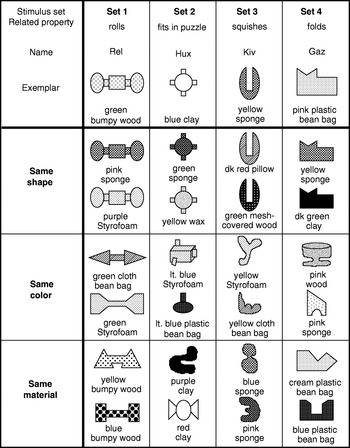
The experimental stimuli consisted of four sets of novel objects (see Figure 1). Each set consisted of an exemplar and six test objects. The exemplars for Sets 1 and 2 were made from rigid materials, and the exemplars for Sets 3 and 4 were made from non-rigid, deformable materials. The exemplar for Set 1 was a 14·0 cm×3·8 cm barbell-shaped piece of wood painted green with a bumpy texture; the exemplar for Set 2 was an 8·3 cm in diameter blue clay ball with four clay pegs; the exemplar for Set 3 was a 14·0 cm tall×5·7 cm wide piece of yellow sponge cut into a rounded ‘V’ shape; and the exemplar for Set 4 was an 11·4 cm×9·5 cm pink polygon-shaped plastic bean bag.
Stimuli used in Experiments 1 and 2.

For each exemplar two different kinds of properties could be demonstrated. One kind of property was designed to highlight the shape of rigid exemplars or the material of deformable exemplars. These properties are referred to as ‘related’ properties because they were based on the shape of the rigid exemplars and the material of the deformable exemplars. The other kind of property was not based on the shape, color or material of the exemplar. Thus, these are referred to as ‘arbitrary’ properties. These properties are not expected to direct children's attention to any particular feature of the exemplar. For Set 1, the related property was rolling, and for Set 2, the related property was fitting into a puzzle (see Figure 1). For Set 3, the related property was squishing into a cup, and for Set 4, the related property was folding. Because each individual child only saw two arbitrary properties and because these properties were not based on any feature of the exemplars, the same two arbitrary properties, having a small design on it that glowed in the dark or having a sticker on the back, were used for all four sets.
For each set, two of the test objects matched the exemplar in shape but were a different color and were made from a different material; two matched the exemplar in color but were different in shape and made from different materials; and two matched the exemplar in material but were different in shape and color. The stimuli were identical to those used by Samuelson & Smith (Reference Samuelson and Smith2000) with the exceptions that one of the color matches in Set 4 was replaced because the original had broken and one of the shape matches for Set 2 that was made of wood was replaced by a cloth pillow. This second change was made so that one of the shape matches and one of the color matches in each set was deformable. Although Samuelson & Smith (Reference Samuelson and Smith2000) found that it was the rigidity of the exemplar, and not the rigidity of the test objects, that influenced children's categorizations, we equated the rigidity of the test objects across sets, nonetheless.
Design
Each child saw all four sets of stimuli. Each child saw a related property demonstrated for one of the rigid exemplars and an arbitrary property demonstrated for the other. Likewise, each child saw a related property demonstrated for one deformable exemplar and an arbitrary property for the other. Which exemplars had related and arbitrary properties was counterbalanced across children.
Procedure
The procedure was identical to that of Samuelson & Smith (Reference Samuelson and Smith2000). The experimenter sat across from the child at a table. The child's parent sat next to the child and was asked not to interfere with the experiment or direct the child's responses in any way.
The experiment began with training trials. These trials were included to familiarize the child with the experimental setting and to make sure they were comfortable saying both ‘yes’ (to the item identical to the exemplar) and ‘no’ (to items that differed from the exemplar) in response to the experimenter's questions. Thus, the stimuli used on these trials were objects familiar to two-year old children. On the first training trial the child was introduced to a stuffed animal, told ‘Edward is a very picky bear. He only likes things like this’. Then the experimenter showed the child the egg exemplar and said ‘This is an egg, and you know what? It opens’, and opened and closed the egg. The experimenter set the egg by Edward and told the child they were going to find more eggs for him. Before presenting each test object, the experimenter reminded the child that the egg opens. The experimenter then brought out a test object, and asked ‘Is this an egg?’. On each training trial, the experimenter praised the child for each correct response and provided corrections for incorrect responses. Each child was presented with up to eight randomly ordered training trials, which included at least two presentations of the identical egg. We used the same conservative criteria used by Samuelson & Smith (Reference Samuelson and Smith2000) to ensure that children understood the task. Specifically, we required that children correctly answer four consecutive training trials in order to be included in the analysis. Data from five two-year-old children and one three-year-old child were excluded for failure to meet this criterion.
The experimental trials proceeded in the same manner as the training trials with the exception that the experimenter did not praise or correct the child during these trials. The experimenter introduced the child to a stuffed animal, told the child the animal only ‘wants things like this’, named the exemplar and demonstrated the property for the child before placing the exemplar by the animal. Then the experimenter presented each test object one at a time. Again, before presenting each test object, the experimenter reminded the child of the exemplar's property. For example, the experimenter would say, ‘Remember, this is a rel and it rolls’, and then present a test object and ask, ‘Is this a rel?’. Note that we, like Samuelson & Smith (Reference Samuelson and Smith2000), did not demonstrate the properties with the test objects because we were interested in the effect of the exemplar demonstration on children's responses to the test objects. Further, in their property generalization task Samuelson & Smith (Reference Samuelson and Smith2000) found that children were capable of generalizing the properties demonstrated with the exemplar without the properties being demonstrated with the test objects.
After all six test objects for a set were presented, the experimenter moved on to the next set. Between sets, the two- and three-year-old children were allowed to choose a sticker to take home. This measure helped the younger children remain engaged in the task. Like Samuelson & Smith (Reference Samuelson and Smith2000), we required that children say ‘no’ to at least one test object during the experimental trials as an additional check that they understood the task. Data from four two-year-old children were excluded for not meeting this criterion. The order of the exemplars and the test objects was randomly determined and counterbalanced across children. Children's yes/no responses were recorded on a datasheet by the experimenter during the experiment.
RESULTS
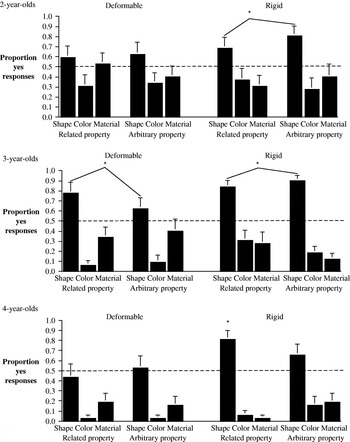
Figure 2 shows the mean proportion of ‘yes’ responses to test objects that matched the exemplar in shape, color or material for demonstrations of related and arbitrary properties at each age (data are graphed as proportions to correspond to data from Samuelson & Smith (Reference Samuelson and Smith2000) but no trials were omitted from any analysis so proportions correspond to frequencies). These data were analyzed in a rigidity (2)×test object (3)×relatedness (2)×age (3) repeated measures ANOVA with age as the only between-subjects factor. This analysis yielded main effects of age (F(2, 45)=3·50, p=0·04, η2=0·135), and test object (F(2, 90)=105·09, p<0·001, η2=0·700), and test object×age and rigidity×test object interactions (F(4, 90)=2·95, p=0·02, η2=0·116) and (F(2, 90)=19·55, p<0·001, η2=0·303), respectively. These were subsumed by a significant relatedness×rigidity×test object×age interaction (F(4, 90)=3·17, p=0·02, η2=0·124). Because the two main questions asked in this experiment were (1) whether the previously seen tendency of three-year-old children to generalize names for deformable stimuli by shape was replicated and (2) whether younger and older children also showed this bias, the data were further analyzed using tests of simple effects at each age. Specific direct age comparisons are presented in a subsequent analysis.
Results of Experiment 1. Proportion of ‘yes’ responses to test objects that matched the exemplar on shape, color or material for deformable and rigid exemplars following demonstrations of related or arbitrary properties for two-, three- and four-year-old children. Bars represent standard errors. Proportions of ‘yes’ responses significantly different from chance levels (0·50, dashed line) are indicated by an *. Lines indicate cells collapsed for analyses against chance (see text). Count noun syntax was used to introduce the names in this experiment.

Simple-effects and t tests – three-year-old children
Recall that Samuelson & Smith (Reference Samuelson and Smith2000) found that three-year-old children's proportion of ‘yes’ responses to test objects that matched the exemplar in shape was higher than the proportion of ‘yes’ responses for test objects that matched the exemplar in color or material, regardless of whether the exemplar was rigid or deformable. The data depicted in the middle panel of Figure 2 replicate this finding. Tests of simple effects on the data from three-year-old children that included the rigidity, test object and relatedness factors, revealed a significant main effect of test object (F(2, 30)=86·90, p<0·001, η2=0·853) and a significant rigidity×test object interaction (F(2, 30)=12·69, p=0·0001, η2=0·458) for this age group. The main effect of relatedness was not significant and there were no significant interactions involving this factor. Thus, we collapsed across this factor and conducted further tests of simple effects split on rigidity. These tests revealed significant effects of test object both when the exemplar was rigid and when it was deformable (rigid: F(2, 30)=90·37, p<0·001, η2=0·858; deformable: F(2, 30)=38·91, p<0·001, η2=0·722). Tukey's HSD tests (∝<0·05) on the data from the sets with rigid exemplars revealed that the proportion of ‘yes’ responses was significantly higher for test objects that matched the exemplar in shape, compared to material or color. The proportion of ‘yes’ responses to test objects that matched the exemplar in color and material did not differ. For the sets with deformable exemplars, Tukey's HSD tests revealed that the proportion of ‘yes’ responses to shape-matching test objects was higher than the proportion for material-matching test objects which was in turn higher than the proportion for color-matching test objects. Thus, three-year-old children generalized novel names for both rigid and deformable exemplars to test objects that matched those exemplars in shape more often than to test objects that matched in material.
Tests of simple effects on data from three-year-old children indicate that these children generalized names for the deformable stimuli by shape. Note, however, that these tests only confirm that children said ‘yes’ to shape-matching test objects more than material-matching ones. Another important question is whether children said ‘yes’ to shape-matching test objects at levels greater than what would be expected by chance. To examine this issue, we compared three-year-old children's proportion of ‘yes’ responses to test objects that matched the exemplar in shape to 0·50. We collapsed across relatedness in this analysis because the previous analyses revealed no main effects or interactions involving this factor at this age. T tests revealed that three-year-old children said ‘yes’ to test objects that matched the exemplar in shape at levels significantly different from those expected by chance both when the exemplar was rigid (t(15)=9·49, p<0·001) and when it was deformable (t(15)=2·93, p=0·01). Thus, three-year-old children showed strong and systematic attention to shape with both rigid and deformable exemplars.
Simple-effects and t tests – two-year-old children
As can be seen in the top panel of Figure 2, two-year-old children's response pattern was different. Two-year-old children had a high proportion of ‘yes’ responses to test objects that matched the exemplar in shape, but with some stimulus sets they had an equally high proportion of ‘yes’ responses to test objects that matched the exemplar in material. Tests of simple effects on the data from two-year-old children that included the rigidity, test object and relatedness factors revealed a significant main effect of test object (F(2, 30)=15·51, p<0·001, η2=0·508) and a significant rigidity by test object interaction (F(2, 30)=3·55, p=0·04, η2=0·191). There were no significant effects of relatedness. Thus, we collapsed across this factor and conducted further tests of simple effects split on rigidity. These tests revealed significant effects of test object both when the exemplar was rigid and when it was deformable (rigid: F(2, 30)=15·69, p<0·001, η2=0·304; deformable: F(2, 30)=6·54, p=0·004, η2=0·511). Tukey's HSD tests on data from the sets with rigid exemplars revealed that the proportion of ‘yes’ responses was significantly higher for test objects that matched the exemplar in shape compared to material or color. In contrast, Tukey's HSD tests on data from sets with deformable exemplars revealed a significant difference in responding to the shape- and color-matching test objects, but no differences in responding to the shape- and material-matching or material- and color-matching test objects.
As with data from three-year-olds, we compared two-year-old children's proportion of ‘yes’ responses to chance levels, collapsing across relatedness. Two-year-old children said ‘yes’ to test objects that matched the exemplar in shape at levels significantly different from chance when the exemplar was rigid (t(15)=4·14, p<0·001) but not when it was deformable (t(15)=1·16, n.s.). Consistent with the analyses above, these results suggest that two-year-old children showed a bias to generalize novel names by shape, but only with rigid stimuli – this bias did not extend to the naming of deformable stimuli.
Simple-effects and t tests – four-year-old children
Data from the four-year-old children can be seen in the bottom panel of Figure 2. As is clear in the figure, four-year-old children were more selective in their responding – they did not say ‘yes’ as often as children from the other two age groups. In fact, the only case in which they showed a high proportion of ‘yes’ responses was to test objects that matched rigid exemplars in shape following demonstrations of properties related to the shape of those exemplars. Tests of simple effects that included the rigidity, test object and relatedness factors on the data from four-year-old children revealed significant main effects of rigidity (F(1, 15)=10·06, p=0·006, η2=0·401) and test object (F(2, 30)=31·11, p<0·001, η2=0·675), a significant rigidity×test object interaction (F(2, 30)=7·39, p=0·003, η2=0·330) and a significant relatedness×rigidity×test object interaction (F(2, 30)=3·57, p=0·04, η2=0·192). To examine this three-way interaction, we conducted further analyses on the related and arbitrary properties separately.
For trials following a demonstration of a related property, tests of simple effects that included the rigidity and test object factors revealed a significant main effect of test object (F(2, 30)=29·22, p<0·001, η2=0·680) and a significant rigidity×test object interaction (F(2, 30)=8·34, p=0·001, η2=0·497). Further tests of simple effects split on rigidity revealed significant effects of test object both when the exemplar was rigid and when it was deformable (rigid: F(2, 30)=59·70, p<0·001, η2=0·260; deformable: F(2, 30)=5·27, p=0·01, η2=0·799). Tukey's HSD tests on the data from the sets with rigid exemplars revealed that the proportion of ‘yes’ responses was significantly higher for test objects that matched the exemplar in shape compared to those that matched in material or color. The proportion of ‘yes’ responses to test objects that matched the exemplar in color and material did not differ. For the sets with deformable exemplars, however, Tukey's HSD tests revealed no difference in responding to the shape- and material-matching test objects. There was a significant difference in responding to shape- and color-matching test objects, but no difference in responding to the material- and color-matching test objects.
T tests comparing responses on trials following demonstrations of related properties to chance indicated that the proportion of ‘yes’ responses to test objects that matched rigid exemplars in shape was significantly higher than would be expected by chance (t(15)=3·48, p=0·003), but the proportion of ‘yes’ responses to test objects that matched deformable exemplars in shape was not significantly different from chance (t(15)=0·49, n.s.). Overall then, for trials following demonstrations of related properties, four-year-old children systematically generalized novel names by shape when the exemplar was rigid and a property related to shape was demonstrated, but this bias did not carry over to the naming of deformable stimuli.
For trials following a demonstration of an arbitrary property, tests of simple effects that included the rigidity and test object factors revealed a different pattern of significance. Specifically, there were significant main effects of rigidity (F(2, 15)=5·45, p=0·03, η2=0·266) and test object (F(2, 30)=15·90, p<0·001, η2=0·514), but no interaction. A paired t test revealed that the overall proportion of ‘yes’ responses was higher when the exemplar was rigid compared to deformable (t(15)=2·33, p=0·03). Moreover, Tukey's HSD tests revealed there was a higher proportion of ‘yes’ responses to shape-matching compared to color- or material-matching test objects, but no differences in responding to color- and material-matching test objects. Critically, t tests comparing responses to chance levels indicated that four-year-old children's proportion of ‘yes’ responses to shape-matching test objects did not exceed levels expected by chance when the exemplar was rigid (t(15)=1·43, n.s.) or when it was deformable (t(15)=0·27, n.s.). Thus, when an arbitrary property was demonstrated, four-year-old children did not systematically generalize names for rigid or deformable exemplars by shape.
Direct age comparisons
Taken together, analyses of performance at each age suggest a curvilinear trend in children's generalizations of names for deformable stimuli following demonstrations of related and arbitrary properties. Three-year-old children generalized names for deformable stimuli by shape similarity even after a demonstration that highlighted the material the exemplar was made of, but two- and four-year-old children did not. In the previous analyses, however, children's performance was examined separately at each age. This was needed to examine the details of children's shape and material responding for each set at each age, but it was limited by the absence of direct age comparisons for the deformable sets. Thus, to investigate the developmental changes more directly, a second set of analyses comparing the performance of two- and three-year-old children and three- and four-year-old children was conducted. As is clear in Figure 2, there were large differences between age groups in children's overall pattern of responding – that is, the number of ‘yes’ and ‘no’ responses to the three different kinds of test objects in a set. Because we wanted to directly examine differences in this overall pattern of responding, we used ANOVAs in these analyses. These analyses focused specifically on children's generalizations of names for deformable stimuli.
The previous analyses of data from two- and three-year-old children revealed no differences in name generalization following demonstrations of related and arbitrary properties for either age group. Therefore, we collapsed across this factor and performed an age (2)×test object (3) ANOVA on the proportion of ‘yes’ responses for the sets with deformable stimuli. We only report significant age-related effects. This analysis revealed an age×test object interaction (F(2, 60)=5·35, p=0·007, η2=0·151). As discussed previously, two-year-old children were equally likely to say ‘yes’ to test objects that matched the exemplar in shape and material, but three-year-old children said ‘yes’ to test objects that matched the exemplar in shape significantly more than those that matched in material. Thus, the difference across these age groups revealed in previous analyses was statistically robust in a direct age-related comparison.
Because the previous analyses of data from four-year-old children revealed a significant difference in responding following demonstrations of related and arbitrary properties, we performed separate age (2)×test object (3) ANOVAs on the proportion of ‘yes’ responses for the sets with deformable stimuli following demonstrations of related and arbitrary properties. Analyses of responses following demonstrations of related properties revealed a significant main effect of age (F(2, 30)=5·29, p=0·03, η2=0·150). As can be seen in Figure 2, four-year-old children said ‘yes’ less often, particularly to test objects that matched the exemplar in shape. Recall that this brought their responding to shape to chance levels. Analyses of responses following demonstrations of arbitrary properties revealed no significant age-related effects. As can be seen in Figure 2, both three- and four-year-olds responses were less systematic (i.e. closer to chance levels) following the demonstration of an arbitrary property. Consequently, although three-year-old children's weaker bias to attend to shape in the arbitrary property condition was strong enough to lead to above chance responding in the analyses of three-year-olds' data above, it was not strong enough to produce age-related differences when compared to four-year-old children's responses. Importantly, however, there were robust age-related differences between three- and four-year-olds when related properties were demonstrated: both three- and four-year-old children generalized names for rigid exemplars by shape, but only three-year-old children generalized names for deformable exemplars by shape following demonstrations of a property related to material.
DISCUSSION
When presented with a novel deformable object and a novel name, three-year-old children systematically generalized the novel name to other objects that were the same shape as the named object, even after a demonstration designed to highlight the material substance of the exemplar. This finding replicates Samuelson & Smith's (Reference Samuelson and Smith2000) previous result. Importantly, when two-year-old children were presented with the same stimuli and demonstrations they did not generalize novel names in the same way as three-year-old children. Two-year-old children were as likely to say ‘yes’ to test objects that matched the exemplar in material as to those that matched in shape when generalizing novel names for deformable objects. In contrast to the two- and three-year-old children, four-year-old children's generalizations were clearly modulated by both the rigidity of the exemplar and the kind of property demonstrated. When a property not specifically related to the shape or material of the exemplar was demonstrated, four-year-old children did not generalize novel names to many test objects, but when they did say ‘yes’ it was most often to test objects that matched the exemplar in shape, and more when the exemplar was rigid than when it was deformable. In the context of a rigid object and a demonstration designed to highlight the rigidity of the exemplar, four-year-old children generalized novel names by shape similarity. Critically, however, in the context of a deformable object and a demonstration that highlighted the material of the exemplar, four-year-old children generalized novel names to the shape- and material-matching test objects equally often.
Taken together then, the data suggest a curvilinear trend in children's tendency to attend to shape when naming deformable stimuli. In contrast to three-year-old children, two-year-old children did not generalize names for deformable stimuli by shape similarity. This suggests that the property demonstrations were enough to pull attention away from shape with deformable stimuli, for at least some children. Consequently, the data do not fit with the idea that three-year-old children's performance was due to the inability of the property demonstrations to attract attention away from shape. Four-year-old children also did not generalize novel names for deformable stimuli by shape similarity. This finding suggests three-year-old children's performance was not due to an automatic pull to attend to shape caused by the use of count noun syntax. Rather, the developmental pattern fits best with Samuelson & Smith's (Reference Samuelson and Smith2000) third proposed explanation for three-year-old children's performance – that this pattern reflects a type of overgeneralization specific to three-year-old children.
Recall that Samuelson & Smith suggested that the dominance of count nouns that name solid objects in shape biased categories in the vocabulary of a typical three-year-old child, along with the fact that many of the names for deformable things that three-year-old children know are also count nouns, causes them to generalize what they know about naming rigid things to the naming of deformable things. By this explanation, it is the co-occurrence of count noun syntax in the naming of both rigid and deformable things in the vocabulary, and not the use of count noun syntax in the experiment, that causes three-year-old children to name deformable things by shape. Thus, this explanation further predicts that three-year-old children should still attend to shape when naming deformable stimuli even if a different syntactic frame is used in the experiment. In contrast, the proposal that the use of a count noun syntactic frame automatically directs attention to shape predicts that switching the syntactic frame should eliminate the bias to attend to shape with deformable stimuli. We tested these competing predictions in Experiment 2.
EXPERIMENT 2
Method
Participants
Twenty-four three-year-old children (range=2 ; 11.20 to 3 ; 2.21, M=3 ; 0.19) were recruited as in Experiment 1. All children were from middle-class, English-speaking families. There were 11 males and 13 females. Data from 3 additional three-year-old children were excluded from the analyses: 1 due to experimenter error, 1 due to parental interference and 1 because he did not finish the task. In addition, data from 2 other children were not included in the analyses because the children did not meet the conservative criteria for understanding the task set by Samuelson & Smith (Reference Samuelson and Smith2000). Informed consent was obtained from the children's parent or guardian prior to the experimental session. Each child received a small gift for participating. None of the children had participated in Experiment 1.
Stimuli, design and procedure
The stimuli and novel names were identical to those used in Experiment 1 (see Figure 1). The design and procedure were identical to Experiment 1, except that the experimenter used a mass noun syntactic frame instead of count noun syntactic frame when introducing the objects and prompting the child. For example, ‘Edward is a very picky bear. He only likes kiv. This is some kiv, and you know what? It squishes.’ Then, the experimenter told the child they were going to find ‘more kiv for Edward’. Before presenting each test object, the experimenter reminded the child of the exemplar's property. We used the same inclusion criteria as in Experiment 1. All children responded correctly to four training trials. Data from one child was omitted from the analysis for failure to say ‘no’ to at least one test object across the experimental trials.
RESULTS
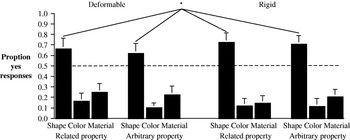
The mean proportion of ‘yes’ responses to test objects that matched the exemplar in shape, color or material following demonstrations of related and arbitrary properties are presented in Figure 3. These data were analyzed in a rigidity (2)×test object (3)×relatedness (2) repeated measures ANOVA. This analysis yielded a main effect of test object (F(2, 46)=50·82, p<0·001, η2=0·719). There were no other significant main effects or interactions.
Results of Experiment 2. Proportion of ‘yes’ responses to test objects that matched the exemplar on shape, color or material for deformable and rigid exemplars following demonstrations of related or arbitrary properties for three-year-old children. Bars represent standard errors. Proportions of ‘yes’ responses significantly different from chance levels (0·50, dashed line) are indicated by an *. Lines indicate cells collapsed for analyses against chance (see text). Mass noun syntax was used to introduce the novel names in this experiment.

As can be seen in Figure 3, overall children said ‘yes’ to test objects that matched the exemplar in shape most often, regardless of whether the exemplar was rigid or deformable and regardless of the kind of property demonstrated. Tukey's HSD tests revealed that the proportion of ‘yes’ responses to test objects that matched the exemplar in shape was significantly higher than the proportions for either material-matching or color-matching test objects. Further, three-year-old children said ‘yes’ to test objects that matched the exemplar in shape more than would be expected by chance (t(95)=4·15, p<0·001). Thus, three-year-old children demonstrated a shape bias when naming both rigid and deformable exemplars, even in the context of a mass noun syntactic frame.
Discussion
When presented with a novel deformable object and a novel name in a mass noun syntactic frame, three-year-old children generalized the novel name to other same-shaped objects – even when the exemplar was deformable. Overall the results of this experiment are remarkably consistent with those of Experiment 1, as well as those of Samuelson & Smith (Reference Samuelson and Smith2000), and strongly suggest that the attention to shape seen previously in three-year-old children was not due to the use of a count noun syntactic frame. Thus, these results, in conjunction with the finding in Experiment 1 of a curvilinear trend in the naming of deformables, support the proposal that three-year-old children overgeneralize a shape bias to the naming of deformable things.
GENERAL DISCUSSION
The goal of this research was to elucidate the processes that support young children's noun generalizations by examining children's tendency to name deformable things by shape similarity. Deformables present an interesting test case for attention to shape because both shape and material are important to their category organization. In our first experiment, we replicated Samuelson & Smith's (Reference Samuelson and Smith2000) finding of attention to shape when three-year-old children name deformable stimuli. We also found that two- and four-year-old children did not generalize novel names for deformable things by similarity in shape. In Experiment 2, we found that three-year-old children still generalized names for deformable stimuli by shape in the context of mass noun syntax. Taken together, this pattern of results is consistent with Samuelson & Smith's (Reference Samuelson and Smith2000) proposal that three-year-old children's performance when naming deformables is specific to this age group and reflects an overgeneralization of what they know about how rigid things are named. The current data have implications for the processes that support children's noun generalizations. Further, the differences in the performance of two-, three- and four-year-old children suggest a developmental process and inform our understanding of how the task, stimuli, syntax and knowledge of how nominal categories are organized in English all come together in a moment in time to create children's name generalizations. The following provides a sketch of this developmental process and shows how it fits with a number of results in the literature. We focus specifically on how young children's noun generalizations change from two to four years of age (see Gathercole & Whitfield, Reference Gathercole and Whitfield2001, for related ideas extending to nine years of age).
Overgeneralization
Samuelson & Smith (Reference Samuelson and Smith2000) proposed that three-year-old children overgeneralize what they know about the naming of rigid things to the naming of deformables because many of the deformable things that children learn how to name early are like rigid things in that they are both solid and named by count nouns. Thus, this is an overgeneralization in the sense that children are applying what they have learned about the dominant segment of their vocabulary to the naming of novel stimuli for which other features might be more relevant. Importantly, by this view, the factors that cause children to overgeneralize word learning biases some of the time are the same factors that create correct generalizations the rest of the time. The current data support these previous suggestions regarding a specific mechanism underlying children's noun generalizations.
This, in turn, leads to novel testable predictions. In particular, the overgeneralization idea suggests that the tendency to generalize novel names by shape should be related to the overall similarity of novel stimuli to categories named by the dominant segment of the vocabulary. Now that the current study has established that generalization of names for deformable things by shape is unique to children around three years of age, future studies can more directly test the proposed mechanism by asking children to generalize names for sets of stimuli that form a continuum from solid and rigid through deformable and malleable to non-solid. If similarity-based generalization is the correct mechanism, there should be, for instance, a point in the direction of non-solids at which three-year-old children stop naming by shape (see Colunga & Smith, Reference Colunga and Smithin press, for initial data supporting this prediction). Manipulating the similarity of stimuli on dimensions other than rigidity (shape, color and texture, for instance) at the same time would further enable an examination of the relative importance of rigidity and other object features in name generalization.
Another future step in this program of research will be to test the proposed link between overgeneralization and vocabulary structure directly. This will require developing either a measure of the statistical structure of older children's vocabularies or a version of the current task that can be used with younger children. The extensive efforts needed to directly test the proposed mechanism are warranted by the clear pattern of results reported here. In particular, the finding that two-year-old children differentiate between rigid and deformable things in their naming, more so than three-year-old children, suggests the value of further investigations with children in this age range to determine which changes in the vocabulary are critical and how these changes mechanistically influence the on-line behavior of novel noun generalization.
Developmental differences
Importantly, these insights into the nature of three-year-old children's naming tendencies are grounded by the results reported here that directly compare two-, three- and four-year-old children performing the same task with the same stimuli. This direct comparison reveals that the performance of three-year-old children seen previously was not typical of all age groups. In so doing, these data make an important contribution not only by suggesting a possible mechanism that brings young children's vocabulary knowledge to bear on the current naming task, but also by providing additional support for previous proposals regarding the origin of the shape bias. According to Smith and colleagues (Samuelson, Reference Samuelson2002; Smith et al., Reference Smith, Jones, Landau, Gershkoff-Stowe and Samuelson2002), the general idea is that children's acquisition of their first nouns is done slowly, word-by-word, and is based on multiple direct pairings of the name and instances of the category. In this stage of the process children are learning how individual nominal categories are organized and named. However, because many of the nouns in the early productive vocabulary of children learning English are names for solid objects in categories organized by similarity in shape (Samuelson & Smith, Reference Samuelson and Smith1999), these first nouns teach children how many nominal categories in general are organized. This knowledge is the basis of word learning biases like the shape bias that enable children to learn more nouns quickly (Samuelson, Reference Samuelson2002; Smith et al., Reference Smith, Jones, Landau, Gershkoff-Stowe and Samuelson2002). In turn, the new nouns children learn strengthen existing biases and may lead to the creation of new biases – biases to attend to features other than shape, for example – to the extent that they are supported by the statistics of the vocabulary (Jones & Smith, Reference Jones and Smith1993; Smith, Reference Smith, Golinkoff and Hersh-Pasek2000; Smith & Samuelson, Reference Smith and Samuelson2006). These new and stronger biases, then, support the acquisition of even more words (see Samuelson, Reference Samuelson2002; Smith et al., Reference Smith, Jones, Landau, Gershkoff-Stowe and Samuelson2002; Smith & Samuelson, Reference Smith and Samuelson2006). Thus, the pattern of age differences we found fits with previous findings of a developmental trend in the strength and context specificity of the shape bias (e.g. Jones et al., Reference Jones, Smith and Landau1991; Landau et al., Reference Landau, Smith and Jones1988; Samuelson & Smith, Reference Samuelson and Smith2005), and provides further support for the view that children's tendency to attend to shape when learning new nouns develops (Samuelson, Reference Samuelson2002; Smith, Reference Smith, Golinkoff and Hersh-Pasek2000).
The developmental differences reported here, and in particular the differences in the performance of two- and three-year-old children, conflict with recent data from Diesendruck & Bloom (Reference Diesendruck and Bloom2003), however. These researchers found no differences in the strength of the shape bias demonstrated by two- and three-year-old children. This difference could be due to differences in the languages being learned (Hebrew vs. English) or the ages of children in these experiments. In particular, the two-year-old children in the present experiment were 2 ; 1 on average. This is very close to the 2 ; 0 children tested in the studies by Jones et al. (Reference Jones, Smith and Landau1991) and Landau et al. (Reference Landau, Smith and Jones1988), and seven months younger than the children in Diesendruck & Bloom's study. Given the rapid pace of noun vocabulary development at this age, it is possible a seven-month age difference could make a large difference in terms of vocabulary knowledge and, by hypothesis, noun generalization.
It is also possible, however, that task differences could account for the disparity between the current findings and results from Diesendruck & Bloom (Reference Diesendruck and Bloom2003). All the stimuli used in Diesendruck & Bloom's study were made from rigid materials such as clay, wood and plastic. In the current study, the critical developmental differences were found with deformable stimuli made from sponge and a bean-bag. In addition, the current study used a yes/no procedure whereas Diesendruck & Bloom used a forced-choice procedure. Recent work with children and a dynamic systems model confirms that critical differences in the structure of these tasks can lead to different patterns of noun generalization behavior – even with the exact same stimuli (Samuelson & Horst, Reference Samuelson and Horstin press; Samuelson, Horst, Dobbertin & Schutte, Reference Samuelson, Horst, Dobbertin and Schutte2006; Samuelson, Schutte & Horst, Reference Samuelson, Schutte and Horstunder review). These task differences thus highlight the importance of using the same procedures and stimuli across ages to investigate whether the biases children demonstrate change over development. This is not to say, however, that differences in the findings of studies that use different stimuli and tasks are unimportant. On the contrary, we feel such comparisons provide critical information concerning the processes that support children's generalizations. The comparison of the current results to those of Diesendruck & Bloom (Reference Diesendruck and Bloom2003), for instance, suggests that children's noun generalizations are influenced by more than just the knowledge children bring to the task about how nominal categories are organized. Rather, it is the on-line realization of this knowledge in a particular task, with particular stimuli, that creates the behavior of noun generalization.
One possible concern, however, is that the yes/no task used here was too difficult for the youngest children in the study. The fact that data from many two-year-old children were excluded for failure to meet our conservative criteria for understanding the task confirms that this procedure was hard for this age group. Nevertheless, the follow-up analyses (see the Appendix) suggest that the results are representative of the performance of two-year-old children generally, rather than specific to the subset of children who passed the criteria for inclusion, and that the developmental patterns do not change when less conservative criteria for inclusion are used with the younger children.
It is important to note that a critical challenge for two-year-old children in the yes/no task seems to be generation of discriminative responses. That is, two-year-old children tend to say ‘yes’ a lot (though, critically not to everything). This is in contrast to three- and, in particular, four-year-old children, and raises an important developmental point: while neither two- or four-year-old children overgeneralized the shape bias with deformable stimuli, there were critical differences in their performance. Specifically, the generalizations of four-year-old children, but not two- or three-year-old children, were influenced by whether the demonstrated property was related to a feature of the exemplar or not. With rigid stimuli, the kind of property demonstrated influenced whether these children showed a bias to attend to shape. When the demonstrated property was related to shape, four-year-old children showed a clear and strong shape bias. However, when the demonstrated property was not related to the shape of the exemplar, they generalized novel names by shape similarity most often, but not at levels statistically different from chance. In part, this finding likely reflects the increased selectivity seen in the four-year-old children, who, overall, did not say ‘yes’ as often as the other children. The performance of the four-year-old children likely also reflects the increased specialization of the biases these children have developed. That is, their greater experience with objects, names and the link between what an object looks like and what can be done with it, might mean that they only generalize names by shape similarity when all aspects of the task context point towards shape. Thus, these data again suggest the important influence of the task on the specific biases children demonstrate, and fit with hypothesized trajectory of change in the development of the shape bias.
Four-year-old children's generalizations of novel names for deformable stimuli are also informative as to the overall developmental trajectory. With these stimuli four-year-old children's generalizations were unsystematic; they did not attend to material significantly more than they attended to shape when generalizing names for deformable exemplars following demonstrations related to the material substance of the exemplar. This result fits with data from Gathercole & Whitfield (Reference Gathercole and Whitfield2001) suggesting that children do not systematically attend to material when generalizing names for deformable things until eight or nine years of age. By Samuelson & Smith's (Reference Samuelson and Smith2000) hypothesis, these data, then, suggest that by four years of age the composition of children's vocabularies have changed enough to prevent overgeneralization of the shape bias to the naming of deformable things, but that these children have not yet learned enough about deformable things to attend to material when naming them. The current data clearly fit with this proposal, although the specific mechanism – change in vocabulary statistics – will need to be explored in future research.
In conclusion, the current studies provide support for the proposal that three-year-old children learning English generalize novel names for deformable things according to shape similarity because their previous knowledge of nominal categories pushes their attention towards shape. The different patterns of noun generalization seen in the different age groups, coupled with the influence of the task and stimuli, however, also suggest the importance of the interaction between the child's knowledge of nominal categories and the current naming context. In this way, the current data fit with prior results from similar studies showing how young children's noun generalizations are tuned to the specifics of the task, stimuli and language being learned (see Smith & Samuelson, Reference Smith and Samuelson2006, for a review). Thus, the current data suggest that the tendency of three-year-old children to overgeneralize a bias to attend to shape in the naming of deformable things emerges over the course of development from the very processes that direct their attention to the most relevant features of objects in so many everyday naming situations.
APPENDIX
A number of two-year-old children were tested but their data was not analyzed either (a) because it was compromised (due to experimenter error, not finishing the task or failure to respond on a number of trials; n=11), or (b) because they failed to meet our conservative criteria for understanding the task (n=9). To check whether the results from the two-year-old children included in the main analyses were specific to those children who met all inclusion criteria, we conducted a second set of analyses comparing data from children who were included in the main sample to a subset of eleven children whose data were excluded from the main analysis.
Of the eleven children whose data were compromised (issue (a) above), we were able to include data from the five children who responded on greater than 66% of the experimental trials in this secondary analysis. One question was what to use to fill the empty cells for these children. The goal of this secondary analysis was to examine whether the performance of children whose data had been excluded was different from that of children whose data was included. Thus, we decided to use the mean proportion of ‘yes’ responses across the children in the ‘excluded’ group who did respond on a particular trial because this method was likely to reinforce differences between the groups rather than amplify similarity (as using the mean across all the children would). Of the children who did not pass Samuelson & Smith's conservative criteria for understanding the task (issue (b) above), we included data from the five children who did not pass training, because these children demonstrated understanding of the task by answering a number of training trials correctly – just not four trials in a row correctly as required by Samuelson & Smith. We also included data from one of the four children who said ‘yes’ on all the experimental trials. We did not include the others, however, because these children did not demonstrate any understanding of the task during training, and recent research suggests two-year-olds demonstrate a ‘yes’ bias when they do not understand yes/no questions (Fritzley & Lee, Reference Fritzley and Lee2003).
We compared the performance of the new subset of eleven children to that of the main sample of two-year-olds via a rigidity (2)×relatedness (2)×group (2) repeated measures ANOVA with group as the only between-subjects factor. This analysis revealed no significant main effects or interactions involving the groups factor. Thus, the performance of children who contributed to the main sample and this subset who were excluded did not differ. As a further check of the generalizability of the two-year-old children's results, we re-ran the omnibus ANOVA with all three age groups, including the additional subset of eleven two-year-old children. We also re-ran the tests of simple effects and t tests on the full set of data from two-year-old children. These tests revealed the same pattern of results reported in the main text. Thus, while the high attrition rate makes it clear that the yes/no task was difficult for these young children (see the general discussion) these analyses confirm that the pattern of results observed was not unique to the subset of two-year-old children included in the main analysis, but was, instead, typical of two-year-old children's responses generally.