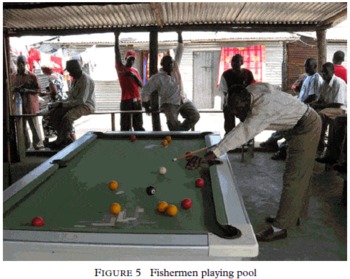
‘Nice shot!’ cries my friend Soumani, a young fisherman, in encouragement to two men who are shooting pool on a used but well-maintained table. The expert shot signals the end of the game; Soumani quickly gets up from the makeshift bench under a corrugated iron roof where dozens of other men are waiting, and takes his turn. He puts a USh500 coin on the rim of the table as a token of admission, sizes up his opponent, a well-known local captain, bends over the pool table and takes aim over his expensive-looking sunglasses. After only a few minutes, the game is over; although Soumani is a regular player, he has to acknowledge defeat to the more seasoned captain. He looks at me in slight despair, heaves a deep sigh and returns to his seat. For the second time this morning Soumani has lost a game; he hopes to win at least once before he sets off to the lake later in the afternoon.
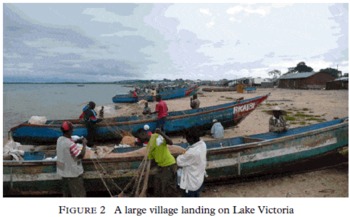
This scene was recently recorded in Lambu, a remote village landing along Lake Victoria in Masaka District, Uganda. Such landings are nowadays commonplace in the region; they are mostly new settlements that typically sprang up alongside the booming market for Nile perch that emerged about twenty years ago in East Africa. The economic history of this commercial table fish species is well documented: introduced into Lake Victoria in the 1950s, the perch was ‘rediscovered’ about three decades later by European fisheries experts and subsequently marketed to overseas (super)markets, mainly in the EU (Pringle Reference Pringle2005a). Nowadays tens of thousands of tonnes of fresh and frozen perch fillets per year are airlifted from around Lake Victoria, boosting foreign exchange reserves and economic growth in the countries around the lake, and generating mass employment in the East African region (Josupeit Reference Josupeit2006; Schuurhuizen et al. 2006).Footnote 1
The majority of actors in the perch market today make a living as fishermen (see also Bokea and Ikiara Reference Bokea and Ikiara2000; Kiggundu Reference Kiggundu and V.2006). There are wide discrepancies in estimating how these local fishermen have been affected by the development of the perch market. Some observers argue that they have to be regarded as victims of global capitalism: ‘small-scale fishermen have missed out on the export boom … and many fishing villages around the vast coastline have been abandoned as a result’ (MacDougall Reference MacDougall2001: 40).Footnote 2 More optimistic observers claim that the emerging perch market must be seen as the successful creation of a new export market with obvious economic benefits: ‘a multitude of local business opportunities have grown as a result of the income generated by the Nile perch fishery’ (Geheb et al. 2008: 95). The observations in this study, on the Ugandan side of the lake, point to a reality that is starkly differentiated: whereas some fishermen have benefited from the perch boom – meteoric careers are not uncommon – for large numbers of fishermen, everyday life at village landings presents itself as an uncertain and marginal existence with limited possibilities for economic mobility.
To understand such marked differences in moving up (and down), detailed study is needed of the professional trajectories of those involved in the sector, especially those at the bottom of the perch chain.Footnote 3 Hence this article explores the Nile perch fishery as a set of careers. Instead of focusing on the fish itself, it switches attention to the life histories of the people who hunt it (cf. Beuving 2006). Careers in the Ugandan perch fishery seem to be determined primarily by access to capital: boats and equipment are expensive, and loans for business development are difficult to obtain. It is therefore no surprise that the small minority of fishermen who succeed in moving up quickly in the perch business are those with abundant access to external financial sources. The majority of fishermen, however, lack sufficient cash to generate a steady income or profit from this expanding business. Their limited success in this regard does not deter them. On the contrary, fishermen settle at village landings in large numbers. They obviously arrive there with the expectation of making money, but, as they generally fail to do so, one has to explain why they remain as fishermen along Lake Victoria's shores.4
An explanation in terms of financial reward is therefore not sufficient, and this article offers as an alternative primarily a sociological analysis of economic life. The sociological perspective sees demand and supply in markets as social institutions which are constructed in action (Carrier Reference World1997). Economic action, in turn, is viewed as being embedded in networks of social contacts; in other words, transactions between actors are shaped in ongoing social interaction (Granovetter Reference Granovetter1985). This social embedding of economic action is regularly interpreted in an instrumental way to mobilize key economic resources such as capital/labour, information and market access (Barth Reference Barth1967; Granovetter Reference Granovetter1985; Long Reference Long2001); but social practices among fishermen on the Ugandan lakeshore do not corroborate this kind of instrumentality. In many cases their network of contacts is not trustworthy and this contributes to the existential insecurity they face. This also reveals the limitation of a sociological turn to the study of economic life that analyses social practices as geared to establishing a predictable and stable environment for economic action.
Thus, an instrumentalist view of social relations does not do justice to the analytical potential of a sociological perspective on economic life that acknowledges the role of culture. As in mainstream economic thinking, the instrumentalist sees actual preferences guiding economic decision as exogenous to the analysis. In a social constructivist perspective, however, preferences are understood as the product of a specific socio-cultural environment; they are therefore viewed as endogenous to the way markets work (Bourdieu Reference Bourdieu2005; Douglas and Ney Reference Douglas and Ney1998). Hence, in order to uncover the logic of economic action, one has to discover how economic actors themselves appreciate opportunities and problems, for instance relating to collaboration and/or investment (Abolafia Reference Abolafia and M.1998). Such cultural aspects can only be understood adequately when approached from the standpoint of the fishermen rather than from a universal (economic) rationality. In this case, this means that one has to consider the social universe that shapes fishermen's careers when they settle at village landings and appreciate how this also makes understandable their staying on when their expectations of making a career in many cases fail to materialize.Footnote 5 The fragment at the beginning of the article shows that recognizing the way fishermen value social life at village landings is an important step towards this.
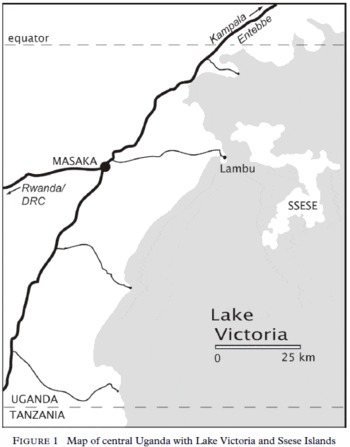
In order to further understand the socio-culturally embedded economic actions of the fishermen, I begin by assessing the social organization of the Ugandan perch business in order to show how the various actors slot into a common career perspective, with each next step being determined by increasing capital requirements. To understand the directions that careers in the perch market take, the article then reconstructs in detail the career history of an ordinary fisherman, Soumani. Soumani's history was recorded during recent anthropological fieldwork and draws on extensive informal conversations with Soumani and his key social contacts (some twenty individuals) and observations of their economic practices.Footnote 6 This approach has important consequences for data collection and for the claims that can be made. Notably, the collected data are not representative in the sense that a survey can be (Flyvbjerg Reference Flyvbjerg2006; Bertaux Reference Bertaux1981). Detailed study of one career, however, helps to uncover broader processes of capital accumulation and economic mobility, and therefore allows comparison with other fishermen operating in situations characterized by similar or contrasting parameters (van Donge Reference Flyvbjerg2006; van Velsen Reference van Velsen and Epstein1967). Fieldwork for this study was mostly carried out in or near Lambu. This village landing in central Uganda presents a logical study location for various reasons: first, it is locally known for its long-time involvement with the perch business; second, it occupies a prominent position in the transit trade to/from the Ssese Islands (an important hub for perch fishing); third, an all-weather road connects Lambu with Masaka town and hence to Entebbe international airport; and fourth, Lambu has recently seen the establishment of a fish-processing factory (see Figure 1).Footnote 7 In Lambu we therefore encounter essential processes shaping careers in the perch business.
SOCIAL ORGANIZATION OF THE UGANDAN PERCH BUSINESS
The large-scale perch export trade that developed in Uganda during the 1980s coincided with four important changes in the lower reaches of the perch market. First, whereas before the 1980s fish were caught and traded by local fishing communities, after the late 1980s specialized landing sites developed to accommodate the expanding flow of fish. The majority of these village landings consist of no more than a narrow strip of beach surrounded by a few makeshift dwellings connected by a dust road.Footnote 8 An important reason for this is that most landing dwellers come from elsewhere in the region and their stay is typically of limited duration. Nonetheless, it appears they frequently enter into partnerships, perhaps to buffer the risks associated with a dispersed and mobile fish resource: crews report that the perch are difficult to detect.9
Second, whereas the fishery sector before the 1980s essentially followed local and regional demand for animal protein, it became geared towards export following the establishment of processing factories around the lake. There are two points here: (a) local demand for perch has remained limited in comparison to export demand and seems mainly confined to consignments that are rejected by processing factories;Footnote 10 and (b) the perch export sector and the local fish-food sector are not well articulated: after arriving at the village landings, the migrant fishermen usually move straight into fishing for money – rather than fishing for food as is common among members of local, established fishing families (compare Geheb and Binns Reference Geheb and Binns1997). Thus they become dependent on revenues from perch fishing to make a living. Perch for export can therefore best be thought of as a cash crop, with perch producers chiefly reliant on a money economy.11
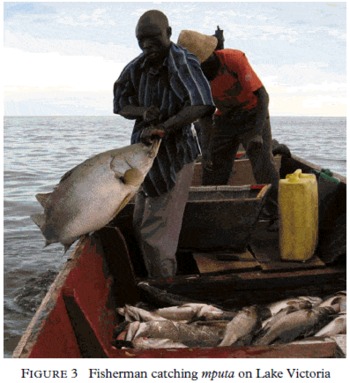
Third, with foreign capital pouring in, increasingly large investments are being made in equipment. This requires some eye for detail. A first glance reveals that plank canoes are used for perch fishing, and most observers have therefore qualified it as artisanal or traditional.Footnote 12 The increasing proportion of canoes powered by modern outboard engines, however, signals an ongoing technological intensification.Footnote 13 Further evidence for this development comes from the growing use of mobile phones to coordinate catches and sales, as well as the widespread use of specialized bait. Perch fishery has thus become more capital-intensive. In the words of a local fishmonger: ‘catching this mputa [Nile perch] is only for the big men, those with money’.
Fourth, food bans imposed by the EU have led to a stricter application of food hygiene rules in the perch-trade network. This has restructured the perch market: whereas previously the perch could be landed at any landing, nowadays only perch from landings fitted with proper infrastructure may be sold to the processing factories.Footnote 14 Furthermore, EU regulations have led to the application of quality criteria at the factory gate and only suppliers meeting these criteria are entitled to contracts with factories. As a result, there is now a premium on establishing reliable contacts with landing managers and factory operators.
These points show that the perch market in Uganda has undergone significant changes during the past fifteen years, making social contacts more than ever essential for actors to move up in this emerging trade. Such contacts are needed to settle at village landings, to get access to cash and reliable market information, and to overcome catch insecurities. To further the sociological understanding of this market organization, I now delve into the question of who engages in the trade, and how they can be differentiated into several groups of actors.
Economic actors in Uganda's perch business
In Uganda's perch business a common distinction is usually made between four categories of economic actors: factory owners/managers, traders, boat owners and fishing crews. An elaboration of these categories reveals important aspects of the economic universe of the perch trade in Uganda.
Factory owners are a small elite of businessmen who process and package the Nile perch and then export the fish to overseas markets (mainly European). In addition, several of them are permitted to levy fees on the perch traded at landings through a system of land concessions granted by the riparian governments. The fifteen enterprises running perch factories in Uganda today can be subdivided into two broad categories.15
First, businessmen identifying as Afro-Asians started buying perch in small quantities around the lake in the early 1980s, mainly for Israeli buyers (Abila and Jansen 1998).Footnote 16 Business went well and they therefore shifted operations to old warehouses in town (mainly Kampala, Jinja and Entebbe), fitted with cutting tables to gut the fish. Some then constructed cold rooms to chill the gutted fish; others purchased ice machines to ensure that the fish arrived in good condition from the lake. In a recent development, these businessmen are establishing processing activities near major landings around the lake. Nowadays, an Indian family company with a worldwide operation runs the majority of these fish factories around Lake Victoria.
European/North American businessmen represent the second prominent group of fish-factory operators. Their establishment in the Nile perch business broadly followed the pattern set by Afro-Asian entrepreneurs, but with three important differences. First, through their contacts with European airline companies, they negotiated access to affordable cargo space and thus lower transport costs to overseas markets. Second, in response to demands from their European customers, they introduced the practice of preparing and exporting fresh (chilled) perch. Third, in the early 1990s, several of them started organizing in producer clubs. In addition to the creation of product standards, this seems to have increased capital flows from foreign investors, banks and development organizations (Ponte Reference World2007).
Traders are a large, heterogeneous group of people who collect perch from landings around the lake and offer it for sale to the factories. Competition between them is stiff, particularly in times of limited supply (factories may source perch from as many as 75 traders), and for traders it is therefore important to maintain good business relations with the factory owners/operators. A small proportion of the traders worked in fish-processing factories or related industries at earlier stages of their careers and now act as their buying agents. However, a majority have previous trading experience and they are often seen trading the perch on their own account. Some of the traders travel around the lake with lorries and procure the fish from their contacts at the landings. Others have developed more stationary businesses: they are supplied by boat owners and their crews (ranging from ten to about forty) and then transport the perch to the factory in specialized collector vessels fitted with an icebox. The large amount of capital needed to acquire these lorries and specialized vessels is beyond most people's financial reach. Factory operators have generally responded to this by providing lorries and/or collector canoes for some of their better-developed business contacts. As a result, the estimated number of perch traders in Uganda presently stands at about five to six hundred.
Boat owners organize the fishing and retail sale of the perch. They do this by investing in plank canoes, outboard engines, lines/hooks and other fishery hardware. These items are expensive, with prices exceeding a local annual income, and few owners can afford to purchase them new. As a result, a vibrant trade in second-hand canoes and engines has emerged around the landing sites. Further, traders increasingly issue credit to aspirant boat owners, mostly in kind: engines, petrol or bait. This has boosted canoe ownership, and local fishery organizations therefore have between ten and fifteen thousand boat owners on record. Many owners have a background in fishing and/or local or regional fish trading and they run their business by building on previous experience. Others, often with access to outside capital, have entered the perch business more recently and often rely on local managers to carry out the catching and marketing of the perch. Nowadays, well-established boat owners may own as many as fifty vessels; the vast majority, however, operate only one or two canoes.
Most people in Uganda's Lake Victoria area consider a canoe a desirable investment for two reasons. First, banks and other financial institutions accept canoes as collateral for loans. Owning a canoe therefore increases one's access to capital. Even without a bank loan, a canoe represents a secure repository for cash since it decreases one's exposure to financial demands from friends or kinsmen. Second, only boat owners enjoy the right to become members of the Beach Management Unit (BMU) – the lowest form of political office at Ugandan landings. In this organization, rules and regulations regarding fishery are formulated based on majority rule. BMU members can therefore influence key decisions about the levying of fees at the landings and access for fellow boat owners.
Crews carry out the fishing trips. They cast nets and long-lines into the lake, haul the fish from the water, and bring the catch ashore; trips may last as long as a week, though shorter periods are more common. This group includes a high proportion of young men and is characterized by a lack of business capital and by an inability to establish credit relations with boat owners and traders. Collaboration with the owners is not unproblematic since it is common for crews to decide to sell the perch outside the predetermined arrangement with the owner. Boat owners therefore often accuse the crews of theft. This is considered a serious allegation, but one that is, however, difficult to disprove; a common response for crewmen therefore is to lie low for a while and then start working with another boat owner.
Crews are usually composed of at least three persons, typically organized into the following labour division: a captain who operates the outboard engine, a deckhand doubling as cook, and a linesman taking care of the catch. During trips, however, they often collaborate intensively and occasionally stand in for one another. A boat owner may recruit the crew personally, but it is nowadays becoming more common for boat owners to collaborate with captains, who, in turn, draw on their personal contacts when putting together a crew. Crewmen are usually paid a fixed amount per trip, but occasionally boat owners may also decide to share profits with the crew.
Careers in the perch business
So far, this differentiation of actors into several categories has focused on how they make money, and mobilize capital and labour. In particular, attention has been paid to the technology they deploy and the types of collaboration they seek. These categories represent different steps in a local ideal of a career in the perch business.
Working as a crewman is often the beginning of such a career. Young men normally go to landings where they know one or two persons, sometimes distant kinsmen, but usually friends. Since few landings boast jetties or other port-type infrastructure, many find their first job by loading and unloading people and goods. These porters enjoy little prestige, and they are often chased away from the beaches. Nonetheless, in this fashion they may become acquainted with crewmen. As a next step, a young man may start running errands for a crew, for instance by sourcing the substances they use when ashore (Kenyan qat and local gin are particularly in demand), or by helping to repair long-lines or other fishing equipment after trips. Crews and captains usually stay ashore together, and a young man may thus get in contact with a captain who may eventually decide to take the young man on board, for instance if one of his other crewmen unexpectedly fails to show up.
Once sufficient capital can be mobilized, either as credit or in savings, crewmen, notably captains (they earn slightly more), are inclined to purchase a canoe. Although this represents a step away from the dependencies that most crewmen face, it does not mean that boat owners make a lot of money. They bear financial risk and they may lose substantial sums of money when perch catches fall below the cost of inputs.Footnote 17 Catches fluctuate unpredictably and are therefore uncertain; in the words of a well-established boat owner: ‘If you go to the lake daily, you may some day not find fish, yet another one gets lots of fish!Footnote 18 Also, I have three canoes, but you may find someone with only one canoe getting more fish.’ If business prospers for a while, boat owners tend to invest in extra canoes and, if possible, in outboard engines. This significantly reduces uncertainties since the boat owner can now rent out some of his equipment and thus generate a more or less steady income.
Large boat owners, in Uganda called omugaga (literally, ‘boss’), are likely to venture into trading perch, mainly to the factories but also to markets further afield where lower quality standards are accepted. In addition to mobilizing sufficient capital to purchase expensive collector/transport boats, at this stage social contacts with factory owners come into play. This often entails developing contacts with brokers who circulate in the factory owner's inner social circle, for instance East African women married to European businessmen or people of mixed African and Asian descent. In a practical sense, this requires one to have some previous experience in town since neither factory owners nor their close contacts are based in rural areas. Moreover, contacts with the inner circle often operate beyond the transaction they embody; they are also shaped in casinos, discotheques and other urban leisure institutions. Large boat owners are therefore almost always well-exposed people.
In a local ideal of a career in the perch business, becoming a trader is considered to be the climax. Factory owners surpass this prestigious position, but these are a small business elite, often with well-developed political and/or international business ties that most people consider to be beyond their reach. People's activities are therefore directed at becoming a perch trader, and preferably one who supplies several factories at the same time in order to fetch the highest price. The successive career steps are organized in a status hierarchy: crewmen look up to canoe owners who, in turn, respectfully address traders. This organization does not, of course, mean that over time crewmen will automatically develop into omugaga. The following case study of Soumani, a young Ugandan man, will uncover some of the key social mechanisms that come into play in shaping economic mobility in the perch business.
CASE STUDY: SOUMANI TWINEOMUGISHA'S CAREER
Soumani was born in 1981 in a small village near Jinja, central Uganda. He is the youngest child of a Muslim priest who often went away on preaching trips in the area. Soumani's (much) older brothers left the village while he was still young, and Soumani was therefore raised by his sisters. In addition to sending him to Qur'anic school, they taught Soumani to prepare matooke, Uganda's national dish (mashed mealy banana). Although cooking is considered to be a woman's job, later on in life Soumani made good use of his culinary skills. Otherwise, the family had, and still retains, some land and a few cattle, mainly goats. There was, however, little surplus money for business and, in his brothers’ absence, Soumani mainly lived from tilling the land and tending the animals.
When Soumani was about fifteen, one of his brothers, a local trader in foodstuffs, introduced Soumani to a nearby village landing (called Masese). A new Indian owner had recently taken over the bankrupt Igloo fish factory, boosting local fish trade. This created the opportunity for Soumani to work as a porter, carrying people and goods from the fishing-canoe mooring at the landing. For a while he made some money in this way, and succeeded in renting one of the makeshift rooms built near the landing site. An upsurge in the civil war in northern Uganda brought an inflow of young men looking for work, and prices for porterage dropped dramatically. Around the same time, Soumani heard from a group of young itinerant traders originating from his village that money could be made with mukene at landings near the Tanzanian border.Footnote 19 He decided to join them, borrowed a small sum of money from his brother, and hitched a ride down south.
After various brief stays at landings along the shores of Lake Victoria, Soumani decided to make halt in Lambu, a large village landing, as described in the introductory section, that doubles as a business centre for trade with the Ssese Islands. He found the mukene business there to be disappointing: mukene from Lambu was low-grade and mostly traded as animal fodder. Profit margins were therefore low and, more importantly, all suitable stretches of sandy beach to dry the little fish were already taken. For a while Soumani relied on porterage, and later he made some money mending nets. Although Soumani barely got by, in this way he came into contact with Ssenondo. A locally born businessman, Ssenondo had recently bought a canoe and started fishing Nile perch using long-lines. This new practice, mukonyo in local parlance, arrived with migrants from the northern part of Lake Victoria in the late 1990s. From his stay at Masese, Soumani had some experience in making long-lines, and Ssenondo was therefore quick to recognize the advantage of recruiting Soumani to his crew.
For a few months Soumani worked as an employee of Ssenondo. In addition to learning the ropes of perch fishery, Soumani expanded his social network at the nearby landings that were regularly visited by the crew on their fishing trips. Significantly, he fraternized with some of the young migrant men he encountered at the landings, taking his meals with them and adopting their dreadlock hairstyle. A final development during this period was that he met Babbes, a young woman from a small town in central Uganda whose mother ran a small shop in Lambu. However, things took a turn for the worse when Ssenondo unexpectedly lost his money in a failed political campaign to run for local councillor; this left Soumani little option but to quit. Babbes's stay in hospital following the difficult delivery of their first child presented another financial setback. A return to porterage was no option for Soumani – in his words, ‘That is a job for the small boys’ – and instead he made some money preparing matooke for the numerous young fishing crew members, known to Soumani from his previous trips, while they were ashore.
During this period, Javira, one of Ssenondo's workers with whom Soumani had become friends, introduced him to Robert, a young man who came to Lambu after a stint as a fish gutter in a fish factory in Kampala. Robert now ran a small video hall with equipment he bought cheaply through his Kampala contacts. The men shared a number of important characteristics. In addition to several mutual contacts, Robert had also adopted a Rastafarian hairstyle, and was also not native to the Lambu area. Soumani figured for a while in Robert's circles, occasionally helping him out with the video shows. Robert's contact with his friend Kadi, a local fishmonger, brought Soumani back to the waters of Lake Victoria, because Kadi's business had fared well and, now that a new factory was being opened nearby, he wanted to invest in perch fishery. Without a residence in Lambu, he had difficulty buying and manning a canoe. Soumani contacted Kadi through Robert, found him a second-hand but well-maintained and reasonably priced canoe, and offered his services as captain. Things went well for a while, and Soumani even saved up enough cash to buy a mobile phone. However, following a few bad fishing seasons,Footnote 20 Kadi sold off the canoe and tried to cut his losses by renting out the outboard engine. Soumani was once again left to his own devices and these days he gets by as a doorman in Robert's video hall.
Analysis of the case
Soumani's case highlights some of the problems faced by a growing number of young fishermen in making a career in Uganda's perch market. The socio-culturalist perspective developed earlier in this article suggests that the ways fishermen understand and try to deal with these problems are shaped by, on the one hand, the organizational form of the perch market and, on the other, the type of social contacts fishermen such as Soumani deploy and the way they value life at the village landings. To bring out the logic of the fishermen's actions, this perspective is now applied to the empirical findings presented in the previous section of this article.
Market organization. Several important characteristics of the perch market may be typified as informal, and this structures Soumani's economic actions in the following ways. In the first place, access to the fishery sector is mediated through fishing technology. As veteran fishermen point out, in the past fishing was typically carried out with small canoes constructed from locally available wood and powered by paddles. Although this mode of fishing is still practised today, it has become an increasingly rare sight. Talks with local carpenters suggest an increasing reliance on imported timber – mostly hardwood from Congolese forests – for the manufacture of canoes. At the same time, local observers suggest that fishing canoes have become taller and heavier in order to accommodate larger perch catches; as a result, the capital required to purchase a fishing canoe has increased. In a related development, a few years ago, Soumani and his colleagues in Lambu shifted their fishing activities from the quiet inshore waters near Lambu to the high waters of the Masira Islands, four to five hours south of Ssese.Footnote 21 They claim that they did so in response to dwindling perch stocks. Non-motorized canoes cannot reach these distant waters, and this low-tech mode of fishing is therefore effectively debarred from the perch sector.
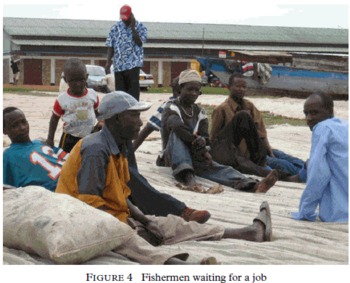
From the above it follows that perch fishing has become increasingly capital-intensive.Footnote 22 Soumani lacks the financial means to buy or even rent a canoe and therefore cannot venture onto the lake by himself. He also lacks the dependable contacts with well-established traders, or even factory owners, to start trading perch himself. His single option is therefore to offer his services as fishing crew. Like many others, Soumani does so mostly by hanging around landing sites until a boat owner in search of crew notices him. What is helpful in this regard is that a number of small, occasional jobs have developed alongside the expanding perch market: fish gutting, porterage, cooking and net mending. These jobs proliferate especially at larger landings where different trade and transport flows meet. However, due to the establishment of a processing factory a few kilometres down the lakeshore, these flows have shifted beyond the reach of Lambu, limiting opportunities for occasional jobs.
Ethnicity presents a third informal pillar in the Ugandan perch market. Lambu is an ethnically heterogeneous place, as exemplified by recent census data: fewer than half of the 1,858 adults registered in 2006 originated from the same district, 5 per cent had migrated from Tanzania or Kenya, and about 50 per cent came from nearby districts, mostly along the lake but also from districts further afield (cf. Namisi and Kyangwa 2004). However, those living in Lambu usually refrain from collaborating with total strangers. This is why Soumani liaises with Robert; both identify as Basoga-speaking (common in the Jinja area). Soumani's marriage with Babbes is further illustrative of this principle: they originate from adjacent villages. Ethnicity in itself, however, does not explain the outcome of Soumani's actions. To better understand this, I now turn to an assessment of the social contacts Soumani draws on in the course of his career.
Social contacts in the perch market. What stands out in Soumani's case is that he does not have much social capital in the sense of commanding a set of reliable business contacts. In part, this is due to the fact that Soumani, like many crewmen, had made a career elsewhere before venturing into the perch business; their life histories are replete with references to economic activity earlier on in their lives, mostly in the agricultural sector. Their late start in the perch business obviously limits the build-up of contacts at landings.Footnote 23 And in part it is due to the business relations crewmen engage in; Soumani's life history suggests a differentiation into contacts with peers and contacts with boat owners.
To understand contacts between fishermen and boat owners, one must realize that the fishermen are contracted as workers. Occasionally, they may rent a canoe and equipment to work on their own account, but most of them prove unsuccessful at this and fall back on selling their labour. Contacts with boat owners are usually limited to the exchange they embody and are often informed by instrumental considerations. Note, for instance, how Ssenondo hired Soumani when he had need of a skilled worker. These contacts therefore generate little interpersonal trust, and usually end when business slows down; most of the time, fishermen are unemployed and they have difficulty consolidating labour arrangements with local boat owners. The life histories of Soumani and his colleagues are therefore replete with stories about being fired without notice and salaries not being paid on time – or not paid at all.
Differences in origin offer an important explanation as to why these relations are usually structured as single-stranded contacts. Crews usually come from elsewhere, and unlike most boat owners (Ssenondo, for example, is a local businessman), few of them have grown up in a riparian community. Moreover, most of them come from locations further afield, and fishermen and boat owners therefore do not draw on a common personal history; in fact, social relations between them develop when they meet at a landing. In developing these contacts, fishermen face an unfavourable labour market. The number of young men at landings typically exceeds the number of fishing crew needed to man the available perch-fishing canoes.Footnote 24 In Lambu, for instance, the 2006 census recorded 1,200 individuals as abuvubi, fisherman, yet at the same time there were only about a hundred canoes operating from this landing. This results in a situation of competition between fishing crews/fishermen; participation in a fishing trip becomes a coveted prize. At the same time, this puts wages under pressure, because canoe owners have no incentive to pay them well.
These factors have important consequences for the organization of money flows. In general, most fishing crews are paid in cash upon arrival after a fishing trip. As one moves up in the hierarchy, for instance by becoming part of a permanent crew, profit-sharing arrangements may become more common, but for the majority of the fishermen this is difficult to attain. Cash payments are usually a fixed amount established before the trip and vary around €5 per day – close to the amount needed to make ends meet at a village landing. In addition, boat owners may pay some money for food and other expenses relating to the trip. If a fishing trip is successful, boat owners usually pay their crews in full and on the spot. It is, however, more common for trips to be less successful than anticipated; and this results in postponed payment, or payment of a lesser amount than that agreed.
These observations reveal a strong dependence of fishermen on boat owners, yet the latter's authority is not entirely unquestioned. As a first indication, during the fieldwork, canoe owners in Lambu frequently mentioned the difficulties they experienced in exercising effective control over their fishing crews, deriving from the incentive structure under which both parties operate. If crews receive a fixed salary, they have a financial interest in shortening the fishing trips: the more trips they carry out, the more money they will make. Canoe owners, however, have an interest in large catches, achieved in their view by long and uninterrupted stays on the lake. The resulting conflict of interest often results in a cat-and-mouse game, because a canoe owner forcing his crew into running long shifts faces the risk of the crew eventually selling fish on their own account – a practice locally known as oguswaaga. Canoe owners usually have the upper hand in finding out about this illegal practice, their well-established network of contacts in the area increasingly facilitated by the use of mobile phones. However, my acquaintance with fishing crews in Lambu indicates that sometimes their attempts to sell off some of the perch catch will go unnoticed; this may then secure a significant addition to their wages.
Contacts with peers are of a different nature. As Soumani's case suggests, during their stay at a landing the young men tend to function in small groups, and such groups may become a source of mutual support – note, for instance, how Javira introduces Soumani to Robert and hence facilitates his job as a doorman.Footnote 25 There are three points for further consideration.
First, members of a peer group tend to spend their leisure time together. In Lambu, for instance, once the men are done with their chores ashore, they gather on a small nearby hilltop where they drink home-brewed liquor and smoke roll-your-own cigarettes, while listening to their pocket radios. Just behind the hilltop there is a small beach, and in the absence of running water in Lambu, many of them come together here to bathe in the lake. A final example: to reduce expenses, peers often share rooms in one of the many cheap hostels that village landings boast and hence spend their nights in small groups. Thus, social life at village landings like Lambu may be typified as tightly knit and dependent on personal contacts.
Second, as a consequence of these close contacts, the peer groups are an important source of identification. Consider, for instance, the common clothing practices found in these groups: sunglasses, baseball caps and polished shoes abound. Although these practices are also found among some canoe owners and traders, the peer groups further stand out because of the widespread adoption of a common hairstyle. That is, once they become a group member, many grow their hair into dreadlocks. This hairstyle is part of a broader identification with Rastafarian culture, which is also expressed in spending much time listening to reggae music and/or discussing statements from particular reggae musicians. Identification with Rasta appears to be socially situated: once a young man leaves the peer group, for instance by becoming a canoe owner or migrating elsewhere, he will usually crop his hair and lose interest in Rastafarianism.
Third, peer groups are usually built on pre-established social relations, notably those of friendship. The group members are therefore not a random collection of individuals who meet accidentally at a village landing. On closer scrutiny, it appears that the composition of these groups mirrors to some extent the social formations aboard the perch canoes; that is, fishing crews are usually composed of individuals from the same peer group. An important consequence of these multi-stranded contacts is that the social hierarchies one encounters ashore translate into the organization of the perch fishing trips. This becomes clearer if we consider the role Robert plays in the group. He is older and more experienced than Soumani and his friends, and he therefore functions as the pivot of the group. Robert's special position in the social hierarchy is further stressed by the way in which he acts as a broker between the young men and the canoe owner, Kadi. Robert is therefore instrumental in providing manpower for the canoes.
The peer groups therefore represent important springboards for men like Soumani to enter the perch business, mainly by getting information about scarce fishing jobs and alternative opportunities at the landings. The groups also offer some protection against the job insecurity that is typical of the perch business, for instance by securing some access to food and accommodation. Especially for fishermen lacking sufficient capital, connecting to a peer group therefore presents an essential step in holding their own against the vagaries of the perch business.
Valuation of the perch business: social life at village landings. The article thus far has shown that the complex networks of contacts among fishermen and with boat owners shape their career-making opportunities and limitations; but these contacts draw not so much on a universal economic rationality – grounded in balancing costs against benefits – as on a situated logic.
To understand this, let us first explore the reasons why young men come to the landings. Like many of his peers, Soumani came to Lambu when he was in his mid-twenties, following a series of other economic activities. He arrived with some cash, and his original plan was to invest this in mukene trading. Soumani's arrival hence builds on the regional reputation village landings have for economic opportunities, which is expressed in the often-noted expression ‘Kunyanya kuliko obugagga’ – ‘There are riches on the lake’. This expression refers in the first place to revenue resulting from commercial fishing; with catches and prices fluctuating considerably, this is seen to take the form of a gamble from which some individuals have benefited by becoming spectacularly rich. For the fishermen, however, making a career in the perch business is difficult; they lack the boats needed to achieve the occasional windfall gain. In daily practice, they rely on the multitude of ancillary activities that have developed with the expanding perch business. Soumani's experience shows that these activities are important because they represent a financial buffer that is needed to keep the fishermen at the landings and hence connected to the perch business.
After their arrival, the fishermen usually quickly discover the difficulties of making money at the landings. Soumani, for instance, in the weeks following his arrival noticed that mukene business failed to bring in a steady revenue. At the same time Soumani saw his capital shrink, chiefly because of unexpectedly high expenditure on food, accommodation and other daily sustenance. Luckily he was offered a job (by Ssenondo) but, once this boss went out of business, Soumani soon faced a blind alley. A logical response for Soumani would have been to move on in search of a better opportunity elsewhere. The case study, however, shows that this is not what he did: Soumani stayed on. To some extent his decision was motivated by expenses connected with migrating and finding employment elsewhere. Furthermore, the expectation of future returns in the expanding perch market may keep young fishermen hanging around for a while. Also, the majority of fishermen are married – about half of them bring their spouse to the village landings; others, like Soumani, find a wife locally – and this promotes settlement rather than ongoing migration. But these pragmatic considerations do not sufficiently explain why so many young men like Soumani persist in a highly uncertain existence at the village landings and do not opt for the more secure, albeit marginal, livelihood they find back home.26
The fieldwork suggests that this is because fishermen display a strong preference for life at village landings. On closer observation, these remote places bear a striking resemblance to African town life, and this is key to their attractiveness. The absence of close kinship contacts (excepting wives) presents a first indication of an urban culture characterizing village landings. Note in this regard that Soumani borrowed some money for the trip to Lambu from a brother, but that he arrived there unaccompanied by his siblings. The limited significance of close kinship ties explains some of the bad press that village landings usually receive. Informal conversations with Masaka townsmen, for instance, suggest that landings figure in the popular imagination as a cesspool of social insecurity. As one interviewee explains: ‘Here in Masaka, I have my people, and in that place [Lambu], they're all strangers; how can you trust them?’ The significant point, however, is that the absence of kinship is to some extent the outcome of conscious choice. Note the following statement of Javira, Soumani's close friend: ‘I have come to Lambu by myself, and here nobody is disturbing me.’ This remark reflects the large degree of personal freedom that the young fishermen experience at village landings – a freedom that is at odds with their experiences back home, notably when older kinsmen are present. The absence of relatives is part of a broader phenomenon in Lambu: the place boasts a wide range of small hostels and hotels which, together with a variety of restaurants and food stalls, can sustain large numbers of visitors. In combination with Lambu's strategic location in trade and transport networks, this promotes ephemeral social contact. Unlike social life in a typical rural setting, social contacts among landing dwellers are patterned loosely; being among strangers is therefore a central experience of those living at village landings.
The abundance of well-developed leisure-time activities presents a second important aspect of the urban culture at landings. Many of these places boast several bars, dance halls, and, as indicated in the introductory fragment of this article, pool tables. In Lambu, a leisure ‘industry’ started developing around the mid-1990s when a particular boat owner bought a video recorder and a television set in Masaka and began to show foreign movies. This initiative met with a rapt audience and, as the perch business expanded, other entrepreneurs quickly followed (some were townsmen; others, like Robert, ex-fishermen). Today there are five video halls in Lambu (more than in Masaka) that offer a daily selection of the latest Nigerian series and Asian fight movies, complemented by satellite broadcasts of English premier league football games at weekends. Other initiatives developed in the wake of this success: a number of makeshift discotheques were created about ten years ago, nowadays frequently hosting one of the numerous karaoke bands that travel from one landing to another (their shows are advertised on posters that are found even at the tiniest village landing). However, the recent establishment of pool tables at many large village landings epitomizes the emerging leisure industry around Lake Victoria's shores. In Lambu, for instance, six pool parlours are nowadays open day and night. Especially after dark, the tables attract scores of young men; some shoot pool, others bet on the outcome of the game, and yet another group, usually those without extra money to spend, only watch the game. These parlours are therefore becoming important social institutions with which young people like Soumani strongly associate, and thus contribute strongly to the attractiveness of village landings.
CONCLUSION
In this article I have investigated the career-making opportunities for local fishermen in the Nile perch market in Uganda. The article argues that the high capital requirements for boat ownership prevent these actors from advancing in the perch business. Fishermen do not succeed in accumulating sufficient capital because, firstly, they are contracted as workers and face large insecurities on the job market around Lake Victoria; secondly, village landings are characterized by an expensive cash economy. Nonetheless, few fishermen decide to leave the perch business because, as the case analysis has revealed, of their appreciation of an emerging urban culture at village landings: these otherwise remote places are characterized by a prospering leisure industry, but also by clothing and hairstyles uncommon in the African countryside, and by a prevalence of contract labour and friendship ties over kinship relations. Young fishermen strongly value the opportunities that village landings offer to lead life ‘urban style’. As they typically come from modest rural backgrounds, this generates a sense of agency and self-determination that presents them with a strong motivation to stay on – even when real opportunities for economic success in the perch market turn out to be limited. Hence a cultural preference for life at the landings, rather than a universal quest for economic opportunity, drives their economic decision making.
The expanding perch market can be seen as exemplifying a broader development in Africa: the continent is in a stage of rapid economic change with new forms of trade booming and new business spawning across the continent. In many instances, such new economic activity attracts scores of young African men and women with the promise of making a successful economic career, but their ambitions may not neccesarily be realized as a result of their following these economic opportunities. The significance of this article is therefore that it highlights the importance of acknowledging the cultural preferences in the choices that such new actors make. Understanding this, in turn, contributes to a better appreciation of why some benefit from Africa's ongoing integration into broader economic structures, whereas others do not. This actor-oriented approach has practical implications: rather than viewing the creation of business opportunities as an automatic response to changes in global demand and supply, the article shows that there is an ongoing need to more fully embrace a perspective on the working of business ‘from inside’ that acknowledges the role of culture in shaping actors’ economic decision-making motivations – a factor that is usually overlooked in conventional economic analyses.
ACKNOWLEDGEMENTS
This article draws on eight months of field research carried out in 2006–8 and made possible by travel grants from the Department of Social Research (VU) and by a Wenner-Gren post-doctoral research grant. Earlier versions of the article were presented to the international ‘Social and Ecological Drivers of Ecosystem Change in Lake Victoria’ (SEDEC) Scientific Meeting, Wageningen University, 2008, and to the European Conference on African Studies, Leipzig, 2009. The author thanks Jens Andersson, Jan-Kees van Donge, Tessel Jonquière, Robert Pringle and Edwin Rap for their critical comments, the Makerere Institute for Social Research in Kampala for their support of the fieldwork, and Catherine O'Dea for language editing.
Map of central Uganda with Lake Victoria and Ssese Islands

A large village landing on Lake Victoria

Fisherman catching mputa on Lake Victoria

Fishermen waiting for a job

Fishermen playing pool