Ferumoxytol (Feraheme) is an “off-label” contrast agent for MRI.Reference Ruangwattanapaisam, Hsiao and Vasanawala 1 – Reference Runge 3 Although initially developed, but not approved, as an MRI contrast agent, it is approved by Food and Drug Administration (FDA) for the treatment of anaemia.Reference Hetzel, Strauss and Bernard 4 , Reference Spinowitz, Kausz and Baptist 5 The formulation of ferumoxytol includes a carboxymethyl dextran coat, Reference Neiser, Rentsch and Dippon 6 which offers sustained iron delivery and decreased immunogenicity.Reference Bernd, De Kerviler and Gaillard 7 There are several potential benefits of ferumoxytol; unlike gadolinium-based contrast agents, its uptake and metabolism is by the reticuloendothelial systemReference Li, Tutton and Vu 8 , Reference Storey, Lim and Chandaran 9 and it is without risk of nephrogenic systemic fibrosisReference Schiller, Bhat and Sharma 10 , Reference Lu, Cohen, Rieves and Pazdur 11 and central nervous system deposition.Reference Varallyay, Nesbit and Fu 12 , Reference McDonald, McDonald and Kallmes 13
Children with CHD often require diagnostic imaging for surgical planning and medical management.Reference Chan 14 – Reference Vasanawala, Hanneman, Alley and Hsiao 17 Because cardiac MRI requires patients to remain still in a restricted space, often for a relatively long scan time, younger children are typically imaged under general anaesthesia.Reference Wu, Mahmoud and Schmitt 18 , Reference Jain, Petrillo-Albarano and Parks 19 Children with CHD have an increased risk of major adverse events under anaesthesia, compared with children without CHD.Reference Dorfman, Odegard and Powell 20 – Reference Faraoni, Zurakowski and Vo 23 The use of gadolinium-based contrast agents requires suspended respirations to obtain better-quality imaging,Reference Olivieri, Cross and O’Brien 24 which may require a deeper plane of anaesthesia with active management of the airway and ventilation with endotracheal intubation.Reference Fogel, Weinberg and Parave 25 – Reference Joshi and Tobias 27 Because of prolonged vascular enhancement, there is decreased need for suspended respirations with the use of ferumoxytol.Reference Muehe, Feng and von Eyben 28 , Reference Vasanawala, Nguyen and Hope 29
However, despite the dextran coat, hypersensitivity reactions resulting in hypotension and death have been reported with the use of ferumoxytol for the treatment of anemia in adults.Reference Rampton, Folkersen and Fishbane 30 , Reference Wysowski, Swartz and Borders-Hemphill 31 The reports of hypersensitivity reactions in adults with the use of ferumoxytol led to a black box warning in 2015. However, hypersensitivity to gadolinium-based agents has also been reported in both adults and children.Reference Dillman, Ellis and Cohan 32 – Reference Rangamani, Varghese and Li 35 The safety data of ferumoxytol in children in the treatment of anaemia are limited.Reference Hassan, Cahill and Rajashekaran 36 , Reference Mantadakis 37 In the few publications of ferumoxytol use, there have been no reports of adverse events in children without CHD for MRI.Reference Ning, Zucker, Wong and Vasanawala 38 – Reference Nayak, Luhar and Hanudel 40
The purpose of this retrospective study was to evaluate the incidence of hypotension and/or anaphylaxis, and the need for vasoactive agents and/or intubation in children with CHD requiring anaesthesia for MRI using ferumoxytol, as compared with gadolinium-based contrast agents.
Methods
Following Institutional Board Approval and waiver of consent, we retrospectively evaluated the incidence of hypotension and adverse events in children under the age of 18 years who underwent cardiac MRI with general anaesthesia between 5/1/2014 and 12/31/2015. Because anaesthesia can promote hypotension in children, and because patients undergoing MRI without anaesthesia are not monitored as closely, we limited the study to patients receiving general anaesthesia in order to ensure consistent data and to exclude the potential effect of anaesthesia on the outcomes assessed.
Baseline demographic and medical characteristics
Baseline demographic data included the patient’s age, gender, height, weight, and detailed description of the type of CHD, which was condensed into single or two ventricles, for the purpose of analysis. Other procedures performed during the same anaesthetic as the cardiac MRI, such as cardiac catheterisation, were also noted. Pre-procedure location was determined. Patients in the Neonatal Intensive Care Unit (newborns) and outpatients were included in the study, whereas patients in the Cardiovascular Intensive Care Unit were excluded. Vital signs including baseline heart rate and blood pressure were obtained from the patient’s medical record. When available, three blood pressures obtained before anaesthesia for cardiac MRI imaging were averaged and determined as the patient’s baseline blood pressure.
Anaesthetic information
Details of the anaesthetic administered were obtained from the patient’s electronic anaesthetic record, including the patient’s anaesthesiologist, American Society of Anesthesiologists status, method of airway management – e.g., nasal cannula, laryngeal mask airway, and endotracheal intubation – and anaesthetic induction technique – intravenous or mask. Anaesthetic medications, doses, timing of administration, and duration of the anaesthetic were also recorded. All patients, regardless of contrast agent used, undergo induction of anaesthesia in a radiology room outside the MRI scanner. The administration, type, amount, and timing of vasoactive agents used during the anaesthetic procedure were documented. Location and duration of post-anaesthetic care unit recovery, complications, and unanticipated admissions to the ICU or hospital were also obtained from the medical record.
Vital signs, including non-invasive blood pressure and heart rate, were obtained and recorded in an electronic anaesthesia record every 2–3 min throughout the anaesthetic and imaging procedure. Hypotension was defined as a sustained decrease (15–20 min) in systolic or mean blood pressure by more than 20% from baseline after the administration of contrast agent. The timing of contrast agent administered was dependent on the contrast agent used. Ferumoxytol, unlike gadolinium, was administered before entering the MRI scanner.
MRI imaging
Details of the MRI procedure, including the radiologist of record, indication for imaging, duration of study, type of contrast used, such as gadolinium or ferumoxytol, timing and dose of contrast administered, were obtained from the medical record. The amount of diluted ferumoxytol (3–5 mg/kg) and the duration of infusion (5–15 min) were the same in all patients who received ferumoxytol. Gadolinium, when used as the contrast agent, was given after a period of MRI scanning and required a pause in the MRI scan for contrast administration. Ferumoxytol was administered in an anaesthesia room located outside the MRI scanner, after induction and the placement of a second intravenous line dedicated to ferumoxytol administration. Those patients who received ferumoxytol entered the MRI after contrast administration and the scan proceeded without interruption. MRI imaging was performed on a 3T MRI scanner (GE MR750 3T; GE Healthcare, Waukesha, Wisconsin, United States of America) using a 32-channel cardiac coil and four-dimensional-flow imaging.
Data analysis
Statistical analysis was performed using SPSS software version 22 (IBM SPSS, Chicago, Illinois, United States of America). Continuous data were compared using Wilcoxon’s rank sum test and described as median (quartile 1–quartile 3). Categorical data were compared using χ2 test and described as frequency and percentage. Categorical outcomes of interest, such as various haemodynamic metrics and administration of vasoactive medication, were also compared between ferumoxytol and gadolinium groups using propensity-score-adjusted logistic regression analysis. A propensity score for the use of ferumoxytol was derived on the basis of the following factors: age, weight, diagnosis category, ASA classification, attending anaesthesiologist, attending radiologist, and plan for additional procedures under the same anaesthetic. p Values presented in the text are for unadjusted analyses, and unless there was a change in significance with propensity adjustment adjusted p values were not presented. p<0.05 was defined as statistically significant.
Results
Baseline demographic and medical characteristics
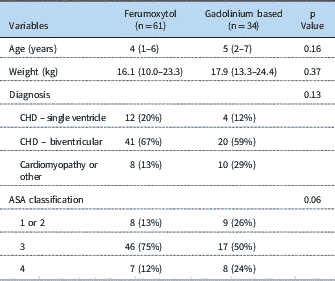
In all, 95 patients were identified: 61 (64%) in the ferumoxytol group and 34 (36%) in the gadolinium group (Table 1). There were no demographic or diagnostic differences between ferumoxytol and gadolinium groups. There were more ASA 3 and 4 patients (56%) in the ferumoxytol as compared with the gadolinium group (26%).
Demographic and diagnostic variables.

Anaesthetic information
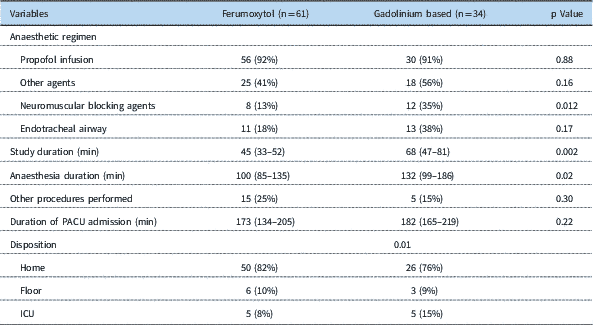
The majority of the patients, 86 (91%), received a propofol anaesthetic with no difference in the type of anaesthetic used between the two contrast agent groups (Table 2). The use of neuromuscular blocking agents was more common in the gadolinium group (p=0.01), as the incidence of endotracheal intubation was different between the groups (gadolinium 38% versus ferumoxytol 18%). The median anaesthetic duration was shorter (p=0.02) in the ferumoxytol group (100 min) as compared with the gadolinium group (132 min), but the duration of post-anaesthetic care unit stay did not differ (ferumoxytol 173 min, gadolinium 182 min; p=0.22). A total of 20 patients (21%) had additional procedures besides MRI imaging under the same anaesthetic procedure, but there was no statistical difference between groups with regard to the contrast agent used (Table 2).
Peri-magnetic resonance imaging data.

PACU=post-anaesthetic care unit
Vital signs
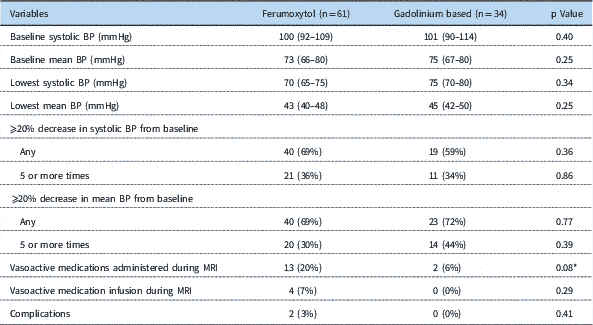
The baseline and lowest systolic and mean blood pressures were no different between groups (Table 3). In total, 59 patients (62%) had an episode of systolic hypotension, greater than a 20% decrease in systolic blood pressure from baseline, and 32 patients (34%) had sustained systolic hypotension, >15–20 min, during anaesthesia for the imaging procedure. Similarly, 63 patients (66%), in total, had at least one episode of a decrease in mean blood pressure, >20% decrease in mean blood pressure, and 34 patients (36%) had sustained hypotension. Although the majority of patients experienced hypotension (systolic or mean), only a third of the patients had sustained hypotension and 15 (16%) were treated for hypotension with vasoactive medications. There was no difference in the frequency of hypotensive events or the use of vasopressors as a result of contrast agent used on unadjusted analysis or when adjusted for ferumoxytol propensity score (Table 3).
Hemodynamic and outcome data.

BP=blood pressure.
* p=0.13 with propensity score adjustment.
Vasoactive medications
There was no difference in diagnostic category or baseline blood pressures between patients who did and did not receive vasoactive medications. Patients who received vasoactive medications or had sustained hypotension had longer anaesthetic times (140 min [107–203] versus 95 min [84–129]; p=0.04) and longer post-anaesthetic care unit stay (219 min [183–278] versus 161 min [137–187]; p=0.05) than those who did not.
MRI imaging
MRI imaging time was shorter in the ferumoxytol group than in patients who received gadolinium contrast agents (45 versus 65 min; p=0.022).
Complications
There were two complications, one laryngospasm and one possible anaphylaxis, in patients who received ferumoxytol, but none in the gadolinium contrast group (p=0.41). The patient with suspected anaphylaxis developed hypotension treated with vasopressors and intubation, but had no skin manifestations or respiratory complications. The laryngospasm event was in a different patient and was noted at the time of emergence from anaesthesia at the completion of the imaging procedure and not during or coincident with contrast agent administration. Although there was a non-significant trend (after propensity score adjustment) for more patients in the ferumoxytol group to receive vasoactive medications (Table 2), more of the patients who received gadolinium agents were admitted to the ICU (p=0.01). However, there were no unplanned admissions to the ICU regardless of the contrast agent used.
Discussion
Similar to other studies of ferumoxytol for non-cardiac MRI in children, this study of 95 children undergoing cardiac MRI revealed a low complication rate (3%) in patients who received ferumoxytol.Reference Cheng, Hanneman and Zhang 15 , Reference Hanneman, Kino and Cheng 16 , Reference Vasanawala, Nguyen and Hope 29 Although hypotension was not uncommon, the incidence did not differ between the contrast agents used. As all the children in this study were managed with general anaesthesia for imaging, the effect of anaesthesia alone on the incidence or frequency of hypotension, isolated from the contrast agent used, could not be determined.Reference Dorfman, Odegard and Powell 20 – Reference Faraoni, Zurakowski and Vo 23
Although the black box warning for ferumoxytol was issued for its adverse effects in adults, children undergoing anaesthesia are at a higher risk for cardiac arrest and/or respiratory arrest than adults.Reference Ramamoorthy, Haberkern and Bhananker 21 – Reference Faraoni, Zurakowski and Vo 23 Furthermore, compared with healthy children who are ASA status 1–2, those who are ASA 3–5 are at a greater risk for cardio-respiratory adverse events.Reference Faraoni, Zurakowski and Vo 23 Similarly, anaesthesia for non-cardiac surgery in children with CHD is associated with a higher risk of adverse events related to anaesthesia than those without cardiac disease.Reference Baum, Barton and Gutgesell 22 The majority (82%) of children in this study were ASA 3 or 4. Despite a greater proportion of ASA 3 or 4 patients in the ferumoxytol group, the risk of hypotension did not differ.
Cardiac MRI requires prolonged anaesthesia and sedation owing to the imaging time required to optimise acquisition parameters in children with CHD. The scan preparation time is more prolonged when gadolinium-based contrast agents are used because it is more dependent on operator factors such as the radiologist’s understanding of cardiac anatomy and surgical management.Reference Chan 14 , Reference Olivieri, Cross and O’Brien 24 Because of the long half-life of ferumoxytol, it can be administered before the initiation of the scan, whereas gadolinium-based contrast agents require a pause during the scan for the radiology technician to enter the room and the radiology nurse to administer the gadolinium-based contrast agent. As shown in this study, ferumoxytol is beneficial in this respect, based on the shorter imaging duration and, as a result, shorter anaesthetic duration in patients receiving ferumoxytol than those receiving gadolinium-based agents.
Despite advances in cardiac imaging, including four-dimensional-flow MRI,Reference Chan 14 – Reference Vasanawala, Hanneman, Alley and Hsiao 17 spatial resolution for anatomic assessment is limited owing to respiratory motion artefact. This issue can be overcome partially by respiratory gating, but at the cost of prolonged scan time.Reference Olivieri, Cross and O’Brien 24 In an effort to minimise motion-artefact-related to respiratory efforts, controlled ventilation is often required when using gadolinium-based contrast agents. In our study, the need for controlled ventilation with gadolinium contrast may have been related to the higher incidence of endotracheal intubation in the gadolinium group. More important, neuromuscular blocking agents were used in 35% of patients in the gadolinium group but only 13% of those who received ferumoxytol (p=0.01), as the former group required breath-holds for gating. Using ferumoxytol enhancement with four-dimensional-flow imaging parameters, assessment of flow, function, and anatomy was enhanced without the need for respiratory pauses.Reference Chan 14 – Reference Vasanawala, Hanneman, Alley and Hsiao 17
There was no difference in post-anaesthetic care unit stay, but planned disposition to higher levels of hospital care after anaesthesia was more common in children who received gadolinium agents. This seemed surprising considering that the ferumoxytol group included more patients with a high ASA status; however, more patients receiving gadolinium agents were more likely to have combined planned procedures, including cardiac catheterisation. The choice of contrast agent used was not dependent on having a combined procedure, although this would seem logical, as ferumoxytol is renal sparing.Reference Schiller, Bhat and Sharma 10 , Reference Lu, Cohen, Rieves and Pazdur 11 Sustained hypotension and use of vasoactive medications, rather than the use of neuromuscular blockade or scan time, was associated with longer anaesthetic duration and post-anaesthetic care unit stay.
One patient in this study had laryngospasm during emergence from anaesthesia, a recognised complication of anaesthesia, Reference Jain, Petrillo-Albarano and Parks 19 , Reference Baum, Barton and Gutgesell 22 , Reference Joshi and Tobias 27 that was unrelated to the use of contrast agent and resolved without escalation of care – i.e., admission to ICU or hospital. The second adverse event was a presumed allergic reaction, either to the anaesthetic agents used or ferumoxytol, in an infant. The tachycardia and hypotension were recognised promptly and managed with vasopressors, and the scan was completed. The patient returned to the neonatal ICU as per protocol for patients originating in the neonatal ICU before the procedure.
Limitations
This study was retrospective and patient selection for a given contrast agent may have been biased by the radiologist’s preference for imaging technique. Thus, we performed propensity adjustment in an effort to adjust for confounding related to non-random selection of imaging agent based on the radiologist assigned, which revealed few important differences. Although some anaesthesiologists may have been more comfortable with a natural airway than others, the regimen of continuous propofol infusion was common to all providers. Because there were very few adverse events, the study was not powered to assess for differences in the incidence of complications. Another potential confounder was the timing of contrast administration. Ferumoxytol was given in the anaesthetic induction room, outside the MRI scanner. Hypotension after its administration may have been coincident with hypotension related to anaesthetic induction, whereas gadolinium was administered in the MRI scanner room after a 15–20 period of scan time. In addition, we did not have a control group of children who underwent cardiac MRI without anaesthesia, as most such children are older and would not be comparable to the group who received anaesthesia.
Conclusions
Reducing imaging time and the need for airway intervention with use of ferumoxytol could have beneficial effects in reducing the risk associated with cardiac MRI. As seen in our study, children with cardiac disease are an at-risk group for complications related to anaesthesia such as hypotension potentially requiring vasoactive agents. The use of ferumoxytol as compared with gadolinium in children undergoing cardiac MRI does not increase this risk, but further prospective evaluation will be necessary to define the overall utility of ferumoxytol in this group of patients.
Acknowledgements
The authors thank Mary Lyn Stein, MD, for her preparation of the initial Redcap data collection sheet.
Authors Contributions
L.W.F.: study concept, data collection and primary author (manuscript content), N.V.: primary data collector and data preparation, and secondary author (abstract content), F.C.: preparation of patient lists for gadolinium and reviewing author for radiologic imaging, S.V.: preparation of patient lists for ferumoxytol and reviewing author for ferumoxytol, D.M.: data analysis and reviewing author for cardiology.
Financial Support
This work was supported by Spectrum Child Health Research Institute, Stanford University, National Institute of Health, National Center for Advancing Translational Sciences, and Clinical Translational Science Award UL1 TR001085
Conflicts of Interest
None.
Ethical Standards
IRB approval was obtained for data collection. Waiver of consent was allowed due to the retrospective nature of the investigation.