Introduction
Type 1 diabetes (T1D) is considered to be an autoimmune disease resulting from selective, progressive destruction of insulin-secreting β cells in the pancreatic islets. The etiology of T1D arises from contributions of both genetics and environmental factors, however, the exact pathogenesis of T1D remains essentially unknown.Reference Atkinson, Eisenbarth and Michels 1 Vitamin D has been hypothesized to directly, or through immunomodulation, protect β cells and prevent T1D.Reference Hypponen 2 Moreover, it has been proposed that vitamin D deficiency during sensitive periods of early development – for immune priming starting in the first gestational trimester and continuing during the 1st year of postnatal life – may contribute to early disease programming via epigenetic changes.Reference McGrath 3 The meta-analyses of observational studies showed that supplementation of vitamin D in early life reduced risk of developing T1D by 5% if taken in gestation, and significantly by 29% if taken in early infancy.Reference Dong, Zhang and Chen 4
The putative role of vitamin D in early disease programming may also contribute to the observed seasonality of birth in T1D patients. Rothwell et al.Reference Rothwell, Staines, Smail, Wadsworth and McKinney 5 showed that more British T1D patients were born during the spring and early summer, and fewer during the winter season. Since then, the seasonality of birth in T1D patients has been extensively explored, and more frequent viral infections during the winter, as well as a different manner of solar radiance and therefore cutaneous vitamin D synthesis, were discussed among explanatory factors.Reference Laron 6
Vitamin D is synthesized in the body from the exposure to sun radiation, animal (e.g. oily fish, eggs) and some non-animal food products (e.g. mushrooms exposed to sunlight or ultraviolet radiation) provide additional sources of the vitamin.Reference Lips 7 Oral intake might be further augmented by fortification and supplementation. There is no cutaneous vitamin D synthesis from October to March in Northern countries,Reference Kimlin 8 so to avoid vitamin D deficiency one possibility is to augment oral vitamin intake by food fortification.Reference Madsen, Rasmussen and Andersen 9 Interestingly, in Denmark, it was mandatory to fortify margarine in 1961–1985. The amount of vitamin D added to margarine was small (1.25 μg/100 of margarine).Reference Jacobsen, Hypponen, Sorensen, Vaag and Heitmann 10 Still, on average, it provided 0.4–0.6 μg of vitamin D/person/day, and contributed 13% to all dietary vitamin D among adult Danes.Reference Jacobsen, Hypponen, Sorensen, Vaag and Heitmann 10 , Reference Haradsdóttir and Thaarup 11
The aim of the present study was to assess whether gestational and early infancy exposure to extra vitamin D from margarine fortified with vitamin D affected seasonality of birth in Danish T1D patients. We hypothesized that early life exposure to vitamin D would underlie the seasonal patterns seen in T1D cases, and further that these seasonal trends would be less pronounced or eliminated during the periods when expectant mother and/or infants were exposed to extra vitamin D from fortified margarine, compared with periods when margarine was not fortified.
Methods
Exposure assessment and seasons of birth
Due to the issues related to data feasibility, the exposures around margarine fortification termination in 1985 were analyzed. The various exposure groups were formed taking into account (a) the date when the ministerial order cancelling mandatory margarine fortification in Denmark was introduced (1 June 1985), (b) full 9 months of gestation, (c) full 4 months of margarine shelf life and (d) additional full 2 months of total fortified margarine washout from the households.
Specifically, for 2-year gestational exposure or non-exposure, the individuals born from June 1, 1983 to May 31, 1985 comprised the group of exposed cohorts (sensitivity analyses were run expanding exposure group by birth cohorts from January 1, 1983) and those born from September 1, 1986 to August 31, 1988 formed the group of unexposed cohorts (sensitivity analyses were run expanding non-exposure group by birth cohorts born until December 31, 1988).
Further, the groups for gestational only and for a first postnatal life exposure were differentiated and defined as follows:
-
∙ those born from June 1, 1983 to May 31, 1984 (1 year in total) formed the group of individuals exposed to fortified margarine during the 1st year of postnatal life (sensitivity analyses were run by expanding the first postnatal exposure group to include birth cohorts since January 1, 1983);
-
∙ those born from September 1, 1984 to May 31, 1985 (9 months in total) comprised the group of only prenatally exposed cohorts;
-
∙ those born from September 1, 1986 to August 31, 1987 (1 year in total) formed unexposed group (sensitivity analyses were run expanding non-exposure group by birth cohorts born until December 31, 1988).
The months of birth were grouped into four seasons: winter – December to February, spring – March to May, summer – June to August and autumn – September to November (sensitivity analyses were run with the season starting 1 month earlier: winter – November to January, spring – February to April, summer – May to July and autumn – August to October).
Outcome assessment
The unique personal identification numbers (CPR) for all individuals born in Denmark from 1983 to 1988 were received from the Danish Civil Registration System (CVRS). The Danish CVRS was established in 1968, and registers all persons in Denmark alive on April 1, 1968 and born thereafter.Reference Pedersen 12 The information on T1D diagnoses was obtained through the individual CPR linkage with the Danish Childhood Diabetes Registry (DSBD). In Denmark, since January 1, 1996, all hospitalized incident cases of T1D in children aged 0–14 years (i.e. born since 1981) have been reported to the DSBD, where the original hospital records were checked to establish the diagnosis date, here defined as the date of the first insulin injection.Reference Svensson, Lyngaae-Jorgensen, Carstensen, Simonsen and Mortensen 13
Statistical analyses
Cox regression models with time to T1D diagnosis as an outcome, and season of birth as explanatory variables were run. The models differentiated by exposure group and sex were run, as the terms of formal three-way interactions between season, exposure and sex were statistically significant (0.02<P<0.07). As sensitivity test, all the analyses were also re-run in logistic regression models. The data set for the analyses was constructed in Stata/SE 12.1 (StataCorp, 2011), and the analyses were run in SPSS 19 (IBM, 2010).
Results
There were 331,623 individuals born in Denmark from 1983 to 1988; 886 (0.26%) developed T1D by the age of 15 years, where the majority (503, or 56.8% of all T1D cases) were diagnosed at age 10–14 years. There were more males in the entire population (170,431 or 51.4%) as well as among those with T1D (480 or 54.2%). Both among males and females, more people were born during spring and summer compared with autumn and winter. The size of the study population by sex, season of birth and age of T1D development is presented in the Supplementary Table S1.
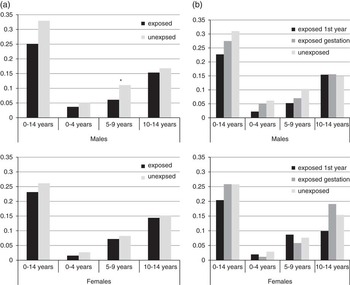
Figure 1a and 1b presents the percentages of individuals developing T1D, by age at diagnosis and various exposure groups, in males and females. The largest change in T1D risk in prenatally exposed birth cohorts compared with prenatally unexposed birth cohorts was observed in males developing T1D at age 5–9 years.
(a) The percentages of individuals developing type 1 diabetes (T1D) by age at diagnosis in gestational exposure groups. (b) The percentages of individuals developing T1D by age of diagnosis, in exposure groups differentiated into gestational only, 1st postnatal year exposure and non-exposure groups.

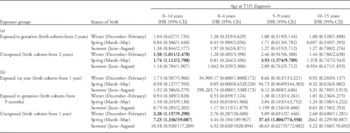
Table 1 presents the result of Cox regression analyses and shows hazard ratios for T1D development among individuals born in various seasons compared with autumn, in various exposure groups, in males and according to age at T1D diagnosis. The T1D hazards were higher among those born in winter and in spring compared with those born in autumn in unexposed males with T1D diagnosis at age 0–14 years; further, the T1D hazards remained higher in those born in spring compared with those born in autumn in males with T1D diagnoses at age 5–9 years. On the other hand, there were no differences in T1D hazards between those born during various seasons among males exposed prenatally or during the 1st year of postnatal life. Sensitivity analyses expanding gestational and 1st postnatal year exposure groups, as well as shifting the seasons of birth by 1 month back, have showed similar results: T1D hazards were higher among males born in spring compared with born in autumn in only unexposed cohorts, and the pattern remained in male individuals with diagnoses at 5–9 years. Among females, the main (Supplementary Table S2a and S2b) and sensitivity analyses did not reveal consistent results.
Hazard ratios (HR) with 95% confidence interval (CI) for type 1 diabetes (T1D) by seasons of birth in (a) exposed prenatally and unexposed, (b) exposed during 1st year of life, exposed prenatally and unexposed, in males, in groups of age at T1D diagnosis

Reference [born autumn (September–November)] in bold – statistically significant results.
Discussion
The two previously conducted studies did not detect any seasonality of birth among Danish T1D patients.Reference McKinney 14 , Reference Streym, Rejnmark, Mosekilde and Vestergaard 15 In our study, the investigation of seasonality of birth in T1D was not an objective per se. Rather, we hypothesized that seasonality of birth would be attenuated/eliminated among individuals with T1D born within vitamin D fortification periods, as opposed to individuals born outside these periods, due to extra intake of vitamin D during gestation/early infancy in sunshine-deprived months. Our results, showing that seasonality of birth was detected only in males unexposed to fortification, so that those born in spring had a higher risk of developing T1D compared with those born during autumn, suggest that this could in fact be true for male T1D patients.
Due to the fact that the fetus is entirely dependent on the vitamin D status of the mother,Reference Dror and Allen 16 the vitamin D levels of the offspring fluctuates according to the seasons as a result of variations in UVB radiation, unless the change is counterbalanced by dietary intake of vitamin D. Previously, the pronounced seasonal variation in serum 25-hydroxyvitamin D levels has been demonstrated in British adults, with low levels of 25-hydroxyvitamin D3 measured from December to May.Reference Hypponen and Power 17 Seasonal variation was also demonstrated in the neonatal blood in Danish newborns from the Dry Blood Spots (DBS cards), where the lowest serum 25-hydroxyvitamin D3 levels were found among those born from October to May.Reference McGrath, Eyles and Pedersen 18 Further, in our preliminary analyses of PKU cards from about 100 individuals exposed to extra vitamin D from fortification (e.g. those born from June 1983 to May 1985), and about 100 individuals unexposed to extra vitamin D (e.g. those born from September 1986 to August 1988) a tendency of higher 25-hydroxyvitamin D3 levels at birth could be seen for the exposed children, particularly for those born in October to December (unpublished data). The previous findings on seasonally fluctuating neonatal 25-hydroxyvitamin D3 levels, our preliminary data on fortification effects for these seasonal fluctuations, together with the multiple studies suggesting protective effect of vitamin D, if taken early in life, for later T1D riskReference Dong, Zhang and Chen 4 support our hypothesis that those born during the period of fortification may have reduced or eliminated vitamin D deficiency during winter, and therefore attenuated seasonality of birth for T1D risk. Meanwhile, the previous studies, which did not detect seasonality of birth in Danish T1D patients, omitted accounting for the distinct-in-time vitamin D fortification periods.
The associations between gestational exposure to food fortification and seasonality of birth identified in our study were different for males and females. Some previously conducted studies on seasonality of birth in T1D also showed the seasonality in boys, but not in girls,Reference McKinney 14 , Reference Jongbloet, Groenewoud, Hirasing and Van 19 and explained it as an artifact,Reference McKinney 14 or in terms of the seasonal pre-ovulatory over-ripeness ovopathy (SPrOO) hypothesis.Reference Jongbloet, Groenewoud, Hirasing and Van 19 The latter hypothesis proposes that seasonal non-breeding periods (e.g. winter seasons) may result in non-optimally ripped oocytes (i.e. pre-conceptual conditions), which is a life start for individuals with developmental defects, and more frequently occurs in males.Reference Jongbloet 20 Our results showing that T1D increased mostly in boys of 5–9 years age, which coincided with seasonality of birth occurring in these boys, is a fact supporting SPrOO hypothesis. However, if extra vitamin D coming from fortified food was helping normal ripping of oocytes in sunshine-deprived months from October through March, the SPrOO hypothesis would explain the attenuated seasonality of birth for boys born from summer throughout early winter. According to our results, the risk of developing T1D was decreased in boys born early spring, hence suggesting that extra vitamin D was operating during late gestation or early infancy, and discriminating the explanatory power of SPrOO hypothesis in our case.
An alternative explanation could be that extra vitamin D prevented viral infections in infants, which in turn resulted in lower risk of T1D in those born in early spring during fortification period. Generally, prenatal or early childhood infections may both protect from the T1D and accelerate autoimmunity.Reference Bach and Chatenoud 21 , Reference Stene and Rewers 22 According to the results of the previously conduced Danish study, neonatal infection increased the T1D risk in boys but not in girls.Reference Svensson, Carstensen, Mortensen and Borch-Johnsen 23 Considering the possibility that vitamin D may prevent development of neonatal infections,Reference Parekh, Lax, Dancer, Perkins and Thickett 24 exposure to extra vitamin D from margarine fortification during late gestation may have been the factor that contributed to the reduced T1D risk in boys born in spring during the margarine fortification period.
The present study did not intend to assess the association between gestational exposure to extra vitamin D and the T1D risk overall, as this would require the association to be adjusted for birth cohort effect in T1D incidence in Denmark. More specifically, the studied exposed individuals were born during 1983–1985, and unexposed during 1986–1988, and a steady yearly increase in T1D incidence in Denmark for children born after 1980 has previously been proved.Reference Svensson, Lyngaae-Jorgensen, Carstensen, Simonsen and Mortensen 13 Nevertheless, the examination of seasonality in adjacent birth cohorts within exposure or non-exposure periods was a strong feature of this study, as the individuals for the analyses were unselected in relation to daily vitamin D intake, T1D occurrence or possible confounders that can be assumed to be balanced between the individuals from the adjacent birth cohorts. We needed, however, to consider other potential societal events occurring simultaneously with the changes in fortification practice, as well as confounders changing over time during 1983–1988. We are unaware of any significant relevant societal changes occurring simultaneously in time with the mandatory margarine fortification cancellation. Among the potential confounders, which might have changed over time, we explored the changes in Danes’ margarine consumption, monthly sunshine hours in Copenhagen and the number of influenza cases reported to General Practitioners in Denmark. According to Danish food disappearance statistics,Reference Fagt and Trolle 25 margarine intake during the period from 1983 to 1985 decreased only slightly, and these changes were most likely too small to be expected to influence the interpretation of the current results. Calculated averages of the amount of monthly sunshine hours obtained from the Danish Meteorological Institute, as well as monthly reported influenza cases between the years from 1983 to 1988 did not differ, and presumably could not explain our findings either.
The limitation of the study was that a similar seasonality of birth analysis around the initiation of the margarine fortification program in 1961 could not be done, as we lack complete and valid information on T1D diagnoses before the age of 15 years. In addition, those unexposed around the initiation would have presented individuals unexposed during gestation or 1st year of life, and also unexposed during mother’s pre-pregnancy. When only analyzing the period around the cessation of the fortification in 1985, we may have had the problem of pre-pregnancy loading which potentially could matter as much as exposure during gestation and during infancy.
In conclusion, our study suggests that exposure to food fortified with a low dose of vitamin D early in life eliminates seasonality of birth in T1D male patients. Further studies are required to further investigate the identified gender differences and confirm our findings.
Acknowledgments
The authors thank statistician Kyle Raymond for constructing the data set and statistical advice, and Birgitte Marie Skogstad for language revision.
Financial Support
The study is a part of the 4 years project ‘D-tect’ funded by the Programme Commission on Health, Food, and Welfare under the Danish Council for Strategic research (grant number 0603-00453B).
Conflicts of Interest
None.
Ethical Standards
All administrative and disease databases are accessible for research purposes in Denmark. The collection of data in these registries has been undertaken in accordance with the generally accepted ethical principles and has been approved by the relevant ethical committees in accordance with the Danish law. For this study, the Danish Data Protection Agency provided the permission for the access to the Danish Civil Registration System, where individual CPR numbers are stored (J. no.: 2012-41-41156). This permission also included the permission to merge CPR numbers with different nationwide disease registers.
Supplementary Material
To view supplementary material for this article, please visit http://dx.doi.org/10.1017/S2040174415007849