I. Introduction
The rise and fall of the Vikings cannot be understood without addressing the development of their ships. Before 800 AD the Vikings did not use sails, allegedly because rowing matched their perception of hard work and masculinity (Husemann, Reference Husemann2006). Then, however, shipbuilding improved, and the new ships, which included sails, were perceived as one of the secrets of the Vikings’ military success for the next two and a half centuries (Christensen, Reference Christensen1996). The decline of the Vikings started, inter alia, when Germanic cities established the Hanseatic League (Hanse). The cog-build vessels of the Hanse had the advantage that their decks were higher than those of the Viking ships and, thus, arrows could easily be shot downwards at the Vikings and it became difficult for the Vikings to board these new cogs. Although the Vikings changed their ships to adopt some of the features of the cogs, this came too late to make up the advantage of the Hanse (Husemann, Reference Husemann2006).
In analysing this development, one could compare the various ships which the Vikings and their rivals used throughout the centuries. Yet, one can also focus on the question why and how the Vikings changed their ships. This question, to what extent they adapted their ships, is indeed crucial in order to understand the Viking age in Europe.
A similar line of thinking can be applied to a study which analyses whether ‘law’ affects the development of a specific people. An examination of the law ‘as such’ may not be sufficient, because the adaptability of the law to new or changing circumstances may be more important for the success or failure of a particular country. Thus, legal adaptability will be discussed in this article.
It is organised as follows: Part II explains the basic idea why law reacts to new circumstances. Part III looks at the worst case scenario by discussing a fictional country (Elbonia) where legal adaptability is poor. From this follows Part IV, which identifies the main adaptability criteria. By using empirical data from the three Baltic States (Lithuania, Latvia, Estonia), Part V provides an example of how to ascertain the degree of legal adaptability of particular countries. Part VI contains some caveats on a maximum of adaptability. Part VII concludes.
The relationship between this article and existing research is threefold: first, it takes the new quantitative methodology of comparative law into account.Footnote 1 Second, its purpose is not to review and criticise existing studiesFootnote 2 but to introduce new ideas. Third, it will not engage in the general discussion of the application of the evolutionary theory to law. The main focus is on the criteria which determine the level of legal adaptability of a particular country. What is not discussed is how evolutionary elements, such as selection, mutation, migration, recombination and mating may work in law, nor which direction the evolution of law may take.Footnote 3
II. Does law ‘just react’?
The concept of legal adaptability may be criticised, because law does not merely react: rather it could be stressed that law ‘matters’ for development. For instance, company law may be the cause and not the outcome of a particular development: when in the nineteenth century restrictions on the establishment of joint-stock companies were broken down, waves of foundations followed, since it then became possible to pursue capital-intensive projects in a permanent, differentiated organisational form (cf. Horn, Reference Horn, Horn and Kocka1979, p. 176). It is also asserted that for financial development the extent of legal protection for shareholders is decisive, because better protection motivates more people to invest in shares and thus leads to a broader distribution (La Porta et al., Reference La porta1998).Footnote 4
But causality does not always work this way. If there is causality, it can also go the other way. For instance, there are examples which show that only after the number of investors and the importance of the capital market increased shareholder protection was strengthened (Coffee, Reference Coffee and McCahery2002; Cheffins, Reference Cheffins2001). And it is also likely that, for example, the rise of new technologies, terrorist attacks, new diseases, increased international competition, or corporate scandals cause law-makers to respond.
Of course, this does not mean that the law only responds to these external circumstances. Legal systems have their own internal dynamics (Carvalho and Deakin, Reference Carvalho, Deakin, Rogowski and Wilthagen2007). And the next parts of this article, too, provide various reasons why the law of a particular country does not (or should not)Footnote 5 ‘just react’. This is indeed the core of the idea of ‘legal adaptability’. Legal adaptability does not suggest an automatic change but just wonders to what extent the law of a particular country is able to respond to new or changing circumstances.
III. Elbonia: the worst case scenario
The different factors which can be decisive for legal adaptability are best revealed by a worst case scenario. I will use a fictional country called ElboniaFootnote 6 to illustrate this.
Here, the Elbonian legislature does not react to changing circumstances – once a particular law has been passed it is there forever. This is first of all based on structural reasons. In Elbonia both inefficient centralisation and decentralisation co-exist. Political powers concerned with local problems are centralised and consequently the central legislature cannot tell how its law is applied locally. Conversely, powers concerned with problems which can only be tackled uniformly are decentralised, and thus the various local law-makers try to solve these problems, but without success. There is no evaluation on how the existing law works in practice on any level of legislation. Empirical evidence is not taken into account and feedback by interested parties and academics is not wanted. This is combined with complex bureaucratic structures which usually prevent any new ideas from being brought up. And even if doubts about the efficiency of the existing law are raised, a lengthy law-making process has the consequence that reforms which eventually take place come far too late. Finally, since Elbonia is not a proper democracy, the people cannot put pressure on the legislature to take changing circumstances into account.
Secondly, there are person-related reasons, which make the Elbonian legislature unresponsive to change. All Elbonian politicians and civil servants come from the same tiny town and all of them have studied ‘rickshaw-spotting’ at the same university. They have therefore, for instance, no knowledge of foreign languages, natural sciences, sociology and economics. Thus, they disregard developments in foreign laws, new scientific inventions and discoveries, as well as research on the economic and social impact of their laws. Moreover, Elbonian politicians and civil servants are notoriously corrupt. They can therefore be bribed by rent seekers so that it is ensured that even the most urgent reforms do not take place.
Thirdly, in order to stabilise the Elbonian system the legislature is keen on preventing any adaptability by other persons or groups from taking place. Thus, there is neither freedom of contract nor arbitration nor self-regulation. All law is mandatory. Contractual parties are banned from taking modern developments (such as the use of e-mail or new types of contracts) into account. Neither can this be evaded by choosing the law of a different country, because ‘choice of law’ is equated with a ‘race to the bottom’Footnote 7 and thus outlawed completely. The same line of reasoning applies to arbitration and self-legislation. Here too it is said that parties must not evade the official national laws and courts.
Fourthly, the Elbonian legislature hinders courts from reacting to external change. The safest way to guarantee this is that not a lot of legal actions are taken in the first place. Court costs are extremely high. All parties have to be represented by at least four lawyers, which also leads to an increase in costs. In order to bring a suit burdensome forms have to be handed in and various other formalities have to be complied with. And usually it takes about ten years until judgment is given. If, despite these reasons, parties take legal action, Elbonian law guarantees that all similar cases are decided in exactly the same way, thus eliminating response of the courts to new circumstances. On the one hand, this is achieved through substantive law. Since all laws are not only mandatory but also very detailed, judges have little discretion. This is strengthened by strict rules on interpretation in order to ensure that judges stick closely to the wording and do not ‘fantasise’ about the law’s purpose, customary law, equity and good faith. On the other hand, there is a strict procedural law. Judges are not allowed to question the parties or experts who may point out the practical out-datedness of particular legal concepts. There is also a strict doctrine of stare decisis, because precedents must never be overruled. Yet, this doctrine can only be assessed by the judges themselves, because Elbonian judgments are not allowed to be published, thus ensuring that judges are not ‘unduly influenced’ by outside pressure. Finally, in order to guarantee little change, there is a unique law on judges. Appointment of judges is decided on political grounds. A special test is held in order to exclude applicants who may disrupt the present system by ‘innovative ideas’. For appointed judges the principle of non-independence applies. This means an ongoing screening of the judges’ political attitudes as well as their adherence to the substantive and procedural ‘doctrine of formality’. Only if they comply with this doctrine, judges may be promoted.
Fifthly, Elbonian law prevents advocates (solicitors and barristers) from putting pressure on the courts to change outdated legal concepts. This is mainly achieved by law firms not facing competitive pressures. As there is only a very limited number of lawyers, they do not have to make any effort to get clients. Rather it is the case that clients have to beg lawyers to act as their counsel.Footnote 8 If clients manage to get counsel, there is no guarantee that their lawyer will act in their interest, because contingency fees are forbidden and liability suits against lawyers are inadmissible.
Sixthly, the legislature also ensures that the general public and legal academia do not foster the adaptability of the law. Freedom of speech and press is prohibited, and discussions at schools or universities not desired. Foreign languages are not taught, and Elbonian universities do not provide any information about foreign laws. The legal education is controlled through state universities and state exams. The examination itself only tests codified law, which must be learned by heart and is then recited.
But it would not be fair simply to blame the legislature. As far as judges have some room for manoeuvre, they do not respond to changed circumstances either. They only apply deductive and formalistic lines of reasoning and take no notice of anything that is not written in the laws or is not part of binding precedents. Foreign ideas are resolutely disregarded. If you mention a comparative idea to a judge of the Supreme Court, he may, for example, cut you off by saying that ‘just because the English do it this way, we don’t have to do the same’.Footnote 9 And in two decisions it was even stated that ‘this Court should not impose foreign moods, fads, or fashions on Elbonians’.Footnote 10
Advocates do not foster change either. For example, the drafting of contracts is not regarded as an ‘art’ but as a mere technicality. The templates which are used are not adapted to new circumstances and any creativity is said to be as alien to the legal profession. For instance, it may be stated that: ‘Lawyers are boring. They sit at their desks in their offices surrounded with dull tomes containing antiquated judicial opinion on cases no one cares about with little relevance to the modern world.’Footnote 11
Legal academics and the general public as a whole have similar attitudes. Formality is always considered as paramount, and criticism of out-dated laws is not expressed. In public discussions neither Fichte’s ‘dialectical triad’ (thesis, antithesis, synthesis) nor Popper’s ‘trial-and-error method’ can be used, because principles of harmony oppose any disagreement. The legal academic is not a lot better: different schools of thought are not tolerated. It is also not appropriate to raise points which are based on economic, social, or political lines of reasoning, or on the law of foreign countries. This is also reflected in the teaching of future lawyers which celebrates the model of a lawyer as a ‘Paragraphen-Automat’ (Weber, Reference Weber and Winckelmann1988, p. 323).
IV. Adaptability criteria
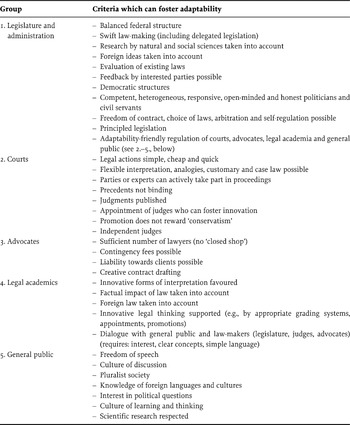
The ‘Elbonian case’ demonstrates that adaptability depends on a complex set of criteria. If one attempts to structure them, it may look like the list in Table 1 overleaf.

This list is not comprehensive. However, it should be noted that some topics have deliberately not been included because they are ambiguous. For instance, ‘natural law’, on the one hand, may foster legal adaptability because it gives judges a tool to disregard codified law that is too formal and inflexible. On the other hand, it may also prevent innovation by incorporating ethical and moral arguments which are based on the status quo. Another example is whether there are professional or lay judges. On the one hand, professional judges may be more knowledgeable and thus notice that certain legal concepts are outdated. On the other hand, it is also possible that lay judges foster adaptability because they may not bother about formal legal arguments in the first place.
Regarding the composition of the list, it is noteworthy that the category ‘courts’ is only one out of five groups. This differs from an article by Beck et al. (Reference Beck2003, p. 664), which tries to measure legal adaptability. Beck et al. just use the variable ‘legal justification’ as a proxy for legal adaptability. This variable is ‘formed by the normalised sum of: (i) complaint must be legally justified, (ii) judgment must be legally justified, and (iii) judgment must be on law (not on equity)’.Footnote 12 However, as the Elbonian case shows, this is too limited as the degree of legal adaptability of a particular country depends on a larger set of criteria. This is also in line with the origins of the term ‘legal adaptability’. The English version of this term was probably first used in an article by Jamin (Reference Jamin2002), in which he re-examined the position of the great French jurist Lambert. In the original article, Lambert (Reference Lambert1900) advocates the openness of legal science in general, thus ensuring a continuous adaptation du droit.
In another study, Pistor et al. (Reference Pistor2003) use different indicators. In order to ascertain the innovative capacity of the corporate law of particular countries they look at: (i) the rate of statutory change; (ii) the mandatoriness of the law; (iii) the establishment of a supervisory authority for stock exchanges; and (iv) the difference between legal-origin and transplant countries. However, this is still considerably shorter than the aforementioned list. This is also acknowledged by Pistor et al. themselves, by admitting that they do not address political and constitutional factors although they may influence the innovative capacity of legal systems (Pistor et al., Reference Pistor2003, p. 681). Furthermore, it has to be noted that Pistor et al.’s purpose is different from this article. Whereas the present article seeks to understand legal adaptability generally, Pistor et al. are interested in the development of corporate laws and the specific case of transplant countries.
In another respect, these previous studies could, however, be exemplary. Beck et al., Pistor et al. (to some extent) and other studies use a quantitative methodology in order to ascertain whether law or specific features of the law, such as legal adaptability, matter for financial development. In order to make this work, it is necessary to translate the variables of the aforementioned list into numbers. Partly, this quantification of legal adaptability could be based on previous research. For example, some of the criteria on the legislature may be related to the empirical data which exists for the rule of law and corruption.Footnote 13 For courts, research by Djankov et al.Footnote 14 can be useful. And for the general public, one can contemplate employing some of the Hofstede-criteria on culture.Footnote 15 Of course, for a number of variables, such as, for instance, ‘open-minded politicians’, ‘pluralist society’, and ‘innovative legal thinking’, quantification is difficult. Thus, as always, a numerical approach to law has its inherent limits (Siems, Reference Siems2005). But, despite these limits the next part will provide an example of how it may be possible to ‘measure’ the degree of legal adaptability of particular countries.
V. Why Estonia is not Elbonia
The three Baltic States (Lithuania, Latvia, Estonia) may be regarded as very similar. They are relatively small north-eastern European countries and in the last 100 years they have shared many historical similarities, namely the occupation by Germany and the Soviet Union, the first and second independence after World War I and 1990, and the accession to the EU in 2004. But there are also differences. For instance, Lithuania is the only Catholic country, Latvia is the country with the largest ethnic minorities,Footnote 16 and Estonia is the only country whose language belongs to the Finno-Ugric languages.Footnote 17 With respect to legal adaptability, it may therefore be an open question of whether similarities or differences prevail.
In gathering information, the first problem was that not all data collections cover the three Baltic States.Footnote 18 Secondly, the choice of variables can often be challenged. For instance, the meaningfulness of indices of the World Bank and of Transparency International are disputed (Perry-Kessaris, Reference Perry-kessaris2003; Twining, Reference Twining2005). One can also criticise variables which use rankings based on hits on the internet,Footnote 19 because they do not take into account what actually is mentioned on the specific web pages. Thirdly, legal adaptability may vary between different areas of law. In particular, there may be a distinction between public and private law, because in the former areas of law not only the integrity and competence of the parliament but also of the competent authority is crucial.
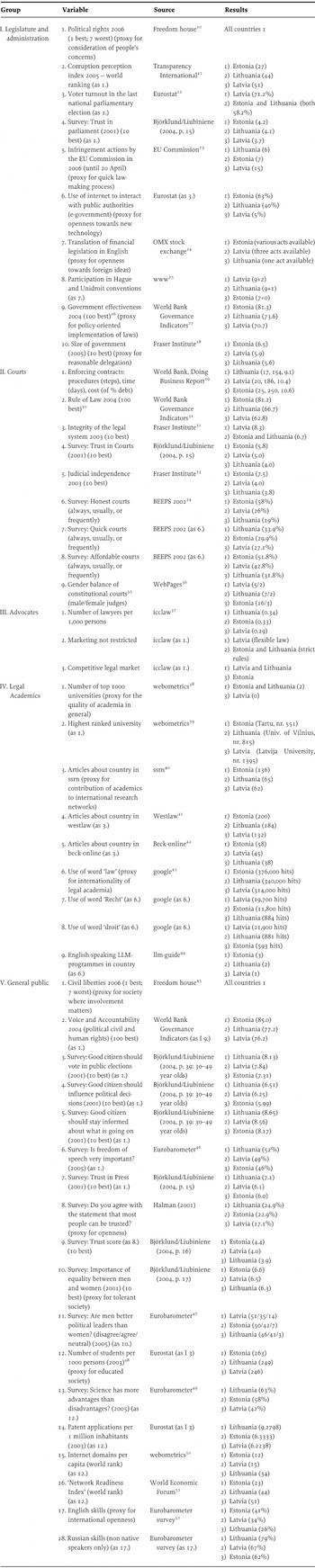
Despite these limits, Table 2 displays some general indicators for legal adaptability. The main categories derive from the groups of Table 1 (Part IV, above). In general, Estonia performs significantly better than the two other countries. It is 25 times in first place (Lithuania 15 times; Latvia 8 times). Its result could even be better as Estonia has a smaller population than Lithuania and LatviaFootnote 53 and some, but not all, variables take this difference into account.Footnote 54 In detail, Estonia is particularly strong in the categories ‘legislature’ and ‘legal academics’. In the category ‘general public’ Estonia and Lithuania perform well and in the category ‘courts’ all three countries display similar values. Finally, with respect to advocates Lithuania and Latvia perform better than Estonia, which may be due to the bigger markets in these countries.
Proxies for legal adaptability in the Baltic States

These differences in legal adaptability correlate with economic data. For instance, the GNI per capita is higher in Estonia (7,010) than it is in Lithuania (5,740) and Latvia (5,460).Footnote 55 Yet, this does not necessarily mean that the economic differences are caused by the different degrees of legal adaptability. It could equally be possible that the wealth of a country results in having better institutions which in turn have an influence on legal adaptability.Footnote 56
VI. Advising Elbonia: caveats
Returning to the miserable state of legal adaptability in Elbonia, one may wonder which adaptability criteria would be most urgent to incorporate. In particular, it can be questioned whether any of the five categories (Parts IV, V, above) works best. This could be based on the different ‘leverage’ of each group. For instance, the use of statutory law could be superior to the use of case law, because the legislature can make decisions about everything whereas courts can only decide about the cases which are brought before them. Yet, the counterargument would be that courts can act more quickly and in a more balanced way than the legislature. Thus, the leverage of the legislature may be higher, but adaptation by courts may be more efficient. Things are getting even more complicated when the criteria ‘legal academics’ and ‘general public’ are taken into account: since judges and advocates are trained at universities and politicians, civil servants, judges and advocates are part of the general public, the ‘leverage’ of adaptability of these two groups of criteria is higher than that of the other groups (legislature, advocates and courts). Yet, the counter-argument is again efficiency, because the way academics and the general public think and behave cannot be changed easily. As a result, adaptability with respect to each of the five groups has its advantages. One could therefore suggest that for a country such as Elbonia it would be best to make everything, i.e. all criteria of the list, as adaptive to external change as soon possible. This would, however, be naïve for two reasons:
1. Stability
In the previous parts legal adaptability was implicitly regarded as favourable. Yet, one can easily construct counter-examples of excessive adaptability. In a system of statutory law this would be, for instance, the case if the population (or the parliament) voted every day on the most important topics: By means of online voting this could be easily done in practice, and may have the consequence that, for example, the tax rate changes daily, and abortion is allowed on Monday, prohibited on Tuesday and Wednesday, and then allowed again on Thursday. In a case law system this model of complete adaptability would abolish appeals as well as the relevance of statutory law and precedents. Judges could always make decisions based entirely on their personal preferences. Then, it may, for instance, be the case that a particular conduct is treated as a crime in district A and B, but not C on Monday, but – due to different judges in these districts – as a crime in district C, but not A and B on Tuesday.
The first problem with too much adaptability is therefore legal uncertainty. People and businesses must be able to trust in the law.Footnote 57 Secondly, law is not a mere technicality. To some extent, the origins of law are based in moral, ethical or even religious questions.Footnote 58 Complete ‘legal relativism’ may therefore be at odds with the belief that law must not disregard overall goals without reluctance. This is, thirdly, also in line with the fact that, to some extent, ‘all lawyers are conservative’. Lawyers proceed by statute and precedent. Therefore, they always have to look back in order to find out what the law is, and then advance existing arguments. This ensures consistency of the law. It also corresponds with the role of judges, because a system where they would not need to be concerned with the past would equate them to politicians, and thus weaken democratic principles and the separation of powers. Fourthly, it would not be efficient to change all path dependencies in the law of a particular country. Weak path dependencies do not need to be changed because from today’s point of view the law has not become inefficient.Footnote 59 This is different for semi-strong and strong path dependencies. Yet, at least for semi-strong path dependencies, change would also not be recommended. Although in this case today’s law is not efficient any more, the switching costs are too high to justify its change.
This importance of legal stability can also be confirmed by the fact that in many developed countries parts of the law are very old. For instance, a radical supporter of legal adaptability may be puzzled by the fact that the French and the Germans use their 200 and 100 year old Civil Codes, and in England case law which is even older is applied, whereas everything else has changed in the last centuries (political systems, industrialisation, technology, internationalisation etc.). There are four possible answers as to why these laws have persisted: first, weak adaptability in these countries; second, no fundamental changes in the deep structures of these societies; third, law is often just technical so that deeper structures do not matter (e.g., sale contracts existed 200 years ago and exist today; just the products have changed); and, fourth, only superficially the law is still the same, but its application has changed. Probably all of these four explanations contain some truth. In any case, the actual persistence of some core concepts also indicates the value of some conservatism of the law.
As a result, it would not be a good idea if Elbonia introduced an ‘absolute system of legal adaptability’. Thus, Elbonia may look at the trade-off between adaptability and stability which exists in a particular foreign legal system and contemplate adopting it. Yet, this may also lead to problems.
2. Changing ‘change’
Forms of change vary in different legal traditions. As a starting point this depends on whether a society has a linear or cyclical notion of time.Footnote 60 More precisely, one can, first, distinguish whether change usually happens by ‘renewing (bringing forward of ancient practices), maintaining (developing an existing practice in extended form), or reforming (rethinking of existing traditional formula)’.Footnote 61 Secondly, a distinction can be made based on the importance of legislatures, courts and academics. Thirdly, countries may follow a conceptual and structured or an open and ‘chaotic’ perception of law. Fourthly, judges in particular may be seen as either law-makers, or law seekers, or law appliers.Footnote 62 Fifthly, one may distinguish between countries which are closer to a system of relativism (and thus open to change) and countries where some questions are ‘beyond dispute’.Footnote 63
Given these different traditions, one could claim that a country belongs to a ‘particular box’ and that it cannot get out of it easily. However, this would be a too simplified picture of legal traditions. ‘Legal systems never are – they always become’ (Mattei, Reference Mattei1997, p. 14),Footnote 64 so that the idea of pure legal traditions is merely a didactic device (Siems, Reference Siems2006). In reality it is therefore the case that in all countries means for fundamental changes, which address general inadequacies, and incremental changes, which address particular cases, coexist. Thus, one cannot assume that a particular form of adaptability is fundamentally alien to a particular country.
Yet, this does not mean that a country such as Elbonia can successfully copy any element of adaptability. Questions of form – such as adaptability – and substance cannot be separated but should be in equilibrium. In comparative law it is increasingly understood that the concept of functionality is too reductive, because not only the legal rules as such but also the functions which the law performs differ.Footnote 65 Different preferences – such as exemplified in the varieties of capitalismFootnote 66 – may therefore suggest different forms of adaptability. Consequently, changing legal adaptability by legal transplants is possible but not easy.Footnote 67 For Elbonia it can therefore not be said abstractly how its ill-conditioned system of change should be changed. Rather, the foregoing line of reasoning suggests a careful approach to changing ‘change’.
VII. Concluding remarks
This article started with the adaptability of Viking ships and then focused on the topic of legal adaptability. However, adaptability is a general social phenomenon,Footnote 68 and its explanatory power is even used in areas where this may appear alien. For instance, according to a newspaper article, ‘Cambridge economists are planning to use mathematical methods to find out why some religions prosper and others decline’, in particular, ‘which factors help religions to adapt to the modern world’.Footnote 69
Given these diverse uses of the concept of adaptability, one may wonder whether the output of this article can be valuable more generally. This may indeed be possible. The groups of the above-listed criteria of legal adaptability (Part IV) can be extended to other types of adaptability. Here too there are usually global factors (above: general public), educational factors (above: legal academics), personal features of the actors involved (above: courts and advocates), and structural elements (above: legislature). For example, adaptability in shipbuilding may also depend on global factors (perhaps: general technical skills of a particular society), educational factors (perhaps: a particular apprenticeship system for shipbuilders), personal features (perhaps: rewards for innovate shipbuilders), and structural elements (perhaps: functioning supply chains in order to get the materials necessary for shipbuilding).
In face of these similar features, it would be interesting to link different types of adaptability. This would be particularly useful for legal adaptability, as law cannot be understood without its social, cultural and economic context. The next step in the investigation of legal adaptability would therefore be an analysis of how fields, which are related to law, adapt to changes, and how this interacts with legal adaptability.