The important role of social comparison in collective bargaining has long been recognized (Ross, Reference Ross1947). Because the main function of collective bargaining is to allocate scarce resources between two parties with conflicting interests – the labor union and the employer – the notion of equity is especially salient in collective bargaining. In this context, evaluating equity always involves a process of comparison with others because no objective criteria to evaluate equity exist (Adams, Reference Adams1965). For example, Ross observed that ‘comparisons play a large and often dominant role as a standard of equity in the determination of wages under collective bargaining’ (Reference Ross1947: 50).
The relative nature of equity raises an important question: How do bargaining parties determine their referents? If bargaining parties evaluate equity through comparisons with others, their choice of referent will be an important determinant of their perception of equity, which will in turn influence their bargaining behavior and the bargaining outcomes (Babcock, Wang, & Loewenstein, Reference Babcock, Wang and Loewenstein1996). Previous research has shown that the choice of referents in collective bargaining is not free from self-serving bias (Babcock, Loewenstein, Issacharoff, & Camerer, Reference Babcock, Loewenstein, Issacharoff and Camerer1995; Babcock, Wang, & Loewenstein, Reference Babcock, Wang and Loewenstein1996): labor unions tend to include employees with higher wages among their referents, while employers tend to include employees with lower wages (Babcock et al., Reference Babcock, Loewenstein, Issacharoff and Camerer1995). This bias means that the bargaining parties rarely agree on appropriate referents; they are likely to use different criteria and have different notions of what constitutes a fair division of the available resources. In such a setting, the parties may be unwilling to make concessions, which increases the likelihood of impasse (Babcock, Wang, & Loewenstein, Reference Babcock, Wang and Loewenstein1996).
In this respect, the collective bargaining process of Wisconsin teachers provides an intriguing case because there is consensus on an appropriate comparison group: the athletic conference, which is the set of schools competing against one another in high school sports (Halm, Reference Halm1985; Jarley, Reference Jarley1987; Olson & Jarley, Reference Olson and Jarley1991). The purpose of this study is to examine why the bargaining parties use athletic conference as a wage comparison group.
Two possible explanations can be proposed for the use of the athletic conference. The first is that the conference provides the best-suited group for wage comparison purposes. Consensus exists among those involved in Wisconsin teachers’ collective bargaining that two criteria are especially important in the choice of referents, geographical proximity and size similarity (Halm, Reference Halm1985; Jarley, Reference Jarley1987), and school districts that are geographically close and similar in size are often grouped into athletic conferences. The second explanation is that the bargaining parties may have chosen the athletic conference because it is institutionalized, that is, infused ‘with value beyond the technical requirements’ (Selznick, Reference Selznick1957: 17) or ‘taken for granted’ (Meyer & Rowan, Reference Meyer and Rowan1977: 341). According to institutional theorists, social environments consist of elaborate rules and requirements, and conforming to those rules and requirements is more important for organizations than technical considerations (Meyer & Rowan, Reference Meyer and Rowan1977; Scott & Meyer, Reference Scott and Meyer1991).
Although these two explanations appear to be contradictory, many scholars have maintained that they can be compatible (e.g., Powell, 1991; Scott, Reference Scott1991; Heugens & Lander, Reference Heugens and Lander2009; Deniz-Deniz & Garcia-Cabrera, Reference Deniz-Deniz and Garcia-Cabrera2014). Previous empirical studies have shown that organizational behaviors may be driven by both technical considerations and institutional pressures (e.g., Tolbert & Zucker, Reference Tolbert and Zucker1983; Palmer, Jennings, & Zhou, Reference Palmer, Jennings and Zhou1993; Goodstein, Reference Goodstein1994; Lee & Pennings, Reference Lee and Pennings2002; Sherer & Lee, Reference Sherer and Lee2002). A meta-analysis of institutional research has also suggested that institutionalized behaviors may increase both substantive performance and conformity to social pressures (Heugens & Lander, Reference Heugens and Lander2009).
The compatibility of the two explanations, however, makes it difficult to disentangle them. While many previous studies have attempted to show that organizational behaviors are driven by institutional pressures, the approaches adopted in these studies were largely indirect (Scott, Reference Scott1991). For example, as evidence of institutionalization, some scholars have tried to demonstrate that the relationship between organizational characteristics and the adoption of certain practices weakens over time (e.g., Tolbert & Zucker, Reference Tolbert and Zucker1983). Others have used various proxies, such as the pervasiveness of a practice (e.g., Haunschild & Miner, 1997) or its rate of success (e.g., Westphal, Gulati, & Shortell, 1997), to measure institutional pressure. However, as Scott (Reference Scott1991) noted, a lack of association is at best very weak evidence and the proxies used in previous studies are subject to various interpretations. In their meta-analytic review of institutional theory, Heugens and Lander (Reference Heugens and Lander2009) concluded that previous studies confound institutional effects with technical effects and that future studies need to differentiate the two more clearly (for a similar argument, see also Scott, Reference Scott1991).
The best way to test whether a practice is indeed institutionalized would be to conduct an experimental study in which organizations are randomly assigned to control and institutionalization conditions and to examine the differences. Although ideal, this approach is clearly not feasible in organizational settings. The next best way would be a natural experiment. A natural experiment is a type of quasi-experiment that identifies a naturally occurring or unplanned event that is exogenous to the unobserved variables and examines how such an event affects organizational behaviors (Shadish, Cook, & Campbell, Reference Shadish, Cook and Campbell2002; Remler & Van Ryzin, Reference Remler and Van Ryzin2015). That is, if organizational behaviors are driven by technical considerations, they should not be affected by any event that is unrelated to the technical characteristics of a practice. By contrast, if a practice is institutionalized, the same event should affect organizational behaviors in predictable ways. Natural experiments are often used when controlled experiments are not feasible. Compared with statistical analyses, a natural experiment approach provides a higher ability to make causal inferences (Shadish, Cook, & Campbell, Reference Shadish, Cook and Campbell2002).
The present study adopts a natural experiment approach to differentiate between institutional and technical effects. Specifically, this study investigates how the bargaining parties engaged in Wisconsin teachers’ collective bargaining responded to the realignment of the athletic conferences. In Wisconsin, the Wisconsin Interscholastic Athletic Association (WIAA) has realigned the athletic conferences almost every year between the 1978–79 and 1992–93 school years, the period studied here. We argue that the conference realignments can be regarded as a natural experiment exogenous to collective bargaining because the realignment is determined by the WIAA and is unrelated to the wage determination process. Thus, if the bargaining parties use their athletic conference as a wage comparison group for technical reasons, mere conference realignments should not affect their choice of comparison group. By contrast, if the use of athletic conferences is indeed institutionalized, the bargaining parties will change their comparison group when they experience conference realignment.
This study attempts to determine whether the bargaining parties changed their comparison groups when they experienced conference realignment. Unfortunately, no information on the comparison groups that the parties actually used was available. Thus, in this study, the choice of comparison groups was measured indirectly using the weight given to the conference wage average in the teacher wage equation. Capturing an individual’s or organization’s decision-making criteria by considering the weights assigned in statistical analyses is a widely used technique in judgment analysis (Cooksey, Reference Cooksey1996).
INSTITUTIONAL SETTING
Public education is traditionally one of the most decentralized public services in the United States. In Wisconsin, public education is provided by more than 400 school districts, most being K-12 districts, offering educational programs from kindergarten to 12th grade. The citizens in each school district elect a school board, which directs the school district. These school boards have broad authority within state guidelines and regulations over matters such as assigning students, opening and closing schools, and spending (Finch & Nagel, Reference Finch and Nagel1984). Within the public education system, the school boards are public employers for collective bargaining purposes.
Collective bargaining in the public sector in general is a relatively new phenomenon (Freeman, Reference Freeman1986). In 1962, only 1% of Wisconsin teachers were covered by collective bargaining. However, collective bargaining in Wisconsin public schools grew dramatically during the late 1960s and the early 1970s. By the mid-1970s, virtually all teachers in Wisconsin were covered by collective bargaining contracts (Saltzman, Reference Saltzman1982). Reflecting the decentralized nature of the school system, collective bargaining occurs between teachers’ unions and school boards at the district level. Although both bargaining parties are affiliated with centralized organizations in Wisconsin, statewide organizations usually play a limited role and only provide information and services to their members.
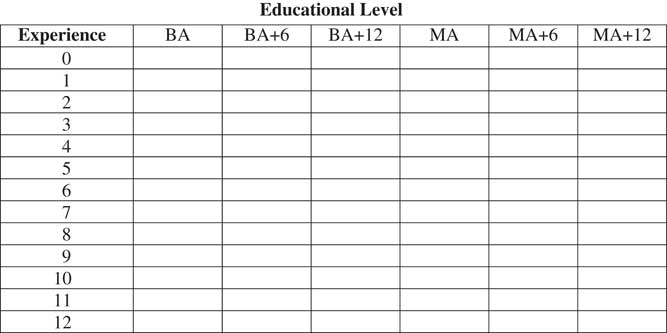
Teachers’ collective bargaining is based on a sophisticated wage grid. Figure 1 shows a typical wage grid in which individual teachers’ wages are determined by their education and experience levels. Each column represents a different education level; for instance, the second column represents teachers with a bachelor’s degree plus six credits. Each row represents a different number of years of experience. In some districts, the wage grid is indexed; that is, the wages in each cell in the grid are expressed as ratios relative to a base cell. The salary for a teacher with a bachelor’s degree and no experience (the upper-left corner cell) is usually used as the base cell.
A typical salary schedule for teachers

As mentioned above, in Wisconsin teachers’ collective bargaining, the athletic conference has been widely used as a wage comparison group (Halm, Reference Halm1985; Jarley, Reference Jarley1987). In the United States, interscholastic athletics are recognized as an integral component of public education. An interscholastic athletic program can be defined as ‘a contest between selected individuals or teams representing two or more schools organized and controlled by school authorities’ (Daughtrey & Woods, Reference Daughtrey and Woods1976: 359). Forsythe maintained that ‘athletic competition in our high schools has come to be an American tradition and institution. In no other country have intercollegiate and interscholastic athletics developed to the same extent as in the United States’ (Reference Forsythe1954: 1). In 1991, more than 90,000 students who were members of 5,348 boys and girls teams from 423 high schools participated in interscholastic athletic competitions in Wisconsin (Wisconsin Interscholastic Athletic Association [WIAA], 1991).
In Wisconsin, interscholastic athletic competition is regulated by the WIAA. The main function of this group is to promote uniform standards in interscholastic athletic competition, including determining student eligibility, establishing regulations for conducting contests, and interpreting rules. It also conducts state tournaments and develops insurance plans (WIAA, 1997). The WIAA groups high schools into athletic conferences for interscholastic competition, but athletic conferences have the authority to determine their own regulations. The functions include establishing principles and policies governing interscholastic competitions, arranging schedules, declaring conference champions, maintaining and preserving records, and assigning athletic officials (Forsythe, Reference Forsythe1954). There are ~50 athletic conferences in Wisconsin.
In Wisconsin, conference realignments occurred almost every year for several reasons, including changes in school populations and the consolidation of school districts. Initially, high schools joined athletic conferences voluntarily, and thus, conference affiliation and withdrawal was a local affair occurring outside of WIAA authority (Otte, Reference Otte1997). However, this voluntary approach was not successful for all schools. For example, the February 1964 WIAA Bulletin reported the results of a survey on the problems associated with conference affiliation, in which it was found that ~100 member schools experienced problems with conference affiliation, and these were especially serious for 25 member schools. To address this problem, the WIAA amended its constitution to provide the Board of Control with final and full authority to determine any conference realignments in 1973. Under the new rules, any conference realignment now requires approval by the Board of Control. The first statewide conference realignment by the Board of Control entered into effect in the 1977–78 school year (Otte, Reference Otte1997). In 1978, the Board of Control developed a ‘Position on Alignment,’ which established the criteria for conference realignment. The ‘Position on Alignment’ requires the Board of Control to apply the following criteria in conference realignment decisions: distance to be traveled, school enrollment, comparability of athletic participation and other school-sponsored activities, and traditional rivalries. The factors to be considered are listed here in descending order of importance (WIAA, 1997).
THEORY AND HYPOTHESES
There are two possible explanations for why Wisconsin teachers’ unions and school boards use athletic conferences as the comparison group in wage negotiation. One explanation is that athletic conferences are technically superior to other potential groups for wage comparison purposes. It is well documented that the bargaining parties in teachers’ collective bargaining customarily consider the salaries and working conditions of comparable school districts (Babcock, Wang, & Loewenstein, Reference Babcock, Wang and Loewenstein1996). In Wisconsin, there exists consensus that two criteria are especially important in the choice of referent: geographical proximity and size similarity (Halm, Reference Halm1985; Jarley, Reference Jarley1987)Footnote 1 .
Geographical proximity tends to render school districts similar in various ways (Goldhaber, Lavery, & Theobald, Reference Goldhaber, Lavery and Theobald2014). School districts in the same region face similar labor market conditions and compete with each other to recruit new teachers (Boyd, Lankford, Loeb, & Wyckoff, Reference Boyd, Lankford, Loeb and Wyckoff2005; Reininger, Reference Reininger2012). In addition, districts in the same region are likely to share similar demographic characteristics, tax bases, and political climates (Brueckner & Saavedra, Reference Brueckner and Saavedra2001; Goldhaber, Lavery, & Theobald, Reference Goldhaber, Lavery and Theobald2014), all of which are likely to affect the cost of education and the amount of resources devoted to education. Previous empirical studies have shown that geographically proximate districts tend to have similar salary levels (Greenbaum, Reference Greenbaum2002).
It has also been well documented in organizational theory that differences in size are associated with differences in structure, resources, constraints, and environments (e.g., Hannan & Freeman, Reference Hannan and Freeman1977). In Wisconsin teachers’ collective bargaining, Arbitrator Yaffe (La Crosse Education Association vs. School District of La Crosse, 1983) maintained that ‘the size of school districts appears to significantly affect the conditions of employment of their employees for a variety of reasons, including, but not limited to, differing political climates…the correlation which exists between the size of staff and the flexibility districts have…and the labor relations history and sophistication of the parties’ (p. 3).
There are reasons to believe that school districts in the same conference are geographically closer and more similar in size than districts in different conferences. Although athletic conferences are not formed for collective bargaining purposes, geographical proximity and size similarity are indeed the two most important criteria used by the WIAA to establish athletic conferences. Geographical proximity is emphasized because people do not want to travel long distances to watch or compete in high school sports, and size similarity is important to ensure fair competition among member school districts (WIAA, 1997).
An alternative explanation is that athletic conferences are institutionalized as a wage comparison group that is infused ‘with value beyond the technical requirements’ (Selznick, Reference Selznick1957: 17) or ‘taken for granted’ (Meyer & Rowan, Reference Meyer and Rowan1977: 341). Institutional theory emphasizes the effect of social environments on organizations. Social environments consist of elaborate rules and requirements, and under institutional theory, it is more important to the organization to conform to the social environment than to conform to technical requirements (Meyer & Rowan, Reference Meyer and Rowan1977; DiMaggio & Powell, Reference DiMaggio and Powell1983; Meyer & Scott, Reference Meyer and Scott1983). Institutional theorists maintain that such conformity increases the organization’s legitimacy, that is, the ‘cultural support for an organization’ (Meyer & Scott, Reference Meyer and Scott1983: 201), which is critical for organizational survival and growth (Meyer & Rowan, Reference Meyer and Rowan1977; DiMaggio & Powell, Reference DiMaggio and Powell1983). From this perspective, organizations are ‘captives of the institutional environment in which they exist’ (Tolbert & Zucker, Reference Tolbert and Zucker1983: 22). Institutional scholars have maintained that the effects of the institutional environment are especially strong in education (Scott & Meyer, Reference Scott and Meyer1991).
Several observations are consistent with the institutional argument. Not all athletic conferences in Wisconsin consist of school districts that are geographically close and similar in size. For example, the WIAA classifies school districts into three classes based on size, but some athletic conferences contain more than one class of school district. In addition, certain conferences include school districts that are more than 120 miles apart (Halm, Reference Halm1985). The findings that bargaining parties with conflicting interests rarely agree on an appropriate wage comparison group due to self-serving bias (Babcock, et al., Reference Babcock, Loewenstein, Issacharoff and Camerer1995) also suggests that the use of athletic conference may not be accounted for by technical factors. The fact that athletic conferences are still used in wage negotiations is consistent with the argument that the use of these conferences is institutionalized.
As mentioned above, the two explanations can be compatible. Thus, it is difficult to differentiate whether the bargaining parties use athletic conferences as referents because of their technical merits or because of institutional pressure (Heugens & Lander, Reference Heugens and Lander2009). This study overcomes this problem by adopting a natural experiment approach. A natural experiment approach identifies a naturally occurring or unplanned event exogenous to collective bargaining and examines its effects on the choice of comparison groups (Shadish, Cook, & Campbell, Reference Shadish, Cook and Campbell2002). If the event, such as a conference realignment, is exogenous, it should not be systematically related to the technical criteria for referent selection. Thus, we can infer from the bargaining parties’ reactions to such an event whether the use of athletic conferences is institutionalized. If the bargaining parties select their comparison groups based on technical criteria, conference realignment should not affect their choice of comparison group. By contrast, if athletic conferences are indeed institutionalized, the bargaining parties will change their comparison group when they shift from one conference to another.
While we believe that this realignment can be regarded as exogenous to collective bargaining, an important question is the extent to which this is truly the case. While the choice of comparison group is made by the bargaining parties, the realignment decision is made by the WIAA. The main function of comparison groups in collective bargaining is to provide criteria for evaluating wages, while the primary purpose of conference realignment is to ensure fair competition among the WIAA member schools. Thus, the two decisions are made independently by different organizations for different purposes. Furthermore, interviews with the director of the WIAA suggest that the WIAA does not pay attention to the implications of conference realignment for teachers’ collective bargaining.
However, realignment may reflect changes in the technical criteria for the selecting referents. The two technical criteria – geographical proximity and size similarity – are in fact two of the criteria that the WIAA uses in conference realignment. To the extent that conference realignment actually results from changes in geographical proximity and size similarity, the bargaining parties may respond to conference realignment not only because of institutional pressure but also for technical reasons. To rule out this alternative hypothesis, the geographical proximity and size similarity of athletic conference were measured and included as control variables in this study. We argue that conference realignment can be regarded as exogenous to collective bargaining after controlling for geographical proximity and size similarity.
This study attempts to determine whether the bargaining parties changed their referents when athletic conference realignment occurred. Unfortunately, no information on the referents actually used by the parties was available. Thus, in this study, the use of referents was indirectly measured via the weight given to the conference wage average in a teacher wage equation. To illustrate the approach used in the present study, let us assume that we have only two observations for each school district: one before an athletic conference realignment that occurred at time t and one after realignment. Then, we can estimate separate teacher wage equations for before and after realignment.
 $${ \rm Before}\,{\rm realignment}\,\left( {t{\minus}1} \right)\,\colon\,\,{\rm Salary}_{{i,t{\minus}1}} \,{\equals}\,{\ralpha }_{0} {\plus}{\ralpha }_{1} {\rm AC}\_{\rm OLD}_{{i,t{\minus}1}} {\plus}{\ralpha }_{2} {\rm AC}\_{\rm NEW}_{{i,t{\minus}1}} {\plus}{\rm {\rvarepsilon}}_{{i,t{\minus}1}} ,$$
 $${\rm After}\,{\rm realignment}\,\left( {t{\plus}1} \right)\,\colon\,\,{\rm Salary}_{{i,t{\plus}1}} \,{\equals}\,{\rgamma }_{0} {\plus}{\rgamma }_{1} {\rm AC}\_{\rm OLD}_{{i,t{\plus}1}} {\plus}{\rgamma }_{2} {\rm AC}\_{\rm NEW}_{{i,t{\plus}1}} {\plus}{\rm {\rvarepsilon}}_{{i,t{\plus}1}} ,$$
where
Salary i,t−1=salary of teachers at school district i before realignment t−1,
Salary i,t+1=salary of teachers at school district i after realignment t+1,
AC_OLD i,t−1=average salary at schools within the previous athletic conference of school district i before realignment t−1,
AC_OLD i,t+1=average salary at schools within the previous athletic conference of school district i after realignment t+1,
AC_NEW i,t−1=average salary at schools within the new athletic conference of school district i before realignment t−1,
AC_NEW i,t+1=average salary at schools within the new athletic conference of school district i after realignment t+1,
ε i,t−1 and ε i,t+1=error terms.
These equations regress the salaries of focal school district i on the average salaries of the previous and new athletic conferences. The weights α1, α2, γ1, and γ2 represent the salary increase in focal school district i associated with a 1-unit increase in the average salary within its respective conference. Greater weights suggest that an average salary increase for the athletic conference have a larger impact on the focal district’s salaries, implying that the focal school districts paid more attention to what occurred within their athletic conference.
By comparing the weights placed on previous and new athletic conference wage averages in the two equations, we can infer whether the bargaining parties changed their comparison groups when conference realignment occurred. Because a focal district is affiliated with a previous athletic conference before realignment and a new athletic conference after realignment, institutional theory suggests that the bargaining parties would give greater weight to the previous athletic conference average than to the new athletic conference average before realignment (α1>α2) and greater weight to the new athletic conference average than to the previous athletic conference average after realignment (γ1<γ2). In addition, institutional theory predicts that the weight given to the previous athletic conference average would decrease after realignment because the focal school district is no longer affiliated with that athletic conference (α1>γ1). Similarly, institutional theory predicts that the weight given to the new athletic conference average would increase after realignment (α2<γ2).
However, this approach has two limitations. First, the error terms in the two wage equations (ε i,t−1 and ε i,t+1) are unlikely to be independent of each other because the data for each equation are from the same sample of school districts. Second, this method does not take advantage of the existence of multiple observations before and after realignment. To overcome these limitations and take advantage of pooled cross-sectional time series data, the following model was estimated:
 $$\eqalignno{ {\rm Salary}_{{i,t}} & \,{\equals}\,{\rbeta }_{0} {\plus}{\rbeta }_{1} {\rm AC}\_{\rm OLD}_{{i,t}} {\plus}{\rbeta }_{2} {\rm AC}\_{\rm NEW}_{{i,t}} {\plus}{\rbeta }_{3} \left( {{\rm AC}\_{\rm OLD}_{{i,t}} _{{}} {\times}{\rm POST}_{{i,t}} } \right) \cr & \,\,\,\,\,{\plus}{\rbeta }_{4} \left( {{\rm AC}\_{\rm NEW}_{{i,t}} {\times}{\rm POST}_{{i,t}} } \right){\plus}{\rbeta }_{5} {\rm POST}_{{i,t}} {\plus}{\rm d}_{i} {\plus}{\rm t}_{t} {\plus}{\rm {\rvarepsilon}}_{{i,t}} _{,} $$
where,
Salary i,t =salary of teachers at school district i at time t,
AC_OLD i,t =average salary at schools within the previous athletic conference of school district i at time t,
AC_NEW i,t =average salary at schools within the new athletic conference of school district i at time t,
POST i,t =0 if before realignment and 1 if after realignment for district i at time t,
d i and t t =district- and time-specific effects, respectively,
ε i,t =error term.
In this equation, β1 and β2 represent the weights given to the average salaries for the previous and new athletic conferences before realignment, respectively, and β3 and β4 represent the changes in weights given to the average salaries for the previous and new conferences when realignment occurred, respectively. The weights given to previous and new conference averages after realignment are β1+β3 and β2+β4, respectively. District- and time-specific effects were captured by d i and t t , respectively, which were controlled for by including district and year dummies as control variables.
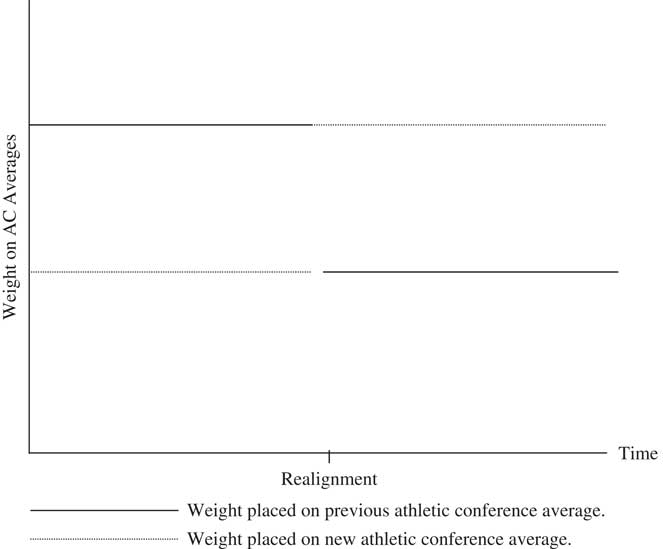
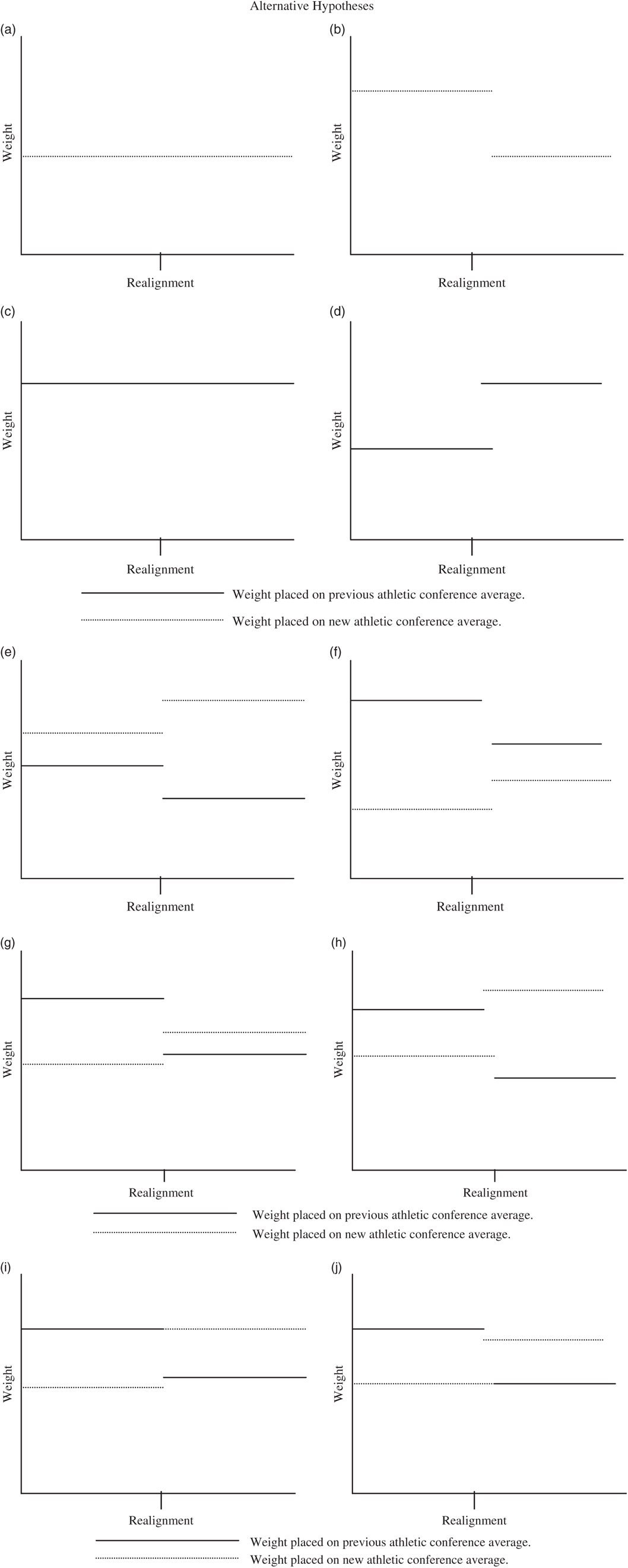
Figure 2 describes a situation that provides support for institutional theory, where both the level of the weights and the change in the level of the weights placed on the previous and new conference wage averages are symmetrical before and after conference realignment. That is, when a school district experiences conference realignment, the bargaining parties reduce the weight given to the previous conference wage average to the level that they gave to the new conference wage average before realignment. By the same token, the bargaining parties increase the weight given to the new conference wage average after realignment to the level that they gave to the previous conference wage average before realignment. Figures 3a–3j show other possible patterns describing the weight placed on the previous and new conference wage averages before and after realignment. Some of these patterns are inconsistent with institutional theory, while other patterns are consistent but do not provide as strong support as the pattern described by Figure 2.
The predicted changes in the weights given to previous and new athletic conference wage averages before and after conference realignment

Alternative hypotheses

Using Equation (3), we tested eight hypotheses, each designed to rule out one or more of the alternative hypotheses depicted in Figure 3. Figures 3a–3d depict situations in which the weight given to the new and previous conference wage averages did not change over time or changed in opposite directions. Figures 3e and 3f depict the possibility that while the weight given to new and previous conferences changed in directions consistent with institutional theory, the relative weight of the two conferences is inconsistent with institutional theory in the pre- or post-realignment periods. Figures 3g–3j show cases where both the changes in weight over time and the relative weight of the two conferences are consistent with institutional theory. In these cases, however, the support for institutional theory is weaker than in the case depicted in Figure 2.
Hypothesis 1: The weight given to the new conference wage average after realignment is greater than the weight given to the new conference wage average before realignment.
Hypothesis 2: The weight given to the previous conference wage average after realignment is less than the weight given to the previous conference wage average before realignment.
The purpose of Hypotheses 1 and 2 is to establish that the weight given to the previous and new conference wage averages changed in the direction predicted by institutional theory, ruling out the alternative hypotheses depicted in Figure 3a–3d. These hypotheses suggest that β4>0 and β3<0, respectively.
Hypothesis 3: The weight given to the previous conference wage average before realignment is greater than the weight given to the new conference wage average before realignment.
Support for this hypothesis would rule out the possibility that the bargaining parties had used the school districts in the new conference as a comparison group even before conference realignment (Figure 3e). This hypothesis suggests that β1>β2.
Hypothesis 4: The weight given to the new conference wage average after realignment is greater than the weight given to the previous conference wage average after realignment.
Support for this hypothesis would rule out the possibility that the bargaining parties paid more attention to the previous conference than to the new conference, even after realignment (Figure 3f). This hypothesis suggests that β2+β4>β1+β3.
Hypothesis 5: The change in the weight given to the new conference wage average after realignment is equal and opposite in sign to the change in the weight given to the previous conference wage average after realignment.
Support for this hypothesis would rule out the possibility that conference realignment had an asymmetrical effect on the weight given to the previous and new conferences (Figure 3g). This hypothesis suggests that β4=−β3.
Hypothesis 6: The weight given to the new conference wage average after realignment is equal to the weight given to the previous conference wage average before realignment.
Support for this hypothesis would rule out all hypotheses except that depicted in Figure 3i. This hypothesis suggests that β2+β4=β1.
Hypothesis 7: The weight given to the previous conference wage average after realignment is equal to the weight given to the new conference wage average before realignment.
Support for this hypothesis would rule out all hypotheses except that depicted in Figure 3j. This hypothesis suggests that β1+β3=β2.
Hypothesis 8: The weight given to the new conference wage average after realignment is equal to the weight given to the previous conference wage average before realignment, and the weight given to the previous conference wage average after realignment is equal to the weight given to the new conference wage average before realignment.
This is a joint hypothesis combining Hypotheses 7 and 8, suggesting that β2+β4=β1 and β1+β3=β2. Support for this hypothesis would be consistent with Figure 2 and would rule out all hypotheses depicted in Figure 3.
METHOD
Sample
The sample used in the present study was limited to the 369 K-12 school districts in Wisconsin during the period between the 1978–79 and 1992–93 school years. In total, 101 districts were dropped due to incomplete data. Some of the school districts did not engage in collective bargaining in the 1970s or were not affiliated with the WIAA. We focused on school districts that experienced athletic conference realignment during the period. If a school district did not change its athletic conference, it is extremely difficult, if not impossible, to empirically test the validity of institutional theory. Among the 268 school districts with complete data, 86 incidents of athletic conference realignment occurred in 79 school districts during the period studied.
To allow a transitional period during which the bargaining parties adjusted their comparison groups, we dropped the year before realignment and the year of realignment from our analyses. Excluding the year before realignment reduces the possibility that the parties adjusted their comparison group based on a realignment decision made several months before the actual realignment. Inertia also exists in comparison group selection, and the bargaining parties commonly used both their previous and new conferences as comparison groups during the transitional periodFootnote 2 .
In subsequent analyses, we included only school districts that remained in both the previous and new conferences for at least 3 years. Spending less than 3 school years in one athletic conference means that those years were sandwiched between two conference realignments. For example, if a school district remained in one conference for two school years, the first year is the year of realignment and the second year is the year before realignment. For the reasons mentioned above, the bargaining parties might not have had sufficient time to adjust their comparison group during such a short stay in a conference.
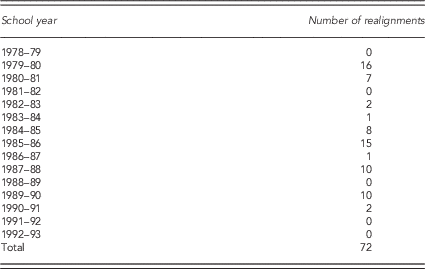
Among the 86 incidents of athletic conference realignment, eight were eliminated because they did not meet the 3-year requirement. Seven school districts experienced conference realignment twice during the period under study; in these cases, we included in our analyses only one realignment, namely, the one that lasted the longest. This process eliminated six more realignmentsFootnote 3 . Thus, subsequent analyses were based on 72 conference realignments. Table 1 reports the distribution of the 72 realignments over time.
Frequency of athletic conference realignment by school year

Dependent variable
Collective bargaining over teachers’ wages occurs over a sophisticated wage grid, where individual teachers’ wages are determined by their education and experience. However, teacher collective bargaining usually focuses on several benchmarks rather than on the grid as a whole. Thus, we analyzed three benchmarks: the wage for teachers with master’s degrees and maximum experience (MA MAX), that for teachers with master’s degrees and no experience (MA MIN) and that for teachers with bachelor’s degrees and no experience (BA MIN). The dependent variables are the log wages measured in 1990 dollars.
Independent variables
Athletic conference wage averages for each benchmark were calculated by taking the average of the log wages in 1990 dollars for all conference schools excluding the focal district. Because the school districts in this study experienced conference realignment, two different conference averages were calculated for each focal school district. The previous conference (AC_OLD) is the conference with which the school district was affiliated before realignment, and the new conference (AC_NEW) is the conference with which the school district was affiliated after realignment. To compare the weight given to the athletic conference wage averages before and after realignment, the two conference averages were calculated for the entire period. That is, the average for the new conference was calculated for the period before realignment and that after realignment even though the focal district was not affiliated with the new conference before realignment. Similarly, the average for the previous conference was calculated for the periods before and after realignment.
Control variables
To rule out the possibility that realignment actually reflected changes in the geographical proximity and size similarity of the conference, it was important to control for the two technical criteria. The geographical proximity (GEOPRX) of a conference was calculated as follows. First, the distance between two school districts was calculated using the Haversine formula (Sinnott, Reference Sinnott1984) and the latitudes and longitudes of each school district. This formula gives the distance between two points on the great circle; the geographical proximity of a conference was calculated by taking the average of the inverses of the distances between the focal district and other districts in the conference.
Size similarity (SIZSIM) was calculated in a similar but slightly different way. First, the absolute difference in enrollment between two school districts was calculated. Then, the absolute difference scores were divided by the number of students enrolled in the focal district because an enrollment difference of 100 will be perceived very differently by a school district with thousands of students than by a school district with only a few hundred students. A conference’s size similarity was calculated by taking the average of the inverses of the relative enrollment differences between the focal district and other districts in the conference.
We also included other district characteristics that may influence teacher wages, such as the property wealth per student (WEALTH), the local private sector log wage (PRVTWAGE), and the local property tax rate (TAX) (Olson & Rau, Reference Olson and Rau1997). The property wealth and the local private sector wage were measured in 1990 dollars. The property wealth was measured in millions of dollars. Because it is usually determined after collective agreement is reached, the local property tax rate was lagged (Olson & Rau, Reference Olson and Rau1997).
Analyses
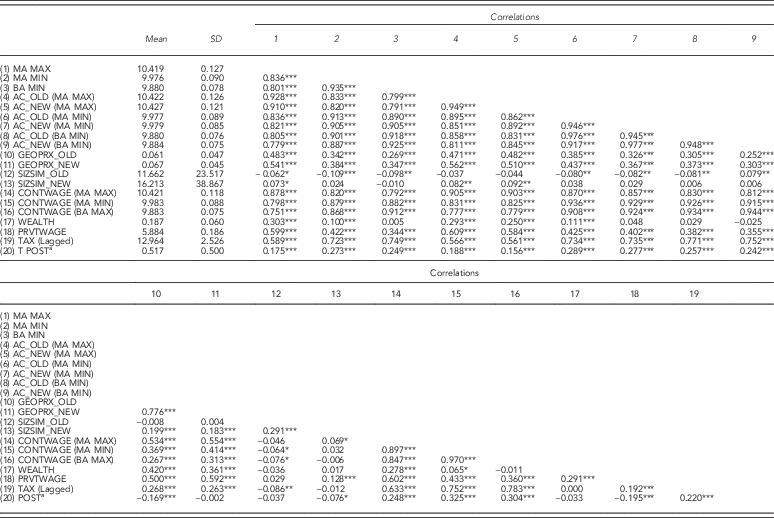
Before estimating a model for the bargaining parties’ responses to conference realignment, we must address the problem that arises from the spatial nature of the data. When observations are spatially distributed, unobserved variables are likely to be correlated spatially, which may produce spatial correlation in the error term (Upton & Fingleton, Reference Upton and Fingleton1985; Case, Reference Case1991). Glass, Peckham, and Sanders (Reference Glass, Peckham and Sanders1972) noted that violating the independence assumption is far more serious than violating other assumptions. In ordinary least squares estimations, this violation does not affect the parameter estimates but is likely to result in biases in standard errors (Kennedy, Reference Kennedy1998). Thus, the statistical test is incorrect if observations are not independent. To control for this possibility, we included the average wage of contiguous school districts (CONTWAGE) as a control variable, thereby assuming that the error terms were correlated only between neighboring districts. While this assumption may have been too restrictive, it is arguably preferable to ignoring the possibility of spatial correlation. Table 2 reports the descriptive statistics for all variables.
Means, SD, and correlations

Note. a 1 if observation was after realignment, 0 otherwise.
*p<.05, **p<.01, ***p<.001.
RESULTS
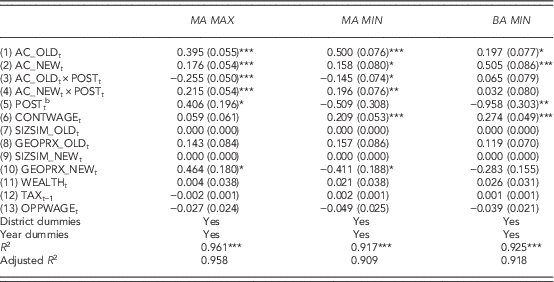
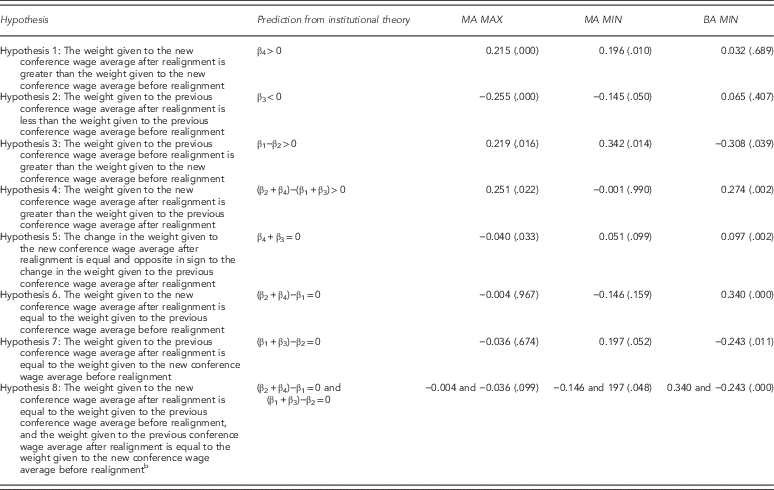
Table 3 reports the ordinary least squares estimates for the three benchmarks, and Table 4 reports the tests for the hypotheses using the ordinary least squares results. The third column of Table 4 reports the results for the MA MAX, which show that the bargaining parties increased the weight given to the new athletic conference wage average (Hypothesis 1, β4=0.215, p<.001) and reduced the weight given to the previous conference average (Hypothesis 2, β3=−0.255, p<.001) when athletic conference realignment occurred. The results also show that while the bargaining parties placed greater weight on the previous athletic conference average than on the new conference average before realignment (Hypothesis 3, β1−β2=0.219, p<.05), they placed greater weight on the new conference average than on the previous conference average after realignment (Hypothesis 4, (β2+β4)−(β1+β3)=0.251, p<.05). These results are consistent with institutional theory.
The bargaining parties’ reaction to athletic conference realignmentFootnote a

Note. a Based on 72 K-12 school districts that experienced realignment. Standard errors are in parentheses.
b 1 after realignment, 0 before realignment.
*p<.05, **p<.01, ***p<.001.
Results of the hypothesis testsFootnote a

Note.
a p-values are in parentheses.
b This is a joint test of Hypothesis 6 and Hypothesis 7.
However, the effect of conference realignment on the weight given to previous and new conference averages was not symmetrical. The decrease in weight given to the previous conference average after realignment was larger than the increase in weight given to the new conference average after realignment (Hypothesis 5, β4+β3=−0.040, p<.05). Although this effect was not symmetrical, we cannot reject the hypothesis that the weight given to the new conference average after realignment was equal to the weight given to the previous conference average before realignment (Hypothesis 6, (β2+β4)−β1=−0.004, n.s.) or the hypothesis that the weight given to the previous conference average after realignment was equal to the weight given to the new conference average before realignment (Hypothesis 7, (β1+β3)−β2=−0.036, n.s.). Finally, we cannot reject a joint test of Hypotheses 6 and 7 (Hypothesis 8, (β2+β4)−β1=−0.004 and (β1+β3)−β2=−0.036, n.s.). Thus, we cannot reject the hypothesis that the weights behaved as depicted in Figure 2. These results suggest that the athletic conference is institutionalized as a wage comparison group in Wisconsin teachers’ collective bargaining.
The fourth column of Table 4 reports the results for the MA MIN. Compared to the MA MAX, the MA MIN provides weaker support for institutional theory. The results show that the bargaining parties increased the weight given to the new conference average (Hypothesis 1, β4=0.196, p<.01) and reduced the weight given to the previous conference average (Hypothesis 2, β3=−0.145, p=.05) after conference realignment. They also placed greater weight on the previous conference average than on the new conference average before conference realignment (Hypothesis 3, β1−β2=0.342, p<.05). However, the weights given to the previous and new conference averages were almost identical after conference realignment (Hypothesis 4, (β2+β4)−(β1+β3)=−0.001, n.s). While the changes in the two weights were equal and opposite in direction (Hypothesis 5, β4+β3=0.051, n.s.), those changes were not large enough to make the weight given to the new conference average greater than the weight given to the previous conference average after conference realignment. Thus, we could not reject the individual hypotheses that the weight given to the new conference average after realignment was equal to the weight given to the previous conference average before realignment (Hypothesis 6, (β2+β4)−β1=−0.146, n.s.) and that the weight given to the previous conference average after realignment was equal to the weight given to the new conference average before realignment (Hypothesis 7, (β1+β3)−β2=0.197, n.s.). However, a joint test of Hypotheses 6 and 7 was rejected (Hypothesis 8, (β2+β4)−β1=−0.146 and (β1+β3)−β2=0.197, p<.05). Thus, only limited support for institutional theory was found in the MA MIN.
The results for the BA MIN are not consistent with institutional theory. The bargaining parties gave greater weight to the new conference than to the previous conference even before realignment (Hypothesis 3, β1−β2=−0.308, p<.05). There was no evidence that the weight given to previous or new conference averages changed when the bargaining parties experienced realignment (Hypothesis 1, β4=0.032, n.s, Hypothesis 2, β3=0.065, n.s).
DISCUSSION AND CONCLUSION
This study examined why the bargaining parties in Wisconsin teachers’ collective bargaining used athletic conference as a wage comparison group, specifically examining whether the use of athletic conferences was institutionalized beyond their technical merits. Using athletic conference realignment as a ‘natural experiment,’ this study examined whether the bargaining parties changed their comparison group when conference realignment occurred. For the wages of teachers with a master’s degree and maximum experience (MA MAX), the bargaining parties increased the weight given to the new athletic conference and reduced the weight given to the previous conference when realignment occurred, suggesting that the bargaining parties changed their comparison group. These results are consistent with institutional theory.
However, the results for the wages of teachers with a master’s degree and no experience (MA MIN) provide only limited support for institutional theory, and those for teachers with a bachelor’s degree and no experience (BA MIN) were not consistent with institutional theory. While we do not have data to examine why the three wage benchmarks behaved differently, we speculate that the difference may reflect the nature of teachers’ collective bargaining. Previous studies suggest that the benchmark of primary importance to the bargaining parties is the MA MAX (Olson & Jarley, Reference Olson and Jarley1991), which reflects the fact that most teachers in Wisconsin have some credits beyond a bachelor’s degree and some experience. In addition, the MA MIN and the BA MIN are entry-level wages, and no current teachers will be affected by the outcomes of negotiation based on these benchmarks. Thus, the role of social comparison is likely to be more important for determining the MA MAX. In some school districts in Wisconsin, the wage grid is fully indexed, that is, wages for each cell in the grid are expressed by ratios to a base cell. However, ratios between cells differ widely across districts. Thus, if bargaining is based primarily on the MA MAX, we expect that the effect of social comparison decreases as the distance from the MA MAX on the grid increases. This may explain why the MA MIN behaved more similarly than the BA MIN to the MA MAX.
This study has several implications for institutional theory. First, while institutional theory emphasizes the role of institutions, it has had difficulty disentangling institutional effects from technical effects (Heugens & Lander, Reference Heugens and Lander2009). The approaches adopted in previous studies to demonstrate institutional effects are largely indirect and subject to various interpretations (Scott, Reference Scott1991). This study overcomes this problem by adopting a natural experiment approach. A natural experiment approach is a type of quasi-experiment that improves our ability to make valid causal inferences about institutionalization (Shadish, Cook, & Campbell, Reference Shadish, Cook and Campbell2002). Using a natural experiment approach, we show that the bargaining parties changed their comparison group when they experienced conference realignment. Because conference realignments can be regarded as exogenous to collective bargaining, such changes in comparison groups are unlikely to be accounted for by technical factors, suggesting that the use of athletic conferences as referents was indeed institutionalized in Wisconsin teachers’ collective bargaining.
This study suggests that a natural experiment approach can be a useful tool for institutional scholars to test their arguments. A natural experiment approach can be applied to various settings. For example, if an environmental event reduces the technical efficiency of widely used practices or structures, such environmental event can be regarded as a natural experiment. Institutionalization of practices or structures can be tested by examining whether organizations still adopt or maintain the practices. More studies using a natural experiment approach will help to improve our understanding of institutional theory.
Second, this study has implications for the ongoing debate among institutional scholars on how institutionalization affects performance (Heugen & Lander, Reference Heugens and Lander2009). Traditionally, institutionalists argue that institutionalization ‘often conflicts sharply with efficiency criteria’ (Meyer & Rowna, Reference Meyer and Rowan1977: 340–341), thus reducing organizational performance. However, such an argument has been increasingly questioned in recent years (Heugen & Lander, Reference Heugens and Lander2009). Some institutional scholars have asserted that institutionalization may actually improve organizational performance by allowing organizations possessing legitimacy to attract more resources (Baum & Oliver, 1991). Institutionalization may also improve organizational performance because newly emerged institutions may simply be more efficient (Westphal et al., 1997); alternatively, institutionalization may allow organizations to differentiate themselves while conforming to institutions (Deephouse, 1999).
This study suggests a different mechanism through which institutionalization can improve organizational performance; institutionalization itself may improve organizational performance. There are strong theoretical reasons to believe that the institutionalization of the use of athletic conferences as a comparison group improved organizational performance. Previous studies have demonstrated that the parties in collective bargaining seldom agree on an appropriate wage comparison group due to a self-serving bias, which increases the likelihood of a strike (Babcock et al., Reference Babcock, Loewenstein, Issacharoff and Camerer1995; Babcock, Wang, & Loewenstein, Reference Babcock, Wang and Loewenstein1996). The institutionalization of athletic conferences as a comparison group eliminates an important source of labor disputes. It is important to note that increased performance results directly from the institutionalization process itself, not from the nature of the institutionalized practices. Any groups of referents, if institutionalized, will do equally well.
Third, it is also important to note that such improvement in performance occurred not only at the organizational level but also at the organizational field level. Institutional scholars suggest that conforming to institutional pressures may improve organizational performance because increased legitimacy may help organizations to attract more material resources and support. However, the organizational field as a whole may suffer efficiency losses because institutionalized practices may conflict with efficiency. In the present study, however, the institutionalization of athletic conferences improved the performance of Wisconsin teachers’ collective bargaining as a whole by reducing the possibility of labor disputes.
Heugens and Lander (Reference Heugens and Lander2009) have recommended more research on between-field variations in institutionalization. One potentially fruitful area of research is whether institutionalization improves the performance of organizational fields. That is, do organizational fields with strongly institutionalized practices perform better than less institutionalized fields? Organizational fields with strong institutions may perform better because they may experience fewer unnecessary conflicts within fields or be viewed as more legitimate by outside stakeholders, thus attracting more resources and being less subject to governmental regulations. Future research is needed to examine this possibility.
Finally, our results suggest that institutions play an important role even in very competitive environments, such as collective bargaining. While it may be true that legitimacy is more important in education than in other areas (Scott & Meyer, Reference Scott and Meyer1991), collective bargaining, as studied here, always involves two parties with conflicting interests. To many game theorists, economic models of action are the most appropriate for situations such as this one (Gibbons, Reference Gibbons1992). However, our results show that institutions play important roles even in such competitive activities.
Some limitations of the present study should be recognized. We assumed that the two variables – geographical proximity and size similarity – captured all of the technical criteria. If other technical criteria for reference selection are associated with conference realignment, our results would overestimate the extent to which the use of athletic conferences as a comparison group is institutionalized. However, because conference realignment and the choice of a reference for collective bargaining are determined by independent organizations for very different purposes, this possibility seems remote.
Another limitation of this study is the nature of the analyzed school districts. The school districts that experienced conference realignment may have differed in some significant ways from the school districts that remained in one conference. Thus, the generalizability of our findings is not clear. However, we suspect that the strength of the institutionalization of the use of athletic conferences was weaker in the school districts that experienced conference realignment than in other school districts. Those school districts were likely to be affiliated with a less homogeneous conference in terms of geographical proximity and size similarity. Tolbert and Zucker (Reference Tolbert and Zucker1983) argued that efficiency considerations are important in the institutionalization process. To the extent that this is true, our results may actually underestimate the strength of institutionalization in the use of athletic conferences.
Acknowledgments
The author thanks Adam Gamoran, Carolyn Kelley, Anne Miner, Craig Olson, and John Witte for their helpful comments. The author also appreciates support from the Institute of Management Research at Seoul National University.