


%20--%3e%3c!DOCTYPE%20svg%20PUBLIC%20'-//W3C//DTD%20SVG%201.0//EN'%20'http://www.w3.org/TR/2001/REC-SVG-20010904/DTD/svg10.dtd'%3e%3csvg%20version='1.0'%20id='Layer_1'%20xmlns='http://www.w3.org/2000/svg'%20xmlns:xlink='http://www.w3.org/1999/xlink'%20x='0px'%20y='0px'%20width='64px'%20height='64px'%20viewBox='5.5%20-3.5%2064%2064'%20enable-background='new%205.5%20-3.5%2064%2064'%20xml:space='preserve'%3e%3cg%3e%3ccircle%20fill='%23FFFFFF'%20fill-opacity='0'%20cx='37.785'%20cy='28.501'%20r='28.836'/%3e%3cpath%20fill='%23595959'%20d='M37.441-3.5c8.951,0,16.572,3.125,22.857,9.372c3.008,3.009,5.295,6.448,6.857,10.314%20c1.561,3.867,2.344,7.971,2.344,12.314c0,4.381-0.773,8.486-2.314,12.313c-1.543,3.828-3.82,7.21-6.828,10.143%20c-3.123,3.085-6.666,5.448-10.629,7.086c-3.961,1.638-8.057,2.457-12.285,2.457s-8.276-0.808-12.143-2.429%20c-3.866-1.618-7.333-3.961-10.4-7.027c-3.067-3.066-5.4-6.524-7-10.372S5.5,32.767,5.5,28.5c0-4.229,0.809-8.295,2.428-12.2%20c1.619-3.905,3.972-7.4,7.057-10.486C21.08-0.394,28.565-3.5,37.441-3.5z%20M37.557,2.272c-7.314,0-13.467,2.553-18.458,7.657%20c-2.515,2.553-4.448,5.419-5.8,8.6c-1.354,3.181-2.029,6.505-2.029,9.972c0,3.429,0.675,6.734,2.029,9.913%20c1.353,3.183,3.285,6.021,5.8,8.516c2.514,2.496,5.351,4.399,8.515,5.715c3.161,1.314,6.476,1.971,9.943,1.971%20c3.428,0,6.75-0.665,9.973-1.999c3.219-1.335,6.121-3.257,8.713-5.771c4.99-4.876,7.484-10.99,7.484-18.344%20c0-3.543-0.648-6.895-1.943-10.057c-1.293-3.162-3.18-5.98-5.654-8.458C50.984,4.844,44.795,2.272,37.557,2.272z%20M37.156,23.187%20l-4.287,2.229c-0.458-0.951-1.019-1.619-1.685-2c-0.667-0.38-1.286-0.571-1.858-0.571c-2.856,0-4.286,1.885-4.286,5.657%20c0,1.714,0.362,3.084,1.085,4.113c0.724,1.029,1.791,1.544,3.201,1.544c1.867,0,3.181-0.915,3.944-2.743l3.942,2%20c-0.838,1.563-2,2.791-3.486,3.686c-1.484,0.896-3.123,1.343-4.914,1.343c-2.857,0-5.163-0.875-6.915-2.629%20c-1.752-1.752-2.628-4.19-2.628-7.313c0-3.048,0.886-5.466,2.657-7.257c1.771-1.79,4.009-2.686,6.715-2.686%20C32.604,18.558,35.441,20.101,37.156,23.187z%20M55.613,23.187l-4.229,2.229c-0.457-0.951-1.02-1.619-1.686-2%20c-0.668-0.38-1.307-0.571-1.914-0.571c-2.857,0-4.287,1.885-4.287,5.657c0,1.714,0.363,3.084,1.086,4.113%20c0.723,1.029,1.789,1.544,3.201,1.544c1.865,0,3.18-0.915,3.941-2.743l4,2c-0.875,1.563-2.057,2.791-3.541,3.686%20c-1.486,0.896-3.105,1.343-4.857,1.343c-2.896,0-5.209-0.875-6.941-2.629c-1.736-1.752-2.602-4.19-2.602-7.313%20c0-3.048,0.885-5.466,2.658-7.257c1.77-1.79,4.008-2.686,6.713-2.686C51.117,18.558,53.938,20.101,55.613,23.187z'/%3e%3c/g%3e%3c/svg%3e)
%20--%3e%3c!DOCTYPE%20svg%20PUBLIC%20'-//W3C//DTD%20SVG%201.0//EN'%20'http://www.w3.org/TR/2001/REC-SVG-20010904/DTD/svg10.dtd'%3e%3csvg%20version='1.0'%20id='Layer_1'%20xmlns='http://www.w3.org/2000/svg'%20xmlns:xlink='http://www.w3.org/1999/xlink'%20x='0px'%20y='0px'%20width='64px'%20height='64px'%20viewBox='5.5%20-3.5%2064%2064'%20enable-background='new%205.5%20-3.5%2064%2064'%20xml:space='preserve'%3e%3cg%3e%3ccircle%20fill='%23FFFFFF'%20fill-opacity='0'%20cx='37.637'%20cy='28.806'%20r='28.276'/%3e%3cg%3e%3cpath%20fill='%23595959'%20d='M37.443-3.5c8.988,0,16.57,3.085,22.742,9.257C66.393,11.967,69.5,19.548,69.5,28.5c0,8.991-3.049,16.476-9.145,22.456%20C53.879,57.319,46.242,60.5,37.443,60.5c-8.649,0-16.153-3.144-22.514-9.43C8.644,44.784,5.5,37.262,5.5,28.5%20c0-8.761,3.144-16.342,9.429-22.742C21.101-0.415,28.604-3.5,37.443-3.5z%20M37.557,2.272c-7.276,0-13.428,2.553-18.457,7.657%20c-5.22,5.334-7.829,11.525-7.829,18.572c0,7.086,2.59,13.22,7.77,18.398c5.181,5.182,11.352,7.771,18.514,7.771%20c7.123,0,13.334-2.607,18.629-7.828c5.029-4.838,7.543-10.952,7.543-18.343c0-7.276-2.553-13.465-7.656-18.571%20C50.967,4.824,44.795,2.272,37.557,2.272z%20M46.129,20.557v13.085h-3.656v15.542h-9.944V33.643h-3.656V20.557%20c0-0.572,0.2-1.057,0.599-1.457c0.401-0.399,0.887-0.6,1.457-0.6h13.144c0.533,0,1.01,0.2,1.428,0.6%20C45.918,19.5,46.129,19.986,46.129,20.557z%20M33.042,12.329c0-3.008,1.485-4.514,4.458-4.514s4.457,1.504,4.457,4.514%20c0,2.971-1.486,4.457-4.457,4.457S33.042,15.3,33.042,12.329z'/%3e%3c/g%3e%3c/g%3e%3c/svg%3e)
%20--%3e%3c!DOCTYPE%20svg%20PUBLIC%20'-//W3C//DTD%20SVG%201.0//EN'%20'http://www.w3.org/TR/2001/REC-SVG-20010904/DTD/svg10.dtd'%3e%3csvg%20version='1.0'%20id='Layer_1'%20xmlns='http://www.w3.org/2000/svg'%20xmlns:xlink='http://www.w3.org/1999/xlink'%20x='0px'%20y='0px'%20width='64px'%20height='64px'%20viewBox='5.5%20-3.5%2064%2064'%20enable-background='new%205.5%20-3.5%2064%2064'%20xml:space='preserve'%3e%3cg%3e%3ccircle%20fill='%23FFFFFF'%20fill-opacity='0'%20cx='36.924'%20cy='28.403'%20r='28.895'/%3e%3cpath%20fill='%23595959'%20d='M37.442-3.5c8.99,0,16.571,3.085,22.743,9.256C66.393,11.928,69.5,19.509,69.5,28.5c0,8.992-3.048,16.476-9.145,22.458%20C53.88,57.32,46.241,60.5,37.442,60.5c-8.686,0-16.19-3.162-22.513-9.485C8.644,44.728,5.5,37.225,5.5,28.5%20c0-8.762,3.144-16.343,9.429-22.743C21.1-0.414,28.604-3.5,37.442-3.5z%20M12.7,19.872c-0.952,2.628-1.429,5.505-1.429,8.629%20c0,7.086,2.59,13.22,7.77,18.4c5.219,5.144,11.391,7.715,18.514,7.715c7.201,0,13.409-2.608,18.63-7.829%20c1.867-1.79,3.332-3.657,4.398-5.602l-12.056-5.371c-0.421,2.02-1.439,3.667-3.057,4.942c-1.622,1.276-3.535,2.011-5.744,2.2%20v4.915h-3.714v-4.915c-3.543-0.036-6.782-1.312-9.714-3.827l4.4-4.457c2.094,1.942,4.476,2.913,7.143,2.913%20c1.104,0,2.048-0.246,2.83-0.743c0.78-0.494,1.172-1.312,1.172-2.457c0-0.801-0.287-1.448-0.858-1.943l-3.085-1.315l-3.771-1.715%20l-5.086-2.229L12.7,19.872z%20M37.557,2.214c-7.276,0-13.428,2.571-18.457,7.714c-1.258,1.258-2.439,2.686-3.543,4.287L27.786,19.7%20c0.533-1.676,1.542-3.019,3.029-4.028c1.484-1.009,3.218-1.571,5.2-1.686V9.071h3.715v4.915c2.934,0.153,5.6,1.143,8,2.971%20l-4.172,4.286c-1.793-1.257-3.619-1.885-5.486-1.885c-0.991,0-1.876,0.191-2.656,0.571c-0.781,0.381-1.172,1.029-1.172,1.943%20c0,0.267,0.095,0.533,0.285,0.8l4.057,1.83l2.8,1.257l5.144,2.285l16.397,7.314c0.535-2.248,0.801-4.533,0.801-6.857%20c0-7.353-2.552-13.543-7.656-18.573C51.005,4.785,44.831,2.214,37.557,2.214z'/%3e%3c/g%3e%3c/svg%3e)
%20--%3e%3c!DOCTYPE%20svg%20PUBLIC%20'-//W3C//DTD%20SVG%201.1//EN'%20'http://www.w3.org/Graphics/SVG/1.1/DTD/svg11.dtd'%3e%3csvg%20version='1.1'%20id='Layer_1'%20xmlns='http://www.w3.org/2000/svg'%20xmlns:xlink='http://www.w3.org/1999/xlink'%20x='0px'%20y='0px'%20width='64.000977px'%20height='64px'%20viewBox='0%200%2064.000977%2064'%20enable-background='new%200%200%2064.000977%2064'%20xml:space='preserve'%3e%3cg%3e%3ccircle%20fill='%23FFFFFF'%20fill-opacity='0'%20cx='32.064453'%20cy='31.788086'%20r='29.012695'/%3e%3cg%3e%3cpath%20fill='%23595959'%20d='M31.943848,0C40.896484,0,48.476562,3.105469,54.6875,9.314453C60.894531,15.486328,64.000977,23.045898,64.000977,32%20s-3.048828,16.457031-9.145508,22.513672C48.417969,60.837891,40.779297,64,31.942871,64%20c-8.648926,0-16.152832-3.142578-22.513672-9.429688C3.144043,48.286133,0,40.761719,0,32.000977%20c0-8.723633,3.144043-16.285156,9.429199-22.68457C15.640137,3.105469,23.14502,0,31.943848,0z%20M32.060547,5.771484%20c-7.275391,0-13.429688,2.570312-18.458496,7.714844C8.381836,18.783203,5.772949,24.954102,5.772949,32%20c0,7.125,2.589844,13.256836,7.77002,18.400391c5.181152,5.181641,11.352051,7.770508,18.515625,7.770508%20c7.123047,0,13.332031-2.608398,18.626953-7.828125C55.713867,45.466797,58.228516,39.353516,58.228516,32%20c0-7.3125-2.553711-13.484375-7.65625-18.513672C45.504883,8.341797,39.333984,5.771484,32.060547,5.771484z%20M44.117188,24.456055%20v5.485352H20.859863v-5.485352H44.117188z%20M44.117188,34.743164v5.481445H20.859863v-5.481445H44.117188z'/%3e%3c/g%3e%3c/g%3e%3c/svg%3e)
7.1 Background
As already addressed in the previous chapter, the basic unit in stigmergic problem solving is the production of a “materialized” solution that in some way can be stored and reused. Today, the digitization of information and the invention of the Internet represents a revolution in both the scale and types of such solutions that now are available. If we look back in history, the storage of human knowledge has been a major challenge. Improvements and technological innovation have been essential in increasing our ability to solve problems collectively. In order to better understand the basic mechanisms of stigmergic problem solving, this chapter briefly describes the invention of writing and the printing press, two of the most important historical achievements. In human cultural history, most researchers agree that these two technological transitions resulted in a significant improvement in our collective external memory system which led to major economic, social, political, religious, epistemological, and educational change (Donald, Reference Donald1991; Ong, Reference Ong2013).
The last major transition in stigmergic problem solving has unfolded itself in recent decades with the invention of the Internet, which enabled new types of large-scale collective problem solving (Lévy, Reference Lévy1999). Today, information can be shared with more people than ever before and across time in an unprecedented way. Compared with prints, it is very easy to technically copy and reuse all kinds of digital content without any additional cost. An important catalyst is the declining price of storage of information. The different types of human stigmergic problem solving from the previous chapter illustrate how human stigmergy is increasing in complexity and evolving into new forms in the online setting.
However, the historical analysis in this chapter will move back in time to examine the basic rudimentary mechanisms in human stigmergic problem solving. This is a type of collective problem solving that follows a long historical line of technological development, with two milestone achievements. The invention of writing initiated a “reuse revolution,” which the printing press transformed into a “copy revolution.” The chapter explores how stigmergic problem solving evolved from a simple form into increasingly complex forms, which in the final section is labeled as frozen and fluid stigmergic problem solving.
7.2 The Invention of Writing
The invention of writing can be regarded as the first example of human stigmergic problem solving. Before writing, human sharing of knowledge was always limited to shared practices and verbal communication, but now it became possible to store information for a much longer time independent of the original writer. This transition represented a major advancement in the establishment of a collective memory because information could now be stored and reused, not only for a longer time period, but the information could be transported in the environment.
Writing was invented as a symbolic system that could support the limited memory capacity of humans. Without any transfer or storage of knowledge, there is always a risk that valuable information will be lost. For thousands of years after the Agricultural Revolution, human social networks remained relatively small and simple because they were very difficult to organize without being able to store information. Knowledge sharing happened through verbal communication or observational learning. In order to develop a larger and more complex society, it became necessary to invent a more effective information sharing system (Fischer, Reference Fischer2003: 28–29).
It was the ancient Sumerians, who lived in today’s Iraq, who first invented such a system between the years 3500 BC and 3000 BC. Sumer’s expanding society needed to invent new ways to administer and manage its raw materials, manufactured goods, workers, planted fields, tributes, royal and temple inventories, incomes, and expenditures. Human memory was no longer enough, and a writing system was invented to process mathematical data with the help of two types of signs. The number of signs was a combination of base-6 and base-10 numeral systems, giving signs for 1, 10, 60, 600, 3,600, and 36,000. The other type of signs represented information about people, animals, merchandise, territories, dates, and so forth. The writing combined numerals with pictograms and symbols to describe facts and figures and identify commodities. The first texts were economic documents, used for accounting such as recording the payment of taxes, the accumulation of debts or the ownership of property (Fischer, Reference Fischer2003: 22–33; Harari, Reference Harari2014: 136–140). The system gave the same type of information, “so and so many of such and such a commodity.” Because writing was time consuming, the outreach was limited to a very small reading public, but the practice was still important for record-keeping. The writing was done on clay tablets, an abundant material in the Middle East, which was easy to work on (Figure 7.1). Clay makes it easy to erase information and preservation is simple because the clay only needs to dry in the sun or one can bake it (Fischer, Reference Fischer2003: 22–33; Harari, Reference Harari2014: 136–140).
Inscribed clay tablet from third millennium BC. Proto-Cuneiform clay tablet with seal impressions: administrative account of barley distribution with cylinder seal impression of a male figure, hunting dogs, and boars ca. 3100–2900 BC. Sumerian, Mesopotamia, probably from Uruk (modern Warka).

In another system from the same period and area, numerals were made by pressing the round end of a reed stylus vertically into the clay. The first written texts were partial scripts, as the system of material signs could only represent specific types of information within a limited area. Writing did not intend to copy spoken language, but was instead used in areas where spoken language was inefficient (Fischer, Reference Fischer2003: 28–36; Harari, Reference Harari2014: 138–144).
Between 3000 BC and 2500 BC, more signs were added to the Sumerian writing system, and it was gradually transformed into a full script that we today call cuneiform. The individual signs in this early writing system gradually became separated and independent from the eternal world of objective phenomena. The signs became stylized, making it easier to produce diverse texts and prolong the spoken word in a multitude of ways. By 2500 BD, kings were issuing decrees, and some were even writing personal letters. Within a thousand years, phonetic writing has made itself the most fundamental tool for Mesopotamian city-states growing into powerful empires (Fischer, Reference Fischer2003: 28–36; Harari, Reference Harari2014: 138–144).
Systemic phoneticism as a complete writing system evolved over a long period of time. Fischer (Reference Fischer2003: 33) claims that all other writing systems and scripts are derivatives of a basic original idea that emerged between 6,000 and 5,700 years ago in Mesopotamia. This idea of systemic phoneticism spread both east to the Indus and west to the Nile, and played an important part among other rising civilizations (Fischer, Reference Fischer2003: 32–33). Obviously, the writing systems evolved, and with time, the number of symbols was gradually reduced, making the symbols more abstract. The early clay tablets show at least fifteen hundred different pictograms and symbols, each representing one concrete object. In the “sounding out” or phonetization of “foot,” “hand,” or “head,” human writers and readers were acknowledging the unique relation between an object, its graphic representation, and its phonetic value or cue. Because abstract ideas or names were difficult to grasp, their meaning also referred to a concrete object. For example, a “mouth” could mean both mouth and speech, and weeping combined the two concrete pictograms “eye” plus “water.” Over time, the pictograms became more standardized and abstract, but with the same phonetic value. At one point, the object itself was often no longer recognizable in the pictogram, but the pictogram’s relation to the object and its phonetic value would still remain. The pictogram had become a readable symbol, but these symbols still only covered a small area of system-external referents (Fischer, Reference Fischer2003: 29–30). This was still not complete writing, but a rich system of reminders that met the immediate demands of its users. Graphic symbols became signs of a writing system first when the phonetic value of a symbol was no longer bound to a system-external object within a system of limited, similar values. A person could then read a sign for its sound value alone within a standardized system of limited signs, this representing the birth of complete writing and systematic phoneticism(Fischer, Reference Fischer2003: 32–33).
At first, Sumerian systemic phoneticism was of minor importance, used to transcribe foreign words or phonetically sounding out hard-to-identify signs that held several possible meanings. From the early fourth to the early third millennium BC, most Mesopotamian writing remained essentially pictographic, with only limited phoneticism. However, by 2600 BC, phonetic writing had increased, and the fifteen hundred symbols had been reduced to about eight hundred pictograms, symbols, and signs. Logography (whole-word writing, including homophonic) and phonography (exclusively phonetic writing) did not fully develop until about 2400 BC (Fischer, Reference Fischer2003: 32–33).
In Egypt, writing was taken in around 3000 BC, but instead papyrus was used as a writing material. Papyrus is a kind of paper made by pounding strips of the plant Cyperus papyrus into sheets. It is thin, light, flexible and easily stored, and thus offers significant advantages compared with the bulky clay tablets. The ink dried easily, making the writing quick and it required less surface area per word than cuneiform wedge syllables. Papyrus writing continued in Egypt until the first few centuries AD. The Egyptians developed another full script known as hieroglyphics that can represent spoken language more or less completely (Fischer, Reference Fischer2003; Harari, Reference Harari2014: 138–144). Hieroglyphs compose a writing system with more than 1,000 distinct characters, including both ideograms (representing a whole word or idea in a single sign) and phonograms (representing either an alphabetic sound or a group of consonants). This advanced writing system was used in formal inscriptions on tomb and temple walls. However, a simpler version known as hieratic was used for the multitude of everyday documents required by the bureaucracy. One only had to use 450 signs, hieratic was quicker to write and more economical of space (H. Wilson, Reference Willcox, Rosenberg, Askay, Metcalf, Harris and Domnauer2019).
Both in Sumer and pharaonic Egypt, the invention of writing was combined with the simultaneous invention of new techniques of archiving, cataloguing, and retrieving written records. The scribes, who could write, became the most important social group (Figure 7.2). They were also able to find and reuse information by using catalogues, dictionaries, calendars, forms and tables (Harari, Reference Harari2014: 144–145). Each scribe had his own writing kit; it was a slate palette with two shallow cups for holding red and black ink cakes, and it also had a thin wooden brush case and small water jug. An ancient Egyptian scribe wrote much in the same way as we do with watercolors today. Scribes trained young boys at special schools, thus introducing the world’s first formal educational systems. Scribal education in the hieratic script required training for five or six years (Fischer, Reference Fischer2003: 46–50; Wilson, Reference Willcox, Rosenberg, Askay, Metcalf, Harris and Domnauer2019).
Egyptian scribes managing granaries when reaping the corn. The scribes record quantities of harvest wheat, probably for tax purposes. Tomb of Menna. Detail from the frescoes in the vestibule, XVIII dynasty of Amenhotep III in Luxor. Original ca. 1400–1352 BC.

With time, an entire social class of scribes arose, most of them employed in agriculture. An essential activity was record-keeping, making and updating of lists. Scribes measured the fields for taxation purposes, checked deliveries of harvested grain, and weighted precious metals. They helped illiterates draw up contracts, letters, inventories, and wills, and made agreements and intentions permanent and binding. The scribes became the world’s first lawyers. To become a priest or lawyer, a scribe would need even more training and learn more signs. Lawyers had to be familiar with civil and religious laws and have knowledge of previous official records, which were administered by archivists. Doctors also compiled their own collections of recipes and treatments, and many copied content from texts found in the temple library. Egyptians believed that the transformation of speech to writing made the words real and true (Wilson, Reference Willcox, Rosenberg, Askay, Metcalf, Harris and Domnauer2019).
The written word was without doubt the vital precondition for the development of much more complex societal structures such as the dynasties. Egypt’s kingdoms united a few centuries after the hieroglyphs’ were taken in use. The way we write today and even some of our signs are the descendants of ancient Egyptian founders (Fischer, Reference Fischer2003; Harari, Reference Harari2014: 138–144).
The invention of writing made it possible to save solution to collective problems. It emerged as a need in societies that wanted to expand in size. A collective memory was the basic precondition for the collective organization of more complex activities. It made it possible to reuse information in a much more flexible way anywhere by anyone. In addition, systematic phoneticism opened up for another way of producing ideas beyond verbal information exchange.
However, until the invention of the printing press, human stigmergic problem solving was limited because it was very time consuming to copy existing knowledge. Papyrus and paper, which allowed for more substantial writing, decayed with time. The access to knowledge was also limited because only a few people could read. Therefore, it is uncertain whether writing had any substantial impact on human cognition since such a small percentage of people in the population would know how to read and write. However, it is worth noting that Plato, in Phaedrus, criticizes the activity of reading because it weakens our ability to remember (Halavais, Reference Greenwood2018: 38).
7.3 The Invention of the Printing Press
In the long term, the writing system and practices gradually improved. The symbolic systems evolved into the alphabet and the Indian numerals we use today. These symbols were much more flexible since they could represent “almost anything.” However, the writing material still posed significant limitations in the cumulative accumulation of knowledge. Clay tablets made it possible to write only a very limited amount of information. Although papyrus was lighter and could store more information, it would gradually be corrupted. It was also time consuming to copy information because scribes had to write every new book copy by hand. Consequently, much knowledge was lost because written texts were not copied. When goldsmith Johannes Gutenberg invented the printing press around 1440, it solved many of these problems (Figure 7.3). It drastically reducing the cost of printing books and removed the need for human scribes. It opened up for a new type of collective knowledge advancement across countries and among a broader part of the population. Before the time of printing press, copying texts happened seldom, now mass copying became the new norm. This “copy revolution” resulted in the reuse of existing knowledge, but it also opened up new ways of improving our knowledge.
The Printer’s Workshop, 1568. One of 133 woodcut book illustrations, showing the interior of a printing press. In the foreground, two men working at the press, the right man applying ink onto the letterpress matrix, the left man taking off a freshly printed sheet. In the background, two men seated in front of type drawers, holding a composition stick. In the foreground, two piles of printed and blank sheets of paper.

7.3.1 Mass Copying of Printed Information
Even before printing was invented, the shift from parchment to paper as a cheaper writing material had contributed greatly to the writing of more letters, diaries, memoirs, and notebooks. Writing was important for merchants and literati. However, texts still needed to be duplicated by hand, making it both time consuming and expensive. Since the invention of writing, preservation had been the major challenge. Before printing, no manuscript or document could be preserved for long without undergoing corruption. All documents were vulnerable to moisture, theft, and fire, and their loss was inevitable. While stone inscriptions endured, papyrus or paper records crumbled, giving rise to the rule: “Much is preserved when little is written; little is preserved when much is written.” If one wanted more than one record, scribes would always have to copy the text. Copying of manuscripts was dependent on both the support and shifting demands of local élites and the availability of scribal labor. As a result, only a few books or texts could be copied, enriching a few areas while many others were forgotten. The perseverance of the antique heritage could only be very limited in scope (Eisenstein, Reference Eisenstein1980: 113–114, 217–218).
With this background, possibly the most important feature with print is preservation of knowledge. With printing, the durability of the writing material became much less of a problem. The new strategy was not to store knowledge by locking books down in vaults, but instead to produce and distribute a multitude of copies beyond the reach of accident. Preservation was achieved by quantity, using abundant supplies of paper, instead of expensive high-quality skin. Although printed paper still decayed with time, the mass production of books made it unnecessary to think about preservation (Eisenstein, Reference Eisenstein1980: 114–116).
The enormous increase in circulation show evidence of the instant success of printed books. By the end of the fifteenth century, after 50 years of printing in workshops in 236 European towns, at least 35,000 editions had been produced, amounting to 15–20 million copies. (Febvre & Martin, Reference Febvre and Martin1976: 186). During the sixteenth century, between 150,000 and 200,000 different editions were published. With an average of 1,000 copies per edition, between 150 and 200 million copies were published. During this period, books were made accessible to anyone who could read (Febvre & Martin, Reference Febvre and Martin1976: 262).
The quantity of book copies established a new type of permanence in knowledge production. The new idea was that valuable information could best be preserved by being made public. This idea ran counter to tradition, but it was the necessary precondition for early-modern science and Enlightenment thought. This mass copying of books also resulted in a democratization of the access to knowledge. Many more people could now learn both old and new knowledge by reading books (Eisenstein, Reference Eisenstein1980: 114–116).
In the first phase after the invention of the printing press, the primary focus was on saving and reviving ancient texts and ideas. It is important not to forget that the printer and the bookseller worked for profit. Fifteenth-century publishers only financed books that would likely sell enough copies to raise a profit. The Latin classics that were most popular continued to be those that had been most popular in the Middle Ages. Up until fifteenth century, printing also helped circulate those humanist texts that had been most commonly used in the Middle Ages as an introduction to classical literature. Among them, the most popular translations into the vernacular languages were the works of Aesop and Cato. As such, the immediate effect of printing was to increase the circulation of those manuscripts that were already popular. This increased the volume of some selected works and let other texts be forgotten (Febvre & Martin, Reference Febvre and Martin1976: 249, 253).
Before 1500, 77 percent of the books were printed in Latin. In other languages, there were typically translations of the whole Bible into German, Italian, French, Spanish, Flemish, and Czech. Religious works dominated, with 45 percent of the total production, including not only the Bible, but also numerous other books needed for Church services. Both clergy and laypeople wanted Books of Hours (devotional work) and local priesthoods made breviaries and missals. Of other books, medieval and contemporary literatures comprised 30 percent, and books about law and scientific subjects comprised 10 percent of the total production. There were few editions of the great classics of medieval philosophy or theology because the reader group was limited to students and teachers at the universities (e.g., Bologna, Cologne, and Paris). These books were commentators of the Bible, like William of Ockham and Aquinas (Febvre & Martin, Reference Febvre and Martin1976: 249–251).
Printers sometimes hesitated to publish scientific works in Latin because the reader group was very limited. In science, many texts remained available only in manuscript for a longer period than in any other field. The number of authors getting into print on scientific subjects rose each year, but the majority of works had no lasting scientific interest because it was within practical astrology. Most of the extensive “scientific” literature written in the vernacular and intended for a mass market was medical remedies, prognostication, and astrological tables. Works dealing with practical astrology were particularly popular in both fifteenth and sixteenth century among a large group of readers including lawyers and merchants. At the same time, the most original mathematical work by Nicolas Chuquet (1484) remained in manuscript. There was an absence of objective critical sense and there were few advances in scientific theory. However, printing helped draw public attention to technical works in architecture, agriculture, and machines. It was not before in the middle of the seventeenth century that the first reviews of research appeared. Although early printing certainly helped scholars in some fields, it did not in general strengthen the acceptance of new ideas or knowledge. Even the new geographical discoveries tended to be ignored, and only after 1550 did the situation change (Febvre & Martin, Reference Febvre and Martin1976).
The first decades of the sixteenth century were similar to the fifteenth century, with religious work dominating. Religious books continued to be popular in the vernacular languages, including different illustrated devotional works like Books of Hours. Many more bibles were also published, including specific translations of parts of the Bible, especially of the Psalms, the Apocalypse and Job. Devotional literature, particularly mystical works, amounted to one-sixth of the entire output. For example, Thomas á Kempis’s Imitation of Christ was the most frequently reprinted work of all (after the Bible) down to recent times. However, because of the overall increase in book production, the proportion of religious works decreased and classical texts kept increasing. For example, in Strasbourg in the fifteenth century, more than 50 percent of all books were religious, while fewer than 10 percent were by classical authors. This changed in the period from 1500 to 1520, with only 27 percent being religious and 33 percent being either Latin or Greek texts or work by contemporary humanists. The different works of Virgil, printed 161 times in the fifteenth century, came out 263 times in the sixteenth century, in addition to the innumerable translations (Febvre, Reference Febvre and Martin1976 #1298).
If we look at the beginning sixteenth century, there is a significant increase in the diversity of the books being published. Books were increasingly published to support collective knowledge advancement in a range of different societal sectors. In addition to the clergy, students and the upper classes, the bourgeoisie also began to form their own libraries (Febvre, Reference Febvre and Martin1976 #1298: 78, 88). For example, book became very important in the legal profession. The number of lawyers increased steadily, and they needed access to law collections. Lawyers and royal officials also had their private libraries. Sixteenth-century members of the legal profession were an important group among booksellers. While churchmen were declining in relative importance as purchasers of books, lawyers, members of an ascending social group, became steadily more important. Their importance as booksellers’ clients was especially high in Paris, the seat of government and of the courts of appeal, where the legal profession numbered 10,000. Of 186 Parisian collections listed between 1500 and 1560, 109 belonged to lawyers and royal officials, and only 29 to clergymen. Few soldiers owned libraries, but a surprising number of merchants, tradesmen, and artisans owned books, sometimes in large numbers. These included haberdashers, weavers, drapers, tanners, grocers, cheesemongers, hawkers, locksmiths, pastrycooks, skinners, dyers, shoemakers, and coachbuilders (Febvre & Martin, Reference Febvre and Martin1976: 263–264).
Furthermore, people gained interest in fiction, especially moralizing narratives like romances of chivalry. In Spain, Amadi de Gaule became immensely popular in 1508, and numerous new stories were produced in the following years. A wide reader group was interested in history, but rather legendary histories like the legend of Troy than objective historical accounts. In this period, stories were printed that could pass as national epics (e.g., King Arthur). These books were often illustrated and published in vernacular languages, targeting merchant customers and the wealthy bourgeoisie. In addition, there was an enormous increase in elementary grammars in Latin, showing the rapidly increasingly interest in learning how to read among the population. (Febvre & Martin, Reference Febvre and Martin1976).
The book fair was also a great gathering place for ordinary people, and a large number of the popular books was sold here such as almanacs, prophecies, popular storybooks, often illustrated with woodcuts, were all on sale (Figure 7.4). As the book production increased, systems were invented to provide a better overview of the total production. At the Frankfurt Fair, catalogues were used to give visitors an overview of the books available. These were forerunners of the innumerable bibliographies, which are nowadays produced at regular intervals. Catalogues of books were already from 1470, and it eventually evolved into a general catalogue of all the books available there. They became important among publishers in making the titles they produced more widely known (Febvre & Martin, Reference Febvre and Martin1976: 230–231).
Martin Luther’s translation of the New Testament, 1524. Luther’s first translation of the New Testament arrived in September 1522. This 1524 edition was printed by Melchior Lotter in Wittenberg, Germany. Its most stunning distinction is the 44 woodcuts made by Georg Lemberger in what is known as Fürstenkolorit. In this type of illumination, the woodcuts are colored and heightened with gold, suggesting this Bible was created for an aristocrat. Luther downplayed the importance of priests, arguing that the divine text was straightforward enough for everyone to read and understand.

Book learning represents perhaps the most important social revolution in European history. Previously, book reading had primarily been the activity of old men and monks, but now it gradually became the most important activity in the daily life during childhood, adolescence, and early manhood. The middle class had access to a richer and more varied literature. With the support of the Church, schools were established to teach people how to read the Bible. Because of schooling, more people could acquire knowledge and skills more effectively in a range of different sectors. Textbooks were invented to support students at different levels of learning, both in Latin and law. Print also made it possible to mass copy multimodal texts that combined letters, numbers, and images, thus enhancing knowledge production in several different areas (e.g., technical literature). However, increased literacy also widened the gap between literate and oral cultures in the population (Eisenstein, Reference Eisenstein1980).
In comparison, the era of the Internet has not brought the same need to upgrade the skill level in the larger population. The shift in popularity towards images and videos offers an easier alternative access to information, and may have reduced the dependency on reading skills. Anyone can videotape behavioral skills accompanied by verbal instructions. However, because the number of knowledge productions has increased exponentially and access from the online setting is immediate, the primary challenge today is to find the best solution. This involves the ability to search after information and identify the optimal solution in an effective way.
The process of remembering has been outsourced to the web. A search may involve an attempt to learn something new, or it can be an attempt to refind information that has been used before. Search engines have often retained a history of individual’s searches. On the web, the traditional way of remembering a site was to bookmark it, but users are now instead increasingly conducting the same queries in web search engines, making the process of remembering linked to search in new ways. The aim is now to predict what information individuals need. By analyzing conceptual similarity among documents in our collective memory, it is possible to automatically suggest relevant solutions without even needing to do a search (Halavais, Reference Greenwood2018: 43–55).
Compared with the printing press, the Internet reduces the importance of remembering yet further. When learning by reading became more common with the invention of print, it significantly reduced the role of mnemonic aids like rhyme and cadence. The nature of the collective memory was transformed. In the age of scribes, reading and writing had been closely connected to oral communication, but now reading was increasingly done as an individual practice. Book learning transformed the knowledge acquisition practices, allowing craftsman outside universities to teach himself new skills. Nor did students need to follow their master in order to learn a language or academic skill. Gatherings became less important, while bookshops, coffee houses, and reading rooms provided new kinds of communal gathering places (Eisenstein, Reference Eisenstein1980: 66,132). Today, this tendency is further reinforced because people can gain access to the world of knowledge from home and do not need to visit libraries to borrow books.
With printing, publishers and print dealers also began to deliberately promote the authors and artists. Title pages and booksellers’ catalogues would include portrait heads of authors and name, birthplace, and the personal histories of the author. The self-portrait acquired a new permanence with its print-made immortality, and it increased the drive for fame. Personal celebrity became related to printed publicity (Figure 7.5). Increased standardization strengthened the appreciation of individuality (Eisenstein, Reference Eisenstein1980).
Book frontispiece from 1679. Portrait of Jean-Baptiste Tavernier (1605–1689). Tavernier was a seventeenth-century French gem merchant and traveler. In 1675, he published Les Six Voyages de Jean-Baptiste Tavernier from his six voyages to Persia and India between the years 1630 and 1668.

Contemporary writers who had their names attached to hundreds and thousands of copies of their works became conscious of their individual reputations and authorship took on an altogether new significance (Febvre & Martin, Reference Febvre and Martin1976: 261). Today, the famous knowledge producer does not need to be a virtuous writer, but can be anyone who can write a blog or publish a video, illustrated by the popularity of a growing amount of YouTubers or TikTokers, the influencers who have become the new famous persons. With the online setting, publishing is always possible, but the issue will rather be how to get attention among all the different voices that are present. Videos without many views will not show up in the search results, and will fail to produce any revenue.
Furthermore, the invention of printing also led to a change in the style of writing. When authors began to compose with the new presses in mind, the act of writing became separated from performing before a live audience. Consequently, literary compositions became less impulsive because all works would go through additional stages of copy-editing (Eisenstein, Reference Eisenstein1980: 121, 234, 322). Interestingly, the popularity of the video productions today can be interpreted as a revival of “live writing” in a new form. The original impulsivity in knowledge production is to some degree returning in the meme culture and amateur vernacular productions (see Section 6.5).
Before the advent of printing, anyone could copy manuscripts. The author needed a Maecenas or a patron to finance the writing. After the introduction of printing, this arrangement did not immediately change. Printers, like the copyists before them, had no monopoly in the texts published, and they would usually print ancient text. For many committed humanists, the problem of making a living was of pressing immediacy. To ask money from the bookseller was not yet common practice before the late sixteenth century. A new practice that was quickly adopted of printing was to acknowledge the patron at the beginning or end of the book. Gradually, however, it became normal for authors to sell their manuscript to a bookseller for a specific sum (Febvre & Martin, Reference Febvre and Martin1976: 160–161).
When an early printer made a book, there was nothing preventing another printer from bringing out the same work if he wanted to. At first, this created few problems since classical and medieval texts were already well known in manuscript. The need for texts was so pressing that many separate editions of the same text could appear simultaneously without prejudice because the market could absorb all that were produced. As the competition between the publishers gradually sharpened, it became increasingly important to sell at a low price. There was a growing temptation to reprint a work that had just been brought out by someone else, especially since the pirate could easily copy an edition page for page and did not have to pay anything to the author. Because of the lack of international law governing copyright and publishing, pirated editions could, for example, be smuggled into France from Dutch printers. This led publishers who were planning an important book to increasingly seek monopolies from government authorities in the publication and sale of a title over a certain number of years. Large profits could be gained in having monopoly to the publication of the works of the main Church Fathers, and of service books. In addition, the publishers sought out new work to publish (Febvre & Martin, Reference Febvre and Martin1976: 160, 240).
In the eighteenth century, booksellers prolonged their privileged rights in a book. They bought manuscripts and enjoyed a permanent monopoly over the right to publish a book once they had the bought the manuscript. Occasionally, they built great fortunes while the creators of those fortunes were left in penury. It was not before the end of the eighteenth century, that authors achieved legal right to their work through the recognition of copyright, which gives the author an exclusive ownership for a fixed period. The profession of author developed little by little (Febvre & Martin, Reference Febvre and Martin1976: 163–166).
It was only after printing that terms like plagiarism and copyright began to hold significance for the author. In contrast, some of the CI projects today illustrate a movement back to shared authorship and free access. This includes both the use of Creative Commons licenses (e.g., open textbooks) and the free sharing of research through Open Access. Draft versions of articles in Wikipedia may resemble plagiarism because information is copied from other sites, but the content will usually be revised beyond original recognition within a short period. All the collective work is part of a Knowledge Commons ineligible of any personal ownership (Loveland & Reagle, Reference Loveland and Reagle2013). In a historical perspective, encyclopedias have always relied heavily on previous editions. The nomenclature – or list of words – has always been reused as a basis to establish a new encyclopedia. Borrowing or “pirate copying” has been a common way of knowledge sharing between different encyclopedias, including direct copying of portions of other encyclopedias’ content. There are numerous examples of this practice from the eighteenth century. In this sense, Wikipedia does not represent a completely new production model, but is also a continuation of how encyclopedias always have been made (Loveland & Reagle, Reference Loveland and Reagle2013). A major advantage with collectively owned knowledge is that information can be reused and improved much more rapidly, thus increasing the pace of innovation in society (Nielsen, Reference Nielsen2011: 59–60). In collective projects like Wikipedia, there are no “authors,” just contributors or editors (Wikipedians) It illustrates that some types of knowledge production in the online setting downplays the importance of individual authorship.
7.3.2 Flexible Modification of Printed Information
The New Formats of Printed Information
With the printing press, new types of books and printed information contributes to increased diversity in the accessibility of knowledge. The book format becomes more varied. Initially, the earliest printers copied manuscripts and tried to make the books resemble these manuscripts. However, as printed texts multiplied, the book was no longer a precious object that one could only find in a library. People also wanted books they could transport easily and use anywhere at any time. Therefore, a large number of books were produced in small formats, especially devotional works like Books of Hours. In addition, popular tales and classical authors were added to the “portable collection” from the end of the fifteenth century. Overview of all the content in the book became important, and both pagination and chapter headings were introduced (Febvre & Martin, Reference Febvre and Martin1976: 78, 88).
Before printing, images were seldom used to demonstrate points in technical texts or texts about nature. Early readers lacked plant guides or bird watcher’s manuals. When scribes made duplications, it was more than enough work to copy the words, and in the course of centuries, ancient texts would gradually lose their original illustrations. With the printing press, fields like architecture, geometry, geography, and life sciences experienced a major boost because images could now be included in the books (Figure 7.6). Many tools such as banderole, letter-number keys, and indication lines were invented to make it easier to combine images with texts in the printing process. This was especially important in technical literature that described the relationship between words and things. It also became much easier to set up mathematical tables, and images inspired an entirely new genre of textbooks that used images for didactic purposes (e.g., Comenius to instruct children). Some even claim that the “printed image” was more important than the “printed word.” Perhaps, most importantly, the printed book made possible new forms of interplay between letters, numbers and pictures that by far exceeded the separate value that these symbolic representational systems had (Eisenstein, Reference Eisenstein1980: 54–55, 68–70, 264).
Printed illustrations in John Gerard’s Herbal History of Plants from 1633. This is the most famous English herbal, first published in 1597.

Early printing was definitely most valuable for descriptive sciences such as natural science and anatomy because of the new opportunities to include illustrations in books. One result was that the human anatomical structure became widely known. Both botanists and zoologists who had previously struggled to understand local plant species in ancient texts would now also instead turn to direct observation. In 1520, the first work illustrating flora was published and became the prototype for all subsequent works. These books were read by enlightened and curious amateurs and not only scientists. One of the most distinguished of all printers, was Blaeu, the pupil of Tycho Brahe, who founded an important publishing house Amsterdam and made tremendous progress in the production of atlases (Febvre & Martin, Reference Febvre and Martin1976: 154, 277–278) (Figure 7.7).
Theatre of the World, 1570. Theatrum Orbis Terrarum (Theatre of the World), is considered to be the first true modern atlas, written by Abraham Ortelius and originally printed on May 20, 1570, in Antwerp, World Map. Credit: Ortelius, A., Diesth, A. C. & Llwyd, H. (1570) Theatrvm Orbis Terrarvm. Antverpiae: Apud Aegid. Coppenium Diesth.

Before printing, in the age of scribes, the advancement of learning had primarily been regarded as a search for lost wisdom. The transmission of written records was a constant struggle against the gradual corruption of paper copies. No technique could permanently record and store information for subsequent retrieval. Therefore, the first phase of the printing revolution centered on accumulating and preserving these old records. However, readers soon discovered that most of the ancient maps, charts, and texts were outdated, and map publishers, for example, soon began to publish genuinely new and improved editions. Over this period, there is a gradual change from saving corrupted copies and lost knowledge to the publishing of improved editions in all scholarly fields. Systems of charting the planets, mapping the earth, codifying laws, and compiling bibliographies were all revolutionized before the end of the sixteenth century. The old Hellenistic achievements were first copied and then, within a very short time, they were improved. New and philosophical ideas of progressive change were now emerging. David Hume, a prominent philosopher, claimed that the main advantage of printing was that it could continually improve and correct works in successive editions. A growing number of themes was associated with limitless progress instead of the older “decay of nature” theme. This was especially prominent in large collaborative reference works, where a series of new and augmented editions offered the promise of enlightenment. When a new version was published, it would remain available for correction, development, and further refinement by successive generations. There was a total shift in focus, from attempts to save and retrieve scattered fragments of previous work, to building complete new versions in most areas, spurring the many intellectual “revolutions” that happened in this period (Eisenstein, Reference Eisenstein1980: 112–113, 124). For example, the printing press helped establish a community of scientists who could reuse knowledge more effectively by communicating their discoveries through scholarly journals. Scientists developed norms on how to use correct references and cite published work. This made it easier to build on earlier work through a system that provided a chain of evidence (Nielsen, Reference Nielsen2011: 59).
Furthermore, the press printed thousands of handbills and posters intended for the public. Many of them provided information about current events such as a festival or ceremony. Posters could provide information about condemned and proscribed books. This was the first literature of information, the ancestor of the modern newspaper (Febvre & Martin, Reference Febvre and Martin1976: 289–290). In the seventeenth century, the first newspapers were invented, creating an entire new field of providing up-to-date information to the public. They did not only provide information about what was happening in society, but they also gave critical reviews of politics and other issues. From then on, it became more important to be a newspaper editor than an orator in a public square (Eisenstein, Reference Eisenstein1980: 132).
Amplifying the Number of Translations
Another very important part of the printing revolution was the enormous increase in book translations into the vernacular languages. The first half of the sixteenth century saw exceptional economic prosperity and literate humanism. In this period, the printing press made the Greek classics available in not only Latin and Greek, but translated into vernacular languages and made available for all who can read. Virgil, Ovid, and historians like Caesar were popular, making the translations more important than the original works. For example, Plato was not published in Greek before in 1578 and was primarily known through Latin and French translation. This was a period when scholars brought together ideas of representative thinkers in an attempt to make permanent the works of creative spirits in all fields (Febvre & Martin, Reference Febvre and Martin1976).
The growing book trade stimulated publication in the national languages for economic reasons, and ended up fostering the rise of the vernacular languages. Printing had a huge impact already in the sixteenth century. Its presence in some linguistic groups ensured revival and continued expansion, while its absence resulted in some provincial dialects becoming less important. The preservation of a given literary language would often depend on printed catechisms or Bibles. These books materialized the difference between a separate “national” language and a spoken provincial dialect. Printers also homogenized languages by standardizing spelling, syntax, and idioms for millions of writers and readers, paving the way for the more deliberate purification and codification of all major European languages. These written languages stimulated the emergence of nationalism as opposed to Latin. A “mother’s tongue” learned “naturally” at home would be reinforced by a homogenized print-made language. When learning to read, the child would first meet a standardized version of what the ear had first heard. This movement was amplified when schools began to teach reading skills by using vernacular language instead of Latin language (Eisenstein, Reference Eisenstein1980: 117–118).
The Church also wanted to spread their religious ideas more effectively by mass copying the Bible and liturgical texts. Especially Luther and the Protestant Church discovered that printed religious texts could help them gain support for the movement. More than anything, Protestantism was a “book religion.” Between 1517 and 1520, Luther’s 30 publications probably sold well over 300,000 copies, making a huge impact on the spread of these religious ideas. Protestant doctrines stressed Bible reading as necessary for salvation and did generate a pressure toward literacy and incentives to learn to read; while the Catholic Church worked in the opposite direction, with the priest reading for all (Eisenstein, Reference Eisenstein1980: 303, 333–334, 422). Nevertheless, print also led the Catholic liturgy to become more standardized and fixed in a form that would remain more or less the same for the next 400 years. The Church could insist on uniformity because everyone could use the same liturgical texts. Because the Latin language was retained in all Western countries, the same texts could be recited and the same ceremonies performed throughout the Catholic world. (Eisenstein, Reference Eisenstein1980: 313–314).
Furthermore, Luther exemplified how new types of printed information could be used to communicate political information in a much more effective way. Flysheets and posters were used as a part of this propaganda campaign in Germany. In 1517, Luther’s Theses were printed as flysheets and distributed throughout the country within only 15 days. Luther wrote his Appeal to the Christian Nobility of the German Nation (1520) in German, not in Latin, for it was intended for the widest possible audience. Sermons, tracts, and vigorous polemics were immediately reprinted throughout Germany. Catechisms were cheaper and easier to understand and produced in even greater numbers than the Bible, which shows the first example of a truly mass readership and a popular literature within everybody’s reach. The tracts were easy to transport, well-printed, with clear, bold titles within beautiful borders decorated in German style. The resounding name of Martin Luther was placed at the front, often with his portrait, which contributed to him rapidly becoming famous. Because of this text production, all Germany caught fire, and pamphlets came out on all sides, ridiculing the Pope and monks with illustration and caricature. The capacity of the press to influence public opinion was revealed in this period (Febvre & Martin, Reference Febvre and Martin1976).
It did not take many years before most rulers became aware of how influential books could be. For example, in France, until 1534 printers and booksellers who dealt in Protestant books could count on immunity, and they would seldom be harassed. After this date, the French king began pursuing, arresting, and executing printers and booksellers who had distributed the “false works” of Luther. The King must suddenly have understood the importance of the book in propagation of heresy. In January 1535, he even forbade any book to be printed within the kingdom on pain of death by hanging. However, it was impossible to enforce, and one month later, 12 Parisian printers were instead appointed to publish “those books which are necessary and approved for the public good.” The French authorities had little success in their policy of repression through the book trade. French printers seem to have carried on working uninterruptedly. It just resulted in a growing underground trade in banned books and an increasing amount of literature with an outward appearance that was orthodox but in reality was a vehicle for heretical propaganda (Febvre & Martin, Reference Febvre and Martin1976: 309–311). Not so differently today, we see how information on the Internet is politicized and some governments even try to censor information.
Just as printing favored the growth of the Reformation, it also shaped modern European languages. Slowly, all the major Latin literature became generally available in vernacular languages. In 1549 in Paris, 70 of 332 books were printed in French, but this had increased to 245 of 445 books in 1575. The market gradually favored the literary language of the nation and Latin declined fully in the late seventeenth century. Luther also played a decisive role in the development of German language through his translation of the Bible and the catechisms he wrote. In order to be understood by the people of both Upper and Lower Germany, he simplified the spelling and standardized the grammar and vocabulary. In the period from 1518 to 1525, Luther wrote one third of the total amount of books published in German. Nor did Luther’s translation of the Bible decline during the second half of the century. During the whole period of Reformation, books produced were predominantly in German. Afterwards, Latin made a recovery and German did not triumph until the seventeenth century (Febvre & Martin, Reference Febvre and Martin1976).
By the seventeenth century, languages in Europe had generally assumed their modern forms through a process of unification and consolidation, whereby one single language was written within fairly large territories. Spelling also became fixed and came to correspond less and less with pronunciation. The establishment of centralized national monarchies in the sixteenth century further reinforced this process. Latin managed to survive for a longer period because it remained the most widely used language of international communication. It was also popular in countries where foreigners seldom learnt the national languages like in Flanders, Germany, and England. In the eighteenth century, French took over as the natural international language of philosophy, science, and diplomacy, which every educated European had to know (Febvre & Martin, Reference Febvre and Martin1976).
7.4 A Summary of Human Stigmergic Evolution
7.4.1 The Invention of Writing
In the Stone Age, the process of copying solutions would always be limited to local communities, inhibiting a wider transfer of knowledge. There was always a risk of losing skills because the collective memory was only “saved” through embodied practices and active teaching across generations (see Chapter 9). This all changed with the invention of writing. It marked the beginning of human stigmergic problem solving, a new type of collective problem solving, that would forever change human lives. It made knowledge sharing transcend the limitations of time and space. For the first time, writing made it possible to separate information from the person, message from messenger. Solutions could now be stored and accessed by many other persons independently of each other. Although human communities have always attempted to reuse existing solutions, it is writing as a technological system that makes it possible to materialize solutions into a “frozen” form.
Both the invention of writing and the printing press spurred the development of more advanced societies. Writing coincided with the parallel invention of a number system that could support trade and transactions in ways that were more effective. All ancient civilizations were dependent on archiving, cataloguing, and retrieving written records. Scribes, clerks, librarians, and accountants could help people retrieve the stored information (Harari, Reference Harari2014: 144).
Human were no longer dependent on their limited cognitive memory, and could begin to store records of their interactions in archives on clay tablets or papyrus. This was the rudimentary form of stigmergic problem solving, a technology that made it possible to save and copy human knowledge at a new and unprecedented scale. An externalized collective memory created the necessary condition for more effective collective problem solving in increasingly larger groups.
Although humans already had utilized stigmergy in trail systems, the invention of writing brought stigmergy to another level. This was a “meta-tool,” built on marker-based stigmergy that not only allowed for sharing of information, but made knowledge creation possible through a new symbolic system. As a sign system, the invention of systematic phoneticism detaches the marks from its original relation to the surface when pictograms become more standardized and abstract. This evolvement is not a part of a grandiose mastermind plan, but emerges as small incremental improvements between language users over time. The accumulation of all these local improvements is eventually the establishment of a coherent and flexible system that makes it possible for humankind to be more creative than ever before.
Solutions could now be represented as separate units of information that could be manipulated in their own way. However, early writing had significant limitations, particularly because of the writing material. It was time consuming to copy information, nor was it possible to modify information at a later point in time. Text written on a clay tablet could only be used in its original format. Papyrus permitted greater production of text, but it decayed more rapidly than clay.
This early writing can be regarded as a rudimentary form of human stigmergic problem solving because the process of copying a solution was nearly as time consuming as making a new solution. Only a few persons, the scribes, knew how to write and read, and it was not before the invention of the printing press that reading became a more common activity in a larger part of the population.
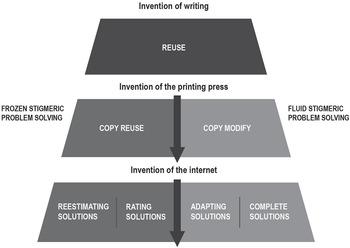
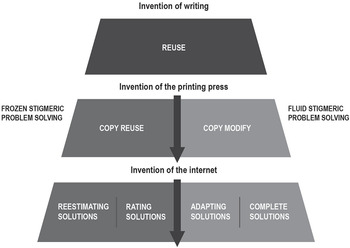
Figure 7.8 gives a brief overview of the history of stigmergic problem solving as it evolves over human history.
7.4.2 The Invention of the Printing Press
The figure shows that human stigmergic problem solving originates from the invention of writing. This was a rudimentary type that made it possible to “reuse” solutions because written information could be stored. Knowledge could for the first time be exchanged across time and space because information was separated from the person.
However, it is the “copy revolution” of the printing press that enables full-scale use of human stigmergy throughout society. The reduced cost of making a book allowed for a much more flexible reuse and sharing of existing knowledge across wider geographical distances. All types of written knowledge could now easily be copied and made accessible to many more readers. As knowledge became materialized, millions of books spurred a major societal transformation. As a result, human stigmergy evolved into frozen and fluid stigmergic problem solving, two full-fledged subtypes.
On one hand, the mass production of identical copies made it possible for the Church and others to spread the same message to everyone. The act of copying information moved from a scribe and into a machine that could reproduce “frozen” complete chunks of information at an unprecedented pace. The large number of copies manifest a new type of quantitative stigmergy. Before the printing press, books would gradually be corrupted, but now this problem was “solved” by instead copying many books. Frozen stigmergic problem solving builds on these “copy reuse” practices in the printer workshops that made it possible to scale up knowledge production.
In the first years after the printing press was invented, the primary goal was to save ancient knowledge, and it led to a classical revival. However, it did not take long before printers began to produce other types of books, including not only religious works, but also storytelling books, books about law, scientific works, and technical books. Books were distributed over large geographical areas and became accessible almost everywhere. This radical increase in available knowledge made it possible for people to learn faster from each other. Knowledge sharing was amplified.
On the other hand, the printing press made possible a new type of fluidity or flexibility in the knowledge production. The content in books could not only be copied, but it could more easily be improved or adjusted to local contexts. Economic incentives made printers translate books into many different vernacular languages. This started with the Bible, but other areas were soon included. Classical works were translated from Latin to the vernacular languages. All these translations strengthened the position of the different European languages, and would with time contribute to more nationalism.
Moreover, the printing workshops made books in a larger variety of different formats. There were books in both large and small sizes, which made is easier for people to bring the book anywhere. Textbooks were invented to help people learn to read. The rulers also became gradually more aware of the political importance of controlling printed information, and leaflets and posters played new and important roles in providing information to the public. The invention of newspapers was part of this development.
Furthermore, the new book editions resulted in a gradual improvement of the accumulated collective knowledge in society. Scientific journals were established and sought to reuse and synthesize knowledge in a systematic manner through citing other’s work (Eisenstein, Reference Eisenstein1980: 126). New scientific fields were born, centered on the revisions and improvement of previous work with an increased emphasis on corrections, reuse, and refinement. Printed books could include illustrations and figures, and this spurred the development of technical knowledge and the natural sciences. Stored solutions in books could be modified and used to solve new problems. In this historical context, Fluid stigmergic problem solving emerges as a new type of stigmergy that builds upon new “copy modify” practices. It marked a shift away from the need to save old, corrupted books to instead acquiring updated knowledge in the most recent edition of a book.
Before the printing press, fluid stigmergic problem solving would evolve as a slow and unplanned process. Although writing as a symbolic system improved gradually over time, it primarily evolved through irregular modifications in the practical use of symbols. With printing, books were being published regularly in new editions, as a planned improvement of a previous version. This strategy spurred innovation and collective knowledge advancement, and all the new editions created a sense of constant progress.
7.4.3 The Invention of the Internet
The next major transformation of human stigmergic problem solving is the recent invention of the Internet and the digitalization of information. While the success of the printing press is about making identical copies at a low cost, this cost is almost completely removed with the invention of the Internet. Solutions can now be permanently stored in an online setting; the problems of information decay are removed. A book can now be copied and reused in an infinite number of ways. In a historical perspective, frozen stigmergic problem solving has become more important than ever before, the sharing of knowledge now transcends both geographical-spatial limitations and time-limitations.
Anyone with access to internet can easily make his or her own public contribution, amplifying the democratization of knowledge production. Many amateurs are today sharing their practical knowledge openly, for example in videos that demonstrate their skills (see Section 3.3). This sharing is not motivated by money, but by a desire to share. Viewers or readers have become reviewers, both through the traces of their online activity and the ratings they actively give. This marks a transition from the age of the printing press with books creating a new type of impersonal connection between authors and the readers because they became unknown to each other (Eisenstein, Reference Eisenstein1980: 66, 132). Before the Internet, a few production facilities made a huge number of identical copies of information to the population, but there were few feedback loops. Reviews of knowledge products were written in newspapers and magazines by just a few persons (Benkler, Reference Benkler2006).
In contrast, the online setting reconnects the producer and the viewer in a completely new way. Solutions are now attached to their actual use because readers leave digital traces. This has led to the evolution of new subtypes of stigmergy such as “rating complete solutions” and “reestimating the solution.” Active user evaluations of the quality of a solution have become much more important, including different types of metainformation, like comments or quantitative ratings. These aggregated digital traces are used by algorithms to determine what attention a specific solution gets.
From one perspective, the user evaluations become a part of the solution when ratings and reviews are saved as attached metainformation. These comments add relevant information to the content and can provide an important peer assessment of the quality. Viewers can also interact with each other through the meta-feedback. Nor will these ratings be “frozen” because they change over time and add a certain level of fluidity to this type of stigmergy. Even in prediction markets, the fluidity of the market mechanism contributes to the “frozen” solution through constant reestimations.
Furthermore, the Internet amplifies fluid stigmergic problem solving and transforms the previous “copy modify” practices into two new subtypes, “adapting complete solutions” and “completing solutions.” Both utilize qualitative stigmergy in enabling contributions to build on each other.
While the printing press opened up for the adaptation of new book editions and translations, these processes are now scaled up at an unprecedented scale. Open textbooks make it possible to modify and translate the original version into multiple new versions. For instance, in the Global South, the adaptation of an already existing textbook can make it easier to produce them at a lower cost. The book is no longer a printed unmodifiable material artifact, but in digital format it can instead be regarded as an open-ended solution that can easily be adjusted to new contexts (see Section 3.2.3). Another example is political memes, which illustrate how modified versions become part of a community of similar types of work. Many amateurs will be involved in copying and modifying the original meme (e.g., image or sound).
The second type of fluid stigmergic problem solving is “completing solutions.” It is born out of the digitization of information and characterized by collective work on draft versions of knowledge products. It makes it possible to coordinate complex projects with a huge number of participants such as open databases, argument maps, open source software, and Wikipedia. These processes are built around a transparent production environment and asynchronous communication. This allows for flexible participation, where errors are regarded as valuable because they trigger others to “fix” the content.
If we compare our internet society today with the Sumerians, one could claim that we still face the same challenge as our ancestors in how to store human knowledge in an optimal way. The Creative Commons license system illustrate how the knowledge production is changing. Both “copy reuse” practices and “copy modify” practices can now be performed without needing to ask the author for permission.
Although the Internet has democratized knowledge production, we are still struggling to organize our collective memory. Even when information is stored openly, it is not necessarily easy to find relevant information. When solutions compete for “attention,” there are many losers, perhaps too many. In this system, the mechanism of rating solutions become essential, but is the crowd majority always wise? There is a risk that cumulative cultural evolution ends up being a fight about whom gets to be on the top of the “billboard.”



 Open access