

Introduction
Invasive predators are a leading cause of biodiversity loss on islands worldwide, having contributed to more than 50% of bird, mammal and reptile extinctions (Doherty et al. Reference Doherty, Glen, Nimmo, Ritchie and Dickman2016). Rats Rattus spp. are perhaps the most successful invasive predator and are established on approximately 80–90% of islands globally (Towns et al. Reference Towns, Atkinson and Daugherty2006). Occurring on 78% of islands known to support highly threatened vertebrates (Spatz et al. Reference Spatz, Zilliacus, Holmes, Butchart, Genovesi, Ceballos, Tershy and Croll2017), rats are well documented to be exceedingly detrimental to island avifauna (e.g. Courchamp et al. Reference Courchamp, Chapuis and Pascal2003, Towns et al. Reference Towns, Atkinson and Daugherty2006, Tabak et al. Reference Tabak, Poncet, Passfield and Martinez Del Rio2014, Harper and Bunbury Reference Harper and Bunbury2015). For instance, between Taukihepa and Lord Howe Islands in the South Pacific alone, the ubiquitous black rat R. rattus is responsible for the extinction of 10 native and endemic species of birds (Towns et al. Reference Towns, Atkinson and Daugherty2006, Shiels et al. Reference Shiels, Pitt, Sugihara and Witmer2013).
The Micronesian Scrubfowl Megapodius laperouse is a species of ground-nesting bird that occurs in the Mariana and Palau archipelagos of western Micronesia (Jones et al. 1995). A member of the family Megapodiidae, they do not incubate their eggs with body heat but instead use external, environmental sources of heat (Jones et al. 1995). The subspecies of scrubfowl in Palau M. l. senex buries its eggs in large mounds of sand filled with decomposing organic matter, which it constructs predominantly in littoral strand forest that occurs throughout portions of the archipelago (Wiles and Conry Reference Wiles and Conry2001, Olsen et al. Reference Olsen, Eberdong, Ketebengang, Blailes and Chen2016). The largest segment of this population is found in the UNESCO World Heritage listed Rock Islands Southern Lagoon Conservation Area (RISL) (Olsen et al. Reference Olsen, Eberdong, Ketebengang, Blailes and Chen2016).
Citing a small, fragmented distribution, comparatively small population size, and its continued decline, IUCN (2016) classifies the Micronesian Scrubfowl as ‘Endangered’. Documented and potential threats to the species are mostly, but not wholly, deterministic in nature and include hunting, egg collecting for human consumption, and introduced predators (Pratt et al. Reference Pratt, Engbring, Bruner and Berrett1980, USFWS 1998, IUCN 2016). Sources suggest that introduced rats are a direct threat to scrubfowl in both the Mariana and Palau archipelagos, but none cite any direct, quantitative evidence as justification (USFWS 1998, Wiles and Conry Reference Wiles and Conry2001, Olsen et al. Reference Olsen, Eberdong, Ketebengang and Chen2013). Four species of rat have become established in Palau, two of which—the Polynesian rat R. exulans and black rat—occur in forested areas of the RISL (Wiles and Conry Reference Wiles and Conry1990) and may be detrimental to scrubfowl. Although no other species of scrubfowl is known or believed to be threatened by rats (IUCN 2016), populations of some ground and burrow-nesting seabirds have been seriously affected (Jones et al. Reference Jones, Tershy, Zavaleta, Croll, Keitt, Finkelstein and Howald2008, Ruffino et al. Reference Ruffino, Bourgeois, Vidal, Duhem, Paracuellos, Escribano, Sposimo, Baccetti, Pascal and Oro2009).
Aside from rats, another potential stressor to wildlife populations on islands is the pressure of tourist visitation. The effect of nature-based tourism and recreation on global bird populations has drawn relatively little attention in either public or academic forums (Steven et al. Reference Steven, Pickering and Castley2011, Steven and Castley Reference Steven and Castley2013). Of the 35 recognized global biodiversity hotspots (Myers et al. Reference Myers, Mittermeler, Mittermeler, Da Fonseca and Kent2000), Polynesia-Micronesia supports the most bird species threatened by tourism (Steven and Castley Reference Steven and Castley2013, Bellard et al. Reference Bellard, Leclerc, Leroy, Bakkenes, Veloz, Thuiller and Courchamp2014). Steven and Castley (Reference Steven and Castley2013) determined that 63 birds listed as ‘Critically Endangered’ and ‘Endangered’ by IUCN (2016) are directly threatened by tourism, and that species occurring in coastal areas are amongst those most at risk. Palau is one of the world’s top SCUBA diving destinations (IMF 2016), and most of this activity occurs in and around the RISL. Many of the beaches and coastal areas on which ‘Endangered’ scrubfowl breed are also highly attractive as picnic sites where dive operators bring tourists in large numbers on a daily basis. As a response, the local government has built and maintains facilities on these beaches to support and cater to these activities.
In addition to tourism activities and facilities potentially having a direct effect on scrubfowl breeding in the RISL, they may also have an indirect impact by augmenting rodent populations through supplementary food provision (Oro et al. Reference Oro, Genovart, Tavecchia, Fowler and Martinez-Abrain2013, Ruffino et al. Reference Ruffino, Russell and Vidal2013). In the absence of predators, population densities of rats on tropical islands are generally very high because of greater access to relatively rich food resources (Harper and Bunbury Reference Harper and Bunbury2015). A consistent availability of anthropogenic food resources further enables these populations to endure environmental variability, further increasing their densities and their threat to native fauna (Russell and Ruffino Reference Russell and Ruffino2012, Ruffino et al. Reference Ruffino, Russell and Vidal2013). Understanding the potential effects of tourism and rats on the Palau Micronesian Scrubfowl is essential to their conservation in Palau.
Here, we investigate whether rat and tourist presence affect Palau Micronesian Scrubfowl numbers, and whether rat numbers are affected by human presence on islands in the RISL. We undertook active and passive surveys for scrubfowl and rats on uninhabited islands in the RISL that were classified as either visited or not visited by tourists, and aimed to assess the relationships between rats, scrubfowl, and tourist presence. We specifically tested the following hypotheses: 1) rat occupancy is significantly higher on tourist visited compared to tourist-free islands (Oro et al. Reference Oro, Genovart, Tavecchia, Fowler and Martinez-Abrain2013), 2) scrubfowl relative abundance is significantly lower on tourist visited compared to tourist-free islands (Steven et al. Reference Steven, Pickering and Castley2011), and 3) scrubfowl relative abundance is significantly lower on islands with high rat occupancy (Harper and Bunbury Reference Harper and Bunbury2015). We discuss our findings in the context of future research and conservation management for threatened species on the Rock Islands of Palau.
Methods
Study area and survey island selection
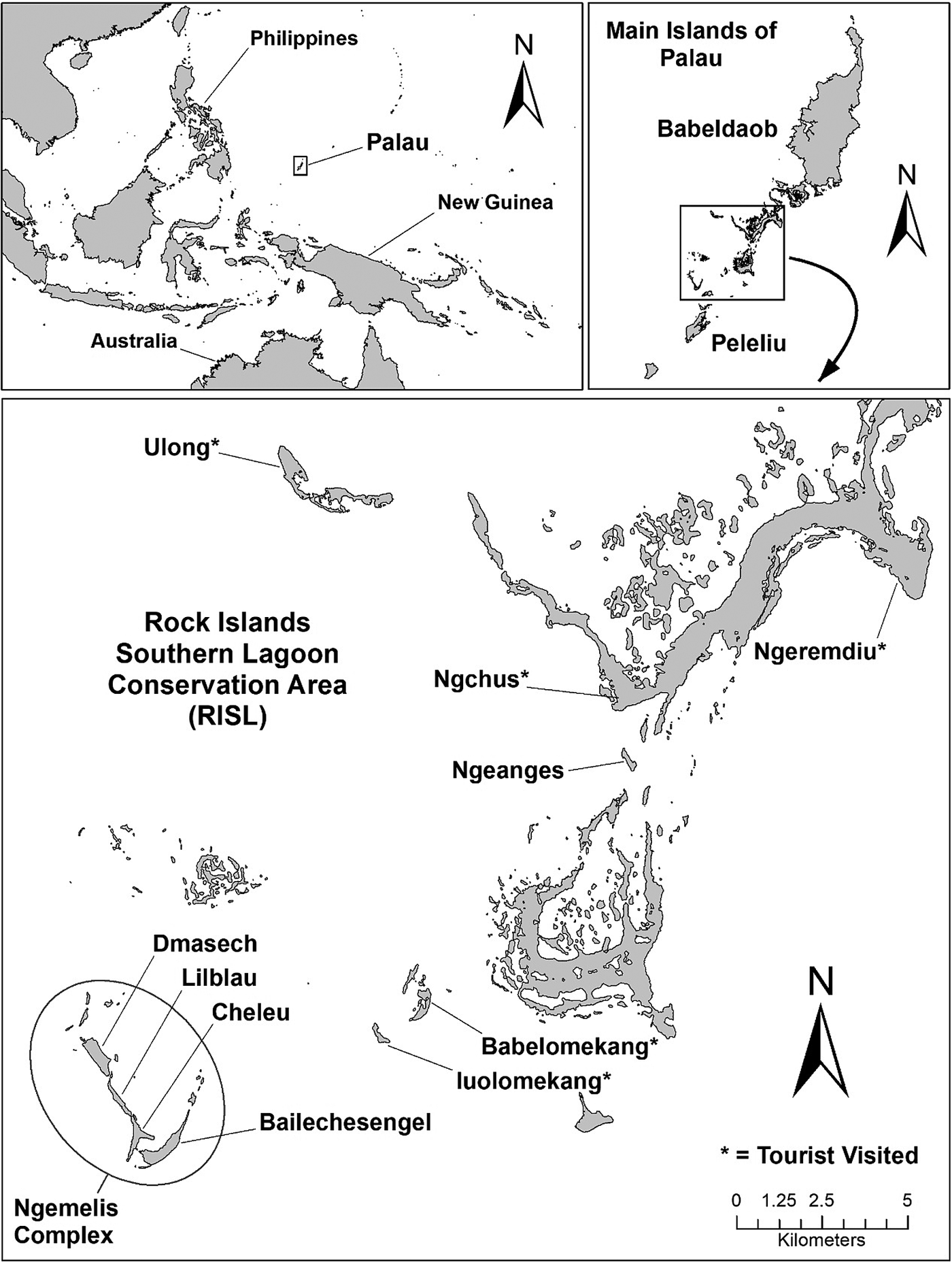
The Palau archipelago (7°30'N, 134°35'E; Figure1) is the westernmost assemblage of islands in Micronesia. It extends 700 km north-east to south-west and is comprised of 12 inhabited islands and over 500 smaller uninhabited islands and islets (Neall and Trewick Reference Neall and Trewick2008, Olsen Reference Olsen, Gillespie and Clague2009). Approximately 87% of the archipelago is forested, 75% of which is classified as native tropical lowland rainforest (Kitalong et al. Reference Kitalong, DeMeo and Holm2013). Our research was focused primarily on the uninhabited islands of the RISL that lie between Babeldaob to the north and Peleliu to the south-west (Figure 1), where scrubfowl are relatively abundant (Olsen et al. Reference Olsen, Eberdong, Ketebengang, Blailes and Chen2016). Unlike other islands in the archipelago, these “rock islands” are ancient, uplifted reefs and are thus coralline in nature (Engbring Reference Engbring1988). The vast majority of islands in the RISL are characterized by nearly vertical, highly fissured and eroded, densely forested karst slopes that protrude abruptly from the water and are undercut at the water’s edge (Pratt et al. Reference Pratt, Engbring, Bruner and Berrett1980, Engbring Reference Engbring1988). Despite the heavy forest cover, these uplifted areas exhibit very little soil development and provide no suitable substrate for scrubfowl to construct their mounds (Pratt et al. Reference Pratt, Engbring, Bruner and Berrett1980, Olsen et al. Reference Olsen, Eberdong, Ketebengang, Blailes and Chen2016). The majority of scrubfowl in the RISL breed in the fringing, sandy littoral zones that additionally characterize a relatively small number of these islands (Olsen et al. Reference Olsen, Eberdong, Ketebengang, Blailes and Chen2016); some of these littoral areas are also heavily visited by tourists (P. Radley pers. obs.).
Map of the study area within the Rock Islands Southern Lagoon Conservation Area (RISL), Palau, and the locations of five tourist visited and five tourist-free islands surveyed for rats and scrubfowl between 15 December 2016 and 22 January 2017.

We selected islands in the RISL for surveys based on the occurrence of sandy littoral areas that supported level, beach strand forest cover. This cover type falls under the category of “Limestone Forest” (Kitalong et al. Reference Kitalong, DeMeo and Holm2013), an ecotype that was consistent in plant species composition and structure at all study sites and was suitable habitat for scrubfowl. Although rats are known to occur in all terrain of the islands in the RISL (T. Hall pers. comm.), areas of strand cover were solely selected for our surveys because of their exclusive use for tourist activities on visited islands, their preferred use by scrubfowl for breeding (Wiles and Conry Reference Wiles and Conry2001, Olsen et al. Reference Olsen, Eberdong, Ketebengang, Blailes and Chen2016), and the nearly inaccessible nature of the limestone areas of the islands. Tourist visited islands were additionally characterized by the presence of picnic tables and barbeque facilities, roofed shelters of varying sizes, and restrooms situated in cleared and maintained areas just off the beach. We specifically chose islands for surveys based on 1) the existence of large enough areas of littoral strand forest that were capable of accommodating full length (180 m) rat survey transects, and 2) the level or degree of human visitation they received (Figure 1). Of six islands in the RISL that are regularly visited by tourists, the five we chose for surveys both met the above size criteria and received moderate to heavy tourist visitation. Four of the five selected tourist-free islands were located in the Ngemelis Complex (Figure 1), a local government conservation area from which tourists are prohibited. The fifth, Ngeanges, was known to receive only occasional day visits by locals or kayakers. It should be noted that in this sense, none of the islands in our study were truly unvisited “controls” but represent a contrast between heavy tourism and very occasional local use.
Rat presence / absence surveys
We quantified rat presence with the use of peanut butter scented WaxTags® (www.traps.co.nz). Transects of 10 waxtags spaced 20 m apart (for a transect length of 180 m) (Ruffell et al. Reference Ruffell, Innes, Bishop, Landers, Khin and Didham2015a, 2015b) were established in the available and accessible strand forest habitat on all 10 islands selected for surveys, where tags were secured to trees approximately 10 cm above the ground. Each transect was run parallel with the shore roughly equidistant between the beach and the limestone face behind. The lengths of accessible beach habitat for transects was small and ranged from 185 to 680 m (
 $ \overline{x} $
= 419.5), a portion of which on tourist-visited islands was occupied by the facilities described above. Three beaches on tourist islands were just long enough to accommodate 180 m transects and tourist facilities were by default included in the sampling area. The facilities on the remaining two tourist islands with longer beaches were likewise included in sampling areas to avoid any possible bias in rat detections.
Rat surveys were conducted in two replicates over four nights each, on 15 – 18 December 2016 and 19 – 22 January 2017. Waxtags were deployed for two nights across each island type (i.e. tourist-visited and tourist-free) during each survey. Given the size of the RISL and the relatively long travel times between some islands via small motorboat, it was necessary to alternate the days of deployment and retrieval of tags by island type. Specifically, tags were deployed and retrieved on days one and three (respectively) of each replicate on tourist visited islands and deployed and retrieved on days two and four of each replicate on tourist-free islands.
Scrubfowl call-playback surveys
We established and surveyed a total of 48 scrubfowl count stations in the RISL, 19 on tourist- visited islands and 29 on islands not visited by tourists. We collected data on scrubfowl presence and relative abundance on six mornings between 9 and 16 January 2017. Scrubfowl surveys consisted of a combination of stationary call playback counts and spot-mapping conducted on the same beaches and in the same habitat as rat surveys. Count stations were established during counts and were spaced 100 m apart in littoral beach strand habitat approximately 10 m inland from the mean high tide mark. We conducted surveys by walking from one end of target beaches to the other, stopping every 100 m to broadcast pre-recorded scrubfowl calls after acquiring a GPS location of each station. Recordings used for surveys were those of Palau Micronesian Scrubfowl that we collected in the Rock Islands in February and March 2016. Call playback was projected towards the limestone face behind the beach as scrubfowl have been observed to not only occur in the littoral strand forest, but also in the dense forest on the face and top of the limestone relief. Surveys at stations consisted of approximately 1 minute of call playback followed by 4 minutes of quiet listening and observation, during which time all scrubfowl seen or heard were recorded and their general locations relative to the observer mapped in field notebooks. After completion of each 5-minute playback survey period, we slowly walked to the next station, spot mapping all scrubfowl seen and/or heard while in transit between stations to avoid double counting birds at successive stations. Birds mapped in this manner were included in count totals at the stations they were detected closest to if it was determined that they had not already been included in station-based counts.
Statistical analysis
We assessed waxtags for evidence of rat chewing for both survey replicates across all islands, recording a ‘1’ for tags that were bitten and ‘0’ for tags that were not. We did not attempt to identify rat species. Site occupancy and detection probabilities for rats were estimated with and without the covariates “Tourist” and “Island” by fitting models in the “unmarked” package in R (Fiske and Chandler Reference Fiske and Chandler2011). The resulting logit parameter estimates were back-transformed and model fit and selection were assessed using Akaike’s Information Criterion (AIC). To further confirm model fit we compared our occupancy model with a null model of our data using a Likelihood Ratio Test. Occupancy and detection probabilities were then predicted for rats on tourist visited and tourist-free islands as groups and occupancy was further predicted at the island level. Many of these estimates were on the upper boundary (i.e. occupancy = 1), hence meaningful confidence intervals could not be calculated (Hutchinson et al. Reference Hutchinson, Valente, Emerson, Betts and Diettrerich2015). We provide standard errors instead. Lastly, averaging the number of waxtags bitten across replicates, we used “Tourist” as a covariate to further test for an effect of tourist presence on rat numbers across islands with a Gaussian family generalized linear model (GLM).
To account for small sample sizes and the boundary estimates, we compared our rat occupancy results to those of a Bayesian GLM that provided posterior means and credible intervals for rat occupancy probabilities for treatment and control island groups, as well as at the island level. To represent a lack of knowledge of the true values of these parameters, the prior probability distribution of both the detection and island occupancy probabilities were assumed to be uniform for this inference. Highest posterior density (HPD) 95% credible intervals were generated for the posterior means of the island level inference while 95% equal-tailed credible intervals were produced for the island group inference.
As a result of unanticipated and unavoidable logistical constraints, we were able to complete only one round of scrubfowl call playback surveys, and because of this we could neither calculate detection probability nor estimate site occupancy for the species (Knape and Korner-Nievergelt Reference Knape and Korner-Nievergelt2015). In lieu of occupancy modelling, we first used a Fisher’s F-test to evaluate scrubfowl survey sample variance between tourist-visited and tourist-free islands to verify homoscedasticity and then compared sample means of the two groups with a two- sample t-test. We then employed both a Poisson family GLM and a logistic regression (Bates et al. Reference Bates, Maechler, Bolker and Walker2015) to assess the effect of tourist presence on scrubfowl across islands, using “Tourist” as a covariate and “Island” as a random effect, with survey station used as the observational unit. We applied a Hosmer Lemeshow goodness of fit (GOF) test (Lele et al. Reference Lele, Keim and Solymos2016) to determine if there was any difference between this model and our observed data.
To test for an effect of rats on scrubfowl, we first calculated island level relative abundances of scrubfowl and compared them to the Bayesian posterior means of island level rat occupancy probability in a Pearson’s product-moment correlation. We followed this with a Gaussian family GLM to model island level scrubfowl relative abundance against rat posterior means and tourist presence, using “Rat” and “Tourist” as covariates. All statistical analysis was performed in program R (R Core Team 2015).
Results
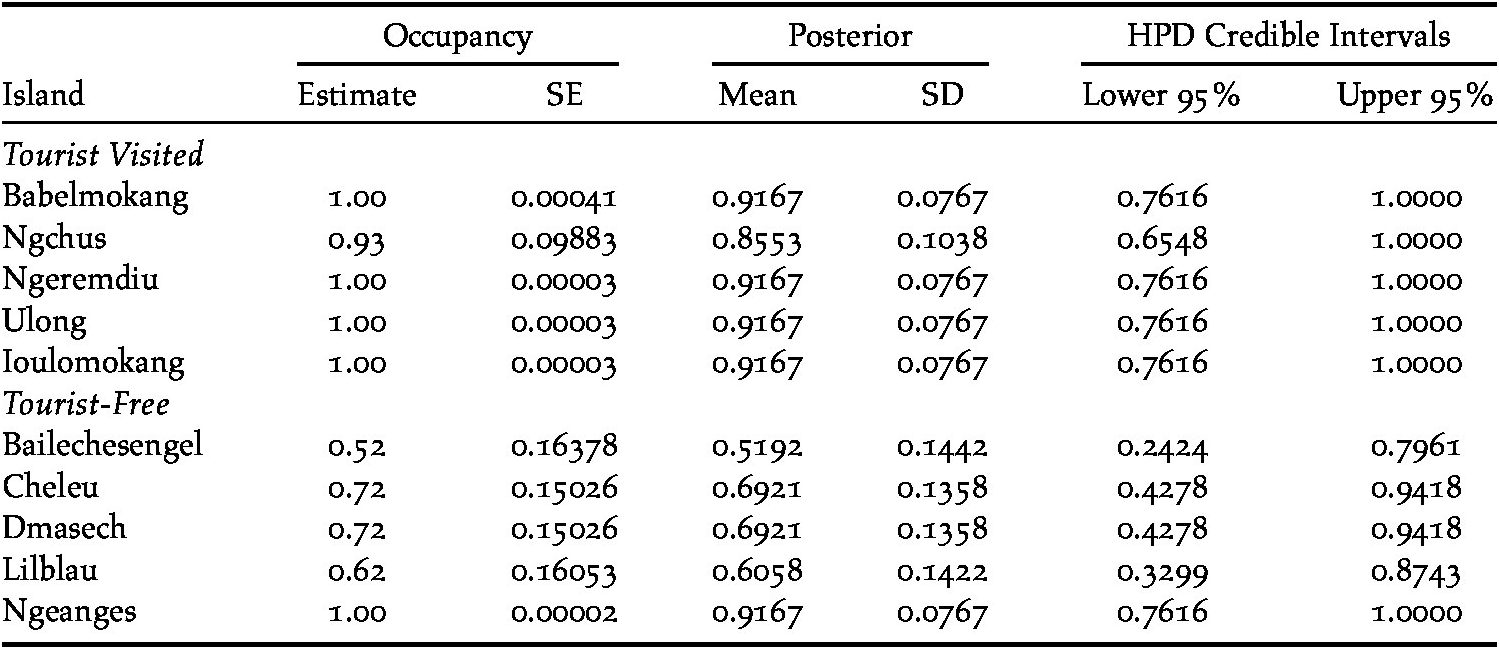
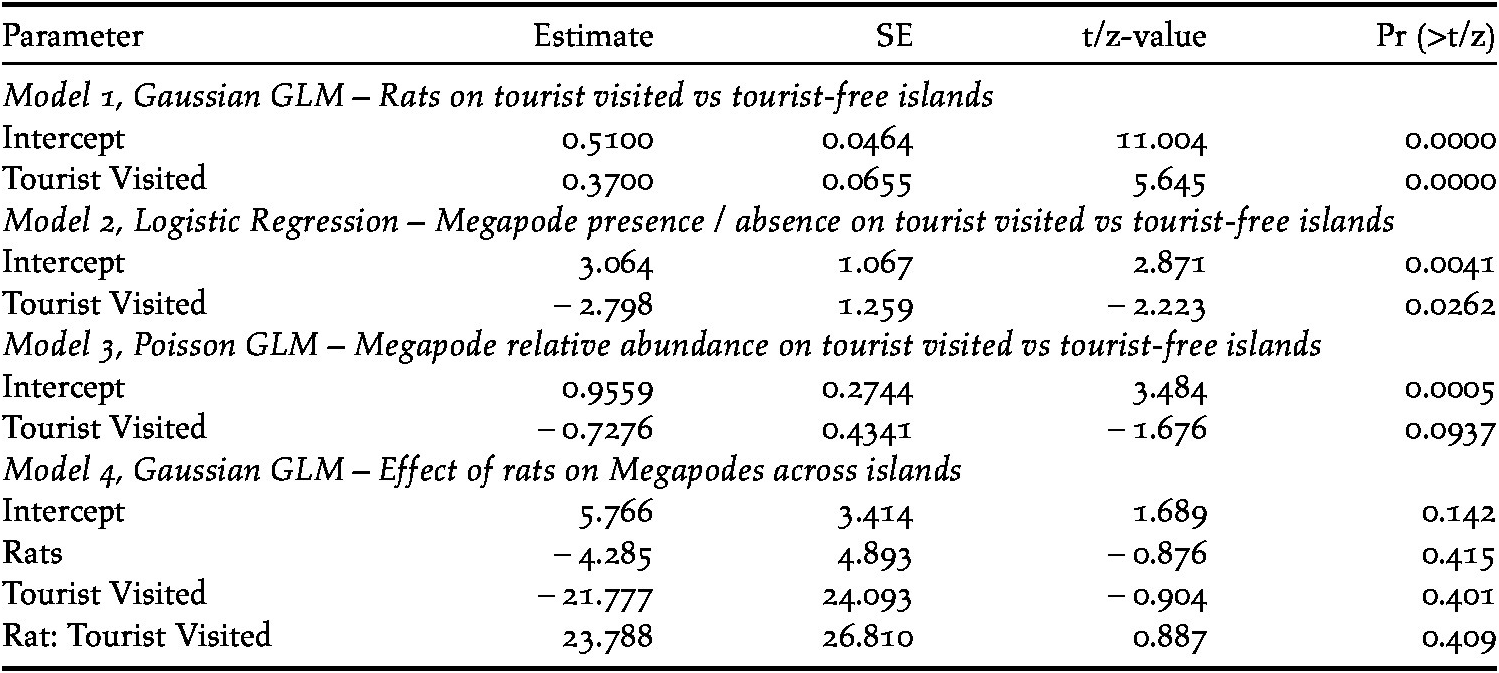
Rats were detected on all islands surveyed in the RISL, where they chewed a mean ± SD of 44.5 ± 4.9 waxtags on tourist-visited islands and 25.5 ± 9.2 on islands not visited by tourists. Occupancy modelling showed that the tourist covariate had a significant positive influence on both rat detection probability (P < 0.001) and site occupancy (P < 0.01). The probability of detecting rats on the tourist-visited islands as a whole (0.89; 95% CI 0.80–0.94) was significantly higher (P = 0.031) than on tourist-free islands (0.52; 0.42–0.62). Likewise, occupancy on tourist visited islands (0.99) was significantly (P = 0.028) higher than on tourist-free islands (0.73). The Bayesian posterior means for occupancy probability (0.90 and 0.69, respectively) were also significantly different (P = 0.028) (Table 1). At the island level, occupancy estimates for tourist-visited islands ranged from 0.93 to 1.00 and from 0.52 to 1.00 for tourist-free islands while Bayesian posterior means ranged from 0.86 to 0.92 and from 0.52 to 0.92, respectively (Table 1). In all instances, the Bayesian GLM provided equal-tail and HPD credible intervals that were slightly more accurate when compared to the occupancy generated CI for each island group and each individual island (Table 1). The results of our Gaussian GLM comparing station-level averages of rat detections across tourist-visited and tourist-free islands further supports the hypothesis that tourist presence has a significant positive relationship with rat detections (Table 2, model 1).
Island level rat occupancy estimates and standard errors compared to island level occupancy probability Bayesian posterior means and 95% credible intervals for tourist visited and tourist-free islands in the Rock Islands Southern Lagoon Conservation Area (RISL) of Palau.

Results for four models used to assess the effect of tourist presences on rats (model 1) and Palau Micronesian Scrubfowl (model 2 and 3), and the effect of rats on scrubfowl (model 4) on tourist visited and tourist-free islands in the Rock Islands Southern Lagoon Conservation Area (RISL) of Palau.

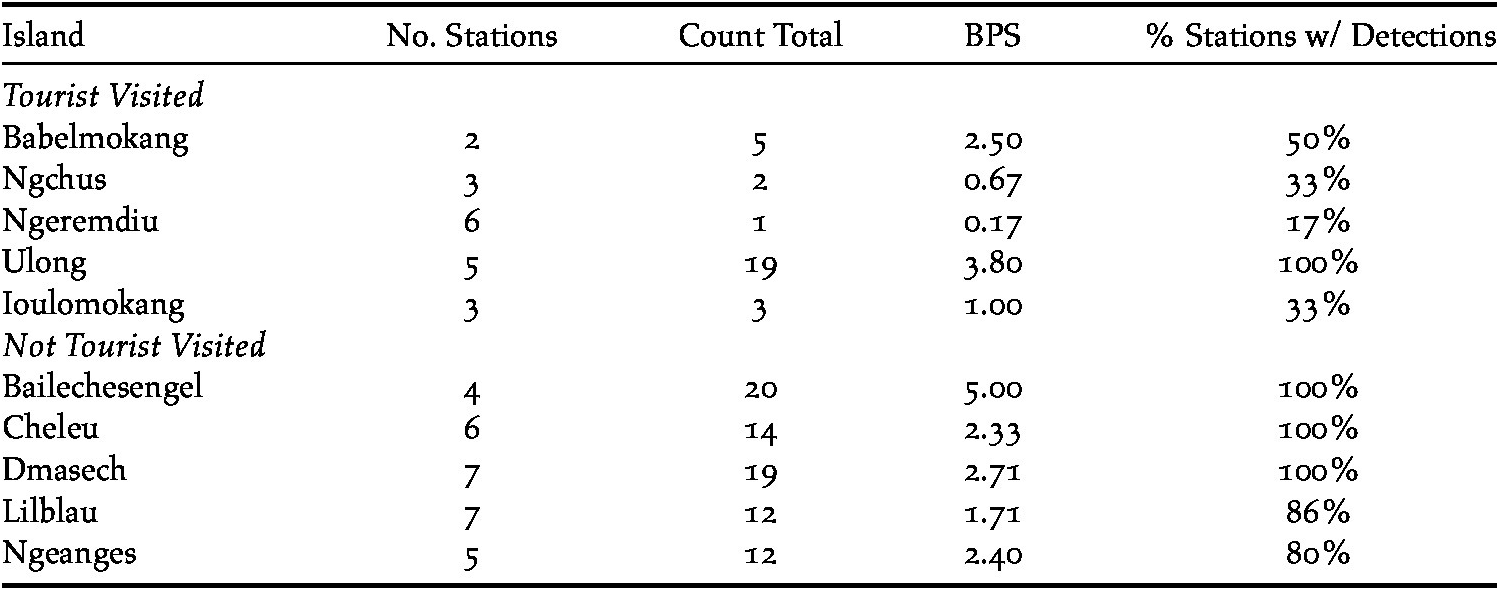
We recorded 107 scrubfowl detections during surveys across all 10 islands, yielding a mean detection rate of 10.7 birds per island (range = 1–20) (Table 3). On tourist-visited islands, 30 individual detections were recorded from nine of 19 (47%) count stations compared to 77 detections recorded from 27 of 29 (93%) stations on tourist-free islands. Sample variance between the two island groups was confirmed to be homoscedastic (P = 0.221). The relative abundance (i.e., mean birds per station or BPS) of scrubfowl on tourist islands (1.58 BPS, SD ± 2.29) was lower than on tourist-free islands (2.66 ± 1.78), although the difference was not statistically significant (P = 0.074; two sample t-test). However, the presence of scrubfowl at survey stations on tourist islands was significantly lower than on tourist-free islands (P = 0.026; logistic regression [Table 2, model 2]). The results of the Poisson GLM indicated that although the tourist covariate appears to have a slight negative influence on scrubfowl relative abundance, the coefficient was not significantly different from the intercept (Table 2, model 3). The Hosmer Lemeshow GOF test was non-significant (P = 0.51) when comparing the Poisson model and our observed data, thus confirming that the model was a good fit.
Total counts and relative abundances during call playback surveys for Palau Micronesian Scrubfowl on tourist visited and tourist-free islands in the Rock Islands Southern Lagoon Conservation Area (RISL) of Palau. No. Stations is the number of survey stations per island, and Count Total is the total number of scrubfowl counted per island.

A Pearson’s product-moment correlation conducted at the island level showed a weak but non-significant negative relationship between rat occupancy and scrubfowl relative abundance (-0.49, 95% CI -0.85–0.20; P = 0.152). The results of the Gaussian GLM indicated that while both the covariates rats and tourists appeared to have a slight negative influence on scrubfowl relative abundance, the coefficients were not significantly different from the intercept (Table 2, model 4).
Discussion
We did not find a strong negative relationship between rats and scrubfowl presence on islands in the RISL. This outcome is at odds with numerous other studies that have attributed island bird extinction and extirpation to invasive rats (e.g. Tabak et al. Reference Tabak, Poncet, Passfield and Martinez Del Rio2014, Harper and Bunbury Reference Harper and Bunbury2015) and conservation advice naming rats as a threat to the Palau Micronesian Scrubfowl (USFWS 1998, Wiles and Conry Reference Wiles and Conry2001, Olsen et al. Reference Olsen, Eberdong, Ketebengang and Chen2013). Rats (particularly black rats) affect island landbird populations primarily at the level of productivity by predating eggs, hatchlings or chicks in nests, but they also opportunistically take adults of some smaller species (Shiels et al. Reference Shiels, Pitt, Sugihara and Witmer2013, Harper and Bunbury Reference Harper and Bunbury2015). Unlike other avian species, scrubfowl eggs and hatchlings are not outwardly visible and vulnerable to predation for days to weeks on end within an open nest. Instead, their eggs are buried under up to a metre of sand or soil and organic matter, through which hatchlings dig their way to the surface after hatching (Jones et al. 1995). A young scrubfowl would be most vulnerable for a relatively brief period just as it erupts from the incubation mound, after which it emerges as a “super-precocial” chick that cannot only run but is immediately capable of flight (R. Dekker pers. comm.). The window of opportunity for predation by rats is therefore relatively very narrow and any scrubfowl young taken by rats may likely be more so by chance. The lack of an obvious or significant effect in our study may be due to the fact that rat predation is negligible on larger subadult and adult birds.
Some studies show that other island birds are able to coexist with introduced rats with no apparent negative effects at the population level. Larger, ground-nesting seabirds (e.g. albatrosses, frigatebirds, and gulls) tend to be far less affected by rats than smaller, burrow- nesting seabirds (e.g. storm petrels and some Alcids), a result that may stem from the size of the former and their likely adeptness at defending their eggs and young from predators (Jones et al. Reference Jones, Tershy, Zavaleta, Croll, Keitt, Finkelstein and Howald2008). Populations of larger burrow nesting shearwaters that breed almost exclusively on rat-infested islands in the Mediterranean were found to be limited less by rats than the smaller, resident storm petrels, and more so by physical characteristics of the islands themselves (Ruffino et al. Reference Ruffino, Bourgeois, Vidal, Duhem, Paracuellos, Escribano, Sposimo, Baccetti, Pascal and Oro2009). Tabak et al. (Reference Tabak, Poncet, Passfield and Martinez Del Rio2014) found that the occurrence of three mostly ground-dwelling passerines, the Falkland Pipit Anthus correndera, Long-tailed Meadowlark Sturnella loyca, and Dark-faced Ground Tyrant Muscisaxicola maclovianus, were unaffected by the presence of Norway rats R. norvegicus in the Falkland Islands, regardless of island size. While the endemic pipit avoids areas of tussac grass Parodiochloa flabellata, a habitat preferred by Norway rats, the above ground feeding behaviours of the latter two may reduce their exposure to rats (Hall et al. 2002).
There is the possibility that rats act as a competitor for food resources (Shiels et al. Reference Shiels, Pitt, Sugihara and Witmer2013), but our data are not appropriate to test this hypothesis. Although there is little in the literature pointing to rats as direct resource competitors for avian species (Shapiro Reference Shapiro2005, Tabak et al. Reference Tabak, Anderson, Robb, Poncet, Passfield, Martinez and Martinez Del Rio2016), Shiels et al. (Reference Shiels, Pitt, Sugihara and Witmer2013) suggest that those birds relying on either arthropods or fruit as a major component of their diet may experience direct competition with rats. The Palau Micronesian Scrubfowl is omnivorous, with a diet consisting of a variety of fruits, seeds and other plant matter, various insects and land crabs (Jones et al. 1995). Likewise, both species of rat that occur in the RISL are known to be highly opportunistic, exploiting virtually any available food source, but relying heavily on plant matter, with insects providing the majority of animal protein in their diets (Shiels et al. Reference Shiels, Pitt, Sugihara and Witmer2013, Harper and Bunbury Reference Harper and Bunbury2015). The broad dietary intake of scrubfowl in the RISL may serve to minimize the chances of direct resource competition, and as primarily a scratch feeder, the species may fill a functionally different foraging niche than rats (Jones et al. 1995).
Our results further suggest that tourists may have a negative impact on scrubfowl, as shown by lower relative abundance and detection rates at tourist compared to tourist-free islands. Aside from negative consequences to individual physiology and reproductive success, other studies (e.g. Otley Reference Otley2005, Ma and Cheng Reference Ma and Cheng2008, Steven et al. Reference Steven, Pickering and Castley2011, Steven and Castley Reference Steven and Castley2013) show that the behaviour, distribution and movement patterns of some bird species in tourist visited areas are affected by human presence, while their apparent abundance or numbers are not. Otley (Reference Otley2005) further found that up to 80% of Gentoo Pygoscelis papua, King Aptenodytes patagonicus, and Magellanic Spheniscus magellanicus Penguins at tourist-visited sites in the Falkland Islands avoided travelling between beach and colony areas during daylight hours when most human visitors were present. Indeed, scrubfowl on tourist visited islands in the RISL tended to be more skittish upon approach than on islands that experience little or no human presence (P. Radley pers. obs.). From a statistical standpoint, however, our Poisson GLM does indicate a slight negative effect of tourism on scrubfowl relative abundance. The relatively high number of birds detected on Ulong (Table 3), a tourist-visited island, may have prevented this model from showing a significant result. This may leave the result of our logistic regression to be a more accurate reflection of the effect of tourists on scrubfowl.
Lastly, our results suggest that tourist presence may positively influence rat numbers. The probability of detecting rats on islands that routinely receive high levels of tourist visitation was 42% greater than on islands that were tourist-free. While occupancy on tourist-free islands was relatively high and the difference between these islands and tourist-visited islands is lower than the difference between detection probabilities, occupancy on tourist islands approached 1.00. We cannot rule out that these differences are not the result of historical visits by local people for the purpose of fishing or hunting coconut crabs Birgus latro. One likely reason for this disparity, however, is that high tourist presence often equates to a greater availability of food waste that may supplement the diet of rats on islands routinely and heavily visited by tourists (Sealey and Smith Reference Sealey and Smith2014). Depending on the season, an island’s infrastructure, and its proximity to popular dive sites in and around the RISL, several dozens to nearly a hundred tourists could be fed buffet-style at the picnic facilities on a single beach every day (P. Radley pers. obs.). The resulting waste was often left at these facilities in plastic bags for the local government clean-up crews to remove for disposal. In some instances, smaller portions of organic waste were simply discarded by locals, tourist and tour operators in the vegetation adjacent to picnic facilities.
There are numerous published studies illustrating the effect of tourism, particularly nature-based tourism, on wildlife populations (Steven et al. Reference Steven, Pickering and Castley2011, Steven and Castley Reference Steven and Castley2013). Surprisingly, however, we could find little pertaining to the possible direct effects of tourism activities on populations of invasive rats, particularly in tropical island ecosystems. Only Sealey and Smith (Reference Sealey and Smith2014) describe high concentrations of rats at tourist facilities as a result of the availability of solid food waste generated by tourist-based operations on Great Exuma Island, Bahamas. That study, however, focused specifically on large facilities or resorts on the island, and sheds no light on its broader ecological effects on rats at the ecosystem level (Sealey and Smith Reference Sealey and Smith2014). Resource subsidies across numerous ecosystems, however, have been found to increase individual fitness and resilience of various opportunistic species, leading to increases in densities and decreases in temporal variability of some populations (Oro et al. Reference Oro, Genovart, Tavecchia, Fowler and Martinez-Abrain2013). Insular rodents with access to allochthonous resources tend to grow larger, occur at higher densities, and their populations tend to persist in the longer-term in part because they are better able to withstand local environmental stress (Stapp and Polis Reference Stapp and Polis2003, Ruffino et al. Reference Ruffino, Russell and Vidal2013). Our field observations strongly indicate that food subsidies are routinely made available to rats on islands in the RISL, and that this is likely to present a significant challenge to rat-sensitive species inhabiting these islands.
Habitat and scrubfowl detectability
While Palau supports the richest assemblage of native flora and the highest rate of plant endemism in Micronesia (Costion et al. Reference Costion, Kitalong and Holm2009), plant diversity across islands in the RISL is relatively homogenous (Kitalong Reference Kitalong2014). Based on this, and on the fact that the RISL supports the majority of breeding scrubfowl in the archipelago, with incubation mounds occurring on all islands surveyed, we assumed that habitat would not be a factor in our analysis of scrubfowl relative abundance.
The only comprehensive survey of scrubfowl in the Palau archipelago was conducted by Olsen et al. (Reference Olsen, Eberdong, Ketebengang, Blailes and Chen2016), in which a combination of 15-minute passive counts and broad area searches (for birds and mounds) were used to survey 122 beach / island sites. They detected 350 individuals at 61 (50%) of the sites surveyed, for a detection rate of 2.9 scrubfowl per beach or island included in the surveys. Olsen et al. (Reference Olsen, Eberdong, Ketebengang, Blailes and Chen2016) suggested one confounding factor that could have decreased their detections is the possibility of “commuting” by scrubfowl between their nesting and feeding grounds, a phenomenon documented in other species (Jones et al. 1995, R. W. R. J. Dekker pers. comm.). As a result, birds may have at times been detected on return visits at sites where they had not previously been encountered, or not detected at sites they previously had (Olsen et al. Reference Olsen, Eberdong, Ketebengang, Blailes and Chen2016).
By comparison, our surveys yielded a mean detection rate of 10.7 scrubfowl with at least one bird detected at every one of the 10 beaches or islands surveyed in the RISL. This difference may have been the result of our use of a targeted active survey, employing call-playback from fixed stations at survey sites. Many of our detections were of birds that responded from a distance from habitat atop the limestone relief, birds we would not have detected without call-playback. Given our relatively high detection rates, and the fact that we detected birds at every site surveyed, commuting by scrubfowl may not have been encountered on the islands we surveyed during our work.
Conservation implications
In March 2017, Island Conservation executed an eradication of rats from the island of Ngeanges and was developing plans with the local government to do likewise for other islands in the RISL (T. Hall pers. comm.). This is inarguably the optimal approach to conservation of tropical island landbird species threatened by rats (Russell and Holmes Reference Russell and Holmes2015, Jones et al. Reference Jones, Holmes, Butchart, Tershy, Kappes, Corkery, Aguirre-Muñoz, Armstrong, Bonnaud, Burbidge, Campbell, Courchamp, Cowan, Cuthbert, Ebbert, Genovesi, Howald, Keitt, Kress, Miskelly, Oppel, Poncet, Rauzon, Rocamora, Russell, Samaniego-Herrera, Seddon, Spatz, Towns and Croll2016, Spatz et al. Reference Spatz, Zilliacus, Holmes, Butchart, Genovesi, Ceballos, Tershy and Croll2017). While our results suggest that rats do not detrimentally affect scrubfowl, other species of native and endemic landbirds that share forested habitat with scrubfowl in the RISL may be at threat (Harper and Bunbury Reference Harper and Bunbury2015). These species include the ‘Endangered’ Palau Ground Dove Alopecoenas canifrons and perhaps the Palau Fantail Rhipidura lepida, and Micronesian Imperial and Nicobar Pigeons Ducula oceanica and Caloenas nicobarica, respectively. Aside from some point-count based inventories (VanderWerf Reference VanderWerf2007), few studies have been carried out on Palau’s terrestrial avifauna and little is known about population trends for most species in the RISL. Given the significantly higher level of rat detection probability and occupancy on tourist-visited islands relative to tourist-free islands, a study comparing the vital rates of landbirds across the two island types would be beneficial (Saracco et al. Reference Saracco, Radley, Pyle, Rowan and Taylor2014). The threat of rats to island landbirds suggests that quantitative studies concerning the effect of tourism on rat populations would be an asset to other insular nature-based tourism destinations globally.
To further manage rat numbers in the RISL, a good first step would be managing tourist waste by enforcing a “pack-it-out” policy that requires tourist operations to remove all their food waste from the islands they visit. Adequate signage, education and onsite enforcement of removal of all food refuse by tourist operators would go a long way to decrease supplementary food sources that may be helping to sustain or augment rat populations on tourist visited islands in the RISL.
Acknowledgements
Edith Cowan University School of Science provided financial, administrative, and logistical support, and project ethics approval (which conforms to the requirements of the “Australian code of practice for the care and use of animals for scientific purposes”, 8th Edition, Ref. No. EA28). The Palau National and Koror State Governments provided all necessary research permits, and the latter further permitted access to restricted conservation areas. We are grateful to Clarence Kitalong for all boat transport and whose vast local knowledge of the islands made our work possible. Mike Lohr assisted with scrubfowl surveys. Greg Budney, Cornell Lab of Ornithology, provided sound recording equipment to record megapode calls. Jim Baldwin, a Statistician at the U.S. Forest Service Pacific Southwest Research Station, provided the Bayesian estimates of occupancy probability. Richard Camp and Marcos Gorresen, U.S. Geological Survey, Hawaii, provided valuable input pertaining to analytical approach and methods. Fred Amidon, U.S. Fish and Wildlife Service, Hawaii Field Office, provided technical insight with Figure 1. We thank two anonymous reviewers for their comments on an earlier version of this manuscript. This work was supported by the Rufford Small Grants for Nature Conservation (grant no. G1002201), Club 300 Bird Protection (G1002235), and the World Pheasant Association (G1002935).