Introduction
Diapsids are documented in several late Paleozoic continental assemblages and became more common during the middle–late Permian, when multiple ‘younginiform’ and other early neodiapsid specimens have been found in east Africa (Piveteau, Reference Piveteau1926; Carroll, Reference Carroll1981). The oldest recorded archosauromorphs, including at least one archosauriform species, are also known from a few specimens collected in middle–upper Permian rocks of east Africa, Europe, and possibly South America (e.g., the non-crocopodans Protorosaurus speneri von Meyer, Reference von Meyer1832, and Aenigmastropheus parringtoni Ezcurra, Scheyer, and Butler, Reference Ezcurra, Scheyer and Butler2014; the proterosuchid Archosaurus rossicus Tatarinov, Reference Tatarinov1960; the possible early archosauriform Eorasaurus olsoni Sennikov, Reference Sennikov1997) (Tatarinov, Reference Tatarinov1960; Sennikov, Reference Sennikov1997; Gottmann-Quesada and Sander, Reference Gottmann-Quesada and Sander2009; Ezcurra et al., Reference Ezcurra, Scheyer and Butler2014, Reference Ezcurra, Velozo, Meneghel and Piñeiro2015; Martinelli et al., Reference Martinelli, Francischini, Dentzien-Dias, Soares and Schultz2017). The numerical dominance of diapsids in terms of abundance and taxonomic diversity occurred in terrestrial assemblages only after the biotic recovery from the deadly end-Permian mass extinction (ca. 251.9 Ma; Bakker, Reference Bakker and Hallan1977; Chen and Benton, Reference Chen and Benton2012; Ezcurra and Butler, Reference Ezcurra and Butler2018; Simões et al., Reference Simões, Vernygora, Caldwell and Pierce2020). Thus, the fossil record of Early Triassic diapsids is very important to understand how the biotic crisis affected ecosystems and the patterns and processes of their recovery. The best sources of information of these assemblages in the aftermath of the end-Permian mass extinction are from continental deposits in current-day South Africa, China, and Russia, and marine beds of Europe and China (Sennikov, Reference Sennikov1996; Chen and Benton, Reference Chen and Benton2012; Benton et al., Reference Benton, Zhang, Hu, Chen, Wen, Liu, Huang, Zhou, Xie, Tong and Choo2013; Scheyer et al., Reference Scheyer, Romano, Jenks and Bucher2014; Smith and Botha-Brink, Reference Smith and Botha-Brink2014; Viglietti et al., Reference Viglietti, Benson, Smith, Botha and Kammerer2021). The Lower Triassic continental rocks of the Panchet Formation of the Damodar Basin in current-day eastern India (Fig. 1) have yielded a relatively diverse vertebrate assemblage, but it has been considerably less sampled than those of the above-mentioned countries. Therefore, an improved knowledge of the Panchet assemblage has the potential to generate a more global understanding of the aftermath of the mass extinction.
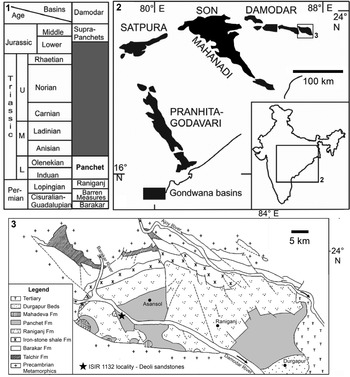
Geographic and stratigraphic occurrence of ISIR 1132. (1) Chronostratigraphy of the Damodar Basin; the Panchet Formation is highlighted in bold. (2) Gondwana basins of peninsular India. (3) Geological map of the Panchet area indicating the discovery site of ISIR 1132. (1, 2) After Bandyopadhyay (Reference Bandyopadhyay1999) and Bandyopadhyay and Ray (Reference Bandyopadhyay and Ray2020); (3) after Gupta (Reference Gupta2009).

The Panchet Formation is composed of red mudstones related to ancient pools and lakes in its lower portion and mainly yellow to brownish, medium-grained sandstones with larger clasts deposited in a large delta in its upper portion (Robinson, Reference Robinson1958). The fossil vertebrate assemblage of the Panchet Formation is composed of fishes, several temnospondyl taxa, the dicynodont Lystrosaurus spp., two cynodont species, and isolated proterosuchid bones assigned to the genus Proterosuchus (e.g., Huxley, Reference Huxley1865; Lydekker, Reference Lydekker1885; Tripathi and Satsangi, Reference Tripathi and Satsangi1963; Satsangi, Reference Satsangi1964, Reference Satsangi1987; Bandyopadhyay, Reference Bandyopadhyay1999; Ray, Reference Ray2005; Gupta, Reference Gupta2009; Warren et al., Reference Warren, Damiani and Sengupta2009; Gupta and Das, Reference Gupta and Das2011; Das and Gupta, Reference Das and Gupta2012; Bandyopadhyay and Ray, Reference Bandyopadhyay and Ray2020; Pal, Reference Pal2021). As a result, the diapsid record of this unit is currently limited to archosauromorphs. Here, we report on a small isolated diapsid partial ilium (ISIR 1132) that was collected in the upper portion of the Panchet Formation during the late 1990s by one of us (KS). This specimen is interpreted as a non-archosauromorph neodiapsid, expanding the reptile diversity in this Indian unit and allowing more comparisons with other Lower Triassic continental beds worldwide.
Material and methods
Phylogenetic analysis
In order to test phylogenetic relationships of ISIR 1132, we scored this new specimen in the latest version of the most extensive phylogenetic dataset currently available for Permian and Triassic archosauromorphs, which also includes some early lepidosauromorphs and non-saurian diapsids (Ezcurra, Reference Ezcurra2016; Ezcurra et al., Reference Ezcurra, Fiorelli, Trotteyn, Martinelli and Desojo2021a, Reference Ezcurra, Bandyopadhyay and Gowerb). This data matrix has proved to be useful to test the relationships of terrestrial neodiapsid species (Scheyer et al., Reference Scheyer, Spiekman, Sues, Ezcurra, Butler and Jones2020). In addition, we also scored the late Permian non-saurian neodiapsid Claudiosaurus germaini Carroll, Reference Carroll1981, the late Permian–Early Triassic non-saurian neodiapsid Hovasaurus boulei Piveteau, Reference Piveteau1926, and the Middle Triassic lepidosauromorph Fraxinisaura rozynekae Schoch and Sues, Reference Schoch and Sues2018a. The latter was scored based on Schoch and Sues (Reference Schoch and Sues2018a) and the former two based on first-hand study of specimens (Claudiosaurus germaini, MNHN MAP1, holotype; Hovasaurus boulei, MAP316, lectotype, MAP333, lectotype, MAP 337, lectotype, MAP 349, and MAP 373) and bibliography (Carroll, Reference Carroll1981; Currie, Reference Currie1981; Ketchum and Barrett, Reference Ketchum and Barrett2004). We deactivated 35 terminals before the tree searches (see Supplementary Information), which were included by Ezcurra and Butler (Reference Ezcurra and Butler2018) only for the purpose of morphological disparity analyses, and character 119 was deactivated (following Ezcurra et al., Reference Ezcurra, Fiorelli, Martinelli, Rocher, von Baczko, Ezpeleta, Taborda, Hechenleitner, Trotteyn and Desojo2017, and Butler et al., Reference Butler, Ezcurra, Liu, Sookias and Sullivan2019). Thus, the active data set is composed of 126 terminals and 716 characters. The following characters were considered additive: 1, 2, 7, 10, 17, 19–21, 28, 29, 36, 40, 42, 50, 54, 66, 71, 74–76, 122, 127, 146, 153, 156, 157, 171, 176, 177, 187, 202, 221, 227, 263, 266, 278, 279, 283, 324, 327, 331, 337, 345, 351, 352, 354, 361, 365, 370, 377, 379, 386, 387, 398, 410, 424, 430, 435, 446, 448, 454, 458, 460, 463, 464, 470, 472, 478, 482, 483, 485, 489, 490, 504, 510, 516, 529, 537, 546, 552, 556, 557, 567, 569, 571, 574, 581, 582, 588, 648, 652, and 662 because they represent nested sets of homologies. Modifications to the data matrix and the matrix are available in the Supplemental Data.
The matrix of discrete morphological characters was analyzed under equally weighted maximum parsimony using TNT v.1.5 (Goloboff et al., Reference Goloboff, Farris and Nixon2008; Goloboff and Catalano, Reference Goloboff and Catalano2016). The search strategy initially used a combination of the tree-search algorithms sectorial searches, drifting, ratchet, and tree fusing, until 100 hits of the same minimum tree length were achieved. The shortest trees obtained were then subjected to a final round of TBR branch swapping. Zero length branches in any of the recovered most parsimonious trees were collapsed. Topologically unstable terminals were detected and alternative strict reduced consensus trees were explored using the iterPCR protocol implemented in TNT v.1.5 (Pol and Escapa, Reference Pol and Escapa2009). Branch support was quantified using decay index (Bremer support) values and a bootstrap resampling analysis, with 1,000 pseudo-replicates and reporting both absolute and GC “Group present/Contradicted” (i.e., difference between the frequencies of recovery in pseudo-replicates of the clade in question and the most frequently recovered contradictory clade) frequencies (Goloboff et al., Reference Goloboff, Farris, Källersjö, Oxelman, Ramírez and Szumik2003).
Repositories and institutional abbreviations
AM, Albany Museum, Grahamstown, South Africa; BP, Evolutionary Studies Institute (formerly Bernard Price Institute for Palaeontological Research), University of the Witwatersrand, Johannesburg, South Africa; ISI, Indian Statistical Institute, Kolkata, India; MNHN, Muséum national d'Histoire naturelle, Paris, France; NHMUK PV, Natural History Museum, Palaeontology Vertebrates, London, UK; PIN, Borissiak Paleontological Institute of the Russian Academy of Sciences, Moscow, Russia; SAM-PK, Iziko South African Museum, Cape Town, South Africa; TMM, Vertebrate Paleontology Collections, University of Texas at Austin, Austin, Texas, USA.
Systematic paleontology
Reptilia Linnaeus, Reference Linnaeus1758 [Laurin and Reisz, Reference Laurin, Reisz, de Queiroz, Cantino and Gauthier2020]
Diapsida Osborn, Reference Osborn1903 [Gauthier and de Queiroz, Reference Gauthier, de Queiroz, de Queiroz, Cantino and Gauthier2020]
Neodiapsida Benton, Reference Benton1985
Neodiapsida gen. et sp. indet.
Figures 2, 3.4
Occurence
Yellow-brownish sandstones of the upper Panchet Formation (middle-late Induan; Gupta and Das, Reference Gupta and Das2011), Damodar Basin; close to or on the Damodar River bed, near Deoli village, West Bengal, eastern India (Fig. 1).
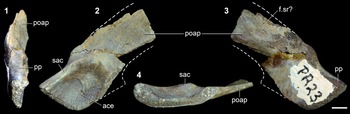
ISIR 1132. Left ilium in (1) anterior, (2) lateral, (3) medial, and (4) ventral views. Abbreviations: ace, acetabulum; f.sr?, possible facet for sacral rib; poap, postacetabular process; pp, pubic peduncle; sac, supraacetabular crest. Scale bar equals 2 mm.

Description
ISIR 1132 is represented by a left ilium that lacks the ischiadic peduncle and the posterior end of the postacetabular process, as well as the dorsal and ventral margins of this process (Fig. 2). The surface of the bone is generally well preserved. The bone has a maximum preserved length of 18.4 mm and a maximum preserved height of 15.1 mm. The iliac blade is transversely thinner than the acetabular region. There is no preacetabular process; instead, the anterior margin of the iliac blade is dorsoventrally short, straight, and sloping slightly posterodorsally in lateral view. The anteriormost region of the dorsal margin of the iliac blade is slightly convex dorsally and possesses a posterodorsal orientation at a higher angle than that of the main axis of the supraacetabular crest. This angle is ~35° with respect to an inferred horizontal plane based on comparisons with other Permo-Triassic neodiapsids (see Discussion). This anteriormost region is separated by a shallow emargination from a straight, even more posterodorsally oriented dorsal margin of the iliac blade, which is ~45° with respect to the horizontal plane. The preserved portion of the postacetabular process (Fig. 2) indicates that it had a strong posterodorsal orientation, although the dorsal and ventral margins of the process are broken. The lateral surface of the iliac blade is smooth and flat, without ridges or distinct depressions. The medial surface of the iliac blade is damaged on its central portion, and on the postacetabular process there is a slightly striated region (Fig. 2) that probably was the attachment area of a sacral rib.
The acetabular region possesses a deep, well-delimited subcircular acetabulum (Fig. 2). The acetabular wall extends ventrally to the pubic peduncle, forming a ventral apex that indicates the presence of a likely fully closed acetabulum. The posterodorsal region of the acetabulum has a crescent area of smooth bone that has a few pits and grooves and probably represents the origin for the iliofemoral ligament (Conrad, Reference Conrad2006). The rest of the acetabular wall is highly rugose. The anterior and dorsal margins of the acetabulum are framed by a very thick and moderately laterally developed supraacetabular crest (Fig. 2). The posterior end of the supraacetabular crest curves slightly ventrally and finishes abruptly into a rounded structure. Anteriorly, the supraacetabular crest reaches the most distally preserved region of the pubic peduncle (Fig. 2). The latter is anteroventrally oriented at an angle of ~32° with respect to the horizontal plane. The pubic peduncle is sub-cylindrical in cross-section and its dorsoventral height increases gradually towards the anterior end. From this anterior end, the pubic peduncle decreases in transverse width posteriorly towards a thinner acetabular wall. The medial surface of the acetabular region is slightly convex and ornamented by faint and thin posteroventrally oriented grooves, at least on its posterior half. The cortical bone of the anterior half of the medial surface of the acetabular area has been eroded away.
Material
ISIR 1132, partial left ilium lacking the ischiadic peduncle and the dorsal, ventral, and posterior portions of the postacetabular process (Fig. 2).
Remarks
ISIR 1132 represents just the second diapsid taxon identified for the Panchet Formation, whose upper tetrapod fossil assemblage is dominated numerically by proterosuchid archosauriforms, temnospondyls, and dicynodonts (Huxley, Reference Huxley1865; Tripathi and Satsangi, Reference Tripathi and Satsangi1963; Bandyopadhyay, Reference Bandyopadhyay1999; Ezcurra et al., Reference Ezcurra, Bandyopadhyay, Butler, Sengupta, Sen, Sookias and Nesbitt2020). Thus, non-archosauromorph neodiapsids seem to have been rare components of this assemblage (as well as in other regions of Pangea; see Discussion), and this seems to have been independent of size bias because small-sized fish elements are common in the upper Panchet Formation. No reptile specimen has been found so far in the mudstones of the lower Panchet Formation, even though it does preserve partial articulated skeletons of the dicynodont Lystrosaurus (Robinson, Reference Robinson1958; Bandyopadhyay, Reference Bandyopadhyay1999). Although potentially diagnostic at a genus/species level, ISIR 1132 is only a partial ilium and the erection of a new taxon based on such a fragmentary specimen would not be recommended on the the basis of discovery of more complete specimens of this taxon in the Panchet Formation or elsewhere.
Discussion
Anatomical comparisons and phylogenetic relationships
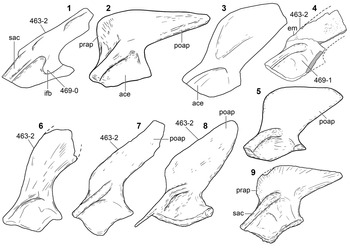
ISIR 1132 possesses a unique combination of character states that distinguish it from non-neodiapsid tetrapods. The iliac blade of ISIR 1132 is considerably larger than the poorly developed and mainly dorsally projected blades of non-amniote, non-diadectomorph, and non-seymouriamorph tetrapods (e.g., the temnospondyls Trematolestes, Archegosaurus, and Metoposaurus—Schoch, Reference Schoch2006; Witzmann and Schoch, Reference Witzmann and Schoch2006; Sulej, Reference Sulej2007; the lissamphibians Triadobatrachus and Prosalirus—Stocker et al., Reference Stocker, Nesbitt, Kligman, Paluh, Marsh, Blackburn and Parker2019). The acetabulum is well developed dorsoventrally, being taller than the height of the iliac blade dorsal to it. By contrast, the acetabulum is restricted to the ventral half of the ilium and, therefore, the iliac blade is relatively taller in seymouriamorphs (e.g., Discosauriscus; Klembara and Bartík, Reference Klembara and Bartík1999), diadectomorphs (e.g., Diadectes and Limnoscelis; Sumida, Reference Sumida, Sumida and Martin1997; Tseajaia; Moss, Reference Moss1972), non-mammaliamorph synapsids (e.g., Oedaleops, Casea, Ophiacodon, and Dimetrodon; Romer and Price, Reference Romer and Price1940; Sumida et al., Reference Sumida, Pelletier, Berman, Kammerer, Angielczyk and Fröbisch2014; Lystrosaurus; Surkov et al., Reference Surkov, Kalandadze and Benton2005; Massetognathus; Jenkins, Reference Jenkins1970; Procynosuchus and Exaeretodon; Bonaparte, Reference Bonaparte1963), and non-diapsid sauropsids (e.g., Eomurruna; Hamley et al., Reference Hamley, Cisneros and Damiani2021; Procolophon; Watson, Reference Watson1914; Millerosaurus; Watson, Reference Watson1957; pareiasaurs; Jalil and Janvier, Reference Jalil and Janvier2005; Labidosaurus; Sumida, Reference Sumida1989). The acetabulum of ISIR 1132 is subcircular, lacking the posterodorsal invasion of finished bone present in the araeoscelidan non-neodiapsid diapsids Araeoscelis gracilis Williston, Reference Williston1910 (Vaughn, Reference Vaughn1955) and Petrolacosaurus kansensis Lane, Reference Lane1945 (Reisz, Reference Reisz1981; Fig. 3.1).
Within Neodiapsida, ISIR 1132 differs from the vast majority of archosauromorphs in the absence of a preacetabular process (see Ezcurra, Reference Ezcurra2016), with the exception of the tanystropheid Trachelosaurus fischeri Broili and Fischer, Reference Broili and Fischer1918, the allokotosaur Trilophosaurus buettneri Case, Reference Case1928 (TMM 31025-75), the rhynchosaur Noteosuchus colletti (Watson, Reference Watson1912) (Fig. 3.5; Ezcurra et al., Reference Ezcurra, Montefeltro and Butler2016), and the archosauriform Vancleavea campi Long and Murry, Reference Long and Murry1995 (Nesbitt et al., Reference Nesbitt, Stocker, Small and Downs2009). In addition, the dorsal margin of the iliac blade is horizontal or slightly posterodorsally oriented at an angle <30° in all Permo-Triassic archosauromorphs that we know, contrasting with ISIR 1132. Conversely, the absence of a preacetabular process and strongly posterodorsally oriented dorsal margin of the iliac blade (angle >30°) co-occur in the putative ‘younginiform’ Hovasaurus boulei (Fig. 3.3; Currie, Reference Currie1981), the choristoderan Cteniogenys sp. (Fig. 3.6; Evans, Reference Evans1991), and several lepidosauromorphs, including the Triassic Fraxinisaura rozynekae (Fig. 3.7; Schoch and Sues, Reference Schoch and Sues2018a), Sophineta cracoviensis Evans and Borsuk-Białynicka, Reference Evans and Borsuk-Białynicka2009, and Planocephalosaurus robinsonae Fraser, Reference Fraser1982 (Fig. 3.8; Fraser and Walkden, Reference Fraser and Walkden1984) and younger species (e.g., Gephyrosaurus bridensis Evans, Reference Evans1980; Evans, Reference Evans1981; Sphenodon punctatus Gray, Reference Gray1831; Morphosource Media ID 000011010, 3D specimen; Shinisaurus crocodilurus Ahl, Reference Ahl1930; Conrad, Reference Conrad2006). Although the non-saurian neodiapsids Youngina capensis Broom, Reference Broom1914 (Gow, Reference Gow1975), Acerosodontosaurus piveteaui Currie, Reference Currie1980, and Claudiosaurus germaini Carroll, Reference Carroll1981, share the absence of a preacetabular process with ISIR 1132, these differ in the presence of a slightly posterodorsally oriented dorsal margin of the iliac blade (angle <30°).
The iliac blade of sauropterygians is considerably reduced, being subequal to the acetabular region (e.g., the nothosauroids Pachypleurosaurus edwardsi Nopcsa, Reference Nopcsa1928, and Neusticosaurus sp.; Carroll and Gaskill, Reference Carroll and Gaskill1985; the placodont Placodus gigas Agassiz, Reference Agassiz1833; Rieppel, Reference Rieppel1995; the early eosauropterygian Panzhousaurus rotundirostris Jiang et al., Reference Jiang, Lin, Rieppel, Motani and Sun2019) or only slightly larger (pistosauroids, e.g., Yunguisaurus liae; Sato et al., Reference Sato, Cheng, Wu and Li2010), clearly contrasting with the condition in ISIR 1132 and other early sauropsids. Ichthyosauromorphs have a similarly reduced iliac blade (e.g., Sclerocormus parviceps Jiang et al., Reference Jiang, Motani, Huang, Tintori, Hu, Rieppel, Fraset, Ji, Kelley, Fu and Zhang2016) or an unexpanded, strap-like iliac blade, sometimes with a preacetabular process (McGowan and Motani, Reference McGowan and Motani2003). Regarding more phylogenetically enigmatic sauropsid, likely neodiapsid, clades, ISIR 1132 differs from kuehneosaurids (e.g., Icarosaurus siefkeri Colbert, Reference Colbert1966; Colbert, Reference Colbert1970; Pamelina polonica Evans, Reference Evans2009; Fig. 3.2) and pantestudines (e.g., Pappochelys rosinae Schoch and Sues, Reference Schoch and Sues2015, Odontochelys semitestacea Li et al., Reference Li, Wu, Rieppel, Wang and Zhao2008, Proganochelys quenstedtii Baur, Reference Baur1887; Schoch and Sues, Reference Schoch and Sues2018b) in the presence of a strongly posterodorsally oriented dorsal margin of the iliac blade and absence of a preacetabular process. The former feature also allows differing ISIR 1132 from other neodiapsid taxa, namely thalattosaurs (e.g., Askeptosaurus italicus Nopcsa, Reference Nopsca1925; Müller, Reference Müller2005; Gunakadeit joseeae Druckenmiller et al., Reference Druckenmiller, Kelley, Metz and Baichtal2020), saurosphargids (e.g., Largocephalosaurus qianensis Li et al., Reference Li, Jiang, Cheng, Wu and Rieppel2014), Helveticosaurus zollingeri Peyer, Reference Peyer1955, and Eusaurosphargis dalsassoi Nosotti and Rieppel, Reference Nosotti and Rieppel2003 (Scheyer et al., Reference Scheyer, Neenan, Bodogan, Furrer, Obrist and Plamondon2017). The ilium of ISIR 1132 contrasts with that of other neodiapsids in the presence of a shallow emargination on the dorsal margin of the anterior portion of the iliac blade (Fig. 3.4). A similar emargination is present in some tanystropheids (e.g., Tanystropheus longobardicus Bassani, Reference Bassani1886; Spiekman et al., Reference Spiekman, Fraser and Scheyer2021), but this is because of the presence of a tuber-like, anteriorly projected, preacetabular process that it is absent in ISIR 1132. The iliac blade of ISIR 1132 is extremely low above the acetabulum, in which the ratio between the height of the iliac blade at the level of the dorsalmost extension of the supraacetabular crest (Fig. 4.3) versus the maximum height of the iliac acetabulum (Fig. 4.3) is 0.42. This ratio is similar in Erythrosuchus africanus Broom, Reference Broom1905 (0.44), but considerably higher in all other Permo-Triassic neodiapsids (0.51–1.92; Table 1).
Comparison of selected diapsid ilia in lateral view. (1) Petrolacosaurus kansensis, (2) Pamelina polonica, (3) Hovasaurus boulei, (4) ISIR 1132, (5) Noteosuchus colletti, (6) Cteniogenys sp., (7) Fraxinisaura rozynekae, (8) Planocephalosaurus robinsonae, and (9) a proterosuchid specimen from the Panchet Formation. Not to scale. Abbreviations: ###-# (463-2, 469-0, 469-1), character number-state number; ace, acetabulum; em, emargination; ifb, invasion of finished bone; poap, postacetabular process; prap, preacetabular process; sac, supraacetabular crest. Drawn from (1) Reisz (Reference Reisz1981), (2) Evans (Reference Evans2009), (3) Currie (Reference Currie1981), (5) AM 3591, (6) Evans (Reference Evans1991), (7) Schoch and Sues (Reference Schoch and Sues2018a), (8) Fraser and Walkden (Reference Fraser and Walkden1984), and (9) NHMUK PV R10149.

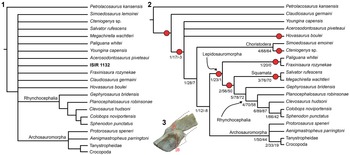
Phylogenetic relationships of ISIR 1132 and measurements taken to calculate the relative height of the iliac blade above the acetabulum. (1) Strict consensus tree of 1,404 most parsimonious trees; (2) strict reduced consensus tree of the same most parsimonious trees after the a posteriori pruning of ISIR 1132; the alternative positions of ISIR 1132 among the most parsimonious trees are indicated with circles. (3) Ilium of ISIR 1132 in lateral view showing the height of the iliac blade at the level of the dorsalmost extension of the supraacetabular crest (A) versus the maximum height of the iliac acetabulum (B).


These comparisons indicate that the morphology of ISIR 1132 is more similar to that of continental non-archosauromorph neodiapsids. The quantitative phylogenetic analysis found 1,404 most parsimonious trees (MPTs) of 3,996 steps, with a consistency index of 0.23498 and a retention index of 0.62537. The interrelationships among the archosauromorph species in the strict consensus tree are identical to those of the most recent analyses of this data set (Fig. 4; Maidment et al., Reference Maidment, Sennikov, Ezcurra, Dunne, Gower, Hedrick, Meade, Raven, Paschchenko and Butler2020; Scheyer et al., Reference Scheyer, Spiekman, Sues, Ezcurra, Butler and Jones2020, fig. S3; Ezcurra et al., Reference Ezcurra, Fiorelli, Trotteyn, Martinelli and Desojo2021a, Reference Ezcurra, Bandyopadhyay and Gowerb), with the exception of a trichotomy composed of Aenigmastropheus parringtoni, Protorosaurus speneri, and more deeply nested archosauromorphs. On the other hand, the phylogenetic relationships among non-archosauromorph neodiapsids are strongly unresolved, contrasting with the analyses of previous versions of this dataset; only Rhynchocephalia is recovered outside of Archosauromorpha (Fig. 4.1). The iterPCR protocol found that ISIR 1132 is responsible for this lack of resolution and the a posteriori pruning of this species results in almost fully resolved interrelationships among non-archosauromorph neodiapsids (Fig. 4.2). The ‘younginiforms’ Youngina capensis, Acerosodontosaurus piveteaui, and Hovasaurus boulei are found in a polytomy together with a clade composed of Choristodera + Sauria. Claudiosaurus germaini is the sister taxon to all other species with the exception of the outgroup. ISIR 1132 is alternatively found as the sister taxon to all other species with the exception of the outgroup or the outgroup + Claudiosaurus germaini, among “younginiforms”, the sister taxon to Hovasaurus boulei or the choristoderan Cteniogenys sp., or in multiple positions among non-rhynchocephalian lepidosauromorphs among the MPTs. As a result, the phylogenetic position of ISIR 1132 can be constrained to a non-archosauromorph neodiapsid based on the results of this analysis.
The position of ISIR 1132 within Neodiapsida is supported by the presence of a roughly circular iliac acetabulum, without posterodorsal invasion by finished bone (character 469: 0→1). By contrast, Petrolacosaurus kansensis possesses an irregular acetabulum as a result of invasion of finished bone on its posterodorsal corner (Reisz, Reference Reisz1981; Pritchard et al., Reference Pritchard, Turner, Nesbitt, Irmis and Smith2015). Most of the positions of ISIR 1132 among non-archosauromorph neodiapsids are not supported by synapomorphies, but the presence of a strong posterodorsal slope of the dorsal margin of iliac blade, with an angle ≥30° in lateral or medial view (character 464: 1→2), supports its placement at the base of Lepidosauromorpha or as the sister taxon to Cteniogenys sp. or Hovasaurus boulei. Only one additional step is necessary to force the position of ISIR 1132 at the base of Archosauromorpha in an alternative suboptimal topology. Four additional steps are required to place ISIR 1132 as a member of Proterosuchidae (the only other diapsid clade documented until now in the Panchet Formation), thus highlighting the strong morphological differences between them.
The Early Triassic Gondwanan record of continental non-archosauromorph neodiapsids
Several Gondwanan continental Lower Triassic units have yielded fossil diapsid specimens, but the vast majority of them belong to Archosauromorpha (e.g., Prolacerta broomi Parrington, Reference Parrington1935, and Proterosuchus spp. in the Lystrosaurus Assemblage Zone of the Karoo Basin of South Africa; Broom, Reference Broom1903a; Parrington, Reference Parrington1935; Prolacerta broomi and Antarctanax shackletoni Peecook et al., Reference Peecook, Smith and Sidor2019, in the Fremouw Formation of Antarctica; Colbert, Reference Colbert1987; Peecook et al., Reference Peecook, Smith and Sidor2019; Teyujagua paradoxa Pinheiro et al., Reference Pinheiro, França, Lacerda, Butler and Schultz2016, and Elessaurus gondwanoccidens De-Oliveira et al., Reference De-Oliveira, Pinheiro, Da-Rosa, Dias-Da-Silva and Kerber2020, in the Sanga do Cabral Formation of Brazil; Pinheiro et al., Reference Pinheiro, França, Lacerda, Butler and Schultz2016; De-Oliveira et al., Reference De-Oliveira, Pinheiro, Da-Rosa, Dias-Da-Silva and Kerber2020; Kadimakara australiensis Bartholomai, Reference Bartholomai1979, and Kalisuchus rewanensis Thulborn, Reference Thulborn1979, in the Arcadia Formation of Australia; Bartholomai, Reference Bartholomai1979; Thulborn, Reference Thulborn1979; Proterosuchus sp. in the Panchet Formation of India; Satsangi, Reference Satsangi1964; Charig and Sues, Reference Charig, Sues and Kuhn1976). By contrast, the fossil record of Early Triassic non-archosauromorph diapsids (excluding parareptiles in the case that they are diapsids; see Ford and Benson, Reference Ford and Benson2020) in the southern continents is composed of a handful of African and possibly Australian species. Lower Triassic continental units of Africa have yielded the non-saurian neodiapsids (probably grouped into a monophyletic Tangasauridae sensu Currie, Reference Currie1982) Kenyasaurus mariakaniensis Harris and Carroll, Reference Harris and Carroll1977, from the Maji ya Chumvi Beds of Kenya (Harris and Carroll, Reference Harris and Carroll1977) and Hovasaurus boulei from the “Couches à Poissons et Ammonites” of the Diego Basin of Madagascar (Ketchum and Barrett, Reference Ketchum and Barrett2004); the latter species is also known from upper Permian beds of the same country (Piveteau, Reference Piveteau1926). The very rich fossil record of the lowermost Triassic Karoo beds of South Africa have yielded only one probable lepidosauromorph specimen, the holotype of Paliguana whitei Broom, Reference Broom1903b (Carroll, Reference Carroll1975; Ezcurra et al., Reference Ezcurra, Scheyer and Butler2014). The Lower Triassic Arcadia Formation of north-western Australia yielded two partial skulls of the enigmatic reptile Kudnu mackinlayi Bartholomai, Reference Bartholomai1979. This species was originally described as a lepidosauromorph closely related to Paliguana whitei (Bartholomai, Reference Bartholomai1979), but more recently it has been suggested that it may represent a procolophonid parareptile (Evans and Jones, Reference Evans, Jones and Bandyopadhyay2010). However, the presence of an anterior maxillary foramen, multiple nutrient foramina on the maxilla, straight to slightly recurved marginal tooth crowns without expansion at base, and probable absence of lacrimal suggest neodiapsid or saurian affinities (see Ezcurra, Reference Ezcurra2016) rather than a procolophonid identity for Kudnu mackinlayi.
An additional, enigmatic Early Triassic diapsid from the Karoo Basin is Aenigmasaurus grallator Parrington, Reference Parrington1953. This species is only known from a partial postcranium that has been largely ignored in the literature since its description. The combination of character states present in Aenigmasaurus grallator led Parrington (Reference Parrington1953, p. 734) to consider it as a “problematic reptile” and “a very late survivor of extremely primitive captorhinomorph-synapsid stock.” Subsequently, Kuhn (Reference Kuhn1966) considered Aenigmasaurus grallator as an eosuchian—therefore a diapsid. The dorsal vertebrae of Aenigmasaurus grallator seem to have at least paradiapophyseal and postzygodiapophyseal laminae and the ilium a straight supraacetabular crest and a depressed lateroventral surface of the postacetabular process. All these character states either are apomorphies of Archosauromorpha or more deeply nested clades within it (Ezcurra, Reference Ezcurra2016). On the other hand, the purported presence of an ectepicondylar foramen contrasts with the condition in archosauromorphs—but Parrington (Reference Parrington1953) reported that the bridge of bone closing this foramen was destroyed during preparation—and the alleged presence of a precoracoid differs from the condition in neodiapsids (Parrington, Reference Parrington1953). Thus, Aenigmasaurus grallator may be an archosauromorph, but its affinities are far from clear, pending a revision of the anatomy of the species.
In conclusion, ISIR 1132 not only is an important addition to the vertebrate assemblage of the Panchet Formation, but also to the Early Triassic fossil record of Gondwana. The scarcity of non-archosauromorph neodiapsids in the southern continents contrasts with the situation before the end-Permian mass extinction, when, conversely, archosauromorphs were very rare components of their ecosystems and non-archosauromorph neodiapsids were comparatively better represented (Ezcurra et al., Reference Ezcurra, Scheyer and Butler2014). The still unresolved phylogenetic relationships of ISIR 1132 among non-archosauromorph neodiapsids do not allow determining if this species is part of a post-extinction surviving clade, as is the case of tangasaurids, or a member of a lineage that started to diversify in the aftermath of the biotic crisis, as is the case of lepidosauromorphs. Either way, ISIR 1132 shows that the earliest Triassic diapsid vertebrate assemblage of the Panchet Formation was not restricted only to archosauromorphs, as is the case in the Lystrosaurus Assemblage Zone of the Karoo Basin of South Africa.
Acknowledgments
The phylogenetic analysis was performed with TNT v.1.5, a program made freely available through the Willi Hennig Society. This research was supported by funding of a National Geographic Society Young Explorers grant (#9467-14 to MDE), a Marie Curie Career Integration Grant (630123 to R.J. Butler), and Agencia Nacional de Promoción Científica y Tecnológica in the context of the Complete Archosauromorph Tree Project (CoArTreeP) (PICT 2018- 01186 to MDE). The authors are thankful for the infrastructure facilities provided by the Indian Statistical Institute and J.C. Cisneros for discussion about the affinities of Kudnu mackinlayi. We thank the reviewers S. Spiekman and N. Fraser and the editor H.-D. Sues for their comments and suggestions, which improved the final version of the manuscript.
Data availability statement
Data available from the Dryad Digital Repository: https://doi.org/10.5061/dryad.m905qfv1s.
SUPPLEMENTAL DATA
Operational taxonomic units deactivated a priori in the phylogenetic analysis
Dinocephalosaurus orientalis, Macrocnemus obristi, Fuyuansaurus acutirostris, Pectodens zhenyuensis, Protanystropheus antiquus, Trachelosaurus fischeri, Tanystropheus haasi, Eorasaurus olsoni, Prolacertoides jimusarensis, Archosaurus rossicus holotype, Archosaurus complete, Panchet proterosuchid, Vonhuenia fredericki, Chasmatosuchus rossicus combined, Chasmatosuchus magnus combined, Chasmatosuchus vjushkovi, Koilamasuchus gonzalezdiazi, Kalisuchus rewanensis holotype, NMQR 3570, Shansisuchus kuyeheensis, Uralosaurus combined, Osmolskina czatkoviensis, Osmolskina complete, Otter Sandstone archosaur, Prestosuchus nyassicus, Dagasuchus santacruzensis, Hypselorhachis mirabilis, Waldhaus poposauroid, Vytshegdosuchus zbeshartensis, Bystrowisuchus flerovi, Bromsgroveia walkeri, Moenkopi poposauroid, Mandasuchus tanyauchen, Lutungutali sitwensis, and Nyasasaurus parringtoni.
Character modified from the phylogenetic dataset of Ezcurra et al. (Reference Ezcurra, Bandyopadhyay and Gower2021b)
464
Ilium, slope of dorsal margin of iliac blade in lateral or medial view, excluding the preacetabular process if present: (0) sub-horizontal, angle below 10° with respect to the horizontal plane; (1) posterodorsal, angle higher than 10° but lower than 30°; (2) strongly posterodorsal, angle equal to or higher than 30°, usually being sub-parallel to the posterior half of the supraacetabular crest. ORDERED. The first and second states were inverted, and the third state was added here.
Scorings modified in character 464 from the phylogenetic dataset of Ezcurra et al. (Reference Ezcurra, Bandyopadhyay and Gower2021b)
All taxa scored as (0) were changed to (1) and all taxa scored as (1) were changed to (0) because these two states were inverted in the new formulation of the character. In addition, Petrolacosaurus kansensis was changed from (0) to (2), Clevosaurus hudsoni Swinton, 1939, Cteniogenys sp., Gephyrosaurus bridensis, Planocephalosaurus robinsonae, Salvator rufescens (Günther, 1871), and Sphenodon punctatus were changed from (1) to (2); Dinocephalosaurus orientalis was changed from (?) to (1); Teraterpeton hrynewichorum Sues, 2003, was changed from (?) to (0); and Protorosaurus speneri was changed from (1) to (1/2).