

I. Introduction
Privately (investor) owned firms and cooperatives coexist in many sectors within modern economies where they compete for market share (Hansmann, Reference Hansmann1996; Hendrikse, Reference Hendrikse1998; Sexton and Lavoie, Reference Sexton, Lavoie, Gardner and Rausser2001; Frick, Reference Frick2017). Pennerstorfer and Weiss (Reference Pennerstorfer and Weiss2013) provide data from the European Commission that illustrate how cooperatives account for considerable market shares in most European member states, particularly in the agri-food chain. George Hendrikse formally analyzes through several documents the coexistence of both governance structures, that is, types of firms, within a given market sector. He has done so mainly through principal-agent models (Hendrikse, Reference Hendrikse2007), while emphasizing the relative efficiency of cooperatives as equilibrium organizational forms when dealing with different decision-making processes (Hendrikse, Reference Hendrikse1998). Similar conclusions are reached when considering cooperatives from an incomplete contracting perspective (Hendrikse and Veerman, Reference Hendrikse and Veerman2001).
When comparing cooperatives with privately owned firms, Pennerstorfer and Weiss (Reference Pennerstorfer and Weiss2013) suggest that members of the cooperative have incentives to free-ride on quality. Similarly, Bontems and Fulton (Reference Bontems and Fulton2009) present a theoretical model in which the advantage of the efficiency of a cooperative “is directly linked to the goal alignment between the cooperative and its members. This efficiency advantage is influenced by the extent of income redistribution between members and the degree of rent seeking that takes place in the organization” (p. 322). These authors focus on the information costs and redistribution policies that a cooperative faces.
Our model builds on a similar intuition in terms of aligning the objectives among members of a cooperative, but follows Hart and Holmstrom's (Reference Hart and Holmstrom2010) approach based on contracts as a frame of reference. Thus, we provide a link between the traditional research on the coexistence of different governance structures, which is generally based on problems related to the agency, and the characteristics related to the emergence of new generation cooperatives. Note that the ownership structure of firms is a major determinant of agency costs since it defines any misalignment that arises between the interests of owners and managers, with vertical integration potentially exacerbating any agency problems inherent to the structure. In this regard, Cadot (Reference Cadot2015) empirically illustrates the lower operating expenses of vertical integration faced by French wine cooperatives in relation to other firms, although vertical integration is shown to be less rewarding for the cooperatives.
The principal-agent models address the problems of the agency by designing contracts to mitigate frictions arising from conflicting interests and asymmetric information. However, as emphasized by Hart and Holmstrom (Reference Hart and Holmstrom2010), the property rights approach assumes that any conflict arising after the contract is agreed upon is resolved through bargaining with side payments. They argue that, “many decisions made in a firm will be carried out without consultation or negotiation with other firms even when these decisions impact the other firms in a major way. It is rare, for instance, for a firm to go to a competitor with the intention of extracting side payments for avoiding aggressive moves (p. 484).” That is, if they feel aggrieved by the outcome of the contract, the parties may shade by underperforming, which creates deadweight losses. In this article, we follow Hart and Moore (Reference Hart and Moore2008) who define the term shading as withholding “some part of consummate performance” if a contractual party feels “shortchanged” as opposed to “getting what he is entitled to.” Thus, shading takes place whenever a party feels aggrieved after signing the contract and it remains outside the scope of the original contract initially agreed upon by the parties. The aggrievement model of Hart and Holmstrom (Reference Hart and Holmstrom2010) addresses conflicting interests by adopting an organizational form to mitigate the effect of shading. In this regard, the findings on the social comparison obtained by the psychology literature have been incorporated into the economic and strategic management ones to analyze incentive differentials and shading problems.
The literature on social comparison is based on the fact that individuals acquire information about other people who are like them, while being affected by the resulting comparisons (Festinger, Reference Festinger1954). Applied to the current setting, it implies that “when deciding how much effort to exude, workers respond not only to their own compensation but also to pay relative to their peers as they socially compare” (Larkin, Pierce, and Gino, Reference Larkin, Pierce and Gino2012, pp. 1200–1201). Economists and (strategic) managers have argued that these comparisons may lead to envy and provide incentives to sabotage other workers within the same organization (Nickerson and Zenger, Reference Nickerson and Zenger2008; Bartling and von Siemens, Reference Bartling and von Siemens2010). Empirical analyses illustrate the importance of social comparisons (Blinder and Choi, Reference Blinder and Choi1990), their effect on the reduction of effort among workers (Cohn et al., Reference Cohn, Fehr, Herrmann and Schneider2012) and emerging unethical behavior (Gino and Pierce, Reference Gino and Pierce2010). On the other hand, Faulkender and Yang (Reference Faulkender and Yang2010) show that the phenomenon leads to escalated salaries of executives and among employees within a given firm.
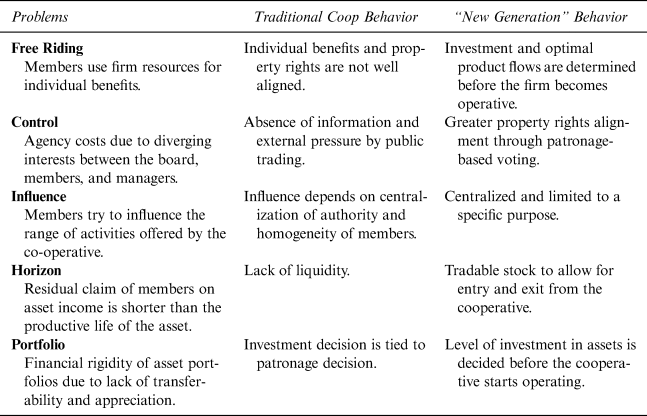
Katz and Boland (Reference Katz and Boland2002) define the new generation cooperatives as organizational hybrids that combine aspects of investment and traditional cooperative ownership structures and present a summary of the five main property rights problems exhibited by traditional cooperatives and the solutions presented by the new generation cooperatives. With Table 1, we describe these problems and interpret the main trends implicit in the shift towards new generation cooperatives. When dealing with property rights problems, the new generation cooperatives are changing their behavior, which provides important intuition about the results we obtain, although we do not formalize this shift. The differences in the objectives and, therefore, potential payoffs described in Table 1 indicate that low coordination incentives do not necessarily prevent the existence of a cooperative structure, but it may be severely damage by its performance. Consider, for example, the free riding problem and note how the new generation cooperatives align the individual benefits of their members before they begin to function, which is also the case when choosing their portfolio. The increase of coordination incentives between members deal with both the control and influence problems and allows members to enter or leave the cooperative based on the alignment of their liquidity interests with those of the cooperative solves the horizon problem.
Property Rights Problems: Traditional vs. New Generation Cooperatives

Source: Based on Figure 1 in Katz and Boland (Reference Katz and Boland2002).
Thus, the success of (new generation) cooperatives in dealing with standard property right problems is based on the alignment of objectives and payoffs among their members or an increase in coordination incentives. Our model uses this alignment to determine the incentives of the members to shade on a given agreement and disrupt potential coordination incentives.
From the point of view of the literature, following Cook (Reference Cook1995) and Hendrikse (Reference Hendrikse1998), it can be argued that new generation cooperatives emerge to account for the property rights problems described in Table 1, with a similar conclusion being reached by Borgen (Reference Borgen2004) from a socio-economic perspective. As already emphasized, the change between both types of cooperative may be interpreted as an increase in coordination incentives among the members of the cooperative. In this respect and as stated by Holmstrom and Roberts (Reference Holmstrom and Roberts1998, p. 92): “… high degrees of frequency and mutual dependency seem to support, rather than hinder, ongoing co-operation across firm boundaries.” While building on these existing interdependencies to design our model, we move beyond the property rights-based interpretation by Katz and Boland (Reference Katz and Boland2002).
Our analytical model is based on Hart and Holmstrom (Reference Hart and Holmstrom2010) and analyzes the strategic choice of organizational form among producers in a market. It illustrates how cooperatives as integrated organizations and private firms, as non-integrated organizations, coexist to obtain different social surpluses. In the context of wine production, we can consider a winery as composed of wine growers and winemakers. Growers could delegate the winemaking process to an external winemaker or contribute to the winemaking process themselves. When wine growers delegate to an external winemaker [integration], their individual contributions to the process may not be explicitly acknowledged and the winemaker cannot exert quality control over the production chain. However, if growers interact in the process of winemaking [non-integration], they can highlight the quality of their individual contributions and have more quality control in wine production. This quality coordination problem has been studied by Pennerstorfer and Weiss (Reference Pennerstorfer and Weiss2013), who show their dependence on the process of quality aggregation and the number of member in a cooperative.
Valette, Amadieu, and Sentis (Reference Valette, Amadieu and Sentis2018) empirically illustrate how despite the standard theoretical claims about the greater inefficiency of cooperatives in relation to private firms, French wine cooperatives survive longer than corporations. They conclude that this is due to the ability of cooperatives to smooth shocks evenly across their members, providing them with additional resilience relative to privately owned wineries. Declerck and Viviani (Reference Declerck and Viviani2012) reach a similar conclusion regarding the ability of cooperatives to absorb fluctuations at the expense of their members, particularly during bad times. Fares and Orozco (Reference Fares and Orozco2014) describe the compensation mechanism of the tournament implemented by the French wine cooperatives to improve the performance of its members.
Herbst and Prüfer (Reference Herbst and Prüfer2016) develop an alternative model of organizational choice and quality provision based on friction for decision making. They emphasize the optimality of private firms when the cost of decision making is high, while cooperatives (and nonprofits) dominate as these costs decrease. Frick (Reference Frick2017) suggests an organizational design approach that focuses on managing entry and exit, motivating members, and investing in corporate culture to improve the performance of cooperatives. Several case studies, especially in developing countries, conducted by Ewert, Hanf, and Schweickert (Reference Ewert, Hanf and Schweickert2015) illustrate the fundamental role played by other factors, such as financial constraints.
We focus on the similarity of the payoffs received by the parties that make up the units within an organization as the main determinant of the boundary choices of firms. Payoff similarities will also be used to show how cooperatives may be uniquely efficient within the current strategic setting due to a lower shading intensity applied by their members. The basic intuition is clear from the literature on the firm boundaries determined by incomplete contracts in organizational forms, when agreed upon competitively, conditions the sense of entitlement of the parties (Hart and Moore, Reference Hart and Moore2008).Footnote 1 If ever at all, shading takes place after the organizational form has been chosen.
Our basic model relates to Hart and Holmstrom (Reference Hart and Holmstrom2010), who build on the contracts as reference points approach of Hart and Moore (Reference Hart and Moore2008) when defining firm boundaries “to deal with strategic decisions that are taken in the absence of ex post bargaining” (p. 484). Therfore, we restate their initial assumptions and maintain their notation. They assume that the organizational forms making up the market, that is, private firms and cooperatives, are granted ad hoc and do not consider the choice between them resulting from payoff differentials on the coordination game played by the units interacting within the market. We incorporate this feature in the current article, leading to a two-stage game that expands the formal setting introduced by Hart and Holmstrom (Reference Hart and Holmstrom2010).
The article proceeds as follows. Section II presents the basic model and the results that follow from Hart and Holmstrom (Reference Hart and Holmstrom2010), which constitute the basis on which we build our model. The main results obtained are developed both intuitively and formally through Sections III and IV. The final section summarizes the main findings and concludes by suggesting potential extensions.
II. Model
In this section, we summarize Hart and Holmstrom (Reference Hart and Holmstrom2010) and set the stage for our formal model environment, where units can choose the type of organizational structure they want to form before playing the coordination game. The form of organization will be chosen to maximize the net social surplus of the shading costs, which may be incurred after a certain form of organization has been agreed upon. In this regard, as already stated, the units may either operate independently or delegate in an independent boss who maximizes their private joint profit.
The basic strategic environment is composed of two units, A and B, which have a lateral relationship, that is, they interact within the same output or input market, such that each unit is operated by a manager who triggers external effects on the other unit. Units are presented with a binary decision, they must choose “Yes” or “No.” Coordination occurs if and only if both units choose “Yes.” Otherwise, units face non-coordination. In this sense, coordination may be interpreted as the decision of the units to remain as active producers within a joint project while any of them leaving the project results in non-coordination. Two main organizational forms are considered: non-integration, where units are separate firms whose managers are also the bosses, and integration, where the units are part of a single firm with an outside manager acting as boss and the managers of each unit as subordinates. We will identify non-integrated organizational forms with private independent firms, while the integrated scenario will be assumed to correspond to a cooperative structure.
Two types of benefits are assumed to be generated by each unit: monetary transferable profits, v i, i = A, B, and private nontransferable benefits, w i, i = A, B, in the form of job satisfaction for the manager working in the corresponding unit. The boss of a unit can divert all profits from the unit to herself, leading to a non-integrated payoff of v i + wi if she is also the manager of unit i = A, B. The private benefits always reside with the managers. Therefore, if both units are integrated, the professional outsider acting as boss receives v A + v B. Keep in mind, in the non-integration, both bosses receive the private benefits generated by each unit, which are ignored under integration in favor of total profits. The social surplus is given in both cases by v A + v B + w A + w B.
Regardless of the organizational form, coordination constitutes an agreement by both units to proceed with a given project and implies a change in the benefits received by the managers of the units and the corresponding bosses. In this regard, following Hart and Holmstrom (Reference Hart and Holmstrom2010) and without loss of generality, profits and private benefits will be normalized to zero in both units under non-coordination. Table 2 presents the coordination game between bosses and unit managers. Accordingly, the entries of the table define the change in the transferable monetary profits and nontransferable private benefits that result from the coordination decision made by the bosses and managers of each unit.
Coordination-Based Payoffs Received by Bosses and Unit Managers

The following notation has been introduced to simplify the presentation
 $$\Delta z_A = \Delta v_A + \Delta w_A,\quad \quad \Delta z_B = \Delta v_B + \Delta w_B,$$
where Δz i, i = A, B, represents the change in total surplus in unit i derived from coordination, and S ≡ Δz A + Δz B accounts for the change in aggregate social surplus absent shading costs.
Following Hart and Holmstrom (Reference Hart and Holmstrom2010), coordination is assumed to lead to a reduction in private benefits due to the independence lost by the managers and its effect on job satisfaction, that is,
 $$\Delta w_A \le 0, \Delta w_B \le 0.$$
Shading will be used to force bosses to internalize the externalities generated on other parties. This may occur in integration and non-integration since the relationship between both units is assumed to persist in both settings after the strategic coordination decision is made. It will also be assumed that the party receiving k i less than his maximum payoff will be aggrieved by k i and shade to the point where the payoff received by the other party falls by θk i. Hart and Holmstrom assume that θ ϵ (0,1) is an identical exogenous value for all parties. We will parameterize this variable as a function of the spread existing between coordination profits and private benefits within a given unit.
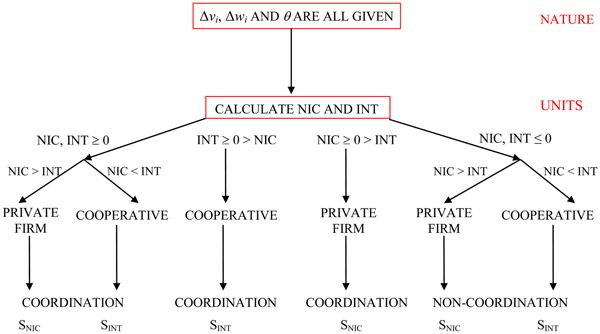
The decision stages that lead to the coordination game played by the organizational structures are summarized in Figure 1 and defined as follows.
1. Nature. The bosses and managers of both organizational structures observe the values of the benefit variables, v i and w i, the surplus changes derived from coordination, Δv i and Δw i, together with Δz i, with i = A, B, as well as the value of the shading parameter θ.
2. Coordination choice. Given the previous values, bosses and managers decide whether to coordinate or not after accounting for the resulting shading costs.
Hart and Holmstrom (Reference Hart and Holmstrom2010) Coordination and ad hoc Organizational Form Choice

The determined environment exogenously introduced by Hart and Holmstrom (Reference Hart and Holmstrom2010) assumes that the resulting coordination and organizational form choices are determined de facto by nature. That is, the intensity of shading, a parameter that determines the equilibrium conditions illustrated in Figure 1, is not the result of the interactions that take place within the units that make up an organization, but is exogenously given ex ante. As described in the Introduction, the literature on social comparison provides the required incentives at the psychological, managerial, and empirical levels to justify the fact that the value of the shading parameter must be endogenously defined resulting from the payoff differences between the agents composing the different units within the potential resulting organizational structures.
After some basic algebra, the model defined by Hart and Holmstrom (Reference Hart and Holmstrom2010) gives rise to the following coordination conditions.
• The non-integration coordination condition (NIC) defined for any Δz i value, i = A, B, is given by
(1)where i ≠ j. If Δz i ≥ 0, i = A, B, then condition (1) is trivially satisfied. However, if Δz i < 0, and Δz j > 0, then this condition states that coordination will take place under non-integration only if the costs of shading imposed by manager j on manager i are larger than the losses derived by the latter from coordination. $$\Delta z_i + \theta \Delta z_j \ge 0,$$
Social surplus in the (NIC) setting [with Δz i < 0, and Δz j > 0] is therefore given by
$$\eqalign{S_{{\rm NIC}} = {\rm }\Delta z_A + \Delta z_B & + \theta \Delta z_i \; {\rm under \; coordination} \cr & - \theta \Delta z_j \; {\rm under \; non} - {\rm coordination}.} $$Note that, if coordination occurs, then unit i will shade by θΔz i, as it receives a payoff of Δz i < 0 from coordinating.
• The integration coordination condition (INT) defined for any Δv i value, i = A, B, is given by
(2)$$\Delta v_i + \Delta v_j + \theta \left( {\Delta w_i +\Delta w_j} \right) \ge 0.$$Trivially, if Δv i ≤ 0, i = A, B, then condition (2) is violated. Thus, for this condition to hold we need at least one of the Δv i changes in private profits to be positive.
Social surplus in the (INT) setting [with Δz i < 0, Δz j > 0, and Δv i + Δv j > 0] is given by
$$ \eqalign{ S_{{\rm INT}} =\,& \Delta z_A + \Delta z_B + \theta \left( {\Delta w_A + \Delta w_B} \right) \; {\rm under \; coordination} \cr & - \theta \left( {\Delta v_A + \Delta v_B} \right) \; {\rm under \; non}-{\rm coordination}.} $$


If coordination takes place, then managers will shade by θ(Δw A + Δw B), as both Δw A and Δw B are negative. If, on the other hand, condition (2) does not hold and units do not coordinate, then the boss will shade by θ(Δv A + Δv B).
To provide additional intuition for the analysis performed through the rest of the article, we rewrite the respective (NIC) and (INT) coordination conditions as follows.
 $$\Delta v_A + \Delta w_A + \theta \left( {\Delta v_B + \Delta w_B} \right) \ge 0$$
 $$\Delta v_A + {\rm }\theta \Delta w_A + \Delta v_B + \theta \Delta w_B \ge 0$$
It should be noted that the lower degree of quality control exerted over the production chain within the cooperative [integrated] environment implies that the contributions of the individual growers to the winemaking process cannot be explicitly acknowledged. As a result, when shading, they can only do so through their respective Δw A and Δw B values, as illustrated in equation (2′). On the other hand, private [non-integrated] wineries can recognize the contributions of the individual growers, which allows the latter ones to shade through their entire Δz B values, as described in equation (1′).
III. Choice of Organizational Form When Shading Is a Function of Misaligned Interests
We now extend the model of Hart and Holmstrom (Reference Hart and Holmstrom2010) to allow both units to choose the form of organization under which they will decide whether to coordinate or not. We start by illustrating how, given our definition of shading intensity, managers will be more willing to delegate if their Δw values are close to the respective Δv of the boss.
Consider the coordination payoffs received by the managers and the boss within each unit. We parameterize the intensity of the shading parameter θ as a function of the difference in coordination incentives existing between the boss and the unit managers. The definition of the [finite] θ i (v, w) variable, i = A, B, is therefore given by
 $$\theta _i\left( {\Delta v_i,\Delta w_i} \right) = \left \vert {\Delta v_i + } \right \vert \Delta w_i \Vert.$$
Note that we have to account for the possibility that Δv i < 0, while knowing that Δw i < 0 under coordination. We must, therefore, consider the absolute value of Δw i within the absolute value expression that deals with the distance separating both payoffs. As a result, a substantial difference between both payoffs leads to an increase in the value of the shading parameter. That is, the strength or effort devoted by a party to shade depends on the existing differences in objectives (and payoffs) with respect to the other one. This assumption directly follows from the guilt-envy (Fehr–Schmidt) inequality aversion literature based on comparisons of absolute differences in payoffs between the parties. Camerer (Reference Camerer2003) offers a review of the literature on this topic. The importance of the shading parameter to determine the coordination incentives of bosses and managers within both units can be easily illustrated numerically.
Proposition 1
If θ = 0, then INT > NIC for any Δz i < 0, and Δz j > 0.
Proof. If θ = 0, the functions (1′) and (2′) become, respectively, Δv A + Δw A ≥ 0 and Δv A + Δv B ≥ 0. The result follows from the fact that Δv B > 0 while Δw A < 0.
The dominance of the INT over the non-integration one prevails for all θ < 1, Δv i, and Δw i, i = A, B, with INT = NIC trivially when θ = 1. The behavior of the integration and NICs follows from the relative strength that shading by a given party has under non-integration. In this case, both parties are able to recognize their respective contributions, which allows them shade through their entire Δz i values. It, therefore, follows that:
Proposition 2
Coordination is more likely to take place under integration (non-integration) when the θ variable is relatively low (high).
Proof. Changes in the value of the shading parameter have the following effect on the NIC and INT conditions described in equations (1′) and (2′), respectively.
 $$(\partial \; ({1}^{\prime})\; / \; \partial \theta ) = \Delta v_B + \Delta w_B$$
 $$(\partial \; ({2}^{\prime}) \; / \; \partial \theta ) = \Delta w_A + \Delta w_B$$
We have assumed that Δz B > 0, which implies that Δv B > 0 > Δw A. As a result
 $$(\partial \; ({2}^{\prime}) \; / \; \partial \theta ) \lt \; (\partial ({1}^{\prime})/\partial \theta ).$$
That is, decrements in the value of θ will increase the integration coordination incentives over the non-integration ones. Given the fact that INT = NIC when θ = 1, we will get
 $${\rm INT } \gt {\rm NIC \; when}\,\theta \lt 1$$
 $${\rm INT } \lt {\rm NIC when}\,\theta \gt 1.$$
Therefore, similar (dissimilar) interests on both sides in the form of coordination payoffs would lead to a lower (higher) shading intensity, which encourages coordination within an integrated (non-integrated) organizational environment.Footnote 2 It immediately follows that:
Lemma 1
If the intensity of shading depends positively on the existing payoff imbalances between bosses and managers, then:
• Integration (non-integration) with coordination is more plausible when the profits of bosses and benefits of managers are similar (dissimilar).
Corollary 1
Given Δz i < 0, Δz j > 0, and Δv i < 0, social surplus tends to be higher under integration whenever coordination takes place, due partly to the lower θ values generated by the respective units.
The direct dependence of social surplus of the value of θ when comparing the NIC and INT settings implies that a lower shading parameter tends to increase the social surplus generated in the INT in relation to the NIC setting. This result follows intuitively from Corollary 1, although a detailed formal analysis is presented later. At the same time, we will be illustrating how:
Proposition 3
Both organizational forms, an integrated cooperative and a non-integrated private firm, may coexist in a coordinated equilibrium and the former may even obtain a higher social surplus than the latter.
IV. Choice of Organizational Form in a Duopoly
We turn now to a more formal analysis where the current model will be used to explain how these forms of organization may coexist optimally within the coordinated unequal equilibria. Cooperatives are more willing to coordinate when the θ (Δv, Δw) values are small and similar for all units involved. At the same time, if heterogeneity is allowed for in the values of θ (Δv, Δw), then any unit with a sufficiently divergent payoff structure [leading to a high θ (Δv, Δw) value] has an incentive to avoid the integrated setting and imposes a non-integrated though coordinated organizational form. Therefore, the highly unequal θ (Δv, Δw) values between units favor the emergence of non-integrated but coordinated structures.Footnote 3 To illustrate these points, we must allow for heterogeneous θ (Δv, Δw) values between both units to be defined.
Consider two different θ i (Δv i, Δw i) values, θ A and θ B, one for each unit, although the analysis can easily account for a larger number of units. We concentrate on the nontrivial Δz i < 0, and Δz j > 0 case, and assume that I = A and j = B. Therefore, for a non-integrated equilibrium with coordination to be more plausible than an integrated equilibrium with coordination, we need equations (1′) > (2′), which, after some basic algebra, implies that
 $$\left( {1 - \theta _A} \right) \; \Delta {w}_A \gt \left( {1 - \theta _B} \right)\Delta {v}_B.$$
Note that Δw A < 0 and Δv B > 0. As a result, it is sufficient (though not necessary) for this inequality to hold that either θ A or θ B are higher than one with the other being at least as high. This implies that large payoff differentials between parties within a unit may shift coordination to a non-integrated environment. However, it is also possible that this inequality is maintained when θ B > 1 and θ A < 1. In this case, the unit shifting faces larger payoff inequalities between its parties. In addition, Δv B should be large enough to achieve coordination under non-integration, an equilibrium which would not necessarily be plausible under integration.
Clearly, for the sake of completeness, an integrated equilibrium with coordination would be more plausible than a non-integrated equilibrium with coordination if equations (2′) > (1′), which implies that
 $$\left( {1 - \theta _B} \right) \; \Delta v_B \gt \left( {1 - \theta _A} \right) \Delta w_A.$$
In this case, it is sufficient (though not necessary) for this inequality to hold that either θ B < 1 and θ A ≤ 1 or θ B ≤ 1 and θ A < 1.
The social surplus could be greater in any of these organizational structures. Note, however, that highly aligned and similar payoffs work in favor of an integrated organization [cooperative] due to the lower value of θ generated by its units. We will show how, in the Δz i < 0, and Δz j > 0 case, there exist reasonable payoff and shading values that allow for an integrated form of organization to lead to a higher social surplus under coordination than the non-integrated one. For this to be the case, we require that SINT > SNIC under coordination, that is,
 $$\Delta z_A + \Delta z_B + \theta _A \; \Delta w_A + \theta _B \; \Delta w_B \gt \Delta z_A + \Delta z_B + \theta _A \; \Delta z_A,$$
which simplifies to
 $$\theta _B \Delta w_B \gt \theta _A \Delta v_A.$$
We know from equation (4) that θ B > θ A.Footnote 4 Thus, for equation (5) to hold we need 0 > Δw B >> Δv A.
The main implications derived from equations (4) and (5) for the coexistence of both forms of organizational within the socially unequal coordinated equilibria are summarized as follows.
Proposition 4
For coordination under non-integration to be more plausible but lead to a lower social surplus than coordination under integration it suffices to have
 $$\Delta v_B \gg 0 \approx \Delta w_B \gg \Delta v_A \approx \Delta w_A.$$
These requirements state that the unit that avoids integration must exhibit considerably unequal payoffs between the boss and the manager. In this case, the unit avoids integration, but continues to coordinate under non-integration. At the same time, the other unit must exhibit similar negative payoffs that prevent its shading from affecting integration coordination.Footnote 5
Proposition 5
For coordination under integration to be more plausible and lead to a higher social surplus than coordination under non-integration it suffices to have
 $$\Delta v_B \gt 0 \approx \Delta w_B \gt \Delta v_A \approx \Delta w_A.$$
Note that equation (7) is implied by equation (6).
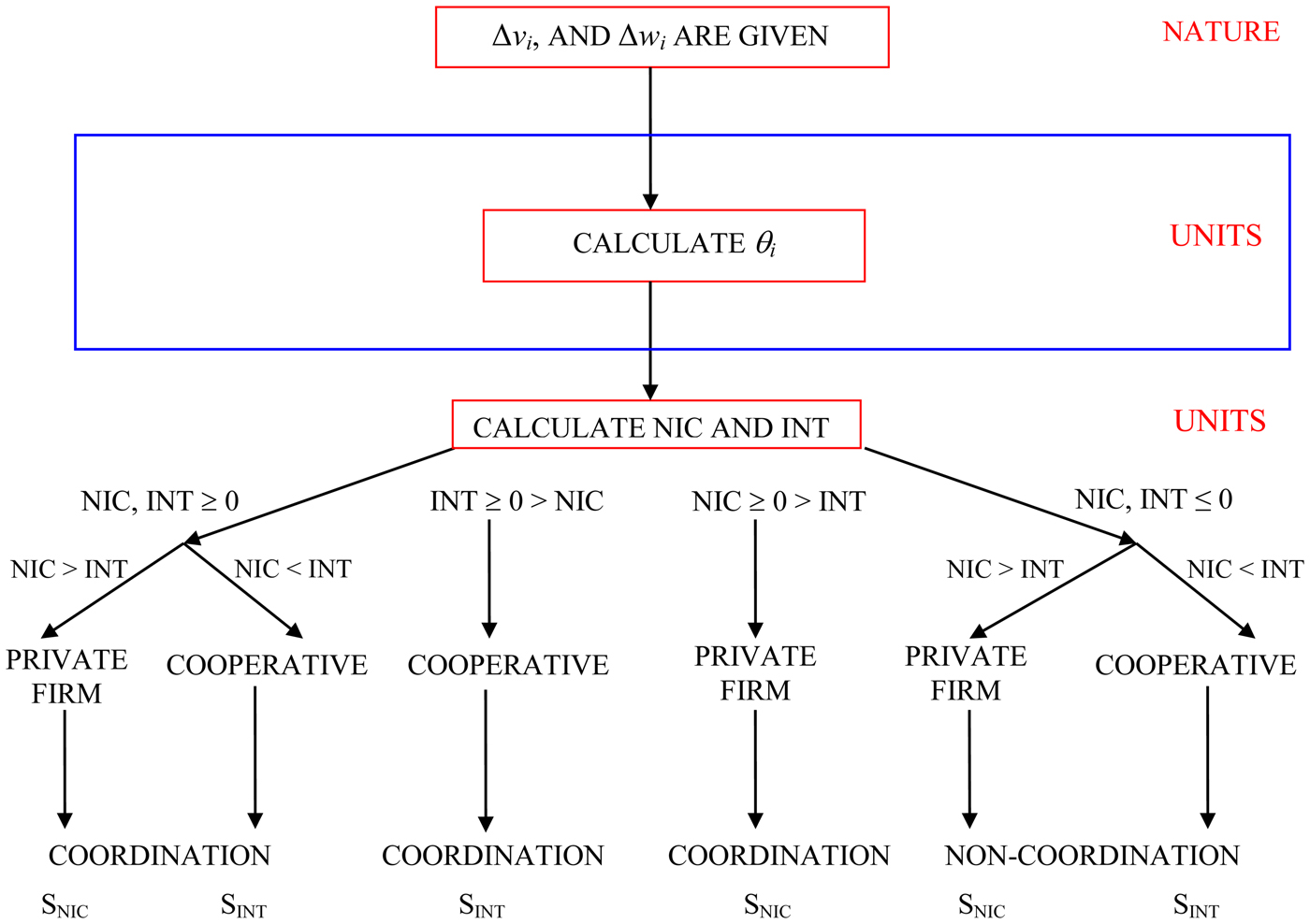
Figure 2 illustrates the process that determines the choice of organizational form by the units based on the corresponding value of the shading parameter. It also describes the potential coexistence of both organizational forms, that is, cooperatives and private firms, within a given economic system, whether coordinated or not. Note that each unit has complete information about the other, so that both units know the values of v i and w i, i = A, B, and each unit can calculate the resulting changes in the payoffs derived from the coordination, that is, Δv i and Δw i, together with Δz i. An immediate extension of the current model to which we refer to in the Conclusion considers a stochastic environment where the payoffs and resulting shading values of each unit are unknown.
Therefore, as illustrated in Figure 2, given perfect information on the set of payoffs, both units will calculate the resulting coordination incentives beforehand and, as a result, choose the best form of organization that consists of either an integrated or non-integrated one. If the information was not perfect, particularly so when determining the calculation of the θ i variables, then a standard two-stage game will be played by both units, with expectations determining the potential equilibria of the second coordination stage being carried over to the initial organizational form choice and together determining the equilibrium of the game.
Extension of Hart and Holmstrom (Reference Hart and Holmstrom2010) with the Coordination and Organizational Form Choice Environment Being Based on Social Comparison

The decision stages that lead to the organizational coordination game played by both units are defined, therefore, as follows.
1. Nature. Both unit managers observe the values of the benefit variables v i and w i as well as the resulting surplus changes derived from coordination, Δv i and Δw i, together with Δz i, with i = A, B.
2. Shading. Given the values of Δv i and Δw i, unit managers calculate the value of the resulting shading parameters θ i as well as the coordination payoffs under both governance structures.
3. Coordination and organizational form choice. Unit managers choose both to coordinate or not and the corresponding governance structure leading to the highest payoff after accounting for the resulting shading costs.
Finally, we consider the scenario where the values of the parameter that allow for coordination under non-integration (integration) do not allow for a coordinated integrated (non-integrated) structure to coexist. This constraint requires considering two different types of organizational structures defined by different parameter values. The values of the parameter that define the integrated structure are identified through the superscript I, while we will use N for those of the non-integrated one. For the INT structure to provide a higher social surplus than the NIC, we require
 $$\Delta ^Iz_A + \Delta {^I}z_B + \theta _A^I \Delta {^I}w_A + \theta _B^I \Delta {^I}w_B \gt {\rm }\Delta {^N}z_A + \Delta {^N}z_B + \theta _A^N \Delta {^N}z_A.$$
The following parameter values follow from the existence and equilibrium conditions defined through the article and can be easily shown to guarantee the coexistence of both types of structures, with the social surplus obtained from integration under higher coordination than that derived from non-integration under coordination
 $$\theta _A^N , \theta _B^N \gt 1: {\hbox{ follow from equation }}\left( 4 \right)$$
 $$\theta _A^I , \theta _B^I \lt 1: {\hbox{\,follow from equation }}({4}^{\prime})$$
 $$\vert \Delta ^Nz_A \vert \gt \vert \Delta ^Nz_B \vert : {\hbox{given equation }}\left( 1 \right)\,{\hbox{and since}}\,\theta _B^N \gt 1$$
 $$\Delta {^I}z_B \lt \Delta {^N}z_B: \hbox{follows from equation}\,\left( 6 \right)$$
 $$\Delta {^I}z_A \gt \Delta ^Nz_A: {\hbox{\,follows from equation}}\,\left( 7 \right)$$
 $$\Delta {^I}w_A, \Delta {^I}w_B \gt \Delta {^N}z_A\; : \hbox{follow from equations}\,\left( 6 \right)\,{\rm and} \,\left( 7 \right)$$
V. Summary and Conclusion
The article shows how an integrated cooperative and a non-integrated private firm may coexist as organizational forms in a coordinated equilibrium. We also show how the cooperative may obtain a higher social surplus. This result is based on the intensity of shading depending positively on the existing payoff imbalances between bosses and managers. These imbalances determine the incentives of bosses and managers with respect to the coordination decision of the units together with the choice of the form of the organization, which leads to the potential coexistence of both organizational forms in equilibrium. In this case, private firms are more plausible to coordinate when the parties receive considerably unequal payoffs, while a decrease in the imbalances between bosses and managers makes coordination more plausible within a cooperative.
The results obtained lead us to conclude that similar interests between both parties, the boss and the unit managers, either strengthened internally by a common quality objective or externally through a third institutional party, will reduce shading and encourage coordination within a cooperative (integrated) environment. On the other hand, dissimilar private interests between the parties result in a non-integrated though coordinated equilibrium scenario.
Our analysis directly related to the empirical setting analyzed by Schamel and Santos Arteaga (Reference Schamel, Santos Arteaga, Windsperger, Cliquet, Hendrikse and Ehrmann2015), where both organizational forms coexist while obtaining a different equilibrium payoff in terms of significant monetary rewards for sensory quality signals. In a related context, Schamel (Reference Schamel2015) identifies cooperative governance and the difficulty of monitoring the individual growers among the main reasons why German wine cooperatives lag in terms of reaping rewards for established quality signals.
The current model has considered a purely deterministic environment that could be extended to a stochastic setting, where payoff imbalances and the resulting shading variable vary, shaping the strategic interactions taking place between the parties. This extension would lead to a two-stage game played by both units, whose expectations would determine their coordination decision and their choice of organizational form. It would then relate closer to Hendrikse (Reference Hendrikse1998), where both forms of organization coexist within a stochastic environment based on the strategic choice of the potential projects of each organization. This extension also allows us to consider additional stochastic scenarios not only within the current cooperative versus the private firm environment, but also to select different group structures within a strategic management setting (Larkin, Pierce, and Gino, Reference Larkin, Pierce and Gino2012). That is, the different group (and compensation) structures would become optimal resulting from the expected differences in the payoffs obtained by group members.