1. INTRODUCTION
Problem reformulation in design is concerned with the metamorphosis of design semantics into a formal mathematical model. Design semantics are the “meaning” of a design work as intended by a designer: the structure and behavior of a design object are conceived in terms of symbolic elements and relationships. A mathematical model reifies the design semantics as symbols and mathematical functions. The development of artificial intelligence (AI) algorithms to automate design problem reformulation tasks is an enduring challenge in design automation. Existing methods either require dependence upon high levels of embedded knowledge engineering in the form of rules, heuristics, grammars, or domain/task-specific procedures (e.g., Ellman et al., Reference Ellman, Keane, Banerjee and Armhold1998; Gelsey et al., Reference Gelsey, Schwabacher and Smith1998; Medland & Mullineux, Reference Medland and Mullineux2000; Campbell et al., Reference Campbell, Cagan and Kotovsky2003) or require a large database of training cases (e.g., Duffy & Kerr, Reference Duffy and Kerr1993; Schwabacher et al., Reference Schwabacher, Ellman and Hirsh1998). It would be useful to develop a method characterized by the following desirable features: a knowledge-lean method that does not need any significant design domain or task knowledge to be embedded into the system; a training-lean method that can extract design knowledge over one or very few cases; and a simple and computationally efficient method applicable over different design domains, representational forms (analytical, nonanalytical, etc.), problem sizes, and complexity (small, medium, large, etc.).
To classify the subset of tasks that come under problem reformulation, consider some of the major questions that designers face while creating a design representation (Papalambros & Wilde, Reference Papalambros and Wilde2000): which design elements to represent as variables, which ones to fix as parameters, what relationships between variables and parameters to consider as objective functions or as constraints, how to decompose a large, over- or underconstrained design problem, how to reformulate problems into mathematically simpler forms so that they become easier to solve, and so forth. Once a mathematical representation is constructed, numeric algorithms are applied to a defined problem space and the optimal or feasible solutions are found (even though reformulation and solution search are cyclic, iterative processes).
Yet, how are these representations reified in the first place or reformulated in subsequent phases of designing? It is known that designers encode the “meaning” of a design object in the design representation through symbols. They construct such representations on the basis of experience-based knowledge and current design problem requirements. However, from an AI standpoint, there is no obvious rule-based answer to their approach. There is no known computational process that takes in abstract modeling requirements as input and produces a mathematical representation as output. This is because a mapping between design representation syntax and the encoded design semantics is not a simple one-to-one direct one but a complex and multifaceted one. The authors believe that trying to go from abstract semantics to syntax is a too hard and general problem to tackle by known machine learning and AI methods. Thus, the motivation of this research is to develop a computational method that assists with design problem reformulation tasks by acquiring the semantic structural–behavioral knowledge of the design from its syntactic representation and using the acquired knowledge to reformulate the same syntax.
2. AN ANALOGICAL INSPIRATION FOR THE PROPOSED METHOD
The inspiration for the method came from an analogy we identified between the latent semantic analysis approach (LSA; Landauer & Dumais, Reference Landauer and Dumais1997) from statistical natural language processing (SNLP) and image compression methods (Kalman, Reference Kalman1996; Strang, Reference Strang2003) from digital image processing (DIP). Both involve use of the linear algebra-based matrix factorization method of singular value decomposition (SVD). In SNLP, SVD-based LSA is used to reveal semantic patterns in textual data by analyzing contextual occurrences of words in sentences rather than individual word meaning. In DIP, SVD is used to identify pattern redundancy in image data for compression of images. SVD, applied in these two diverse domains, suggests an intriguing connection between semantic knowledge and its syntactic representation. As stated in Section 1, a symbolic–mathematical design representation is the description of semantic design knowledge. Structural elements in behavioral relationships are encoded as symbols in functions in a syntactic representation. Using the mappings from SNLP and DIP to design problem reformulation, we conjectured that SVD would be able to reveal the connections between the syntax of design representation and intended design semantics. We use structural and behavioral analogies to explain the mappings to design.
2.1. Structural analogies
2.1.1. LSA, analytic design formulations, and nonanalytic incidence matrix design formulations
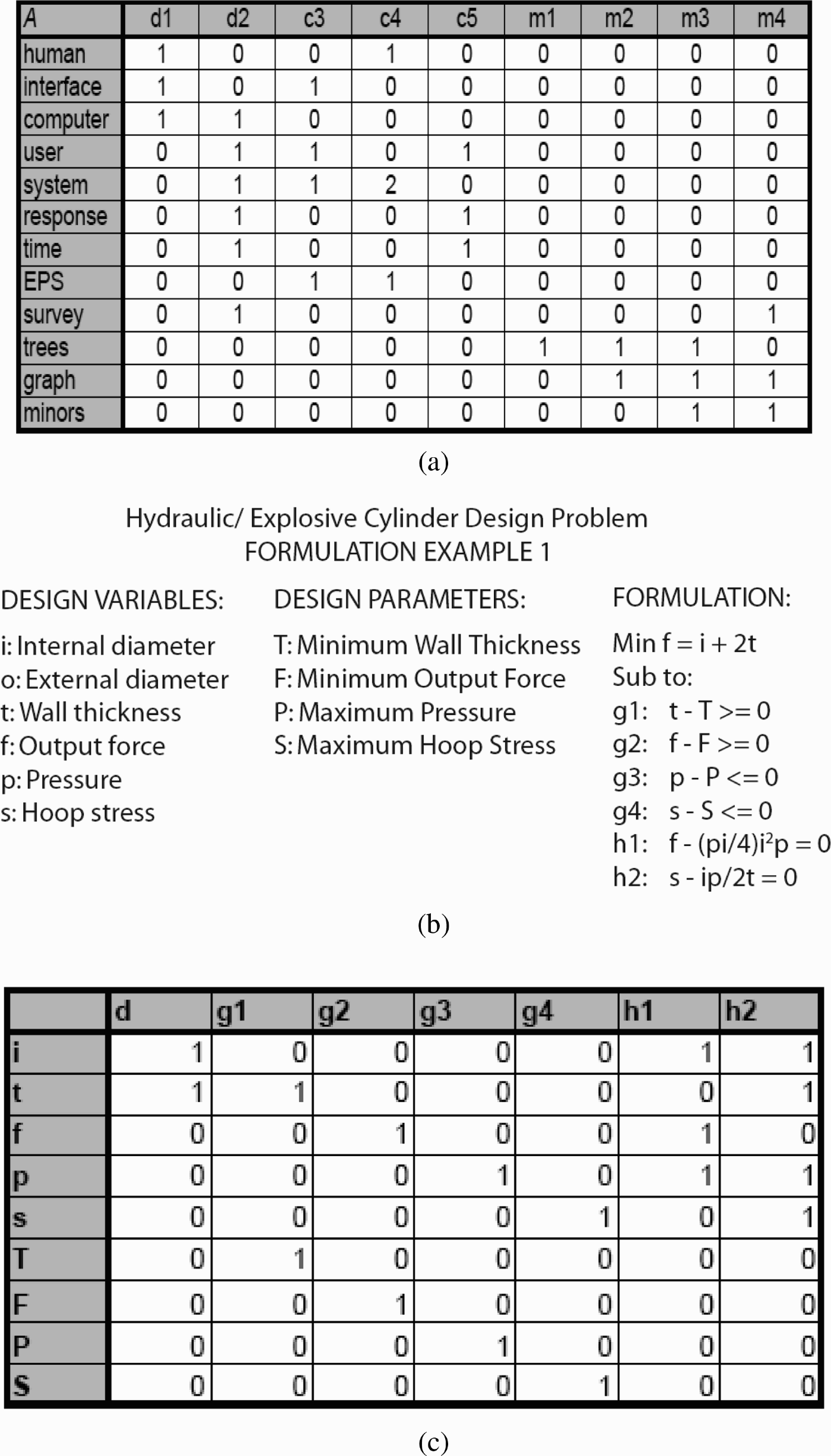
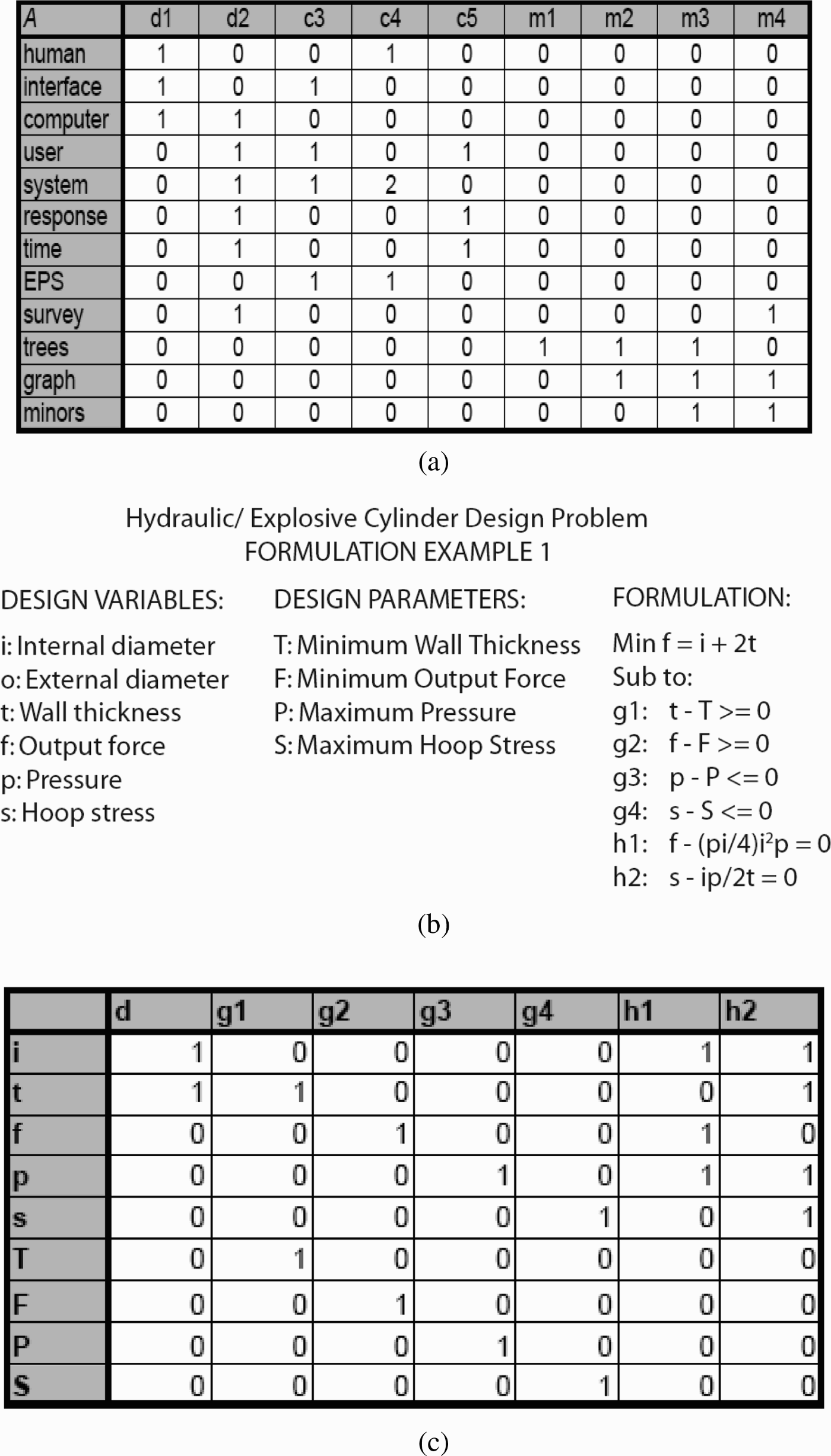
In LSA, a corpus of linguistic data is converted into a word-by-document matrix. Rows represent words and columns represent documents in which the words appear (Fig. 1a). The matrix entries are a measure of the number of times a word appears in a specific document. If we draw a structural analogy between words in sentences (natural language) and design variables in functions (analytic mathematical language), a similar matrix representation could be developed for analytically stated design problems. Rows would represent design elements (variables, parameters) and columns would represent relationships between these elements (objective functions, constraints). The matrix could thus represent the semantic “meaning” of the design through relationships between variables and functions. Figure 1b shows an example formulation: an analytic, nonlinear, single objective optimization model for a hydraulic cylinder. Figure 1c shows the matrix representation for this problem. Each entry measures whether the variable/parameter occurs in a function. We call this occurrence matrix A. The semantic meaning is recast through this occurrence matrix by capturing the associative patterns between sets of elements (words or variables, and, in general, components of a domain) and experiences (documents or functions, and, in general, syntactic structures composed of those elements).
(a) A latent semantic analysis word-by-document example based on Landauer and Dumais (1997), (b) a single objective hydraulic cylinder problem based on Papalambros and Wilde (2000), and (c) a design occurrence matrix single objective hydraulic cylinder problem.
In LSA terminology (Landauer & Dumais, Reference Landauer and Dumais1997), the matrix captures how events occur in episodes. This matrix form plays a crucial role in embedding the multiple pathways by which relations between events and episodes exist. It is these pathways that SVD uncovers. Mathematics, as a formal language for design representation, has the advantage of defining precise relations between variables and functions. Yet, it also has the disadvantage of the formality of mathematics in that the relation between input and output, variable and function, is largely fixed; sophisticated graph-based techniques are needed to “unfix” the relations. Michelena and Papalambros (Reference Michelena and Papalambros1997), for example, review these methods and present a hypergraph-based algorithm that decomposes a design problem into weakly connected subproblems.
The occurrence matrix form can be used to represent both analytically and nonanalytically formulated problems. The functional dependence table (FDT) form (Li & Li, Reference Li and Li2005) is an established method of representing an analytic formulation as a nonanalytic matrix formulation, or of representing relationships between design variables based on results from numerical simulations. It has a direct structural correspondence with the word-by-document matrix in LSA. In this general structural analogy, the matrix measures how elements occur in the local context of one another. A notable difference is that linguistic analysis uses very large matrices derived from very large corpora of natural language. In contrast, matrices from the design domain are restricted to the size of the individual design problems and are likely to be much smaller in size. It is not a priori obvious whether SVD could uncover the multiple pathway relations between variables and functions, and this is an important research question.
2.1.2. DIP and nonanalytic design structure matrix (DSM) formulation
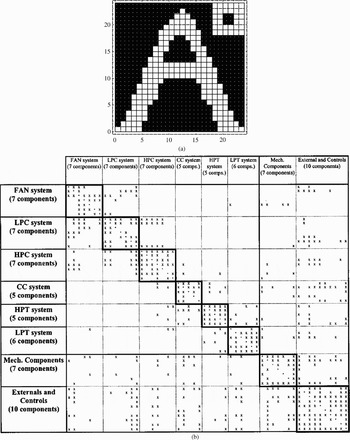
In the DIP domain, SVD is widely used for image compression tasks. An image is converted into a matrix of size m × n; the mn matrix entries contain measurements of pixel values (Kalman, Reference Kalman1996; Fig. 2a). A structural analogy between pixel-to-pixel mappings (image processing) and design element-to-design element mapping (nonanalytic design representation) can be drawn. A similar matrix representation already exists as an established nonanalytic form of design problem representation: the DSM (Sosa et al., Reference Sosa, Eppinger and Rowles2003; Fig. 2b). The example DSM representation shows an aeroengine problem with 54 design components in eight subsystems. Similar DSM representations also exist for mappings such as tasks and processes. The analogy, at this point, is only drawn in a structural way, as no obvious similarity exists between what the image matrix represents and what the DSM represents. In a general structural sense, however, the matrices correspond to relationships that exist between the same elements within a knowledge domain in rows as well as columns. Although image matrices can be square or rectangular, DSM matrices are always square.
(a) A 24 × 24 image prepared by Kevin Kirby for D. Kalman, A singularly valuable decomposition: the SVD of a matrix, College Mathematics Journal 27(1), 2–23. Copyright 1996 ASME. Reprinted with permission. (b) A design structure matrix representation from M.E. Sosa, S.D. Eppinger, and C.M. Rowles, Identifying modular and integrative systems and their impact on design team interactions, Journal of Mechanical Design, 125, 240–252. Copyright 2003 ASME. Reprinted with permission.

2.2. Behavioral analogy
However diverse the structural analogies may appear, they seemed deserving of a deeper analysis. We found that the same approach is also a widely used one in many other knowledge domains such as design text, content, and team performance analysis (Dong, Reference Dong2005), prediction of psychological phenomenon (Wolfe & Goldman, Reference Wolfe and Goldman2003), internet search algorithms (Strang, Reference Strang2003), and clustering gene microarray data (Liu et al., Reference Liu, Hawkins, Ghosh and Young2003). We therefore turned to a behavioral analysis of the mathematical structure of SVD to draw a behavioral analogy.
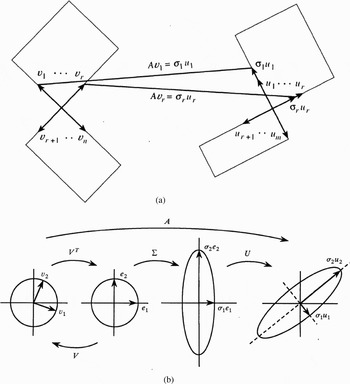
SVD factorizes a general rectangular matrix A with m rows and n columns by decomposing it into a product of three matrices, A = USVT, where U (m × m) and V (n × n) are the left and right singular matrices, and S (m × n) is a rectangular matrix with r nonnegative singular values that capture the dominant association patterns in the data in decreasing order of magnitude. The number of singular values is r, where r is the rank of A. The mathematical idea (Strang, Reference Strang1993, Reference Strang2003; Fig. 3) is as follows: the row space of A is r-dimensional and inside Rn, and the column space of A is r-dimensional and inside Rm. We choose special orthonormal bases V = (v1, v2, … , vr) for the row space, and U = (u1, u2, … , ur) for the column space, such that Avi is in the direction of ui. s i provides the scaling factor and Avi = s iui. In matrix form, this becomes AV = US or A = USVT. Thus, a general rectangular matrix A is diagonalized into two independent spaces represented by special orthonormal bases U and V, and related to each other by the magnitudes of the singular values. A well-known result in linear algebra is that if a dimensionality reduction is performed on this decomposition using the first k largest singular values, then this produces a linear least squares approximation of A. This dimensionality reduction step strengthens the most important association patterns of matrix A (through the first k singular values) and weakens the less important ones, treating them as noise (the r – k singular values).
(a) Orthonormal bases that diagonalize A and (b) a geometrical interpretation of transformation in two dimensions. Both from G. Strang, Introduction to Linear Algebra, Wellesley–Cambridge Press, Wellesley, MA. Copyright 2003 Wellesley–Cambridge Press. Reprinted with permission.

2.2.1. What does SVD do in LSA?
A word-by-document matrix A contains measurements of local occurrences of words in documents. SVD of this matrix A produces factors U and V. These are new, abstract, orthogonal bases with orthonormal components derived from mutual co-occurrence information contained in the original data matrix. U and V represent abstract “word” and “document” spaces. The vectors in U and V measure correlations between the elements in the original co-occurrence matrix, but are themselves uncorrelated to each other. In other words, A has been diagonalized into a word-space U and a document-space V. The singular values in S capture the dominant patterns of association in matrix A in a decreasing order of magnitude. All the words and documents can now be represented as linear combinations of these orthonormal vectors. In a dimensionality reduction step, a k-reduced linear least squares approximation of the original matrix is produced. The original data is now observed in a reduced number of dimensions.
The conceptual explanation for this mathematical process is based on the notion that linguistic knowledge contains a large number of weak interrelations. Words that appear together in sentences or documents share semantic similarity: they occur together in sentences to capture meaning. The dimensionality reduction step induces implicit relationships (“latent” in the LSA terminology) based on explicit local relationships between words and documents. The matrix A shows local explicit relationships between words and documents. However, implicit global relationships can be induced through the dimensionally reduced matrix A′ as the result of a computation that “globally” takes into account all the associations of all the words with all the documents. Words and sentences expressed as linear combinations of orthonormal vectors can be plotted as vectors in real space. Semantic similarity is assessed between them through cosine measurements. This reveals the semantic relationship of a word with a document, even though the word may not occur directly in the document. A principal claim in LSA is that choosing a “correct” dimensionality (lower than the original) makes it possible to observe these implied patterns in the data that are not directly observed in the original data. For example, this computation will capture the semantic relationship that “SVD” shares with “linear algebra,” even though it may not appear directly in the title of a book Introduction to Linear Algebra. If “SVD” is used as a search term instead of “linear” or “algebra” in searching for a book on linear algebra, the query should still bring up books on linear algebra. In LSA, it is the degree of approximation that is interesting. There is no attempt to reduce the error between the approximation and the original matrix because the claim is that the approximation reveals patterns that cannot be observed in the original data. A larger error might actually be useful to uncover latent relations.
2.2.2. What does SVD do in image compression?
In image compression, the focus is on producing a “least lossy” approximation of the original matrix A because the objective is data compression. The matrix A (m × n) is a representation of pixel values. The rank r of a matrix is a measure of the number of independent columns or rows of the matrix. Thus, it is a measure of the redundancy in the data. This has a direct behavioral analogy with images. Any large-scale feature in the image will tend to show redundancy, as rows and columns will contain similar repeated values to represent this feature. This implies that an approximation of the original matrix will be able to represent, without any loss, the original data. The objective in data compression, therefore, is to find the best dimension that is able to reproduce the original data to a high degree of approximation. Note the difference in interpretation from LSA: in image compression, error reduction, and a “least lossy” approximation is the aim.
The mathematics is relatively simple. SVD is performed on matrix A. Then, an optimal reduced rank approximation is found that is “good” enough to represent the original data. A common “rule of thumb” measure is that the human eye should not be able to make out the loss in data.
2.3. Behavioral characteristics from SVD and dimensionality reduction
Based on the above discussion, the following behavioral characteristics are interesting for extracting semantic meaning from design representations.
2.3.1. Dimensionality reduction and implicit pattern extraction
Design knowledge contains a large number of strong and weak semantic interrelationships. While constructing a design representation, designers choose to model some of these explicitly, whereas some of them are possibly left implicit, that is, they are not explicitly represented. Consider a simple example: the concepts of area (a), volume (v), length (l), breadth (b), and height (h). In a representation, two functions could be a = l * b and v = l * b * h. However, that volume is also area times height is an implied, latent, or weak relationship that exists in the semantic space but is not explicitly stated in the representation. In fact, it is often not explicitly stated as it could produce redundancies or overconstrain the problem, both of which are undesirable for numerical solution packages. Although this is a trivial case, in general, it should be asserted that each functional representation is one possible ordering or capture of a behavior through the symbols that occur in the function. Other behaviors may weakly appear that are not included in the explicit representation. The process of projection of symbols (U space) onto functions (V space), and vice versa, done by SVD locates these weaker, latent relations. If SVD is able to extract implicit patterns in the natural language domain, then it should be able to do so for design representations. This property may be useful to recreate the semantic meaning of the design work intended by the combination of the symbol space and the function space even where this meaning is not explicitly stated. The SVD method followed by dimensionality reduction could reveal patterns contained in the syntax that are not directly observable in the original co-occurrence matrix. Almost always, design representations are sparse. Symbolic design representations do not explicitly code all the semantic relationships. Thus, this is an important characteristic for design problem reformulation.
2.3.2. Redundancy, matrix compression, and explicit pattern extraction
The image compression discussion shows that if the data matrix contains redundancy, then, at some reduced approximation, the exact original data is reproduced, that is, a lossless compression is obtained. For a large design problem, if the matrix contains redundancy, then this is an indication that the explicit relationships in the problem representation can be inferred at a lower approximation than the original, that is, at some lower k = r (rank of matrix A). In a design problem reformulation task, we need the method to find the implicit as well as the explicit relationships.
2.3.3. Inference of multiple and invariant relationships from a single representation
The above discussions show that SVD and dimensionality reduction might be able to capture both explicit–invariant and implicit–multiple design relationships from a design formulation. The explicit relationships are important, because they show the invariant features of the original formulation. The implicit relationships are important because they show the possible relationships between variables and their relationships that are not explicitly available in the design formulation because they arise from local association information in the original formulation. In an intuitive way, this is the seat of design problem reformulation: observing these implicit relationships will be similar to varying the “modeling freedom” because these implicit relationships may suggest multiple reformulation possibilities. Some of these, when made explicit, will change the problem formulation. We will show that there are two parameters by which designers can experiment with extraction of multiple reformulations from a single design representation: the number of singular values to retain in the dimensionality reduction step and a cosine threshold value to measure semantic similarity in the inferred design relationships. If the inferred relationships show a transparent relationship across cosine threshold values and k-values, and not some arbitrary, random behavior, then this is a useful property for design problem reformulation. In some design problems, there are multiple potential formulations that can be considered to be “good” formulations and no dominant formulation. By varying these parameters, different reformulations can be observed.
3. METHOD
3.1. Method summary
The method for problem reformulation performs inductive and unsupervised inference of semantic design knowledge from purely syntactical examples of design formulation data. Design formulation examples expressed in standard forms make up the training set. The method operates on each individual sample. The method acts as a “design formulation assistant” by restructuring design formulation knowledge from existing experiences and reconstructing it for similar problems (problems from a common design domain, e.g., the design of hydraulic cylinders, or sharing a common mathematical form, e.g., an incidence matrix or a Design Structure Matrix); and assisting with one-shot reformulation decisions on a single problem formulation task. The designer can query the system for reformulation decisions of various types. The method operates incrementally such that the same query returns different answers as the number of samples increases.
We demonstrate the method on an analytically formulated hydraulic cylinder design problem and a large scale, nonanalytically formulated aeroengine problem employing a DSM representation. In this paper, we show that the method can assist with the selection of variables, parameters, and functions, the identification of design cases, design decomposition, and performing modularity and integration analysis for systems by identifying shared or linked groups of variables and functions. The results show that the method does not require design domain or task knowledge to be prespecified, and is able to develop this knowledge over inductive experiences. It learns quickly over a very small data set, needing just one example (i.e., problem formulation statement) to show useful performance. It is computationally simple to implement and can be applied over different problem domains, for different tasks, over different problem sizes.
3.2. Analytic and nonanalytic design representations
In this section, we describe the representational formalisms that we employ along with brief descriptions of the example problems that we use to demonstrate the method.
3.2.1. Analytic formulations
An analytic formulation is a design formulation in which variables and parameters are characterized by symbols, and mathematical functions describe the relationships between them. Common examples of analytic formulations are design optimization formulations (Papalambros & Wilde, Reference Papalambros and Wilde2000): linear, quadratic, nonlinear, continuous, discrete, mixed, and so forth. Equation (1) describes an optimization problem formulated in its general canonical form:

Subject to
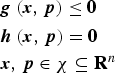
where x is the vector of design variables and p is the vector of design parameters. Parameters are quantities that are kept fixed for a particular design model. Vectors g and h are vectors of inequality and equality constraints, respectively, and set feasibility conditions. Both x and p belong to some subset χ of the real space Rn, where n defines the total number of dimensions in terms of the numbers of variables and parameters. Functions f are a vector of objectives to be minimized; for a single objective case, this becomes a single function f.
An example analytical formulation is the hydraulic cylinder design problem (Fig. 1b) that we use to demonstrate the method. There are five design variables and four design parameters. The objective is to minimize the diameter of the hydraulic cylinder subject to four inequality and two equality constraints. We apply our method onto this problem to demonstrate the following tasks: selection of design variables, parameters, and constraints; identification of design cases. We use an additional multiobjective formulation of the same problem to test whether the method can identify multiple as well as invariant design relationships by varying the parameters.
3.2.2. Nonanalytic formulation: Aeroengine design problem
A nonanalytic formulation is a design formulation in which design elements are represented as symbols and relationships between them are captured as binary mappings in a matrix: there exists/does not exist a design relationship between two design elements or functions. Nonanalytic formulations are used frequently for system decomposition and related analysis tasks in large-scale or complex problems. An analytic formulation can be converted into a nonanalytic form matrix using an FDT. Examples of nonanalytic formulations are matrix forms such as the FDT form (Li & Li, Reference Li and Li2005) or a DSM form (Rowles, Reference Rowles1999; Sosa et al., Reference Sosa, Eppinger and Rowles2003). Figure 2b shows the DSM representation for a large Pratt and Whitney commercial aircraft engine (Rowles, Reference Rowles1999; Sosa et al., Reference Sosa, Eppinger and Rowles2003) with 54 design components in eight subsystems [fan, low-pressure compressor (LPC), high-pressure compressor (HPC), combustion chamber (CC), high-pressure turbine (HPT), low-pressure turbine (LPT), mechanical components, externals, and controls]. The matrix elements show which components share interfaces and/or design dependencies with which other components. The method is applied to this problem to demonstrate the following tasks: design decomposition, analysis of modular versus integrative systems. This example is also used to evaluate the computational performance of method over large-scale problems.
3.3. Method description
3.3.1. Data representation
We use the single objective hydraulic cylinder problem to demonstrate the method. The first step is to convert an analytical problem formulation, Figure 1b, into an occurrence matrix A, Figure 1c. The rows represent variables and parameters, and the columns represent the objective and the constraints. Each matrix entry A ij is set to 1 if a variable or parameter occurs in an objective or constraint and 0 otherwise. The matrix captures local patterns of occurrence of design elements in the “context” defined by the functions, where the coming together of the elements themselves defines the context.
3.3.2. SVD analysis: Rerepresentation of the formulation
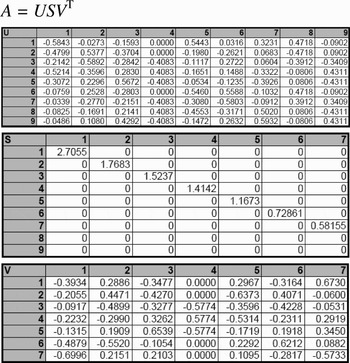
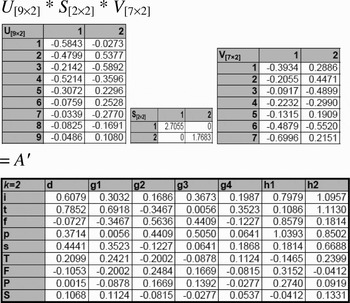
SVD on matrix A produces USVT, a rerepresentation of A in terms of new abstract orthogonal bases U and V with independent components derived from mutual co-occurrence information contained in the original data matrix. The columns of U represent an abstract “design element” space and the rows of V represent an abstract “design function” space. Each row of U (with r components) is an abstract representation of the m variables/parameters. Each column of V (with r components) is an abstract representation of the n functions. The singular values capture the dominant association patterns in A. Thus, US and SVT describe a scaled design element and design function space, respectively. Each design element or function can be expressed as a linear combination of the dimensional vectors in U and V scaled by the singular values. In this step, the discrete local explicit relationships between variables and functions are converted into continuous global implied relationships. The original relationships are decoupled to produce abstract orthonormal vectors, linear combinations of which represent the variables and functions represented in real space. Figure 4 shows the SVD for the data matrix shown in Figure 1c.
Singular value decomposition results for the matrix in Figure 1c.

3.3.3. Dimensionality reduction
In the dimensionality reduction step, the first k singular values are preserved to produce a least squares approximation A′ = U(m × k) * S(k × k) * VT(n × k). Because the approximations based on retaining only the k largest singular values will overplay the most important associative patterns and underplay the rarer ones, variables and functions that mutually share high coupling relations in A will be strengthened and those that do not will be weakened. The step causes semantically positively correlated variables (those that appear together in functions) to cluster together in this dimensionally reduced space, whereas negatively correlated variables (those that do not appear together) fall far from each other. This is how implicit relationships are induced using the explicit relationships. Figure 5 shows the k = 2 reduced approximation of the matrix A. The truncated matrix A′ shows that the entries change to higher or lower values, induced from the explicit binary relationships.
The k-reduced approximation A′ of A, k = 2.

Consider in matrix A (Fig. 1c) that the variable “internal diameter” i occurs in constraint h2:s = ip/2t measured by A17 = 1. It does not occur in constraint g4:s − S ≤ 0, indicated by A15 = 0. But, from the algebraic relation in h2, we can see that the value of i affects the value of s (or vice versa), which will affect the behavior of the constraint g4. Here, i implicitly affects and is affected by the behavior of g4 even though it does not occur in it explicitly. This is an example of implicit knowledge that designers regularly employ. A pure symbolic AI-based inference system, for example, would need to encode such knowledge as an explicit algebraic substitution rule. The matrix A′ (Fig. 5) shows that the original 0 between i and g4 has changed to a higher value A′15 = 0.1987 (showing that there is an implicit relationship) and the original 1 between i and h2 has changed to A′17 = 1.0957 (showing a stronger relationship than 1). The original 1–0 local entries have been rerepresented in terms of a “global” map of syntactical associations that each element has with every other one.
3.3.4. Graphical representation of dimensionality reduction
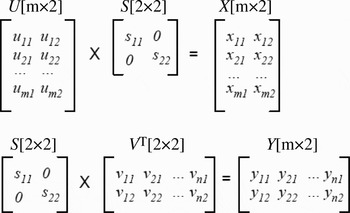
Here, US is the scaled design element space and SVT is the scaled functions space. Now consider the dimensionality reduction operation in terms of the following matrix multiplications with k = 2 (Fig. 6):
Matrix operations for dimensionality reduction, k = 2.

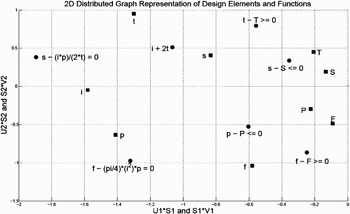
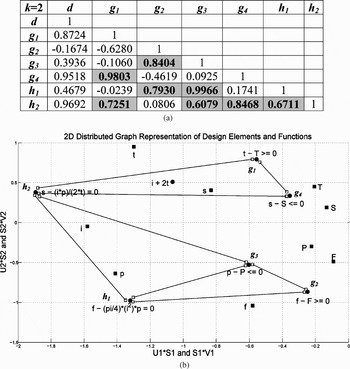
Variables X and Y give us the 2-D reduced US and SV spaces, so each pair of entries [(x 11, x 12), (y 11, y 12), etc.] gives us the coordinates for each design element and function in a common 2-D space. Figure 7 shows the graph for the 2-D representation of the single objective hydraulic cylinder problem. Graphs for k = 2 and k = 3 help to visualize the “abstract semantic space” generated by the SVD and dimensionality reduction analysis, especially in terms of the visual relations between the design elements and functions projected into the same space. For higher k values, it is not possible to plot graphs, but the mechanics of the method stays the same.
Graph representation for dimension reduction, k = 2.

3.3.5. Cosine similarity measurements: Reconstruction of design knowledge
The previous steps show that the method converts discrete relationships between variables and functions into a continuous position-based representation in real space. Thus, distance is a measure of semantic relationship. Variables, parameters, and functions that are positively correlated in the syntax will tend to cluster together in the dimensionally reduced space, as explained above. Thus, the reduced dimensionality representation can be queried using a convenient “distance” metric to get semantically related groupings of design elements and design functions. Each point in Figure 6 is a vector in 2-D space that represents a design element or function. We use a cosine distance metric because it will capture magnitude as well as direction in space. Thus, a cosine angle measurement between any two vectors, x and y, cos(θxy) = xTy/‖x‖ ‖y‖, is a measure of their semantic similarity: the higher the cosine angle value, the more the similarity, and vice versa. Continuing with the same example as in the above section, variable i has coordinates (−1.5809, −0.0483) and constraint h2 has coordinates (−1.8929, 0.3804). The cosine between these is 0.9739. Confirming expectations, this shows that there is a high semantic relationship between them. Further, the cosine between i and g4 comes out to be 0.7041. This is a high measurement, considering that in the original matrix A15 = 0 for the relationship between i and g4. This serves as validation that the method brings out implicit relationships existing between design elements and functions.
A query in this space can measure three types of semantic similarity: between design elements as cosines between X vectors, between functions as cosines between Y vectors, and between design elements and functions as cosines between X and Y vectors. The next sections show how these queries assist with various reformulation tasks.
4. PROBLEM REFORMULATION TASKS: HYDRAULIC CYLINDER DESIGN
The hydraulic cylinder design problem is an example of an analytically formulated problem. Using this example, we show the following design problem reformulation tasks: selection of design variables and constraints and design case identification.
4.1. Selection of design elements and relationships
One of the first steps in formulating a design problem are decisions about which design elements to consider as decision variables, which ones to fix as parameters, and what functional relationships to consider between the chosen elements. Often, these decisions are based on previous experiences of a designer and the physics of the problem being modeled. It is likely that problems of the same class will share a similar set of design elements. Also, because design variables are semantically linked in terms of behavioral relationships (e.g., the hoop stress s should be less than a maximum value S), when a designer considers one element as a variable, it becomes important to know what other elements and relationships should be considered in conjunction. This semantic knowledge, as we have seen in the discussion above, is not always explicitly available in the original problem formulation. For example, should the hoop stress equation (h4:s − S ≤ 0) be considered as a part of the model if i is chosen as a variable? Obviously, i does not occur in this equation, so how can one tell a priori?
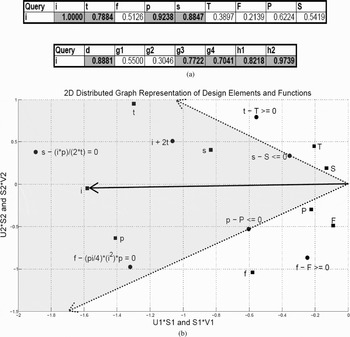
A measurement of similarity between any one variable and all other variables and functions using a cosine of the angle between them in space can show how this variable is associated with any other. The concept of a cosine threshold is one parameter that a designer can use to experiment with various reformulations. Fixing a cosine threshold, all variables and functions that show higher than threshold cosine measurements with the query variable/function are returned as semantically similar to the query. Recall that the local, explicit, discrete relationships in the matrix A have now been converted into a global, implicit, continuous distance-based representation in real space. Semantic similarity is a continuous function of distance: the higher the cosine value (smaller angle), the higher the semantic similarity. Thus, a higher cosine threshold implies a “tighter” definition and returns fewer coupled variables and functions, whereas a lower one “relaxes” the definition and returns more. By varying cosine thresholds and observing different groups returned as answers, the designer can observe different possible formulations. If we fix i as the query variable, then Figure 8a shows the cosine measurements between i and all the other variables and functions in the k = 2 space. If we choose a cosine threshold of 0.7, then {t, s, p, g3, g4, h1, h2} are returned as semantically related to i. If we increase it to 0.8, then {p, s, h1, h2} are returned. It is clear that the threshold of 0.8 returns only the variables and functions that i explicitly occurs with or in, but a threshold of 0.7 also includes variables and functions that share an implied relationship. This can be confirmed from Figure 8b, which shows the variables and functions returned with the cosine threshold set to 0.7. The query on i returns functions g3: p − P <= 0 and g4: s − S <= 0. i does not occur in either of these, but as we will show in the next section, they are important functions to consider for variable i.
(a) Cosine measurements of i with all elements and relationships and (b) elements and relationships returned for query variable I, cosine threshold = 0.7.

A “good” choice of a cosine threshold will lead to “good” reformulations. As a heuristic for identifying good cosine thresholds, we have developed a matrix reordering algorithm that reorganizes a cosine measurement matrix (a matrix where row i and column j are represented by variable i and function j, I = 1 to m, j = 1 to n; matrix entry A ij measures the cosine between variable i and function j in k-reduced space, refer to aeroengine problem presented later) to cluster variables and functions sharing similar cosines to reveal block matrices on the diagonal with similar cosine values. Alternatively, we have also applied the k-means clustering algorithm on the k-reduced space to reveal these semantically related clusters.
4.2. Heuristic design case identification
The computations shown in the previous sections can be utilized to inform a specific problem reformulation task: design case identification. Any problem formulation model contains a set of constraints. This model could be over- or underconstrained, that is, not well formulated. “Design cases” are sets of active or critical constraints for a design optimization problem formulation that lead to a well-formulated model. One method for identifying these design cases is monotonicity analysis (Papalambros & Wilde, Reference Papalambros and Wilde2000), which is a problem solving by reformulation method in which constraint activity information is used to reformulate the problem to a simpler form when a problem is over- or underconstrained. A significant characteristic to note here is that this process of reformulation is actually similar to discovering previously unobserved implicit relationships between variables, parameters and constraints, that, when made explicit, make solving the problem possible.
In the case of this example problem, there are five design variables, and six design constraints. The number of nonredundant, active constraints cannot exceed the number of design variables for a consistent solution to be found, revealing that there will be design “cases.” All the constraints cannot be active at the same time. There will be sets of active constraints, leading to different cases. Papalambros and Wilde (Reference Papalambros and Wilde2000) identify three design cases: stress-bound, pressure-bound, and thickness-bound. Their results show that for design variable i (internal diameter) either constraints [g3, (g2, h1)] or [(g4, h2), (g2, h1)] will be active, and for variable t (wall thickness) either constraints [(g4, h2), (g2, h1)] or (g1) will be conditionally critical. Figure 9a and b shows that cosine measurements between function vectors in the 2-D space show similar conclusions by purely a syntactic analysis of design formulation. High cosines in Figure 9a are shown as connections in Figure 9b. Cosines between constraints (g2, h1) and (g4, h2) are high, with constraints g3 and g1 sharing high cosines with these two groups, respectively.
(a) Design “cases” group identification by method and (b) cosine measurements for groups shown in (a).

Note that monotonicity analysis is a mathematically rigorous, rule-based procedure, and it can identify these cases without ambiguity. Our method can only provide insights into design case “clusters,” and cannot provide optimal solutions as monotonicity analysis does. For example, whereas it shows that there are groups of (g2, h1) and (g4, h2), it cannot tell that these need to be active together as a case. However, monotonicity analysis is applicable only on problems where regions of monotonic behavior in constraints may be identified. This method quickly turns into a very complex solution procedure for even a small–medium-sized problem as the number of variables and constraints increase. Our method would be particularly suited for such large problems, where, if used in conjunction with monotonicity analysis, will be able to focus a designer's attention on possible design cases to consider as semantically related variables and functions. An added advantage of the method is that it can be used to identify semantically related groups for analytic as well as nonanalytic formulations, whether or not functional relationships are available.
4.3. Performance analysis over multiple samples
We have shown that the method requires just one training sample to extract implicit design knowledge. However, a designer may wish to apply the method on several samples of a problem in a specific design domain to explore the implied knowledge returned in these separate cases. We have claimed that the method is training lean, and can identify the multiple as well the invariant aspects of design knowledge, whether it is applied onto one or several design formulation samples of a given design problem.
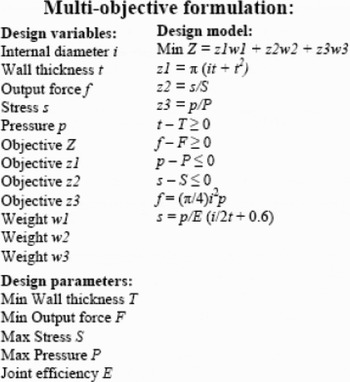
To analyze the performance of the method over multiple samples, we applied the method on an additional formulation of the same problem. There are multiple ways in which the same problem can be formulated by different designers. Figure 10 shows a multiobjective formulation of the hydraulic cylinder problem (Michelena & Agogino, Reference Michelena and Agogino1988), with conflicting objectives and a slightly different set of constraints and parameters than the single objective formulation.
Multiobjective formulation of the hydraulic cylinder problem based on Michelena and Agogino (1988).

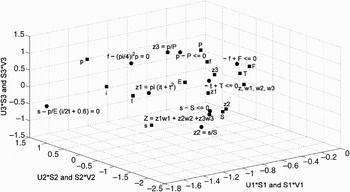
The main conclusion to report is that the method generalizes very quickly over very few training examples. By generalizing, we mean that similar and consistent answers are returned for different variations in formulation for the same problem. As seen in the previous section, the method needs just a single formulation to infer the “correct” answers. The answers returned from the multiobjective formulation reinforce this result. The method correctly identifies semantic groupings of variables and constraints within design cases. This is interesting because, in general, computational design support systems require either a very high level of knowledge engineering, or they require a large database of training examples. Although it is possible to automatically generate a training database in numerical optimization cases (Schwabacher et al., Reference Schwabacher, Ellman and Hirsh1998), generating a training database for symbolic cases will be more difficult. Given the specific conditions related to each problem, formulations from the same design domain or even the same problem in different settings can have widely differing mathematical forms (Ellman et al., Reference Ellman, Keane, Banerjee and Armhold1998). Thus, it is difficult to define the learning characteristics and problem representation form for a training database in any general sense. The advantage provided by this method is that it requires only one sample to infer the explicit and implicit design knowledge. Any other samples, incrementally added to the “training database” serve to confirm that the answers are “correct.” All samples are “real” design experiences that either reinforce or change the learning gained from previous samples. The same set of cosine similarity measurements on these two samples reveals that the method returns “correct” answers. For example, parallel to the design case identification task in the single objective case, Michelena and Agogino (Reference Michelena and Agogino1988) use monotonicity analysis to identify three design cases for the multiobjective problem: Case P (pressure inactive), Case S (stress inactive), and Case PS (pressure and stress inactive) with all of the cases having force f and thickness t active. The SVD based method applied onto this example shows (Fig. 11, k = 3) that the pressure and stress groups are distinctly apart, with force and thickness falling in the middle (as supported equivalently by cosine or k-means calculations).
Graph representation for dimension reduction, multiobjective cylinder, k = 3.

Because the algorithm is based on extraction of syntactic patterns, it does not discriminate between “wrongly formulated” and “correctly formulated” examples. However, it can be conjectured that over many numbers of design formulation samples, a statistical effect will ensure that the algorithm generalizes “correctly,” assuming that most of the examples provided to the algorithm are “correct” from the design point of view.
The method can be used to capture multiple patterns from the same example by varying the cosine threshold and the k value. The cosine threshold parameter has been discussed in previous sections. We now present the effects of the second parameter: changing the k value (the number of dimensions retained in the dimensionality reduction step) to observe multiple patterns or invariance in formulations. We examine the effect of design problem size on the answers returned, and the number of dimensions k that are retained while performing the dimensionality reduction compared to the number of “correct” answers the algorithm returns. The relevance or “correctness” of the answers returned by the queries was assessed based on how the reformulation suggested by the answers matches up with those provided by the documented results reported in the source paper. For example, in the previous section we present a comparison of the answers returned by the queries from our method with the well-known and documented monotonicity analysis applied to the same problem. Because monotonicity analysis is mathematically proven and guaranteed to find the optimal solution in this case, and our results match those provided by the monotonicity analysis, it may be safely claimed that the answers returned by this algorithm are correct. By studying the effect of problem size and the value of k, we also assess the multiple patterns that are returned as answers, and the invariance of design knowledge across these answers.
4.4. Effect of problem size
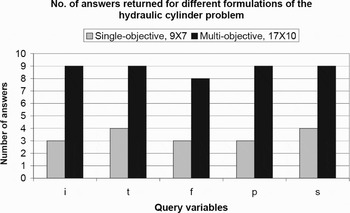
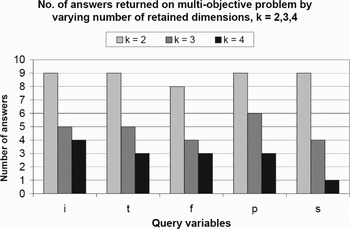
Keeping the number of dimensions k fixed, the method pulls more variables, parameters, objectives, and functions as the size of the problem increases. For example, the multiobjective version of the problem contains more variables and constraints than the single-objective version. If we keep the number of k dimensions fixed for both design formulation samples, the number of answers returned to the query variables in the multiobjective case is higher than in the single objective case. Figure 12 shows this result, as over two examples of the same problem with different formulations, we see that the method manages to capture the variances in the formulations. The single objective formulation has an original matrix size of 9 × 7 (Fig. 1c). The multiobjective formulation of the same problem has an original matrix size of 17 × 10, as the multiobjective problem has an increased number of variables, parameters, and objective functions. The method returns a higher number of semantically related groups of variables and functions as answers in the multiobjective case.
Answers returned from different formulations of the cylinder problem.

This is an interesting result; it provides proof that the method scales up well. As problem size and the complexity of interaction between variables and functions increases, so will the number of implied relationships. If the method scales up well, it should be able to handle an increase in problem size or complexity without a significant increase in computation time or increase in complexity to the designer to apply the method. A designer wishing to formulate a new problem from the same design problem domain would be able to retrieve different answers to the same query using different samples from the database. They would be able to see how different designers have conceptually “grouped” variables and functions as semantically related to each other. For example, the multiobjective formulation of the problem also uses monotonicity analysis as the design solution method, but because of the differences in formulation, groupings of variables and functions in design “cases” appear different from the single objective formulation. The method captures these differences, and our results show similar groupings of design cases as reported in the two original sources.
The method is also able to capture invariance of design knowledge within the multiple patterns, because the answers returned for the two different cases have overlaps. This implies, for example, that because of the physics of the system being modeled, if i and s are semantically related, then the method applied on both the formulations should return this as a case. If we compare the two example cases, to the query variable i, the single objective formulation returns the set {t, s, p} as related variables, whereas the multiobjective formulation returns the set {t, f, p, s}. Normally, there will be subjective influences in problem formulation: different designers may choose to model the same problem in different ways. However, there may be some invariant design knowledge that will be common across these different formulations because of the physics of the problem.
Our results show that, through the capture of multiple patterns (different answers to the same query in different formulations), the method captures the differences in formulation. Through the capture of invariant design knowledge (same answers to the same query across different formulations) the method captures the basic “physics” in the formulation.
4.4.1. Effect of the number of retained dimensions
Increasing the number of dimensions k shows that the number of variables, parameters, objectives, and functions returned reduces, until the final number of dimensions k becomes equal to the original rank of the matrix, when it returns exactly the same answers as directly available in the original problem formulation. The reduced dimensionality approximation captures hidden design patterns in the problem statement. For different families of designs, experimentation on various problem sizes will lead to the correct or an optimal number of dimensions that give the best results. Heuristically, the “optimal value” of k is the one that leads to well-formulated problems. Problem size, complexity of interactions, and the design domain characteristics all affect the search for the best value of k. For example, in the cylinder design family, because of the relatively small size of the problem, the best dimensions came out to be 2 and 3. Comparing the two formulations, we can see in Figure 12, that in fixing k = 2, the multiobjective version (larger problem size) returns more answers (eight or nine) compared to the answers from the single-objective version (four or five). This is an indication that, sometimes, for very large or complex problems, fixing k to very low values (say 2) can mean that the algorithm is unable to discriminate between conceptually close pattern groups, and it would need more dimensions to bring out the patterns. Figure 13 shows that for the multiobjective formulation, the number of answers returned reduces (and becomes more relevant as “correct” answers) as we increase k from 2 to 3. Beyond k = 4, the performance deteriorates, and the answers returned are not semantically relevant.
Answers for different k values for the multiobjective cylinder problem.

In conclusion, the correct dimensionality is best left as a parameter that the user can modify heuristically for various problem classes and sizes. The problem domain, size, and complexity affect the correct value of k. From the mathematics of SVD and dimensionality reduction, it is clear that as the k values approach closer to the rank r (the full approximation) the implied relationships retuned reduce, until by k = r, only the explicit occurrence matrix relationships are returned. Therefore, as a heuristic for choosing a “good” k value, the search is limited to the range of initial k values that return implied relationships when these relations are not evident from the original matrix A. To identify the well-formed reformulations, we choose the k values that returned implicit information, and then used the K-means clustering algorithm or the matrix reordering approach based on cosine measurements. Within this range of chosen k values, if a well-formed reformulation exists, both these methods return such a reformulation in the form of tightly coupled clusters of variables and functions.
5. PROBLEM REFORMULATION TASKS: AEROENGINE PROBLEM
We now demonstrate the method on a nonanalytical DSM representation of a large commercial aircraft engine (Pratt and Whitney PW4098; Sosa et al., Reference Sosa, Eppinger and Rowles2003) for the following tasks: design decomposition, and modular and integrative systems analysis. This problem, in demonstrating the design decomposition task, also served to validate whether it is able to identify the “correct” subproblem clusters, given a problem with a significant amount of coupling and for which the subproblem decompositions are already predefined by a designer. In the design decomposition experiment, we perform a reverse analysis; we already know the “answer,” that is, the subproblem clusters that are predefined by the designer, and we check whether the method is able to return the same “answer.”
5.1. Design decomposition
Figure 2b shows the eight subsystems that form the aeroengine. The system and subsystem definitions have been identified by a team of collaborating designers and industry design experts (Rowles, Reference Rowles1999; Sosa et al., Reference Sosa, Eppinger and Rowles2003). A cross between two components in the matrix shows that they share a design interface or dependency. Thus, in the occurrence matrix A, A ij is 1 if components i and j share a design interface, and is 0 if they do not. All diagonal entries A ii = 1 with the interpretation that a component shares a design interface with itself. The 54 × 54 matrix in Figure 2b shows the subsystems already identified. This serves as a validation test: if we merge the subsystem information into a single occurrence matrix, without telling the method about the subsystem definitions that design experts have predecided, will the method be able to identify these subsystems as tightly bound clusters? Thus, the method does not know about the subsystems, only the explicit design dependency information between any two components. Elsewhere, we have shown using small examples (Sarkar et al., Reference Sarkar, Dong and Gero2008) that the method can be successfully used for design decomposition. In this problem, we test the method on performing design decomposition on a large-scale complex problem.
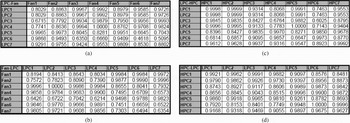
We applied the method to the matrix A, without providing it any identification on subsystem boundaries. The results show that our method is able to identify the subsystem boundaries, keeping a cosine threshold of 0.7, and at k = 2. We use Simon's general definition of a “nearly decomposable system” in which the decomposition should lead to weakly interacting subsystems with strong interactions within each subsystem. In terms of our method, the “strong interactions within each subsystem” clause implies that components of the same subsystem have strong local interactions through shared design interfaces, and will show mutually high cosine measurements. This enables them to be identified as a cluster or chunk. We identify these clusters by using the matrix reordering algorithm on cosine measurement matrices (Figs. 14–16) that cluster together design elements with high similar cosine values, thereby allowing the identification of the cosine threshold.
(a) Fan subsystem, (b) low-pressure compressor (LPC) subsystem, (c) high-pressure compressor (HPC) subsystem, (d) combustion chamber (CC) subsystem, (e) high-pressure turbine (HPT) subsystem, (f) low-pressure turbine (LPT) subsystem, (g) mechanical components subsystem, and (h) externals and controls subsystem.

(a) Low-pressure compressor (LPC)–fan cosine measures, (b) fan–LPC cosine measures, (c) LPC–high-pressure compressor (HPC) cosine measures, and (d) HPC–LPC cosine measures.

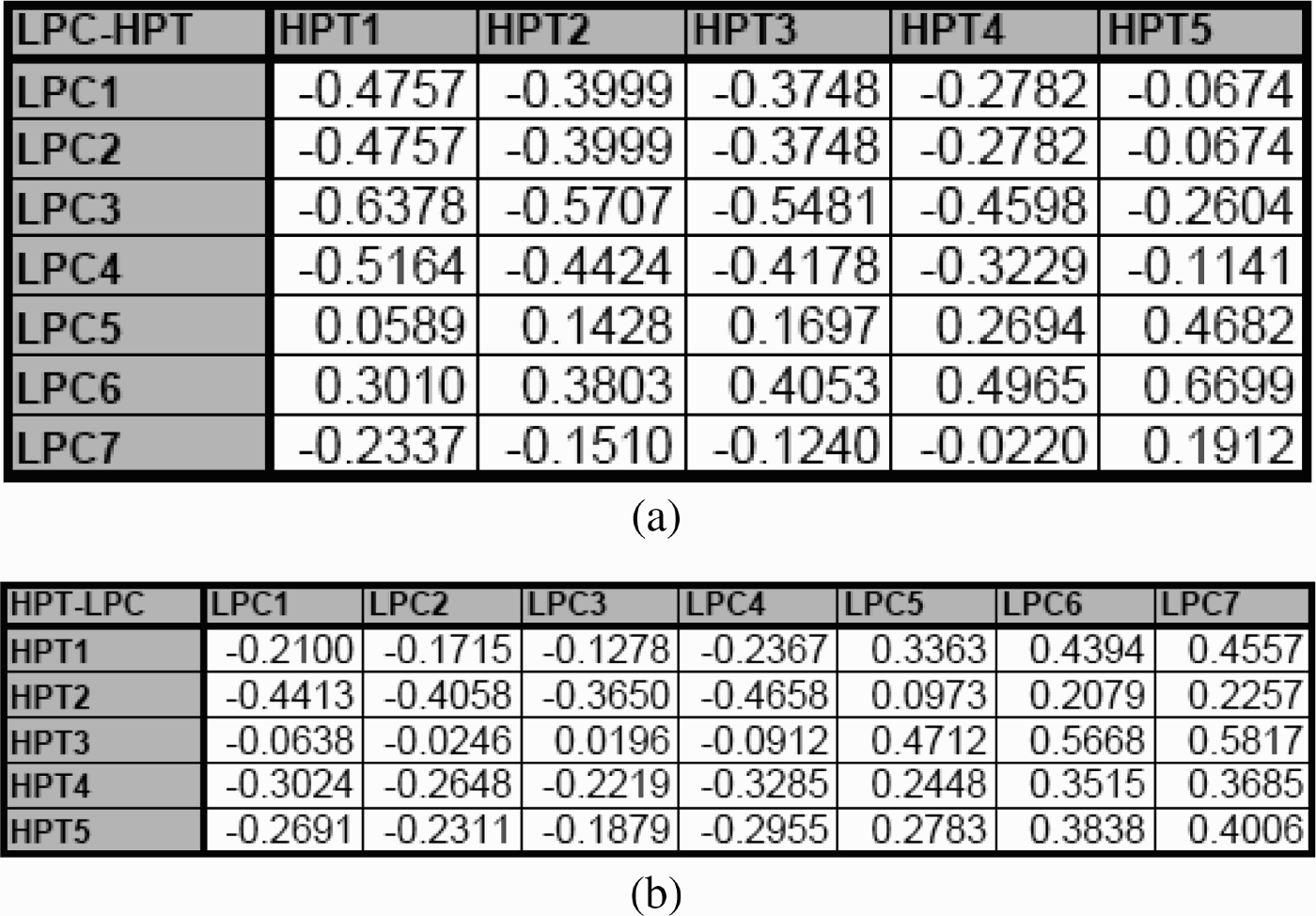
(a) Low-pressure compressor–high-pressure turbine (LPC–HPT) cosine measures and (b) HPT–low-pressure turbine (LPT) cosine measures.
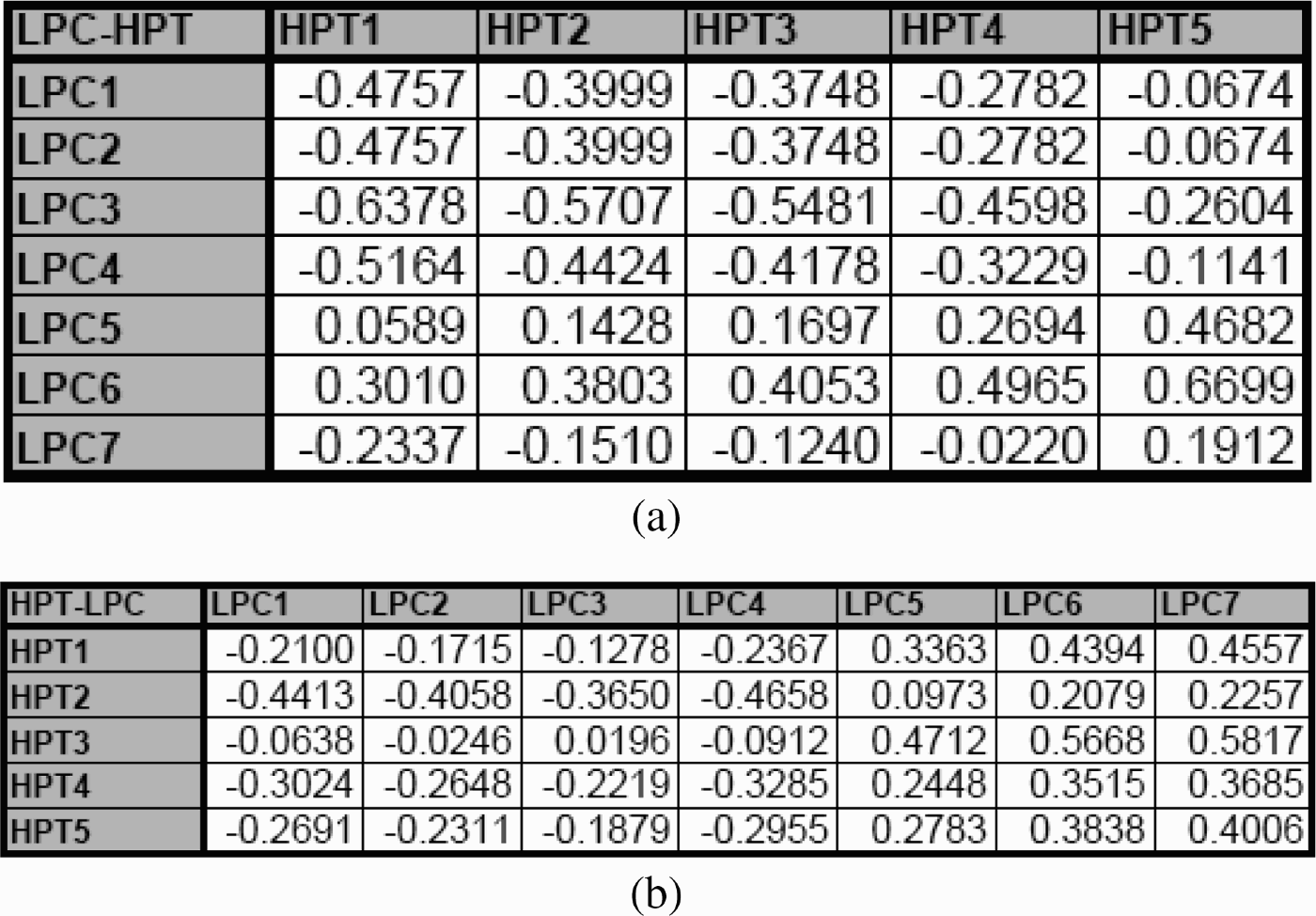
Figure 14a–h shows the cosine measurements for the eight subsystems. For ease of visual representation, we show these eight matrices, but they are part of the same large 54 × 54 matrix produced as a result of the SVD decomposition, and can be identified using the matrix reordering algorithm. Note that very few “outliers” do exist (values lower than 0.7). They point to the observation that two specific components within a subsystem do not share a strong local interaction. This is not unlikely; not all components will have strong local interactions with all the others to be defined as a subsystem. The subsystems are identified based on the observation that most measurements within a cluster show cosine values well above 0.9.
Because this method works by measuring distributed “global” patterns of associations between the aeroengine components, it reveals implicit indirect associations as well as explicit ones. Even those components that do not interact directly with each other show a high cosine similarity with each other based on common interaction with a third components. As a simple example, note from the original matrix (Fig. 2b) that, in the Fan subsystem, component 1 shares design interfaces with components 3 and 4 but not with 5. Both components 3 and 4 share a design interface with 5. Now, note that in the original matrix A, there would be a 0 for matrix entry A 15. However, the cosine between components 1 and 5 after the k-reduction comes out to be 0.9948 (Fig. 14a), which is an indication showing that the two share a high semantic relation.
5.2. Modular versus integrative systems analysis
Going back to Simon's definition of a “nearly decomposable system,” there is another clause: that of “weakly interacting subsystems.” Not only will the components within a subsystem show high interaction, as a group, this subsystem will show low interaction with other subsystems. Thus, ideally, components within the subsystems we have identified should show low cosine measurements with all the other components from the other subsystems. We have demonstrated this for small scale problems (Sarkar et al., Reference Sarkar, Dong and Gero2008). In large-scale design problems such as this one, it is rare for a system to be perfectly decomposable. One of the main problems is that it becomes difficult to identify subsystem boundaries, because elements within a subsystem share design interfaces with elements from other subsystems. It is for this reason that we aim for a “nearly decomposable system” rather than a “perfectly decomposable one.” It becomes important now to analyze which subsystems within this large system are modular and which ones are integrative, to reach upon a final decision on the decomposition.
The original source paper provides the following definitions for modular and integrative systems: “a hypothetically perfect modular system would be one whose components do not share design interfaces with components that belong to other subsystems.” On the other hand, a “‘hypothetically perfect’ integrative system would be one whose components are completely physically distributed throughout the product resulting in components that share interfaces with all the systems that comprise the product.” For a perfectly modular system, our method would show very high intra subsystem cosine measurements and very low inter subsystem cosine measurements.
For the aeroengine problem, however, components of one subsystem share design interfaces with components from other subsystems. In such a case, modularity is defined on the basis of the observation that subsystems that share concentrated interactions with only a few other subsystems (i.e., on account of spatial integrity) will be defined as modular. In contrast, subsystems that show distributed interactions with all other subsystems will be defined as integrative. For example, the LPC subsystem is a modular subsystem, because its components share design interfaces with components from the Fan and the HPC subsystems but not with the others. In contrast, the externals and controls subsystem is an integrative one because its components shares design interactions with components from all the other subsystems.
Following up this example in terms of our method, the LPC system should show high cosine similarity with the Fan and the HPC systems but low cosine similarity with the other systems. Figure 15a–d shows that this is indeed the case: the LPC–Fan, Fan–LPC, LPC–HPC, and HPC–LPC matrices show high cosine measurements. Note that the measurements for a pair lead to two different matrices because the original matrix contains asymmetric design relations.
Figure 16 shows, as examples, that the LPC–HPT and HPT–LPC matrices show low cosine similarity as confirmation that the LPC subsystem shows low cosine similarity with the elements from all other subsystems for which it does not share design interfaces with. From our results, the LPC subsystems show low cosine similarity with HPT, LPT, and CC systems.
The external and controls subsystem is identified as an integrative subsystem, as our results show that it has high cosine measurements components from almost all the other subsystems. Our method identifies the Fan, LPC, CC, HPT, and LPT as the modular systems. The HPC system falls somewhere in between the clearly modular and clearly integrative systems: it is more modular than the externals and controls system, but more integrative than all the others. These results match the results reported by the authors in the source paper.
In the source paper, the decomposition of the aeroengine into the eight subsystems was based on information collected from design experts. This information was not provided to our method, but the decomposition suggested by the method “matches” the results produced by human experts. Decomposition of large systems into subsystems is heavily dependent on subjective choices exercised by designers. Frequently, there is no one “right” solution. Using this method, and varying cosine thresholds and k values, designers can use this method to observe multiple decompositions. Last, because the method captures implicit and explicit relationships between design elements in a distributed way, changing just one dependency value in the original matrix will produce changes in all the resulting matrices and cosine values, which may then alter the decomposition decision suggested. This allows designers to experiment with the matrix entries, that is, the dependency matrix in an efficient way to observe how the decomposition decision may change.
6. THEORETICAL CONJECTURES
Design problem modeling and reformulation is not a well-understood cognitive task. How do humans infer and reason in an ambiguous and ill-structured knowledge domain such as design, represent such knowledge using a formal, precise, unambiguous representational system such as mathematics, and juggle between the semantics of design knowledge and syntax of representation in a robust manner? A symbolic AI view would argue that the process is based on rules operating on symbolic representations “all the way down.” However, the method we present here shows at least four abilities that are not explained by this view: an ability to infer design semantics that are difficult to encode as formally stated algebraic, logical, or symbolic “rules”; an ability to learn implicit semantics that are not explicitly coded into the design representation; an ability to automate a range of tasks that traditionally require a range of different solution algorithms, that is, different symbolic approaches and methods; and an ability to infer multiple “right” answers instead of one “right” answer. This last ability also characterizes a quality that separates design from traditional AI problem solving: the existence of multiple nondominated solutions that can qualify as “right” solutions in an open solution space that develops along with the search for a solution, instead of a single solution or a closed set of solutions, the space of which is defined and fixed at the time the problem is defined. The method shows that it is possible to perform problem reformulation tasks using a pattern recognition and extraction approach on symbols. This is different to symbols being used to define “explicit” rules to reify semantic knowledge in design representations.
Although we do not claim to present a computational model for any cognitive phenomena in this work, we do believe that the structure of cognitive neurobiological mechanisms can provide metaphors to inspire the design of robust computational mechanisms. We show that empirical findings on brain processes in cognitive neuroscience, and theoretical claims for knowledge representation and memory process models in situated cognition and constructive memory viewpoints in cognitive science corroborate the structure and performance of our method. We present a set of theoretical postulates that propose a perspective on how symbols may interact to account for the demonstrated success of the SVD-based method presented in this paper.
6.1. What is the connection between design syntax and semantics?
Whether knowledge in the brain exists in symbolic form (Simon, Reference Simon1995) or is only represented symbolically (Clancey, Reference Clancey1997, Reference Clancey1999) is a lasting debate relevant to any discipline that concerns itself with intelligence and its artificial construction. Design is no exception. Design is a discipline with the pragmatic aim of transforming the world we inhabit into a more desirable future world (Simon, Reference Simon1969/1981; Gero, 1990). Designing, as a process, deals with a defining a formulation that has to be represented to be realized, and yet cannot be defined precisely because it does not yet exist. It is recurrently forced to confront conceptual debates on knowledge and its symbolic reification. The physical realization of any design enacts out the tension between the need to reason with abstract, ambiguous, ill-structured (Simon, 1969/1981) knowledge of the world and the need to represent such knowledge in a symbolic, precise, well-structured way to formalize the processes of designing and production.
Whatever be the form in which knowledge exists in the brain, we know that an observable result of the cognitive activity of designing is the external symbolic representation. We work with the following general hypothesis: If the symbol is a syntactic abstraction produced by the brain (internally or externally), then there is a relationship between the symbolic system of representation and the semantic content that it intends to represents. For design, this implies that there is a connection between the symbolic–mathematical design representation and design semantics. What is this connection?
The basis of pure symbolic AI, the physical symbol system (PSS) hypothesis, gives us the following understanding: “A PSS is simply a system capable of storing symbols (patterns with denotations), and inputting outputting, organizing and reorganizing such symbols and symbol structures, comparing them for identity or difference, and acting conditionally on the outcomes of the tests of identity. Digital computers are demonstrably PSSs, and a solid body of evidence has accumulated that brains are also. The physical materials of which PSSs are made, and the physical laws governing these materials are irrelevant as long as they support symbolic storage and rapid execution of the symbolic processes mentioned above … ” (Simon, Reference Simon1995, p. 104). Following this kind of pure symbolic AI logic, the symbol i is a reference to a physical quantity in the world being modeled “internal diameter for a hydraulic cylinder.” Similarly, symbol s is a reference to a physical quantity “hoop stress in the cylinder.” Symbolic relations and operations exist between these symbols. Inside a computer, there is no notion of symbol to object mapping. The computer needs a human being to interpret that i means “internal diameter.”
Because the mapping is defined by designers, in such “rule” representations, there is a one-to-one mapping between symbol and meaning. However, the preceding quote would suggest that there is no difference in the i as it exists in a computer program and the way i exists in the brain. Symbolic operations between i and s would be the same as inside a human brain and in a computer. We surmise that there must be a difference based on the evidence that humans can produce design formulations and reformulations, but cannot always explain the “rules” by which they do it. Computers, on the other hand, cannot perform this behavior at all; else, it would have been a routinely automated one.
Symbolic AI or expert systems based approaches take a “symbol” to “object in the world” relationship as a given. From this basis, a symbol represents some object or construction in the world. Symbolic operations between these symbols are then encoded as “rules,” and this becomes the definition of “knowledge.” However, the idea of a direct “symbol” to “object in the world” relationship (the original design occurrence matrix A) cannot explain why the design representation should be able to encode “implicit” or “latent” meaning. Why is SVD, which measures syntactical associative patterns, able to reveal implicit semantics that are not explicitly coded into the syntax? Why did we choose SVD as the algorithmic basis for this method?
As the work in this paper shows us, semantic design knowledge is richer than what is directly observable from the sparseness of its external representation. For example, consider that i shares a “deep,” “implicit,” or “latent” relationship with the hoop stress equation “s − S <= 0,” without even occurring in it explicitly. It is hard or impossible to engineer a “symbolic [reasoning] process” based on “comparing them for identity or difference, and acting conditionally on the outcomes of the tests of identity” (Simon, Reference Simon1995, p. 104) to explain such implicit relationships. However, human designers seem to use such associational implicit relationships abundantly, almost in an intuitive, pattern/perceptual recognition sense. Evidently, there is no one-to-one mapping or correspondence between the symbol and its semantic meaning in terms of the reference to the “thing” in the world out there, between design syntax and design semantics. The semantic meaning contained in a single symbol seems to be distributed over the whole system of symbolic representation, and seems to require this whole system to explain its intended meaning. The one-to-one mapping representation (the original design occurrence matrix A) is sparse and the actual frequency of association between a symbol (design element) and its “meaning” within a behavioral relationship (mathematical function, simulation relation, etc.) is extremely low. The simple mapping hides, in a latent way, the richness of associations and correspondences of a different kind.
6.2. “Symbols aren't simple”: Insights from cognitive science and cognitive neuroscience
Clancey explains this dilemma by explaining that the “symbol” does not mean the same thing in a computer and in a human. In a computer, it is an entity referring to a “thing” in an isolated, atomic way. In fact, it needs a human being to make even this interpretive association between the symbol and the thing it represents. Inside a computer, it is just symbols and explicit, fixed associations between symbols: a “flat” relationship. Using the theory of situated cognition and constructive memory, Clancey proposes that, in human reasoning, a symbol is the result of dynamic relations, couplings between perceptual and conceptual categorizations. Such a categorization allows itself to be “restructured,” “recategorized,” or “recoordinated” based on experiences. The same symbol can be a different symbol in different circumstances. In short, Clancey's reformulation of the physical symbol system hypothesis suggests a focus in shift: from the symbol itself to the relations between conceptual categorizations that result in symbolic systems that are not static, but dynamic and changing. In a human being, knowledge is dynamic, because the “meaning” that a symbol captures continues to change as the conceptual categorizations that lie at its basis keep changing. In a new experience, symbols are not simply retrieved from an older experience, copied and acted upon using descriptive rules. Perception, conception, and action arise together as a physical reactivation of categorizations. This he defines in terms of “structural couplings between concepts” and “reactivation and recoordination” processes that can be simultaneous or sequential. We summarize the important point that, in a human being, a symbol is not an isolated atomic entity, but is an abstraction that requires a large body of perceptual and conceptual activations to define it. These develop through experience. It is the dynamic relations activated in experiences that give rise to symbols, and these very same relations that are important in capturing its meaning. Clancey's theory provides insight into the fact that the “dynamic activations of associations, relations and patterns” view lies at the basis of the “rules between things” view. For a “rule” “s − S <= 0” to form, we first need a dynamic activated relation between s and S based on all previous experiences that the reasoning entity has had. The “rule” is a higher order grounded result of lower order activations between concepts and percepts. At the lowest order, all combinatorial associations and relations are possible and plausible as perceptual and conceptual relations. Therefore, two experiences that have the same set of percepts and concepts could still be different, because the set of perceptual conceptual relations activated could be different.
Thus, if symbols result from semantic perceptual conceptual associations, then what can the associations between symbols in design representations tell us about this semantics? The development of expertise in any knowledge domain, including design (Cross, Reference Cross2004), depends on the ability to abstract and generalize patterns or “chunks” of knowledge over and above the structural details of experiences. Experts are able to extract the underlying principles of a design domain from specific experiences. They show a capacity to develop “deep” semantic knowledge from the structural aspects of the problems that they see. This gives an expert a capacity to restructure and reconstruct this knowledge while applying it in novel situations. Further, experts demonstrate top down and breadth first strategies in constructing solutions to design problems: an ability that directly shows that given the same set of design requirements, and similar representational systems, experts pursue a set of multiple solutions. In contrast, novice behavior is characterized by a depth first approach, where given one set of design requirements, they explore a single solution in detail before considering another one. This capacity to redefine the problem and consider multiple solutions is typical to design expertise.
Empirical studies in cognitive neuroscience (Mesulam, Reference Mesulam1998) show that this is a fundamental ability in human reasoning: the ability to extract invariant features from episodic experiences that occur through perceptual conceptual activations and generalize them into abstract concepts,. The abstracted “knowledge” is then independent of the specific details of these episodic experiences. Further, “in translating sensation into action … identical sensory events can potentially trigger one of many reactions, depending on the peculiarities of the prevailing context” (Mesulam, Reference Mesulam1998, p. 1014). Abstraction and generalization of multiple “right” patterns, therefore, seem to be fundamental processes that exist across all ranges and levels of representation. They lie at the basis of the ability to act in a new situation on the basis of what is abstracted and generalized over previous experiences. Carrying this interpretation over to design representations, the SVD method reveals that there can indeed be multiple patterns encoded within a single design representation. There may be multiple potential nondominant reformulations are possible depending upon the level of abstraction (cosine thresholds and k-values). We discussed in Sections 4 and 5, for example, that different design decomposition results appear by varying the cosine threshold and the k-value, and all of these may be considered to be “valid” decompositions.
A symbol is, in a way, the result of the “highest level” of abstraction produced by any species (Deacon, Reference Deacon1997) over perceptual conceptual dynamic activations in experiences. Symbolic reasoning and representation is the hallmark for human beings. It is what sets them apart from other species. To understand how symbols may reify knowledge in design representations, we should explore what kind of abstraction, extraction, and encoding of knowledge happens across experiences that involve symbols in large part, such as design experiences.
Deacon (Reference Deacon1997) uses C.S. Pierce's theory of the three modes of reference: icons, indexes, and symbols. An icon is a reference to an obviously perceived similarity between two things, an index is an indication of some correlation, whereas a symbol is an agreed upon conventional relationship between two things. In this sense, an indexical association is one that exists between a symbol and the object it is referring to. A symbolic association is one that exists between two symbols. He proposes that reference is hierarchical: to be capable of indexical reference is to be already capable of iconic reference, to be capable of symbolic reference is to be already capable of indexical reference. This, however, is only the first proposition. His second, and stronger, proposition is presented by reporting extensive empirical results on actual symbol learning and grounding experiments performed with primates, the chimps Sherman, Austin, and Lana. The proposition is this: “the learning problem associated with symbolic reference is a consequence of the fact that what determines the pairing between a symbol and some object or event is not a probability of their co-occurrence, but rather some complex function of the relationship that the symbol has to the other symbols …” (Deacon, Reference Deacon1997, p. 83) In our case, the symbol is the design variable, and the event or object it is paired to is another variable or behavior expressed through a mathematical function. He is saying that a symbol does not lose its indexical association with the object it is referring to (i to internal diameter of a cylinder) even though there is no direct physical referent present (an actual hydraulic cylinder does not exist yet), because “the possibility of this link is maintained implicitly in the stable associations” between symbols. This is also known as decontextualized meanings, a behavior known only to exist in humans and is a key aspect of human symbolic processing. There is a kind of dual reference in operation: symbols refer to objects (sense); they also refer to each other (reference). Finally, after a symbolic system of representation has been developed through extensive indexical interactions between symbol and object, the mutual reference between symbols is used to pick out the reference between objects and not vice versa. This directly implies that symbols exist contextually in a system: the power of one symbol to explain an indexical meaning about an object is distributed over its associations with all the other symbols that it exists with. Using language as the explanatory domain (we refer to our analogy from Section 2 in the bracketed words), he says (Deacon, Reference Deacon1997, p. 83) “this referential relationship between words [design variables]—words [design variables] systematically referencing other words [design variables]—forms a system of higher order relationships that allows words [design variables] to be about indexical relationships [design structure and behavior], and not just indices in themselves. [This distribution of relations] is also why words [variables] need to be in context with other words [variables] in phrases and sentences [mathematical functions], in order to have any determinate reference [and potential “meaning”]. Their indexical power is distributed, so to speak, in the relationships between words [variables]. Symbolic reference derives from combinatorial possibilities and impossibilities, and we therefore depend on combinations both to discover it (during learning) [design] and to make use of it (during communication) [in our case, design representation].”
6.2.1. Why SVD reveals design semantics from syntax?
We are now in a position to explain the answer to the “why” question. Why is SVD able to reveal semantic relationships from the syntax? We believe the success of SVD for this method is based on the observation that the syntax (and more explicitly, the occurrence matrix) is a representation in which each symbol occurs contextually with other symbols, and in representing knowledge as such, is a distributed map of associations, relations, and patterns between symbols. SVD is able to capture this kind of mutual referencing between symbols that encodes semantic meaning. No single higher order logical/pure symbolic AI “rule” is able to describe such distributed, multiple, combinatorial referencing. SVD can because it is a unique matrix factorization method that decouples the distributed associative relationships containing dependency and redundancy information into two independent abstract spaces, and then uses combinations of these abstract vectors to describe the original elements. The dimensionality reduction step in the method restructures these relations in a lower dimensional space to bring out the implied strong and weak patterns. Drawing from the above discussion, we propose the following theoretical postulates relating the syntax of design representation, the semantic meaning it intends to represent, and knowledge reification mechanisms that connect the two:
1. A symbolic–mathematical design formulation embeds the semantic meaning of a design object in explicit and implicit ways.
2. Explicit meaning arises from the locally represented mathematical mapping between two symbols. Implicit meaning arises from the global, contextual, nonexplicitly represented associative relationships that a symbol has with all the other symbols; multiple global associative relationships (implicit meaning) derive from the local explicit relationships (explicit meaning).
3. Explicit and implicit semantic meanings of a design can be acquired by inducing the correct levels of abstraction to view the associative relationships between symbols.
4. Some design reformulation tasks can be modeled as processes that use the implicit meaning globally acquired from local explicit relationships to change these explicit relationships.
Based on the above postulates, the capacity of SVD to extract implicit semantics and semantics that are difficult to be coded as an explicit “rule” can be explained: we do not need an explicitly stated algebraic rule to capture the knowledge that a design variable is semantically implicitly related to a behavioral constraint in which it does not appear directly. Semantic knowledge about design structure and behavior pertaining to the object in the world is recoded efficiently within a few symbolic associations. Operations revealing these symbolic associations will be able to predict and communicate the actual behavior of design objects in the world, or imaginary ones that do not exist yet. We can now also explain the fact that, as these associations become grounded over different episodic experiences, the probability of choosing a reformulation in the next similar experience is based on a restructuring and rerepresentation of older maps of distributed associations.
Semantic meanings are polysemous and contingent upon enacted meanings (the meaning that is possible given experiences and current perception). A single symbol can influence the meaning of other symbols based on the statistical pattern of their occurrence. What SVD does is calculate how the variation of the occurrence of a symbol affects the expression of that symbol and the functioning of that symbol in producing a semantic meaning. An addition to the symbolic “rule-based” perspective, AI could incorporate another lower level “rule:” the simple, distributed associations that exist between symbols and their co-occurrence patterns analyzed from a statistical pattern extraction perspective can reveal multiple semantic meanings in design representations.
7. CONCLUSIONS
We presented a SVD-based, dimensionality reduction and clustering-based method for acquiring semantic design knowledge from the syntax of design representation. The knowledge acquisition problem was modeled using an unsupervised pattern recognition and extraction perspective. We demonstrated the method on a range of problem domains, representational forms, and problem sizes. The method performs well in terms of computational efficiency: it is knowledge-lean and does not need high level knowledge engineering; it is training-lean and needs only one or two “training” examples to induce design reformulation decisions. The method demonstrates other abilities that cannot be measured by computational efficiency measurements alone. It is able to extract implicit semantic design knowledge from a representation, is able to extract knowledge that is hard to encode as explicit “rules,” is able to extract multiple “right” reformulation decisions from the same design representation, and is able to automate various problem reformulation tasks that traditionally require a range of different algorithms in a simple and efficient manner. In contrast to knowledge-rich AI approaches, this method is based on an unsupervised pattern recognition perspective. Although knowledge-driven strategies and techniques make a design computation system powerful and rigorous, and guarantee optimality of decisions, they also require much effort to build and maintain. Therefore, in addition to knowledge-rich approaches, it may be beneficial to explore knowledge-lean approaches. It is expensive to develop, build, and maintain design computation and automation systems and methods, and have them applicable only to specific design domains or tasks. Therefore, to augment the capacities of knowledge-rich specific methods that focus on optimal solutions (e.g., systems in which knowledge-rich AI methods and techniques are combined with numerical optimization techniques), it may be beneficial to have exploratory modeling and reformulation methods that allow a designer to develop insight and heuristically explore the problem for symbolic reformulation tasks at the preoptimization stage.
To explain these demonstrated successes, we explored a possible theoretical basis of why SVD is able to reveal design semantics from design syntax in such a robust manner. An analysis on the nature of symbolic reasoning in human beings deriving from empirical findings and theoretical insights from cognitive science and cognitive neuroscience was presented. The behaviors of the SVD method were compared with these arguments. This resulted in a set of postulates that encode an alternate perspective on how semantic meaning may be encoded in symbolic design representations in a distributed manner, as patterns of associations between symbols and their co-occurrence patterns. These patterns of associations between symbols, rerepresented and reconstructed on different abstraction levels, reveal the encoded semantic meaning.
Somwrita Sarkar is a graduate student and Research Assistant in the Design Lab, University of Sydney. Her research focuses on design computation, cognition and automation, and the use and development of AI and machine learning algorithms in design and management.
Andy Dong is an Associate Professor of design and computation at the University of Sydney. His research addresses the link between language and design, including how the mutual interrelations between our knowledge of language and our knowledge of design can be modeled and studied computationally.
John S. Gero is a Research Professor at the Krasnow Institute for Advanced Study and at the Volgenau School of Information Technology and Engineering, George Mason University. He was formerly a Professor of design science and Co-Director of the Key Centre of Design Computing and Cognition at the University of Sydney. He is the author or editor of 48 books and over 600 papers and book chapters. He has been a Visiting Professor of architecture, civil engineering, cognitive psychology, computer science, design and computation, and mechanical engineering in the United States, United Kingdom, France, and Switzerland. His research focuses on computational, cognitive, and neurocognitive studies of designing.