INTRODUCTION: NAMES AND SOCIETY
Not long ago the US linguist, Tom Markey (Reference Markey1982:131) characterised the onomastics of his day as a nonscientific, butterfly-collecting enterprise, devoted to ‘mere recognition of etymological detail’. Three years later Algeo (Reference Algeo1985:137) observed in the same journal (Names) that studying names was like stamp collecting—‘the bigger the mass, the bigger the mess’. Around that time, however, the label socio-onomastics was coming into being (Van Langendonck Reference Van Langendonck1982), stressing, to the contrary, the sociolinguistic potential of the subject matter. Names typically are chosen within a certain social context and reveal the way parents (or other name givers) relate to the community around them (Lieberson Reference Lieberson2000). Virkkula (Reference Virkkula2014) provides an overview of a range of sources originally in Finnish and Russian which amplify this theme. Name choices may reveal certain fashions, longer trends, and social instincts (Ainiala Reference Ainiala and Hough2016) or better still ‘social intuitions’, to cite the term that Virkkula (Reference Virkkula2014:2) prefers. Individual knowledge and aspirations as well as individual and communal ‘taste’ respond to, consolidate, or change a spirit of the age (Virkkula Reference Virkkula2014:1–4 and references therein). Pablo Mateos (Reference Mateos2014) reflects further on the linguistic, religious, regional, cultural, and legal factors that shape the ways in which names are chosen and transmitted over time and across space. He too points to unwritten social norms and customs that produce distinctive ethnic and geographic patterns over time: ‘A sort of “name sediment” accretes over time that can be very distinctive of particular places’ (Mateos Reference Mateos2014:2). Thus in more settled communities names can be considered communal and epistemological resources, though these may be altered by language contact, migration, and new patterns of social contact.
There is now a fair amount of attention to changes in naming patterns induced by increasing movements of economic migrants to the West, who must adapt to new legal or social expectations, while not necessarily wishing to jettison their cultural practices of naming entirely (see e.g. Reisaeter Reference Reisaeter, Helleland, Ore and Wikstrøm2012 on Norway). This study centres around South Africans of Indian ancestry, whose naming patterns over a 150-year period in diaspora reflect the intricacies of heritage, change, and identity. It is the intention to show that first name choices—at least in the community under study—show a parallel sociolinguistic salience to that of better known phonetic variables, and become associated indexically in similar ways with social variables like tradition versus modernity, social class, and subethnic levels of affiliation. In other words, choices from, and manipulations of, ‘free’ linguistic forms result in creativity, novelty, and change in the special indexical field (see Eckert Reference Eckert2008) constituted by personal names.
Where South Africa is concerned, more generally, studies exist of both tradition (clan names and praise names in African culture; e.g. Koopman Reference Koopman2002) as well as change. For the latter the focus falls on themes like names as protest (see Herbert Reference Herbert1997), changing heritage and identity in post-apartheid society (Machaba Reference Machaba2003), and first name changes that reflect a drift away from traditional African practices (de Klerk Reference de Klerk2002). There thus seems justification for considering names to have ‘performative potential’ (Hansen Reference Hansen, vom Bruck and Bodenhorn2006)—at least for parents as name givers.
SOCIOHISTORICAL BACKGROUND
An Indian identity in South Africa emerged from 1860 onwards, a period that saw semiforced migration of indentured workers under British colonialism (see e.g. I. Meer Reference Meer1980), together with a strand of nonindentured Indians who arrived as relatively free workers, or as small and even large-scale traders (Vahed Reference Vahed2005; Dhupelia-Mesthrie Reference Dhupelia-Mesthrie2009).Footnote 1 For a long time this was the largest community of Indians outside Asia, and probably remains so, despite competition from the UK and the US.Footnote 2 A fairly strong sense of community arose out of the vicissitudes of the colonial and later apartheid periods. This was more or less an ‘enclave’ community, since entry of Indians into South Africa was prohibited after 1911, when indenture came to an end. There was always a small degree of fluidity within the developing community in terms of religion, class, and language, as well as relations with the wider society. Caste slowly and largely fell away as a relevant aspect of social organisation for most of these communities (Kuper Reference Kuper1955; Mesthrie Reference Mesthrie1992a). As far as language was concerned, a robust differentiation initially existed within an overall cohesion: Tamil, Hindi, Telugu, Urdu, Gujarati, and ‘Other’ were the main ones listed in official sources since 1910.Footnote 3 Marriages across religious barriers were infrequent in the period up to 1960 (Maasdorp Reference Maasdorp1968; Mesthrie Reference Mesthrie2007). Young Hindus, Muslims, and Christians of Indian origin socialised freely but did not generally intermarry. This pertained to linguistic groups too. A North Indian (mainly Hindi, Urdu, and Gujarati) versus South Indian division (mainly Tamil and Telugu) by languages was also a marital dividing line.Footnote 4 Furthermore, within the North Indian groupings there was almost no intermarriage between Gujarati and Hindi speakers, being accounted for, this time, by social class (deriving from trading class versus indentured ancestry) as much as geographical origins. Amongst South Indians there was a greater openness to marriage between Telugu and Tamil speakers (Prabhakaran Reference Prabhakaran1992:138–40), who were united by indenture and partially by regional and cultural background.
Since the 1970s the effects of education and urbanisation changed many of these social certainties. An equally important factor was linguistic assimilation as the new generation gradually, imperceptibly, and involuntarily shifted to English as dominant language (see Mesthrie Reference Mesthrie2007). Yet allegiance to the culture associated with the receding languages remained; so that many families still think of themselves as ‘Hindi’, ‘Gujarati’, ‘Tamil’, and ‘Telugu’, though others may profess a broader contemporary identity, either as ‘Indian South African’ or just ‘South African’. (To capture this nuance I sometimes use the terms ‘Hindi-aligned’, ‘Tamil-aligned’, etc. rather than the now-inaccurate ‘Hindi-speaking, Tamil-speaking’, etc.) From this period on there was also a greater degree of proselytization that saw many working-class Indians convert from Hinduism to Christianity (Pillay Reference Pillay, Elphick and Davenport1997; Hansen Reference Hansen2012). Today marriages across former barriers of language are no longer rare. As far as religion is concerned, however, a salient border remained between Islam and other religions (Oosthuizen & Hofmeyer Reference Oosthuizen and Hendrik Hofmeyer1981). Christian–Hindu marriages within the Indian community are, however, becoming more common, especially among the working classes, with a tendency towards Christianity becoming the religion of the new family. For all these differences and changes, the emergence of an Indian sociolect of South African English in the KwaZulu-Natal area from the 1960s onwards was one of the unconscious bonds that held young people together.
The enormous consequences of these changes in terms of naming patterns are the subject of the rest of this article. It will be shown by quantitative means in ensuing sections that the relationship between social change and name change is not linear: some subcommunities embrace and generate change more readily than others. The changes themselves are of different kinds, involving modifications of traditional Indian names, adoption of Western and Christian names, as well as adaptations of Western names. (To avoid ambiguity, I generally use the term first name and reserve Christian in italics for first names that are etymologically and historically associated with Christianity). To appreciate these changes, it is necessary to first step backwards and provide some background on how Indian South Africans of the nineteenth century coped with the bureaucratic expectations of a Western-oriented colony.
TRADITIONAL NAMING PATTERNS IN INDIA
First names functioned differently in traditional village India compared to, say, Western patterns. Tamil Nadu state in the south of India, the area that produced the largest number of Indian immigrants to South Africa, still has a clear-cut naming practice that goes back centuries. A child is given a personal name at a naming ceremony traditionally held twelve days after birth, when a name is formally bestowed after having consulted the local priest.Footnote 5 This is the raashi or raasi name, whose first syllable is determined by the priest, in accordance with the constellation at birth (raashi literally means ‘sign of the zodiac’ in Hindi and other languages).Footnote 6 For more formal usage, this personal name is preceded by the father's personal name (a.k.a. patronym), which in turn is preceded by the village name (i.e. the village one's male lineage ‘originally’ came from). The sequence ‘Village name – father's personal name – personal name’ is an inversion of the western order ‘personal name – middle name – surname’. Individuals in South India are known by their personal name and the rest of the sequence often abbreviated. There are of course exceptions and modifications. If a sequence of two initials and personal name is not definitive, then a person may take on an added name, with the name of the grandfather (of the male lineage) coming second, after the village name. A title (usually related to caste status or an eminent grandparent or other ancestor) may be used penultimately or at the end of a naming sequence as a marker of status later in life. As an example, we take a famous cricketer V.V.S. Laxman, born in Hyderabad (Telangana State). His full name is Vangipurapu Venkata Sai Laxman, where the first name denotes the village of family origin, the second denotes his father's personal name, the third is a title and the last his personal name. In cricket commentaries he is referred to by personal name (Laxman), or by initials (V.V.S.), or initial plus personal name (V.V.S. Laxman), but never by the father's (personal) name Venkata or the village name Vangipurapu). There is thus no option of referring to him by ‘surname’. Female children are named in this way too, but the father's personal name is replaced by that of the husband upon marriage. (Things were not always this male dominated. Up to medieval times in India Dravidian cultures were more matrilineal and used matrilineal naming practices; see Prabhakaran Reference Prabhakaran1999:194).
North Indian traditions of relevance to South Africa were slightly different in terms of serial order. Here too first names and one's father's first name were important. However, unlike the South Indian prototype, the personal name comes first. It is followed by a caste name or patronym. In Gujarat the middle name is a patronym, which for women is changed upon marriage to the personal name of the husband. In the Bihar and Uttar Pradesh areas (of relevance to this study) a fixed surname is/was not mandatory, with the first name and patronym being sufficient. The next section details how these patterns had to change in the new diasporic setting.
CHANGES IN INDIAN NAMING SYSTEMS IN SOUTH AFRICA: 1860–1980
While traditional village Indian naming systems persisted for a considerable time in South Africa, they had to eventually give way (within roughly a century) to the bureaucratic needs of state and commerce, which required fixed surnames in the Western style. A number of options opened up. In many cases the personal name of the father became the surname: thus Moonsamy, Ramsamy, Lachman, Tulsi, and Harilal can be first names or surnames in South Africa. Some surnames commemorated the village or area of origin: thus Bangal, Bihari, Madurai, Karodia, Valodia, and Randeria are surnames in South Africa that refer to a district or wider area of origin. Many surnames show the importance of religious deities: for example, Govindsamy, Ram, and Sewsunker (referring respectively to Krishna, Ram, and Shiva).Footnote 7 While the deities are pan-Indian, the form of the name in South Africa is often localised by language. To take the first example: in the period surveyed in this section Govind would be associated in South Africa with the Gujarati community, its analogues are Govindsamy (or Goinsamy) in Tamil (with the word sami for deity affixed), and Gobind in Bhojpuri-Hindi of the country.Footnote 8
Many adopted surnames show a caste or occupational affiliation: Ahir ‘cowherd’, Mistri ‘artisan’, Chetty ‘businessperson, agriculturalist, banker’. In other cases a caste title was adopted as surname: Maharaj (Brahmin title), Singh (Kshatriya title), Naidoo (caste title of Tamil Nadu), Ayar (Brahman title of Tamil Nadu), and Reddy (caste title of the Telugu area of Andhra Pradesh and to a lesser extent Tamil Nadu).Footnote 9 The caste titles cited above that are used as surnames are now bleached of original caste connotations. At best some of them might be cited today as a kind of ancestral pride, rather than arising from strict caste relevance or awareness. The adopted surnames of the 1960s or earlier have attained a somewhat classical status today. The demands of modern state bureaucracies means that they are relatively fixed. Some surnames have even passed into the general South African society, with surnames like Singh, Naidoo, and Desai sometimes found outside what is considered the Indian part of South African society.Footnote 10 For the purposes of this article it is important to note that the new fixed surnames of the period leading up to the 1980s remain, for the most part, easily recognisable in terms of religion and broad areas of ancestral origin. It is therefore uncontroversial to use them as the basis for deciding the ancestral background of individuals, with minor exceptions that are discussed later.
Where personal names are concerned, many of the names in the original ships’ lists (1860–1911) have survived in South Africa. Equally many names have not survived: Ehlsiah (m), Sarathee (m), Choureamah (f), Poinagavanam (f), Cokah (m), Loambur (m), Pauroo (f), and Cubloseeya (f) would not be familiar to Indian South Africans of the 1960s onwards (and generally deemed ‘very old fashioned’).Footnote 11 Generally speaking, up to the 1960s and 70s North and South Indian personal names in South Africa retained the different ‘sedimentation’ inherited from India, based on both regional practices as well as different structural features of the languages. A name like Munien (m), Soondrum (m), Mariamah (f), and Chengamah (f) continued to be identified with South Indian heritage, while Boodhoo (m), Jugmohan (m), Ganga (f), and Mayna (f) continued to be identified with North Indian ancestry.Footnote 12 Overlaps were relatively few.
CHOICES IN INDIAN NAMES IN SOUTH AFRICA: 1980 TO THE PRESENT
For the purposes of this South African study, traditional names for Hindus are those that are found in one or more parts of India; they typically have an origin in Sanskrit, Tamil, Telugu, or Hindi. These most often refer to names of gods and goddesses, or heroes and heroines of a classical age and concepts relating to religion or culture. To give a few examples: names like Krishna, Vishnu, Sivaji, and Ramsamy all refer to male gods; Parvati, Uma, and Lakshmi to female gods. Example of cultural rather than religious meanings for names are Veena (f) ‘a flute’, Mala (f) ‘a garland’, and Perithambi (m) ‘elder brother’. Traditional names thus usually have a meaning; and most speakers of an Indian language are aware of them. Muslim names traditionally come from Indian or Middle Eastern traditions or both. Here too names are usually chosen for their religious and cultural associations. Names of the prophets feature prominently for males (Mohammed, Ebrahim, Dawood, Yakoob); other Quranic or cultural names for females (Rashida, Rukaya, Sofia, Momin).Footnote 13
However, new influences are discernible from the 1980s onwards, as the rest of this article demonstrates. New indexicalities have come into play, involving the tropes of Westernisation, Christianity, and globalisation. In contrast to the traditional names cited above is a growing number of what I term ‘neo-Indian’ or sometimes—more specifically—‘neo-Tamil’ names, identifiable by two criteria: (i) they do not have a traditional meaning (in Sanskrit, Hindi, Tamil, or Telugu), and (ii) they are rarely or never found in India. The class of neo-Indian names especially is deserving of a full qualitative analysis for its creativity (see Mesthrie Reference Mesthrie and Driver2020). A brief summary with examples suffices here. Hindu parents from the 1980s onwards created new names (wittingly or unwittingly) by processes of rhyme and analogy. An established Indian name that was felt to be ‘modern’ was used as a prototype to generate new names. Once a new name proved attractive, it spawned a set of analogical rhyming and other variants. These suggest a kind of linguistic competition and dialogue between names, or at least among those bestowing them on children. A modern name like Sivanya (meaning ‘wife of Shiva’) gave rise by analogy to a popular new name Rivania. While this is not a traditional name (lacking a Sanskritic or Dravidian meaning or referent) it retains an Indian ‘feel’ because of the suffix -anya/-ania, which etymologically means ‘goddess’ (though this meaning may not always be clear to name givers in an era of language shift). Rhyming variants (showing consonant mutation) started to proliferate in the 1990s: female names like Sivania, Rivania, Livania, Nivania, and Kivania can now be observed. A second analogical process involves vowel mutation to give a new set of names: Rivania, Ravanya, and Ruvanya as well as Livania, Lavania, and Luvania. This process is known as ablaut, vowel gradation or apophony in grammatical studies, giving the well-known sing – sang – sung tense variations in English and other Germanic languages.Footnote 14
Western names adopted in the community today are also varied. Many glamorous, punchy, or prestigious names of Western and global cultures have been recently adopted: names like Genevieve, Gizelle, Claudette, Alexander, Clinton, and Joash are common today. Some names explicitly index (at a secondary order) a sports hero or pop star: Letoya, Brittany, Arantxa, Keegan, and Dylan. These names enable the parents to imagine a new belonging, not to (mostly) working-class Durban of Indian origin, but upper-class or successful Euro-America. Victorian names like Faith, Hope, and Constance, once fairly common among early Christians in the Indian community, are now very rare. ‘Positive’ Bunyanesque names like Brilliant, Knowledge, Beauty, and Innocent, would be associated with Christians of Zulu (or related) ethnicity today and are also uncommon. Zulu first names (like Sipho or Ayanda) are seldom utilised by Indians nor are Afrikaans names, unless they follow another trope, viz. ‘famous’, ‘glamorous’, or ‘globally iconic’. Thus Charlize and Anneline reflect the glory of a now-global actress and a former Miss World respectively. Interestingly, some Western names in the Indian community have sparked the rhyming tradition found with Hindu names: there are now Mervyn, Shervyn, and Kervyn as well as Demika, Delika, and Jelika (see Mesthrie Reference Mesthrie and Driver2020 for details).
THE DATA BASE, HYPOTHESES, AND WAYS OF PARTITIONING THE SOCIAL AND LINGUISTIC VARIABLES
The rest of this article demonstrates quantitatively that the indexicalities of westernisation, Christianity, and globalisation are taken up in different ways, according to factors like religion, social class, and subethnicity corresponding to area of ancestral Indian origin. It also investigates whether there are sex differences in the innovative trends in naming. From the author's lifetime experience it was hypothesised at the outset that:Footnote 15
(a) Hypothesis 1: Traditional names are almost categorical in the Muslim community and among Gujarati Hindus.
(b) Hypothesis 2: Hindi-aligned Hindu communities now show a mixture of traditional and Christian names, while perhaps leaning towards the traditional.
(c) Hypothesis 3: Tamil-aligned and Telugu-aligned Hindu communities now show a mixture of traditional and Western names, while perhaps leaning towards the Western.
(d) Hypothesis 4: Converts to Christianity name their children entirely along Christian lines.
(e) Hypothesis 5: There are class tendencies in first name choices, with the working-class Hindu communities showing a greater preference for Western names than the Hindu middle-classes (see the qualitative claim in Hansen Reference Hansen, vom Bruck and Bodenhorn2006).
(f) Hypothesis 6: There are asymmetrical patterns of influence or accommodation within the Hindu groups, with originally North Indian names being more readily adopted by South Indians than vice versa.
(g) Hypothesis 7: The patterns of innovation apply equally to both sexes within the religious and linguistic groups studied.
To investigate these hypotheses three sets of data were used, which together enable one to peel away at the different layers of relevant subgroupings.
(a) The first—data set (a)—is a relatively small set of thirty sociolinguistic interviews designed for sociophonetic purposes, which explored in detail the background as well as interests of forty-three individuals. (The extra thirteen individuals are siblings whose names and relevant biographical details are mentioned in the interviews).Footnote 16 This data set allows fully accurate details of sex, class, religion (and religious conversion where applicable), as well as family and linguistic background. Religion was covered by a specific question at the beginning of the interview and sex was visibly deducible. Regarding social class, there were no difficulties in assigning individuals to one of two broad groupings: middle or working class. This was done by a mix of criteria, mainly occupation of parents and type and location of dwelling. The interviews were originally chosen with a ‘judgment sample’ eye, expected in variationist sociolinguistics—that is, striving to achieve a balance in numbers for sex, social class, ancestral language, and religion, keeping in mind the population characteristics. The drawback is that the sample is too small to be representative. Hence it is not the main data set of this study, but used for supportive purposes (see the section below entitled Further insights).
(b) The second and main data set (b) therefore sought representativity and drew on a list of matriculants of 2010 (described more fully below). This investigation hinged on accepting that surnames gave crucial biographical data that enabled one to partition the data set into broad groupings for religion (Muslim vs. Hindu/Christian) and ancestral language (Tamil/Telugu, Hindi, Gujarati). One drawback is that Christians and Hindus cannot generally be separated by their surnames. Hence a third data set was necessary.
(c) Data set (c) comprised separate school lists aimed specifically at Hindus of different language groups, viz. part-time Tamil, Telugu, and Hindi schools. They enabled us to isolate Hindus of different language backgrounds and study their naming practices separately from Christians.
Some further discussion of data set (b) is necessary: The national matriculation results of all those who sat for these final year of school exams since 2010 are available online, via several search engines.Footnote 17 These results hence constitute a comprehensive data base and a representative sample of young people of Indian background, since drop-out rates are very low, given the scarcity of job opportunities (personal communication by two school principals). The years 2010–2013 gave the full names of students and their results. Since 2014 the policy was changed to replace first names by initials. A sample was constituted from the 2010 results by considering all schools in the city of Durban and environs up to a thirty-mile radius, this being the acknowledged hub of Indian life in South Africa, and once occasionally dubbed ‘Little India’. All names having a recognisably Indian surname at the formerly Indian and White schools were copied onto a new data base in EXCEL.Footnote 18 The lists from formerly ‘Black’ schools did not give any evidence of recognisable Indian surnames. This is not true of the former ‘White schools’, which are now multiracial, and given local demographics and economics do have a fair-sized number of Indian students. The number of students in the sample of unambiguously Gujarati Hindu background was smaller than expected (n = 10) and had to be boosted by other means to bring it up to a usable statistical level. (The names of pupils enrolled in 2017 at a full-time primary school in Durban attracting students from Gujarati families was used for this purpose bringing the total up to fifty-three).Footnote 19
In terms of ethics, permission was obtained from all individuals interviewed—data base (a)—to use the interviews for bona fide research purposes, as well as from the heads of schools from which lists of Indian language schools were obtained—data base (c). Data base (b) was extracted from a publicly available online source. In keeping with good ethics no student is listed by their full name in this article; so it is impossible to identify (or harm!) any individual by the first names cited here. The few illustrative examples of matchings of a personal name with a surname are fictitious insofar as each part of the name is authentic, but not the pairing.
Although matching surnames to an Indian background is overall not difficult, some minor fluidities and complexities need to be acknowledged. It is possible that some Indian surnames might now be associated with families outside the community, for example, with ‘Coloured’ people and/or post-apartheid ‘bi-racial’ marriages. If so, this would be a relatively tiny number. Likewise, older ‘first families’ of Indian Christians in South Africa, who tended to have Christian surnames (Thomas, Israel, Paul), would be indistinguishable from other South Africans (‘Whites’ and ‘Coloureds’) in the present data base. While it might be possible to identify such Indian Christians based on the location of the school, this guesswork was avoided and, again, not warranted in view of the small numbers involved. The vast majority of more recent Christian converts (from the 1970s on) have kept their Indian surnames and are therefore identifiable from data base (b) as belonging to this study. Muslim surnames in the data base might include a small number of people who self-identify as ‘Malay’, ‘Zanzibari’, or ‘Middle Eastern’, rather than ‘Indian’ in South Africa. However, the Muslim population of Durban is predominantly of Indian origin, and this subsample remains in my estimation, reliable (and vindicated by the near-invariant results for Muslims in table 2).
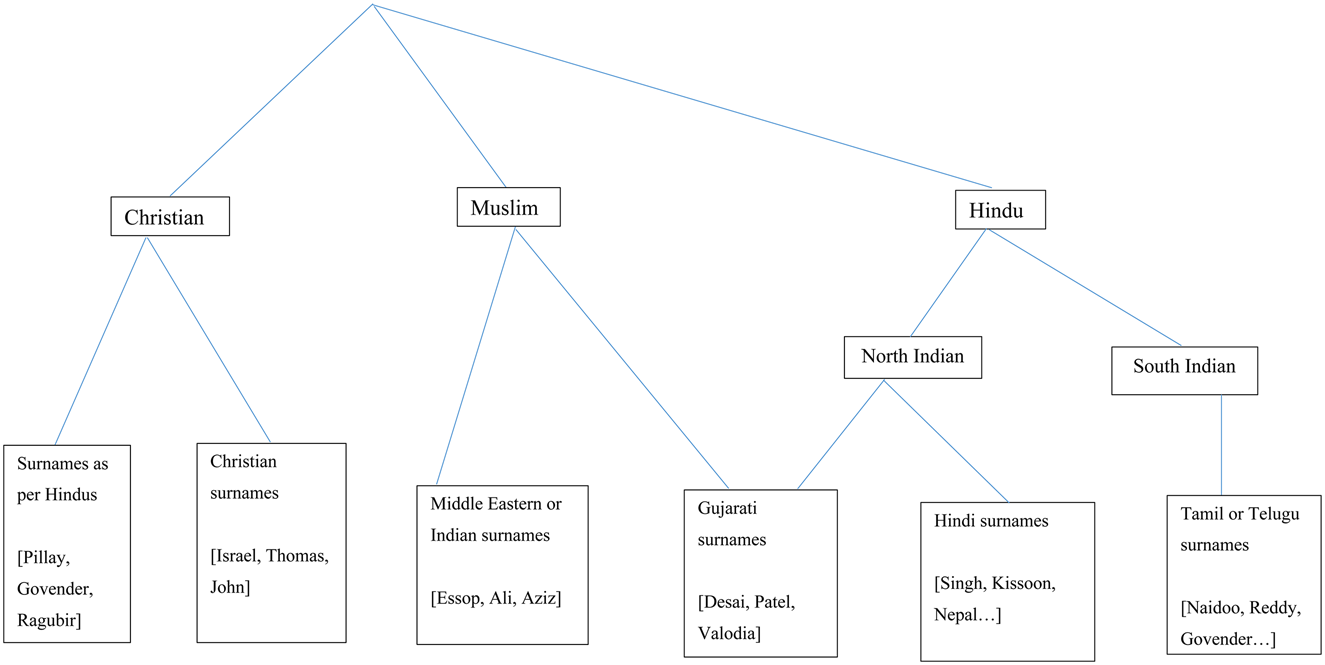
Using these surnames to decide which subgroup a first name belongs to is thus not circular, since the surnames are now fixed. At the highest level (see Figure 1) it is possible to separate Muslims and Hindus via their surnames (e.g. Khan is a Muslim surname, Naidoo is a Hindu surname—though some overlaps involving Gujarati surnames are discussed below). Within the majority Hindu religious grouping, three subgroups are easily identifiable via the surnames: (a) South Indians (of Tamil or Telugu ancestry e.g. Naidoo, Pillay), (b) Gujaratis (e.g. Patel, Hargovan), and (c) people of Hindi ancestry (e.g. Chaudhary, Batohi).Footnote 20 A few surnames are shared between Gujaratis and the Hindi group (e.g. Harilal), but most are distinctively one or the other. An individual with a surname like this had to be excluded from this study if from the anonymous data base (b), but not if from the other two, since the ancestral background is easily retrievable from the interview data and Indian language school lists. There were five such exclusions. Some distinctively Gujarati surnames may apply across religion to Muslim or Hindu families (e.g. Patel, Desai) and described further below in terms of exclusions. It is not possible to isolate affiliation to a Telugu rather than Tamil ancestry purely from the surnames (Prabhakaran Reference Prabhakaran1992). This information is summarised in Figure 1 below.Footnote 21
Patterns of differentiation and overlap for surnames among Indian South Africans.

The independent variables in the main statistical focus on historical change in first names are as follows.
(i) Religion: Muslim versus non-Muslim, with data sets (a) and (c) allowing differentiation of non-Muslims into Hindu and Christian;
(ii) (ii) Linguistic group: primarily by North versus South Indian origins; and secondarily within the North Indian group by Gujarati versus Hindi ancestral language affiliation;Footnote 22
(iii) Sex: to anyone familiar with community norms, male and female personal names are easily distinguishable from each other without signs of encroachment, and can therefore be tracked for possible differences in degrees of change according to the parameters ‘traditional’ versus ‘nontraditional’. (The only sex-ambiguous name was Kiran, all five instances of which were excluded);
(iv) Social class is a parameter which has some relevance to the patterns of innovation or retention. It could not be studied from the main data set (b), as the surnames do not in themselves indicate social class, and using indirect criteria like type or location of school is in my experience not a strong diagnostic. Hence social class is dealt with separately via data set (a).
The coding for the dependent variables were as follows: 1 = traditional Indian name (Hindu or Muslim); 2 = nontraditional Indian name. Within 2 we differentiate between 2a = neo-Indian or adapted Indian name and 2b = Western name. For finer discrimination, category 1 is subdivided into 1a (‘traditional name historically associated with North Indian culture’), 1b (‘traditional name historically associated with South Indian culture’), and 1c (‘traditional name historically associated with Islamic culture’). This subdivision enables one to track the mutual influences across these categories in South Africa.
Table 1 gives the four most common names in this study in four relevant categories and the number of tokens (in which spelling variants are included).
Most common first names in data set (a) by religion and patterns of innovation.

There are some final grey areas, which have to be addressed before any classification for quantitative purposes can be accepted. Two currently very common names, Nikita and Natasha, may seem innovations from the Western side, but are in fact also traditional Indian names—Nikita from Sanskrit ‘house, habitation, temple’ and Natasha, etymologically from Nataraj (an alter nomen for Shiva) plus Asha (Sanskrit ‘wish, desire, hope’). However, this name usually has a Western pronunciation in South Africa—[nəˈtæʃə:] rather than Indian [na.ˈʈɑ:s.ɦɑ:].Footnote 23 Nikita was thus treated as 2 (‘North Indian’) while Natasha was coded as ‘not sure’ (and therefore excluded).Footnote 24 There are other names which may at first sight appear Western, but are in fact departures from an older pronunciation or spelling. Thus Tylin, which is from Thayalin or Dayalin (meaning ‘kind, compassionate’ in Tamil), does not count as ‘Western’. Nor does it count as traditional, given its un-Tamil pronunciation—[ˈthaɪlən] rather than [tɑjɑ:lɑn]. Hence it falls into the intermediate category—that is, neo-Indian. Similarly, Teagan while appearing Western is related to the Tamil form Thiyagan (meaning ‘sacrifice’).
As noted above there were five exclusions when the expected home/ancestral language could not be determined from the surname alone. There was one additional instance when the religion could not be deduced. Another twenty-three individuals of Gujarati background were omitted, even though it was possible to specify their ancestral language and religion with near certainty. These individuals carry surnames (Desai, Patel, Paruk) that have been adopted or retained by both Hindus and Muslims. As such, the surname does not allow us to deduce the religious background of the individual student. Examining the first name in addition to the surname however, does make it almost entirely certain what the religious background would be (Suleiman Patel is Muslim, Harish Patel is Hindu). However, these twenty-three names were excluded, since it would be technically circular to use a first name (a dependent variable in the study) to infer religion (an independent variable) and then proceed with a correlation.Footnote 25
Checking procedures
Initial coding was done by the author, with several checking procedures undertaken to ensure further consistency of judgements. Firstly, two academics and a priest from India with expert knowledge of Sanskrit, modern Indian languages, and current and past Indian names were consulted for their special knowledge. They served to corroborate most of my categorisations and correct a few impressions. Secondly, five priests or office bearers of different Hindu societies, one Christian pastor, and one Muslim imam, who had all been born in South Africa, provided their input. Thirdly, three Indian South African acquaintances of mine from the Durban area, with no knowledge of linguistics but wide community experience, were given a selection of 200 names to indicate which religion and linguistic groups they would associate them with. They showed almost total agreement with the authors’ own judgements. A fourth checking procedure was to subject all but the most obviously Western names (Ryan, Michelle, Darryn, Elaine) to a Google search to ensure that the judgments about ‘traditional’ versus ‘neo-Indian’ and in some cases ‘Western’ were correct. Given the ubiquity of young peoples’ ‘virtual existence’ today, every such name searched had South African hits, ranging from one to a few score. A clear confirmation of being a traditional Indian name rather than a likely South African innovation was whether it had, in addition, hits with addresses in India. This procedure also helped determine whether a name was Western or not, in cases where there was some doubt—for example, Triona, which turned out to be Western (and based on Catriona). To illustrate: Indian South African names like Krishnaveni and Satish turned up scores of different surnames on Google in India as well as South Africa. These were easily categorisable as 1 (traditional).Footnote 26 In contrast, names like Kubashni and Prinolan returned no Google hits from India at all, and a small number of hits—with different surnames (fifteen and five respectively)—in South Africa. These are therefore categorised as 2a (neo-Indian).Footnote 27
THE STATISTICAL RESULTS
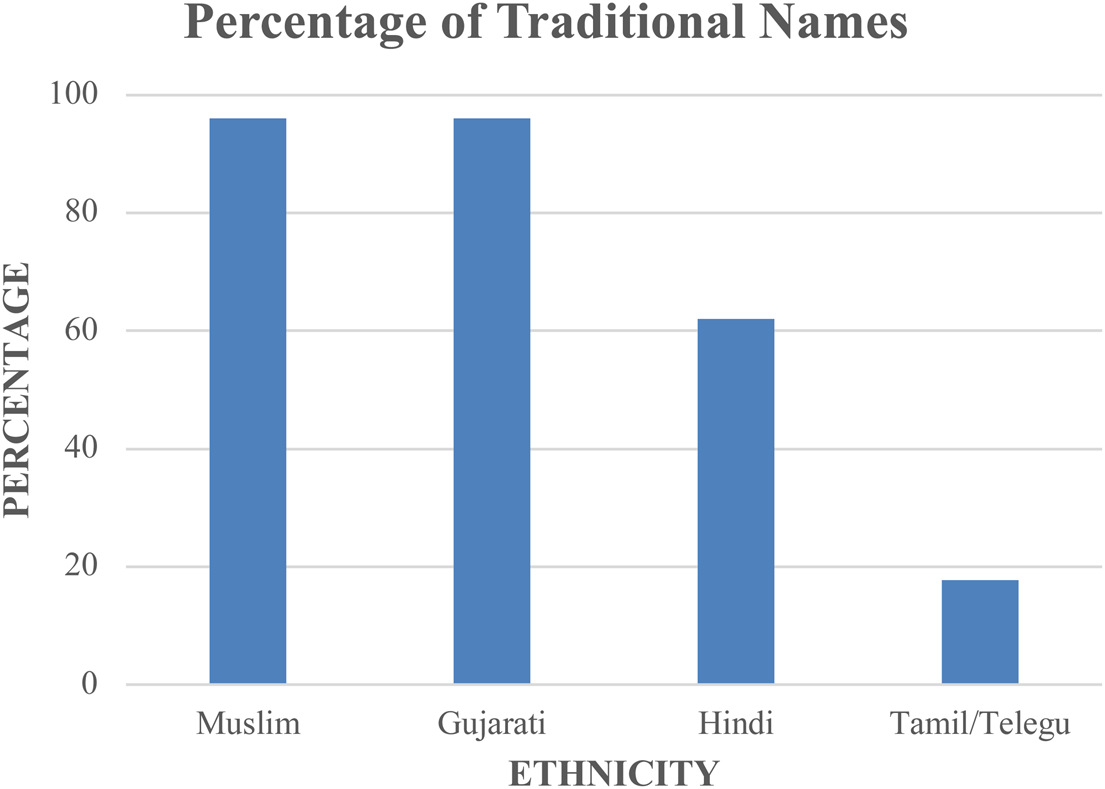
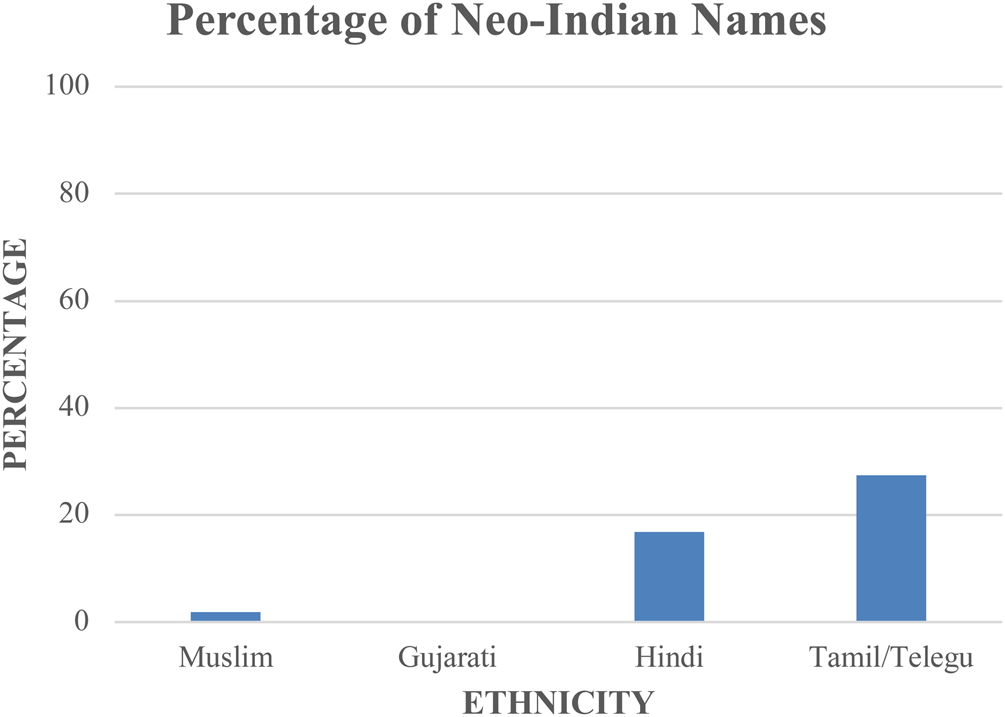
I first present a raw percentage count of the 2,169 first names in data set (b) according to the major independent variables in Table 2. Figures 2–4, based on Table 2, give a graphic indication of the differential preferences among four social groupings derivable from the surnames.
Percentage of traditional first names in four social group.

Percentage of neo-Indian first names in four social groups.

Percentage of Western first names in four social groups.

Proportion of traditional, neo-Indian, and Western first names in four subgroups by religion and ancestral language (N = 2,146; Pearson's Chi-squared test = 923.72, df = 6, p-value < 0.0001).Footnote 28

The p-value of < 0.0001 in Table 2 shows overwhelming statistical significance for Hypotheses 1 to 3, viz.:
-
Hypothesis 1 is confirmed in Table 2: among Muslims 96% of names are traditional and among Gujarati Hindus 96% of names are traditional.Footnote 29
-
Hypothesis 2 is confirmed in Table 2: among Hindi-aligned families 62% names are traditional.
-
Hypothesis 3 is confirmed in Table 2: among families of South Indian ancestry 18% of names are traditional.
The results thus show that the first names of Muslims in the data base are almost entirely traditional, those of Gujarati Hindus are almost entirely traditional, while the other groups are more varied. A majority of Hindi-aligned families still choose traditional names (or at least chose them for their children at birth in the late 1990s), but 17% of the names in this segment were neo-Indian and 20% Western. The South Indian group moves even further away from the traditional naming pathways. Only 18% of the names in this segment of the data base were traditional, another 28% were neo-Indian and 54% Western. The very low proportions of Hindu names here arguably goes beyond the proportion of converts to Christianity, as I demonstrate below. The overall distribution in the various subgroups can be explained by a mix of factors to do mainly with changing ideologies and contact with the ancestral country, and is discussed in the conclusion.
We now investigate how traditional Indian names are diffusing across the main social groups identified, this time leaving out the Western names. Table 3 shows an asymmetry in relation to whether names continue to be chosen from one's ‘own’ traditional language group or from what are historically associated in South Africa at least with another of the Indian subgroups (see discussion at end of Traditional naming patterns in India). The second row in Table 3 records the number of names (as tokens, not types) adopted by one group from another Indian subgroup. The Gujarati and Hindi groups record nil, or close to nil here; while the South Indian group shows 38.5% for choosing traditional Indian names that a generation ago were associated with North Indian Hindu groups.
Proportion of traditional names adopted from ‘own’ versus another Indian subgroup (N = 1,027; Pearson's Chi-squared test = 295.88, df = n/a, with simulated p-value = 0.0005 based on 2,000 replicates).

Table 4 does the same for neo-Indian names, checking whether the prototype for each innovated Indian name was originally associated in South Africa with North or South Indian naming traditions. This type of name shows similar asymmetric accommodation patterns: 21.4% (n = 299) among South Indian families, for example, Ronitha (f) and Prinesh (m), and only 2.1% (n = 96) among North Indian families, for example, Lishen (m). So Hypothesis 6 concerning asymmetric accommodations is borne out.
Proportion of neo-Indian names adopted from ‘own’ subgroup or another Indian subgroup (N = 403; Pearson's Chi-squared test = 21.407, df = n/a, with simulated p-value = 0.0005 based on 2,000 replicates).

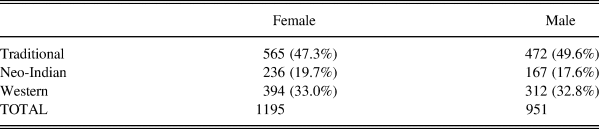
We now test Hypothesis 7—that the proportions of names in the categories traditional, neo-Indian, and Western are roughly the same for both sexes in the sample of names. Table 5 gives the relevant overall breakdown. The percentages in the table look very similar for males and females in each category, and this is confirmed by the Chi-squared test results which return a nonsignificant p-value of 0.3751. Hypothesis 7 is thus confirmed by Table 5: there are no sex differences in patterns of innovation.
Proportion of traditional, Neo-Indian, and Western names in two subgroups by sex (N= 2,146; Pearson's Chi-squared test = 1.961, df = 2, p-value = 0.3751).

FURTHER INSIGHTS FROM THE SUPPLEMENTARY DATA BASES
This section briefly covers hypotheses and assumptions that could not be answered by data set (b), the large but relatively one-dimensional list of names. The remaining data sets—(a) and (c)—fill in some gaps, at a nonstatistical level because of their small size or special nature. To repeat briefly, these claims were that Christian families bestowed entirely Christian/Western names for their children (Hypothesis 4); that working-class Hindu families show a greater preference for Western names than their middle class counterparts (Hypothesis 5). We also double check an assumption underlying Hypothesis 7 (that there was no difference over patterns of naming by sex of the child). The assumption was that children's names were not gender neutral and hence that identifying sex of an individual from lists of names (as in Table 5) was unproblematic.
A closer look at religion and Western first names
The interview data set (a) confirms that people who were born Christian had Western first names (n = 5 out of 5), constituting support (but not proof) for Hypothesis 4. Two youngsters who had recently converted to Christianity in their teenage years had kept their Hindu names. (This is one aspect that data set (b) does not offer information on.) The interview data set also strongly confirms that a number of Hindu youngsters had been given Western first names at birth (n = 10 out of 29). This did not apply to Muslims (n = 0 out of 9). Within the Hindu set, Western names were most common among families of Tamil ancestry (n = 6 of 14),Footnote 30 less common among families of Hindi ancestry (n = 3 out of 13), and not found among Gujaratis (n = 0 out of 2).Footnote 31
A further look at the spread of Western first names among Hindus
Data set (c) comprises the records of part-time schools teaching Tamil, Telugu, or Hindi. It thus enables us to study first names among Telugu families as distinct from Tamil ones. The Andhra Maha Sabha (Telugu Cultural Society), whose students are entirely Hindu, supplied me with lists of students from their records of Durban branches for the years 1998–2001, which enabled me to work with 239 names.Footnote 32 The proportion of students with Western first names was 13.39% (thirty-two out of 239 names). For Tamil I was given access to the records for 2015 of one relatively large school in Durban which offers part-time Tamil language and culture classes. A total of 102 names from twelve different grades showed thirty-one (or 30%) Western first names. For children with Hindi as ancestral language, the records of the Hindi Shiksha Sangh (Hindi Teaching Society) of 2016 show thirty Western names out of a possible 4,175 children enrolled nationally, a miniscule 0.7%.Footnote 33 Although these records are disparate, I believe that they add to the picture suggested by the main data set regarding religion. Hindu families that send their children to cultural and language classes do show investment in traditional and neo-Indian names. With the Hindi segment this is near categorical. Western names do turn up in larger numbers in such Hindu families of Tamil and Telugu background (and one can conjecture that the proportion of Western names would be even higher in families that do not show this cultural investment in special part-time language and cultural classes). The percentages above suggest the possibility that within the South Indian group, families of Tamil ancestry are ahead of those of Telugu ancestry in adopting Western personal names.
Filling in the gaps on social class
My expectation of a class effect (Hypothesis 5) in choosing Western names over traditional Hindu names is borne out from the data set (a) of interviews. First, we need to factor out Christians, who almost always bestow a Western/Christian name at birth (n = 5 out of 5), from Muslims (n = 0 out of 9), and Gujarati Hindus (n = 0 out of 2), who almost always never do. The remaining twenty-seven (Hindus by birth) show 64% of traditional names in middle class families (n = 9 out of 14) and a much lower 38% in working class ones (n = 5 out of 13). Conversely, for Western names the percentages are 14% in middle class families and 54% in working class ones.Footnote 34
Confirming the sex-based nature of names from the interview data base
The interview data base (a) allows us to check the assumption made above that the sex of an individual can be reliably inferred from first names. Of the forty-three names, none were sex ambiguous within any of the three naming traditions (Hindu, Christian, Muslim). This gives supporting evidence for the assumption made in arriving at sex-based statistics (see Table 5 above).
CONCLUSION
Overall, we note no encroachment between Hindu and Muslim first names, and between Christian and Muslim first names. Muslims form an onomastic island. The reverse flow does not occur. Within the Hindu group, Gujarati-aligned families are almost an island, they do not adopt Christian names or names associated with South Indian Hindu heritage. However, they do continue to share first names with other North Indians of Hindi ancestry—for example, Roshan (m), Priyanka (f). The remaining Hindus—a majority—prove more permeable as demonstrated via the tables and Figures 2–4.
We may ask what the motivations are for these different trends in the subgroups surveyed. Muslims show the continuing high impact of religion in their cultural practices (irrespective of social class). It is of little surprise, then, that their naming practices in diaspora remain traditional. Conversion to other religions is frowned upon, and incoming converts are expected to take on an Islamic name. With Hindus, traditional naming practices are diluted by the attractiveness of Western names, even among the unconverted. Within the Hindu group, Gujaratis show the least influence from Western or Christian names (and almost no conversions to Christianity). As a mostly trading and professional class they have maintained relatively strong ties with India (F. Meer Reference Meer1969:15–23). Hence their continued favouring of Hindu names. The remaining communities show a greater degree of Westernisation consequent upon the experience of indenture (1860–1911) as well as the subsequent receptivity to Western education (Mesthrie Reference Mesthrie1992b). Even among those who adhere strongly to their original Hindu religion and culture, Western first names prove hard to resist, most especially as we have seen among families of South Indian ancestry (but amenable to class differences). For many of them it is the surnames that now appear to carry the historical and cultural associations of being Indian South Africans of Tamil or Telugu ancestry (a good example of ‘sedimentation’ or ‘grounding’). The first names, in contrast, are freed up to enable parents to imagine a new belonging, not to (mostly) working-class Durban of Indian origin, but to upper-class or successful, globalised Euro-America. The subcommunity with Hindi as ancestral language is somewhere in between. In being strongly (but not fully) receptive to Hindu names, they show the continuing attraction of religious and cultural practices marked in India as more ‘national’ than ‘regional’ (including watching Bollywood films). But they also find it hard to ignore the globally attractive Christian names and perhaps the westernising influence of their Tamil-aligned, working-class friends in Durban altogether.
This analysis of names overall shows their potential to unlock complex indexicalities underpinning change in a multilayered diasporic field, one in which descendants from different ancestral areas of a former homeland have merged loosely into a new community. The data base gives ample evidence of cultural maintenance as well as innovation. Between the poles of classical tradition and innovative global modernity are the hybrid practices that combine a Western and an Indian orientation. The data does exemplify the invisible sense (Ainiala Reference Ainiala and Hough2016) that gives rise to new fashion trends. Individualistic acts of naming create echoes or dialogues with those of others and relate to new forms of subethnic and geographical coherence. In particular, the neo-Indian first names now have a distinctive Google presence, localised largely (or ‘sedimented’) to South Indian heritage in South Africa.