Introduction
The Sahiwal cattle belong to a group of large Zebu breeds that are generally classified as dual purpose. The breed is mainly utilized for milk and beef production because it has relatively high milk production and growth performance compared with other Zebu cattle breeds (Trail and Gregory, Reference Trail and Gregory1981; Muhuyi, Lokwaleput and Sinkeet, Reference Muhuyi, Lokwaleput and Sinkeet1999; Joshi, Singh and Gandhi, Reference Joshi, Singh and Gandhi2001). The Sahiwal breed has evolved in harsh and diverse tropical environments and carries unique adaptive capabilities that make it relatively competitive in terms of production and adaptation under low-input production systems (Muhuyi, Reference Muhuyi1997; Philipsson, Reference Philipsson, Galal, Boyazoghu and Hammond1999; Joshi, Singh and Gandhi, Reference Joshi, Singh and Gandhi2001). The breed has been spreading to various tropical regions and comes second to the Brahman in terms of distribution among the Zebu breeds of South Asian ancestry (FAO, 1992; Joshi, Singh and Gandhi, Reference Joshi, Singh and Gandhi2001; Mulindwa, Ssewannyana, Kifaro, Reference Mulindwa, Ssewannyana and Kifaro2006; Hatungumukama and Detilleux, Reference Hatungumukama and Detilleux2009). Previous studies on the Sahiwal cattle breed have mainly focused on performance evaluation. Furthermore the existing reports mainly describe the breed characteristics, highlighting only the desirable attributes. There is no literature study that collates and critically examines information from the various countries on the strengths and shortcomings in the existing breeding and conservation strategies. This study was therefore designed to critically examine breeding and conservations programmes of Sahiwal cattle genetic resources in the tropics, focusing on Pakistan, India and Kenya as locations of main development and distribution. The purpose of this study was to identify shortcomings and strengths in the existing strategies, and opportunities for genetic improvement and conservation. In this paper, the term Sahiwal genetic resources is used to refer to both Sahiwal and its crosses with other cattle breeds.
Study methodology
This study was based on review of both published and unpublished literature concerning Sahiwal cattle breeding and conservation programmes in the tropics. The review mainly focuses on the weaknesses and strengths of existing programmes, and identified opportunities that could enhance breed improvement, utilization and conservation. Information was sourced from journal articles, project and institutional reports, and discussions with key resource persons. Specific information on use values and performance of Sahiwal cattle is highlighted. Breeding and conservation programmes in Pakistan, India and Kenya are specifically described, with emphasis on within country improvement and conservation strategies. A general discussion is dedicated to identifying some of the strengths and opportunities within country strategies that would enhance sustainable utilization and conservation efforts. It should be noted, however, that this review might not have captured all other breeding and conservation programmes for the Sahiwal breed in the tropics. This would be expected because breeding and conservation programmes may be existing in other regions but seldom reported through the conventional avenues. The difficult in finding published information on livestock breeding programmes described in sufficient detail in the tropics has been acknowledged (Rege et al., Reference Rege, Kahi, Okomo-Adhiambo, Mwacharo and Hanotte2001; Kahi, Rewe and Kosgey, Reference Kahi, Rewe and Kosgey2005).
Breed description, uses and performance of Sahiwal cattle in the tropics
The Sahiwal breed is commonly of a reddish dun colour with more of a dark-brownish colour around the hump and neck (Muhuyi, Lokwaleput and Sinkeet, Reference Muhuyi, Lokwaleput and Sinkeet1999; Ojango, Malmfors and Okeyo, Reference Ojango, Malmfors and Okeyo2006). In males, the colour darkens towards the extremities (i.e. head, legs and tails), while females maintain the reddish coat colour. Sahiwals have a characteristic large, long and drooping ears; skin coat is generally smooth and shiny especially during hot-weather conditions. Males attain a wither height of about 140 cm with a well-developed thoracic hump that is normally perpendicular to the backline (Muhuyi, Lokwaleput and Sinkeet, Reference Muhuyi, Lokwaleput and Sinkeet1999). Females are about 120 cm at maturity, they have large udders compared with other Bos indicus breeds and large unevenly distributed teats. Compared with other Zebu cattle breeds, Sahiwal are generally docile and of low temperament, characteristics that allow them to be milked in the absence of calf (Kimenye, Reference Kimenye1978).
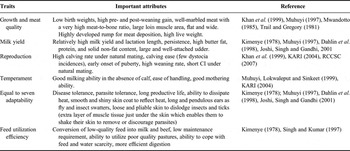
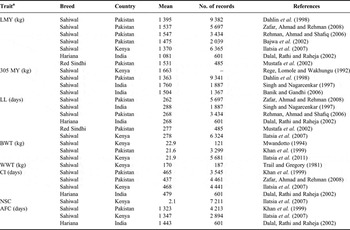
Some of the traits description and their corresponding attributes that have traditionally been considered important for Sahiwal cattle in the tropics are summarized in Table 1, whereas Table 2 shows performance estimates of various production and reproductive traits of Sahiwal cattle and other selected Zebu cattle breeds in the tropics. Sahiwal cattle generally possess attributes and characteristics that make them relatively competitive under highly challenging low-input production systems in the tropics. However, it is important to note that there are other indigenous Zebu cattle breeds that are relatively more adapted to specific production systems, a fact that demonstrates clear trade-offs between the Sahiwal genetic resources and such breeds with regard to productivity and adaptability. For example, in a recent study on the role of Sahiwal genetic resources in pastoral production systems in Kenya, Roessler, Ilatsia and Valle Zárate (Reference Roessler, Ilatsia and Valle Zárate2010) and Ilatsia et al. (Reference Ilatsia, Roessler, Kahi and Valle Zárate2010) reported that pastoralists rated Sahiwal genetic resources highly with regard to production and fertility traits but were more apprehensive of their disease, parasite and drought tolerance relative to the local East African Zebu breed. Such trade-offs need to be taken into account when making consideration of the various options for designing breeding programmes, because cattle keepers in low-input production systems prefer mixed-breed herds, attaching to each breed involved different trait profiles depending on their desired production objectives (Valle Zárate, Reference Valle Zárate1996). Thus, the future breed planning and organization should take a comprehensive account of the breed attributes that capture the full array of contributions of Sahiwal genetic resources to producers' livelihoods.
Production and functional traits of Sahiwal cattle and some of their related attributes.

Performance estimates for production and reproductive traits of Sahiwal cattle in the tropics.

aLL, lactation length; LMY, lactation milk yield; 305 MY, 305 day adjusted milk yield; CI, calving interval; AFC, age at first calving; NSC, number of services per conception; BWT, birth weight; WWT, weaning weight.
According to the livestock sector strategy of the Government of Punjab and the Agricultural Census Organization in Pakistan, Sahiwal genetic resources are among the leading sources of milk in Pakistan, coming second to buffaloes in domestic milk supply in Punjab province which is home to nearly half of the Pakistan population (Agricultural Census Organisation, 2006; Khan et al., Reference Khan, Rehman, Khan and Ahmad2008; Government of Punjab, 2010). In Kenya, Sahiwal genetic resources are mainly kept by pastoralists, private and government ranches, and by a few smallholder dairy farmers for domestic milk production and revenue generation through sale of live animals and surplus milk (Muhuyi, Reference Muhuyi1997; Bebe et al., Reference Bebe, Udo, Rowlands and Thorpe2003; Roessler, Ilatsia and Valle Zárate, Reference Roessler, Ilatsia and Valle Zárate2010). Sahiwal bulls and semen have been exported from Kenya to several other East and Central African countries for crossing with various local Zebu breeds for milk production as well as provision of farm power (KARI, 2004; Mulindwa, Ssewannyana, Kifaro, Reference Mulindwa, Ssewannyana and Kifaro2006; Hatungumukama and Detilleux, Reference Hatungumukama and Detilleux2009). In India, Sahiwal and their crosses are raised by smallholder farmers, government and private nucleus farms mainly for dairy production (Joshi, Singh and Gandhi, Reference Joshi, Singh and Gandhi2001; Singh, Kumar and Varma, Reference Singh, Kumar and Varma2005). Previous organized cross-breeding programmes involving the Sahiwal and mainly European breeds have been used to develop synthetic breeds in India. For example, the Karan Swiss and Frieswal have been developed through several years of crossing the Sahiwal to the Brown Swiss and Friesian breeds, respectively (Singh and Gurnani, Reference Singh and Gurnani2004; Gaur et al., Reference Gaur, Kumar, Singh, Rathi, Singh and Biswas2006; NDRI, 2007). The synthetic breeds have shown the advantage of combining the high-production levels of the European breeds and adaptation of the Sahiwal on a sustainable basis for dairy production under smallholder production conditions (Kahi et al., Reference Kahi, Thorpe, Nitter and Baker2000; Singh and Gurnani, Reference Singh and Gurnani2004; Gaur et al., Reference Gaur, Kumar, Singh, Rathi, Singh and Biswas2006).
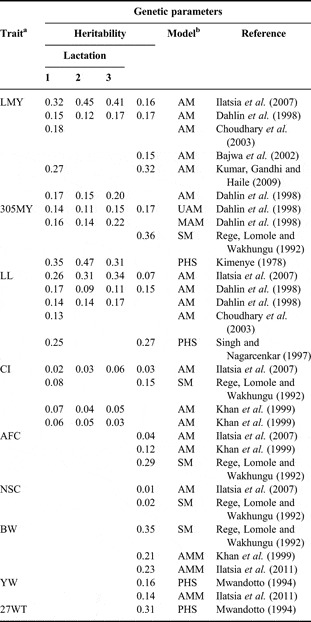
Performance and genetic parameter estimates for various production and reproductive traits of Sahiwal cattle are presented in Tables 2 and 3, respectively. Differences in performance estimates reflect diversity in the gene pools and influence of environmental conditions and production circumstances. Most of these studies were, however, based on data collected from institutional herds, where production conditions might be quite different from the commercial herds. Furthermore, datasets used in the studies were very limited (Table 2), a fact that could cast doubt on the accuracy and reliability of some of the estimates. However, lack of proper recording systems is widely acknowledged as a major challenge in achieving comprehensive performance evaluation in developing countries (Wasike et al., Reference Wasike, Magothe, Kahi and Peters2011). Slow and undesirable genetic progress has been reported in the breeding goal traits of Sahiwal cattle in the tropics despite selection emphasis on these traits (Dahlin et al., Reference Dahlin, Khan, Zafar, Saleem, Chaudhry and Philipsson1998; Khan et al., Reference Khan, Dahlin, Zafar, Saleem, Chaudhry and Philipsson1999; Rehman, Ahmad and Shafiq, Reference Rehman, Ahmad and Shafiq2006; Ilatsia et al., Reference Ilatsia, Muasya, Muhuyi and Kahi2007). This has been attributed to low selection intensities within the small herds, poor production conditions and high mortalities, inappropriate evaluation procedures and inbreeding depression that may emasculate genetic potential of breeding animals. Inbreeding depression has been reported on some performance traits in stationed maintained Sahiwal cattle populations in Kenya (Rege and Wakhungu, Reference Rege and Wakhungu1992) and Pakistan (Iaved, Mohiuddin and Abdullah, Reference Iaved, Mohiuddin and Abdullah2001).
Heritability estimates for productive and functional traits of Sahiwal cattle in the tropics.

aLL, lactation length; LMY, lactation milk yield; 305 MY, 305 day adjusted milk yield; CI, calving interval; AFC, age at first calving; NSC, number of services per conception; BW, birth weight; YW, yearling weight; 27MWT, weight at 27 months.
bUAM, univariate animal model; MAM, multivariate animal model; PHS, paternal half-sib correlation; SM, sire model; ICC, intra-class correlation; AMM, animal-maternal mode.
Breeding and conservation programmes
Sahiwal genetic resources are distributed in 27 countries in Asia, Africa and the Caribbean (Joshi, Singh and Gandhi, Reference Joshi, Singh and Gandhi2001; FAO, Reference Rischkowsky and Pilling2007). Pakistan, India and Kenya are endowed with the majority of pure-bred Sahiwal cattle and have actively been involved in breeding and conservation programmes. This section will therefore focus on documented breeding and conservation programmes in these three countries. It should be noted, however, that other programmes might have been developed in other regions but have not been reported.
Pakistan
The Sahiwal breed originated in the arid subtropical Indus region of the Punjab province (Dahlin et al., Reference Dahlin, Khan, Zafar, Saleem, Chaudhry and Philipsson1995). It was raised in nomadic pastoral systems by the indigenous people for dairy production. However, increased irrigation activities in this region in the 1910s displaced the Sahiwal breed, as farming communities preferred Hissar and Haryiana breeds for draft power (RCCSC, 2007). Pakistan has a national database for various livestock species and breeds; however, there are huge disparities in reported population figures for the Sahiwal cattle breed. According to the country report submitted to the FAO, Pakistan has estimated 0.35 million Sahiwal cattle (Government of Pakistan, 2003). This estimate is far below that of the recent livestock population census published by the Agriculture Census Organization which indicates a population of approximately 2.7 million Sahiwal cattle, out of which approximately 80% (2.0 million) are found in the Punjab state province alone (Agricultural Census Organisation, 2006). The reasons underlying these huge discrepancies in the estimates cannot be discerned; however, it is possible that both estimates could have either included or excluded some non-descript breed types and other Sahiwal derivatives. It is possible that the population census results could include figures arising from inaccuracies and inconsistencies on the farmer's and enumerator's side in breed identification especially where documented pedigree information is lacking.
Strategic breeding and conservation programmes have been operational in Pakistan for the last three decades. This could be traced to previous collaborative research programmes involving the FAO, the Pakistan Research Council and the Swedish University of Agricultural Sciences which recommended the establishment of a genetic improvement and conservation programme for the breed in Punjab (FAO, 1992; Dahlin et al., Reference Dahlin, Khan, Zafar, Saleem, Chaudhry and Philipsson1995). This was in recognition of the economic contribution of the breed to rural livelihoods, as well as the threat posed to the future of the breed due to indiscriminate cross-breeding and changes in agricultural systems. This initiative culminated in the recent establishment of the Research Centre for Conservation of Sahiwal Cattle (RCCSC) by the Punjab state government (RCCSC, 2007). The RCCSC has the statutory mandate to register Sahiwal cattle, carry out performance recording and genetic evaluation and to conduct strategic research, in collaboration with national and international research organizations, for genetic improvement and conservation of the breed. Currently, the centre has 24 sub-centres in Punjab which host more than 11 000 registered breeding cows. It also provides artificial insemination (AI) and extension services, and coordinates various disease and parasite control programmes as incentives to Sahiwal producers to participate in the breeding and conservation programmes (RCCSC, 2007). The livestock sector strategy for the government of Punjab state has also prioritized the Sahiwal cattle breed among other indigenous livestock breeds for further genetic improvement and conservation (Government of Punjab, 2010).
Pure breeding is mainly implemented within government and private farms (Dahlin et al., Reference Dahlin, Khan, Zafar, Saleem, Chaudhry and Philipsson1998; Khan et al., Reference Khan, Dahlin, Zafar, Saleem, Chaudhry and Philipsson1999; Bajwa et al., Reference Bajwa, Khan, Ahmad and Gondal2002; Bhatti et al., Reference Bhatti, Khan, Rehman, Hyder and Hassan2007). The breeding programme depicts an open nucleus breeding system where the RCCSC-coordinated nucleus herds are the main source of breeding animals for other medium and smallholder livestock farms (RCCSC, 2007). Transfer of genetic superiority is mainly realized through AI where superiority of candidate breeding bulls for milk production is evaluated based on a progeny testing (PT) programme (RCCSC, 2007). Multiple ovulation and embryo transfer (MOET) is used to enhance reproductive rates of promising breeding cows (RCCSC, 2007). The RCCSC herds and other private herds form in situ conservation units. These farms are also the source of semen and embryos which are frozen and stored for future use.
Indiscriminate crossing remains a major challenge to conservation of the Sahiwal cattle breed in Pakistan (FAO, 1992; Dahlin et al., Reference Dahlin, Khan, Zafar, Saleem, Chaudhry and Philipsson1995; Government of Pakistan, 2003). To forestall this, the Pakistan government has formulated breeding policies and regulations that prohibit crossing of the Sahiwal cattle with exotic dairy cattle breeds (Government of Pakistan, 2003), but allows cross-breeding of non-descript populations with exotics breeds. However, enforcement of these regulations has not been fully achieved because of lack of clear mechanisms for their implementation. This could be because breeding and mating decisions are made by individual farmers targeting at the best genetic solution for their farm, which might not always coincide with conservation purposes, unless incentives are given. Further, it may be difficult for farmers to discriminate among which cattle breeds to use in crossing. The net consequence has been that illicit cross-breeding is further predominating leading to erosion of Sahiwal cattle genetic resources.
Both private and government stakeholders are involved in the breeding programme at various levels. However, our study did not find evidence of the technical efficiency, in terms of economic and genetic sustainability, of the existing breeding programme organization. Furthermore, formal breeding goals that reflect the production objectives and breeding aims of the various Sahiwal producers are not documented notwithstanding that Sahiwal genetic resources play different roles alongside other cattle breeds. In addition, the existing breeding programme prioritizes lactation performance and fertility (as a proxy for adaptation) without clear evidence of how other important functional attributes are accounted for.
Nonetheless, the RCCSC could be regarded as a model conservation programme for the Sahiwal breed in the tropics where both human and financial capital has been concentrated to enhance breed conservation and utilization. The expertise at the RCCSC, together with other collaborating institutions provides a platform for consolidating efforts towards developing appropriate breeding schemes involving the various producers. The active involvement of the farmers and private farms in the genetic improvement and conservation programme also provides an opportunity to set up a more inclusive breeding programme and organization with improved chances of sustainable success. The active Sahiwal cattle breed Society in Punjab organizes regularly exhibitions aimed at promoting the breed among producers (RCCSC, 2007).
India
Unlike in Pakistan, our study did not find a national database indicating the population estimates of Sahiwal cattle in India. Nonetheless, there exist breeding and conservation programmes in the country. A pure breeding programme is implemented in 12 state-owned farms receiving technical support from the National Dairy Research Institute (NDRI) (Joshi, Singh and Gandhi, Reference Joshi, Singh and Gandhi2001; NDRI, 2007). The contributions of the NDRI in the breeding programme are similar to those carried out by the RCCSC in Pakistan and mainly involve coordination of performance recording, genetic evaluation and dissemination of genetic material to the farmers (Joshi, Singh and Gandhi, Reference Joshi, Singh and Gandhi2001; NDRI, 2007). The breeding goal mainly focuses on increased milk production. This is achieved through a performance testing programme based on recorded lactation milk yield of daughters of candidate bulls, supported by AI and a MOET programme (NDRI, 2007). There is no evidence of whether adaptation to local production conditions is also considered as an important breeding goal. Furthermore, similar to the case of Pakistan, there was no clear evidence of how the breeding organization involving the governmental herds is planned for sustainable genetic improvement and conservation.
In situ conversation is mainly concentrated in the 12 government maintained herds where less than 2000 breeding animals are hosted (Joshi, Singh and Gandhi, Reference Joshi, Singh and Gandhi2001; Government of India, 2003). There are also a few Sahiwal herds maintained on religious basis referred to as ‘Gaushalas’ given that cattle are sacred in the Hindu religion (Sadana, personal communication). There are two well-maintained ‘Gaushalas’ at Sirsa in Haryana and Gurudwara in Punjab, each with a herd of approximately 200 Sahiwal cows. Smallholder farmers also keep between 2 and 3 pure Sahiwal cows for milk production (NDRI, 2007). Ex-situ conservation involves cryopreservation of frozen semen and embryos in national gene banks maintained by the NDRI.
Unlike in Pakistan where the breeding policy is prohibitive of crossing Sahiwal cattle with other breeds, various state breeding policies and regulations in India encourage cross-breeding of the breed with exotic breeds for dairy production (Government of India, 2003). Ironically, cross-breeding has been acknowledged as a major contributor to depletion of Sahiwal genetic resources in India (Joshi, Singh and Gandhi, Reference Joshi, Singh and Gandhi2001). This observation could be related to a lack of clear regulatory and monitoring mechanisms of these cross-breeding programmes especially at the farmer level, a situation that increases the tendency towards unplanned crossing.
Kenya
The history of Sahiwal cattle in Kenya dates back to the early 1930s when breeding bulls were imported from India and Pakistan for upgrading the local Zebu for higher milk production and enhanced growth performance under low-input production conditions (Meyn and Wilkins, Reference Meyn and Wilkins1974; Trail and Gregory, Reference Trail and Gregory1981). The promising results of the upgrading programme led to an increase in demand for Sahiwal bulls mainly by the Maasai pastoralists. A decision was taken in 1962 by the government to consolidate breeding activities by collecting the best Sahiwal cows and bulls from various livestock centres to create the National Sahiwal Stud (NSS) (Meyn and Wilkins, Reference Meyn and Wilkins1974). Other private Sahiwal ranches were also established to supplement the NSS (Muhuyi, Reference Muhuyi1997). Currently, there are at least 18 ranch herds that host approximately 7 000 pure-bred Sahiwal cattle with about 1 500 breeding cows (KARI, 2004). Just like in India, there exists no national database showing breed-specific population figures. However, some unpublished reports by field livestock extension officers in the pastoral areas estimate the Sahiwal population at 50 000 with about 170 000 Sahiwal × Zebu cross-breds (MOLFD, 2006).
Pure-breeding and cross-breeding programmes are the main genetic improvement strategies for the Sahiwal breed in Kenya. Pure-breeding programmes mainly involve 18 ranches, besides pastoral herds. Genetic gain is generated in the nucleus herds, mainly through male and to a lesser extent female selection; the transfer of genetic progress to the pastoral herds is realized exclusively through breeding bulls (Muhuyi, Reference Muhuyi1997; Trail and Gregory, Reference Trail and Gregory1981). The primary breeding goals of producers are high milk production, large body size, good fertility and adaptation to local production conditions (Roessler, Ilatsia and Valle Zárate, Reference Roessler, Ilatsia and Valle Zárate2010). However, the suitability as well as genetic and economic sustainability of the currently followed and alternatively suggested breeding schemes reflecting producers breeding goals has not been ascertained.
Conservation of Sahiwal genetic resources in Kenya involve both, in-situ and ex-situ strategies. Government and privately owned nucleus herds act as in-situ conservation units that produce breeding animals for the pastoral herds (Muhuyi, Reference Muhuyi1997). Pastoralist herds also act as in-situ conservation units where Sahiwal cattle genetic resources are reared for both subsistence and commercial purposes. Ex-situ conservation takes place exclusively through preservation of frozen semen at the Central Artificial Insemination Station from superior bulls at the NSS (KARI, 2004). Unlike in the case of India and Pakistan, there is no national breeding policy in Kenya that governs use and development of specific livestock species and breeds. The yet-to-be-operationalized animal breeding policy recently developed by the Ministry of Livestock Development (MOLD, 2009) describes conservation measures only in general terms and gives broader recommendations with no clear or specific policies accounting for the multiple roles that different livestock species and breeds play under various production systems. Nonetheless, there are strengths in the current set-up that could form a basis for establishment of an expanded and more inclusive breeding programme. For example, all the nucleus herds keep some performance and pedigree records that could be combined to form a basis for a coordinated joint selection programme among the nucleus herds. The NSS is a research facility under the Kenya Agricultural Research Institute. This offers an opportunity for effective mobilization of financial and human resources, and other infrastructure to provide the required technical support in implementation, monitoring and evaluation of the breeding programme. The existence of the Sahiwal Cattle Breed Society also offers an opportunity to enhance more coordinated breeding and husbandry activities involving the various producers. However, the current diversity of organizations and recording systems involved and the lack of co-ordination between them has to be regarded as a weakness, which needs to be overcome.
General discussion
Breeding goals and breeding organization
The success and sustainability of the breeding and conservation programmes for Sahiwal cattle genetic resources reviewed will depend not only on the technical quality of the selection process but also on the structures of the breeding organization and how the producers' desired breeding goals are accounted for. Except for the Kenyan case, this study did not find evidence of participatory definition of breeding goals that incorporate producers' production objectives. The existing breeding goals are either informal and narrow (i.e. based exclusively on production) or largely neglect the functional attributes that have defined the uniqueness of the Sahiwal breed under low-input production systems, by only addressing adaptation indirectly through selection on fertility. For the programmes to remain relevant and sustainable, compatibility with the socio-cultural and economic aspects of the producers needs to be ascertained and incorporated into future breed planning (Valle Zárate and Markemann, Reference Valle Zárate and Markemann2010). The present rather marginal and mostly informal involvement of producers in the breeding and conservation programmes in each of the three countries might form a basis for their formal incorporation into the organization. Studies on participatory identification of production aims and breeding goals are already underway in Kenya (e.g. Ilatsia et al., Reference Ilatsia, Roessler, Kahi and Valle Zárate2010; Roessler, Ilatsia and Valle Zárate, Reference Roessler, Ilatsia and Valle Zárate2010); similar or different approaches of farmer participation could be applied in the Indian and Pakistani cases.
The breeding systems reviewed in this study are based on a pyramidal management of the population with the breeders of nucleus herds at the top and participating herds at the lower levels. Performance recording and evaluation are confined in the nucleus herds as a basis for genetic evaluation and selection. However, evaluations are based on data obtained from either single or a few herds (see Table 2) with focus on production parameters while functional traits such as fertility and survival are seldom considered. Future performance evaluation should strive to better co-ordinate existing data sources, extend the traits to be monitored and augment data from the small herds and pastoralists to improve not only data amount and accuracy but also account for possible genotype × environment interactions that might occur when animals are transferred from the stations to the production sector. According to our study, the organization between the various herds and stakeholders is not even, transparent and may require substantial efforts to consider the organizational aspects towards the achievement of optimal economic and genetic success. Professional planning and implementation will be critical in order to achieve optimal benefits from the breeding programmes and also make them more sustainable (Kahi, Rewe and Kosgey, Reference Kahi, Rewe and Kosgey2005).
Cross-breeding
The benefits of cross-breeding strategies involving the Sahiwal breed have sometimes been overstated to an extent that improvement of this breed has been synonymous to cross-breeding. Most of the cross-breeding programmes are not systematic, a scenario that is worsened by either lack of proper policies or in the case of their existence, there is lack of clear regulatory and enforcement mechanisms to ensure that such policies achieve the intended purpose. Strategies that support pure-breeding schemes that produce breeding animals to be used in cross-breeding in a systematic way may be most suitable to combine farmers' preferences with the purposes of breed conservation. This would particularly be important in curbing indiscriminate crossing that is largely blamed for rapid depletion of Sahiwal genetic resources in the tropics (FAO, 1992; Dahlin et al., Reference Dahlin, Khan, Zafar, Saleem, Chaudhry and Philipsson1995; Joshi, Singh and Gandhi, Reference Joshi, Singh and Gandhi2001). Cross-breeding programmes can be carried out in a way that support and not replace pure-breeding programmes. Kahi et al. (Reference Kahi, Thorpe, Nitter and Baker2000) recommended cross-breeding systems for Kenya which are able to raise animal production from low to intermediate levels rather than programmes optimized for production, which are logistically difficult to implement and economically unsustainable. It would therefore be desirable that the Sahiwal cross-breds are not just evaluated in terms of their on-station performance (e.g. Singh, Kumar and Varma, Reference Singh, Kumar and Varma2005; Mulindwa, Ssewannyana, Kifaro, Reference Mulindwa, Ssewannyana and Kifaro2006; Hatungumukama and Detilleux, Reference Hatungumukama and Detilleux2009), but also on their resilience to physical environmental conditions in which they are to perform and including considerations for breeding organization and compatibility with conservation of the pure-breed. More effective implementation of cross-breeding policies could also be achieved by the use of ear notching or tagging where sanctions or penalties are preferred in cases where such identity marks are tampered with.
Future considerations
There are prospects for the three countries to cooperate in terms of exchange of genetic material and experiences in their Sahiwal breeding programmes. The difference in herd performances across the countries is an indication that there is some variance in the gene pools of the sub-populations which could be exploited through exchange of breeding material, although some of the differences could also be manifestation of different production environments. The active participation of the respective cattle keepers, the national research and training institutions offer an opportunity for the technical staff to share their experiences and contribute to the realization of the programmes by conducting relevant research, monitoring and evaluation. This could also form the basis for a joint analysis of alternative genetic improvement and conservation strategies aimed at better utilization of Sahiwal cattle genetic resources. The cooperation will also be greatly advantageous in the use of shared infrastructure such as animal information systems and in the application of biotechnologies such as AI and MOET in the breeding and conservation programmes. However, there are logistical challenges that need to be addressed in order to realize the full potential of such a scheme. For instance, farmer preferences may differ between the countries and each country might have Sahiwal cattle breed standards on which potential breeding animals are selected and allowed to join their nucleus stock. This was one of the reasons that an initial programme for semen importation from Pakistan into the Kenyan sub-population was suspended in 1992 over concerns of breed conformity and lack of evidence for genetic merit of the bulls (Muhuyi, personal communication). Furthermore, there are differences in the recording schemes among countries which would make direct comparison of bulls' breeding values a bit difficult and therefore the need to have a standardized basic recording system. The full benefits of the MOET could be realized subject to effective genetic evaluation and selection of female candidates for the scheme. There are also concerns about the financial sustainability of a co-ordinated programme, regarding financial support and cost-benefit sharing given the fact that there would be specific issues within individual countries that would be of priority.
Acknowledgements
We thank the German Academic Exchange Service (DAAD) for providing financial assistance to E.D. Ilatsia. We also greatly acknowledge the two anonymous reviewers for comments and suggestions that have gone a long way in improving the quality of this article.