Introduction
According to the Centers for Disease Control and Prevention (CDC), broad-spectrum agents including vancomycin should be important targets for antimicrobial stewardship program (ASP) interventions.1,2 These interventions are essential to prevent emergence of multi-drug-resistant organisms (MDROs).Reference Abdel Hadi, Eltayeb, Al Balushi, Daghfal, Ahmed and Mateus3–Reference Baroudi, Flaugher, Grace and Zakria6 It is estimated that over 2.8 million MDROs occur annually in the United States (U.S.), entailing substantial patient harm, and contributing to more than $4.6 billion in health-care costs.1,7
Vancomycin is recommended for hospital acquired pneumonia (HAP), ventilator associated pneumonia (VAP) and severe community-acquired pneumonia (CAP) with risk factors for MRSA, defined as isolation of MRSA in past year or hospitalization with intravenous antibiotic use within 90 days.Reference Kalil, Metersky and Klompas8,Reference Metlay, Waterer and Long9 Vancomycin overuse can lead to increased patient safety risks and adverse effects including renal failure.Reference Liu, Tong, Davis, Rhodes and Scheetz10 Nasal MRSA PCR (nMP) screening has been shown to reduce vancomycin useReference Mulugeta, Kantharia, Veve, Vincent, Beaulac and Patel11–Reference Gentges, El-Kouri, Rahman, Mushtaq, Hudson and Scheck14 and studies have shown a high negative predictive value of nMP for pneumonia.Reference Metlay, Waterer and Long9,Reference Gentges, El-Kouri, Rahman, Mushtaq, Hudson and Scheck14,Reference Parente, Cunha, Mylonakis and Timbrook15 It has also been shown to be cost-effectiveReference Henson, Ghonim and Swiatlo16,Reference Meng, Pourali and Hitchcock17 thus providing an opportunity for early discontinuation of vancomycin.
The average vancomycin use density for pneumonia in our regional hospital was at 72 days of therapy [DOT]/1,000 patient days which was higher than other regional affiliates (average 45 DOT/1,000 patient days). Baseline data showed vancomycin use to be the highest among hospitalized pneumonia patients (42% [40/95]) admitted to the intensive care unit (ICU) and floors (Supplementary Figures 1A and 1B). nMP tests were infrequently ordered and vancomycin overuse was associated with additional financial costs as well.
Given the large percent of vancomycin use in pneumonia, this quality improvement (QI) project was conducted with the aim to decrease vancomycin use in hospitalized pneumonia patients by 20% at our tertiary-care center in 6 months.
Methods
Context
Our healthcare system (a 180-bed tertiary-care hospital with 24 ICU beds) in Northwestern Iowa is among the largest tertiary-care centers catering to underserved populations in the Upper Midwest. We selected stakeholders for this QI initiative including antimicrobial stewardship team (composed of pharmacist ASP lead, pharmacy director, chief medical officer, chief nursing officer, chief hospitalist, chief of critical care, microbiology director), pharmacy staff, information technology (IT) informaticist and front-line providers. Current state information was collected by observation of pneumonia order-set with special attention to computerized physician order entry system for vancomycin and nMP orders in electronic medical record (EMR, Epic). Interviews (going to Gemba ie interaction with frontline personnel) and focus-groups involving 15 providers and staff were conducted.
Discussions with stakeholders led to the preintervention process map (Supplementary Figure 2). Vancomycin was only used for pneumonia patients categorized as HAP, VAP or severe CAP as designated by the admitting clinicians. In our system, use of pneumonia order-set is ∼ 99% to order antibiotics for patients in whom severe CAP, HAP/VAP is suspected. The admitting clinicians designated patients to have HAP/VAP or severe CAP based on their clinical presentation/course and had to preselect the designations according to the definitions provided in the pneumonia order-set to be able to order vancomycin as vancomycin was only indicated for these categories of pneumonia per the order-set. Only those pneumonia patients designated as HAP/VAP or severe CAP in pneumonia order-set received vancomycin.
Once vancomycin was ordered in the order-set, an assigned pharmacist followed all orders for vancomycin. Preintervention, nMP ordering was not contained within the pneumonia order-set and had to be ordered separately. The overall rate of ordering nMPs was low (ordered in only 13% [5/40] pneumonia patients receiving vancomycin in April 2024). When nMP (Xpert® MRSA NxG [Cephid, Sunnyvale, CA]) was ordered, the swab was collected, processed in the lab with results available within 24–48 hours. Patients colonized with MRSA underwent decolonization according to guidelines.Reference Liu, Bayer and Cosgrove18 If nMP was ordered by the provider, the assigned pharmacist followed up on the results: if negative, the pharmacist notified the primary team to discontinue vancomycin by a sticky note in the EMR. For all nMPs sent at baseline, sticky notes were placed for all of the negative results; however, nMPs were not being routinely ordered.
While assessing contributing factors for vancomycin overuse, we found that despite our pharmacy MRSA policy requiring nMP for pneumonia, they were rarely ordered. Frontline providers reported that the biggest gap was lack of guidance or direction for ordering nMP in pneumonia order-set. Many advanced practice providers and new residents were unaware of application of nMP in pneumonia. Based on these activities, we developed a fishbone/cause effect diagram as shown in Figure 1. Additionally, during the 15 interviews and focus-groups, frontline personnel completed check-boxes highlighting factors contributing to high vancomycin use and data was collected, collated and assessed through Pareto chart (Supplementary Figure 3). Vancomycin overuse was related with lack of ordering nMP due to difficulty/not remembering to order nMP.
Fishbone (cause effect) diagram.

Upon thorough review of the current state, a key driver diagram was constructed (Supplementary Figure 4).
Intervention
As a team, we created an impact-effort matrix and prioritized interventions to optimize vancomycin use. Based on our policy, as informed by guidelines,Reference Kalil, Metersky and Klompas8,Reference Metlay, Waterer and Long9 we agreed to add default nMP order in pneumonia order-set when vancomycin is selected for treatment of patients with HAP/VAP or severe CAP. Adding default nMP to the pneumonia order-set would be a relatively low-effort but highly impactful intervention as it would affect ordering providers uniformly across the hospital, and would be permanent. This change would align with Nielson’s heuristic principles as reliance on provider recall would be eliminatedReference Nielsen19 and meet criteria for “5 Rights” of clinical decision support (right information, to the right person, in the right intervention format, through the right channel, at the right time in workflow).Reference Osheroff, Teich, Middleton, Steen, Wright and Detmer20,Reference Bates, Kuperman and Wang21
Auto-checked nMP order in order-set for HAP/VAP went live on 10/7/24 and the pilot was observed to be smoothly functioning in terms of the workflows. After HAP/VAP was successfully piloted as observed by rounding on floors, ICUs, pharmacy and microbiology lab, we implemented the default nMP order for severe CAP category of pneumonia order-set on 11/4/24. The new auto-checked nMP order in pneumonia order-set for HAP/VAP and CAP is shown in Supplementary Figures 5A and 5B. There were extensive discussions with stakeholders and education for providers. After implementation, qualitative interviews of frontlines and plan-do-study-act cycles were undertaken to discern changes needed to address any discrepancies/unexpected observations.
Measures
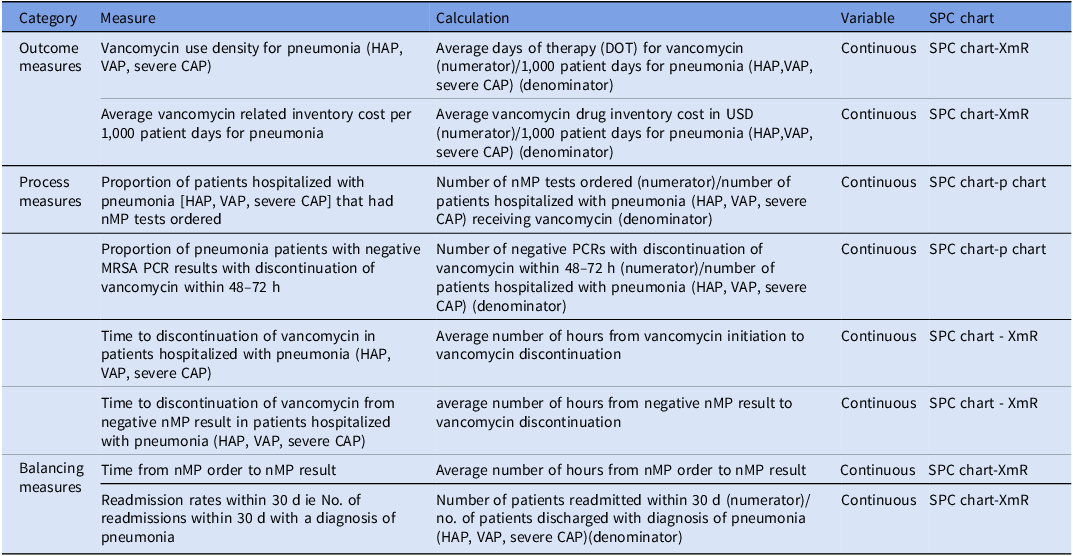
The outcome, process and balancing measures are presented in Table 1.
Outcome, process and balancing measures

Cost analysis
The cost analysis was based on average wholesale price (AWP) of both injectable vancomycin and 0.9% sodium chloride sterile compounding fluids ($7.53/dose). This value was multiplied by 2, the average number of vancomycin doses given in a 24-hour period of time and then multiplied by our days of therapy/1,000 patient days value to determine inventory cost of therapy in USD (U.S. dollars)/1,000 patient days. For surveillance costs, MRSA PCR cost was determined using laboratory’s cost of the nMP test ($30.24/test) multiplied by the number of tests that were administered in the observed time period, divided by patient days, and the value was expressed as cost of tests in USD/1,000 patient days.
Data analysis
We conducted a quasi-experimental study using a pre and post study-design to compare the measures between preintervention period (P1: 4/1/24 to 9/30/24) and postintervention period (P2: 10/15/24–3/15/25).
Data was analyzed using Microsoft Excel (Microsoft, Richmond, WA) and statistical process control (SPC) charts were used for display and analysis of data. Table 1 details types of SPC charts used for the measures. QI Macros SPC Software for Excel 2023 (KnowWare International, Inc., CO) was used to create SPC charts and significance/sustained shift was defined per SPC rules of significance.Reference Carey and Lloyd22 These rules help differentiate special cause variation that signals change from common cause variation, ie occurring randomly or by chance.Reference Carey and Lloyd22 Additionally, comparisons for continuous variables were performed by t-tests and for proportions by Chi-square (χ 2) or Fisher exact test, where applicable, with a P-value of <.05 considered statistically significant.
This project was conducted according to local institutional standards for QI initiatives; therefore, IRB approval was not obtained. We followed Standards for Quality Improvement Reporting Excellence (SQuIRE) guidelines for reporting.
Results
During P1, a total of 239 patients with pneumonia (20 [8%] with HAP/VAP and 219 [92%] with severe CAP) received vancomycin, while during P2, a total of 281patients with pneumonia (19 [7%] with HAP/VAP and 262 [93%] with severe CAP) received vancomycin.
Postintervention, the outcome measures (vancomycin utilization and cost of therapy) showed a significant decline. There was a significant and sustained decrease in vancomycin use density as shown in the X chart and the phase analysis (Figure 2(A)). The average vancomycin use density decreased from 72.2 days of therapy (DOT)/1,000 patient days to 36.3 DOT/1,000 patient days postintervention (P < .0001).
Significant and sustained decline in outcome measures (vancomycin utilization and cost of therapy for hospitalized pneumonia patients). (A) vancomycin use density. (B) cost of vancomycin drug inventory (USD)/1,000 patient days.

The average vancomycin drug inventory cost decreased from 1,089.5 USD/1,000 patient days in P1 to 546.3 USD/1,000 patient days in P2 (P < .0001) and the new process was sustained and in control (Figure 2(B)). The average vancomycin drug inventory cost decreased by 50% with net vancomycin drug inventory cost savings of 543.20 USD/1,000 patient days.
The average surveillance cost denoted by average nMP test cost/1,000 patient days, increased from 42 USD/1,000 patient days in P1 to 419.6 USD/1,000 patient days in P2, increasing by 377.6 USD/1,000 patient days. Taking into account mean surveillance costs, the net average cost savings were 165.6 USD/1,000 patient days solely in vancomycin drug inventory costs.
All process measures showed significant changes. The average number of nMP tests ordered in hospitalized patients with pneumonia receiving vancomycin increased from 13% (31/239) in P1 to 87% (37/43) after the first intervention and to 100% (238/238) after second intervention (Figure 3) (P < .0001). After implementing the default nMP order in pneumonia order-set for HAP/VAP category on 10/7/24, we observed that nMP ordering increased for HAP/VAP patients and to some extent for CAP patients possibly due to Hawthorne effect of rounding after implementation. Once we implemented the default order for severe CAP category on 11/4/24, the nMP orders showed a significant and sustained increase to 100%. The proportion of pneumonia patients receiving vancomycin with a negative nasal MRSA PCR result that had vancomycin discontinued within 48–72 hours increased significantly (Supplementary Figure 6A), with the average increasing from 8% (20/239) in P1 to 71% (200/281) in P2 (P < .0001). Overall, this was also the proportion of all patients with pneumonia that had vancomycin discontinued within 48–72 hours (8% in P1 compared to 71% in P2). All patients that had vancomycin discontinued within 48–72 hours had a negative nMP. With the proportion of increased nMP testing in P2, the discontinuation rates within 48–72 hours also increased significantly from P1 to P2.
Proportion of hospitalized pneumonia patients who had nasal MRSA PCR tests ordered.

The average number of hours of vancomycin therapy, i.e., vancomycin initiation to vancomycin discontinuation in patients with pneumonia declined significantly (Supplementary Figure 6B) from mean of 122.4 (±6.1) hours during P1 to mean of 66.4 (±9.5) hours in P2 (P < .001). The time to discontinuation of vancomycin from negative nMP results showed a sustained decrease in P2 (supplementary Figure 6C), with the average number of hours decreasing from 117 (±5.4) hours in P1 to 52.9 (±7.2) hours during P2 (P < .0001).
There were no special causes detected for balancing measures (supplementary Figures 7A and 7B). The turnaround time from nMP order to nMP results did not show any significant change (average of 24.3 and 24.1 hours during P1 and P2 respectively). Readmission rates among patients discharged with pneumonia within 30 days remained stable without any significant changes. The average readmission rates during P1 and P2 were 10.3 and 10.1 % respectively.
Qualitative interviewing of frontlines revealed smoothly running workflows and an overall positive attitude about this change.
Discussion
In this QI initiative, with engagement from stakeholders, we made significant improvement in reducing vancomycin utilization in pneumonia patients. Our outcome and process measures showed significant and sustained changes while our balancing measures remained unchanged.
Our primary outcome was vancomycin use density that decreased significantly by 49.5% postintervention. Thus, we were able to achieve more than our desired objective of 20% decrease stated in our aim.
Our secondary outcome was vancomycin drug inventory cost that also showed a significant decrease by 50% postintervention with net vancomycin drug inventory cost savings of 543.20 USD/1,000 patient days. The average surveillance cost increased by 377.6 USD/1,000 patient days. Taking into account mean surveillance costs, the net average cost savings were 165.6 USD/1,000 patient days solely in vancomycin drug inventory costs. Thus, this cost minimization analysis showed net cost savings. This was an underestimation as did not include overhead vancomycin costs, including close monitoring of vancomycin drug levels and additional vancomycin infusion costs. Added expense of MRSA testing was thus offset by savings from administering less vancomycin. Additionally, money saved by prevented MDRO infections as shown in the literatureReference Henson, Ghonim and Swiatlo16 would also justify the added expense of universal testing in pneumonia patients receiving vancomycin. Hence, overall, this was a cost-effective intervention, with estimated total cost savings projected to be around 40 million USD since intervention.
All of our process measures intended to gauge processes around ordering of nMP and discontinuation of vancomycin within 48–72 hours among pneumonia patients showed significant and sustained changes. Nasal MRSA PCR ordering reached 100% in P2. Among pneumonia patients receiving vancomycin, we were successfully able to discontinue vancomycin in the majority (71%) within 48–72 hours, compared to 8% preintervention. All patients that had vancomycin discontinued within 48–72 hours had a negative nMP test. With the proportion of increased nasal PCR testing in P2, the discontinuation rates within 48–72 hours increased significantly postintervention.
Postintervention, the average length of vancomycin therapy in pneumonia patients was noted to significantly reduce by 46% (from > 120 h in P1 to 66.4 h in P2). Our process measure of time from negative nMP results to discontinuation of vancomycin decreased significantly by 55% (from average of 117 to 52.9 h), showing improved provider compliance. The reasons for not discontinuing vancomycin in a few patients with negative nMPs were associated with provider clinical decision-making for vancomycin continuation for critically ill patients.
There were no special causes detected for balancing measures. Our balancing measure of 30-day readmission rates for patients discharged with pneumonia remained unchanged postintervention and interestingly, our 30-day readmissions were lower than reported data (our average readmission rates were around 10% compared to reported national average rates of 17%).Reference Weinreich, Nguyen and Wang23 The other balancing measure of turnaround time from ordering of nMP to results was unchanged and was important to evaluate as we did not want the nursing staff or microbiology lab personnel to get overwhelmed after implementation. HAP/VAP admissions also remained low throughout the study period which is considered a desirable observation in accordance with expected standards for high quality healthcare.
While previous studies have explored impact of ASP efforts and evaluated the use of nasal MRSA PCR testing on vancomycin de-escalation,Reference Papastergiou, Tsioutis and Mendris4,Reference Chiotos, Fitzgerald and Hayes5,Reference Mulugeta, Kantharia, Veve, Vincent, Beaulac and Patel11–Reference Meng, Pourali and Hitchcock17 our study distinguishes itself by use of standardized QI methodology focusing on applicability of informatics in ASP to optimize vancomycin use. To our knowledge, this is the first report utilizing informatics-based order-set changes for automated nMP tests to reduce vancomycin use that demonstrates application of forcing function/automation for ASP efforts. Our intervention of an automated order-set for nMP in Epic was able to effectively reduce vancomycin utilization with resultant cost savings. The prevalence of MRSA in the U.S. has shown varying trendsReference iggs, Li and Jackson24 and MRSA prevalence at our healthcare facility is around 12.5%. Adoption of automated nMP testing with its high negative predictive valueReference Metlay, Waterer and Long9,Reference Gentges, El-Kouri, Rahman, Mushtaq, Hudson and Scheck14,Reference Parente, Cunha, Mylonakis and Timbrook15 was a cost-effective intervention for our institution and can be considered for implementation in other hospital systems.
The transformative, automated informatics-based intervention was one of the major strengths of our successful QI initiative. Through building an automated, preselected order-set for nMP in Epic, we were able to circumvent human factors, change behavior, and have an effective implemented intervention. Another strength was engaging the frontlines that led to a thorough understanding of the problem. Listening to the providers helped us in identifying their needs and creating an effective solution. Our teams worked well together and conducted plan-do-study-act cycles embodying the core principles of QI work. The new standardized process fit in our workflows and was favorably received by the frontlines. The automation eased the process for nMP ordering, while not adding any extra clicks for physicians or other providers. The project appealed to the rational and emotional side of the stakeholders and was aligned with Kotter’s principles of change management.Reference Kotter25 This QI project provides an example of EMR automation aiding clinical tasks and supports previous studies showing applicability of informatics in improving workflows.Reference Bright, Wong and Dhurjati26
Our study had limitations. We did not evaluate and are not aware of any indication shifting for vancomycin use. Another limitation is that pneumonia was presumed based on utilization of a pneumonia order-set; however, some patients may have had an alternative primary diagnosis, including heart failure, chronic obstructive pulmonary disease exacerbation or pulmonary embolism. Rates of order-set use vary across hospitals nationallyReference Pham, Stein and Worden27,Reference Naicker, Tariq and Donovan28 The high rate of order-set use in our single-center study may not reflect the practice across other hospitals and could have impacted vancomycin reduction. Data that could not be analyzed and needs evaluation in future studies includes length of hospitalization and acute kidney injury data.
To summarize, the uptake of our intervention was highly successful with percent of nMP tests ordered reaching 100% and vancomycin utilization for pneumonia declining by 49.5% with considerable cost savings. We were successfully able to discontinue vancomycin in the majority (71%) of pneumonia patients within 48–72 hours and the average duration of vancomycin therapy decreased by 46% postintervention.
In conclusion, the implementation of an automated default nMP order in pneumonia order-set in Epic led to 100% uptake in nasal MRSA PCR ordering, resulting in significant decline in vancomycin use among hospitalized pneumonia patients. This automated informatics intervention was shown to be highly effective and transformative as a solution. Smooth implementation required collaboration, education and engagement of stakeholders at every step. This highly impactful intervention can be considered for wider application in streamlining antimicrobial stewardship efforts in other institutions and hospital systems.
Supplementary material
The supplementary material for this article can be found at https://doi.org/10.1017/ice.2026.10421
Acknowledgments
We thank Anjala Tess, Katherine Santos, Jeffrey Durney, Erin Mothershead, Ashika Gupta, and Kendra Goeden for editing and technical support.
Author contributions
Concept and design: All authors. Acquisition, analysis, or interpretation of data: Kaushik, Gupta, Thieman, Padomek, Esty, Kisvarday, Acharya, Graham, Pureti. Drafting of the manuscript: Kaushik, Esty, Gupta, Thieman, Kisvarday, Acharya, Padomek, Graham, Pureti. Critical revision of the manuscript for important intellectual content: Kaushik, Esty, Gupta, Thieman, Kisvarday, Acharya, Padomek, Graham, Pureti. Administrative, technical, or material support: Kaushik, Esty, Thieman, Gupta, Padomek. Supervision: Kaushik, Esty, Gupta, Kisvarday, Acharya.
Financial support
This research received no specific grant from any funding agency in the public, commercial, or not-for-profit sectors.
Competing interests
None of the authors have any financial disclosures or other conflicting relationships. The authors fully acknowledge and comply with the Journal’s Conflict of Interest policy. All authors are aware of and in agreement with submission of this paper to Infection Control & Hospital Epidemiology.